issued

Portugal travel update issued by FCDO as booking surge due to Iran war

More than 2.5million Brits visited Portugal last year, and it could be even more popular in 2026 due to the Iran conflict

The Foreign, Commonwealth and Development Office (FCDO) has issued updated travel guidance for those heading to Portugal. The update was released today (March 20).

Fresh information has been provided for individuals seeking to remain in Portugal beyond 90 days under exceptional circumstances. The updated guidance states: “If you’re visiting Portugal and need to extend your visa-free stay for exceptional reasons, such as a medical emergency, you must apply to AIMA using their contact form (access is only available to users in Portugal). If you’re in Portugal with a residence permit or long-stay visa, this does not count towards your 90-day visa-free limit.”

It adds: “If you’re in Portugal with a residence permit or long-stay visa, this does not count towards your 90-day visa-free limit.”

For British passport holders, visas aren’t required for short visits to EU nations or Schengen zone countries provided both conditions are met:

Your combined stay within the Schengen zone must not exceed 90 days within any 180-day period. The number of countries visited is irrelevant. The 180-day timeframe continuously ‘rolls over’, reports the Liverpool Echo.

EES

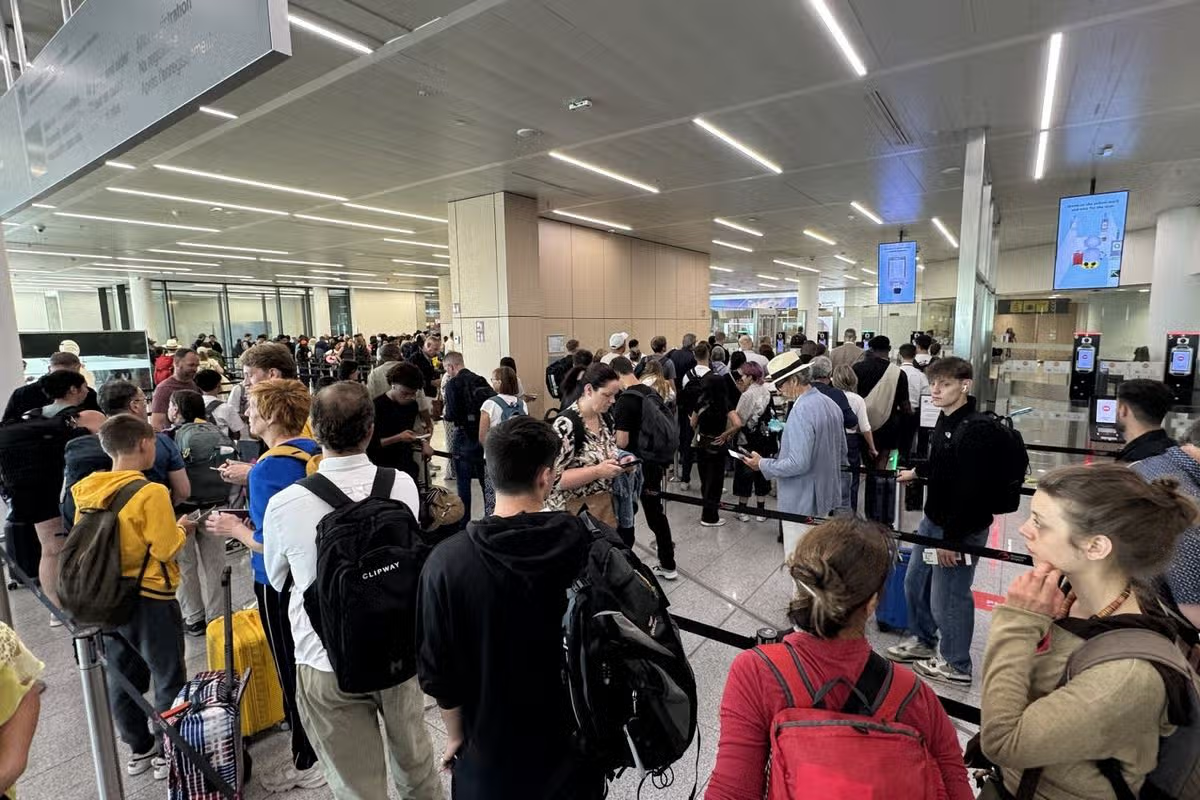
Since October 2025, the European Union has implemented the Entry/Exit System (EES), requiring travellers to provide fingerprints and photographs upon initial entry to or departure from the Schengen zone. It is scheduled to be fully operational by 10 April. However, the system has been plagued by teething problems, resulting in many travellers waiting for hours at airports. Because the system requires non-EU visitors – including Brits – to register their fingerprints and take a photo in person at the border, the additional registration time is already causing massive queues for non-European passengers at airports across the region.

It has caused such disruption that some locations have temporarily suspended its use. The European Commission has suggested that border authorities may pause the new system for up to six hours during peak travel times until September to help ease congestion.

READ MORE: Travel expert Simon Calder warning for anyone with Dubai, UAE or Bahrain flights bookedREAD MORE: Martin Lewis flags ’21-day rule’ for motorists to slash cost of driving

Portugal

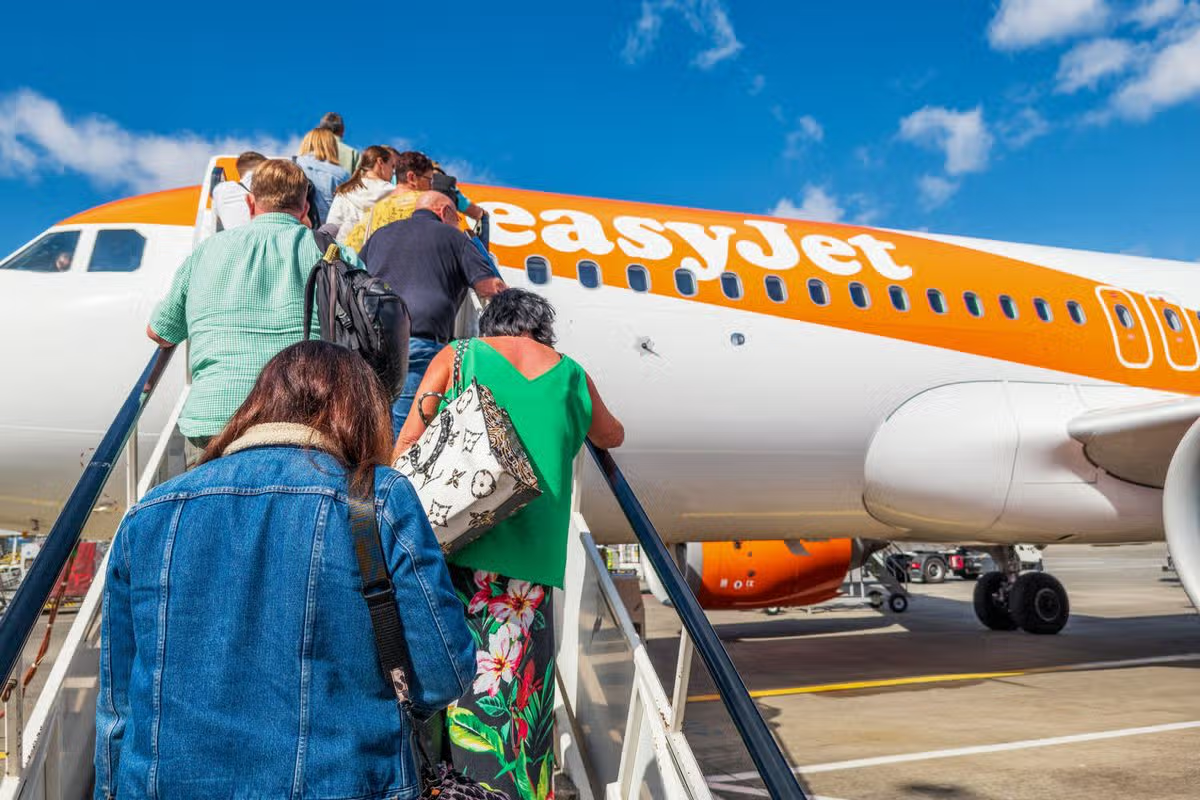
More and more Brits are booking flights to Portugal as the conflict in the Middle East continues. Destinations like Cyprus, Turkey, Greece, Egypt, and Dubai are being viewed as increasingly risky, so travellers are opting for safer alternatives like Portugal and Spain.

Bookings to Portugal had increased by 42% over the two weeks to 13 March, according to Thomas Cook – the largest rise in any of the countries they arrange holidays to. It was followed by the Balearic Islands (40 per cent) and the Canary Islands (16 per cent).

TravelSupermarket shared data on online search interest, which it said demonstrates a “clear surge” for European and Atlantic destinations and away from the Middle East.

Source link

Nationwide members issued good news by BBC expert – what you should know

Nationwide members issued good news by BBC expert – what you should know – The Mirror


reach logo

At Reach and across our entities we and our partners use information collected through cookies and other identifiers from your device to improve experience on our site, analyse how it is used and to show personalised advertising. You can opt out of the sale or sharing of your data, at any time clicking the “Do Not Sell or Share my Data” button at the bottom of the webpage. Please note that your preferences are browser specific. Use of our website and any of our services represents your acceptance of the use of cookies and consent to the practices described in our Privacy Notice and Terms and Conditions.

Source link

Everything you should know as UK red passport warning issued

Everything you should know as UK red passport warning issued – The Mirror


reach logo

At Reach and across our entities we and our partners use information collected through cookies and other identifiers from your device to improve experience on our site, analyse how it is used and to show personalised advertising. You can opt out of the sale or sharing of your data, at any time clicking the “Do Not Sell or Share my Data” button at the bottom of the webpage. Please note that your preferences are browser specific. Use of our website and any of our services represents your acceptance of the use of cookies and consent to the practices described in our Privacy Notice and Terms and Conditions.

Source link

Brits issued warning over passport delays due to new travel rules

New Entry/Exit system and ETIAS requirements coming to Europe in 2026 mean British passport holders need to prepare for biometric checks and travel authorisation.

As winter fades away, millions of Britons are probably mapping out their summer getaways. Some might already have flights secured, and if that’s you, it’s crucial to familiarise yourself with the new regulations taking effect.

Whether you’re jetting off to Europe or across the Atlantic, fresh legislation is being implemented that could result in substantial hold-ups at airports and railway terminals. Updated requirements covering visas, biometric information and passport checks mean that international travel is growing increasingly complex.

That said, provided you understand what’s needed, your journey should remain hassle-free.

For those bound for Europe, the new entry/exit system may trigger bottlenecks. The introduction of this began in October 2025, and by April 2026, it’s anticipated to operate throughout all Schengen zones.

It demands biometric information – fingerprints and a facial photograph – at the airport, reports the Express.

This may create hold-ups at border crossings, so it’s vital to factor these in and avoid leaving your travel arrangements too tight.

Also anticipated in 2026 is the European Travel Information and Authorisation System (ETIAS). This will oblige non- European Union nationals to secure ETIAS approval if they intend to visit Europe for up to 90 days.

The application will set you back £17.46 but comes free for those under 18 and over 70, and remains valid for three years or until your passport runs out.

Whilst this won’t launch until the final quarter of 2026, specialists are encouraging travellers to get ready and stay informed about the upcoming transformation.

Those planning a journey to the US will be required to use the Mobile Passport Control App. The application was created to cut down queuing times at airports and do away with paper documentation.

Upon arrival in the US, passengers must download the app, set up a profile and respond to a number of questions about themselves.

After completing your submission, you’ll be given a QR code to present at passport control.

Nicole Kerr, CEO at ground transportation platform Mozio, said: “UK searches for ‘summer holiday deals’ have increased by 123% in the past three months, as Brits look to secure their travel plans ahead of peak season.

“While a holiday is meant to be a relaxing and stress-free experience, experts have warned that changes to the travel industry could cause delays and confusion.”

Source link

Safety alert issued for travel electronic over ‘serious’ fire risk

The UK Government issued an urgent safety alert for a travel electronic after it was identified as posing a serious risk of fire

The Government has issued an urgent safety warning for households who’ve recently bought a particular travel item or are planning a holiday in the near future. In a recent product safety report published on Wednesday, February 18, officials announced that a specific travel adapter must not be used.

This safety alert follows identification of the product as presenting a “serious risk” of fire during use. According to the government’s official website, the travel adapter fails to “conform to the dimensional requirements” of BS 1363 (the British Standard for 13-amp plugs, socket-outlets, and adapters), whilst also containing an undersized fuse.

The item in question is a black plug manufactured by the brand Decqle.

The product subject to the safety alert includes:

  • Decqle Universal Travel Adapter – model number DQZ9.

They can also be identified by the following numbers: B0D95K3NV3, 1031-YSR3013, and 10433514U000010, reports the Express.

Ensure our latest headlines always appear at the top of your Google Search by making us a Preferred Source. Click here to activate or add us as your Preferred Source in your Google search settings.

It additionally carries the PSD notification number: 2602-0096. A Product Safety Database (PSD) notification number is a unique identifier allocated to reports of unsafe or non-compliant products submitted to the UK’s Office for Product Safety and Standards (OPSS).

The risk description read: “The product presents a serious risk of fire because the plug does not meet the dimensional requirements of BS 1363 and the fuse is too small.

“The fuse is required to ensure the safe operation of the product under fault conditions, and its absence could lead to the plug overheating and/or exploding. Improvements are also required to the product labelling and marking.

“The product does not meet the requirements of the Electrical Equipment (Safety) Regulations 2016 or the Plugs & Sockets etc. (Safety) Regulations 1994.”

As the travel adaptor was imported into the UK, it has been turned away at the border as a corrective action.

If you want ideas and inspiration to plan your next UK adventure plus selected offers and competitions, sign up for our 2Chill weekly newsletter here

Source link