Thursday marks 30 days since Israel’s foreign minister ordered the closure of the UK consulate in occupied East Jerusalem.
Published On 8 Oct 20268 Oct 2026
Workers at the UK consulate in occupied East Jerusalem have removed its signage as the Israeli shutdown deadline arrives, further damaging strained ties between allies.
Journalists from the Reuters news agency saw workers remove a plaque reading “British Consulate General” from the building on Thursday, as well as another sign for its consular section. The UK flag was still flying over the building.
Recommended Stories
list of 3 itemsend of list
Thursday marks 30 days since Israeli Foreign Minister Gideon Saar ordered the closure of the consulate in occupied East Jerusalem. The move was in response to the UK’s wave of sanctions on illegal Israeli settlements, including a ban on importing goods made there.
The United Nations and most countries consider the settlements illegal under international law. Israel disputes this.
The United Kingdom threatened to expel 27 Israeli diplomats if Israel proceeded to close the consulate in occupied East Jerusalem, according to unverified Israeli media reports.
The consulate has not responded to an immediate request for comment.
Israel has been adamant the consulate will close even as the UK has sought to keep it open, including sending the country’s top national security adviser to Israel last week for talks.
The UK’s presence in the city dates back almost 200 years, long before the state of Israel was established in 1948. The closure order does not affect the UK’s embassy in Tel Aviv, which handles diplomatic relations with Israel’s government.
The consulate, in the Sheikh Jarrah neighbourhood of occupied East Jerusalem, handles the UK’s relations with Palestinians in Jerusalem, as well as in the occupied West Bank and Gaza. It also provides consular services to Palestinians.
The UK Foreign Office on Wednesday declined to comment when asked whether the consulate was still operating or if diplomats working there had returned to the UK.
Despite the current strains, the UK and Israel are close economic, security and intelligence partners.
London, United Kingdom – Claire, 52, lives in the Scottish countryside, not far from Edinburgh.
She describes her work as “low-level administration” and does not use social media. She lives a quiet life with her dog, reading and baking in her spare time. Until three years ago, she did not consider herself political.
Recommended Stories
list of 4 itemsend of list
Now, she faces 14 years in prison for her suspected show of support for Palestine Action.
Claire, who requested Al Jazeera withhold her surname, is one of the many people in the United Kingdom who, until three years ago, did not consider themselves activists.
But as the genocide in Gaza was livestreamed, many have rallied around the cause of Palestinian solidarity.
Organisations like Defend Our Juries, Artists for Free Palestine, Workers for Free Palestine, and virtually every other insert-profession-here for Palestine have cropped up across the UK.
In the summer of 2023, Claire read I Shall Not Hate by Dr Izzeldin Abuelaish, a Palestinian physician in Gaza who lost his three daughters to Israeli tank fire. Not long after finishing the book, Claire watched the aftermath of October 7 unfold online.
“For me, there wasn’t a delay between ‘Israel has a right to defend itself’ and then lies,” she told Al Jazeera.
She went to a pro-Palestine rally on Armistice Day, calling for a ceasefire, and “was horrified” by then Home Secretary Suella Braverman, who called the protests “hate marches”.
“I was determined not to ignore [Palestine],” she says.
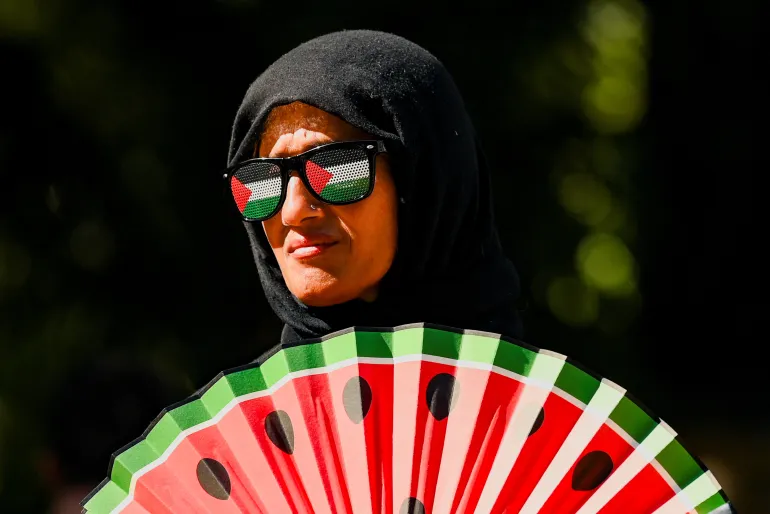
A protester wears eyewear in the colours of the Palestinian flag and holds a fan featuring a watermelon design during a rally organised by Defend Our Juries in Parliament Square, London, Britain, August 9, 2025 [Jaimi Joy/Reuters]
She continued to march, writing letters to lawmakers and fundraising for various Palestinian aid programmes.
In August 2025, she began publicly protesting against the proscription of Palestine Action with Defend Our Juries, the group behind a campaign of civil disobedience aimed at lifting the ban. To date, more than 3,000 people have been arrested for showing support for the pressure group that was banned in 2025.
Earlier this year, police arrived at her door to arrest Claire under Sections 11 and 12 of the Terrorism Act: “Being a member of a proscribed organisation and encouraging others to join a proscribed organisation.”
“I’ve never been in trouble before,” she says. “I’m not backing down.”
A police officer holds a pro-Palestinian protester during a demonstration outside the Parliament, organised by campaign groups including Palestine Solidarity Campaign, Avaaz and Parents for Palestine, calling for sanctions on Israel over ongoing hunger among Gaza’s war-struck population, in London, Britain, June 4, 2025 [Isabel Infantes/Reuters]
Marji, 70, lives in Colchester and had a similar feeling after hearing Braverman’s words.
“I had never been to a protest in my life,” she says, until she carried a “Ceasefire Now” sign at an Armistice Day march in 2023.
“I knew it wasn’t a ‘hate march’.”
Marji’s father served in the British Army, and her father-in-law was in the Royal Air Force and taken as a prisoner-of-war in Japan during World War II.
“Our parents’ generation fought fascism,” she says. “Now Britain is breaking British law.”
Marji, who also requested to be identified only by her first name, had a successful career in financial services, while her husband held an executive-level role.
They are now retired grandparents.
In July, they were arrested in Westminster under Section 12 of the Terrorism Act and are now waiting to see if charges will be laid.
“We’ve had to decide … is it safe to have grandchildren here? When the police could come to the door?”
Her children remain supportive.
“I think they’re proud of us, even if there’s been fear on their part.”
People protest on Vauxhall Bridge during a march in solidarity with Palestinians in Gaza in London, Britain, November 11, 2023 [Kevin Coombs/Reuters]
Across sectors, from the arts to railways, financial services and administration, Britons have risked professional and legal repercussions for the sake of Palestinian solidarity.
Hundreds of thousands have taken to the streets to protest against Israel’s genocidal campaign in Gaza and what they see as the UK’s role in the conflict. They have urged the UK government to cease all arms sales to Israel and cut diplomatic and trade ties as the genocide goes on in Gaza and violence escalates in the occupied West Bank.
This week, tensions have flared again as the Metropolitan Police warned pro-Palestine protesters against rallying on the three-year anniversary of October 7. The force said on Wednesday that five people were arrested outside the Board of Deputies of British Jews in north London for “inciting racial hatred, involving allegedly shouting or chanting slogans calling for Intifada”.
Israel’s latest war on the Gaza Strip – it has waged several since 1948 – began after Hamas, the group that governs Gaza, attacked southern Israel. About 1,200 people were killed that day, while more than 240 were taken captive, including Israeli soldiers, citizens and some foreign nationals.
Since October 7, 2023, Israel’s relentless bombardment has killed more than 74,000 people and devastated Gaza, making life for survivors nearly impossible. The small territory is now home to the largest group of child amputees in modern history.
“The narrative that we had grown up with was wrong – that the people who were there and living peacefully have been cast as ‘terrorists’, when they have suffered terrorism,” Marji says.
A demonstrator argues with the police as students take part in an inter-university march organised by the University of London Coalition in support of Palestinians, on the third anniversary of October 7, 2023 in London, Britain [Carlos Jasso/Reuters]
“The government participation, complicity, and their lies. Their gaslighting makes people more determined,” says Claire.
As the legal dangers and rhetorical backlash mount against pro-Palestine protesters, Marji, whose maternal grandmother was Jewish, is only more resolved: “We knew that saying ‘stop the genocide’ doesn’t mean you’re an anti-Semite. We’re not stupid, we can differentiate between Jewish people and people who support illegal occupation.”
Workers for Free Palestine, which includes a range of trade unions, formed in late 2023 and soon began holding protests.
“Many people oppose how their labour is used to prop up an apartheid state, but have been told there is nothing they can do as individuals,” a spokesperson told Al Jazeera.
Many workers are nervous to speak out against their workplace’s role in producing weapons, their investments in Israel, or other ways of enabling Israel’s war.
“Many are unfamiliar with their rights as workers and are afraid of the repercussions of speaking up – and these repercussions can be very real,” the spokesperson said.
Still, for some, there is not just resolve but optimism.
“Doing nothing makes us feel sick, angry and powerless,” says Marji. “I hope people will wake up and see how our own civil liberties … are being eroded to protect the interests of Israel.”
Al-Awsaj, occupied West Bank – On September 23, weeks before Israel’s parliamentary elections, ministers and lawmakers gathered on an occupied West Bank hilltop to inaugurate a new settlement, Metzoke Eretz, illegal under international law. Finance Minister Bezalel Smotrich used the ceremony to salute the settler outpost that made the eventual settlement possible.
“The first pioneering settlers who were here on the farm… we will lift them up as our greatest joy,” Smotrich said. “It shows that the method works: establish a farm, seize the land, prepare it, turn it into a community, move to the next point. There are many, many such heroes – those who prove they are not doing real estate. They are doing Zionism.”
Recommended Stories
list of 3 itemsend of list
Metzoke Eretz was previously an outpost – the name given to the Jewish settlements illegal even under Israeli law – called Netzah Harel, established in 2023 in the middle of al-Muarrajat, a Bedouin community on private Palestinian land east of Ramallah. Alia Mleihat, 29, and others from the community remember those settlers well. “Of course, this outpost played a major role in displacing the Palestinian Bedouin communities in al-Muarrajat and the areas east of Ramallah,” said Alia, now living in a tent in al-Awsaj, a few kilometres away, after her forced displacement in July 2025. “[The Netzah Harel settlers] took part in every attack the settlers carried out on families, and confiscated sheep, under the protection of the Israeli police and army.”
Dror Etkes, founder of Israeli NGO Kerem Navot, said Smotrich’s description of his “method” was spot-on – except for one omission. “The political discourse skips the [Palestinian] expulsion chapter,” said Etkes, suggesting Smotrich and other politicians avoid doing so explicitly to avoid potential scrutiny from international criminal courts. “They want it to happen, and they know that it happens, and they let it happen.”
Haaretz reported that Metzoke Eretz is one of 19 outposts legalised by the Netanyahu government after nearby Palestinians were violently expelled.
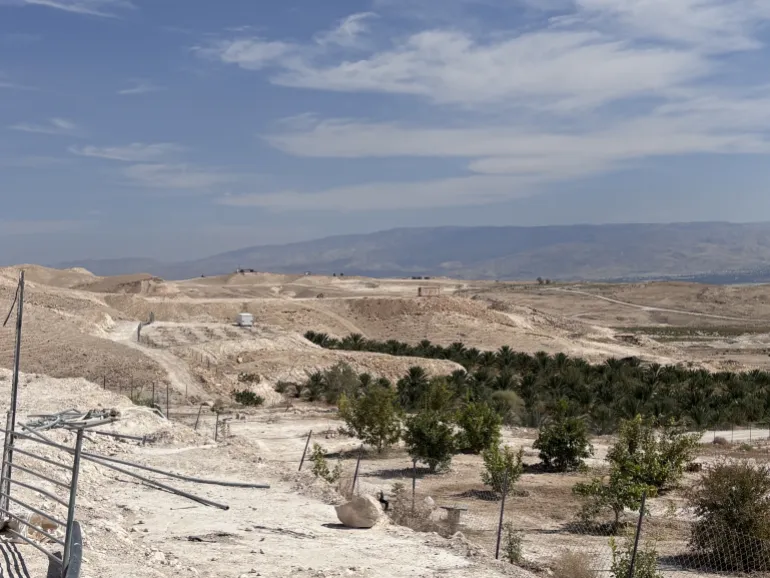
The view from Muhammad Ghawanmeh’s home in al-Awsaj, looking out towards an Israeli outpost on a hill in the background [Al Jazeera]
‘Not a single moment of joy’
Jamal Mleihat, Alia’s 45-year-old uncle, sits with eight relatives nestled inside a bare concrete-block house on the ridge in al-Awsaj, with his daughter Sewar hanging off his lap.
Below the ridge, rows of young trees climb a cultivated slope towards a factory at the foot of the hills. The ridge itself is rock and dust, now home to about 25 families from al-Muarrajat, among others forcibly displaced in the past three years.
“Before October 7 [2023 Hamas attack on Israel, and Israel’s subsequent genocidal war on Gaza], we were in the pastures – no harassment, we moved around freely,” said Jamal, a father of seven. “We had healthcare. We had a school. We had water in the same encampment. Life was a million times better than this.”
Since October 7, the Israeli government has stepped up its raids on the occupied West Bank, while settlers have largely been given free rein to pursue a pogrom against Palestinians, with little pushback from within Israel.
Just below Jamal’s shelter, alone on a slope, Muhammad Ghawanmeh lives with his wife and seven children. His toilet does not work; he relies on water tanks and has almost no electricity. The rocky track to the Mleihats’ area is too steep to drive. He built a fence around the house after recent settler attacks, and now faces constant drone surveillance from Israeli settlers.
Ghawanmeh is from Ras Ein al-Auja, which had been the largest Bedouin community in the central Jordan Valley – so robust that humanitarian coordinators told Al Jazeera in October 2023 that the village’s displacement was unlikely. Instead, its more than 600 Palestinian inhabitants experienced the largest single-community expulsion of Bedouins in the last three years, after repeated attacks by settlers from four surrounding outposts.
“From my childhood, the land was open. The water was open. We were living happily. We’d graze 10 kilometres, 15 kilometres with the sheep, and come back,” he said. “Today we can’t go 500 metres from the house.”
His flock has shrunk from about 300 to roughly 100 physically thinning sheep, which he now must buy fodder for, instead of letting them graze on the land, which he now says is largely forbidden by Israeli settlers and the army.
Jamal Mleihat with his daughter Sewar in al-Awsaj in the occupied West Bank [Al Jazeera]
‘Nothing was left except this’
A few hundred metres beyond Ghawanmeh’s fence, a white trailer and a few containers mark an Israeli outpost, established about six months ago on a hill overlooking Highway 90 and the displaced families along the ridge. Two months ago, Ghawanmeh said, soldiers came to his house and told him he could no longer pass to the highway. The settlers, he said, “are with the army”.
“You leave this place, go to another one, and it follows you – the same problem, unsolved,” Ghawanmeh said. “Every three months, there’s a displacement operation.”
Al-Awsaj barely existed as an inhabited place before, but Bedouin from different depopulated communities have now converged on this barren ridge, overlooking land largely declared – again – off-limits to grazing.
Allegra Pacheco, head of the West Bank Protection Consortium, calls al-Awsaj “basically a refugee camp, an internally displaced camp, that we see in other countries. But here, there’s no safe space. Wherever people like in al-Awsaj go, they’re chased by settlers or their tents are demolished by the Israelis.”
“It’s been very painful to get the authorities, the Palestinian authorities, the international leaders, to recognise that this is a mass displacement happening in front of us, and people have nowhere to go,” she said.
Project of forced transfer
In the West Bank, the United Nations Office for the Coordination of Humanitarian Affairs (OCHA) counts at least 130 Palestinian communities fully or partly displaced by settler attacks and related restrictions since January 2023, and more than 6,400 people uprooted. According to the Palestinian Colonization and Wall Resistance Commission, since October 7, 2023 there have been almost 15,000 attacks by settlers, with 66 Palestinians killed by settlers. OCHA says the rate of settler attacks increased from about three a day before October 7, 2023, to almost seven per day this year.
The increase in displacement after October 2023 can also be seen in the numbers for that year. Nearly 80 percent of all Palestinians displaced by settler violence in 2023 were uprooted after October 7.
A report by Peace Now and Kerem Navot found that Israeli farm outposts had seized roughly 18 percent of the West Bank by the end of 2025. “We’re talking about a land area bigger than the size of the Gaza Strip altogether,” Pacheco said.
“What we’re seeing is a continuous, sustained project of forced transfer and mass destruction,” she said. “Israeli authority demolitions and destructions by the Israeli army, and Israeli civilians – armed groups – carrying out destructions and sowing fear to push people out.”
Israeli NGO B’Tselem’s September report, “The Elimination Project”, links this to Smotrich’s 2017 “Decisive Plan”, which offers Palestinians three choices: live under Jewish supremacy, leave, or face violent repression.
“The Smotrich Plan has been implemented,” Pacheco said. “He laid out exactly what is going on now, and he’s very proud of his success. He now wants to transfer that success to [other areas of the West Bank], and also in the Galilee [an area in Israel with a large population of Palestinian citizens of Israel]. Wherever there are Palestinians living, he wants to make life so difficult that they will leave.”
With Smotrich exercising broad powers over the West Bank through the Settlement Administration within the Ministry of Defence, and leaders in the Israeli West Bank military command increasingly coming from far-right, settler backgrounds themselves, Palestinians across the West Bank describe a deepening symbiosis of military, police, administration and settlers in exacting Palestinian dispossession. “They all work together, like a cell, one completing the other,” said Jamal Mleihat. “The army, the police, the settlers – they’re the ones who displace, they’re the ones who establish the settlement, they’re the ones who take part in the thefts, in everything. And the army covers for them.”
Al Jazeera has reached out to the Israeli authorities for comment on this piece, but has yet to receive a response.
Worse future
Smotrich has withheld part or all of the tax revenues Israel collects for the Palestinian Authority – roughly 60 percent of its income – for much of the past three years. The PA now struggles to provide the most basic of services. In al-Awsaj and elsewhere, that means classrooms that do not open. “The government school is shut down today, no salaries,” Ghawanmeh said.
There is no school bus; families pay for private transport, and “one day they study, one day they don’t, depending on the mood of the driver,” Jamal said. It has left the displaced alone on an inhospitable patch of rock.
“Palestinians have no protection in the West Bank,” said Pacheco. “They are completely vulnerable to assault, attempted murder, arson, invasion of their homes. The Israeli army is supposed to protect them and doesn’t. The Palestinian Authority can’t come in, and the international community is not protecting them.”
“We started to feel there’s no safety anywhere,” Ghawanmeh said. “Fear. Terror. Persecution. Ethnic cleansing. That’s what we feel.”
Amid the dispossession, Ghawanmeh looks out at the unwelcoming land he knows will not be his family’s refuge – only another transient stop. He sees his own brother now only once every month and a half or two. “The threats to Bedouin life have almost become extinction,” he said. “We now live in enclaves, separated.”
“For three years now, the day that’s passing is better than the one that’s coming,” Ghawanmeh said. “Yesterday is better than today. Today is better than tomorrow.”
After Israeli soldiers stormed Birzeit University near Ramallah to demolish a stone memorial dedicated to dead students, Rania Washaha, 47, felt the pain of bereavement again.
Her brother, Fadi, 34, was shot in the head by an Israeli soldier near the northern entrance to el-Bireh in the central West Bank in May 2021.
Recommended Stories
list of 4 itemsend of list
His name was among the 38 students from the university killed by Israel and listed on the stone pillar known as the Martyrs’ Monument.
Israeli soldiers raided the university campus at dawn on Monday, accompanied by 10 military vehicles. A bulldozer demolished the pillar, and soldiers took away the marble stone. In its place, the Israelis left a planter containing a fig sapling, bearing the inscription: “Water it twice.”
Targeting the University
This raid marks the fifth Israeli incursion into the campus since the beginning of 2026 and the 28th since 2002.
Birzeit University’s administration condemned the recent raid, describing the destruction of the Martyrs’ Monument as a violation of international law and an attack on education and national memory.
“Bulldozers won’t erase the memory of the martyrs, military vehicles won’t extinguish the light of knowledge, and these assaults won’t break the university’s resolve to pursue its academic and national mission,” a statement by the university pledged.
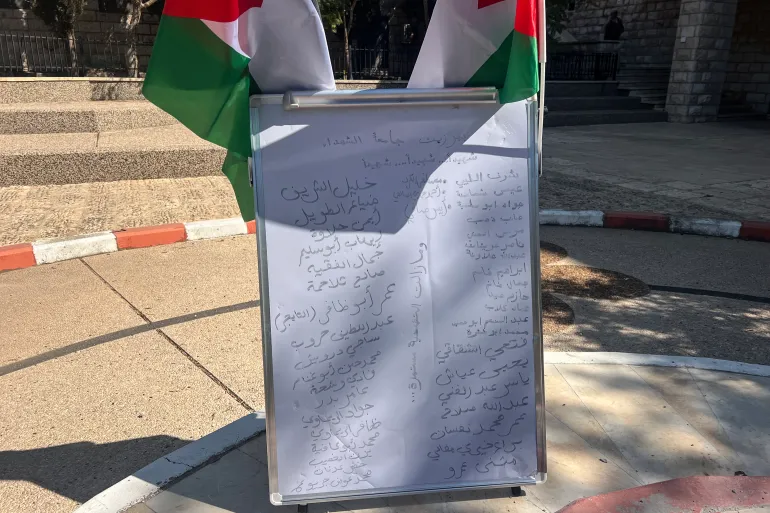
Birzeit University students again wrote the names of martyrs that were inscribed on the memorial [Mohamad Turkman/Al Jazeera]
It came 10 days after another incursion by Israeli forces during the daytime, a day before the start of the new fall semester.
Nardeen al-Memi, the university’s public relations and media officer, told Al Jazeera in the brief minutes of their incursion, Israeli soldiers approached the monument for the first time and photographed it.
The Martyrs’ Monument was erected between 1994 and 1996, bearing the names of students and alumni at Birzeit killed by Israeli forces. The list starts with Sharaf al-Tayyibi, who was shot dead by Israeli forces on the campus in 1984. The names of other students and alumni were added during the years that followed.
“The last name inscribed on the monument was that of student Omar al-Naasan, whom soldiers killed in al-Mughayyir east of Ramallah on September 2 while he was confronting settler incursions,” said Nardeen. “Days after his death, his father came and personally wrote his son’s name on the monument.”
University students organised a protest at the site of the destroyed memorial on Tuesday afternoon, most viewing it as an Israeli attempt to intimidate them.
Sami Adel, a Birzeit student who wanted to use a pseudonym due to his fear of being detained, told Al Jazeera the memorial holds a place in the heart of everyone who has attended the university since the 1990s.
In recent years, Israel has tried to suppress any student activity dedicated to commemorating the martyrs, he said.
“Soldiers detained me for several hours three weeks ago and threatened that if I participated in any political student activity on campus, I would face a long and harsh detention,” he added.
Erasing memory
The removal of the memorial is part of a broader Israeli policy targeting memorials dedicated to Palestinians killed by Israel in the occupied West Bank.
The Israeli far-right has made the issue part of its campaign to erase markers of Palestinian identity.
Zvi Sukkot, a member of the Knesset from the Religious Zionism Party, destroyed one such memorial in the village of Madama, south of Nablus, with a sledgehammer in August. The Israeli military later said that it routinely removes “symbols of incitement”.
The location of the demolished memorial in Birzeit University [Mohamad Turkman/Al Jazeera]
Israeli Finance Minister Bezalel Smotrich submitted a list of approximately 40 Palestinian memorials, proposing their destruction, to Prime Minister Benjamin Netanyahu.
There has been a wider targeting of civic and cultural symbols across the West Bank, particularly in Jenin, by Israeli authorities.
“Jenin Horse”, a monument constructed from the wreckage left behind by an Israeli incursion into the city, was removed. A memorial dedicated to Al Jazeera journalist Shireen Abu Akleh in Jenin was also targeted in 2023.
A cemetery containing the bodies of Iraqi soldiers killed during the 1948 war, also located in Jenin, has been raided by Israelis from illegal settlements.
Other landmarks embedded in the city’s collective memory, including the “Watermelon Roundabout”, have also been targeted.
Crushing resistance
Israel’s targeting of Palestine’s collective memory has coincided with a wider campaign of suppression in the occupied West Bank.
Palestinian universities have been a particular target in this pressure campaign, with campuses raided, students detained, and strict restrictions on activities and events within university grounds.
Israeli authorities are likely focusing on Palestinian universities because they hold a special significance for Palestinian resistance. They historically served as spaces for anti-occupation activism and have been an integral part of the Palestinian political landscape for decades.
Rania Washaha looks at her brother’s photo in her office inside Birzeit University [Mohamad Turkman/Al Jazeera]
Political analyst Mohammed al-Qeeq, who served as president of the Birzeit University Student Council between 2006 and 2007, told Al Jazeera that Israel has targeted writers, influencers, and activists, along with students, to deter any resistance to the occupation.
Universities have historically served as a “fundamental pillar” of Palestinian resilience and identity.
“Israel had also sought to weaken Palestinian political and social cohesion inside universities by deepening divisions between factions and creating chaos”, he said.
Remembering Fadi
For Rania, the memorial served to cement the names of the martyred students in the minds of the next generation of Berzeit students, including her brother’s.
“I cannot deny that I felt a pang of anguish when the memorial was demolished,” she told Al Jazeera. “I realised the goal wasn’t simply to uproot a physical object; I felt the suppressed violence Israel inflicts upon us.”
The memorial, constructed in 1996, stood on the campus when Fadi studied at Birzeit University. He had been arrested multiple times, spending a total of eight years in detention, and Israel denied Fadi the chance to wear a graduation gown.
“He didn’t even complete two years of study due to repeated arrests and injuries from soldiers’ gunfire,” Rania said. “Yet, he loved Birzeit University dearly and would stand by the memorial, contemplating the names of the student martyrs, never knowing that his own name would one day be added to theirs.”
This year, Rania’s son enrolled at Birzeit University as a first-year student. Shortly before classes started last September, an Israeli officer phoned him, threatening him if he participated in any student activities on campus. “Remember what we did to your uncle,” they warned him.
Syrians released from Israeli detention have described abuse including sleep deprivation, violent searches, and dog attacks, while dozens of others remain detained. Al Jazeera’s Heidi Pett met with some of them, who recounted the torture they suffered behind bars.
The United Kingdom’s Green Party has voted to define Zionism as a form of racism, drawing condemnation from the Israeli government.
In a binding vote held at the party’s conference over the weekend, members voted to usher in the new definition as well as a series of other strongly pro-Palestine policies.
Recommended Stories
list of 4 itemsend of list
However, just as the resolution has drawn international criticism, it has also proved internally controversial with four of the party’s five members in parliament opposing it.
Israel on Monday banned party leader Zack Polanski from the country just a day before the politician faces a by-election as he runs in the London constituency that former Prime Minister Keir Starmer represented.
Zionism emerged as a political ideology in the late 19th century. It called for the creation of a Jewish homeland at a time of rising anti-Semitism and persecution of Jews in Europe. Theodore Herzl, an Austro-Hungarian journalist considered the father of political Zionism, originally proposed an independent and colonial Jewish state in either Palestine or Argentina.
Here’s what we know about what the Greens have said:
Green Party leader Zack Polanski, right, chats with Ben Jamal, director of the Palestine Solidarity Campaign, at the 2025 Green Party conference in Bournemouth, England [File: Getty Images]
What is the resolution?
The Greens endorsed the motion to equate Zionism with racism by a vote of 1,022 to 813.
In addition, the party restated its “commitment to Palestinian liberation” and called for the “establishment of a single democratic state throughout historic Palestine”.
The party also recommitted to its support of Palestinians’ right of return as well as to the Boycott, Divestment, Sanctions movement against Israel.
“The real, material, manifestation of Zionism has been the historic and ongoing dehumanisation, displacement, dispossession, disenfranchisement and destruction of Palestinians,” a Green Party statement said.
A significant number of party members, including four of its five MPs, were against parts of the resolution, exposing divisions within the party.
Codeputy leader Rachel Millward said in a post on X that while the party is committed to “stop the genocide”, the term Zionism means “different things to different people, … so I personally do not think the policy helps us do the work we all want to”.
Meanwhile, Polanski, who is Jewish and was away campaigning during the vote, told journalists afterwards that if Zionism equates to the displacement of Palestinians, “that is clearly racist.”
Polanski said he, however, did not support the reference to a single Palestinian state and external entities should not decide what a future state would look like.
How has Israel responded?
Israel has accused the party of legitimising “terrorism”, and senior officials equated it to anti-Semitism.
“The Greens have adopted not only the green of Hamas, but also its ideology: the elimination of the State of Israel through armed struggle,” the Israeli Ministry of Foreign Affairs wrote on social media.
Israeli President Isaac Herzog said it would “deliberately endanger Jews and Israelis everywhere”. Opposition leader Yair Lapid said the party was “racist”.
The Green Party has rejected equating criticism of Israel with anti-Semitism and reiterated its stance against “any form of discrimination or harassment”.
“We know there is no conflict between supporting the rights of Palestinians and the rights of Jewish people,” Polanski and other senior party members said in a statement on Sunday.
Has Zionism been equated to racism before?
Yes. In 1975, the UN General Assembly passed a resolution that “determines that Zionism is a form of racism and racial discrimination”.
The vote was sponsored by the Soviet bloc and the Arab League. It passed after 72 countries, largely from the Middle East and Africa, voted for it. Israel and 34 other countries – chiefly from the West – were against it. Thirty-two other countries abstained.
Just a year before, at the 1974 General Assembly, Palestinian leader Yasser Arafat had given his “olive branch” speech at the General Assembly.
About the same time, African countries opposing the apartheid regime in South Africa, which was increasingly allying with Israel, had resolved separately that the Israeli government was “racist” and both had an “imperialist origin.”
Also, in 1975, at the first international women’s conference, held in Mexico City, attendees decided there would be no international peace outside the “elimination of foreign occupation, Zionism, apartheid” and all other forms of “racial discrimination”.
However, the General Assembly vote proved controversial. Chaim Herzog, then-Israeli ambassador to the UN and later president, told the assembly in a speech that it was “based on hatred, falsehood and arrogance” and proceeded to rip up copies of the resolution in front of the audience.
The US too accused the UN of making “anti-Semitism international law”.
In December 1991, the US, under President George HW Bush, stepped up a campaign to revoke the resolution with Bush declaring at the UN that equating Zionism with racism “is to reject Israel itself” and to “challenge its right to exist”.
Israel also insisted it would not participate in the Madrid Peace Process to continue negotiations between Israel and Palestinian leaders if the resolution was not cancelled.
After much pressure from the US, an overwhelming majority of countries voted for its revocation – 111 to 25, including European and African countries.
Who else equates Zionism with racism?
Jewish Voice for Peace, the American anti-Zionist and pro-Palestinian advocacy group, has also named Zionism as a movement that creates a “racist hierarchy with European Jews at the top”.
In a February statement, the group reiterated its stance against what it called the “colonial ideology” of Zionism’s founders.
Similarly, in the United Kingdom, an employment tribunal in 2024 backed anti-Zionist activist and professor David Miller, who was earlier sacked from his post at the University of Bristol in 2021 for his views that the movement was “inherently racist”.
Ireland and Israel drew 1-1 in a second ill-tempered Nations League match. Irish and Israeli players wore black armbands to commemorate lives lost in Gaza and in the October 7 attacks, before tensions flared at half time over allegations of spitting.
As Israel prepares to mark three years since the October 7 attacks and with less than a month to go to parliamentary elections, one topic is dominating the electoral agenda.
Media reports that Prime Minister Benjamin Netanyahu was warned by the United Arab Emirates before the attacks have put his alleged responsibility back in the spotlight.
“Did he know?” is the question on everyone’s lips.
Listening to the accusatory choir, one might think that Israeli society finally is acknowledging the real meaning of October 7. Yet the opposite is true.
Instead of giving a platform to a reckoning, the elections function to scapegoat Netanyahu for his alleged role in facilitating Hamas’s attack while absolving Israeli society and the Zionist movement of its collective responsibility for the preceding violence and ensuing genocidal aggression.
For example, it does not insist on investigating whether the “Hannibal Directive” was deployed as part of the Israeli military response on October 7 and whether it killed Israeli citizens and how many.
It does not scrutinise subsequent Israeli military operations or whether they put the Israeli hostages in danger or how many were killed by Israeli bombs.
There is no questioning of why key Palestinian negotiators were attacked during ceasefire and hostage negotiations, including Ismail Haniyeh, Hamas’s chief negotiator, in July 2024 in Tehran and Hamas’s negotiating delegation in September 2025 in Doha.
There is no debate about why the Israeli government repeatedly rejected ceasefire proposals that could have brought the hostages back much earlier.
There is little attention paid to the fact that Netanyahu and former Defence Minister Yoav Gallant face arrest warrants from the International Criminal Court for crimes against humanity.
None of these made the cut. Why?
The answer lies in the psychological state of Israeli society. For many Israelis, October 7 became a psychological rupture, making it difficult to reconcile their sense of humanity with their complicity in the criminal reality that followed.
The problem, then, is not that Israelis are in denial or misinformed. It is that a large portion of the society is complicit in criminality and actively avoids reckoning with it.
The absence of Gaza and Palestinians more broadly from Israeli political discourse is because of their complete dehumanisation by Israeli society.
How else could one explain the absence from the election rhetoric of questions about, and subsequent accountability for, actions against the Palestinian people?
Why has the Israeli military killed at least 74,000 Palestinians, the vast majority of them civilians? Why has it carried out mass and arbitrary detentions, torture and enforced disappearances of Palestinians?
Why has the sadistic and often sexually deviant celebration of destruction, subjugation, ethnic cleansing and death by Israeli soldiers been allowed?
What’s more, there is also little interrogation of the consequences of bombing and invading Lebanon, killing nearly 9,000 people since October 2023. Or bombing Syria and Yemen.
These are not isolated abuses. They are symptoms of a system of theft and domination driven by greed and sustained through psychological conditioning, segregation, fear and rewards for aggression. In line with the “Wired to Steal” model, dehumanisation helps produce consent for aggression while escalation following acts of resistance leads to normalisation of further expansion and robbery.
Thus, this election is not about a reckoning with October 7 or its horrifying aftermath. It is a lens onto a fascistic settler society engaged in denial and dehumanisation of an Indigenous “other” as a means of evading and normalising its own ongoing genocidal actions. Although Netanyahu may become the scapegoat, replacing him does not address the underlying machinery of domination and may instead serve to entrench it further.
That machinery remains firmly in place. The continuity between the violence unleashed since October 7 and the longer history of Zionist colonial expansionism is striking, with no lessons learned other than how to improve and grease the machinations of genocide. Fear, victimhood and the construction of a permanently besieged “us” against a dehumanised “them” continue to produce consent for further aggression and expansion.
October 7, therefore, has become not an occasion for genuine reckoning but another means of avoiding one. Netanyahu seeks to focus responsibility for the attacks on questions of what he knew and when while leaving the much broader record of what Israel has done since largely outside the electoral debate. His opponents, meanwhile, have their own complicity and ambitions to answer for. Thus, there is little political interest in a genuine reckoning with October 7. The fixation on Netanyahu allows the wider political establishment and Israeli society to avoid confronting the system of domination in which they remain invested.
The views expressed in this article are the author’s own and do not necessarily reflect Al Jazeera’s editorial stance.
Maysa Abu Daoud and her daughter Mary al-Najjar among five Palestinians killed in Gaza City attack.
Published On 4 Oct 20264 Oct 2026
The Latin patriarch of Jerusalem, Cardinal Pierbattista Pizzaballa, has expressed his “deep sorrow and grief” over the “tragic” killing of two Christian women in an Israeli air attack on Gaza City.
Maysa Abu Daoud and her daughter Mary al-Najjar were among five Palestinians killed in the attack that hit the ground floor of a building in the Remal neighbourhood on Saturday, in the latest Israeli violation of a United States-brokered “ceasefire” agreement with the Palestinian group Hamas.
In a statement, the patriarch extended his “heartfelt condolences” to the loved ones of the two women and to the Christian community in Gaza.
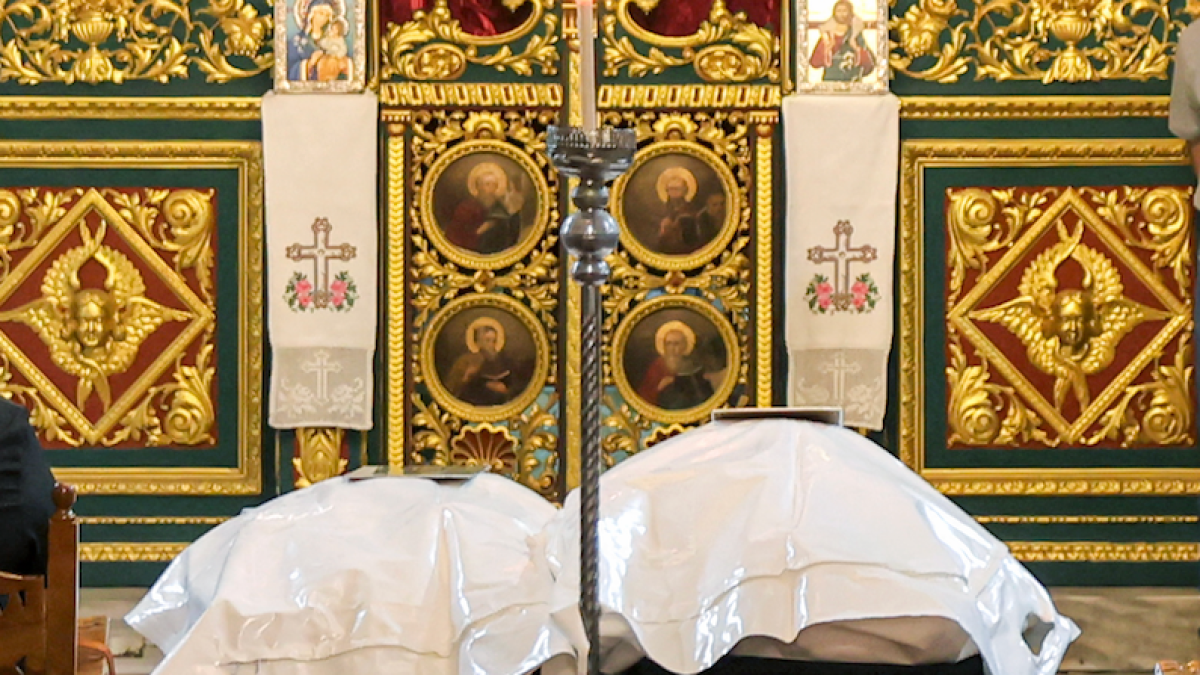
Their funeral took place on Saturday at Saint Porphyrius Church in Gaza City’s Old City.
The two women were Palestinian Christians from Gaza City who devoted their time to helping parishioners and displaced people sheltering at the Holy Family Church, according to Palestine’s Higher Presidential Committee for Church Affairs.
The committee’s chairman, Ramzi Khoury, described their deaths as a “painful loss” for their families, the church and its parishioners.
People inspect the damage after an Israeli attack on a residential apartment in the Remal neighbourhood of Gaza City [Omar al-Qattaa/AFP]
Mary’s son, 14-year-old Fouad al-Najjar, told the Anadolu news agency the strike hit the building at about 1:30am (22:30 GMT).
“My grandmother and my mother died. May God have mercy on them,” he said.
Al-Najjar appealed for an end to Israel’s genocidal war on Gaza, saying Palestinians were losing their loved ones every day.
“We are exhausted by this war and have endured so much,” he said. “For almost three years, we have been living through the same destruction, the same grief and the same war.”
Palestinian Lutheran pastor Munther Isaac, who serves in Ramallah and directs the Bethlehem Institute for Peace and Justice, wrote on X: “The genocide continues in Gaza.”
Civil Defence members carry the bodies of Maysaa Abu Daoud and her daughter Mary al-Najjar during their funeral at the Greek Orthodox Church of Saint Porphyrius in Gaza City [Omar al-Qattaa/AFP]
The Gaza Strip is home to fewer than 1,000 Christians. The community was already small before the war, and many of its members have been killed since then in attacks on their homes and churches throughout the war that began in October 2023.
On October 19, 2023, an attack on the Saint Porphyrius Church compound killed at least 18 people. Two months later, the Latin Patriarchate of Jerusalem said an Israeli sniper shot dead a woman and her daughter inside the Holy Family parish compound in Gaza.
An Israeli strike on the Holy Family Catholic Church compound on July 17, 2025 also killed three people and wounded others, including parish priest Father Gabriel Romanelli.
According to the Ministry of Health in Gaza, Israeli attacks have killed at least 74,228 people, including at least 1,445 since the start of the “ceasefire” in October 2025.
Funeral prayers were held at Gaza City’s Saint Porphyrius Greek Orthodox Church for a Palestinian mother and daughter who were among five killed in an overnight Israeli airstrike on an apartment.
More reports are emerging that Israeli PM Benjamin Netanyahu rejected a Hamas proposal to release all civilian captives taken on October 7, 2023. Netanyahu’s actions have become a key topic less than a month before national elections.
Saeed Ayed* watches over his livestock herd. The animals are starving and parched due to a two-week-long Israeli siege on the Ras al-Ahmar Bedouin community in the occupied West Bank’s Jordan Valley.
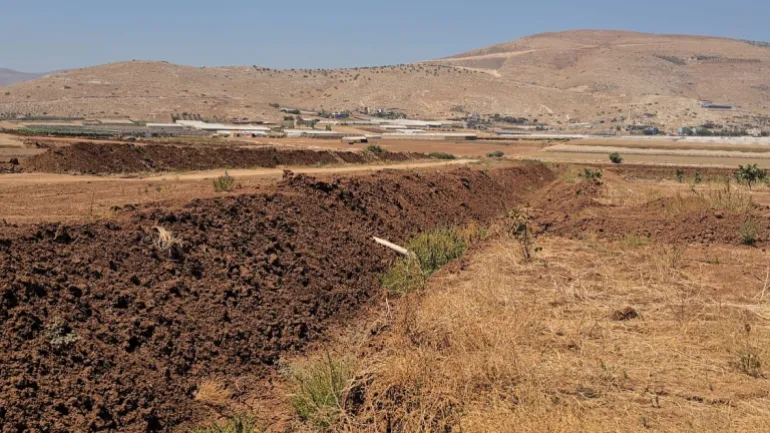
Access to the community has been blocked since mid-September, as Israeli forces continue building a barrier through Palestinian land in the area, including a road for military patrols, trenches and embankments.
Recommended Stories
list of 3 itemsend of list
Since the road closures began, movement for Palestinians has been severely restricted. They are forced to move around at night, transporting water, fodder and milk via donkeys under the cover of darkness to avoid detection by Israeli soldiers and settlers.
Ayed told Al Jazeera that no water had entered the community over the past three days after Israeli forces sealed the access points residents had been using to bring in supplies.
“The situation is dire. We are completely besieged, and the livestock cannot survive without water and food for this long,” Ayed said. “We own 15,000 head of livestock, and we fear they will perish because of the siege.”
Ras al-Ahmar is a 300-person village home to around 50 families who have lived off livestock and herding since the 1970s. Ayed said that Israeli settler attacks – part of a wider pogrom against Palestinians across the West Bank – had intensified since February, accusing settlers of trying to force residents out to seize their land.
“We have faced livestock theft, attacks on our dwellings, beatings of residents and vandalism of our homes. This was happening almost daily, yet we refused to leave. Now, they are completely besieging us to force us out,” he added.
The greatest challenge facing residents is restricted access to medical care as a result of the siege, a particular concern for the elderly.
Disease is also rampant among livestock, particularly newborn animals. And with veterinary teams unable to reach the area and treat the animals, deaths have been reported.
The military barrier – which Israel calls Crimson Thread and says it is needed for security – runs for roughly 20km (12 miles) through the northern Jordan Valley, with a width of up to 50 metres (165 feet).
Construction expanded early this year, including the digging of trenches and the bulldozing of agricultural land that damaged wells, water networks and greenhouses. The Israeli military seized nearly 115 hectares, 85 percent of which is privately owned Palestinian land, according to Kerem Navot, which monitors Israeli land policies in the West Bank.
Abdullah Bisharat, head of the village council of Ras al-Ahmar and Atuf, a nearby rural area also facing the military blockade, told Al Jazeera that the Israeli blockade has stopped 51 schoolchildren from attending classes for two weeks because vehicles can no longer reach them.
Israeli forces confiscated a tractor belonging to the village council on Sunday, detaining its driver as he was delivering animal fodder and water to Ras al-Ahmar, Bisharat said.
“We reached out to human rights organisations, but unfortunately no one was able to break the siege. Hundreds of people there are suffering, the majority of whom are women and children,” Bisharat added.
A trench dug by Israel around the rural Bedouin community of Ras al-Ahmar has restricted their movement [File: Moath Ghannam/Al Jazeera]
Broader context
The targeting of Bedouin and herding communities in the Jordan Valley is part of a mounting pressure campaign on residents to abandon their properties by restricting access to land and pastures. The tactics include settler violence, the demolition of structures and the closure of roads and access points.
The United Nations Office for the Coordination of Humanitarian Affairs (OCHA) has described Bedouin and herding communities as among the groups most vulnerable to displacement in the West Bank. Dozens of Palestinian communities across the West Bank have been entirely or partially displaced since 2023, when Israel began its genocide in Gaza and ramped up its attacks on the West Bank after the October 7 Hamas attack.
OCHA has reported that at least 130 Palestinian communities have experienced full or partial displacement since January 2023, with 48 communities completely displaced, including 12 from January to August.
According to OCHA, more than 2,500 Palestinians were displaced in 2026 due to settler attacks and related access restrictions, out of a total of more than 6,400 displaced since 2023.
As the Israeli elections – scheduled for October 27 – approach, Palestinian analysts and rights advocates argue that the measures being implemented on the ground are entrenching a new reality that may persist regardless of the next government.
Hassan Mleihat, chairman of the al-Baydar Organization for Defense of Bedouin Rights, told Al Jazeera that settlers appear to be rapidly intensifying measures aimed at displacing Bedouin communities in the lead-up to the elections.
Mleihat said that Israel’s objective was to expel as many Palestinians as possible and seize control of their land.
“The road being constructed near Ras al-Ahmar aims to dominate the area’s land under security pretexts and to isolate Palestinian communities into tiny geographical pockets, effectively confining their presence there,” he said.
A new reality
Observers believe the significance of these Israeli measures against Palestinian communities extends beyond their immediate impact on the population, creating demographic, geographic and security-related changes that may prove irreversible even if the Israeli political landscape shifts after the elections.
Adel Shadid, an expert on Israeli affairs, told Al Jazeera that Israel currently exercises an unprecedented degree of control over Palestinian territory in the West Bank. Palestinians, he said, live in small, fragmented and scattered enclaves with Israeli control over security, military and economic matters, as well as the minutiae of daily life.
He said the change was not only limited to geography but also entails normalising the presence of illegal Israeli settlements in the West Bank so that they are viewed as an integral part of the region’s fabric, rather than a temporary presence or a reality subject to change.
“This shift is accompanied by the entrenchment of the perception that the West Bank is no longer viewed as a Palestinian area – or even a disputed one – but rather as a territory where Jews have the right to live in safety and security,” he said.
Shadid argued that this perspective also shapes how Israeli and Palestinian communities in the West Bank are perceived by the Israeli state. Israeli settlers are presented as a population requiring protection, while Palestinians are increasingly framed primarily as a security threat.
“This logic extends to how the land and the very elements of life are treated. A tree, for instance, might be viewed as a potential resource for acts targeting the Jewish community; consequently, cutting it down is seen, within this framework, as a security measure that warrants no intervention,” he said.
Shadid said this was also changing perceptions of the role of the Israeli army and police in the West Bank. He argued that the security forces’ role was increasingly seen as protecting settlers against a so-called “Palestinian threat”, rather than restraining settler aggression against Palestinians.
“This new reality is not tied to the current Israeli government. Rather, it creates a dynamic that will persist beyond the elections, regardless of the outcome,” Shadid said.
*Saeed Ayed is a pseudonym used at the individual’s request for security reasons.
Gaza’s health toll mounts, with 1,439 dead and 5,052 injured since the ceasefire began in October 2025.
Published On 1 Oct 20261 Oct 2026
An Israeli drone strike has killed a Palestinian man and wounded several others in southern Gaza while settlers shot dead another Palestinian man near Ramallah in the occupied West Bank.
The body of Tamer al-Hamayda, 42, and three wounded people were brought to Nasser Medical Complex on Thursday after the strike hit a tent sheltering displaced Palestinians in the al-Mawasi area, west of Khan Younis on the southern coast of the Gaza Strip.
Recommended Stories
list of 3 itemsend of list
Another Palestinian succumbed to wounds sustained in an earlier Israeli drone strike on Tuesday that targeted a gathering of Palestinians in Jabalia refugee camp in northern Gaza, according to medical personnel in Nasser Medical Complex.
Israeli forces also carried out a large-scale demolition operation targeting buildings east of Gaza City’s al-Tuffah neighbourhood.
The Gaza Health Ministry reported eight new deaths and 26 wounded over the past 24 hours, putting the toll since the “ceasefire” took effect in October 2025 at 1,439 killed and 5,052 wounded, with 834 bodies recovered from the rubble.
Israel’s war on Gaza has killed at least 74,040 Palestinians and wounded 175,168 since October 2023, the ministry said.
Occupied West Bank pogroms
In the occupied West Bank, Israeli settlers shot dead a Palestinian man and wounded another during a raid on the village of Yasuf, north of Ramallah, on Thursday.
51-year-old Mashhour Yassin was shot dead by settler gunfire, the Palestinian Health Ministry said.
Describing the attack, the Palestinian Ministry of Foreign Affairs said Israeli forces had detained an ambulance, seizing its key and throwing it aside, “in a crime that reflects clear coordination between the settlers and occupation forces.”
It said the killing “falls within the framework of a serious and continuous escalation in organised settler crimes,” saying Israel gives free rein to settler “terrorism against our people in the service of settlement, annexation, forced displacement and ethnic cleansing plans.”
Yasuf Mayor Jumaa Abdel Fattah told the AFP news agency that dozens of Israeli settlers armed with sticks and firearms had attacked the village, which lies between four Israeli settlements.
“Yassin was at his doorstep when the settlers attacked the village homes. He went out to defend his house,” Abdel Fattah said, adding that Yassin’s nephew was also wounded in the attack.
Abdel Fattah said the settlers had come from Havat Anton, an illegal Israeli settlement established in July that has previously attacked the village’s residents.
Palestinians in the occupied West Bank have reported a surge in settler pogrom attacks in recent months.
More than 500,000 Israelis live in West Bank settlements considered illegal under international law.
According to the UN, at least 1,112 Palestinians in the occupied West Bank have been killed by Israeli forces or settlers in the territory since October 2023, including at least 37 killed by settlers.
At least six people killed in drone attack on passenger van and one person killed in strike on residential apartment.
At least seven Palestinians have been killed and more than 10 wounded in Israeli attacks on the Gaza Strip as Israel continues to violate a nearly year-old “ceasefire”.
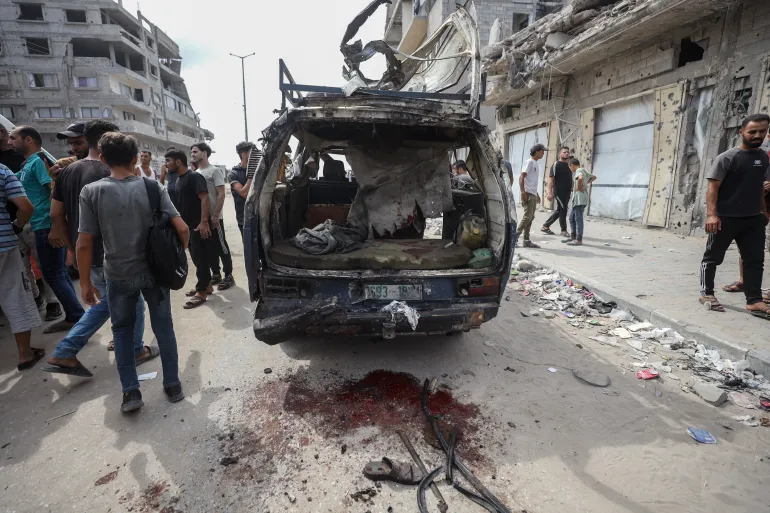
Six of the victims were killed in an Israeli drone attack on a passenger van in Tal al-Hawa, in southwest Gaza City, on Wednesday, according to witnesses and medical sources.
Recommended Stories
list of 2 itemsend of list
The Palestine Red Crescent Society, a humanitarian group that runs ambulance and emergency services, said its crews took 13 wounded people to al-Quds Hospital.
Medical sources told Al Jazeera the injuries sustained by the victims of the attack are “critical”.
“Doctors say it’s difficult to save the lives of the wounded because the health system is decimated by years of Israeli attacks and the blockade,” said Al Jazeera’s Hind Khoudary, reporting from Gaza City. “The number of dead in the strike could rise in the coming hours.”
Earlier, the official Palestinian Wafa news agency reported that an Israeli attack on a residential apartment near al-Shifa Hospital in Gaza City killed at least one woman.
Elsewhere, four Palestinians, including two children, were wounded when an Israeli drone hit a shelter for displaced people in southern Gaza, according to local sources cited by Wafa.
Two other Palestinians were seriously wounded by Israeli forces southeast of Deir el-Balah in central Gaza, while Israeli tank fire was also reported in southern Khan Younis, in the southern part of the Strip.
The attacks came as the Ministry of Health in Gaza, which compiles casualty figures from hospitals across the territory, said in its latest daily update early on Wednesday that the bodies of at least nine people had arrived at hospitals during the last 24 hours.
While eight people were killed around the reporting period, one woman had died from earlier wounds, bringing the number of people killed since the start of the “ceasefire” between Israel and the Palestinian group Hamas in October last year to at least 1,431.
An Israeli strike targeted a vehicle in Tal al-Hawa, in southwest Gaza City [Khames Alrefi/Anadolu]
At least 5,026 have been wounded over the same period, including 31 in the past 24 hours, the ministry said.
“There is supposed to be a ceasefire in Gaza, but the Israeli army’s violence is endless. Every day, Palestinians are killed, injured, and the humanitarian situation is deteriorating,” said Khoudary, describing “terrifying” conditions for Gaza’s residents.
“Everyone inside the Strip is afraid to go to the supermarket, to take their children to school, and to live their everyday lives,” she added.
Overall, Israel’s genocidal war against Palestinians in Gaza has killed at least 74,032 people since October 2023, with another 175,142 wounded, according to health officials.
In August, an analysis by the United Nations Satellite Centre found that the number of destroyed structures across Gaza has increased by 9 percent since the “ceasefire” took effect.
Overall, about 82 percent of structures in Gaza, roughly 200,000 buildings, have been damaged, and about two-thirds of those have been destroyed since the start of the war, according to the UN.
The resolution cites a ‘lack of accountability’ by Israel’s government and an ‘inability to secure justice’ by the US.
The United States Senate has blocked a resolution that would have required President Donald Trump’s administration to report on the killing of nine Americans in the occupied West Bank and on Israel’s treatment of Palestinian children in military detention.
The resolution failed 47-53 on Tuesday, with senators voting largely along party lines.
Recommended Stories
list of 4 itemsend of list
It was brought to the floor by Senator Chris Van Hollen, a Democrat from Maryland, and cited a “lack of accountability” from the government of Israeli Prime Minister Benjamin Netanyahu and an “inability to secure justice” from the US government.
Senator John Fetterman of Pennsylvania was the only Democrat to vote against advancing the resolution, while Senator Rand Paul, a Republican from Kentucky, joined Democrats in supporting it.
Van Hollen forced the vote under the Foreign Assistance Act of 1961, which allows individual members of Congress to demand a formal State Department report on the human rights practices of any country that receives US security assistance.
“Violence is raging in the West Bank, & despite the deaths of nine Americans, the wrongful detention of even more, & the daily torment of Palestinians, we have no accountability from the U.S. or Israeli govt”, Van Hollen wrote on X before the resolution was brought to a vote.
Nine Americans killed
The resolution called for an unclassified report within 30 days of adoption. It would have detailed investigations into the deaths of the Americans, the treatment of US citizens held in Israeli prisons, and the conditions facing Palestinian children in Israeli military detention.
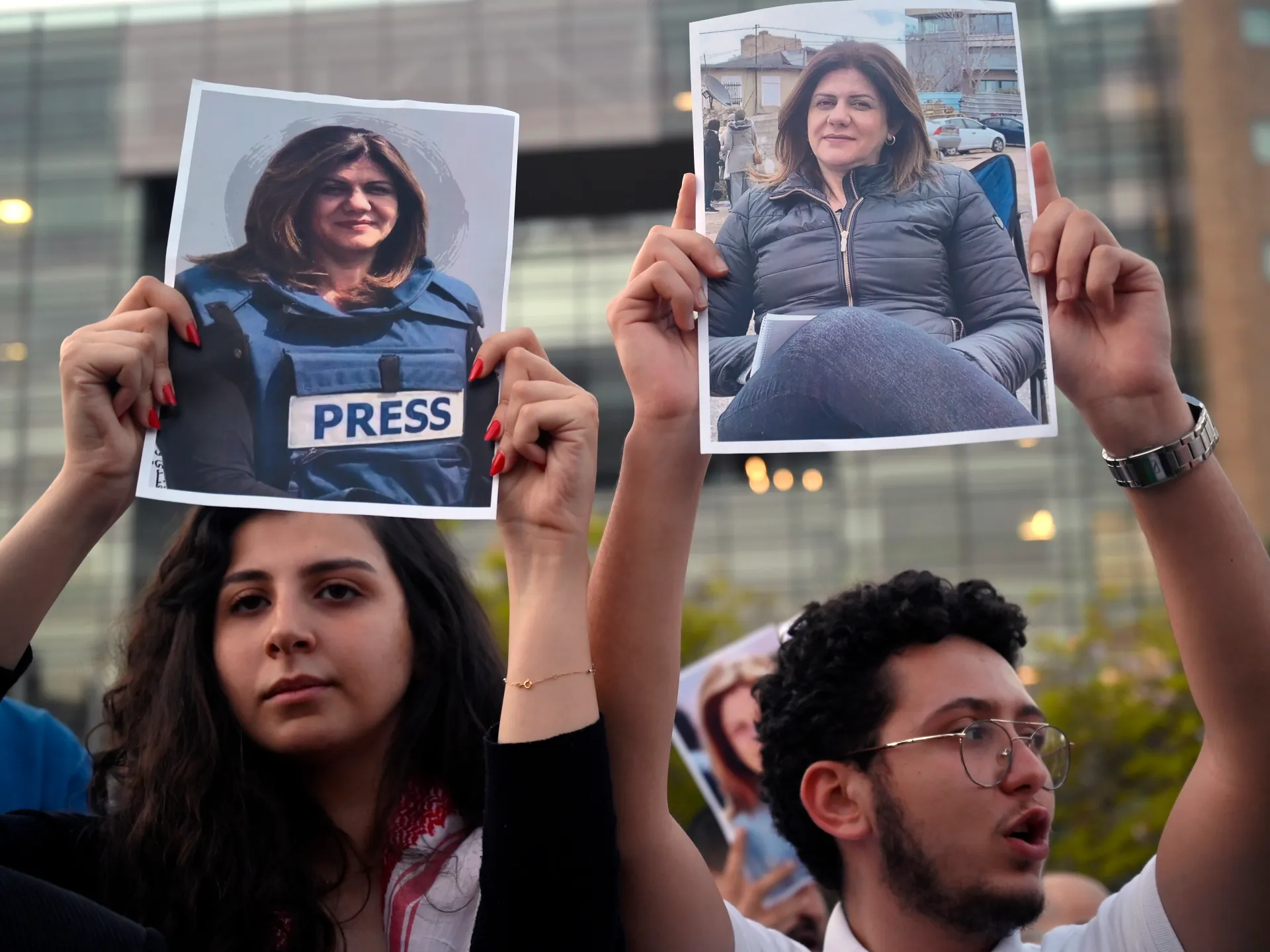
The measure cited the deaths of nine American citizens in the occupied West Bank since January 2022, including Shireen Abu Akleh, a Palestinian-American journalist and Al Jazeera correspondent who was shot in the head and killed in May 2022 while reporting in the city of Jenin.
It also included Aysenur Ezgi Eygi, who was shot in the head and killed by an Israeli soldier in September 2024, and Sayfollah Kamel Musallet, who was beaten to death by Israeli settlers in July 2025.
The others were Amer Mohammad Saada Rabee, who was 14; Tawfic Abdel Jabbar and Mohamed Ahmad Alkhdour, both 17; Omar Assad; Khamid Ayyad; Nasrallah Abu Siyam; and Khamis Rabee Jabara.
The resolution also noted the arrests of several Palestinian-American children by Israeli forces.
Among them was Mohammed Ibrahim, a 16-year-old from Florida, who was arrested in February 2025 and held in pretrial detention for nine months without contact with his family. It noted that US embassy officials and lawyers who met him told his family that he had lost nearly a quarter of his body weight, contracted scabies, and was beaten and tortured.
Other Palestinian Americans who remain in custody include Adam Wajeh Abdelfattah Karakrah, 16, and Sama Safi, 20, a student detained in June in raids targeting students at Birzeit University.
The resolution cited rights groups that have documented the deaths of at least 44 Palestinians in Israeli military camps since the Hamas-led attacks of October 7, 2023. Those groups, it said, have documented widespread abuses, including beatings, sexual violence, harassment and threats, “pointing to systemic and deliberate mistreatment”.
It also went on to note a sharp escalation in Israeli settler pogroms in the occupied West Bank, and stressed that there have been no convictions for the killings of Palestinian civilians by Israeli settlers since 2020.
Mohammed Abu Hijleh still finds it hard to believe that his mother passed away just over a week ago; she had suffered from nothing more than diabetes. But the restrictions Israel imposes on various cities, towns, and villages in the occupied West Bank can alter a Palestinian’s life in an instant.
Zahriya Abu Hijleh, 66, was attending her niece’s wedding reception in her hometown of Deir Istiya, northwest of Salfit, on September 20, when she suddenly felt dizzy and collapsed.
Recommended Stories
list of 3 itemsend of list
After she was taken to the town’s medical centre, the doctor immediately ordered her transfer to Salfit Governmental Hospital, a facility just an eight-minute drive from Deir Istiya.
Mohammed requested an ambulance, but the vehicle could not enter the town because the iron gate operated by Israeli forces at the entrance was closed. Instead, an ambulance from the medical centre transported her to the gate, and from there, she was taken off the stretcher, carried past the gate on foot, and transferred to a second ambulance waiting on the other side.
It is a scenario that happens repeatedly in the occupied West Bank, Mohammed told Al Jazeera.
“My mother was breathing her last; had the gate been open, we wouldn’t have lost her on the way,” he said.
Medics later determined that Zahriya had suffered a pulmonary embolism and required urgent treatment, according to her family.
“Sadly, she died due to the delay,” Mohammed said. “She had no prior health issues other than diabetes.”
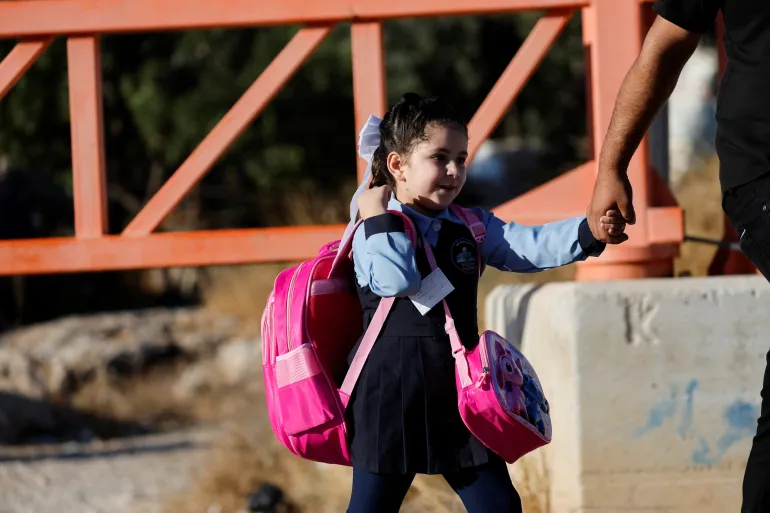
A Palestinian student crosses an Israeli checkpoint as students return to school for the new academic year, near Hebron in the Israeli-occupied West Bank, September 6, 2026 [Mussa Qawasma/Reuters]
Comprehensive closures
The military checkpoints and iron gates erected by Israel in the West Bank have become a significant source of misery for Palestinians.
They disrupt daily life, causing delays for people trying to reach work, schools, and universities, while also posing a daily threat to the lives of the sick.
Israel periodically imposes closures on the West Bank for various reasons, including Jewish holidays. The current closure runs from September 27 to October 3, coinciding with the Jewish festival of Sukkot.
While Israeli settlers move freely between West Bank cities, and even storm Palestinian villages and towns under Israeli army protection, Palestinians are forced to wait for hours at closed checkpoints.
Ibtihal Mansour from Nablus endured such an ordeal last Friday while visiting her in-laws’ home in the village of al-Janiya, near Ramallah.
The family left the village at 10am, hoping to reach Nablus within 45 minutes. But they encountered closures at the Atara and Ein Siniya checkpoints north of Ramallah, effectively trapping them in the area.
“We tried taking alternative routes west of Ramallah, but were surprised to find the road between Ramallah and Nablus blocked by settlers, with all vehicle traffic completely halted. We remained on the roads, trying to find any way through, until midnight, a span of more than 14 hours,” she told Al Jazeera.
Her children were crying, exhausted after spending so long confined in the vehicle. Passing through one roadblock near Nablus, in an area called al-Lubban Asharqiya, a soldier forced Ibtihal to wake the children. When her 11-year-old son did not wake up, she said that the soldier punched him in the head, causing him to jolt awake crying.
“The scene was heartbreaking; I felt a deep lump in my throat and profound sorrow. Long hours of waiting in the vehicle ended with an assault like this, and the ordeal didn’t even end there,” she said, explaining that they had to turn back. “We were forced to spend the night at my sister-in-law’s home in Ramallah before setting out early the next morning for Nablus.”
Like Ibtihal’s family, many Palestinians travelling between cities and villages are forced to stay overnight in hotels or at relatives’ homes. Some municipalities have converted wedding halls and mosques into shelters for those stranded, providing meals donated by residents of towns near the checkpoints.
The Colonization and Wall Resistance Commission (CRRC) recorded 942 checkpoints, closure points, and obstacles across the occupied West Bank as of September 25, up from 793 in March 2024.
The total length of the obstacles amounts to approximately 107.7km (70 miles), according to data from the UN Office for the Coordination of Humanitarian Affairs.
The CRRC says the closures effectively fragment Palestinian communities, making access to workplaces, schools, medical facilities, and agricultural land dependent on whether roads and crossings are open.
Al Jazeera has reached out to Israeli authorities for comment on the road closures and the allegations from Palestinians in this article, but has yet to receive a response.
Strangling Hebron and Jerusalem
In Hebron – which has an Israeli settler presence in the centre of the Old City – the Israeli army has closed the Ibrahimi Mosque to Palestinians and tightened restrictions at checkpoints and gates leading to the site until Wednesday, all while securing access for settlers to celebrate Jewish holidays.
Issa Amro, coordinator of the Youth Against Settlements group, told Al Jazeera that soldiers have closed checkpoints and imposed curfews in several city neighbourhoods, restricting resident movement and making it increasingly difficult to reach the Old City and the Ibrahimi Mosque.
“The area west of the mosque contains settlements and closed zones, while access from the east is limited to a few roads. These measures make reaching the site both more difficult and more dangerous,” he explained.
The situation in occupied East Jerusalem is also fraught, as Israel imposes strict restrictions on Palestinian movement and access to the Al-Aqsa Mosque, while thousands of Israeli settlers enter the site and move about unhindered under heavy security escort.
Activist Fakhri Abu Diab told Al Jazeera that Israel’s closures in occupied East Jerusalem during the Jewish holidays are part of attempts to impose religious sovereignty over the city.
Abu Diab explained that Israeli settlers and hardliners head either to storm the Al-Aqsa Mosque or to synagogues to perform religious rituals, while Palestinians are forced to remain at home.
He described how the closures disrupt daily life in East Jerusalem, shutting shops, schools, and workplaces, and halting movement.
“Israeli police restrict the movement of Jerusalemites. Families and vehicles attempting to move about risk being attacked by extremists and settlers, while the latter are permitted to roam freely and dominate the streets,” he said.
Israel’s national security minister declares ‘we are the owners of the place in Al-Aqsa’ during heavily guarded incursion.
Published On 28 Sep 202628 Sep 2026
Hundreds of Israelis led by far-right National Security Minister Itamar Ben-Gvir have stormed the Al-Aqsa Mosque compound under police protection.
The Jerusalem governorate on Monday said Israeli forces closed intersections and streets surrounding the Old City that lead to the Al-Aqsa Mosque compound, which Jews refer to as the Temple Mount, in occupied East Jerusalem on the third day of the Jewish holiday of Sukkot.
Recommended Stories
list of 4 itemsend of list
It said the Israelis danced in circles and sang inside the courtyards of Al-Aqsa Mosque during the raid, noting that 900 people entered the compound in the morning.
“We are the owners of the place in Al-Aqsa and in the prisons, and we have turned the lives of terrorist prisoners into hell,” Ben-Gvir said.
“The people of Israel are on the path to absolute victory, and today we pray in Al-Aqsa, which is the most important place for the Jewish people.”
Monday’s intrusion came as Israeli authorities forced dozens of Palestinian shopkeepers to close their businesses and residents to remain inside their homes in areas near the mosque to allow Jewish prayers during Sukkot.
“Dozens of Palestinian owners of shops, cafes and restaurants in the Cotton Merchants Market in Jerusalem’s Old City were forced to close them during the Jewish Sukkot holiday to make way for Jewish prayers in the market,” the Association for Civil Rights in Israel said in a statement.
‘Playing with fire’
Palestinian presidential spokesman Nabil Abu Rudeineh described the incursion as “playing with fire and a dangerous provocation to the feelings of Muslims around the world”.
He also warned that Israel was seeking to ignite a “religious war” in the region.
Since 2003, Israeli police have allowed groups of Israelis to make daily incursions into the Al-Aqsa Mosque compound, except on Fridays and Saturdays.
Israel often imposes restrictions on Palestinian worshippers. It prevented Eid al-Fitr prayers at Al-Aqsa this year, allowing only 10,000 Palestinians from the occupied West Bank, home to 3.3 million people, into one of Islam’s holiest sites for the first Friday prayers of Ramadan.
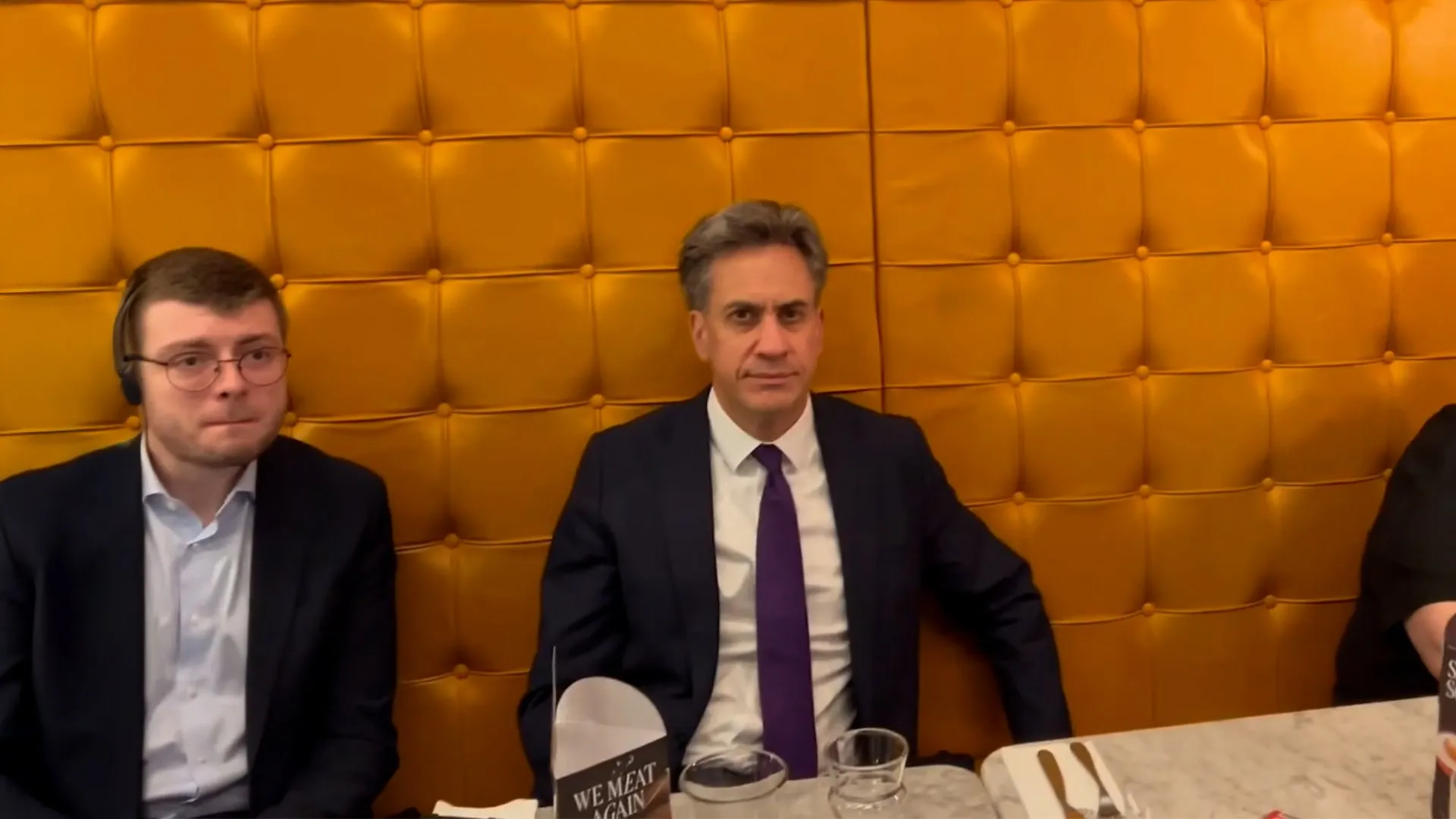
UK Foreign Secretary Ed Miliband was confronted by activists at a Pizza Express restaurant in Liverpool over the proscription of Palestine Action. Nearby, more than 50 demonstrators were arrested while protesting in support of the group outside a Labour Party conference.
Gaza City, Gaza Strip – The partially collapsed roof above Masada Abu Jarad’s apartment is now made up of broken concrete with twisted steel bars protruding from its edges.
And underneath the section of the room that is now open to the elements after the building’s partial collapse, Masada’s family have pitched a tent to provide shelter.
Recommended Stories
list of 3 itemsend of list
The 60-year-old knows the structure is dangerous. The Palestinian Red Crescent and the Civil Defence visited the family last week and warned them that they should leave. But in Gaza, where Israel refuses to allow proper reconstruction to take place after almost three years of its genocidal war, there are few places for them to go.
“We have no options,” Masada says. “I want to leave, but who will give me an alternative?”
She has lived in the building in Gaza City’s Palestine Square area for the past year, after returning to northern Gaza from displacement earlier in the war. But this still isn’t home. Masada’s family is originally from Beit Lahiya in the far north of the Strip, but had to leave early in the war after Israel decimated the area. They are still unable to return.
After repeated displacement, the prospect of moving again without a safe destination has become exhausting. And even if they could move, the cost is prohibitive.
“Even if there is a better place, tell me how I can afford to rent it,” Masada said.
Masada’s experience reflects a wider housing crisis across Gaza for the Palestinians who have survived Israel’s war, which has killed more than 73,000 Palestinians.
A joint assessment by the United Nations, World Bank, and European Union found that 371,888 housing units, 76.6 percent of the housing stock, had been destroyed or damaged as of October 2025. The assessment also found that rebuilding Gaza will need more than $71bn over the next decade.
The dangers of Gaza’s depleted and damaged housing stock became starkly visible on September 16, when a six-storey war-damaged residential building in Gaza City collapsed, killing 21 people, including 12 children, according to the UN and Gaza Civil Defence.
The collapse has become a warning for families living in other damaged structures.
Gaza’s municipality and civil defence have warned residents to evacuate buildings at risk of collapse [Abdelhakim Abu Riash/Al Jazeera]
‘I stay awake so they can sleep’
Abdullah Abu Hajar, 40, lives with his wife and five children in the al-Najma building in Gaza City’s southern Remal neighbourhood.
The six-storey building is severely damaged and unstable. About 17 families, roughly 50 to 60 people, are living there, according to Abdullah.
On the outside walls, municipal notices warn residents and passers-by that the building is unsafe and at risk of collapse.
At night, while his wife and children try to sleep, Abdullah stays awake and listens.
Every unfamiliar sound, such as concrete shifting, stones moving or an unexplained creaking somewhere inside the building, puts him on alert.
“I stay awake all night, keeping watch,” he said. “I can’t close my eyes. I keep just listening to sounds around me.”
Abdullah Abu Hajar stands near the damaged building where he lives with his family [Abdelhakim Abu Riash/Al Jazeera]
Abdullah explained that he feels worried for his children, even though they have adapted to the danger. But he has not.
And after the September 16 building collapse, he grew even more fearful. Since then, he said, he has barely slept.
“I’m already on edge,” he said. “But I don’t know where I can go.”
Abdullah and his family were displaced from Beit Hanoon in northern Gaza after it was attacked by Israel, and moved repeatedly during the war, eventually finding the al-Najma building.
His extended family faces the same uncertainty. Abdullah said that one of his relatives has been moving between southern and northern Gaza, looking for a place where he can pitch a tent.
“I told him to come and stay with us,” Abdullah said. “But he is hesitant because of the condition of this building. At the same time, he has nowhere else to go.”
Islam Hassanein is particularly worried about how weather conditions in the winter will affect the partially collapsed building she lives in [Abdelhakim Abu Riash/Al Jazeera]
A room among the rubble
For Islam Hassanein, 36, the same fears are entwined with the place she calls home.
A mother of five, Islam has spent nearly a year living with her family in a single room on the third floor of a damaged building.
She found the room after searching for somewhere to stay. It was filled with rubble and debris.
“We cleaned it and stayed in it,” she said.
The building is leaning and visibly damaged. The plumbing doesn’t work, so the family uses a bathroom outside. There is little that resembles a family home.
But leaving has proved no easier than staying. “We keep looking, but we can’t find anywhere,” she says. “They might even force us out of here. What are we supposed to do?”
Islam says she would leave immediately if she were offered a safe place.
“If they find us a good place and provide us with a tent, we will leave from the morning,” she says. “But where is this place? And where is the tent?”
Islam’s daughters sit inside the room where they live in the al-Najma building, which is at risk of collapse. [Abdelhakim Abu Riash/Al Jazeera]
The building itself regularly reminds her of the dangers.
“Every day, you hear the cracking,” she says. “People who live here tell us, ‘It’s cracking.’ Then a column fell, and they took us out of the building temporarily.”
The potentially deadly risks will become harder to manage as winter approaches, with its colder and wetter weather.
Water can enter through exposed roofs and walls, and the already weakened structure will face additional pressure from heavy rain.
“Last winter was terrifying,” Islam said. “We were constantly afraid that the building would collapse. I spent most days in my family’s tent because this building was full of openings and would flood whenever it rained.”
“Now, I am very afraid of this winter, and I don’t know what we are going to do.”
The UN says thousands of people are sheltering in damaged buildings considered unsafe because better housing options are unavailable.
Israeli restrictions on the entry of tents, tarpaulins and other essential shelter materials are making the situation more difficult, leaving Gaza in a state of limbo, unable to move on from the war, particularly as Israel can choose to escalate the conflict at any time.
UNICEF estimates that nearly 84 percent of Gaza’s population, more than 1.76 million people, are living in overcrowded displacement sites or damaged and inadequate shelters, with little protection from cold, heavy rain and flooding.
Islam says the war has forced families to take risks they once would have considered unthinkable.
She worries about her five children, but sees few choices available to her.
“They are all afraid,” she said. “But what can we do? If there is an alternative, I will leave. We leave it to God.”
The damaged al-Najma building is among the structures at risk of collapse in Gaza [Abdelhakim Abu Riash/Al Jazeera]



![The view from Muhammad Ghawanmeh’s home in al-Awsaj, looking out towards an Israeli outpost on a hill in the background [Al Jazeera]](https://i0.wp.com/www.aljazeera.com/wp-content/uploads/2026/10/View-from-Muhammads-looking-out-towards-the-outpost-seen-on-hill-in-background-1791321948.jpeg?w=640&ssl=1)
![Jamal Mleihat with his daughter Sewar in al-Awsaj in the occupied West Bank [Al Jazeera]](https://i0.wp.com/www.aljazeera.com/wp-content/uploads/2026/10/Jamal-Mleihat-with-his-daughter-Sewar-1791322462.jpeg?w=640&ssl=1)