Trump says he expects U.S. to end role in Iran war within 3 weeks
WASHINGTON — President Trump said Tuesday that he expects the United States to end its involvement in the war with Iran within three weeks, declaring there probably will be “no reason” for American forces to stay in the region even as top defense officials maintain Tehran’s military capabilities have not been fully eliminated.
Trump told reporters during an Oval Office event that he is confident the U.S. objectives in the conflict will be largely achieved by then, whether Iran makes a “deal” with the United States or not.
“If they come to the table that will be good, but it doesn’t matter whether they come or not,” Trump said. “We’ve set them back. It will take 15 to 20 years to rebuild what we have done to them.”
Trump added that he believes the threats to the Strait of Hormuz, a key oil route, will be “all cleared up” by the time the U.S. leaves the region. But if issues remain, he said, that will not be a problem for the United States.
“That’s not for us,” he said. “That will be for whoever is using the strait.”
Trump’s comments came hours after Defense Secretary Pete Hegseth said that, a month into the war, Iran still has the ability to launch offensive missiles, despite ongoing U.S. and Israeli efforts to weaken Tehran’s military capabilities and weapons programs.
“Yes, they will shoot some missiles, but we will shoot them down,” Hegseth told reporters at a Pentagon briefing, acknowledging the remaining threat.
The comment, made during the first public briefing on the conflict in nearly two weeks, underscored that despite weeks of intensive U.S. military operations and repeated assertions by Trump that Iran’s military has been “obliterated,” the threats posed by Iranian forces have not been fully eliminated.
Gen. Dan Caine, the chairman of the Joint Chiefs of Staff, told reporters at the briefing that the U.S. military remains focused on “interdicting and destroying” Iran’s weapons warehouses and facilities.
“We’ve continued to do the work against Iran’s missile, drone and naval production facilities,” Caine said.
Although air and naval strikes have been the primary focus so far, U.S. officials have not ruled out the possibility of ground operations as thousands of American soldiers and Marines have begun arriving in the Middle East.
Hegseth said it is up to Trump to determine whether ground operations in Iran will become the next phase in the conflict, which the president has said he is open to ending through diplomatic talks.
Trump repeated over the weekend that Iran is “begging to make a deal” to end the war, but on Monday, the president threatened to target Iran’s power-generating plans and oil wells and even desalination plants if a “deal is not shortly reached.”

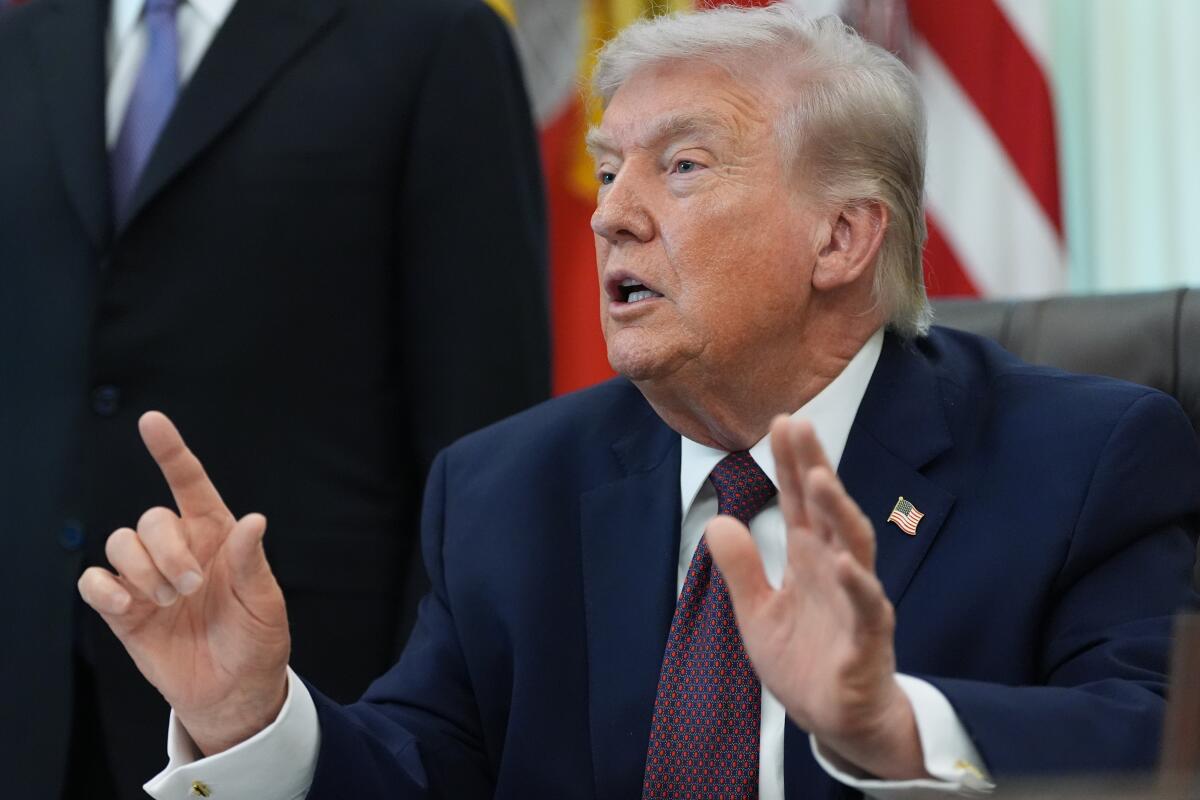
President Trump speaking Tuesday in the Oval Office.
(Alex Brandon / Associated Press)
White House Press Secretary Karoline Leavitt told reporters Monday that the administration will “operate within the confines of the law,” when asked about Trump’s threat to target infrastructure that would potentially harm civilians.
Caine told reporters Tuesday that the U.S. would only “strike lawful targets” when asked about American military considerations for civilian targets.
“We are always thinking about those considerations and developing options to be able to mitigate those risks,” Caine said.
Since the start of the war, Iranian officials have condemned a series of U.S. military attacks that have hit schools, including a Feb. 28 strike at an elementary school that killed at least 175 people, many of them children.
As Trump issues a new wave of threats on key infrastructure, he has at the same time touted ongoing diplomatic talks with Iran and reportedly told aides he’s willing to end the war without resolving Iran’s de facto blockade of the Strait of Hormuz that has rattled global energy markets.
Americans have also felt the financial pinch because of the war when it comes to energy prices. Gasoline prices in the United States reached an average of $4 a gallon Tuesday, a price that Trump says Americans are willing to pay to endure because “they are also feeling a lot safer.”
“All I have to do is leave Iran, and I will be doing that very soon and, [prices] will come tumbling down,” Trump said.
Hegseth, for example, said those diplomatic talks are “very real,” but stressed that the military pressure will continue alongside those negotiations and that ground operations remain an option.
“Our adversary right now thinks there are 15 different ways we can come at them with boots on the ground. And guess what? There are,” Hegseth said. “If we needed to, we could execute those options on behalf of the president of the United States and this department, or maybe we don’t have to use them at all. Maybe negotiations will work.”
He said the goal was to remain “unpredictable.” Caine added that the presence of U.S. ground forces in the region can serve as a “pressure point” as diplomatic efforts continue.
As the hostilities continued in the region on Tuesday, the State Department warned American citizens in Saudi Arabia that U.S. officials were “tracking reports of threats against locations where American citizens gather.
“We advise U.S. citizens that hotels and other gathering points including U.S. businesses and U.S. educational institutions may be potential targets,” officials wrote in a new warning.
And in Rome, Pope Leo XIV told reporters that he hopes Trump is “looking for an offramp” to end the war in Iran and made an appeal to “decrease the amount of violence,” according to the Associated Press.
Meanwhile, Trump administration officials have faced challenges in securing support from some U.S. allies, an issue that Hegseth and the president have publicly pointed out.
On Tuesday, Trump complained that countries have “refused to get involved” in the war and efforts to reopen the Strait of Hormuz.
U.S. allies’ access to oil has been affected by Iran’s chokehold on the key waterway as a result of the joint operation launched by U.S. and Israel. But now, Trump wants those countries to deal with the strait.
“All of those countries that can’t get jet fuel because of the Strait of Hormuz, like the United Kingdom, which refused to get involved in the decapitation of Iran, I have a suggestion for you: Number 1, buy from the U.S., we have plenty, and Number 2, build up some delayed courage, go to the Strait, and just TAKE IT,” Trump wrote on his social media website.
Trump added that countries will have to “start learning how to fight” for themselves.
“The U.S.A. won’t be there to help you anymore, just like you weren’t there for us,” Trump wrote. “Iran has been, essentially, decimated. The hard part is done. Go get your own oil!”
In a separate post, Trump singled out France for barring Israeli military planes from flying over its airspace.
“The USA will REMEMBER!!!” Trump posted on his social media website.
On Tuesday, the Italian and U.K. governments reportedly restricted U.S. warplanes from landing in their military bases.
At the Pentagon, Hegseth acknowledged that the U.S. military has faced “roadblocks or hesitations” from U.S. allies when asking for assistance or use of their bases — and said the president is simply noting that “we don’t have much of an alliance.”
“A lot has been shown to the world about what our allies would be willing to do for the United States of America when we undertake an effort of this scope on behalf of the free world,” Hegseth said.