Israel attacks Lebanon

Israel launches several attacks on Beirut’s southern suburbs | Israel attacks Lebanon News

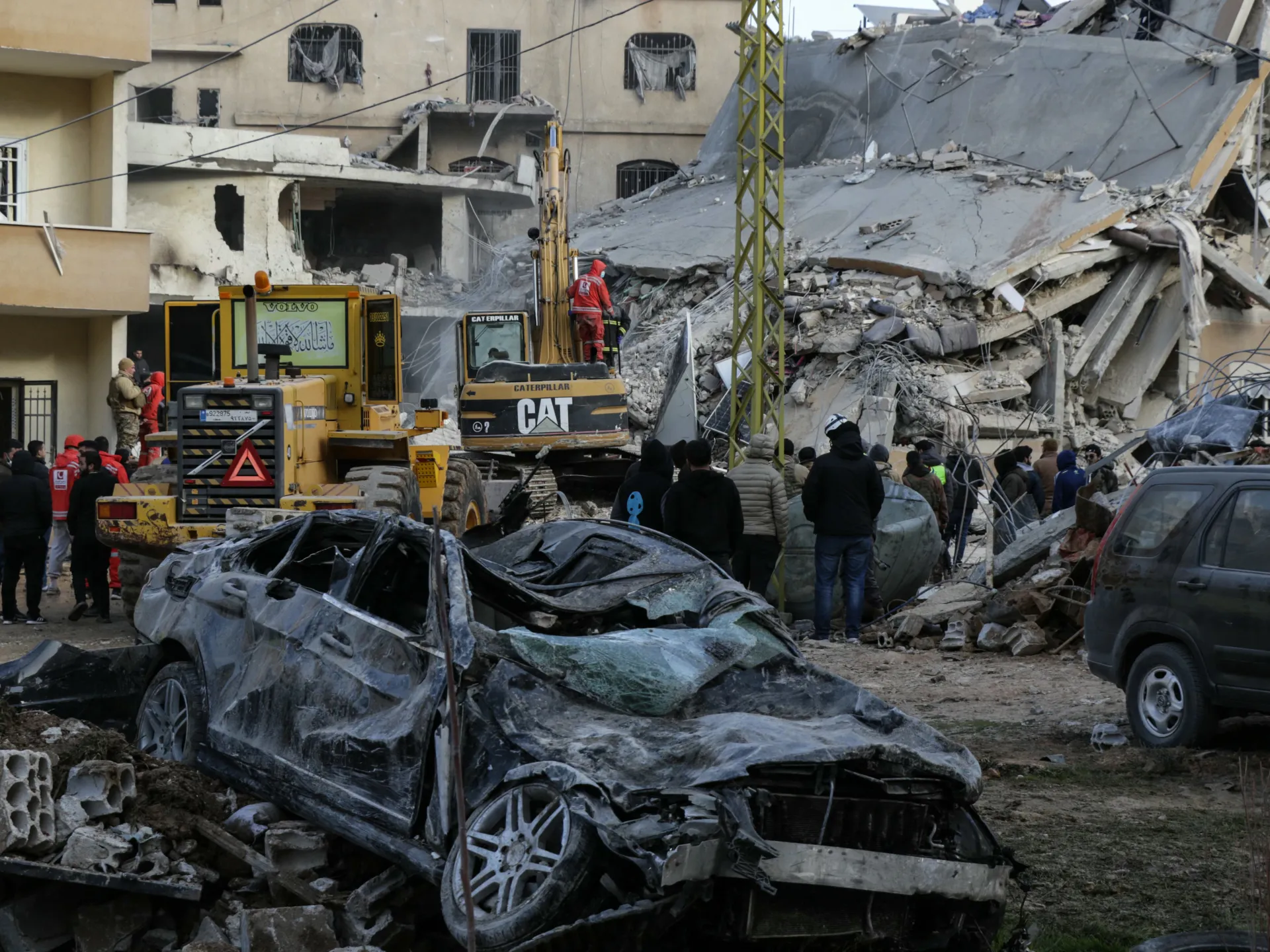
A series of Israeli strikes have targeted Beirut’s southern suburbs on the eve of the Muslim Eid al-Adha holiday, almost an hour after the Israeli army issued a forced evacuation order to residents in areas that it says held underground facilities used by the Lebanese group Hezbollah for drone production.

The attack on Thursday is the fourth time Israel has bombed Beirut since a ceasefire with Hezbollah went into effect in November. It has carried out assassinations and announced strikes that it said targeted Hezbollah sites.

Israel has violated the ceasefire on a near-daily basis for seven months, according to the Lebanese government led by President Joseph Aoun, Arab nations, and rights groups. Aoun has recently appealed to the United States and France to rein Israel in.

Aoun, in a statement on Thursday after the strikes, voiced “firm condemnation of the Israeli aggression” and “flagrant violation of an international accord… on the eve of a sacred religious festival”.

Before the attacks, Israeli military spokesman Avichay Adraee had ordered residents living near buildings in the neighbourhoods of Hadath, Haret Hreik and Burj al-Barajneh in the Dahiyeh suburbs to evacuate.

“You are next to infrastructure belonging to Hezbollah,” Adraee said in a social media post, which included a map of the eight buildings being targeted in four different locations. The message in Arabic indicated that Israel would soon bomb the area.

After the evacuation order, Lebanese media reported the area was nearly emptied of inhabitants, who had been preparing to celebrate Eid al-Adha. It was sealed off as “warning strikes” could be heard, the reports said.

Later Thursday night, the Israeli military also warned residents of the southern Lebanese village of Ain Qana to stay away from two buildings that appear set to be targeted. Ain Qana is located to the east of the coastal city of Sidon.

‘A lot of panic’

Al Jazeera’s Zeina Khodr, reporting from Beirut, in the immediate aftermath of the strikes said, “There was heavy traffic here as people were making their way out. As you can imagine, this did cause a lot of panic. This is not the first time the army has carried out air strikes in Beirut’s southern suburbs since a ceasefire came into force last November, but this is the largest attack.”

Khodr said up to eight buildings were targeted in four densely populated neighbourhoods, adding that the magnitude of these air strikes, meant all the area’s residents had to flee.

Analyst Rami Khouri told Al Jazeera that the attack was “no surprise”, as Israel has been assassinating people over the last three, four months. They’ve continued occupying five places in South Lebanon after the ceasefire agreement.”

“The Israelis have always used military force as their main instrument to get their foes to submit to them,” he said.  “But the irony is that it hasn’t worked. It has only generated great dissent, and we’ll have to see in Lebanon what it means … Hezbollah took a hit last year, and they’re obviously regrouping,” he said. “We don’t know exactly what they’re doing, but they are regrouping,” he added.

Video verified by Al Jazeera’s Sanad agency showed people hurrying away after the evacuation warning:

The Israeli military accused Hezbollah of manufacturing drones in the area in a “blatant violation of the understandings between Israel and Lebanon”.

A Hezbollah official denied that there were drone production facilities at the targeted locations.

The Israeli military “will work to remove any threat to the State of Israel and its citizens and prevent any attempt to reestablish the terrorist organization Hezbollah”, the military said.

“If you talk to people here, what they will tell you is that this is terrorism,” said Khodr, as “Israel warns people to leave in the middle of the night and on the eve of a major religious holiday.”

Lebanese Prime Minister Nawaf Salam also issued a statement condemning the strikes. He called on the international community to deter Israel from “continuing its aggressions” and compel it to fully withdraw from Lebanese territory.

The 14-month war between Israel and Hezbollah killed more than 4,000 people in Lebanon, including hundreds of civilians. The Lebanese government said in April that Israeli strikes had killed another 190 people and wounded nearly 500 since the ceasefire.


Source link

Are Palestinian groups in Lebanon about to give up their weapons? | Israel attacks Lebanon News

Beirut, Lebanon – For decades, Palestinian groups in Lebanon have run their affairs themselves. In the refugee camps established for Palestinians displaced by Israel in 1948 and 1967, Palestinian factions have overseen security and many have retained their arms.

Those days, however, appear to be coming to a close. Instead, the Lebanese state is attempting to take advantage of a period of weakness for the Iran-backed group Hezbollah, as it struggles to regroup from its war with Israel, to exercise its power over the country.

Lebanon’s new government – formed in February and led by former International Court of Justice judge Nawaf Salam – has the backing of regional and international powers to disarm all non-state actors. That includes the many Palestinian groups that have carried arms since a 1969 agreement that allowed them to have autonomy in the 12 official Palestinian refugee camps in Lebanon.

And on Wednesday, Palestinian Authority (PA) President Mahmoud Abbas gave his blessing during a visit to Lebanon. A joint statement from Abbas and Lebanese President Joseph Aoun declared that both sides had agreed that the existence of “weapons outside the control of the Lebanese state has ended”.

“Abu Mazen [Abbas] came to say that we are guests in Lebanon and not above Lebanese authority,” Mustafa Abu Harb, an official with Fatah, the largest political faction in the Palestine Liberation Organization (PLO), told Al Jazeera. “We do not accept weapons in the hands of anyone other than the Lebanese state.”

Is Hamas on board?

Abbas, on his first trip to Lebanon since 2017, also met Prime Minister Salam and Parliament Speaker Nabih Berri to discuss the challenging prospect of disarming Palestinian factions in Lebanon and improving the rights and conditions of the estimated 270,000 Palestinians in the country.

Palestinians in Lebanon do not have the legal right to work in a number of professions, they may not own property or businesses and cannot access public service employment or the use of public services, such as healthcare and social security, according to UNRWA, the United Nations body created in 1948 for Palestinian refugees.

“We reaffirm our previous position that the presence of weapons in the camps outside the framework of the state weakens Lebanon and also harms the Palestinian cause,” Abbas said in the meeting with Aoun, according to the Palestinian state news agency Wafa.

However, questions remain as to whether the divisive Abbas, who has not faced an election since 2005, has the authority to disarm the different Palestinian groups.

A senior Hamas official in Lebanon, Ali Barakeh, told the AFP news agency on Wednesday that he hoped the talks between Abbas and Aoun would go further than just Palestinian groups’ disarmament.

“We affirm our respect for Lebanon’s sovereignty, security and stability, and at the same time, we demand the provision of civil and human rights for our Palestinian people in Lebanon,” Barakeh said.

Hamas, which – along with Hezbollah – is considered part of the wider Iranian-allied “axis of resistance” network, has already cooperated with the Lebanese state on at least one occasion since the ceasefire with Israel. In May, the Palestinian group handed over a fighter suspected of firing rockets at Israel, according to the Lebanese army, and called them “individual acts”.

The group has also said it respects the ceasefire and is willing to work with the Lebanese state.

Palestinian Authority President Mahmoud Abbas speaks during the 32nd Palestinian Liberation Organization (PLO) Central Council session in Ramallah on April 23, 2025.
Abbas made his first visit to Beirut in eight years, where he met with Lebanon’s President Joseph Aoun [File: Zain Jaafar/AFP]

‘Not our president’

Over the course of his two-decade reign, Abbas’s popularity among Palestinians in Lebanon has sharply eroded.

That lack of support can be seen in the Palestinian camps in Lebanon, where posters of Abbas’s predecessor, Yasser Arafat, as well as Hamas’s spokesperson, Abu Obeida, can be seen far more than those of the PA leader.

“None of the Palestinians, except Fatah, claim that he’s our president,” Majdi Majzoub, a community leader in Beirut’s largest Palestinian refugee camp, Shatila, said. “This president doesn’t honour us and doesn’t represent us because he supports the occupation and adopts the occupation’s decisions.”

Aside from Abbas’s unpopularity, other factors may lead to a pushback against any attempt to disarm Palestinian groups in Lebanon.

Nicholas Blanford, a nonresident senior fellow with the US-based think tank Atlantic Council, said it “could be interpreted as a win for the Israelis if the Palestinians … were obliged to give [their weapons] up”.

Blanford also pointed out that defenders of the continued presence of armed Palestinian groups in Lebanon point to events such as the Sabra and Shatila massacre, when between 2,000 and 3,500 Palestinian refugees and Lebanese civilians were killed over two days by right-wing Christian nationalist forces with Israeli support in 1982.

Blanford, however, believes that the consensus is moving towards the disarmament of at least heavy weaponry from the Palestinian factions in Lebanon, and that some Palestinians welcome the move.

“We as a Palestinian people certainly welcome [the initiative] because things have changed,” Majzoub said.

Majzoub said bad-faith actors have taken advantage of the Lebanese state’s lack of authority over the Palestinian camps to avoid being held accountable for crimes.

This pictures taken from the southern Lebanese area of Marjeyoun shows smoke billowing from the site of Israeli airstrikes on the hills of the southern Lebanese village of Nabatiyeh on May 8, 2025. [Rabih Daher/ AFP]
Israeli attacks on Lebanon continue despite a ceasefire [File: Rabih Daher/AFP]

Lebanon’s armed forces rarely enter the Palestinian refugee camps.

In 2007, the army besieged the Nahr al-Bared camp in north Lebanon and clashed with the Fatah al-Islam group, which was based in the camp. Hundreds died in the battle, which left large swaths of the camp uninhabitable.

The Lebanese army has also, on occasion, infiltrated camps to arrest individuals.

The security situation can at times be tense in the camps, as it is in other parts of Lebanon.

On Monday, local media reported that armed clashes between rival drug dealers in Beirut’s Shatila camp forced residents to flee.

Among the worst incidents in the past few years were the large-scale battles that erupted in the summer of 2023 between armed groups in Ein el-Hilweh camp, in southern Lebanon, after a botched assassination attempt on a Fatah official. More than two dozen people were killed in the fighting before a ceasefire was negotiated.

Carrying weapons in the camps was once seen as a right of resistance. But after more than seven decades of displacement and insecurity, some Palestinians in Lebanon today feel that carrying arms is undercutting their struggle for liberation.

“Palestinian weapons have become a threat to the Palestinian revolution,” Majzoub said. “Now, it is better for us to live under the protection of the Lebanese state.”

A young holds a Palestinian flag with a slogan written on it during a protest to condemn Israel's military operations in Gaza Strip, on Beirut's corniche, Lebanon, Monday, April 7, 2025. (AP Photo/Bilal Hussein)
A young man holds a Palestinian flag with a slogan on it during a protest to condemn Israel’s military operations in the Gaza Strip, on Beirut’s corniche, in Lebanon, April 7, 2025 [Bilal Hussein/AP Photo]

Source link

South Lebanon votes in municipal election seen as test of Hezbollah support | Elections News

Despite war losses, Hezbollah is using the vote as an opportunity to show it still has political influence.

Voters in southern Lebanon are casting their ballots in municipal elections seen as a test of support for Hezbollah, a Shia Muslim political and armed group.

The vote on Saturday in the mostly Shia area, where Hezbollah is allied with Amal – the party led by Parliament Speaker Nabih Berri – marks the final phase of Lebanon’s staggered local elections.

It comes after a November 2024 ceasefire between the group and Israel was supposed to end months of attacks. lsrael, however, has continued sporadic strikes as recently as on Thursday, when air raids hit multiple locations in the south.

Both Hezbollah and Amal are widely expected to dominate the municipal races, having already secured control of numerous councils unopposed.

Turnout was high in border villages ravaged by last year’s conflict, with residents of Kfar Kila – a town nearly levelled by Israeli attacks – voting in nearby Nabatieh. Others from surrounding areas cast ballots in Tyre.

“The will of life is stronger than death and the will of construction is stronger than destruction,” Lebanese President Joseph Aoun told reporters on Saturday, as he made a tour of the country’s south. He said he voted for the first time in 40 years in his hometown of Aaichiyeh.

Among those heading to the polls were Hezbollah members still recovering from a series of Israeli attacks in September 2024, when thousands of pagers exploded nearly simultaneously, killing more than a dozen people and wounding nearly 3,000.

“Southerners are proving again that they are with the choice of resistance,” Hezbollah legislator Ali Fayyad, who represents border villages, said in Nabatieh.

Hezbollah still holding political influence

The vote comes at a critical time for Hezbollah. While the group emerged from the conflict with reduced military capabilities and diminished political leverage, the elections offer a platform to reaffirm its influence in the region.

“Lebanon has still not fully recovered from last year’s war between Hezbollah and Israel. In fact, Israel continues to target Hezbollah despite a ceasefire,” said Al Jazeera’s Zeina Khodr, reporting from Nabatieh.

“Hezbollah, no doubt was militarily weakened during the conflict; it lost a lot of its military power but it is using these elections as an opportunity to show that it still has political influence,” Khodr added.

Many feel Hezbollah failed to shield them during the war, yet fears of isolation persist, she said. “They feel vulnerable … not just towards Israel, but also in a deeply divided country and they feel that opponents of Hezbollah are also marginalising the community as a whole.”

Lebanon’s new government has pledged to create a state monopoly on arms, raising pressure on Hezbollah to disarm as required under the United States-brokered truce with Israel.

Lebanon now faces the massive task of rebuilding after 14 months of war, with the World Bank estimating its reconstruction needs at more than $11bn.

In October 2023, Hezbollah launched a rocket campaign on Israel in support of Palestinians in the Gaza Strip, which was being bombarded by Israel following a surprise attack led by Palestinian group Hamas.

Israel responded with shelling and air attacks on Lebanon that escalated into a full-blown war before the ceasefire went into effect in late November.

Source link

Lebanese PM condemns wave of Israeli attacks on southern Lebanon | Israel attacks Lebanon News

Israeli attacks come as residents of Lebanon’s southern districts prepare to vote in municipal elections on Saturday.

Lebanese Prime Minister Nawaf Salam has denounced a wave of Israeli attacks across southern Lebanon, calling on the international community to pressure Israel to respect a ceasefire reached in November with Lebanese group Hezbollah.

Lebanon’s official National News Agency (NNA) said on Thursday that the Israeli military struck a building in Toul, a town in the Nabatieh governorate. The army had earlier warned residents to evacuate the area around a building it said was used by Hezbollah.

Lebanese media outlets also reported Israeli bombardment in the towns of Soujod, Touline, Sawanna and the Rihan Mountain – all in the country’s south.

In a statement, Salam’s office said the Israeli attacks come at a “dangerous” time, just days before municipal elections in Lebanon’s southern districts on Saturday.

The contests are expected to be dominated by Hezbollah and its allies, and there have been growing concerns about the safety of voters, especially in border towns, amid the continued Israeli occupation of parts of southern Lebanon.

“Prime Minister Salam stresses that these violations will not thwart the state’s commitment to holding the elections and protecting Lebanon and the Lebanese,” his office said in its statement.

People gather near the site of an Israeli attack in southern Lebanon
People and civil defence members gather near the site of the Israeli strike in Toul, May 22 [Ali Hankir/Reuters]

As part of the November ceasefire agreement, Hezbollah fighters were to pull back north of the Litani River and dismantle military infrastructure south of that demarcation line.

For its part, Israel was to withdraw all forces from Lebanon but it has kept troops in parts of south Lebanon. It argues it must maintain a presence there for “strategic” reasons.

The truce was based on a UN Security Council resolution that says Lebanese troops and UN peacekeepers should be the only people to bear arms in southern Lebanon, and calls for the disarmament of all non-state groups.

On Thursday, the Israeli military said its forces had carried out several strikes targeting Hezbollah sites and killed one fighter in the southern Lebanon town of Rab el-Thalathine.

Hezbollah did not immediately comment on the Israeli army’s claim.

Separately, a shepherd was injured in a different Israeli attack nearby, the NNA reported.

The Israeli military said its forces also “struck a Hezbollah military site containing rocket launchers and weapons” in the Bekaa Valley in northeastern Lebanon.

The NNA described Israel’s attacks as some of the heaviest since the ceasefire went into effect.

Source link

Israeli army fire hits UN south Lebanon base for first time since ceasefire | Israel attacks Lebanon News

UNIFIL says incident first of its kind since Israel and Lebanese-armed group Hezbollah agreed to a ceasefire last November.

Direct fire from the Israeli military hit the perimeter of United Nations Interim Force in Lebanon’s (UNIFIL) peacekeeping positions in south Lebanon, the mission said.

In a statement on Wednesday, UNIFIL added that the incident on Tuesday was the first of its kind since Israel and Lebanese-armed group Hezbollah agreed to a ceasefire last November.

UNIFIL said one of its bases in the village of Kfarchouba in southern Lebanon was hit. There was no immediate comment from the Israeli army.

“In recent days, UNIFIL has also observed other aggressive behaviour by the [Israeli military] towards peacekeepers performing operational activities in accordance with Security Council Resolution 1701,” it said in a post on X, referring to a UN resolution originally adopted in 2006 to end hostilities between Israel and Hezbollah.

Tuesday’s incident occurred near the Blue Line, a UN-mapped demarcation separating Lebanon from Israel and the Israeli-occupied Golan Heights, it added.

Any unauthorised crossing of the Blue Line by land or by air from any side constitutes a violation of Security Council Resolution 1701.

UNIFIL cited other alleged incidents it blamed on the Israeli army, including being targeted by lasers while it was performing a patrol with the Lebanese army in the southern border town of Maroun al-Ras on Tuesday.

“UNIFIL protests all such and we continue to remind all actors of their responsibility to ensure the safety and security of UN personnel and property and to respect the inviolability of UN assets and premises at all times,” it added.

Volatile ceasefire

Separately on Wednesday, Israel’s military said it killed a Hezbollah fighter in a strike on southern Lebanon.

“Earlier today [Wednesday], the [Israeli military] struck in the area of Qaaqaaiyet El Jisr in southern Lebanon, eliminating a Hezbollah terrorist who held the position of the commander of the Qabrikha area within the Hezbollah terrorist organisation,” a military statement said.

The November ceasefire ended a conflict in which Israel attacked Lebanon by air and invaded the country, devastating vast swaths of southern Lebanon. Hezbollah’s longtime leader, Hassan Nasrallah, was killed in an Israeli attack in September.

The ceasefire terms require that neither Hezbollah nor any other armed group have weapons in areas near the border south of the Litani River, which flows into the Mediterranean some 20km (12 miles) north of the Israeli border.

They require Israel to withdraw troops from the south and the Lebanese army to deploy into the border region.

Although the truce officially ended hostilities, sporadic cross-border attacks have continued. Israel has regularly broken the truce and carried out air raids across southern Lebanon, also hitting neighbourhoods in Beirut’s southern suburbs, where Hezbollah retains strong support.

Israel still occupies five strategic hilltops along the border. While rockets have been fired into Israel from Lebanese territory on two separate occasions, Hezbollah has denied involvement.

Hezbollah’s leader, Naim Qassem, has maintained that the group no longer keeps weapons in the border zone, in accordance with the truce.


Source link