islamic republic

What is Trump’s true objective in the Iran war? U.S. targets provide a clue

The Defense Department last week outlined a concise set of military objectives in President Trump’s war against Iran, claiming its ultimate goal is to dismantle Tehran’s ability to project power beyond its borders. Yet it may be targets the Pentagon has largely left unacknowledged that offer the clearest insight yet into Trump’s true intentions.

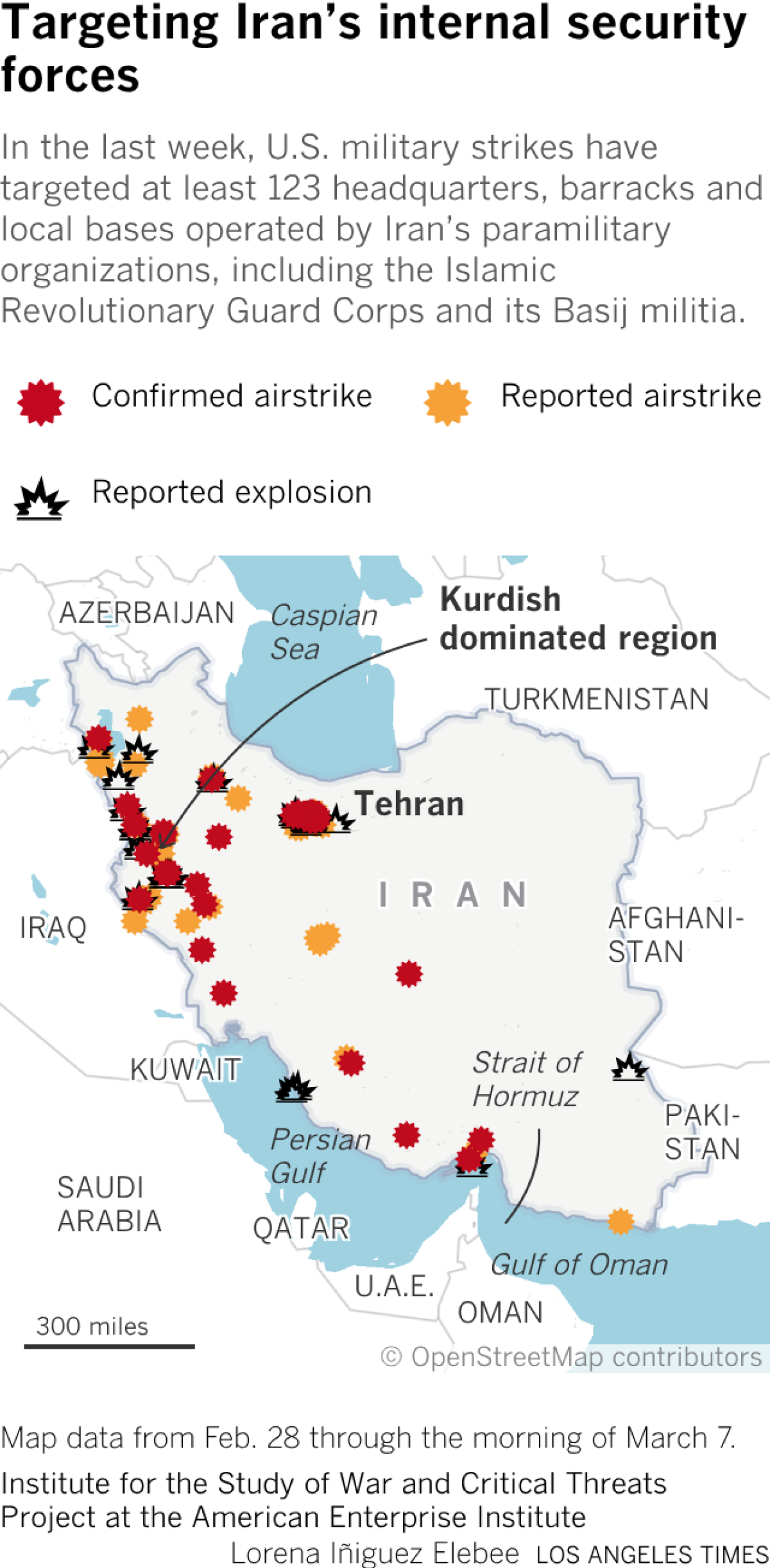
U.S. military strikes have focused on Iran’s ballistic missile, drone and nuclear programs, as well as its naval assets, according to U.S. Central Command. But strikes have also increasingly targeted Iran’s internal security forces, used by the Islamic Republic to suppress public dissent, according to an analysis from the Institute for the Study of War and the Critical Threats Project shared with The Times.

The strikes have targeted at least 123 headquarters, barracks and local bases operated by Iran’s paramilitary organizations, including the Islamic Revolutionary Guard Corps and its Basij militia. Regional police forces, primarily in the capital region around Tehran and in western Iran, near areas dominated by Kurdish groups hostile to the Iranian government, have also been targeted.

Some of those groups are being armed and supported by the U.S. intelligence community, a U.S. official said, speaking on the condition of anonymity to speak candidly.

Nicholas Carl, with the Critical Threats Project, said the pattern indicates the campaign is already underway to set the conditions for a revolution.

“As we are going after these repressive institutions, we are degrading the ability of the regime to monitor its population, to repress its population,” Carl said. “And so it looks as though the strike campaign may be organized around trying to erode the ability of the regime to repress in those areas.”

Analysts said that strikes against internal forces could be greater than they have measured thus far, noting the difficulty of tracking targets in the war based on publicly available data due to an internet blackout strictly enforced by the Iranian government.

Smoke and fire near a cooling tower.

An explosion erupts after strikes near Azadi Tower close to Mehrabad International Airport in Tehran on Saturday.

(Atta Kenare / AFP / Getty Images)

The quieter side of the U.S. campaign suggests a political strategy by the Trump administration that goes beyond simply containing the Iranian government, and may instead aim to lay the groundwork for its overthrow.

Trump and his top aides have been inconsistent in their messaging on their goals for the war, vacillating between calls for regime change and far shorter ambitions, such as an Islamic Republic that remains in power under leadership more acquiescent to the United States.

Before the war began, Trump was presented with an intelligence assessment that large-scale military action was unlikely to topple the Iranian government, two sources familiar with the assessment said. The assessment led analysts at the CIA, the State Department and the Pentagon all to advise the White House against proceeding with the operation. The intelligence analysis was first reported by the Washington Post.

  • Share via

Greasing the wheels for domestic unrest, for insurgency or revolution could serve other strategic purposes for the Trump administration beyond effecting regime change, adding new sources of pressure on an Islamic Republic that, if still intact by war’s end, would face renewed internal pressures at a moment of historic weakness.

Rob Malley, lead negotiator on the 2015 Iran nuclear deal and special U.S. envoy for Iran under President Biden, said that a sustained U.S. campaign that cripples Iran’s ability to maintain domestic control could mean “the regime collapses, in the sense that it can no longer, genuinely and effectively, govern the entirety of the country.”

“Right now, what Trump is saying suggests an extremely ambitious, extremely long-term, extremely perilous campaign that will only end with Iran’s surrender, and it’s very hard to see Iran surrendering,” Malley said. But the campaign may already be working. “Their communications have certainly been penetrated — they cannot meet without being targeted by Israel or the United States,” he added.

A women holds a portrait of the late Ayatollah Ali Khamenei at a protest

A woman holds a portrait of the late Ayatollah Ali Khamenei at a protest Saturday by medical professionals outside Gandhi Hospital in Tehran, which was damaged in an airstrike earlier this week.

(Majid Saeedi / Getty Images)

“Either the regime stays in place weakened, bloodied, finding it harder to govern a more fragmented, chaotic country,” Malley continued, “or the regime no longer can govern.”

An Israeli official did not deny that internal security forces were being targeted, although the official said that Israel was focused on assassinating Iran’s political and security leadership — “tiers one, two and three,” the official said. The vast majority of the strikes against internal security services thus far have been conducted by the United States.

“Our goal is to weaken the ayatollah regime, to a point where the Iranian people can choose their fate,” the official told The Times. “It’s still not at the point where they can do that, but there is work still to be done.”

By all accounts, the campaign against Iran’s military assets has achieved success. Iranian ballistic missile attacks against Israel and U.S. forces and allies in the region have decreased by 90% after just a week of combat, Defense officials said. Drone strikes have decreased by 83%. Over 30 Iranian vessels, including those used as launching pads for drones and aircraft, have been destroyed — a significant number for Iran’s aged and ill-funded naval fleet.

Trump could simply declare victory based on these results alone, said Elliott Abrams, who served as Trump’s special representative for Iran in 2020.

“They will get weaker as they use up resources and we bomb more and more relevant sites. Already air traffic is starting up again,” Abrams said, noting that commercial flights in the region began resuming this weekend. “So I doubt that the president will need a protracted campaign.”

But that would leave the regime in place, leaving open the possibility of a revanchist Islamic Republic that could reconstitute its military and crack down further on democratic protesters — an outcome that could create political backlash for Trump, Abrams said, after losing U.S. service members in combat.

A woman jogs along a street amid closed shops

A woman jogs amid closed shops in south Tel Aviv on Saturday.

(Olympia de Maismont / AFP / Getty Images)

“The outcome remains entirely in doubt — regime collapse after a wave of protests, civil war, a deal that leaves the regime in place behind a new face,” Abrams added. “A real test for Trump would arise if there is a wave of protests as in January, and the regime again starts shooting. Can he do nothing? Unlikely.”

In his initial speech announcing the start of the campaign, Trump addressed the people of Iran, telling them to shelter in their homes until the U.S. bombing campaign concludes.

“When we are finished, take over your government. It will be yours to take. This will be probably your only chance for generations,” the president said. “For many years, you have asked for America’s help. But you never got it. No president was willing to do what I am willing to do tonight. Now you have a president who is giving you what you want. So let’s see how you respond.”

But the president’s message grew muddled over the course of the last week, after he offered conflicting goals in a series of interviews with reporters.

He at once said he was expecting to hand-select the next ayatollah, after assassinating Iran’s longtime supreme leader, Ali Khamenei, in the opening salvo of the war. In other interviews, he said that the joint U.S.-Israeli campaign had killed many of the potential leaders that Washington could have worked with.

On Friday, Trump called for Iran’s “unconditional surrender.” He did not specify whether he was referring to a surrender of Iran’s nuclear program, its ballistic missile program, or on control over the country itself, and in a subsequent interview, said it could simply mean “when Iran no longer has the ability to fight.”

Over the last week, Kurdish leaders have shared accounts of Trump and his top aides reaching out to them and encouraging their involvement in the war, including a ground incursion in western Iran from Iraqi Kurdistan. But the president seems to have placed that effort on hold for the time being. “The war is complicated enough without having — getting the Kurds involved,” he told reporters Saturday aboard Air Force One.

At Central Command headquarters on Thursday, Defense Secretary Pete Hegseth told reporters that Trump maintains his promise to the Iranian people at the outset of the war, that a time will come for an uprising.

Defense Secretary Pete Hegseth addresses the audience as President  Trump listens

Defense Secretary Pete Hegseth addresses the audience as President Trump listens during “The Shield of the Americas Summit“ on Saturday, a gathering with heads of state and government officials from 12 countries in the Americas at the Trump National Doral Golf Club in Doral, Fla.

(Roberto Schmidt / Getty Images)

“No one’s done more than President Trump to reopen the opportunity for those who want a free Iran to do so,” Hegseth said. “Ultimately, it’s common sense, as he said up front, don’t go out and protest while bombs are dropping inside Tehran and elsewhere. There will come a moment where he determines, or they determine, that it’s time to seize that advantage.”

Suzanne Maloney, vice president and director of the foreign policy program at the Brookings Institution and an expert on Iran, said she expects the government to survive the U.S. assault, “still easily able to outgun and outmaneuver any challenges from the streets.”

But a concerted, prolonged campaign could change that assessment.

“Of course, months of full-scale war certainly could also break the system,” Maloney said, adding: “I don’t think the short-term result would be a stable transition to a more liberal system — but rather a collapse of the state itself, and at least for some period of time, a dangerous vacuum of power and order in the heart of the Middle East.”
Source link

Israel believes Iran war could last months, testing U.S. resolve

U.S. and Israeli officials are privately casting doubt on projections from the Trump administration that the war with Iran could end within a matter of weeks — instead warning that a months-long campaign may be required to destroy the country’s ballistic missile capabilities and install a pliant government, multiple sources told The Times.

The prospect of extended combat creates new political risks and uncertainties for President Trump, whose penchant for dramatic, short-term military operations has suddenly given way to a full-scale assault on the Islamic Republic, shocking a MAGA base that for years supported his calls to end forever wars in the Middle East.

One Israeli official told The Times — despite internal guidance among Israeli officials to adhere to the U.S. president’s stated time frame — that the war “definitely could be longer” than the four-week window that Trump repeatedly offered to reporters.

A U.S. official said that in private conversations, top administration officials presume the campaign will require a longer runway now that remnants of Iran’s government have chosen to resist rather than acquiesce to Washington.

Protracted war was always a possibility. Trump was presented with U.S. intelligence assessments gaming out the potential conflict that emphasized how highly unpredictable the results of an attack would be — an analysis the intelligence community believes has borne out on the ground in the chaotic early days of the conflict.

A longer conflict could create diplomatic space between Trump and Israel’s prime minister, Benjamin Netanyahu, who has advocated for the overthrow of the Islamic Republic for over 30 years.

The Israeli leader has succeeded in convincing Trump to take military actions in Iran that American presidents have rejected for decades, from bombing its nuclear facilities to assassinating its leadership, including Ayatollah Ali Khamenei, who was killed in an opening strike over the weekend.

Goal of regime change fades

Yet, mere days into the war, White House officials have all but ceased references to a democratic spring that could sweep Iran’s government aside.

A set of four U.S. goals for the mission no longer calls for changing the regime itself. Still, Netanyahu’s government remains keen on replacing the government, and the nation’s longest-serving premier sees the current war as his best opportunity to do so, one official said.

Speaking with reporters Tuesday, Trump rejected reports that the Israelis had convinced him to launch the attack.

“No, I might have forced their hand,” Trump said. “Based on the way the negotiations were going, I think they were going to attack first, and I didn’t want that to happen. So if anything, I might have forced Israel’s hand, but Israel was ready, and we were ready, and we’ve had a very, very powerful impact because virtually everything they have had been knocked out.”

In a series of interviews this week, Trump said he had been given projections of a four- or five-week war, while noting he is prepared to go longer if necessary.

Michael Rubin, a former Pentagon official who is Iran expert at the American Enterprise Institute, said that projecting a deadline to the conflict at its start would be a strategic mistake for the Trump administration, as it would in effect give Iran’s remaining leadership an end date to wait out the fighting.

“Successive presidents have shown that America has strategic attention deficit disorder,” Rubin said. “If that was the case in Iraq and Afghanistan, it’s especially true under Trump. He imposed a ceasefire on Gaza that let Hamas survive to fight another day; they still haven’t disarmed.”

The duration of the war will depend, in part, on Iran’s ability to resist and defend its remaining capabilities — but also on the president’s willingness to accept an outcome that leaves the Islamic Republic in place.

That decision has not yet been made by Trump, who has vacillated between calls for a democratic uprising across Iran — and U.S. military options to support resistance groups inside the country — as opposed to a shorter campaign that cripples Iran’s political leadership and Islamic Revolutionary Guard Corps.

“I can go long and take over the whole thing, or end it in two or three days and tell the Iranians, ‘See you again in a few years if you start rebuilding,” Trump told Axios.

One of Israel’s primary goals is to effectively eliminate the country’s ballistic missile program, and progress on that score is ahead of schedule, another source familiar with the operation said. “Things are going very well at the moment,” the source added. “Great pace.”

An Israeli military source noted to The Times that the stated goal of the mission is to significantly degrade, but not necessarily destroy, Iran’s ballistic missile capabilities, a goal the source said could be accomplished within Trump’s preferred time frame.

“Israel was quite unhappy Trump ordered the [June 2025] 12-day war ended when it did,” said Patrick Clawson, director of the Iran program at the Washington Institute for Near East Policy. He said he expected the current war would “take time” to comprehensively set back Iran’s ballistic missile capabilities, after a series of Israeli missions in 2024 against the missile program failed to set them back by more than a matter of months.

“Some Israelis think before the recent strikes, Iranian production was fully restored,” Clawson said. “So a really comprehensive attack on Iranian missiles is an important Israeli objective.”

The Maduro model

But no one inside the Islamic Republic system has emerged so far to serve in a supplicant role to Trump in the way that Delcy Rodríguez has stepped in as acting president of Venezuela, after U.S. forces captured that country’s strongman president, Nicolás Maduro, in an audacious overnight raid in January.

Since then, the Stars and Stripes have flown alongside the Venezuelan tricolor at government buildings in Caracas, where senior Trump administration officials have been welcomed to discuss lucrative opportunities in Venezuela’s oil industry.

Trump is now looking for an Iranian counterpart to Rodríguez, he said Tuesday, suggesting he is willing to keep the Islamic Republic in place despite encouraging its citizens to rise up against their government.

“Most of the people we had in mind are dead,” Trump said in the Oval Office. “We had some in mind from that group that is dead. And now we have another group. They may be dead also. Pretty soon we’re not gonna know anybody.”

“I mean, Venezuela was so incredible because we did the attack and we kept the government totally intact,” he added.

Dennis Ross, a veteran diplomat on the Israeli-Palestinian conflict who served in the George H.W. Bush, Clinton and Obama administrations, expressed doubt that Trump would be willing to proceed with a months-long campaign, regardless of Israel’s aspirational objectives.

“I believe President Trump doesn’t define clear objectives so he can decide to end the war at a time of his choosing, and declare the objective at that point, announcing we have achieved what we sought to do,” said Ross, noting that finding a figurehead in Iran as he did in Venezuela was always “a long shot.”

“Unilaterally, he could declare we made the regime pay a price for killing its citizens, and we have weakened Iran to the point that it is not any longer a threat to its neighbors,” Ross added. “He could then say, if Iran continues the war, we will hit them even harder.”

Source link

News Analysis: Toppling Iraq’s Hussein unleashed chaos. Why Iran war poses similar risks

A shock-and-awe campaign laying down a tsunami of bombs. An enemy succumbing rapidly under overwhelming firepower. And a triumphant U.S. president trumpeting a quick and easy campaign.

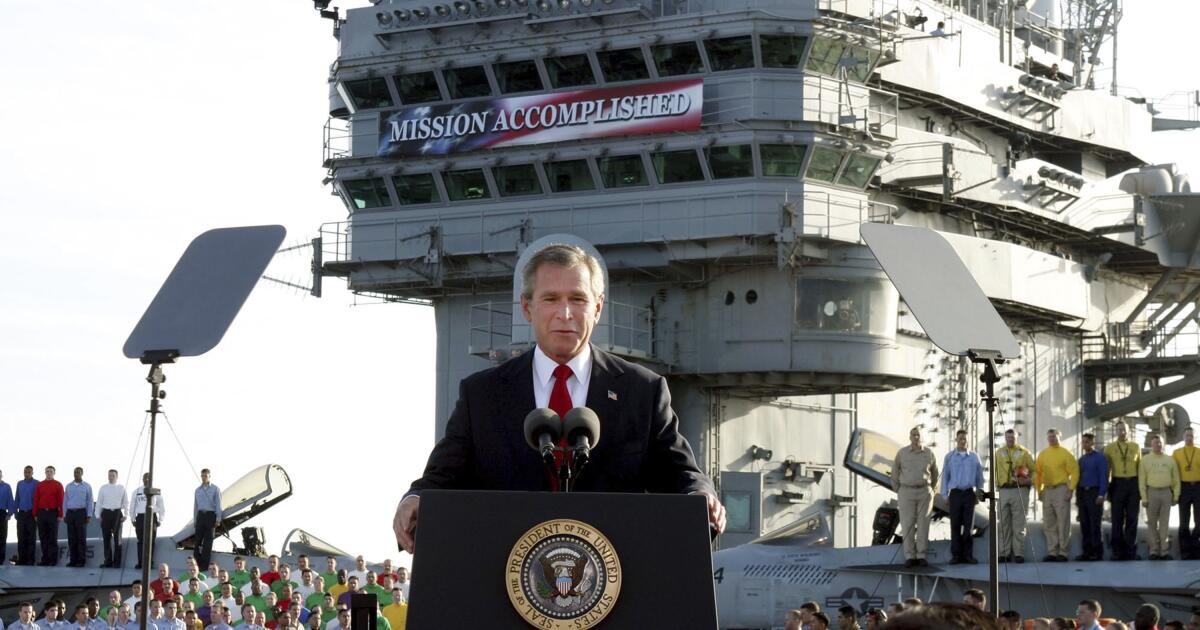
In 2003, President George W. Bush strode confidently on the deck of an aircraft carrier less than five weeks after he ordered the invasion of Iraq and declared the “end of major combat operations” under a banner proclaiming “Mission Accomplished.”

It proved anything but.

The invasion became a meat grinder, leaving thousands of Americans and possibly more than a million Iraqis dead. It unleashed forces whose effects are felt in the region and beyond to this day.

More than two decades later, another U.S. president attacked another Persian Gulf nation, promising rapid success in yet another Middle East adventure that he says will remake the region.

President Trump and his staff have vehemently rejected any comparison between “Operation Epic Fury,” launched Saturday, and “Operation Iraqi Freedom.” On Monday, Defense Secretary Pete Hegseth gave a pugnacious news conference, insisting, “This is not Iraq. This is not endless.”

Yet the assault on Iran — almost four times larger than Iraq with more than double its population — presents no lack of challenges, ones that could spread chaos far beyond Iran’s borders and become a defining feature of Trump’s presidency.

In many ways, analysts say, toppling Iran’s leadership represents a much more complex task than Iraq ever did. Iraq was a state with deep sectarian divisions that was largely dominated by a single dictator: Saddam Hussein.

The Iran that emerged after the 1978-79 Islamic Revolution had a supreme leader, but Iran also developed an elaborate system of governance. That includes a president, a parliament and varying governmental, military and religious hierarchies, noted Paul Salem, senior fellow at the Middle East Institute.

“Unlike Saddam’s Iraq, the Iranian state is multi-institutional and hence much more resilient — and, yes, not as vulnerable,” Salem said. “And hostility to the United States and Israel is at the heart of the Islamic Revolution — baked into the state.”

Here are some of the ways the Iran attacks could develop into the very scenarios Trump once derided in his days as the antiwar candidate:

Boots on the ground

For now, the U.S. and Israel have wielded air power to pound Tehran into submission. In the first minutes of the joint operation, a 200-plane fleet — Israel’s largest — struck more than 500 targets in Iran, according to the Israeli military. One such strike killed Supreme Leader Ayatollah Ali Khamenei.

Iran is still fighting back, lobbing missiles at Israel, Persian Gulf nations, Jordan and other areas with U.S. bases in the region. The U.S. has the qualitative and quantitative edge of materiel to eventually prevail, but Iran’s capabilities will not make it easy, as the losses in service members and planes have demonstrated in the last two days.

And wars have never been won with air power alone. Rather than relying on boots on the ground, Trump expects ordinary Iranians to finish the job for him.

“When we are finished, take over your government. It will be yours to take,” he said in a video address on the first day of the campaign.

During the Arab Spring of 2011, protesters throughout the Middle East took to the streets to demand change. But those efforts mostly did not lead to significant reforms and, in some countries, prompted further repression.

In Iran, it’s true many people would welcome the Islamic Republic’s demise — as many Iraqis rejoiced at Hussein’s fall. But it’s unlikely that mostly unarmed protesters will triumph in a confrontation against enforcers from the Islamic Revolutionary Guard Corps or its volunteer wing, the Basij.

It’s also difficult to gauge how many of Iran’s 93 million people despise the government enough to rise up against it.

Meanwhile, Trump has left the door open for dispatching U.S. troops, but the math of such a deployment raises doubts.

According to the U.S. Army, counterinsurgency doctrine dictates 20 to 25 troops for every 1,000 inhabitants to achieve stability. In the case of Iran that would entail deploying 1.9 million people — almost all the U.S. military’s active duty, reserve and National Guard personnel.

New leadership unclear

At this point, it’s not clear that decapitation of much of Iran’s leadership class will produce any real change in government, much less a successor inclined to bend to U.S. wishes. The top echelons of the Islamic Republic boast a deep bench of mostly hard-liners — not surprising, perhaps, for a nation that has braced for attack for years, if not decades.

Whatever new leadership that does emerge could rally around the “martyrdom” of Khamenei. Not especially popular in life, he appears to have become, in death, a rallying cry for defiance. And martyrs are exalted in Shiite Islam, Iran’s prevalent faith.

“He was the religious leader of the Shiites, so it’s sort of like killing the pope,” Salem said. “And he’s more popular dying as a martyr, than, say, of a heart attack. … He went out in style, no doubt about it.”

When the U.S. occupied Iraq, the expectation was that whatever came next would be a fervent U.S. ally, an idea perhaps best captured in the notion in Washington that a grateful Iraqi populace would shower U.S. troops with flowers. That didn’t happen. And in the Darwin-esque culling of leaders that followed, the ones that emerged victorious had little love for the U.S.

One of them was Nouri Al-Maliki, a Shiite supremacist whose policies were blamed for fueling years of sectarian bloodletting, and whose loyalties often seemed more aligned with Tehran than Washington.

Meanwhile, Tehran, playing on its proximity and deep ties to the new Iraqi ruling class, was able to steer Iraq — a majority Shiite country — deeper into its orbit.

After the Iraqi government — with the help of a U. S.-led coalition — pushed Islamic State out of Iraq in 2017, Iran was able to embed allied militias into Iraq’s armed services. That created the paradoxical situation of Tehran-aligned fighters wielding U.S.-supplied materiel.

Iraq has yet to emerge from Iran’s shadow. After Iraq’s most recent elections, Maliki seems poised to become prime minister once more, prompting Trump to write on Truth Social, “Because of his insane policies and ideologies, if elected, the United States of America will no longer help Iraq.”

A fragmented opposition

Iran’s population is diverse; an estimated two-thirds of Iranians are Persian, while minorities include Kurds, Baloch, Arabs and Azeris.

Those minorities have long-standing grievances against the ruling majority. It’s possible that Trump’s campaign and the resulting disorder could fuel separatist tensions.

Just last month, Iranian Kurdish factions joined together in a coalition that they said would seek the overthrow of the Islamic Republic “to achieve the Kurdish people’s right to self-determination, and to establish a national and democratic entity based on the political will of the Kurdish nation in Iranian Kurdistan.”

An experienced insurgency

Over the decades, the Islamic Republic created a network that at its peak stretched from Pakistan to Lebanon.

It was a fearsome constellation of paramilitary factions and amenable governments that became known as the Axis of Resistance. It included Hezbollah in Lebanon, Hamas in Palestinian lands, Yemen’s Houthis, and militias in Iraq, Afghanistan and Pakistan.

After Hamas’ Oct. 7, 2023, attacks, Israel — and, eventually, the United States — launched offensive campaigns to defang the groups.

Although weakened, the factions still survive, and could form a powerful, transnational and motivated insurgency when the time comes to fight whatever emerges if the Islamic Republic falls.

Bulos reported from Khartoum, Sudan, and McDonnell from Mexico City.

Source link