The BBC war drama depicts a fictional nuclear attack on Britain by Russia and its devastating aftermath – and was so disturbing it was banned from broadcast for two decades

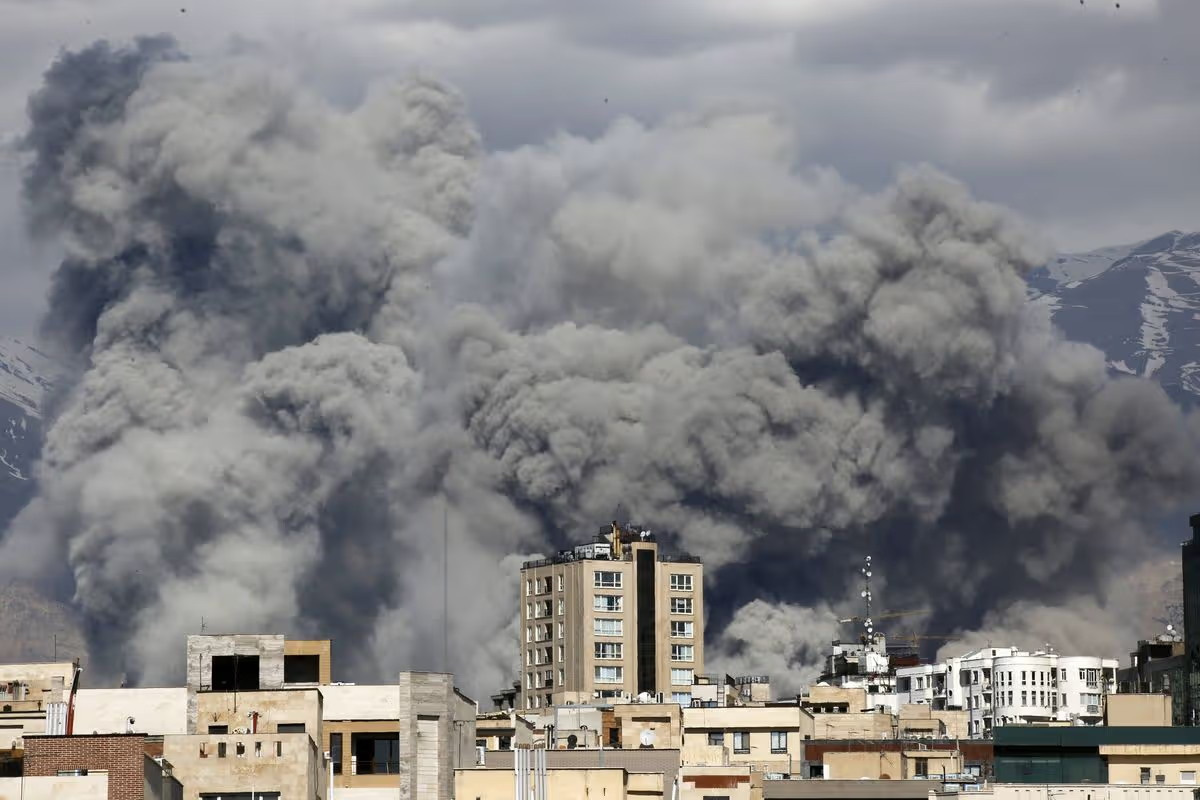
The nuclear war drama was deemed ‘too horrifying’ for British viewers(Image: Anadolu, Anadolu via Getty Images)
In the face of escalating conflicts worldwide – from the intensifying US-Israel joint operation against Iran in the Middle East, Israel’s ongoing war on Gaza following Hamas’ October 2023 attack, to the four-year-long Russia-Ukraine war still in progress – it’s no exaggeration to say we’re witnessing a catastrophic level of global unrest.
Amidst this turmoil, the looming threat of nuclear warfare is ever-present. The aftermath of such a conflict would bring about unimaginable destruction and devastation – the fallout is too horrific to contemplate.
This chilling scenario was portrayed in a BBC documentary from 1965, a film so disturbing it was banned from television broadcast for two decades by the British Broadcasting Corporation itself.
At the time, the corporation justified its decision to prohibit the documentary, stating: “The effect of the film has been judged by the BBC to be too horrifying for the medium of broadcasting. It will, however, be shown to invited audiences..”
The controversial pseudo-documentary finally aired in Great Britain on 31 July 1985, twenty years after its initial scheduled screening date of 6 October 1965. This broadcast coincided with the week leading up to the 40th anniversary of the Hiroshima bombing, reports the Express.
The War Game is currently available for free streaming on BBC iPlayer or can be bought for £5.99 on Amazon Prime Video.
Written, directed and produced by Peter Watkins for the BBC, The War Game depicted a fictional nuclear strike on Britain by the Soviets and its devastating consequences.
The docu-film’s official synopsis states: “In this British documentary, a hypothetical Chinese invasion of South Vietnam triggers a new world war between East and West. In the town of Rochester, Kent, the anticipation of a nuclear attack leads to mass evacuations.
When a stray missile actually explodes, the ensuing firestorm blinds all those who see it. It’s not long before the fabric of society is ripped apart owing to radiation poisoning, a lack of infrastructure and rioting for food and other necessities.”
On 13 April 1966, The War Game had its premiere at the National Film Theatre in London, where it screened until 3 May. Barred from broadcast, the 47-minute docu-drama subsequently appeared at numerous international film festivals, including Venice, where it secured the Special Prize.
The recognition continued – the prohibited BBC production went on to claim the Academy Award for Best Documentary Feature in 1967, alongside two BAFTAs for Best Short Film and the UN Award.
Boasting a near-flawless 93% approval rating on review aggregator site Rotten Tomatoes, The War Game has earned widespread acclaim from critics and viewers.
One reviewer commented on the docu-drama: “Nothing that you have heard or read can fully prepare you for Peter Watkins’ 1965 faux documentary on the aftermath of a nuclear attack on Great Britain.”
Another reviewer added: “One of the most disturbing, overwhelming, and downright important films ever produced.”
A third critic described it as essential viewing, noting: “It was produced by the British Broadcasting Corp. but never televised because it was felt its showing would be both horrifying and depressing. It is. It also is realistic, informative and shattering. It is a movie that everyone should see.”
Whilst one critic said: “Still packs a whallop. Will stick with you for life. Don’t say I didn’t warn you,” another commented on the nuclear war drama, “One of the most skillful documentary films ever made.”
Viewer reactions mirror this sentiment, with one audience member writing in an extensive review: “The War Game, although created as a TV movie for the BBC for the 20th anniversary of the bombing of Hiroshima and Nagasaki, is easily the one of the most disturbing movies I have ever seen, on par only with Gus van Sant’s “Elephant. ” It accurately portrays the effects and aftermath of a nuclear attack and uses a handheld documentary style that makes everything chillingly real.
“There were several times during the film when I had to remind myself that Britain had never suffered a nuclear attack and the footage I was looking at was not real. There are very few films that have left me in the state that this one did when it was over. Much like “Schindler’s List” or “American History X,” this is the kind of movie I think everyone should watch because it is so incredibly informative and brings the viewer so much closer to understanding the pain and monstrosity of a nuclear attack.”
Another viewer described it as: “A harrowing punch in the gut that nothing prepared me for. Unforgettable.”
Meanwhile, one audience member remarked about Watkins’ drama: “Really shook me up and left me reeling for a while after seeing it. Peter Watkins ruined my 3 day weekend with this masterfully done piece of film. Needs to be required viewing for every being capable of understanding images and sound.”
The War Game can be streamed free of charge on BBC iPlayer until July 2026, or purchased for £5.99 through Amazon Prime Video.