International Solidarity

US Labor Independence and Solidarity with Venezuela

The Tucson chapter of the National Writers Union (NWU) has called for a change in the AFL-CIO’s international relations. (Archive)

Illegal US military strikes on January 3, 2026, against Venezuela have elicited a flood of resolutions from labor unions. Some of these have focused solely on the US aggression and solidarity with the Venezuelan people. Others have gone further to condemn the kidnapping and arrest of President Nicolás Maduro and his wife, Cilia Flores. In at least one case, a resolution by the Tucson chapter of the National Writers Union has called for systemic changes to how the AFL-CIO, the US’ largest labor confederation, and its Solidarity Center (formerly the American Center for International Labor Solidarity), conducts its international relations. In each case, union members are undertaking important steps towards peace and solidarity as well as opening up possibilities for the emergence of a truly independent US labor movement. 

These resolutions are the latest in a series of cases where labor has broken with US foreign policies, including military strikes and acts of war. Beginning with the AFL-CIO’s 2005 passage of the USLAW Resolution 53: “The War in Iraq”, the federation and both affiliated and unaffiliated unions have gone on to speak out against coups in Honduras and Bolivia, repressive immigration policies, neoliberal trade agreements, and other global wars and threats of war.

In contrast, the Solidarity Center, the AFL-CIO’s primary channel for international activities, has continued to collaborate with US policies of regime change. The AFL-CIO’s Solidarity Center is historically 90 to 96% funded by the US government, and its policies are set in consultation with the White House rather than with representatives from its member unions. The Solidarity Center is one of the core institutes of the National Endowment for Democracy (NED), along with the International Republican Institute (IRI), the Center for International Private Enterprise (US Chamber of Commerce), and the National Democratic Institute (NDI). The NED was created by the US Congress in 1983 in large part to “…do today [what] was done covertly 25 years ago by the CIA.”

The Solidarity Center has played support roles in coups and coup attempts as well as invasions and occupations in Haiti, Venezuela, and Iraq, to name a few examples. In Haiti, the Solidarity Center withheld support for the largest union during the IRI orchestrated coup and instead funded a small labor organization that refused to oppose the coup. In Iraq, the Solidarity Center ignored unions and workers organizations protesting the US occupation in order to support union organizing that would avoid such direct challenges. 

In Venezuela, the Solidarity Center funneled hundreds of thousands of dollars to plotters of the failed coup of 2002. Since then, the Solidarity Center has provided a black box worth millions in funding for activities in Venezuela. However, it has provided no details about how those funds are being used or to whom they are being distributed. 

The recent freeze in funding for the NED and the Solidarity Center by the Trump Administration is being treated as a crisis. It has resulted in lawsuits by both institutions to recover funding. However, orphaned by the White House, there is another way forward for the AFL-CIO and the Solidarity Center. The Tucson NWU resolution calls for the Solidarity Center to open its books on its activities and to wean itself off government funding. The recent experiences of unions declaring their solidarity with both Palestine and Venezuela have shown many the profound need for a new era of labor independence. 

Labor unionists in solidarity with Venezuela should study and learn from experiences regarding Palestine. Labor mobilizations against the genocide in Gaza represented a break not only with international US policies but, specifically, with the leadership of the AFL-CIO which has long supported Zionism and even to this day, acted to stifle solidarity with Palestine. In an article for Left Voice, Jason Koslowski informs us that, 

“By October 18, a little fewer than 2,000 were dead in Gaza. That’s when one of the AFL-CIO’s organs in Washington State — the Thurston-Lewis-Mason Central Labor Council, or TMLCLC — met and passed a resolution demanding a ceasefire. 

The TMLCLC’s resolution ‘opposes in principle any union involvement in the production or transportation of weapons destined for Israel.’ And it challenges the AFL-CIO leadership, too: 

‘[W]hile the TLMCLC agrees with the AFL-CIO’s statement calling for a ‘just and lasting peace,’ we would ask our parent federation to also publicly support an immediate ceasefire and equal rights for Palestinians and Israelis.

The AFL-CIO leadership caught wind of this dissent. That’s when it stepped in. 

A representative of the AFL-CIO leaders contacted the labor council to declare the dissenting statement void. Under pressure, the Washington labor council deleted the statement from its Twitter account.”

Jeff Shurke is the author of the must-read book No Neutrals There: US Labor, Zionism, and the Struggle for Palestine. Shurke, in an article for Jacobin, adds that, 

“…an AFL-CIO senior field representative informed the council’s board members that their resolution was null and void because it did not conform to the national federation’s official policy…. About a week later, AFL-CIO president Liz Shuler sent a memorandum to all local labor councils and state labor federations across the United States telling them that ‘the national AFL-CIO is the only body that can render an official public position or action on national or international issues.’ Without explicitly referencing the unfolding carnage in Gaza, she was all but telling the federation’s local and statewide bodies they were not allowed to stand in solidarity with Palestine.

Still, the AFL-CIO’s individual member unions — which, unlike central labor councils, operate as autonomous affiliates of the federation — were free to take their own positions. Beginning with the American Postal Workers Union and United Auto Workers (UAW), over the following weeks and months several of them formally joined the growing chorus of international voices demanding a ceasefire in Gaza… culminating in the establishment of a new union coalition dubbed the National Labor Network for Ceasefire.

The AFL-CIO itself eventually came out in favor of a “negotiated cease-fire” in early February 2024, after at least twenty-five thousand Palestinians had already been killed. Despite these positive developments, the AFL-CIO and its affiliated unions at the national level still failed to answer the explicit Palestinian call to refrain from building or shipping weapons for Israel.”

In the case of the Tucson NWU’s resolution, rather than going through labor federations, the resolution has been sent to the national NWU for passage and forwarding to the AFL-CIO for consideration in the next convention. Other unions are debating similar resolutions. There also is discussion of bringing resolutions before labor counsels and federations despite the AFL-CIO’s admonishments. 

Right now, three kinds of resolutions have emerged from labor in response to the January 3rd attack on Venezuela. They are all good. 

•  The first kind is to condemn the attacks without further elaboration. That is positive, but by leaving out reference to the kidnapping of President Maduro and Cilia Flores, the resolutions sidestep the issue of regime change itself. 
•  The second kind adds a demand for the release of Maduro and Flores. This is better and implicitly breaks with the AFL-CIO’s and the Solidarity Center’s support for regime change. 
•  The Tucson NWU resolution is an example of the third approach. It takes worker-to-worker solidarity to its logical conclusion, calling for systemic change so that the AFL-CIO will never again support US coups and invasions but, instead, plot an independent course. That is the most meaningful kind of change, one that lasts beyond just the current moment and conflict. 

The opportunity to achieve that kind of change is here. Abandoned by the White House, pressured by its own rank and file, the time has come for the AFL-CIO to choose a new path. What will be its response?

James Patrick Jordan is National Co-Coordinator for the Alliance for Global Justice and is responsible for its Colombia, labor, and ecological solidarity programs.

The views expressed in this article are the author’s own and do not necessarily reflect those of the Venezuelanalysis editorial staff.

Source: Orinoco Tribune

Source link

‘It Is Venezuela Today. It Will Be South Africa Tomorrow,’ NUMSA Trade Union Warns

South African trade unions and leftist organizations have expressed solidarity with Venezuela. (NUMSA)

Demanding the release of Venezuela’s President Nicolás Maduro and First Lady Cilia Flores, South Africa’s largest trade union marched to the US consulate in Johannesburg on Saturday, January 24.

“In defending Venezuela, we defend the sovereignty of all nations,” concluded the memorandum read aloud outside the consulate by Irvin Jim, general secretary of the over 460,000 members-strong National Union of Metalworkers of South Africa (NUMSA).

“It is Venezuela today … It will be South Africa tomorrow,” Jim warned in his address to the demonstration. US President Donald Trump, who has bombed parts of Nigeria after concocting a false story about a “Christian Genocide” in the country, has also been spinning tales about a “White Genocide” underway in South Africa.

“This is not a joke,” NUMSA warned in a statement. “Donald Trump can easily use the lie of a White genocide in South Africa to invade South Africa, capture South Africa’s president and transport him to a jail in the US, and declare that he is now in charge of our country and all its natural wealth, whilst controlling all trade and natural wealth … After the US criminal military invasion of Venezuela, it is foolish to ignore” this threat to South Africa.

“There is a madman in the White House”

“There is a madman in the White House. There is a fascist in the White House,” NUMSA’s president, Andrew Chirwa, said in his opening address to the demonstration. “Today, it is Venezuela that was attacked by this international criminal. Tomorrow it is” Cuba, Iran, Nigeria,  South Africa. “All over the world this man” is baying “for blood.”

In parallel, the Trump administration is also attempting to strangle South Africa’s economy, threatening to exclude it from the African Growth and Opportunity Act (AGOA), which provides tariff-free access to the US market, on which the country’s automotive sector is heavily dependent.

“Our members and workers across various sectors are losing jobs” because “he has imposed 30% tariffs against South Africa,” Jim added in his speech.

Stressing the need for “an anti-imperialist front to mobilize the workers” across party and union affiliations, Jim said that NUMSA “will soon be convening a political colloquium”, inviting all progressive political parties. “It is about time to unite the working class … behind a  revolutionary agenda,” as South Africa faces increasing US aggression.  

South Africa punished for taking the genocidal state of Israel to the ICJ

South Africa, the union maintains, “is being punished by Trump for taking the genocidal state of Israel to the International Court of Justice (ICJ).” Reaffirming that “this was the correct position … in defense of the people of Palestine,” NUMSA called on the South African government not to cave in to the pressure by Leo Brent Bozell III, Trump’s new ambassador to South Africa.

At his Senate confirmation hearing, he had stated that if appointed, “I would press South Africa to end proceedings against Israel,” and the ICJ itself to stop what he deemed a “lawfare” against Israel.

“If he continues to insult our national sovereignty … by demanding that South Africa must withdraw its case in the ICJ against Israel,” NUMSA insists, “the South African government must act swiftly, and ensure that he packs his bags and leaves the country.”

The South African government must also “continue to demand the release of Venezuela’s President Nicolás Maduro and Comrade Cilia Flores in all international forums,” added the memorandum, which was also copied to the Minister of International Relations.

Demanding that the football governing body “cancel all World Cup matches in the US this year,” a copy of the memorandum was also sent to the FIFA President.

It further called on the African Union (AU) and the BRICS to urgently convene and formulate a coordinated and collective response to the US imperialist aggression.

“No country is safe from America’s greedy appetite”

Recalling the European leaders defending unipolarity under the cover of “rules-based order” at last year’s G20 summit in South Africa, the US had boycotted Alex Mashilo, spokesperson of the South African Communist Party (SACP) said in his address to the protest: “Little did they know that just after a few weeks, that unipolar power will turn against them and demand Greenland.”

Under “the mad Trump administration”, NUMSA emphasized in its statement, “no country is safe from America’s greedy appetite”.

​The US has now even “become extremely dangerous to itself” and “its citizens”, with Trump “brutalizing the American people daily” using “his personal ‘Gestapo’ police commonly known as ICE.”  ​

Expressing “solidarity with American citizens who are being brutalized by ICE,” NUMSA insisted, “This is a moment when all people of the world, including well-meaning US citizens and all South Africans, must unite” against imperialism.

Source: People’s Dispatch

Source link

Progressive Activists, Officials Condemn Venezuela Attacks, Call for Joint Action Against Monroe Doctrine

Poster from the “Nuestra América” summit with a quote from Cuban independence hero José Martí. (Progressive International)

Mérida, January 26, 2026 (venezuelanalysis.com) – Delegates from governments, parliaments, and social movements across the globe gathered in Bogotá, Colombia, on January 25 for the inaugural “Nuestra América” summit.

Convened by the Progressive International at the San Carlos Palace, the emergency congress aimed to establish a unified strategy against what participants described as a “rapidly escalating assault” on Latin American sovereignty.

The high-level meeting, featuring 90 people from more than 20 countries, took place against a backdrop of heightened regional tensions and the Trump administration’s express intent to impose its dictates in the Western hemisphere.

The summit was triggered by the events of January 3, when US forces launched “Operation Absolute Resolve,” involving targeted bombings in Caracas and surrounding areas. The attacks killed over 100 people and drew near-universal condemnation from progressive forces who blasted the operation as a flagrant violation of the UN Charter.

The military incursion saw special forces kidnap Venezuelan President Nicolás Maduro and First Lady Cilia Flores. The pair will face trial in New York on charges including narco-trafficking conspiracy, to which both pleaded not guilty during the arraignment hearing on January 5. Venezuelan officials have repeatedly denounced the kidnapping and demanded Maduro and Flores’ release and return.

The “San Carlos Declaration,” adopted at the close of the Bogotá summit on Sunday, characterized the current moment as a “new age of colonial violence” driven by a “revived Monroe Doctrine and a new ‘Trump Corollary’”.

The text asserted that “the defense of sovereignty in the hemisphere is inseparable from the defense of international law at the global level,” calling for a “coordinated international solidarity” to halt US coercive actions.

“We, the delegates at the inaugural convening of Nuestra América in Bogotá, Colombia, affirm the shared horizon of: a hemisphere that governs itself, defends its peoples, and speaks in its own voice,” the document read. Delegates committed to a “common strategy” to “project Nuestra América as a force for sovereignty and solidarity.”

The gathering featured high-level bilateral exchanges, as well as working groups led by grassroots movements. The final statement emphasized the importance of popular power to defend working-class interests and build international solidarity.

In the coming weeks, the “Nuestra América” movement plans to intensify its diplomatic activity, with a second major meeting already scheduled to take place in Havana, Cuba.

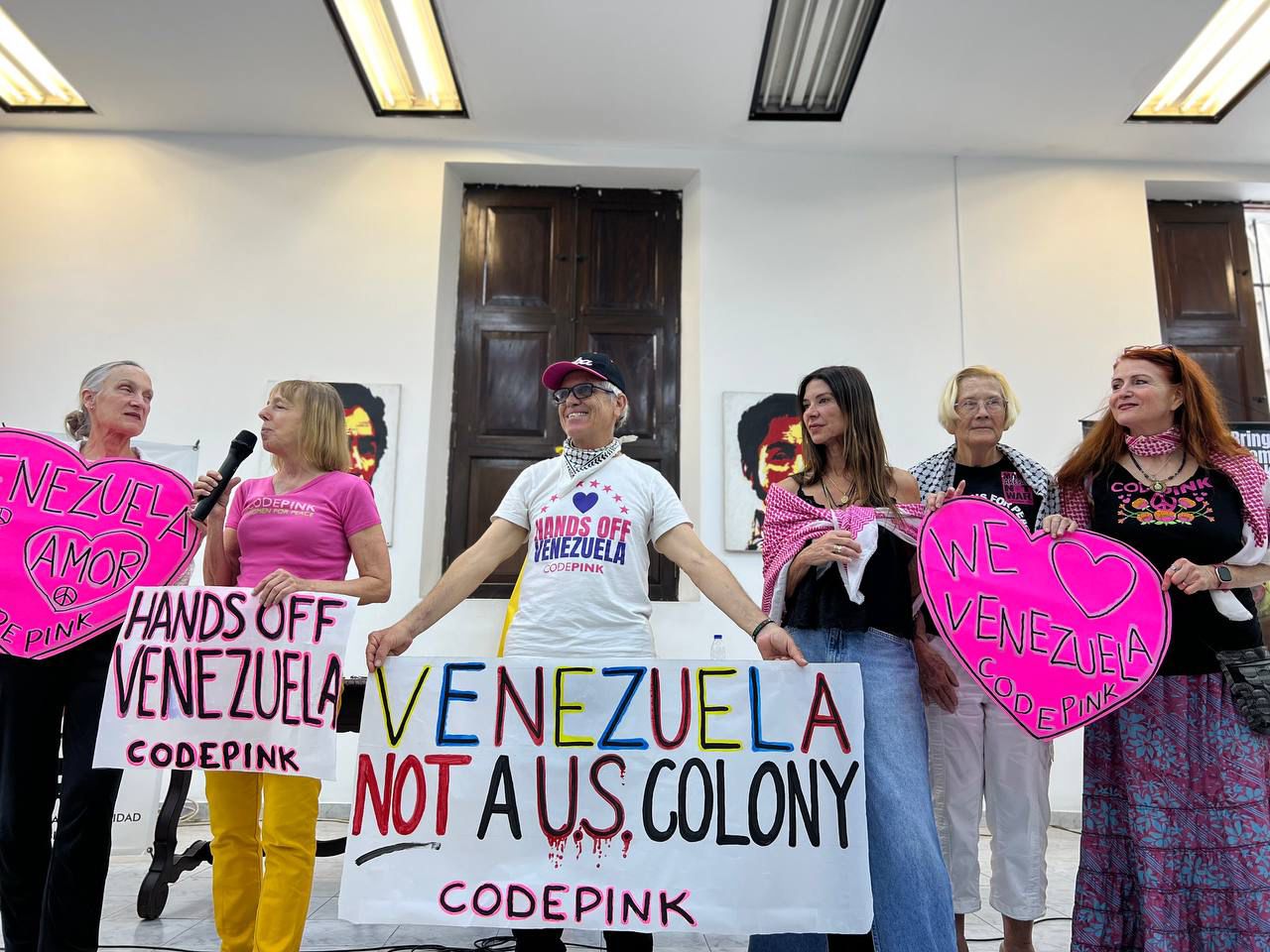
Code Pink’s Latin America coordinator Michelle Ellner attended the Bogotá summit and told Venezuelanalysis that it is urgent to confront a US project of “hemispheric domination that combines military intervention, lawfare, and repression.”

“No country or movement alone can confront the US military and financial apparatus,” she argued. “But together, states, peoples and social movements can continue building an anti-imperialist movement that can sustain those who are currently fighting politically.”

Ellner noted that progressive movements have historically been fractured but that they need to go from “reaction to action.” The Venezuelan-US organizer explained that Code Pink and allied groups are coordinating legislative pressure and mobilizations within the US to challenge the “normalization of intervention.”

Acting government promotes “coexistence and peace”

In Venezuela, Acting President Delcy Rodríguez launched the “Program for Democratic Coexistence and Peace” on Friday during a televised broadcast.

According to Rodríguez, the initiative seeks to “heal the fractures” caused by political violence and “eradicate expressions of hate” that threaten national stability in the wake of the US’ recent attacks and threats.

The program is overseen by a diverse committee led by Minister of Culture Ernesto Villegas alongside several other cabinet members, former business leader Ricardo Cusanno, and various social activists. 

The acting president emphasized the need for political dialogue among different Venezuelan political forces without meddling from Washington and other foreign actors. The government announced plans to present a new law to the National Assembly to institutionalize the initiative.

In recent weeks, Venezuelan judicial authorities have likewise released opposition agents, some of them having been accused of treason and terrorism, as well as people accused of involvement in the unrest that followed the July 2024 presidential elections. Caracas has reported 626 released and invited the UN High Commissioner for Human Rights to accompany the process.

Edited by Ricardo Vaz in Caracas.

Source link