Interactive

‘Every Brilliant Thing’ review: The interactive Daniel Radcliffe

What makes life worth living? For hard-core “Harry Potter” fans with money to burn, it might be getting Broadway tickets to interact fleetingly with Daniel Radcliffe in “Every Brilliant Thing,” an ingenious and touching solo performance piece written by Duncan Macmillan with Jonny Donahoe on the subject of suicide — or more precisely, on the ordinary joys that militate against such a drastic step.

Radcliffe was breathlessly scampering up and down the aisles of the Hudson Theatre before the show began, enlisting audience members to be participants in the play. Having seen “Every Brilliant Thing” twice before, once at the Edye (the black box at Santa Monica’s BroadStage) starring Donahoe in 2017 and once at the Geffen Playhouse’s intimate Audrey Skirball Kenis Theater starring Daniel K. Isaac in 2023, I knew exactly what he was up to.

The play revolves around a list that the narrator began at the tender age of 7 after his mother first attempted suicide. While she was still in the hospital, he started compiling, as much for her benefit as for his own, sources of everyday happiness.

Ice cream, water fights, kind people who aren’t weird and don’t smell unusual. These items are given a number, and audience members assigned a particular “brilliant thing” are expected to shout out their entry when their number is called.

The list gradually grows in complexity as the narrator gets older. Miss Piggy, spaghetti bolognese and wearing a cape give way to more sophisticated pleasures, such as the way Ray Charles sings the word “You” in the song “Drown in My Own Tears” or the satisfaction in writing about yourself in the second person.

Music plays a prominent role in “Every Brilliant Thing,” which was adapted from a monologue/short story Macmillan wrote called “Sleeve Notes.” The narrator’s terribly British father takes refuge from the emotional storms of his household by listening to jazz records in his office. John Coltrane, Cab Calloway, Bill Evans, Nina Simone are favorite artists, and the narrator can tell his father’s mood simply by the record he’s decided to play.

The production, directed by Jeremy Herrin and Macmillan, involves every level of the Hudson Theatre. I assumed I would be safe, occupying an aisle seat in the murderously expensive prime orchestra during a press performance attended by critics. But I wasn’t flashing a pad as my colleague across the aisle from me was doing to ward off any intrusions. And just before the show was about to start, Radcliffe was suddenly kneeling beside my seat asking if the person I was sitting with was my partner.

I told him that we weren’t a couple, just friends, and that I would be the worst person he could possibly ask to perform anything. But Radcliffe wasn’t so easily put off. “Let’s just say that you’re an older couple who have been together for some time,” he whispered. “And all you have to do is hand me this box of juice and candy bar when I refer to the older couple.”

OK, what harm could there be? Little did I know that “older couple” was to become “old couple,” a term that seemed to be repeated incessantly, at least to my Gen X ears not yet accustomed to scurrilous millennial attacks! I composed myself by pretending that we were in the world of anti-realism. But in truth, I would like to be the kind of person who would offer an anxious kid in a hospital waiting room a juice box and a candy bar, so maybe the casting wasn’t so far-fetched after all.

Daniel Radcliffe in the Broadway production of "Every Brilliant Thing."

Daniel Radcliffe in the Broadway production of “Every Brilliant Thing.”

(Matthew Murphy)

A theatergoer was called upon to play the vet who euthanized the narrator’s childhood pet, a dog named Indiana Bones that was symbolized by a coat someone volunteered from the audience. It was the boy’s first experience of death, a difficult concept for a young mind but an important precursor for a boy not given the luxury of existential innocence.

Other audience members, particularly those seated on the stage, played much more elaborate roles. One man, first invited to serve as a stand-in for the narrator’s father, was asked instead to play the boy. He was given one word to say in reply — “Why?” — as his father tries to explain the reason his mother is in the hospital. This same enlisted actor was later called upon to play the dad giving a toast at his son’s wedding, one of the rare occasions when he was able to summon language for the kind of deep feeling he would normally only be able to express through his records.

One kind and patient spectator conscripted to play the school counselor had to remove her shoe to improvise a sock puppet, one of the tools of her empathetic practice. Another audience member sensitively played Sam, the narrator’s love of his life, a relationship that reveals the long-term toll of being raised by a parent suffering from suicidal depression.

Radcliffe’s audience wrangling was as intuitively sharp as his deeply felt performance. He has the comfort of a good retail politician, who’s not afraid of making direct contact with crowds. Two-time Tony winner Donna Murphy, in the house at the reviewed performance, gamely went along when Radcliffe briefly enlisted her luminous services.

Obviously, Radcliffe is the main reason “Every Brilliant Thing” is on Broadway. The show, which began at Britain’s Ludlow Fringe Festival in 2013, is a gossamer piece, a 70-minute curio best experienced in close quarters without the high expectations and ludicrous prices of New York’s turbo-charged commercial theater. The Hudson Theatre lends a mega-church vibe to the proceedings, but the spirits of theatergoers are nonetheless moved.

A scruffy-faced Radcliffe, twinkling accessible geniality in jeans and a sweatshirt, zips up and down the cavernous theater as though waging a one-man campaign against the isolation epidemic. There’s no denying that Harry Potter has matured into an assured stage actor. His Tony-winning performance in “Merrily We Roll Along” should have put to rest any doubts, but the glare of his fame can still obscure his serious chops.

Sincere yet never smarmy, ironic without ever being cynical, well-groomed though far from swank, he’s a more glamorous version of the character than the one originated by Donahoe, the British comedian with an everyman demeanor whose portrayal seemed so genuine at the Edye that I mistakenly thought that the play was his personal story.

Donahoe’s performance was filmed for HBO, but “Every Brilliant Thing” is meant to be experienced in a theater. The whole point of the show is to transform the audience into an impromptu ensemble, a group of strangers emotionally united through the story of one young man’s intimate knowledge of suicide, a subject that Albert Camus called the “one truly serious philosophical problem.”

I’m of two minds about “Every Brilliant Thing.” I was moved once again by the piece, but I’m grateful I didn’t have to wreak havoc on my credit card to pay for my seats. I love the interactive, gentle humanity of the play, but I was also acutely aware of how the work has been commodified. I applaud Radcliffe’s willingness to carve an independent path as an actor, but I might have been more impressed by his adventurousness had he decided to perform in a pocket venue that didn’t have the tiers of pricing I associate with airlines.

Yet launching a conversation around mental health with an audience magnet as powerful as Radcliffe is on balance an excellent thing. And Radcliffe’s compassionate portrayal of a survivor recognizing that he’s not out of the woods just because he made it into adulthood is one of those things that makes a theater lover just a little more appreciative of the humanity at the center of this art form.
Source link

Which countries have seen the highest petrol prices since the Iran war? | US-Israel war on Iran News

Motorists around the globe are already feeling the impact of the United States and Israel’s war on Iran, with fuel prices sharply rising since the war began.

In the US, a gallon of regular petrol that averaged $2.94 in February now costs $3.58, marking a 20 percent increase, according to data from AAA Fuel Prices, a retail fuel price tracker from the American Automobile Association (AAA).

While each US state sets its own petrol prices, several states have surpassed $4 per gallon, with California exceeding $5 per gallon, the highest level it has been in more than two years.

Which countries have the sharpest petrol price increases?

According to data analysed from Global Petrol Prices, a data platform that tracks and publishes retail energy prices across approximately 150 countries, at least 85 countries have reported increases in petrol prices following the initial attacks on Iran by the US and Israel on February 28. Some nations announce price changes only at the end of each month, so higher prices are expected for many others in April.

Vietnam recorded the highest petrol price increase of nearly 50 percent, rising from $0.75 per litre of 95-octane on February 23 to $1.13 on March 9. Laos follows with a 33 percent increase, then Cambodia at 19 percent, Australia at 18 percent, and the US at 17 percent.

The table below shows the countries that have increased petrol prices at the pumps.

Asian countries pay the biggest price

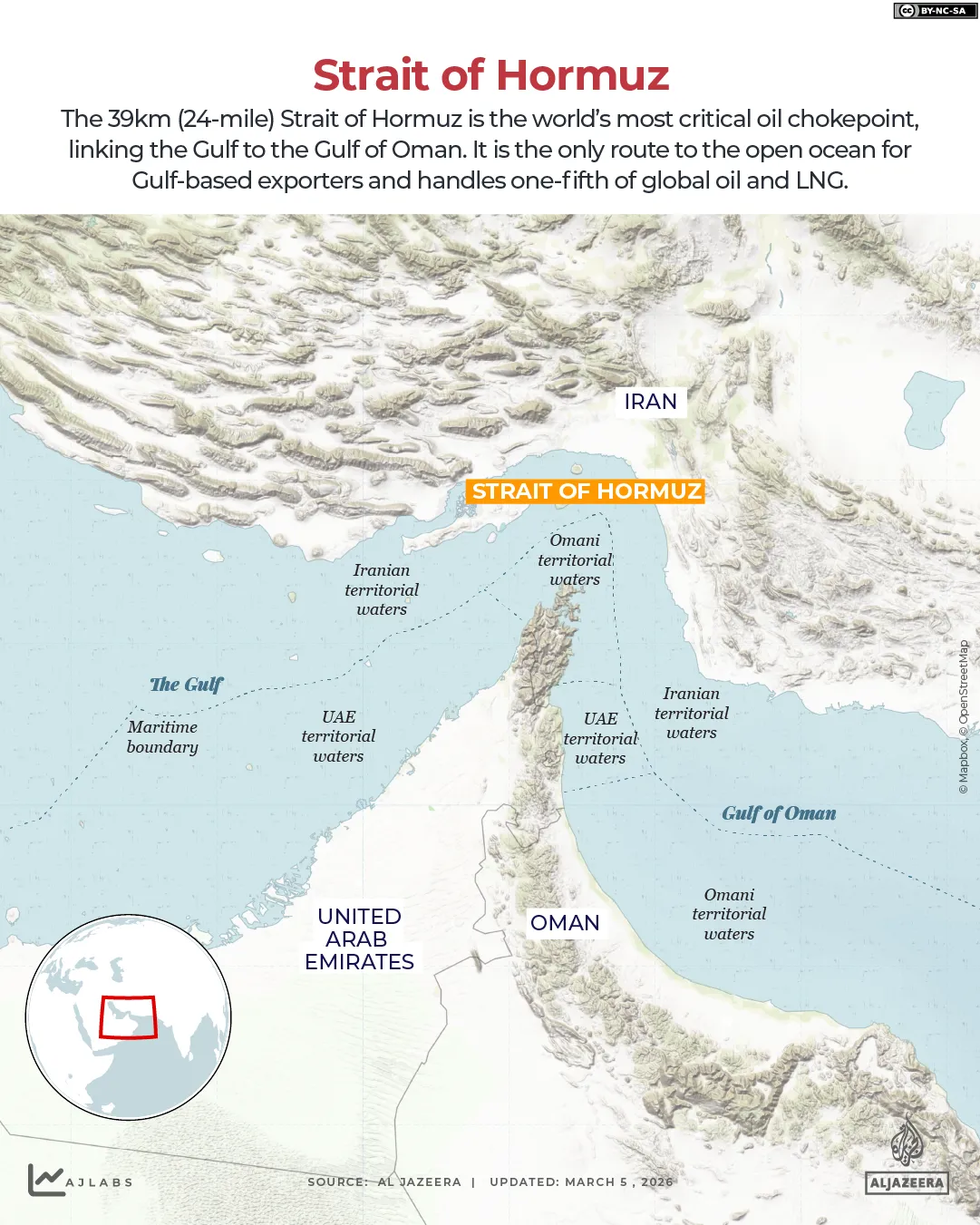
Asia is disproportionately dependent on the Strait of Hormuz for the delivery of its oil and gas, which has been effectively closed since the start of the war. The strait joins the Gulf – also referred to as the Persian Gulf and the Arabian Gulf – to the Gulf of Oman and is the only passage for the region’s oil producers to the open ocean.

INTERACTIVE - Strait of Hormuz - March 2, 2026-1772714221

Japan and South Korea are among the most vulnerable, importing 95 percent and 70 percent of their oil from the Gulf, respectively.

Both East Asian nations have enacted emergency measures to stabilise their energy markets. On March 8, Japan instructed its oil reserve sites to prepare for a potential release of strategic reserves. The next day, South Korea introduced a maximum price cap on petrol and diesel for the first time in 30 years.

In South Asia, the impact of the war is more severe than in East Asia because countries like Pakistan and Bangladesh have much thinner financial buffers and smaller strategic reserves.

In an attempt to conserve energy, Bangladesh‘s government has ordered all public and private universities to close immediately. In Pakistan, government offices will now operate a four-day workweek, while schools have closed, and a 50 percent work-from-home policy has been enacted to save fuel.

In Europe, the Group of Seven finance ministers convened an emergency meeting to discuss rising prices, with French President Emmanuel Macron raising the possibility of releasing 20-30 percent of emergency strategic reserves to ease the pressure on consumers.

How high oil costs drive up the price of food

Oil prices and food prices move in lockstep, with energy prices affecting every stage of the food supply chain, from the fertilisers used in the fields to the trucks that carry food from field to supermarket shelf.

Rising oil prices also directly affect shipping and the cost of transport.

“The lifeblood of the global economy is transport,” economist David McWilliams told Al Jazeera. “It’s getting stuff from A to B – it’s a logistics problem, a supply chain problem, and ultimately transportation is the energy of the global economy.”

Fears of stagflation – increasing inflation and rising unemployment, which major oil shocks have historically summoned – are rising. Economists point to the crises of 1973, 1978 and 2008 as evidence that every significant spike in oil prices has been followed, in some form, by global recession.

In lower-income countries, where populations spend a far greater share of their income on food and import large quantities of grain and fertiliser, rising oil prices could rapidly translate into food shortages.

Interactive_Cost_OilPrices_Food-1773140062

What products are made from oil and gas?

Oil and gas are used for far more than just fuel. They are raw materials for thousands of everyday products.

Plastics, including water bottles, food packaging, phone casings and medical syringes, are all derived from crude oil.

Crude oil is also the hidden ingredient in synthetic fabrics such as polyester, nylon and acrylic, which are used to make everything from sportswear to carpets. It also underpins the cosmetics industry, as it is used to make products such as petroleum jelly (Vaseline), lipsticks and concealers.

Household items also rely on oil-based ingredients, with laundry detergents, dishwashing liquids, and paints all derived from petroleum products.

The global food supply is essentially built on natural gas in the form of fertilisers, used to enhance crop yields and ensure that food production can meet demand.

INTERACTIVE-CRUDE OIL-USED-MARCH 9-2026-1773138980

Source link

Where do the 35 million foreigners living in the GCC come from? | Infographic News

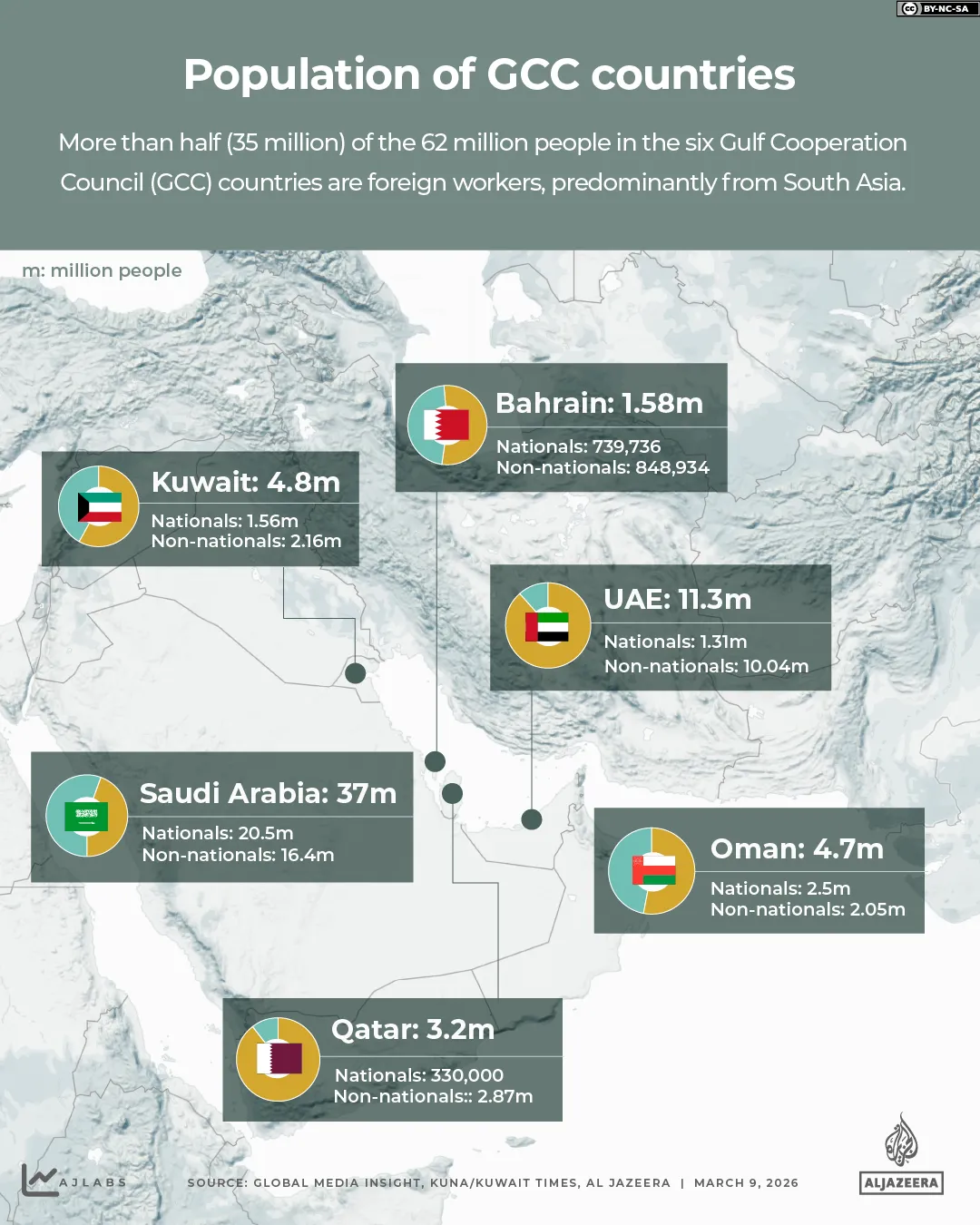
More than half of the 62 million people in the six Gulf Cooperation Council (GCC) countries are foreign workers.

Nearly 62 million people living in the six Gulf Cooperation Council (GCC) countries have been caught in the crossfire of the latest US-Israel war on Iran.

Known for their economic opportunities, these countries, including Bahrain, Kuwait, Oman, Qatar, Saudi Arabia and the United Arab Emirates (UAE), collectively host nearly 35 million foreign workers from around the world, predominantly from South Asia.

Recommended Stories

list of 4 itemsend of list

With the exception of Saudi Arabia and Oman, foreign workers make up the bulk of the populations of people living in the remaining four GCC countries.

The map below illustrates the national and non-national populations in each of the GCC countries.

Interactive_WhereDo_Expats_GCC_MARCH9_2026

Where do GCC foreign workers come from?

Generations of foreign workers in the GCC countries have significantly contributed to the workforce, including labourers, construction workers, household staff, security personnel, and cleaners, all vital to building the modern infrastructures that Gulf nations are known for.

Millions consider the Gulf their home, despite holding nationalities from other countries.

Additionally, highly skilled foreign workers have a long history in industries such as banking, finance, technology, engineering, aviation, medicine and the media.

According to Global Media Insight, a digital marketing agency based out of the UAE,  the 10 largest groups of non-nationals living across the six GCC countries are from:

  • India: 9.1 million
  • Bangladesh: 5 million
  • Pakistan: 4.9 million
  • Egypt: 3.3 million
  • Philippines: 2.2 million
  • Yemen: 2.2 million
  • Sudan: 1.1 million
  • Nepal: 1.2 million
  • Syria: 694,000
  • Sri Lanka: 650,000

Interactive_WhereDo_Expats_GCC_COUNTRY_NATIONALITY_MARCH9_2026

Saudi Arabia

Saudi Arabia is the largest of the six GCC countries, with a population of nearly 37 million.

riyadh
Aerial view of Riyadh city is seen from Mamlaka tower, a 99-story skyscraper, in Riyadh, Saudi Arabia [Amr Nabil/AP Photos]

The oil-rich country has a local population of about 20.5 million and an additional 16.4 million foreign residents.

The five largest groups of non-nationals living in Saudi Arabia are people from:

  • Bangladesh: 2,590,000
  • India: 2,310,000
  • Pakistan: 2,230,000
  • Yemen: 2,210,000
  • Egypt: 1,800,000
  • Sudan: 1,000,000

The UAE

The United Arab Emirates has the second-largest population in the GCC, totaling some 11.3 million people.

Dubai skyline
Dubai skyline is visible with the Burj Khalifa, the world’s tallest building, during the COP28 U.N. Climate Summit, in Dubai, United Arab Emirates, Thursday, November 30, 2023 [Kamran Jebreili/ AP Photo]

It consists of seven emirates, including the capital Abu Dhabi, Dubai, Sharjah, Ajman, Umm Al Quwain, Ras Al Khaimah, and Fujairah.

Emiratis make up nearly 12 percent of the population, with foreigners at almost 88 percent.

The five largest groups of non-nationals living in the UAE are from:

  • India: 4,360,000
  • Pakistan: 1,900,000
  • Bangladesh: 840,000
  • Philippines: 780,000
  • Iran: 540,000
  • Egypt: 480,000

Kuwait

With a population of 4.8 million, Kuwait has the third-largest population in the GCC.

Kuwait
A drone view shows Kuwait City in Kuwait, February 28, 2026 [Stephanie McGehee/Reuters]

Approximately 1.56 million are Kuwaiti citizens, and 2.16 million are foreign workers.

The five largest groups of non-nationals living in Kuwait are from:

  • India: 1,000,000
  • Egypt: 700,000
  • Bangladesh: 350,000
  • Philippines: 250,000
  • Pakistan: 200,000
  • Nepal: 120,000

Oman

Oman’s population stands at approximately 4.7 million people. Oman’s 2.5 million citizens account for nearly 59 percent of the population, while the remaining 2.05 million (or 41 percent) are foreign workers.

Oman
General view of old Muscat the day after Oman’s Sultan Qaboos bin Said was laid to rest in Muscat, Oman, January 12, 2020 [Christopher Pike/Reuters]

The five largest groups of non-nationals living in Oman are from:

  • India: 766,735
  • Bangladesh: 718,856
  • Pakistan: 268,868
  • Egypt: 46,970
  • Philippines: 45,213
  • Uganda: 20,886

Qatar

Qatar skyline
The Doha skyline, seen here [Showkat Shafi/Al Jazeera]

Qatar has a population of some 3.2 million people, with 2.87 million foreign workers accounting for about 88 percent of them. Qatari citizens number around 330,000, making up 12 percent.

The five largest groups of non-nationals living in Qatar are from:

  • India: 700,000
  • Bangladesh: 400,000
  • Nepal: 400,000
  • Egypt: 300,000
  • Philippines: 236,000
  • Pakistan: 180,000

Bahrain

With a total population of 1.58 million, Bahrain has the smallest population in the GCC. Bahraini citizens make up just under half of the population.

Manama
A general view of residential buildings in the Juffair district of Manama, Bahrain, June 22, 2025 [Hamad I Mohammed/Reuters]

The five largest groups of non-nationals living in Bahrain are from:

  • India: 350,000
  • Bangladesh: 150,000
  • Pakistan: 120,000
  • Philippines: 80,000
  • Egypt: 60,000
  • Nepal: 35,000

Source link

Which oil and gas facilities in the Gulf have been attacked? | Infographic News

Global energy markets remain in a state of high alert after several Gulf states suspended oil and gas production following escalating tensions in the region.

Since Saturday’s attacks by the United States and Israel, Tehran has targeted various sites in Israel and across several Gulf countries.

Recommended Stories

list of 4 itemsend of list

Initially, these Iranian attacks focused primarily on US military assets, but Gulf states have reported that Iran has since broadened its scope to target civilian infrastructure, including hotels, airports and energy facilities. Iranian officials have publicly denied targeting Gulf energy facilities, however.

The Middle East remains the world’s dominant source of hydrocarbon reserves and a major driver of crude oil and natural gas output.

How much oil and gas does the Middle East have?

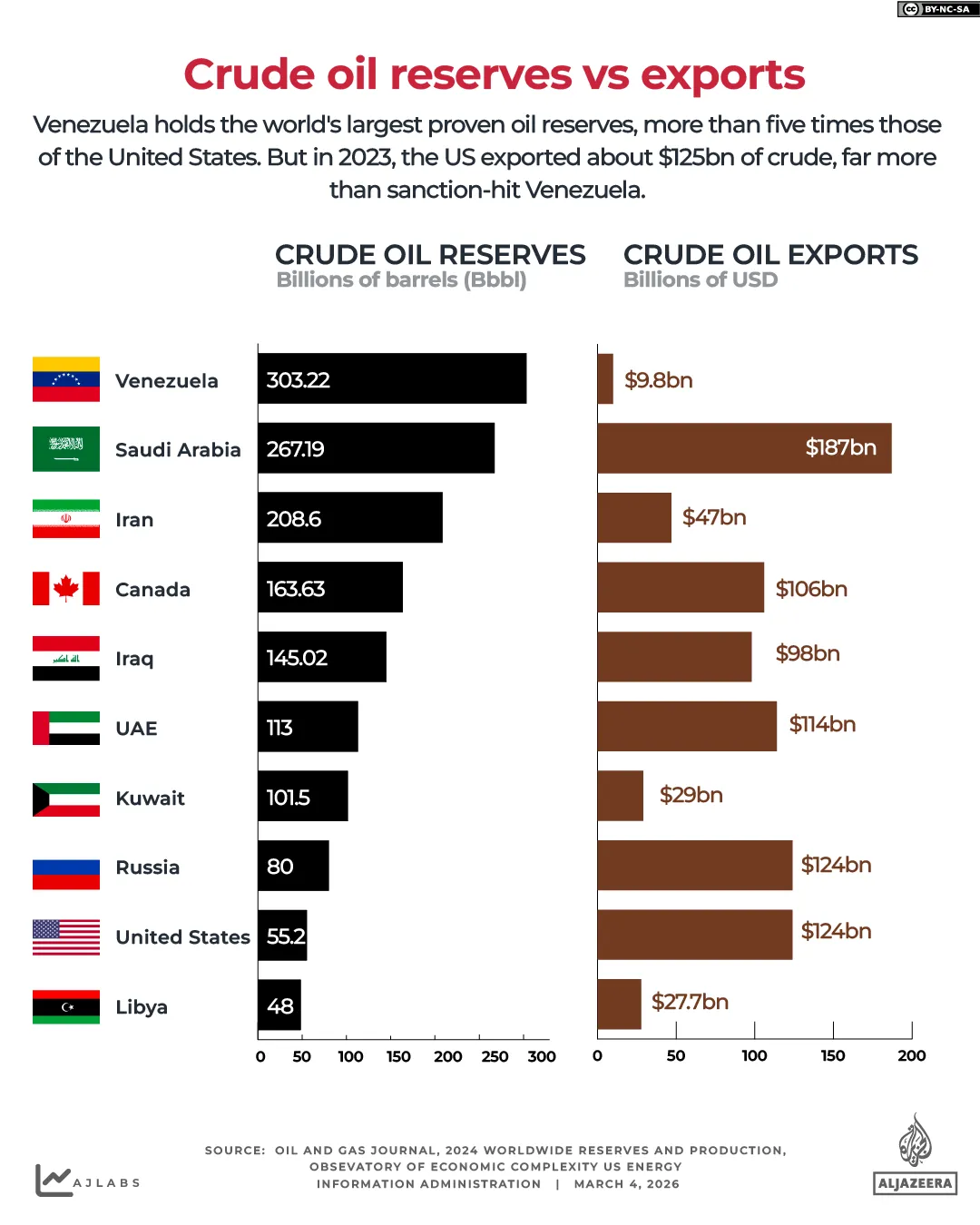
Nearly half of the world’s oil reserves and exports come from the Middle East, which contains five of the seven largest oil reserves in the world.

Once refined, crude oil is used to make various products, including petrol, diesel, jet fuel and a wide range of household items such as cleaning products, plastics and even lotions.

After Venezuela, which has 303 billion barrels, Saudi Arabia holds the world’s second-largest proven crude oil reserves, estimated at 267 billion barrels.

The Middle East’s largest oil reserves:

  • Saudi Arabia: 267 billion barrels
  • Iran: 209 billion barrels
  • Iraq: 145 billion barrels
  • UAE: 113 billion barrels
  • Kuwait: 102 billion barrels

Saudi Arabia is also the world’s top oil exporter with an estimated $187bn of crude in 2024, according to data from the Observatory of Economic Complexity (OEC).

The Middle East’s top oil exporters:

  • Saudi Arabia: $187bn
  • UAE: $114bn
  • Iraq: $98bn
  • Iran: $47bn – largely sold at a discount due to US sanctions
  • Kuwait: 29bn

Other Middle Eastern countries with sizeable oil exports include: Oman ($28.9bn), Kuwait ($28.8bn) and Qatar ($21bn).

INTERACTIVE_IRAN_GCC_OIL AND GAS SUPPLY-CRUDE_OIL_MARCH4_2026
(Al Jazeera)

In addition to crude oil, the Middle East is a global powerhouse for natural gas, accounting for nearly 18 percent of global production and approximately 40 percent of the world’s proven reserves.

Natural gas is primarily used for electricity generation, industrial heating, and in chemicals and fertilisers.

The heart of Middle Eastern gas is a single, massive underwater reservoir called the South Pars/North Dome field. It is the largest gasfield in the world, and it is shared directly between Qatar and Iran.

Gas is transported either through pipelines or by tankers. When using pipelines, the gas is pressurised and moved through steel networks. When pipelines are not feasible, such as across oceans, Liquefied Natural Gas (LNG) is used.

To create LNG, the gas is cooled to approximately -162C (-260F), shrinking its volume and allowing it to be safely loaded onto specialised tanker ships for global transport.

To transport oil and gas, tankers from various Gulf states must navigate the narrow waterway known as the Strait of Hormuz. Approximately one-fifth of global oil and gas passes through this strait, primarily heading to major markets in Asia, including China, Japan, South Korea and India, as well as to Europe.

INTERACTIVE - Strait of Hormuz - FEB24, 2026-1772104775
(Al Jazeera)

Which energy facilities have been attacked?

Here are the facilities which have recorded damage as of Wednesday:

Saudi Arabia – Ras Tanura oil refinery

On Monday, one of the world’s largest oil refining complexes, the Ras Tanura oil refinery owned by Saudi Aramco, was forced to halt operations after debris from intercepted Iranian drones caused a small fire.

This handout satellite image courtesy of Vantor taken and released on March 2, 2026, shows damage at the Saudi Aramco's Ras Tanura refinery.
This handout satellite image, courtesy of Vantor, released on March 2, 2026, shows damage at Saudi Aramco’s Ras Tanura refinery [AFP]

Saudi Aramco is one of the world’s largest companies, with a market capitalisation exceeding $1.7 trillion and revenue of $480bn. Headquartered in Dhahran, in eastern Saudi Arabia, Aramco controls 12 percent of global oil production, with a capacity of more than 12 million barrels per day (bpd).

On Wednesday, Saudi defence officials reported a second drone attempt on the facility but this was successfully intercepted with no damage or disruption to operations reported.

Qatar – Ras Laffan Industrial City LNG facilities

On Monday, Qatar’s Ministry of Defence reported that Iranian drones had targeted an energy facility in Ras Laffan belonging to QatarEnergy, the world’s largest LNG producer.

While no casualties were reported, QatarEnergy suspended the production of LNG and other products at the impacted sites.

RAS LAFFAN INDUSTRIAL CITY, QATAR - MARCH 3: A picture of Qatar Energy's operating facilities on March 3, 2026 in Ras Laffan Industrial City, Qatar. Qatar Energy announced a complete halt to liquefied natural gas (LNG) production at its Ras Laffan and Mesaieed facilities on March 2, 2026, after Iranian attacks targeted energy facilities. (Photo by Getty Images)
QatarEnergy’s operating facilities on March 3, 2026, in Ras Laffan Industrial City, Qatar [Getty Images]

QatarEnergy’s 81 million metric tonnes of LNG exports are mostly bound for Asian markets, including China, Japan, India, South Korea, Pakistan and other countries in the region. The halt in production hiked global gas prices to a three-year high this week.

Qatar – Mesaieed Industrial City

Qatar’s Defence Ministry said the country was attacked by a second drone launched from Iran on Monday, targeting a water tank belonging to a power plant in Mesaieed, without reporting any casualties.

On Tuesday, QatarEnergy also stopped production of some downstream products like urea, polymers, methanol, aluminium and others.

UAE – Fujairah and Mussafah oil terminals

On Monday, a fire broke out at Mussafah Fuel Terminal in southwest Abu Dhabi after it was struck by a drone.

On Tuesday, falling debris from a drone interception caused a fire at the Fujairah Oil Terminal along the eastern coast of the United Arab Emirates. No injuries were reported.

Large fire and plume of smoke is visible after, according to the authorities, debris of an Iranian intercepted drone hit the Fujairah oil facility, in Fujairah, United Arab Emirates, Tuesday, March 3, 2026. (AP Photo/Altaf Qadri)
A large fire and plume of smoke are visible after debris from an intercepted Iranian drone hit the Fujairah oil facility, in Fujairah, United Arab Emirates, on Tuesday, March 3, 2026, according to authorities [Altaf Qadri/AP Photos]

Oman – ports of Duqm and Salalah

On Tuesday, multiple Iranian drones struck fuel tanks and a tanker at the port of Duqm, with at least one direct hit on a fuel storage tank, causing an explosion.

On the same day, a drone strike was recorded at the Port of Salalah, which handles fuel and industrial minerals.

Athe Nova – oil tanker

On Monday, the Athe Nova, a Honduran-flagged tanker positioned off the coast of Khor Fakkan, UAE, was struck by Iranian drones as it was transiting the Strait of Hormuz, setting it ablaze. Despite the fire, the vessel managed to exit the chokepoint into the Gulf of Oman, and no casualties were reported.

Iran’s Islamic Revolutionary Guard Corps (IRGC) claimed responsibility for the strike, identifying the Athe Nova as an “ally of the United States”.

On the same day as the attack, Iran declared the Strait of Hormuz closed, warning that any ship attempting to pass would be “set ablaze”.

Since then, several other tankers have been hit.

INTERACTIVE_IRAN_GCC_OIL AND GAS SUPPLY-ATHE_NOVA_MARCH4_2026
(Al Jazeera)

Other regional energy disruptions

Although not directly targeted, the following energy sites suspended operations in response to Iranian retaliatory attacks:

Israeli offshore gasfields – Major gas production fields such as Leviathan and Tamar were shut down as a precaution following regional drone and missile launches linked to Iran.

Oil fields in semiautonomous Iraqi Kurdistan – Producers including DNO, Gulf Keystone and Dana Gas halted output as a safety measure amid the escalation.

Rumaila oilfield – Operations at Iraq’s largest oilfield – operated by BP – in southern Iraq were halted on Tuesday as a security precaution due to its proximity to the escalation zone.

Source link

How many countries has the US bombed since 2001, and how much has it cost? | Israel-Iran conflict News

Despite promising to end United States involvement in costly and destructive foreign wars, President Donald Trump, together with Israel, has launched a massive military assault on Iran, targeting its leadership and nuclear and missile infrastructure.

Much like his predecessors, Trump has relied on military force to pursue US strategic interests, continuing a pattern that has defined US foreign policy for more than two decades.

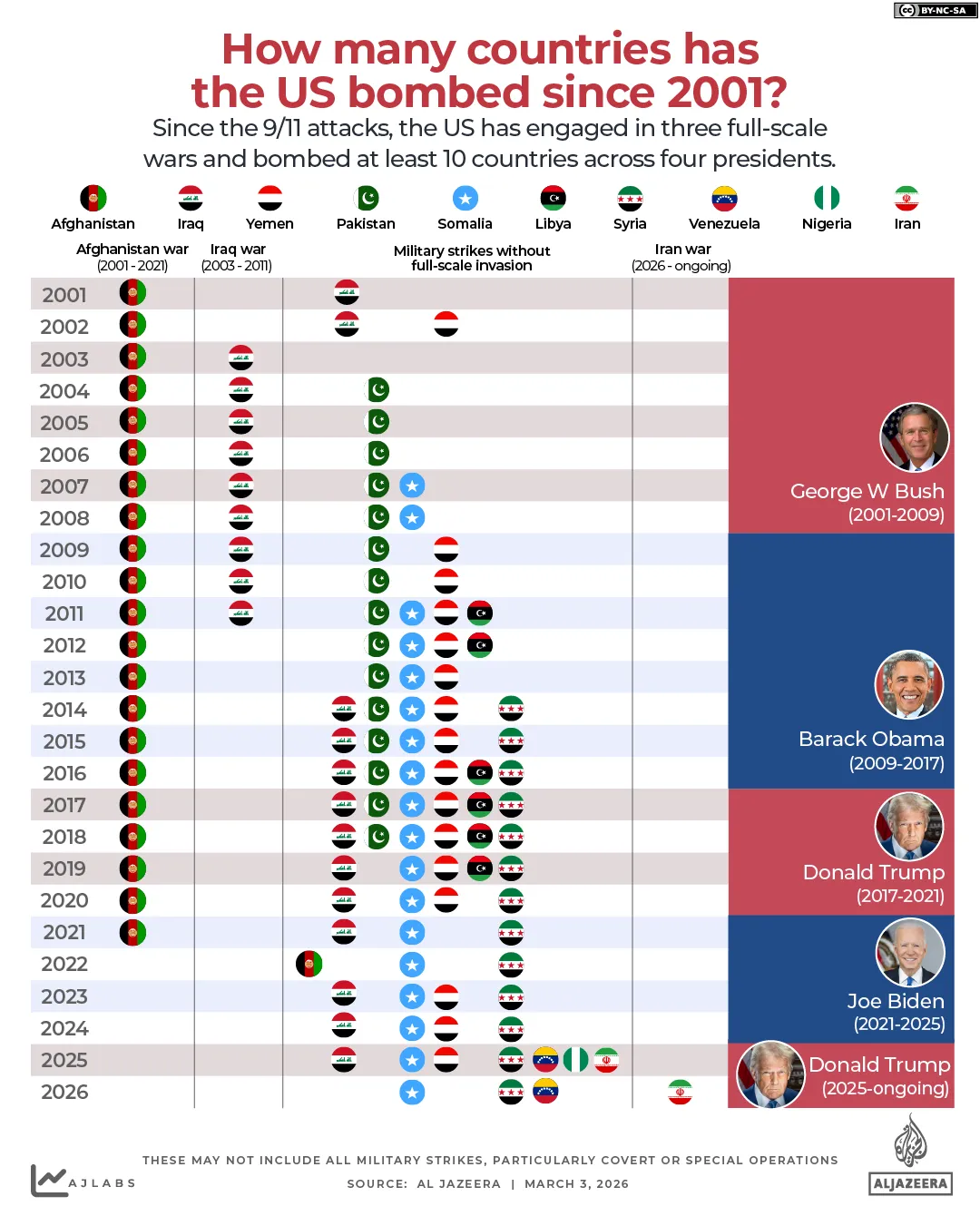
Since the September 11, 2001, attacks on New York and the US capital, the US has engaged in three full-scale wars and bombed at least 10 countries in operations ranging from drone strikes to invasions, often multiple times within a single year.

The graphic below shows all the countries the US has bombed since 2001.

These may not include all military strikes, particularly covert or special operations.

INTERACTIVE - US ATTACKS ON COUNTRIES SINCE 2001 bomb attack war iran iraq afghanistan-1772551549
The US has bombed at least 10 countries: Afghanistan, Iraq, Yemen, Pakistan, Somalia, Libya, Syria, Venezuela, Nigeria and Iran since 2001. [Al Jazeera]

The cost of decades of war

In the aftermath of the September 11, 2001, attacks, President George W Bush launched what he called a “war on terror”, a global military campaign that reshaped US foreign policy and triggered wars, invasions and air strikes across numerous countries.

According to an analysis by Brown University’s Watson Institute of International & Public Affairs, US-led wars since 2001 have directly caused the deaths of about 940,000 people across Afghanistan, Pakistan, Iraq, Syria, Yemen and other conflict zones.

This does not include indirect deaths, namely those caused by loss of access to food, healthcare or war-related diseases.

INTERACTIVE-COST OF WAR-The human cost of US-led wars Afghanistan Iraq Syria Yemen-1750770943
(Al Jazeera)

The US has spent an estimated $5.8 trillion funding its more than two decades of conflict.

This includes $2.1 trillion spent by the Department of Defense (DOD), $1.1 trillion by Homeland Security, $884bn to increase the DOD base budget, $465bn on veterans’ medical care and an additional $1 trillion in interest payments on loans taken out to fund the wars.

In addition to the $5.8 trillion already spent, the US is expected to have to lay out at least another $2.2 trillion for veterans’ care over the next 30 years.

This would bring the total estimated cost of US wars since 2001 to $8 trillion.

Afghanistan war (2001-2021)

The first and most direct response to 9/11 was the invasion of Afghanistan to dismantle al-Qaeda and remove the Taliban from power.

On October 7, 2001, the US launched Operation Enduring Freedom.

The initial invasion succeeded in toppling the Taliban regime within just a few weeks. However, armed resistance groups mounted a prolonged resistance against US and coalition forces.

The war went on to become the longest conflict in US history, spanning four presidencies and lasting 20 years until the final withdrawal in 2021, after which the Taliban regained control of Afghanistan.

An estimated 241,000 people died as a direct result of the war, according to an analysis from Brown University’s Costs of War project. Hundreds of thousands more people, mostly civilians, died due to hunger, disease and injuries caused by the war.

INTERACTIVE-Afghanistan claimed lives

At least 3,586 soldiers from the US and its NATO allies were killed in the war, which is estimated to have cost $2.26 trillion for the US, according to the Cost of War project.

Iraq war (2003-2011)

On March 20, 2003, Bush launched a second war, this time in Iraq, claiming that President Saddam Hussein possessed weapons of mass destruction – a claim that proved to be false.

On May 1, 2003, Bush declared “mission accomplished” and the end of major combat operations in Iraq.

Bush USS Abraham Lincoln
Bush on board the USS Abraham Lincoln aircraft carrier, where he declared combat operations in Iraq over on May 1, 2003 [Larry Downing/Reuters]

However, the subsequent years were defined by violence from armed groups and a power vacuum that fuelled the rise of ISIL (ISIS).

In 2008, Bush agreed to withdraw US combat troops, a process completed in 2011 under President Barack Obama.

The drone wars: Pakistan, Somalia and Yemen

Although not declared wars, the US has also expanded its air and drone campaigns.

Beginning in the mid-2000s, the CIA launched drone strikes inside Pakistan’s tribal areas along the Afghan border, targeting al-Qaeda and Taliban figures believed to be operating there. These strikes marked the early expansion of remote warfare.

Obama dramatically expanded the drone strikes in Pakistan, particularly in the early years of his presidency.

At the same time, the US conducted air strikes in Somalia against suspected al-Qaeda affiliates, later targeting fighters linked to al-Shabab as that armed group grew in strength.

In Yemen, US forces carried out missile and drone strikes against al-Qaeda leaders.

Libya intervention

In 2011 during an uprising against Libyan leader Muammar Gaddafi, the US joined a NATO-led intervention in Libya. American forces launched air and missile strikes to enforce a no-fly zone.

Gaddafi was overthrown and killed, and Libya descended into prolonged instability and factional fighting.

Iraq and Syria

From 2014 onwards, the US intervened in the Syrian war with the stated goal of defeating ISIL. Building on its campaign in Iraq, the US conducted sustained air strikes in Syria while supporting local partner forces on the ground.

In Iraq, US forces advised Iraqi troops, fought ISIL remnants and tried to counter Iranian influence, highlighted by a Trump-ordered 2020 strike that killed Iranian General Qassem Soleimani.

Source link

US-Israel attacks on Iran: Death toll and injuries live tracker | Conflict News

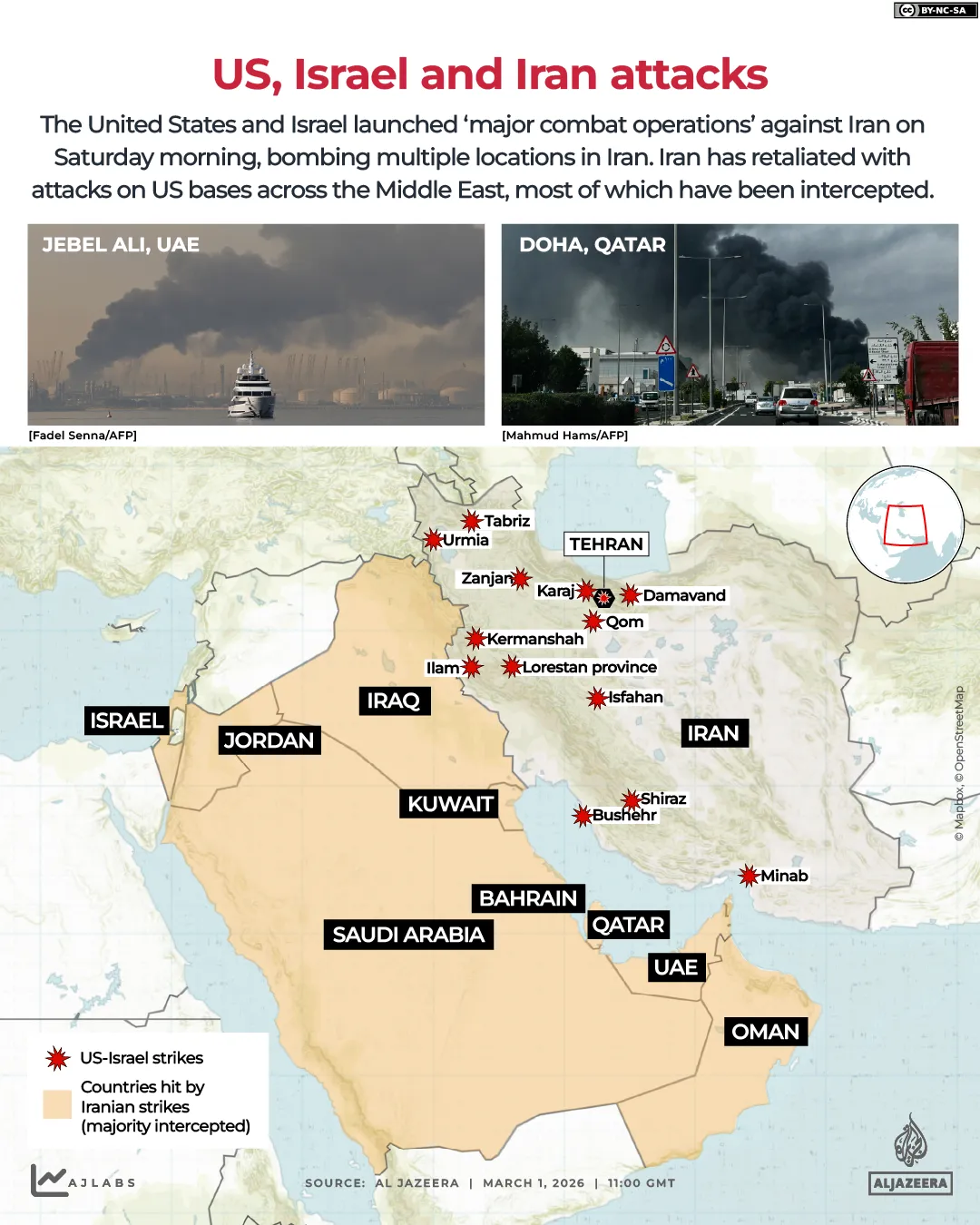
Explosions are being heard in Iran, Israel and across several Middle Eastern states after the United States and Israel began attacking Iran on Saturday.

Tehran has responded by launching waves of missiles and drones at Israel and towards several military bases in the Middle East where US forces operate.

Iran had previously warned that if it were attacked, it would respond by targeting US military facilities across the region, which it considers legitimate targets.

Which countries have been attacked?

Israel’s air force says it dropped more than 1,200 munitions across 24 of Iran’s 31 provinces over the past day in its joint attack with the US.

Iran’s Islamic Revolutionary Guard Corps (IRGC) says it has launched attacks on 27 bases in the Middle East where US troops are deployed as well as Israeli military facilities in Tel Aviv and other parts of Israel.

So far, Iran has launched strikes across eight countries in the region: Bahrain, Iraq, Jordan, Kuwait, Oman, Qatar, Saudi Arabia and the United Arab Emirates.

Most of these attacks have been intercepted.

Interactive_Iran_US_Israel_March1_2026-01-1772368294
(Al Jazeera)

US military presence in the Middle East

The US has operated military bases in the Middle East for decades.

According to the Council on Foreign Relations, the US operates a broad network of military sites, both permanent and temporary, across at least 19 locations in the region.

Of these, eight are permanent bases in Bahrain, Egypt, Iraq, Jordan, Kuwait, Qatar, Saudi Arabia and the UAE.

As of mid-2025, there are about 40,000 to 50,000 US soldiers in the Middle East stationed in both large, permanent bases and smaller forward sites.

The countries with the most US soldiers are Qatar, Bahrain, Kuwait, the UAE and Saudi Arabia. These installations serve as critical hubs for US air and naval operations, regional logistics, intelligence gathering and force projection.

INTERACTIVE - US Military presence in the Middle East June 2026 - FEB24, 2026-1772272732
(Al Jazeera)

How many people have been killed or injured?

Below are the confirmed casualties across the 10 countries that have been subject to attacks as of Sunday at 13:40 GMT.

Due to the rapidly evolving situation, all figures may change as more information becomes available.

Iran – killed: 201, injured: 747

As of Sunday morning, the Iranian Red Crescent Society and official state-linked media have reported preliminary casualty figures of 201 people killed and at least 747 injured as rescue operations continue.

Since then, explosions continue to be heard across Iran with Israel saying it has carried out a large aerial attack on the “heart of the capital”.

The deadliest single incident occurred in the city of Minab in southeastern Iran, where a strike on an elementary girls school reportedly killed at least 148 people and injured 95. The attack occurred on Saturday, and the death toll has been climbing since.

Israel – killed: 9, injured: 121

On Sunday afternoon, an Iranian ballistic missile strike on central Israel’s Beit Shemesh killed eight people and injured about 20. Rescue workers are still combing through the rubble.

Late on Saturday, one woman in the Tel Aviv area was confirmed killed after being struck by falling shrapnel.

At least 121 others have been reported injured, at least one seriously.

At least 40 buildings in Tel Aviv were damaged in Iranian strikes on Saturday, the Israeli newspaper Haaretz reported, citing the city government.

An explosion caused by a projectile impact after Iran launched missiles into Israel following Israel and the U.S. launched strikes on Iran, in Tel Aviv, Israel, February 28, 2026. REUTERS/Gideon Markowicz ISRAEL OUT. NO COMMERCIAL OR EDITORIAL SALES IN ISRAEL
An explosion occurs in Tel Aviv on February 28, 2026, after Iran launched missiles into Israel [Gideon Markowicz/Reuters]

Bahrain – killed: 0, injured: 4

Iranian missiles targeted the headquarters of the US Navy’s 5th Fleet in Bahrain’s Juffair area.

Bahrain’s Ministry of Interior also confirmed that the country’s international airport was targeted with a drone, “resulting in material damage without loss of life”.

On Saturday night, several residential buildings in the capital, Manama, were struck by Iranian drones.

Government hospitals said four people were receiving treatment for shrapnel-related injuries.

A building that was damaged by an Iranian drone attack, after Israel and the U.S. launched strikes on Iran, in Seef, Manama, Bahrain, March 1, 2026. REUTERS/Hamad I Mohammed
A building was damaged in the Seef commercial district of Manama, Bahrain, on March 1, 2026, in an Iranian drone attack [Hamad Mohammed/Reuters]

Iraq – killed: 2, injured: 5

The US and Israel also targeted the Jurf al-Sakher base, also known as Jurf al-Nasr, in southern Iraq, which houses the Popular Mobilisation Forces, made up of mostly Shia fighters, and the Iran-supported Iraqi paramilitary group Kataib Hezbollah.

Iraqi state media and sources within Kataib Hezbollah confirmed that two fighters were killed in the strikes and five were wounded.

In northern Iraq‘s semiautonomous Kurdish region, where the US is reported to still have troops, several powerful explosions were reported near the US consulate and international airport in Erbil.

Air defences intercepted the drone attacks on Saturday, according to reports.

A plume of smoke rises near Erbil International Airport in Erbil on March 1, 2026. Loud explosions were heard early on March 1 near Erbil airport, which hosts US-led coalition troops in Iraq's autonomous Kurdistan region, an AFP journalist said. (Photo by Shvan HARKI / AFP)
A plume of smoke rises near Erbil International Airport in Erbil, Iraq, on March 1, 2026 [Shvan Harki/AFP]

Jordan – killed: 0, injured: 0

The Jordanian armed forces reported intercepting 49 drones and ballistic missiles that entered Jordanian airspace. While their fragments caused localised property damage, there have been no deaths or injuries within the kingdom.

Kuwait – killed: 1, injured: 32

Kuwait’s Ministry of Defence says Ali al-Salem Air Base came under attack by a number of ballistic missiles, all of which were intercepted by Kuwaiti air defence systems.

A drone targeted Kuwait International Airport on Saturday, resulting in minor injuries to a number of employees and limited damage to the passenger building.

On Sunday, Kuwait’s Ministry of Health said one person had been killed and 32 wounded.

Kuwait City, in the aftermath of strikes
Kuwait City in the aftermath of strikes by Israel and the US on Iran [Stephanie McGehee /Reuters]

Oman – killed: 0, injured: 5

On Sunday morning, the Oman News Agency, quoting a security source, said two drones had targeted the Duqm port, injuring one foreign worker.

Later, Oman’s Maritime Security Centre said a Palau-flagged oil tanker was ‌attacked about 5 nautical miles (9km) off Oman’s Musandam governorate, injuring four people.

Qatar – killed: 0, injured: 16

As of Sunday morning, the Qatari Ministry of Interior confirmed that the number of injured was at 16 people. Most injuries were reported to be from falling shrapnel and debris with one person seriously hurt.

The Qatari Ministry of Defence confirmed that two ballistic missiles struck the Al Udeid military base, where US forces are stationed, while a drone targeted an early warning radar installation.

Qatari air defence systems, in coordination with regional partners, successfully intercepted about 65 missiles and 12 drones over Qatari airspace, it said.

The Qatar Civil Aviation Authority suspended all air navigation indefinitely. Qatar Airways grounded all flights and advised passengers that updates will be provided on Monday by 9am (06:00 GMT).

All schools have moved to remote learning, and public gatherings for Ramadan have been suspended until further notice to ensure public safety.

Saudi Arabia – killed: 0, injured: 0

The Saudi Ministry of Foreign Affairs confirmed that Iranian attacks targeted both the capital, Riyadh, and Eastern Province, home to major oil infrastructure and the King Abdulaziz Air Base.

The kingdom has officially reported no casualties as of Sunday afternoon.

United Arab Emirates – killed: 3, injured: 58

As of Sunday afternoon, at least three people in the UAE were confirmed killed and 58 others wounded.

A Pakistani national was killed and seven people were injured when debris from intercepted missiles and drones fell on a residential area near Zayed International Airport in Abu Dhabi.

The Ministry of Defence confirmed that another individual, identified as an Asian national, was killed by falling shrapnel in a residential district of the capital.

Additionally, four airport staff at Dubai International Airport sustained injuries, and four people were injured at Palm Jumeirah after a fire in a building caused by falling debris.

As of Sunday afternoon, The UAE’s Defence Ministry says it detected 165 ballistic missiles, destroying 152, and intercepted two cruise missiles.


Source link

Where are the most endangered languages in the world? | Arts and Culture News

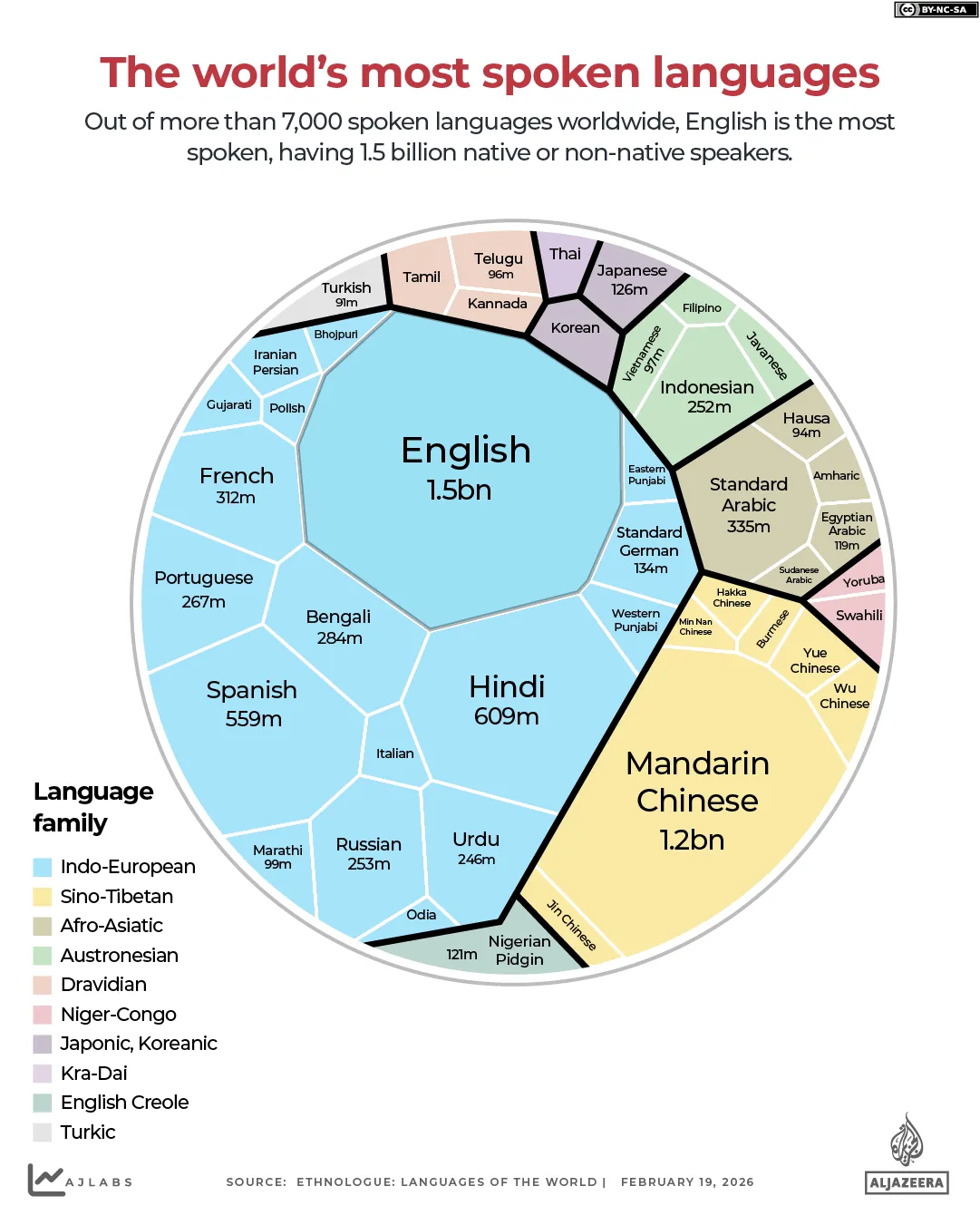
More than 7,000 languages are spoken around the world today and at least 3,000 of them, or 40 percent, are endangered.

English is the most widely spoken language, with approximately 1.5 billion speakers in 186 countries. Two out of every 10 English speakers are native, while the remaining 80 percent speak English as their second, third or higher language, according to Ethnologue, a database which catalogues the world’s languages.

Mandarin Chinese is the second most spoken language with almost 1.2 billion speakers. However, when accounting for native speakers, it is the largest language in the world, owing to China’s large population.

Hindi comes in third at 609 million speakers, followed by Spanish (559 million), and Standard Arabic (335 million).

INTERACTIVE - The world’s most spoken languages - Feb 18, 2026-1771502232

There are 293 known scripts – sets of graphic characters used to write a language – according to The World’s Writing Systems, a reference book about global scripts.

More than 156 scripts are still in use today, while more than 137 historical scripts, including Egyptian Hieroglyphs and Aztec pictograms, are no longer in use.

The Latin script, which is used to write English, French, Spanish, German and more, is used in at least 305 of the world’s 7,139 known living human languages. More than 70 percent of the world’s population use it.

INTERACTIVE - The world’s most common scripts - fEB 18, 2026-1771502264

Which are the most endangered languages?

Of the 7,159 languages spoken worldwide, 3,193 (44 percent) are endangered, 3,479 (49 percent) are stable, and 487 (7 percent) are institutional, meaning they are used by governments, schools and the media.

A language becomes endangered when its users begin to pass on a more dominant language to the children in the community. Many are used as second languages.

According to Ethnologue, some 337 languages are said to be dormant while 454 are extinct.

Dormant languages are those that no longer have proficient speakers, but the language still has social uses and the language is part of the identity of an ethnic community. Extinct languages are those that have no speakers and no social uses or groups that claim it as part of their heritage or identity.

According to Ethnologue, 88.1 million people speak an endangered language as their mother tongue. There are:

  • 1,431 languages with fewer than 1,000 first-language speakers
  • 463 with fewer than 100 speakers
  • 110 with fewer than 10 speakers

INTERACTIVE - The world’s most endangered languages-1771512469

Just 25 countries are home to some 80 percent of the world’s endangered languages. Oceania has the most endangered languages, followed by Asia, Africa and the Americas.

Some endangered languages include:

Oceania 

In Australia, Yugambeh, an endangered Aboriginal language, is spoken by the Yugambeh people, primarily across the Gold Coast, Scenic Rim and Logan in eastern Australia.

In recent years, a strong community-led revitalisation programme and the use of learning apps have made the language more accessible to younger generations.

Asia 

Japan’s Ainu (Ainu Itak) is a critically endangered language. According to UNESCO, it can’t be linked with certainty to any family of languages. The exact number of Ainu speakers is unknown, however a 2006 survey showed that out of 23,782 Ainu, 304 know the language.

Africa

In Ethiopia, Ongota is a critically endangered language.

It was spoken by a community on the west bank of the Weito River in southwest Ethiopia. There are only about 400 members of the community left, with a handful of elders speaking the language.

Americas

In North and Central America, almost all Indigenous languages are endangered. Louisiana Creole, a French-based creole with African and Indigenous influences, is a seriously endangered language in the United States, with it mostly spoken by elders.

Leco is an endangered Indigenous language spoken in Bolivia and is considered an isolated language – one that has no genetic relationship to other languages. The language is only now spoken by elders with a Leco ethnic population of only about 13,500.

Europe

Cornish (Kernewek), spoken in southwest England, was marked as an extinct language by UNESCO, until it was revived and in 2010 changed to an endangered language. It is spoken as a first language by 563 people according to the 2021 England and Wales census.

Source link

Visualising AI spending: How does it compare with history’s mega projects? | Technology News

Spending on AI is forecast to skyrocket to $2.5 trillion in 2026, dwarfing even the largest scientific and infrastructure projects.

World leaders and tech executives are convening in New Delhi for the India-AI Impact Summit 2026, focusing on the role of artificial intelligence in governance, job disruption and global collaboration.

However, behind these discussions lies the financial reality. Over the past decade, AI has drawn one of the largest waves of private investment in modern history, totalling trillions of dollars.

According to Gartner, a United States-based business and technology insights company, worldwide spending on AI is forecast to total $2.5 trillion in 2026, a 44 percent increase over 2025.

To understand the magnitude of these investments, Al Jazeera visualises the staggering amounts by comparing them with some of the largest projects ever created by humanity. We also highlight which countries are spending the most on AI and provide insights into expenditures on data centres, models, services, and security.

What does $1bn look like?

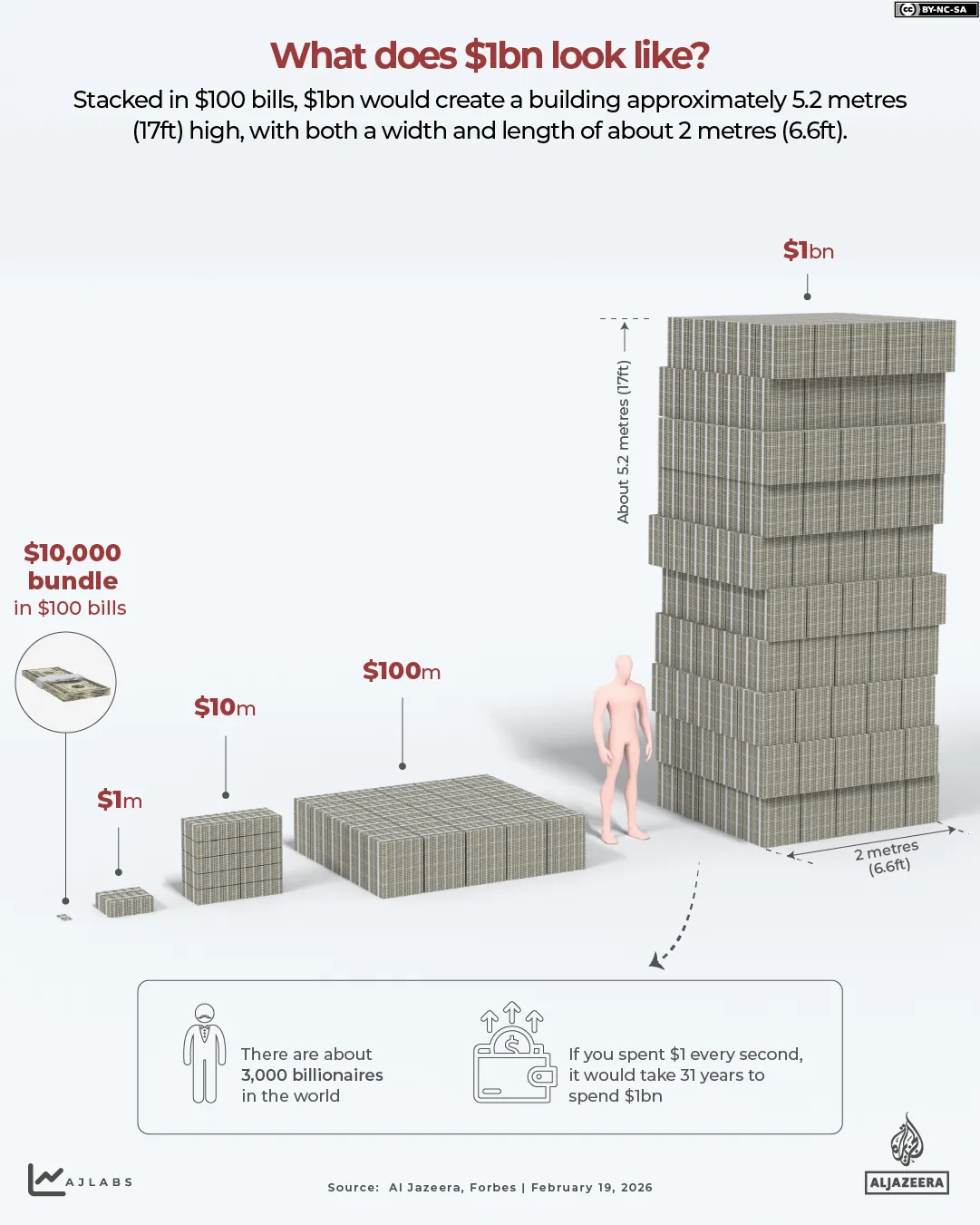
To help understand a trillion dollars, it is useful to first visualise what millions and billions of dollars look like by using a stack of US dollar bills.

If you break these amounts down using $100 bills, here is how they stack up:

  • $1,000 would form a stack about 1cm (0.393-inch) high.
  • $10,000 would form a stack approximately 10cm (3.93-inch) high.
  • $1m would fit inside a briefcase.
  • $10m would fit inside a very large suitcase.
  • $100m would fit on an industrial pallet stacked waist-high.
  • $1bn would create a building approximately 5.2 metres (17 feet) high, with a width and a length of about 2 metres (6.6 feet) each.

INTERACTIVE-What does $1bn look like-1771490010

Another way to think of it is if you spent $1 every second, it would take:

  • 11.5 days to spend $1m
  • 31 years to spend $1bn
  • 31,000 years to spend $1 trillion

In more tangible terms, $1bn is roughly equivalent to:

  • The estimated cost of the Grand Egyptian Museum in Giza, one of the largest archaeological museums in the world
  • The cost of constructing two to three modern football stadiums, depending on size and design
  • Buying 10 luxury private jets (at $100m each)
  • Buying 6.3 tonnes of gold (at $5,000 per ounce)
  • Buying 1 million high-end iPhones at retail price

$1.6 trillion already spent on AI

Over the past decade, AI-related investments have surged nearly 13-fold.

According to the 2025 AI Index Report by Stanford University, between 2013 and 2024, total global corporate investment in AI reached $1.6 trillion. This substantial expenditure dwarfs even the largest scientific and infrastructure projects of the 20th and 21st centuries.

To put the scale of AI investment into perspective, consider how it compares with some of the most ambitious and expensive projects in modern history. All figures are adjusted to 2024 US dollars:

  • The Manhattan Project (1942-46): $36bn
  • The International Space Station (1984-2011): $150bn
  • The Apollo Program (1960-73): $250bn
  • The US Interstate Highway System (1956-92): $620bn

INTERACTIVE-AI investment dwarfs world's mega projects-1771490007

In just over a decade, investment in AI has surpassed the cost of developing the first atomic bomb, landing humans on the moon and the decades-long effort to build the 75,440km (46,876-mile) US interstate highway network.

Unlike these landmark projects, AI funding has not been driven by a single government or wartime urgency. It has flowed through private markets, venture capital, corporate research and development, and global investors, making it one of the largest privately financed technological waves in history.

Global corporate investments in AI cover a vast array of operations, including mergers and acquisitions, minority stakes, private investments, and public offerings. These monumental expenditures highlight the extensive financial commitment to advance AI.

Which countries are spending the most on AI?

The AI investment surge is concentrated in just a few countries, where private capital has fuelled thousands of startups and shaped global innovation hubs.

The US has dominated AI spending, accounting for roughly 62 percent of total private AI funding since 2013. Between 2013 and 2024, US companies spent $471bn on AI. Chinese companies are the second-largest spenders at $119bn, followed by the United Kingdom at $28bn.

These figures exclude government spending, such as the US CHIPS Act or European national AI subsidies.

Global private investment in AI by country, 2013-24:

  • US: $471bn, supporting 6,956 newly funded AI companies
  • China: $119bn, 1,605 startups
  • UK: $28bn, 885 startups
  • Canada: $15bn, 481 startups
  • Israel: $15bn, 492 startups
  • Germany: $13bn, 394 startups
  • India: $11bn, 434 startups
  • France: $11bn, 468 startups
  • South Korea: $9bn, 270 startups
  • Singapore: $7bn, 239 startups
  • Others: $58bn

INTERACTIVE-Which countries are spending the most on AI-1771490012

AI spending to total $2.5 trillion in 2026

AI spending is forecast to skyrocket to $2.5 trillion in 2026, driven by a massive global build-out of data centres and services, according to Gartner.

The bulk of the spending is expected to go towards:

  • AI infrastructure: $1.37 trillion
  • AI services: $589bn
  • AI software: $452bn
  • AI cybersecurity: $51bn
  • AI platforms for data science and machine learning: $31bn
  • AI models: $26bn
  • AI application development platforms: $8.4bn
  • AI data: $3bn

By 2027, Gartner is forecasting that AI spending will surpass $3.3 trillion.

INTERACTIVE-AI forecast to total $2.52 trillion in 2026-1771490006

Source link

Ramadan Mubarak 2026: Hear greetings in different languages | Interactive News

Here is how to wish someone during the holy month of Ramadan in different languages around the world.

Following the sighting of the crescent by the moon-sighting committee on Tuesday, Saudi Arabia has announced that the first day of fasting will be Wednesday, February 18.

There are nearly two billion Muslims globally, accounting for almost one-fourth of the world’s population. Indonesia has the largest Muslim population, approximately 242 million, followed by Pakistan (230 million), India (210 million), Bangladesh (160 million), and Nigeria (120 million).

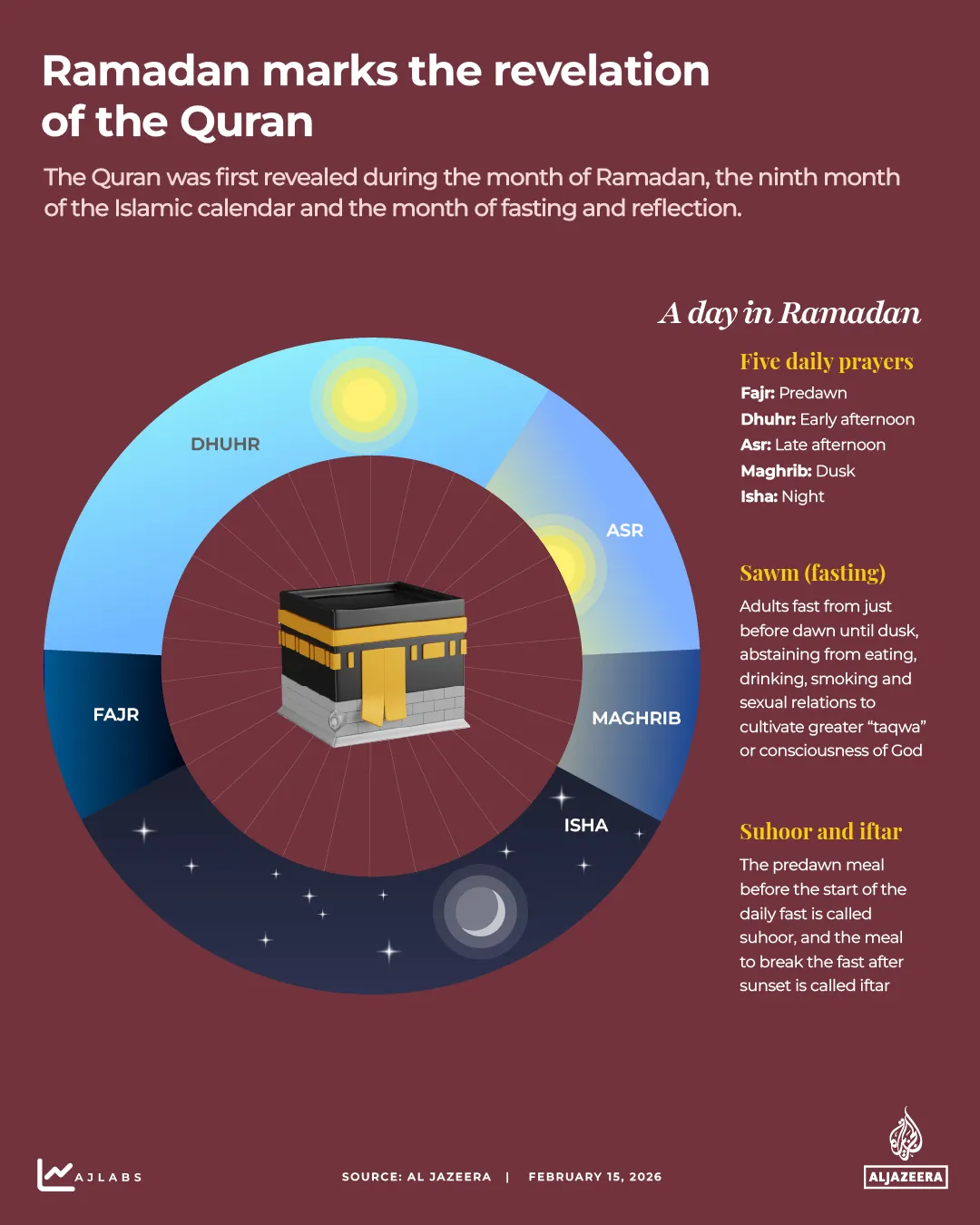
As the holy month begins, many Muslims have been preparing for a period of fasting, reflection, and community. Those observing the fast start their day with a predawn meal, suhoor, and break their fast at sunset with iftar.

Why is Ramadan holy?

Muslims believe that Ramadan is the month when the first verses of the Quran were revealed to the Prophet Muhammad more than 1,400 years ago.

Fasting is one of the five pillars of Islam, along with the Muslim declaration of faith, daily prayers, charity, and performing the Hajj pilgrimage to Mecca if physically and financially capable.

Interactive_Ramadan_2026_Quran_Revealed

Ramadan sayings in different languages

The month begins with the sighting of the new moon, often accompanied by an outpouring of greetings to mark the occasion. Many Muslim-majority countries have their own traditional greetings in their native languages.

Among the most common sayings are “Ramadan Mubarak” and “Ramadan Kareem”. These are Arabic sayings that translate to “blessed Ramadan” and “generous Ramadan”, respectively.

Greetings are not limited to the spoken language. They also extend to sign language and Braille. Some countries have their version of sign language, but placing one hand horizontally across the mouth is common among most to represent fasting.

Below is a collection of Ramadan greeting cards that you can download and share.

Interactive_Arabic-1771254998
(Al Jazeera)
Interactive_Assamese-1771255034
(Al Jazeera)
Interactive_Bengali-1771255067
(Al Jazeera)
Interactive_Bosnian-1771255098
(Al Jazeera)

Interactive_Bahasa-1771306094

Interactive_Dhivehi-1771255183
(Al Jazeera)
Interactive_English-1771255215
(Al Jazeera)
Interactive_French-1771255251
(Al Jazeera)
Interactive_Hindi-1771255287
(Al Jazeera)
Interactive_italian-1771255316
(Al Jazeera)

Interactive_Malay-1771306127

Interactive_Mandarin-1771255395
(Al Jazeera)
Interactive_Nepali-1771255426
(Al Jazeera)
Interactive_Pashto-1771255452
(Al Jazeera)
Interactive_Persian-1771255498
(Al Jazeera)
Interactive_Somali-1771255524
(Al Jazeera)

Interactive_Spanish-1771306172

Interactive_Turkish-1771255580
(Al Jazeera)
Interactive_Uzbek-1771255605
(Al Jazeera)
Interactive_Urdu-1771255637
(Al Jazeera)
Interactive_Sign Language-1771255676
(Al Jazeera)
Interactive_Braille-1771255710
(Al Jazeera)

Source link