innings

Guardians rally in ninth to sweep Angels

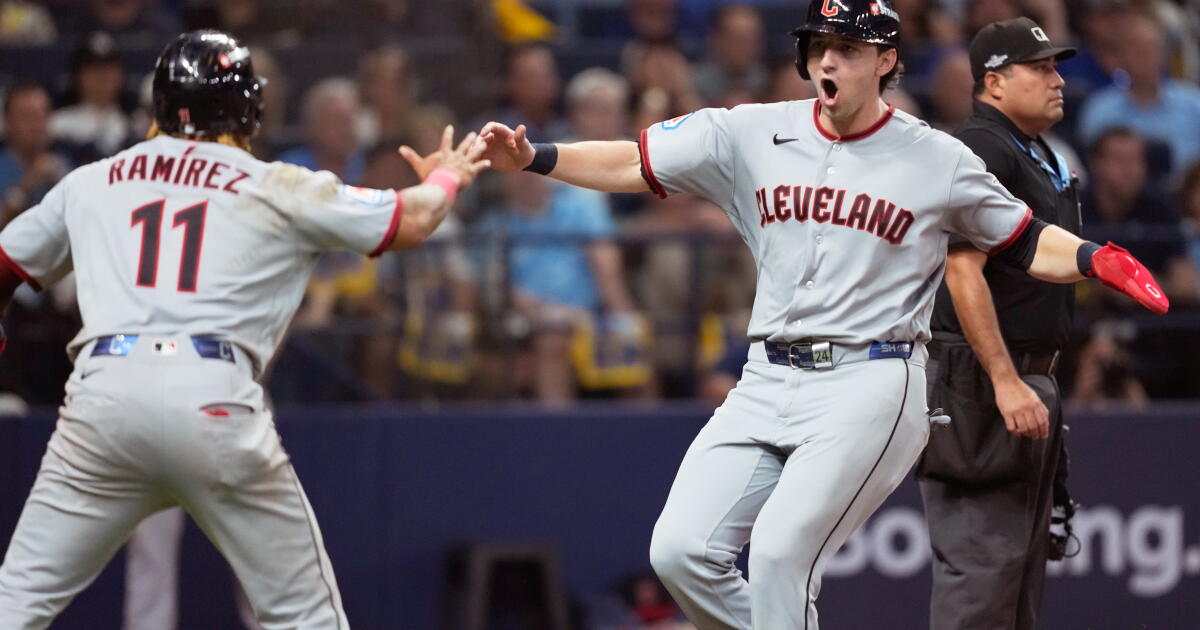
Steven Kwan hit a tying double in the ninth inning, Travis Bazzana followed with a sacrifice fly and the Cleveland Guardians rallied past the Angels 4-3 on Wednesday for their seventh straight victory.

Hunter Gaddis (2-3) retired the final two batters in the eighth to earn the win. Erik Sabrowski worked a scoreless ninth for his second major league save and first since 2024.

With a runner on second, Sabrowski struck out pinch-hitter Travis d’Arnaud and got pinch-hitter Oswald Peraza to pop up to second as Cleveland completed a three-game sweep.

Chase DeLauter, slowed this week by left hamstring tightness, sparked the winning rally with a one-out single off reliever Ryan Watson (1-1) in the ninth.

Petey Halpin ran for DeLauter and went to second on Brayan Rocchio’s single. Kwan roped a ground-rule double to right field for a 3-all tie, and Bazzana’s sacrifice fly sent the Angels to their 10th loss this season when leading after eight innings.

Angels starter Grayson Rodriguez gave up one run and seven hits in 5 2/3 innings, striking out four and walking one. Guardians starter Joey Cantillo gave up two hits in six innings but issued a career-high seven walks and committed a first-inning error that led to a run.

Zach Neto led off the bottom of the first with a single and scored when Cantillo fielded Vaughn Grissom’s one-out dribbler and threw the ball into right field.

The Angels extended the lead to 3-0 in the second when Cantillo walked the bases loaded with one out, hit Neto with a pitch to force in a run, and Mike Trout added a sacrifice fly.

Cleveland cut it to 3-1 in the fifth when Rocchio doubled, went to third on Kwan’s groundout and scored on Bazzana’s sacrifice fly. The Guardians pulled to 3-2 in the eighth when Bazzana bunted for a single, Jo Adell walked and Nathaniel Lowe flared an RBI single to left-center.

Source link

Jo Adell delivers against his former team in Angels’ loss

Parker Messick pitched six innings of one-run ball and Austin Hedges hit a two-run homer in the Cleveland Guardians’ 4-2 victory over the Angels on Monday night.

Jo Adell hit a go-ahead single for the Guardians against his former team. Messick (10-8) gave up three hits, struck out four and walked one while extending to nine his string of consecutive starts with two or fewer runs allowed.

Through 26 starts, the rookie left-hander has a 2.50 ERA with 156 strikeouts in 155 innings.

Colin Holderman struck out three of four batters in the seventh. Hunter Gaddis tossed a scoreless eighth and Cade Smith gave up a run in the ninth before earning his 34th save.

Cleveland (66-66) won its fifth straight and pulled within 2½ games of the first-place Chicago White Sox in the AL Central.

Angels rookie George Klassen (2-2) gave up three runs — two earned — and six hits in 5⅓ innings.

Adell, acquired from the Angels on Aug. 3, snapped a 1-1 tie with a two-out single in the fifth — his 13th RBI in six games. Hedges made it 4-1 with a two-out homer off reliever Blake Weiman in the sixth.

The Angels (52-80) pulled to 4-2 on Gustavo Campero’s sacrifice fly in the ninth, but Christian Moore flied out to the left-center warning track with a runner on for the final out.

Messick retired his first nine batters before Zach Neto and Mike Trout opened the fourth with singles. Neto went to third on Trout’s hit, and Trout took second on the throw.

Trout was caught off the bag on Vaughn Grissom’s hard grounder to second but stayed in a rundown long enough for Grissom to reach second.

Moisés Ballesteros dunked an RBI single into center for a 1-1 tie, advancing Grissom to third. Messick escaped further damage by striking out Jose Siri and getting Campero to pop out.

Cleveland took a 1-0 lead in the third when Steven Kwan and José Ramírez singled, Adell walked and Nathaniel Lowe hit a sacrifice fly.

Up next: Guardians RHP Gavin Williams (12-7, 3.72 ERA) will oppose Angels RHP Walbert Ureña on Tuesday night.

Source link

Once booed in L.A., Alek Thomas delivers for Dodgers in win

Alek Thomas is used to playing center field at Dodger Stadium.

Over parts of five seasons with the Arizona Diamondbacks, the 26-year-old grew accustomed to being booed in L.A., all while watching baseball’s latest dynasty take shape.

“It’s funny, because they always hated me whenever I came out there in center field,” Thomas said before Saturday’s 4-3 win over the Pittsburgh Pirates. “I was, like, ‘Come on, guys, I’m Mexican too. You don’t have to yell at me; like, we’re on the same side here.’

“But, obviously … it doesn’t matter where you’re from. ‘If you’re not a Dodgers guy, you’re not my guy.’”

Thomas, whom Arizona designated for assignment 28 games into the season before trading him to the Dodgers in May, is, well, a Dodgers guy now.

He was called up from triple-A Oklahoma City on Saturday after center fielder Andy Pages sustained a hand fracture after being hit by a pitch Friday.

“Great buy-in [and] great teammate,” Dodgers manager Dave Roberts said of Thomas before the game. “Really good defender. Had a good chat with him earlier. … he’s happy to be back in the big leagues.”

One could imagine how nice it felt for Thomas to hit an RBI single in the fourth inning, in his first game with the Dodgers and the team’s 12th sellout of the season.

“It’s been a little while,” said Thomas, who has spent 55 games in Oklahoma City this year. “So, I’m super glad to be back, and happy to help the team in any way, shape or form.”

Thomas looked solid in his primary role as a defender.

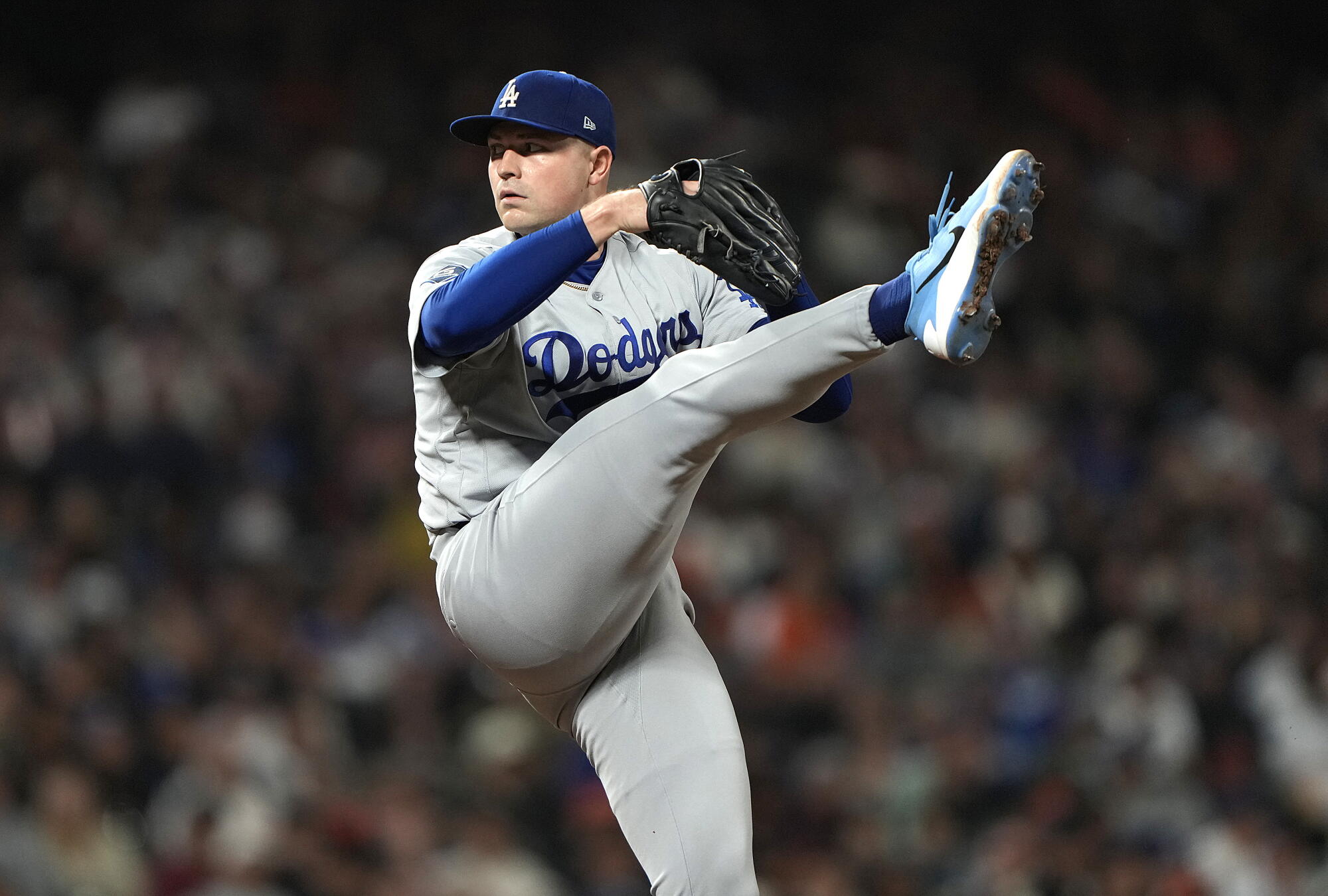
Dodgers pitcher Tarik Skubal delivers against the Pirates at Dodger Stadium on Saturday.

Dodgers pitcher Tarik Skubal delivers against the Pirates at Dodger Stadium on Saturday.

(Gina Ferazzi / Los Angeles Times)

He also showed some hustle, turning a should-be groundout into a two-bagger in the eighth after an error by Pirates first baseman Rafael Flores Jr.

“Andy’s a great player, and speedy recovery for him,” Thomas said. “But I’m gonna try and play my brand of baseball; that’s why the Dodgers got me. So, yeah, I’m just gonna go out there and be myself.”

Tarik Skubal and the Dodgers were themselves, too, after a rough start.

The left-hander gave up three runs and three hits in the first. But Skubal recovered to earn his first win with the Dodgers (79-51), giving up five hits and striking out 11 over seven innings to earn a standing ovation upon his exit.

Teoscar Hernández, who entered with two RBIs over his past 16 games, put the Dodgers on the board with a run-scoring single in the fourth. Six pitches later, Thomas earned his RBI, shrinking the Pirates’ lead to 3-2.

Starter Jared Jones, a Whittier native, lasted four innings for the Pirates (63-68). He gave up two runs on three hits with five strikeouts. Pirates reliever Yohan Ramirez struggled in his place.

Kyle Tucker ended his 0-for-26 drought at home with a go-ahead, two-run single off Ramirez in the fifth.

Relievers Evan Phillips, Jack Dreyer and Tanner Scott combined for two shutout innings. Dreyer struck out Oneil Cruz looking to end the top of the eighth with a runner on third, fighting off the Pirates’ final gasp.

The Dodgers have now taken the three-game series against Pittsburgh and are victors of five straight games for the first time since late May.

Source link

Rookie George Klassen pitches seven strong innings to lead Angels over Astros

Rookie George Klassen gave up one hit in a career-high seven scoreless innings and Josh Lowe homered to lead the Angels to a 3-1 win over the Houston Astros on Tuesday night.

Klassen (2-1), who was making his fifth career start, also set a career mark by striking out seven. He gave up only a first inning single to Jose Altuve.

Cam Smith hit a solo homer off José Fermin with no outs in the eighth to cut the lead to 3-1. But Ben Joyce pitched a scoreless ninth to get his third save and send the AL West leaders to their third straight loss.

Houston starter Cristian Javier (1-4) gave up five hits and two runs in four innings.

The Angels scored all three of their runs with two out for their second win in three games.

The Angels had runners on first and second with two outs in the third when an RBI single by Nolan Schanuel made it 1-0.

Lowe extended the lead to 2-0 with his shot to the seats in left field with two out in the fourth.

The Angels got things going again with two out in the fifth when Schanuel singled to right field. Zach Neto followed with an RBI double that left them up 3-0.

Isaac Paredes walked with two out in the first before Altuve’s single, but Klassen struck out Daulton Varsho to end the inning. The Astros didn’t have another baserunner until Paredes walked to start the fourth. Klassen walked Altuve with none out in the seventh, but retired the next three batters, with two strikeouts, to end his night.

Source link

Tommy John dead: Dodgers pitcher and medical pioneer dies

It’s right there in the medical books, along with Belsey fundoplication, Heineke-Mikulicz pyloroplasty and Keller’s excision arthroplasty: Tommy John surgery.

Purists might refer to it as ulnar collateral ligament reconstruction, but the rest of the world knows it as the career-saving surgery named for a sore-armed left-handed Dodgers pitcher.

Tommy John was facing the bleak reality that his career was likely over when he ruptured a ligament in his left elbow on a summer night in 1974, an injury that had sent so many pitchers into an early retirement. But a then-radical surgery not only saved but revived his career, as well as the careers of hundreds of baseball players ranging from Tom Candiotti to John Smoltz to Shohei Ohtani in the 50 years since.

Always more famous for the surgical procedure than his career stats, John died Saturday, the Dodgers announced. He was 83.

“We are saddened to hear the news of Tommy John’s passing,” Dodgers president and CEO Stan Kasten said in a statement. “… Tommy was an exceptional pitcher throughout his career in Major League Baseball and his courageous role in becoming the first to have surgery that would go on to bear his name can’t be overstated. His impact both on and off the field has been felt by ballplayers of all ages and will be for generations to come.”

A good pitcher before the surgery with 124 wins in 12 seasons with three teams, he won 164 more afterward — only one fewer than Sandy Koufax during his entire career, he liked to point out — in 14 more seasons with four teams, finally retiring at 46 with a 288-231 record and a 3.34 earned-run average.

“Dr. Jobe made it so I could throw a baseball again,” John told The Times’ Sam Farmer in 2023 from his home in Sarasota, Fla. “After surgery, I never missed a start, and I even pitched out of the bullpen every once in a while.”

He pitched for the Dodgers and the Angels and had two successful stints with the New York Yankees but it was with the Dodgers that he had his greatest success, an 87-42 record and a 2.97 ERA, helping them to consecutive World Series appearances.

It was also as a Dodger that he had his history-making operation.

He came to the Dodgers in a trade from the Chicago White Sox in December 1971 with an 84-91 record, a good curveball and a less than intimidating fastball. Pitching coach Red Adams convinced him that precision location and ball movement were more effective than raw speed and John went 11-5 the following season. He also became well acquainted with orthopedist Frank Jobe, the team physician.

Late in the season, he jammed his left elbow sliding into home plate, jarring loose some bone chips. Jobe cleaned things up for John during the offseason.

Dodgers manager Tommy Lasorda congratulates Tommy John after John shut out the Phillies during 1978 NLCS.

Dodgers manager Tommy Lasorda congratulates Tommy John after John shut out the Phillies during 1978 National League Championship Series.

(Associated Press)

Then in July 1974, by which time John had become a mainstay in the pitching rotation, he threw a pitch to Hal Breeden of the Montreal Expos that changed his life, and ultimately the lives of many others.

“Right at the point where I put force on the pitch, the point where my arm is back and bent, something happened,” he told Sports Illustrated. “It felt as if I had left my arm somewhere else. It was as if my body continued to go forward and my left arm had just flown out to right field, independent of the rest of me.

“I heard this thudding sound in my elbow, then I felt a sharp pain.”

John had ruptured the medial ulnar collateral ligament in his left elbow, although he didn’t know that then. The pitch, of course, was nowhere near the strike zone and, despite the pain and in an effort to see if that was a fluke, he tried to throw another. It bounced off the plate, ending his outing and, for all anyone knew, his pitching career.

Jobe recommended total rest but after a month, with no sign of healing, he came up with an outside-the-box suggestion. Earlier, Jobe had grafted a tendon to a recovered polio patient’s ankle to provide stabilization. He thought maybe a tendon could be grafted to a pitcher’s elbow as well.

He gave John a grim choice: Do nothing and never pitch again, or try the surgery at 100-1 odds against success.

“I told Dr. [Frank] Jobe if you do your job I will do more than mine,” John told The Times last year. I just happened to be in the right place at the right time with the right doctor and team.”

So, on Sept. 25, 1974, Jobe took a tendon from John’s right arm, threaded it through holes he had drilled in John’s left elbow and hoped it all would work.

Nerve damage necessitated a second surgery several months later and the prospects were not promising. John’s left arm had atrophied, his hand now basically a claw, and two of his fingers were numb.

Even so, he began rehab, knowing he would miss the entire 1975 season. He taped the unfeeling fingers to the functioning ones so that he could grip a baseball, then, resembling “a little boy throwing against the steps of his back porch,” threw against a wall. He squeezed Silly Putty and strictly adhered to a physical therapy regimen.

By June 1975 he had regained the use of his entire hand and in late September pitched three innings in an exhibition game. He continued his routine through the offseason and into spring training, once joking, “When they operated on my arm, I asked them to put in a Koufax fastball. They did but it turned out to be Mrs. Koufax.”

Surprising many, who considered it at least a minor miracle, he was back in the rotation at the start of the 1976 season and went five innings in his first start, giving up five hits and three runs in a loss to the Braves in Atlanta. He finished the season at 10-10 with a 3.09 ERA, and if anyone was still wondering about his comeback, he put doubts to rest in 1977.

In one of his best seasons, he won 20 games, had a 2.78 ERA and finished second in National League Cy Young award voting for the pennant-winning Dodgers. In a 4-1 win over the Philadelphia Phillies in the clinching Game 4 of the NL Championship Series — then a best-of-five format — John pitched a complete game, striking out eight in a 130-pitch effort.

Dodgers pitcher Tommy John celebrates after the final out in a 4-1 victory over the Phillies in Game 4 of the 1977 NLCS.

Dodgers pitcher Tommy John celebrates after the final out in a 4-1 victory over the Phillies in Game 4 of the 1977 NLCS that clinched the pennant for the Dodgers.

(Associated Press)

He came back with a 17-victory season in ’78 and the Dodgers won the pennant again but again lost to the Yankees in the World Series, with John winning a game in both the NLCS and World Series. After the season, he signed with New York as a free agent.

He was an immediate hit with the Yankees, winning 21 games in 1979 and finishing second in the American League Cy Young voting, then won 22 in ’80. In 1981, the Yankees reached the World Series, once again facing the Dodgers — and John was at the center of the most controversial decision in the series that ultimately sealed New York’s fate.

John was the starter in Game 6 at Yankee Stadium with the Dodgers leading the series, 3-2. The left-hander had won Game 2, giving up three hits over seven innings in a 3-0 victory, and had completed four innings of one-run ball when Yankees manager Bob Lemon elected to pinch-hit for John with two runners on in a 1-1 game. ABC, which broadcast the World Series that year, showed John looking visibly upset and surprised as he paced the dugout.

Bobby Murcer flied out to right to end the inning, and the Dodgers would score eight runs over the next four innings against an ineffective Yankees bullpen to secure a 9-2 victory and win the franchise’s first World Series since 1965.

“At the time my reaction was, ‘why is he doing this?’ I was pitching fine and you don’t pull someone out in the fourth inning just because you need a hit at the time,” John said last year. “I was not happy, but that was so long ago in retrospect could we have won? I think so. Does it matter now? No.”

In John’s two stints with the Yankees — he had four seasons with the Angels in between — he was 91-60 with a 3.59 ERA.

And it was with the Yankees that he made the record book, in a way no player would ever want. He committed three errors in an inning, all on the same play during a game July 27, 1988.

With the Yankees leading the Milwaukee Brewers 4-0 and Jim Gantner on first for the Brewers, John charged a slow roller by Jeffrey Leonard to the first-base side of the mound. First, he bobbled the ball. Then, he sailed it past first baseman Don Mattingly, bouncing it off the right-field ballboy. Dave Winfield made a nice play on the ball and fired a strong throw home. It was on line and probably would have nailed the hustling Gantner but John cut it off, then threw wildly past catcher Don Slaught and into the Brewers’ dugout as Gantner scored.

John’s summation, according to Newsday? “I must have had a metal cup on. It glitched the ions in the air.”

After his playing days, John did some broadcasting, some minor league managing and became a strong advocate for suicide prevention after one of his sons took his own life. And after seeing many young pitchers, some still in their teens, undergo the surgery named for him, he spoke out against arm overuse, recommending less than year-round pitching by young arms.

But regardless of the context, John is forever linked to the operation that continues to be performed by orthopedic surgeons such as Dr. Neal ElAttrache, who began learning how to perform the procedure when he was a fellow at the Kerlan-Jobe Orthopedic Clinic in 1990 from Jobe himself. The two would operate together twice a week throughout the 1990s and were close friends until Jobe’s death in 2014.

“It should have been called the Frank Jobe operation,” ElAttrache told The Times in 2023. “But with Frank being the man he was, it was all about the person he was treating. It wasn’t about him.”

By ElAttrache’s estimation, he has performed the operation between 50 and 75 times per year over his career — including the two he has done on Ohtani, one in 2018 and one in 2023. And although ElAttrache has put his own signatures on the surgery — including a second graft to further fortify Ohtani’s elbow — the operation has remained largely the same since Jobe first performed it in 1974.

John is survived by his wife, Cheryl, and his children, Tommy, Travis and Tamara. A private celebration of his life will be held in Florida.

Source link

For Dodgers’ Charley Steiner, a complete game 3 years in the making

The radio broadcasters reminded listeners of the final score, invited them to tune in again the next day, and signed off. The Dodgers had lost Saturday, so the sounds of “California Stars” wafted through Dodger Stadium.

“Well,” Charley Steiner said to his colleagues in the broadcast booth, “they’re still playing this song.”

The little things can be the ones we remember the most. On Saturday, for the first time in three years, Steiner called all nine innings of a Dodgers game.

In 2024, he beat cancer into remission. The first sign was back pain. He later suffered three back fractures, and to this day the pain is still there.

“It’s gone from intolerable to tolerable,” Steiner said.

He left Dodger Stadium in a wheelchair Saturday. He can walk, but the trek from the broadcast booth to the parking lot is too much, at least for now.

Yet he was in the booth, and on the air for nine innings, so Saturday was a very good day indeed.

Steiner returned for opening day in 2025, but he wore down and left midway through the game. He has called a few games this season, for a few innings each time, building up his workload as if he were a pitcher in spring training.

On Thursday, after Steiner called six innings, he said he would like to try seven the next time. Duane McDonald, the Dodgers’ radio producer, encouraged him to try the full nine.

And so Steiner did, his voice sounding raspy and rusty in the early innings but getting stronger with each successive inning.

He called the statistics put up by Milwaukee Brewers prodigy Jacob Misiorowski “Koufaxian numbers.” He translated an infield single with an exit velocity of 37 mph into everyday language: “That’s driving in the school zone.”

And, on an afternoon Dodgers starter Justin Wrobleski gave up two home runs — that’s 11 homers surrendered in his last 19⅔ innings — Steiner did not miss a beat when reading an advertisement: “Toyota dealers: they make it easy. Wrobleski makes it hard.”

The Dodgers have consistently and graciously told Steiner to take all the time he needed to get better, but recovery is slow, uneven and ongoing.

“Who would have ever thought that sitting could be painful?” Steiner said.

“I get home after a game, and I’m sitting with three ice packs on my back. It’s like I’ve completed playing.”

In the broadcast booth, he sometimes alternates between standing and sitting, or puts his feet up on a table, anything to avoid sitting for hours on end.

The happiest person next to Steiner on Saturday was the one who has been next to Steiner for two decades in the booth: Rick Monday, who checked on Steiner almost every day the past three years and who teased him unmercifully on Saturday, at times using words best left out of a family newspaper.

“You can’t invent chemistry,” Steiner said.

You also can’t invent what is now a lifelong bond.

“I had fun watching him, because I know he has gone through hell,” Monday said. “His world shrunk. We’re used to 50,000 people and you saw, what, one or two a day?”

Steiner nodded.

“Housebound,” Monday said.

“The last three years have been P.T. [physical therapy],” Steiner said. “Every day. Social life? Scratch that.

“If I want to go out to eat, it’s not necessarily where, but what’s the seating like? I can’t sit in a wooden chair.”

It’s too uncomfortable, he said, without cushion or support for his back.

Steiner is 77. He does not have to endure discomfort in the booth. He does not have to be here.

Or, perhaps, he does.

“It’s just nice being back at the park,” he said.

“It’s home.”

He is still building back his strength, no pun intended. His next goal: call a game on consecutive days, just as a relief pitcher has to prove he can pitch on consecutive days.

“But there ain’t going to be no Timmy Trumpet for me,” Steiner said.

That second consecutive day won’t be Sunday. From his home, he’ll do a segment with Monday for the pregame show.

And when might he be back in the broadcast booth on a regular basis? He had a twinkle in his eye, and seven of the most famous words in Dodgers broadcasting lore at the ready.

“Day to day,” he said, “but aren’t we all?”

Source link

Reid Detmers throws eight innings, strikes out 11 in Angels’ win

Reid Detmers pitched eight scoreless innings, Nolan Schanuel had an RBI single in the eighth and the Angels outlasted the Kansas City Royals 1-0 on Saturday night.

Detmers (4-8) gave up two hits, no walks and struck out 11 for his first win this season at Angel Stadium, breaking an 0-5 spell and a streak of 12 games resulting in a loss or no-decision. Ben Joyce worked a hitless ninth for his second save, as the Angels (49-75) won for the fourth time in five games.

In the eighth inning, Jose Siri came on as pinch-runner after Wade Meckler walked. Siri stole second, and Schanuel brought him home on the go-ahead RBI single. Schanuel had three of the Angels’ six hits, finishing three for three.

Nate Pearson (2-1) gave up the winning run for Kansas City (50-74). Randy Dobnak worked 5⅔ scoreless innings during his start, fanning six and giving up four hits.

Kansas City’s Jac Caglianone extended his hitting streak to 13 games.

Source link

Blake Snell has a stellar start and Dodgers get walk-off win over Royals

Dodgers southpaw Blake Snell called his shot.

It wasn’t quite Babe Ruth pointing from the batter’s box. The moment won’t make its way into any movie. But Snell did tell manager Dave Roberts over text message that he was going to throw six innings in his first start back from the injured list after undergoing surgery to remove loose bodies from his elbow.

Then, en route to a 5-4 walk-off Dodgers victory in 10 innings against the Royals, Snell did just that.

“I knew that’s what the plan was coming in, and I really wanted to execute that plan,” Snell said after limiting the Royals to one run and three hits.

Despite Snell’s resume, the two-time Cy Young winner wasn’t guaranteed a smooth return. It had been three months since he’d last started a major-league game. And it was only his second start of the season, after a late buildup in spring training due to shoulder fatigue, a May season debut against the Braves, and surgery shortly after.

Eventually getting back this version of him, however, was key to the Dodgers’ postseason aspirations.

“I think the biggest thing was just being aggressive,” Snell said. “Be in the zone, attack. I know how good my stuff is, so I didn’t want to just be nibbling and then complaining like, ‘Oh that’s a strike.’ I didn’t want to do any of that again like I did versus Atlanta.”

That was a short and not so sweet season debut. He exited after three innings, having put his team in a five-run (four earned runs) hole.

The difference Tuesday was “stark,” as Roberts put it.

To clear room on the roster to activate Snell, the Dodgers (72-48) optioned left-handed pitcher Charlie Barnes to triple-A and transferred right-handed reliever Blake Treinen (right elbow inflammation) from the 15-day IL to the 60-day. Though he has not yet begun a minor-league rehab assignment, manager Dave Roberts said Treinen has not had a setback.

Snell, who had 10 strikeouts Tuesday, kept the Royals off balance all night leaning on a fastball that had a little extra life to it, a curveball that generated a 63% whiff rate, and a changeup that was especially effective against right-handed hitters.

Max Muncy and teammates celebrate after his walk-off single Tuesday.

Max Muncy and teammates celebrate after his walk-off single Tuesday.

(Eric Thayer / Los Angeles Times)

“I was more calm than I thought I was going to be, so that was good,” Snell said. “But the curveball’s finally coming back to how I remember it being. It was always a pitch that was a wipeout, I could throw it, but now I’m finally releasing it where I need to release it. And I’m kind of releasing everything in the same slot out in front.”

Counterintuitively, Snell pointed to his last rehab start, in high-altitude Salt Lake City, as another factor that helped lock him in for Tuesday. It’s a notoriously difficult place to pitch, with the thin mountain air affecting the way the ball moves.

“To have that start and be that frustrated pitching knowing that I can’t throw anything that I want with any shape,” Snell said, “to be able to come here and just pitch and know I can throw a curveball where I want, whenever I want, and a fastball, that felt way better.

“But Salt Lake was so difficult. Oh my God. If I played in Salt Lake growing up, I don’t know if I’d be here today.”

Roberts set expectations low in his pregame availability, saying the hope was to get Snell through five innings. Snell had other plans.

He struck out the side in the first inning and retired the first 10 hitters he faced.

When he finally gave up back-to-back singles to the Royals’ Bobby Witt Jr. and Jac Caglianone, neither was particularly well struck — a soft line drive and a grounder that found a hole on the right side of the infield.

With runners on the corners and one out, Snell gave up the only run of his start, on a sacrifice fly by Salvador Perez.

The next inning, Snell worked around a leadoff hit — a blooper into shallow right field that speedy Tyler Tolbert stretched into a double — and a stolen base, to strand Tolbert at third.

Back out for the sixth, Snell retired the side in order. He finished his outing by getting Perez to chase a changeup below the zone and pop it up behind second base.

“He was fantastic tonight,” Roberts said. “And you know we pushed him a little bit into the six and through the six, but just because he was so efficient, certainly that extra inning was huge for us.”

It was especially important once the back and forth in late innings pushed the game into extras.

Hard-throwing right-hander Seth Halvorsen tossed a scoreless tenth inning in his Dodgers debut, setting up Max Muncy for a walk-off single in the bottom half of the inning.

“That’s the Snell that we’re used to seeing,” Muncy said. “And hopefully we have him for the next two, three months — for the long run.”

Source link