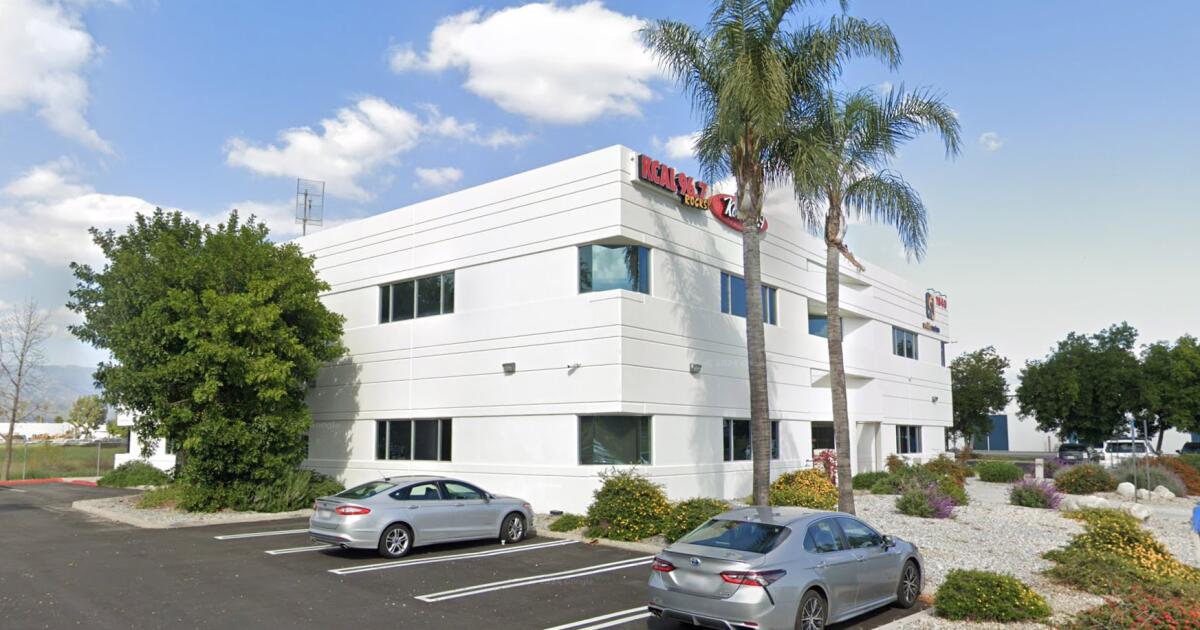
Over the weekend, the Inland Empire radio station, KCAL-FM 96.7, started playing music without any on-air staff.
The Redlands-based radio station laid off all of its radio personalities last week and transitioned into an “All Music, All the Time” classic rock format.
“96.7 KCAL Rocks is turning the page today. Thank you to every listener who made the last chapter what it was,” the station’s staff wrote in a social media post. “Classic rock. Nothing but music. All day across the Inland Empire.”
The station’s veteran radio hosts, part-time and weekend fill-ins, were all cut from the rock station, including Daryl Norsell, who worked at the station for 42 years; Patrick Tish, who said he worked at the station for 15 years and Nikki Preston. John DeSantis, the evening host and program director for the past six years, confirmed the layoffs in a social media post.
“They will be moving to an automated, human-less format. To say this is shocking is an understatement. I have a lot to process, and will be saying more shortly,” DeSantis wrote. “But for right now, I just want to thank all of you for letting me be part of the KCAL family. It has been a radio dream come true. You will always rock.”
The radio station has served the Inland Empire ever since first hitting the airwaves in 1965. KCAL is owned by Anaheim Broadcasting Corporation, which also operates the area’s classic hits radio station, KOLA 99.9FM. Together, the two stations reach over 800,000 weekly listeners in the Riverside-San Bernardino market, according to Anaheim Broadcasting. The company could not be reached directly for a comment on the layoffs.
“We rebuilt KCAL around the music our listeners grew up on, the songs and the artists that made classic rock,” Kelly Sanders, the chief operating officer of Anaheim Broadcasting Corporation, said in a news release to the Southern California News Group “KCAL will deliver a focused, consistent listening experience with broader appeal for both our audience and advertising partners.”
The release also noted that the change “expands the station’s musical focus and will have fewer interruptions and more music throughout the day” and did not address the layoffs, according to a report from the OC Register.
This is the second major blow to the Inland Empire’s broadcast community this summer. In June, the last local on-air hosts at Riverside-based KGGI-FM were laid off, in iHeartMedia’s latest round of national job cuts. In an internal memo, the media giant said the cuts were meant to restructure its radio programming to better “leverage” the company’s technology.
Steve “Razz” Brazill started working at KCAL FM in 1987, as the station’s resident concert photographer and radio personality. In a social media post, he called KCAL his “home” and reminisced about hosting live events at the now-closed Whiskey Creek restaurant in Redlands.
“KCAL has been a part of my identity. And I’m so happy to say I never really had coworkers, I had friends and family, and memories I’ll cherish forever,” wrote Brazill. “Being a part of KCAL ended for all of us today, but those relationships won’t. I’ll miss seeing you all at the studio, but I look forward to seeing you in real life.”
When the gates opened at St. John’s Episcopal Church in San Bernardino on Good Friday, the music coming from inside wasn’t that of angel-faced choristers or pipe organs; it was the collective scream of electric guitars.
As the sky darkened over the white stucco church framed in palm trees and the dry peaks of the San Bernardino Mountains, fringed teenagers made their way inside, shaking their limbs and chattering in excitement. Fluorescent lights shone overhead in a room that, by day, hosted Bible studies and food pantries — that night, it would be the site of Spinkick Dance Hall, a regular underground music series where noses are bound to bleed and limbs to flail along to ear-splitting riffs.
It’s just one of many shows taking place from Pomona to Palm Desert, heralding a Latino-led youth revival where the freewheeling movement of mosh pits meets the raw power of punk rock: Inland Empire hardcore.
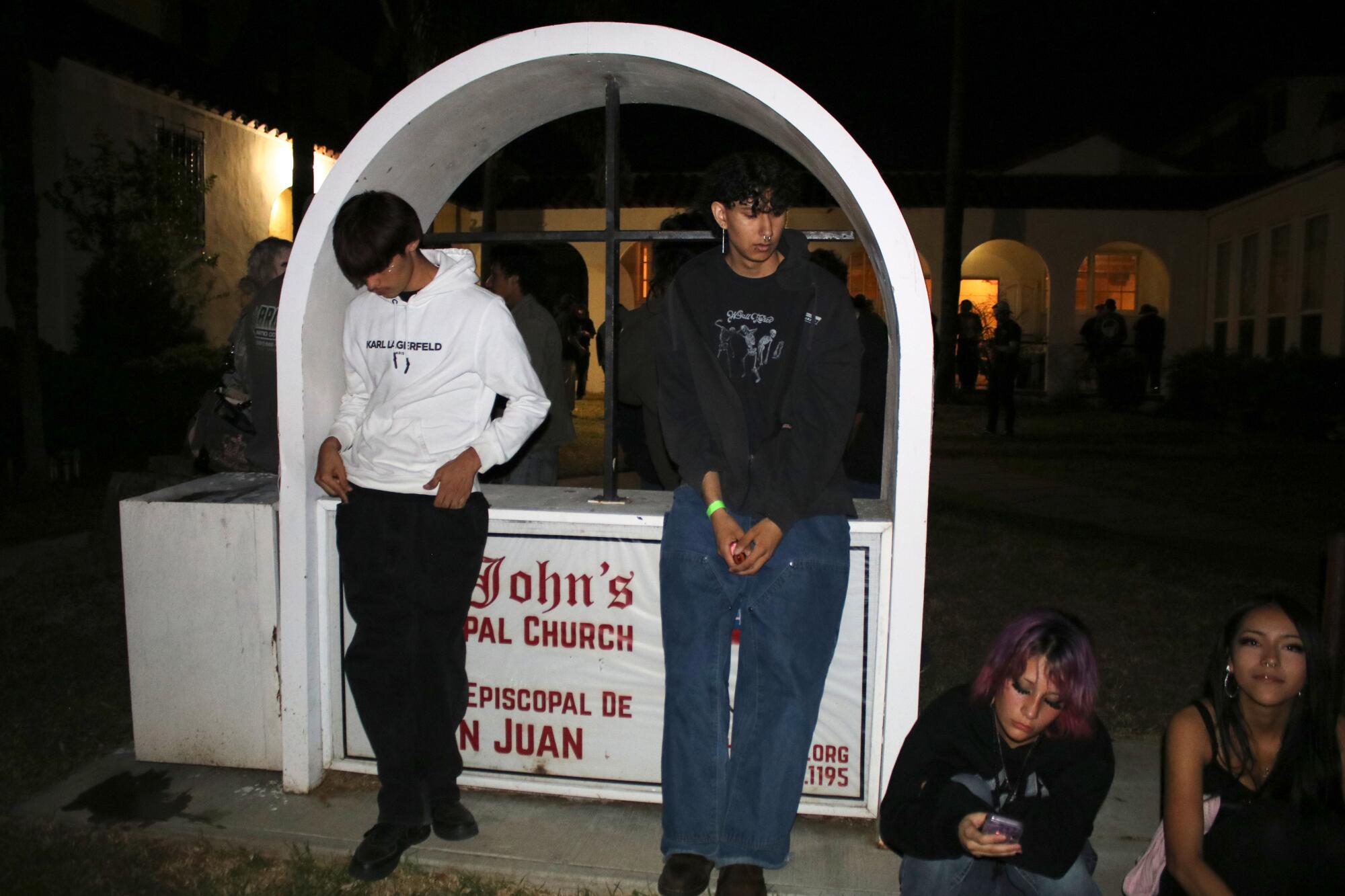
Teenagers congregate in front of St. John’s Episcopal Church in San Bernardino before the start of the night’s hardcore shows on April 3, 2026.
(Katerina Portela / Los Angeles Times)
As the fast-paced and anti-establishment genre known as punk went mainstream in the ’80s, a harder and more unhinged variant emerged in the States; bands like Bad Brains, Minor Threat and Black Flag pushed the limits of vocalization and instrumentation into dissonant new sounds that would make up the subgenre known as hardcore punk.
“As a teenager pre-social media, the music scene was the release for teen angst,” said music photojournalist Zach Cordner. “It was a convergence of nationwide bands that would come to play at [the now shuttered Riverside venue] Showcase Theater, and through word of mouth people got inspired to make cassettes and zines.”
Cordner and his friend Ken Crawford grew up in Riverside in the ’80s and ’90s, photographing the initial wave of hardcore punk taking shape in the Inland Empire. They turned these photographs into a sprawling exhibition held at the Riverside Art Museum earlier this year, “60 Miles East.”
“The scene looks a lot different today than it did in the ’90s,” Crawford said. “It’s browner, it’s queer, and that’s a good thing, to see how it’s become way more diverse.”
Inside the church, the frontman of all-Latino hardcore band Barrio Slam emitted rough growls as the crowd broke into a bustling mosh pit. Teenagers did pinwheel kicks, wrapped Mexican flags over their shoulders and filled the air with chants of “F— ICE.”
Lead vocalist Victor Campos’ family moved from Guadalajara, Mexico, to Pomona, where he says he discovered hardcore through friends. Then, at age 14, Campos attended his first rock show.
“That was the first time that I saw hardcore and metal and the heavier side of music for what it was, and the violence and culture of the shows just sucked me in and I’ve been in it ever since,” Campos said. “It felt like freedom.”
Angela, 19, was in the mosh pit during Load Tha Nine’s performance when she was accidentally struck in the nose by another concertgoer on April 3, 2026, in St. John’s Episcopal Church in San Bernardino. Hardcore shows are characterized by intense music and rough dancing where bloody accidents are not an uncommon sight.
(Katerina Portela / Los Angeles Times)
Jose Ruelas and his Barrio Slam bandmates headbang as they perform on April 3, 2026, in St. John’s Episcopal Church in San Bernardino.
(Katerina Portela / Los Angeles Times)
Campos credits local Latino-led bands like Xibalba and Harsh Reality as inspirations to dive into making music and embrace his identity in the genre.
“In the I.E., it’s really the norm. We’re singing in Spanish, we’re proud. But when we tour, we see it’s not like that everywhere,” Campos said. “Some people still consider punk ‘not for us.’ My own family members will say, ‘You’re listening to white people music.’”
The show at St. John’s is just the tip of the Inland Empire’s DIY venue iceberg. Living rooms, restaurant dining rooms, tattoo shops and record stores have transformed into hardcore venues across the region as established locales closed down.
San Bernardino four-piece “beatdown” group Big Ass Truck is one band that found success beyond the I.E. scene. They signed to Nuclear Blast Records, and at the time of our interview, they had just returned from a tour of Europe.
“With the I.E. especially, we lose a venue like every week. If we have a venue, it’s not staying around for long. I’ve personally seen like three or four venues [in the last few years] just call it,” said Big Ass Truck vocalist Abel Abarca. “So we do get scrappy, and I think that’s what sets the I.E. apart from places like L.A. and O.C.”
San Bernardino hardcore band Big Ass Truck performs a surprise concert at Creator Fest on May 2, 2026, at Creator Tattoo in Pomona.
(Katerina Portela / Los Angeles Times)
Izzy Leyva, 17, describes being met with an immediate “sense of welcoming” at her first DIY hardcore show.
“It’s nice finding people my age to talk about life with. You can start conversations so easily,” Leyva said. “Especially after moshing with someone in the crowd. If you’re struggling to make friends in school, you’ll be able to find someone here.”
She enters the mosh pit fearlessly, dodging flailing arms to two-step — a synchronized dance move that requires punching and running in place — unleashing her energy in the punk sanctum.
“I never feel like an outsider here,” Leyva added.
1
2
3
4
5
1.Mauricio Rivera performs with his band Barrio Slam on April 3, 2026, in St. John’s Episcopal Church in San Bernardino. (Katerina Portela / Los Angeles Times)2.Toni Feliz shows her “IE” tattoo, a nod to her hometown, at Creator Fest on May 2, 2026, at Creator Tattoo in Pomona. (Katerina Portela / Los Angeles Times)3.Izzy Levya, 17, two-steps during Marked for Death’s performance on April 3, 2026, in St. John’s Episcopal Church in San Bernardino. (Katerina Portela / Los Angeles Times)4.Fans dance and “two-step” during Barrio Slam’s performance on April 3, 2026, in St. John’s Episcopal Church in San Bernardino.(Katerina Portela / Los Angeles Times)5.Andres Rodriguez, 18, moshes during Marked for Death’s performance on April 3, 2026, in St. John’s Episcopal Church in San Bernardino. (Katerina Portela / Los Angeles Times)
As 25-year-old Guatemalan American vocalist Jorge Cruz entered the show, he embraced his friends and bandmates. Cruz, who fronts the voracious hardcore band KnuckleSandwich, says he sees TikTok as a major platform for hardcore fans to find one another.
“I saw shows online and was hooked … I used to be so nervous to be in the mosh pit, I’d throw up outside. But when I got in there for the first time, I feel like it changed me into someone who was more comfortable in myself,” Cruz said. “It was like a baptism.”
His music, ranging from songs like “Melting ICE” and corrido-hardcore fusion “El Corrido del Maton,” is inspired by his immigrant household upbringing and interest in Chicano studies.
“Especially with this growing anti-intellectualism going on, and conservatives in our government, writing about Chicano identity and the issues in America feels important,” Cruz said. “There’s no one out there to speak up for us than us.”
A day after attending the show, Garrett Boyer and Kenny Sylvia, longtime friends with nearly matching tattoo sleeves and baseball caps, stood talking in Creator Tattoo Parlor in Pomona.
The pair helps to run Division One, a local booking company that books anywhere from Corona storefront DBZ Books N’ Records to their very own tattoo parlor.
A few weeks prior, Boyer got a call from his sister: His niece was diagnosed with an aggressive childhood cancer called neuroblastoma that had spread through her body, causing his sister to tackle insurance and medical costs. Boyer said he reached out to the hardcore community for help and was “overwhelmed” by the response.
“The community really, really, really came together. A lot of people reached out and really quickly we threw this benefit show that raised thousands of dollars,” Boyer said. “That’s the core of what hardcore music should be and is. It’s community.”
A few months before that, they had united with local bands to throw a benefit show, raising money for immigrant coalition groups after increased ICE raids.
“We thought, ‘How could we not help?’ I’m second generation from El Paso. So many of my neighbors and even my partner’s family were directly affected,” Boyer said. “So many shows are not just about music but they can [impact] people’s lives.”
Brett Rock, bassist of San Bernardino hardcore band Big Ass Truck, performs during Creator Fest on May 2, 2026, at Creator Tattoo in Pomona.
(Katerina Portela / Los Angeles Times)
In Creator’s graffitied back lot area on May 2, bands Load Tha Nine, ’92 and Auditory Anguish opened up a DIY festival called Creator Fest, where 22-year-old Cynthia Garcia came out to “let off steam.”
Garcia, who fronts local band Exutoire, said discovering the local alternative scene “changed everything.”
“In high school, it was very much like nothing was happening. We’re all bored. We’re all depressed. We’re writing, and finally, we get to put the writing to use,” Garcia said. “We meet people that are like-minded and trying to get out of that boredom, and then [the music scene] just exploded.”
At Garcia’s shows, she says she constantly meets concertgoers from L.A., or even from San Diego, who drive hours into the I.E. to be part of its blossoming scene.
At Creator Fest, Abarca commanded the stage, building up the energy of the crowd until hair whipped in frenzies. Abarca says he sees I.E. hardcore continuing to evolve, fusing new genres and making the Inland Empire a place to watch as alternative music booms in the “scrappy” venues of San Bernardino, Corona, Pomona and Riverside.
“Latinos in the Inland Empire have always been hardcore,” Abarca said. “People just know it now because we make them hear us.”