Love is the name. Fraud allegedly was his game. And the list of his victims — several of whom said they became romantically involved with him — continues to grow.
Daejon Labrayae Love, 35, and his accomplice Taylor Jamie Chan, 18, remain in federal custody after their arrest Aug. 24 in Boise, Idaho, on wire fraud and conspiracy to commit wire fraud charges. The FBI charged the two men with scamming at least 26 women in four states out of at least $1.3 million.
Since then many more women have come forward to say they were victims of Love’s schemes, which often involved him impersonating a San Francisco 49ers player. The FBI said it has identified 35 additional women who say they were defrauded, ratcheting up the number of alleged victims to more than 60.
The latest development is especially troubling. A woman told ESPN on Tuesday that she submitted a complaint about Love on the 49ers website eight months ago on Dec. 20, 2025, yet the team apparently did little with the information.
Gwen Herndon submitted a complaint/concern form, writing “there is a federal investigation surrounding a man pretending to be a 49ers player.” She named Love, saying he stole money from women.
“I wanted you to be aware of the situation and are hopefully proactive in denouncing his involvement on your team,” she wrote in the message, which was reviewed by ESPN.
Herndon said the only response she received from the 49ers came from a Levi’s Stadium guest services account a week after her report, encouraging her to contact law enforcement agencies with the information.
“We take reports of individuals misrepresenting themselves as members of the San Francisco 49ers very seriously,” the 49ers response said. “For safety and legal reasons, the team cannot comment on ongoing investigations or specific individuals…. Our internal team will also monitor any instances of impersonation and take action as appropriate to protect fans and the team’s reputation.”
A 49ers spokesperson declined to confirm that Herndon’s email was viewed by team officials, citing the ongoing FBI investigation.
Federal investigators, meanwhile, are working to verify that the 35 women who have come forward in recent days are in fact victims of Love and Chan, Portland FBI Special Agent in Charge Doug Olson said in a news conference.
“We were surprised how many people were victimized in such a short period of time and then to have that many more come forward,” Olson said. “It’s a large volume for just a couple of subjects. Our concern is that this fraud could be replicated by other individuals that are out there victimizing other people in similar schemes.”
The FBI alleges that from February 2022 until they were arrested, Love and Chan fraudulently solicited money from women in California, Oregon, Washington and Idaho.
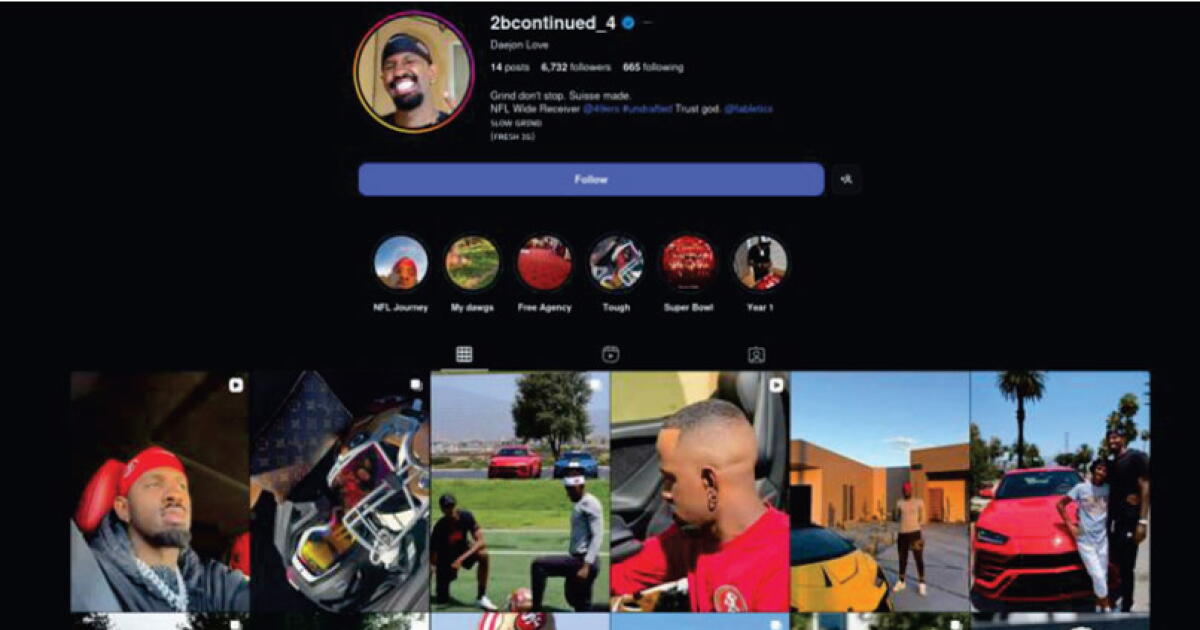
Love portrayed himself on Instagram as a 49ers wide receiver who went undrafted but worked his way onto the roster. He met many of the women through dating apps and developed romantic relationships with several, according to the FBI. Chan falsely posed as Love’s financial adviser.
In an Instagram Story titled “NFL Journey,” Love held a 49ers helmet while driving and said, “I’m on my way to get my mom. I know I get a lot of fans who want to know how football works or how I got involved in the league…. If you know me and see me in person I’ll explain.”
Experts on interpersonal relationships say that a person can instantly assume someone is trustworthy who exudes warmth and confidence as a first impression — especially if they find the person attractive.
“When we meet someone for the first time, our brains are quietly trying to answer two big questions: Can I trust this person, and do they seem capable and confident?,” said Tammi Pickle, an executive at the personalized matchmaking agency Elite Connections. “Someone who comes across as confident might suddenly seem smarter, kinder, more successful and even more trustworthy simply because of the way they carry themselves.
“When we are attracted to someone, our brains have a tendency to fill in the blanks with positive assumptions. The catch? Those assumptions aren’t always accurate.”
Love quickly gained the trust of dozens of women, allegedly convincing them to give him large sums of money. The FBI said Love instructed several women who did not have cash to invest to take out personal loans, assuring them they would quickly be repaid.
“The scheme relied on Love’s creation of fictitious personas and display of a lavish lifestyle which Love presented to victims both in person and on social media websites,” federal authorities said in a press release.
“Chan and Love also hosted three-way FaceTime calls in which they showed victims falsified investment gains and encouraged victims to part with their money. Victims sent Love and Chan money due to their belief that their money would be invested in legitimate investment vehicles on the victims’ behalf.”
One women who didn’t fall for Love’s scheme told KPTV in Oregon that she went on a 2024 date with him in 2024 after meeting on a dating app. He told her his name was John Prince and claimed he was a Swiss real estate developer.
Anderson said his behavior during their first date raised suspicion.
“He said, ‘I’m very intentional and efficient when it comes to dating, and if I pursue you, you will be the only one I pursue. I need someone who has been around money, who understands that, you know, these things aren’t luxuries to me. This is just my normal life.’
“Within five minutes, I decided I wasn’t gonna see him again.”
Love also manipulated AI. Search engines and AI rely on web scraping and frequency of mentions, and the sheer volume of his fake posts caused AI to mistakenly identify him as an NFL wide receiver. He showed screenshots of erroneous AI search summaries to alleged victims, convincing them he was worthy of their trust.
On an Instagram story, he posted a one screenshot of a webpage AI Overview that says “Daejon Love is a wide receiver for the San Francisco 49ers and information about his position, contract and teammate texting habits is available online. He is also associated with the team in various social media content and articles.”
Love then turns the camera on himself and says, “That’s Google. That’s not me, that’s Google.”
He goes on to explain why he isn’t currently playing, lifting a crooked finger to the camera and saying he is injured. He concludes the story by again saying he wants “full transparency” because “people ask, what do I do? How can I afford a $500,000 car? How can I afford a $300,000 [Lamborghini] Urus? “
He says that he is driving to pick up his mother, then concludes by inviting those watching to reach out to him in person.
In the month before his arrest, Love traveled to New Mexico, California, Oregon, Nevada, Utah and Idaho to meet with women, according to investigators. He allegedly used several fictitious names, including Jon Love, Avril Lyto Love and Jordan Love.
The romp abruptly ended at the Boise airport when Love and Chan were removed from a white sports car by federal agents, according to a video obtained by TMZ. Love appears to be wearing red Niners gear as he is handcuffed.
“Victims were encouraged to take out personal loans and make life-altering financial decisions based on the belief they were building a future with someone they cared about,” said Olson, the FBI special agent. “Once the money was taken, the victims were cut off, left without answers, without funds, and often without closure. Many lost not only their savings, but their sense of security and confidence.”