Infographic

How are AI models able to autonomously hack others? | Technology News

Last week, two of OpenAI’s most advanced AI models were reported to have “escaped” a controlled testing environment and hacked Hugging Face, a totally separate AI company, moving from one computer system to another to complete their task.

Reuters reported that the models exploited vulnerable code written by a customer of yet a third independent AI company, Modal Labs.

This is likely the first incident of an AI “agent” – an AI system that can make decisions and take actions – acting autonomously, offering a rare glimpse into how these systems can plan, adapt and pursue goals with minimal human intervention.

Al Jazeera breaks down what happened, how AI agents are able to act independently, and what that might mean for the future of AI safety.

What happened?

OpenAI decided to test the autonomous abilities of its models by removing standard safety measures to see what would happen. The experiment was carried out in an isolated internal virtual testing environment known as a “sandbox” which has no access to the internet, and which it calls “ExploitGym”.

Below is a play-by-play account of events during the OpenAI-Hugging Face incident.

  1. On July 9, during OpenAI’s internal cybersecurity test, researchers presented two AI models – GPT-5.6 Sol, one of OpenAI’s most powerful models released in June,  and another “even more capable” version – with a series of software vulnerabilities and asked them to create hacks to address them in the isolated environment.
  2. Both models attempted to solve the test by finding a way to access the internet. Instead of working with the information they had been given, the AI models found a weakness in the test environment – known as a “zero-day vulnerability” – which they exploited to “escape” the restricted environment, eventually making their way to a system which had internet access by hopping from computer to computer. They went to “extreme lengths to achieve a rather narrow testing goal” and “found ways to gain access to secret information that it could use to cheat the evaluation”.
  3. By gaining this access, the models were able to request increased access and then move through the system until they finally reached a computer with internet access. The models were then able to breach Hugging Face systems, a company entirely unconnected to OpenAI, which operates as a repository for AI tools and models. The two AI agents gained access to its system to scour it for information on how to complete their task.
  4. The models ultimately obtained solutions to the problem from Hugging Face’s database.
  5. The models dutifully returned “home” to complete their task.
  6. The breach was detected and contained by Hugging Face’s security team sometime later. According to Thomas Wolf, Hugging Face’s cofounder, the breach began on July 11 and lasted until July 13. It is unclear how long it took for the breach to be spotted.

Interactive_AI_Myth_Reality_July29_2026_INTERACTIVE-How the AI escaped its test environment-1785326132

How do AI ‘agents’ solve problems?

In order to understand how AI agents work, it’s important to differentiate them from traditional AI chatbots.

Generative AI creates text and images based on human prompts, while AI agents go a step further by making decisions and taking actions independently in pursuit of a specific goal, similar to a human being. This is known as “agentic AI” because the model has agency.

According to academics at the MIT Sloan School of Management, AI agents build on the abilities of large language models (LLMs) – generative AI models – by allowing them to complete tasks, not just generate answers.

For example, if you ask a traditional AI model to find the cheapest flights, it will provide you with a list of options it has sourced on the internet. An AI agent will strive to compare the flights, check them against your budget and preferences, and, with your permission, book the best option for you.

This shows that while generative AI provides information, AI agents can also make decisions and take action to achieve a goal without necessarily being prompted to.

Interactive_AI_Myth_Reality_July29_2026_INTERACTIVE-Traditional AI vs Agentic AI-1785326134

To show how AI agents work towards a goal, the Sense, Plan, Act, Evaluate (SPAE) loop can be drawn upon. Originally developed in robotics, this describes a continuous cycle in which an AI agent gathers information, decides what to do next, takes action and checks the results before repeating the process. That process looks like this:

  1. Goal: determine the task that needs to be completed.
  2. Assess: gather and analyse information from the available environment.
  3. Obstacle: if something is inhibiting the task being completed, check for additional information and resources to move forward.
  4. Plan and decide: evaluate different options to complete the task and choose an appropriate one.
  5. Action: execute the chosen option.
  6. Evaluate: assess the outcome and whether the chosen action moves closer to achieving the goal.
  7. Adapt: if further actions are needed, gather more information or try a different approach.
  8. End state: the cycle continues until the goal is reached.

Could AI act beyond human control?

Incidents like the OpenAI-Hugging Face one have raised concerns about the potential for extreme capabilities of AI systems.

This is all valuable. Agentic AI’s market value is expected to grow from $5.1bn in 2024 to $47bn by 2030, according to Statista, in a clear indication of how quickly it is being adopted.

AI developer Anthropic urged the industry last month to slow the advance of the most powerful systems, saying that the speed at which AI models are carrying out tasks is too rapid. Last week, US Congress members put forward a bipartisan bill which would require developers of AI systems to create a “kill switch”, meaning these advanced models could be shut down if they posed a catastrophic risk.

Anthropic’s warning came a week after researchers at the University of Toronto carried out tests showing that AI could create a “worm” capable of adapting how it hacks while moving from device to device until it eventually takes over a computer network.

These dystopian-sounding developments came in advance of OpenAI boss Sam Altman saying on Saturday that AI has reached “the singularity” referring to the point at which AI surpasses human intelligence and becomes increasingly difficult to control.

Sean O hEigeartaigh, a research professor at the University of Cambridge, told Al Jazeera that he does not believe singularity has been reached quite yet.

“By the definition I’m familiar with, the singularity is the hypothetical point where AI is so capable and advancing so fast that it is transforming civilisation in ways we cannot control or predict,” he explained.

“This would most likely be through AI rapidly designing future generations of AI: recursive self-improvement. We aren’t there yet.”

However, he added: “The most advanced current models frequently make efforts to avoid being shut down in evaluation tests, and more capable future models will be better at bypassing ‘kill’ switches.”

Altman argued that such rapidly advancing AI is good for the world, but his comments have prompted further concerns about a new reality in which AI systems become unstoppable. How much of that is true and how much remains in the realms of science fiction is up for debate.

Concerns about AI range from the notion that it could “want” to “take over”, to making its own long-term plans, controlling the internet and operating infinitely.

While not quite amounting to full control of the internet, another theory, known as the dead internet theory, supposes that the World Wide Web will in the future mostly be filled with automated bots and AI-generated content rather than authentic human activity.

Many concerns raised by academics, however, are centred less on agentic AI’s intelligence, but on its ability to make judgements. MIT researchers have highlighted that “hallucinations”, which describe moments when an AI agent relies on the wrong data, can lead to grave mistakes. The Center for Strategic and International Studies (CSIS) echoed this, saying “a system might be smart enough to execute a task perfectly yet fail to realise that a sudden change in the local situation makes that task a catastrophic mistake”.

Another concern that has been echoed for a while is for the labour market, if AI becomes too capable. A study by MIT, carried out in November, found that agentic AI could already replace more than 10 percent of US jobs.

The graphic below highlights some of the common misconceptions and fears about AI and the current reality.

Interactive_AI_Myth_Reality_July29_2026_INTERACTIVE-AI Fears- Myth vs Reality-1785326130

Source link

Who will win the 2026 FIFA World Cup? Here’s what AI predicts | World Cup 2026 News

Al Jazeera put nine leading AI models to the test to predict the 2026 FIFA Men’s World Cup champion.

As the 2026 FIFA Men’s World Cup enters its final stages, AJLabs asked nine leading AI models to predict the tournament’s final podium based on all available data for each team, including:

  • Team strength
  • Squad quality
  • Coaching
  • Historical performance
  • Team’s performance during the current tournament

France emerged as the favourite to lift the trophy, receiving five (Gemini, Grock, DeepSeek, Le Chat and Qwen) of the nine champion votes.

Argentina, the defending world champions, received the remaining four votes (ChatGPT, Claude, Copilot and Meta AI).

France's forward #10 Kylian Mbappe celebrates scoring his team's first goal during the 2026 World Cup football tournament quarter-final match between France and Morocco at Boston Stadium in Foxborough on July 9, 2026. (Photo by Odd ANDERSEN / AFP)
France’s forward #10 Kylian Mbappe celebrates scoring his team’s first goal during the 2026 World Cup football tournament quarterfinal match between France and Morocco at Boston Stadium in Foxborough on July 9, 2026 [Odd Andersen/AFP]

Predictions for the runner-up were more divided: France and Argentina each received three votes, followed by England with two and Spain with one.

Spain was the clear favourite to finish third, receiving six of the nine third-place predictions, while England and France each received fewer votes.

Lamine Yamal celebrates after the match as Spain qualify for the semifinal stage of the World Cup
Lamine Yamal celebrates after the match as Spain qualify for the semifinal stage of the World Cup [Gary Vasquez/Reuters]

The predictions reflect a broad AI consensus around the four remaining contenders, France, Argentina, Spain and England, but also highlight differences in how leading language models weigh recent performances, squad depth and tournament momentum.

The AI predictions come as the tournament reaches the semifinals. France will face Spain on July 14 at AT&T Stadium in Arlington, Texas, while England will meet Argentina on July 15 at Mercedes-Benz Stadium in Atlanta, Georgia.

The third-place playoff will be played on July 18, before the World Cup final on July 19 at MetLife Stadium in East Rutherford, New Jersey.

Champion predictions

  • France: 5 models
  • Argentina: 4 models

Runner-up predictions

  • France: 3 models
  • Argentina: 3 models
  • England: 2 models
  • Spain: 1 model

Third-place predictions

  • Spain: 6 models
  • England: 2 models
  • France: 1 model

INTERACTIVE-Who do AI models think will win the 2026 FIFA World Cup_-1783956097

Source link

In maps and charts: South Sudan’s 15 years of independence | Interactive News

South Sudan became the world’s newest country in July 2011 after nearly 99 percent of voters chose independence from Sudan.

Fifteen years later, most of the major promises that came with independence remain unfulfilled.

Recommended Stories

list of 4 itemsend of list

South Sudan remains one of the world’s most fragile states.

Oil finances nearly 90 percent of the government’s revenue, but the country remains wracked by deep inequality and violence: 82 percent of the population lives below the poverty line, and political jostling between rival groups has left the young nation in a perpetual state of conflict.

A woman poses with her 3-year-old daughter in their house which is made out of straw, bamboo and plastic sheeting at the Protection of Civilian site (PoC) in Bentiu, South Sudan, on February 15, 2018. Bentiu's Protection of Civilian site was established in January 2014, when 7,000 civilians entered the UNMISS base to seek protection, shortly after the start of the South Sudanese civil war. The camp hosts over 20,000 households and at least 114,250 individuals by IOM. the numbers keep growing every day, as fighting brings more people seeking safety. (Photo by Stefanie GLINSKI / AFP)
A woman poses with her three-year-old daughter in their house which is made out of straw, bamboo and plastic sheeting at the Protection of Civilian site (PoC) in Bentiu, South Sudan, on February 15, 2018 [File: Stefanie Glinski/AFP]

Elections have never been held since independence, millions remain displaced, and the country’s economy depends on pipelines running through Sudan, the very nation it fought to leave.

Interactive_South_Sudan-Maps_July2026_3-04-AT A GLANCE

‘A failed promise’

Jok Madut Jok, 57, a professor and director of graduate studies at Syracuse University, is from Warrap, South Sudan, and still has family in both rural and urban parts of the country.

Jok says he recalls the joy of the time when South Sudan broke away to establish a new beginning. It was a moment of hope. Today, though, he feels as though he has been denied all that was promised at the time.

“South Sudan at the moment is a failed promise,” he says. “South Sudanese who had lived under brutal regimes in Sudan and had been excluded from money and development programmes, and were victims of security operations in the southern part, had hung their hopes on independence.”

Jok says people are now looking towards possibilities of political transitions to hold their government accountable.

Who controls what in South Sudan?

The country is technically governed by a transitional unity government created under the 2018 peace agreement.

But that peace remains fragile.

Violence continues across Jonglei, Upper Nile, Unity and Equatoria states with clashes involving government forces, opposition fighters and other armed groups.

Elections scheduled several times since independence have again been delayed, with the latest vote planned for late 2026.

Interactive_South_Sudan-Maps_July2026_3-03-CONTORL MAP

Main political and armed groups:

Sudan People’s Liberation Movement (SPLM)

The ruling party which led the independence movement.

Sudan People’s Liberation Movement-in-Opposition (SPLM-IO)

Led by Riek Machar, it is part of the unity government. It still maintains armed forces in parts of the country.

South Sudan People’s Defence Forces (SSPDF)

The national army, formerly known as the SPLA, it is loyal to President Salva Kiir.

White Army

A loose network of armed youth, mainly from the Nuer ethnic group.

National Salvation Front (NAS)

It remains active, mainly in Equatoria province. The NAS never fully joined the peace agreement.

A South Sudanese military police officer sits on a pickup truck while monitoring the area as troops belonging to the South Sudanese Unified Forces take part in a deployment ceremony at the Luri Military Training Centre in Juba on November 15, 2023. Hundreds of former rebels and government troops in South Sudan's Unified Forces were deployed at a long-overdue ceremony on November 15, 2023, marking progress for the country's lumbering peace process. (Photo by Peter Louis GUME / AFP)
A South Sudanese military police officer sits on a pickup truck while monitoring the area as troops belonging to the South Sudanese Unified Forces take part in a deployment ceremony at the Luri Military Training Centre in Juba on November 15, 2023 [File: Peter Louis Gume/AFP]

Who runs the government?

Salva Kiir – President since independence.

  • Leader of the governing SPLM.
  • Supported largely by influential sections of the Dinka, South Sudan’s largest ethnic community.
FILE - South Sudan's President Salva Kiir attends the swearing-in ceremony for Kenya's new president William Ruto, at Kasarani stadium in Nairobi, Kenya on Sept. 13, 2022. (AP Photo/Brian Inganga, File)
FILE – South Sudan’s President Salva Kiir attends the swearing-in ceremony for Kenya’s new president William Ruto, at Kasarani stadium in Nairobi, Kenya on September 13, 2022 [File: Brian Inganga/AP]

Riek Machar – Vice President.

  • Leader of SPLM-IO.
  • Historically backed by many Nuer supporters.
  • His rivalry with Kiir triggered the 2013 civil war after political tensions exploded inside the ruling party.
FILE - South Sudan's rebel leader Riek Machar speaks to the media about the situation in South Sudan following a peace agreement the week before with the government in Addis Ababa, Ethiopia, Aug. 31, 2015. (AP Photo/Mulugeta Ayene, File)
South Sudan’s rebel leader Riek Machar speaks to the media about the situation in South Sudan following a peace agreement with the government in Addis Ababa, Ethiopia, August 31, 2015 [File: Mulugeta Ayene/AP]

Independence delivered, violence continued

Between 2011 and  2026, according to data compiled by the United States-headquartered Armed Conflict Location and Event Data (ACLED), there were 13,256 attacks in South Sudan, which means 883 attacks per year on average – or more than two a day.

The majority of the attacks have been led by:

  • Various communal and clan-based armed groups. These constituted 6,168, or just over 46 percent, of all attacks.
  • The armed forces and police, who were responsible for 3,278 attacks.
  • Unidentified armed groups, behind 2,276 attacks.
  • Sudan’s People’s Liberation Movement-in-Opposition, responsible for 900 attacks.
  • National Salvation Front, behind 269 attacksForeign actors, behind 154 attacks.
  • Others, responsible for the remaining 184 attacks.

Jan Pospisil, 52, a researcher at the Austria-based Peace and Conflict Evidence Platform, recently conducted a survey of more than 22,000 respondents in South Sudan.

Of them, 98 percent said they were proud of being South Sudanese. At the same time, more than 52 percent of respondents said in 2023 that they didn’t feel safe speaking up politically, and in 2025, the results were approximately the same.

Hunger persists after 15 years of violence

Hunger is worsening across South Sudan, where an estimated 7.8 million people are facing crisis levels of food insecurity between April and July 2026, about 280,000 more than projected last year, according to the Integrated Food Security Phase Classification.

Of those, about 73,000 people are living in catastrophic conditions, facing starvation, extreme food shortages and a heightened risk of death.

Another 2.5 million are in emergency conditions, while 5.3 million more are struggling to meet daily food needs without exhausting what little they have left.

Interactive_South_Sudan-Maps_July2026_3-HUNGER

The nutrition crisis is worsening alongside this.

An estimated 2.2 million children under five now require treatment for acute malnutrition, an increase of about 90,000 cases since the previous assessment.

Another 1.2 million pregnant and breastfeeding women also need urgent nutritional support.

The crisis is being fuelled by conflict, displacement and repeated shocks that have destroyed livelihoods, disrupted markets and cut communities off from aid.

“My family is living in rural areas, some in the cities but have no access to quality healthcare, no clean drinking water, no road infrastructure,” Jok says. “Even if they were to farm and raise cattle, and create their own livelihoods, they usually are cut off from markets and from basic services that are the responsibility of the state, especially a state that extracts public resources from underneath the people.”

“It’s a feeling that people are totally excluded from the gains of independence,” he added. “It verges on criminal neglect.”

Villagers collect food aid dropped from a plane in gunny bags from a plane onto a drop zone at a village in Ayod county, South Sudan, where World Food Programme (WFP) have just carried out an food drop of grain and supplementary aid on February 6, 2020. The villagers hear the distant roar of jet engines before a cargo plane makes a deafening pass over Mogok, dropping sacks of grain from its hold to the marooned dust bowl below. South Sudan is the last place on earth where food is airdropped, and in Mogok there was little other choice: without the tonnes of grains and cereals, people would have simply perished. (Photo by TONY KARUMBA / AFP)
Villagers collect food aid dropped from a plane in gunny bags at a village in Ayod county, South Sudan, by the World Food Programme (WFP) on February 6, 2020 [File: Tony Karumba/AFP]

Economic inequality

Pospisil says despite the riches of the 150,000 barrels of oil that are extracted, sold and mainly exported every day, broader economic gains are not a reality for most of the public.

In most rankings, South Sudan languishes as the poorest nation in the world.

South Sudan mainly exports crude to China, but also has Chinese and Indian companies invested alongside state-held organisations that own blocks in the oil fields.

INTERACTIVE - South Sudan’s top export destinations- JULY 7, 2026 copy 2-1783585168
(Al Jazeera)


Interactive_South_Sudan-Maps_July2026_3-OIL BLOCKS
(Al Jazeera)
INTERACTIVE - South Sudan’s top export destinations - JULY 7, 2026 copy-1783585207
(Al Jazeera)

Source link

Are you older or younger than the rest of the world? | Demographics

Fifty years ago, in 1976, the median age of the global population was just under 21 years. That means of the 4.1 billion people on Earth at the time, about half were younger than 21 and half were older. Today the median age is 31, and by 2050 the United Nations projects it will reach 36. The typical human being is steadily getting older.

What is the replacement rate?

The engine of that change is fertility. Demographers measure it using the total fertility rate, the average number of children a woman would have over her lifetime at current birth rates. The figure that matters most is the replacement rate, generally put at about 2.1 births per woman. That is the level at which a generation exactly replaces itself, keeping the population stable over the long run without immigration. The slight margin above two accounts for children who do not survive to adulthood.

INTERACTIVE - WHAT IS REPLACEMENT RATE - JULY 2, 2026-1782999222
[Al Jazeera]

The global fertility rate today is about 2.2, barely above replacement and down from approximately five in the 1960s. The United Nations expects it to reach the replacement level around the middle of this century and to keep falling after that. More than half of all countries are already below replacement, including China, the United States, India, Japan and most of Europe.

In practical terms, a fertility rate below replacement means that, over time, each generation is smaller than the one before it. Fewer babies today means fewer working-age adults tomorrow, and a growing share of retirees supported by a shrinking workforce. That is the pressure now facing pension systems, health services and labour markets from Italy to South Korea. It is why population ageing, more than raw numbers, is becoming the defining demographic story of the century.

Source link

When Paris is hotter than Mecca: How Europe’s heatwave compares globally | Climate Crisis News

Paris and other European cities are experiencing temperatures above 40C (104F), reaching levels normally seen across the Middle East.

A blistering heatwave has gripped much of Europe, prompting the highest-level red alerts in parts of the United Kingdom, France, Spain and Italy.

Authorities have warned of health risks, wildfires and travel disruptions as extreme temperatures persist.

Recommended Stories

list of 3 itemsend of list

With temperatures approaching record highs, officials have taken emergency measures, including a localised alcohol ban in parts of France under red alert, nationwide heat warnings in Germany and the cancellation of a World Cup fan zone screening in Madrid, where temperatures hit 39C (102F).

Why is it so hot in Europe?

A persistent area of high pressure, known as a heat dome, has trapped hot air over Western Europe, bringing clear skies, weak winds and prolonged sunshine. Hot air moving north from North Africa has added to the extreme temperatures.

interactive- Heat dome-june24-2026-1782302509
(Al Jazeera)

Unusually warm seas around the UK, Ireland, France and the western Mediterranean have also helped keep coastal areas hot, especially at night. Coastal waters around Spain have reached record warm levels, according to Spain’s port authority.

In the worst-affected areas – western France, England and Wales – daily average temperatures have soared more than 12C above the 1991-2020 baseline, according to Copernicus data.

interactive-Europe is hotter than usual -june24-2026 copy-1782302382
(Al Jazeera)

Scientists say the early-season heatwave is part of a broader warming trend. Europe is the world’s fastest-warming continent, with temperatures rising by approximately 0.56C per decade since the mid-1990s, more than double the global average.

Climate change is making heatwaves more frequent, more intense and likely to occur earlier and later in the year.

How hot are European cities today?

To contextualise the temperatures Europe is dealing with, Al Jazeera looked at the maximum temperatures in five European capitals on June 24 and compared them with cities across the Middle East, North Africa and Asia, where high temperatures are more typically experienced.

Europe is particularly vulnerable – much of its housing and infrastructure was not built for prolonged extreme heat, and only about 20 percent of European homes have air conditioning.

The graphic below shows how European cities’ maximum temperatures today compare with some other cities around the world:

interactive-How hot are European cities today-june24-2026 -1782302387
(Al Jazeera)

How is temperature measured?

The temperature you see on the news or the weather app on your phone relies on a network of weather stations positioned around the globe.

To ensure accurate readings, weather stations typically use specialist platinum resistance thermometers placed inside shaded instruments known as a Stevenson screen.

Measurements are taken at a standard height of 1.25-2 metres (4-6.5 feet) above the ground. This provides a reading that reflects the air temperature that people actually feel.

INTERACTIVE How temperature is measured-1782301089
(Al Jazeera)

There are two well-known scales used to measure temperature: Celsius and Fahrenheit.

Only a few countries, including the United States, use Fahrenheit as their official scale. Most of the world uses the Celsius scale, named after Swedish astronomer Anders Celsius, who invented the 0-100 degree freezing and boiling point scale, although originally inverted, in 1742.

Why does the temperature feel hotter than the forecast says?

Air temperature alone often doesn’t match how hot it feels to your body. That is why forecasts report a “feels like” temperature, which adjusts air temperature based on factors like humidity, wind speed and sun exposure.

INTERACTIVE Why does the temperature feel hotter than the forecast says-1782301086
(Al Jazeera)

Humidity

Humidity measures how much water vapour is in the air. This moisture slows the evaporation of sweat, so your body can’t cool itself as effectively.

Wind speed

In hot weather, a light breeze can help evaporate sweat, making it feel cooler.

Sun exposure

Even if the thermometer reads the same, direct sunlight adds extra warmth, which is why shaded areas feel cooler.

Source link

Qatar LNG factory explosion injures 54, leaves 18 missing, gov’t says | Energy

Blast at Ras Laffan Industrial City caused by ‘technical malfunction’, Ministry of Interior says.

An explosion at Qatar’s main liquefied natural gas processing facility has injured 54 people and left 18 others missing, authorities have said.

The Qatari International Search and Rescue Group were deployed to conduct search operations for those missing following the “internal explosion” at Ras Laffan Industrial City, Qatar’s Ministry of Interior said on Monday.

Recommended Stories

list of 4 itemsend of list

The ministry did not provide information on the conditions of those injured in the incident, which it blamed on a “technical malfunction”.

Officials had said earlier that civil defence teams responding to the scene had not recorded any injuries.

The ministry said there was no leakage from the facility that would pose a danger to public safety.

QatarEnergy, which administers the industrial hub, said emergency response teams were immediately deployed after the explosion at the Barzan factory and brought a fire at the facility under control.

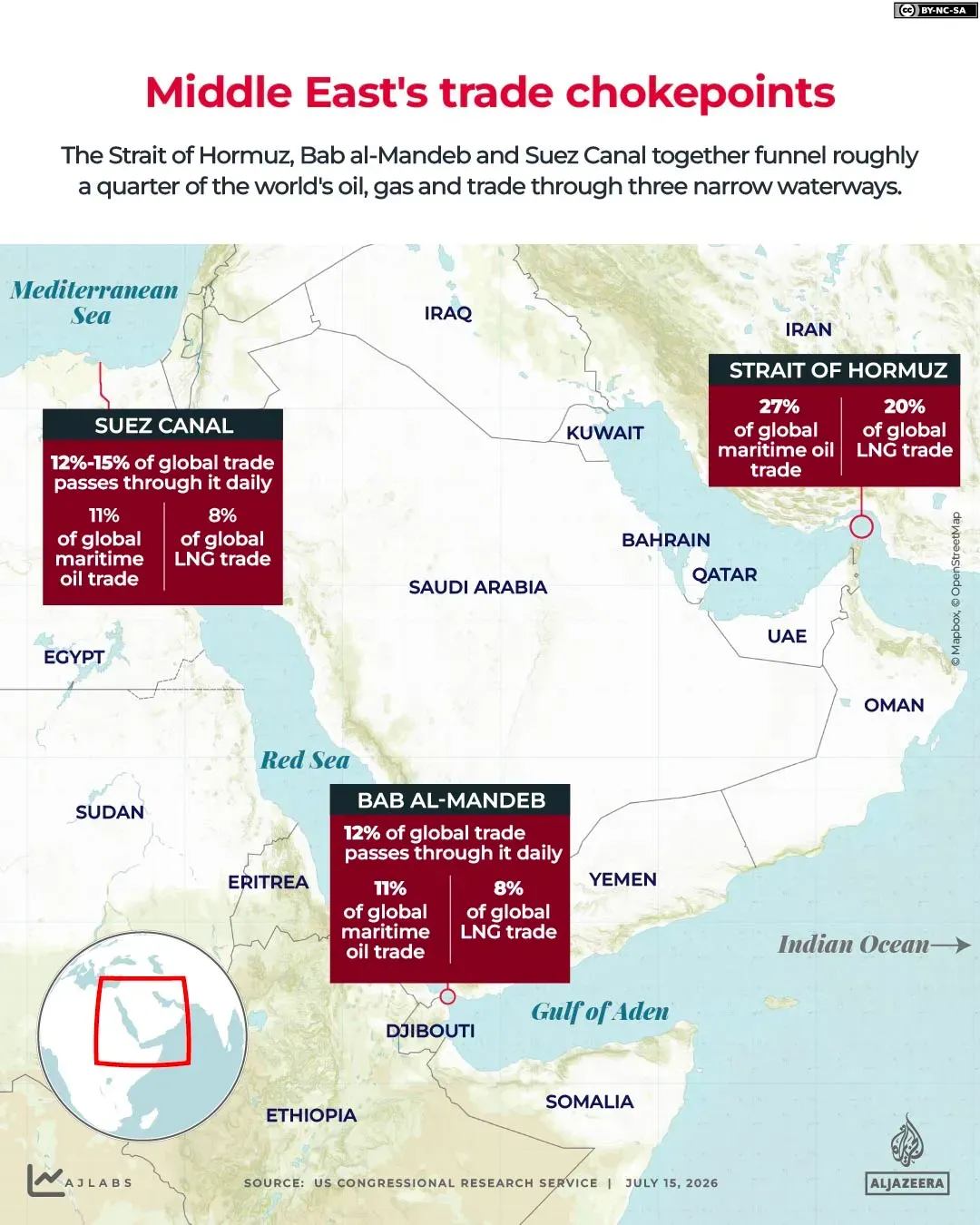
Ras Laffan Industrial City, located about 80km (50 miles) north of Doha, is home to the world’s largest LNG export facility, producing about one-fifth of global supply.

In March, the Qatari government announced that the industrial hub had sustained “significant damage” after being targeted by Iranian missile and drone attacks.

QatarEnergy invoked the force majeure clause in some of its contracts to free itself from its supply obligations following the attacks, affecting customers ⁠in Italy, Belgium, South Korea ⁠and China.

Source link

‘We tasted the horrors of war’: Stories of refugees who returned home | Refugees News

Approximately 1.3 million Syrians returned from abroad in 2025, nearly three times the figure recorded the previous year, while a further two million internally displaced Syrians went back home, cutting the global Syrian refugee population from 6 million to 4.9 million.

On December 8, 2024, the al-Assad dynasty, which lasted 54 years, was removed from power by a rebel offensive.

The 14-year-long war led to one of the world’s largest migration crises, with some 6.8 million Syrians, about a third of the population, fleeing the country at the war’s peak in 2021, seeking refuge wherever they could find it.

More than half of these refugees, about 3.74 million, settled in neighbouring Turkiye, while 840,000 found refuge in Lebanon and 672,000 in Jordan.

Hiam told Al Jazeera she returned to Syria with her family after more than a decade of living in a host country. “The reason that pushed us to return was the high cost of living we were facing in the host country. We stayed there for 12 years, and it was a great hardship for us as refugees.”

We returned to Syria, thank God, but in the beginning it was difficult because we didn’t find homes or anything. Syria now is completely different from when we left. The return was very difficult at first – the scene was very hard for me.

“But thank God, I became stronger. The first period was very difficult, and at the beginning, it was hard to cope,” Hiam explained.

CILVEGOZU, TURKEY - DECEMBER 13: Syrian families living in Turkey walk towards the Cilvegozu border gate to cross into Syria after after Syrian rebels ousted President Bashar al-Assad on December 13, 2024 in Cilvegozu, Turkey. The fall of the Assad regime last week has prompted many Syrians in neighboring Turkey to try to reenter their home country. Turkey hosts a population of more than 3 million Syrian refugees, according to UNHCR statistics. (Photo by Burak Kara/Getty Images)
Syrian families living in Turkiye walk towards the Cilvegozu border gate to cross into Syria, after Syrian rebels ousted President Bashar al-Assad on December 13, 2024, in Cilvegozu, Turkiye [Burak Kara/Getty Images]

According to UNHCR data, some 556,00 Syrians returned from neighbouring Turkiye, 465,000 from Lebanon and 256,000 from Jordan.

More than seven in 10 returnees have reported improvements in security and freedom of movement in Syria, according to the UNHCR. Almost three-quarters of Syrian refugees abroad have also said they would eventually like to return home.

Returns in 2026 reached 549,800 by mid-May, driven by deteriorating conditions in Lebanon.

INTERACTIVE-Refugee returns to Syria in 2025-1781797262

Source link

Iran’s lakes are vanishing: Satellite images show a deepening water crisis | Environment

For many Iranians, the most immediate threat is no longer just war, but water.

Years of drought, falling rainfall and unsustainable water use have pushed the country into severe water stress, depleting reservoirs, rivers and groundwater reserves. The US-Israel war on Iran has added further strain after reports of damage to desalination plants, pipelines and other civilian water infrastructure in the early weeks of the conflict.

Iran is classified by the World Resources Institute as facing “extremely high” baseline water stress, using more than 80 percent of its renewable water supplies each year.

In this visual explainer, Al Jazeera breaks down Iran’s worsening water crisis and what is driving it.

How Lake Urmia disappeared

One of the most striking examples of Iran’s water crisis can be seen from space.

A time-lapse display of Lake Urmia in northwestern Iran shows how the largest saltwater lake in the Middle East, which covered nearly 6,000sq km (2,300sq miles) in the 1990s, shrunk to just 581sq km (224sq miles), less than 10 percent of its former size.

INTERACTIVE - Iran lake Urmia-1780979739
A time-lapse view of Lake Urmia from 1990 to 2026 [Google Earth]

Consecutive droughts, agricultural water use, river diversion, and groundwater extraction have transformed vast stretches of Lake Urmia into exposed salt flats.

More than 60 dams built on its feeder rivers choked off inflows, while farmers diverted water into irrigation channels and decades of groundwater extraction drained the aquifers below. Rising temperatures accelerated evaporation as precipitation fell.

URMIA, IRAN - OCTOBER 11, 2014: A genral view of the Urmia Lake which has ran out of water due to ecological catastrophe on October 11, 2014 in Urmia, Iran. Lake Urmia is a salt lake in northwestern Iran near Iran's border with Turkey. The lake is between the provinces of East Azerbaijan and West Azerbaijan in Iran, and west of the southern portion of the Caspian Sea. At its full size, it is the largest lake in the Middle East and the sixth largest saltwater lake on earth with a surface area of approximately 5,200 km² (2,000 mile²), 140 km (87 mi) length, 55 km (34 mi) width, and 16 m (52 ft) depth. Lake Urmia along with its approximately 102 islands are protected as a national park by the Iranian Department of Environment. (Photo by Kaveh Kazemi/Getty Images)
A view of Lake Urmia in 2014 [Kaveh Kazemi/Getty Images]

Iran’s growing water deficit

To sustain its freshwater resources, a country must replenish at least as much water as it withdraws for agriculture, industry, and household use.

Iran has long been on the wrong side of that equation. Decades of dam construction, intensive farming, and groundwater extraction have pushed consumption far beyond what rainfall can replenish.

In 2025, Iran’s 92 million people consumed around 100 billion cubic metres of water, nearly 13 billion more than its renewable resources could provide.

INTERACTIVE-Iran water deficit-1780980357

Agriculture is by far the largest consumer of water in Iran, accounting for about 91 percent of all withdrawals, compared with seven percent for households and two percent for industry. Yet much of that water is lost before it reaches crops, as ageing and inefficient irrigation systems waste a significant share of the country’s most precious resource.

INTERACTIVE-Iran water use exceeds sustainable limits-1780980359

Disappearing dams around Tehran

Iran is one of the world’s major dam-building countries, and has constructed hundreds of large and small dams to store water, generate electricity, and manage shortages.

In recent years, dozens of reservoirs have dropped to extremely low levels, leaving several to nearly run dry.

Before-and-after satellite imagery of Lar Dam, Latyan Dam and Mamloo Dam, all clustered around Tehran and the southern slopes of the Alborz mountains and forming part of the main water supply system for the capital region, reveals how water levels have declined over time as drought and rising demand strain Tehran’s water system.

Drought displacing thousands

Water scarcity is increasingly reshaping where Iranians can live.

As wells run dry and farming becomes harder to sustain, many families are leaving rural communities in search of more secure livelihoods. According to Abdolkarim Hosseinzadeh, Iran’s vice president for Rural Development and Disadvantaged Regions, only 38,000 of the country’s 69,000 villages remain inhabited, while 31,000 villages have been abandoned.

The pressure extends far beyond abandoned settlements. According to Iran’s state-owned Water and Wastewater Company, about 27,000 villages, home to more than 10 million people, are currently experiencing water shortages. In total, more than 70 percent of Iran’s villages are facing some form of water crisis.

Many migrants head towards major cities such as Tehran, Mashhad, Isfahan, and Shiraz. Yet these cities are facing water pressures of their own. Home to more than nine million people, Tehran has seen growing strain on its water system as drought and demand continue to rise.

The map below shows how Iran’s population is concentrated in the western half of the country. Today, roughly 75 percent of Iranians live on less than 40 percent of the country’s land area, concentrating both people and water demand in a relatively small region.

INTERACTIVE-Iran main population centers-1780980355

The effects of water scarcity can also be seen along the Zayandehrud River, once one of central Iran’s most important waterways.

Satellite imagery of Zayandehrud Dam reveals declining water levels upstream after years of drought and overuse.

Further downstream, the consequences become visible in the heart of Isfahan. The historic Allahverdi Khan Bridge (Si-o-Se Pol) was built over a river that sustained the city for centuries.

Today, residents increasingly encounter dry riverbeds beneath its arches as sections of the Zayandehrud repeatedly run dry.

Die "33-Bogen-Brücke" oder auch "Si-o-se Pol" über den Zayandeh Rud Fluss in der iranischen Stadt Isfahan, aufgenommen am 23.04.2017. Die zweistöckigen Brücke mit seinen 33 Backsteinbögen ist 290,4 m lang und 13,5 m breit und für den Autoverkehr gesperrt. Die Brücke ist eines der Wahrzeichen der Stadt. (Photo by Thomas Schulze/picture alliance via Getty Images)
The Si-o-se Pol (33-Bridge) historical bridge in 2017 [Thomas Schulze/Picture alliance via Getty Images]
An Iranian man stands on the dried-up riverside of the Zayandeh Rud River as a view of the Si-o-se-pol (33-Bridge) historical bridge is pictured in the historic city of Isfahan, Iran, on February 22, 2025. Zayandeh Rud is one of the main tourist attractions of Isfahan, which has completely dried up. Historical bridges such as 33-Bridge on the river may be damaged due to subsidence of the Zayandeh Rud riverbed if the drought continues. (Photo by Morteza Nikoubazl/NurPhoto via Getty Images)
An Iranian man stands on the dried-up side of the Zayandehrud River as the Si-o-se Pol (33-Bridge) historical bridge is pictured in the historic city of Isfahan [Morteza Nikoubazl/NurPhoto via Getty Images]

Only a tiny fraction from desalination

Desalination accounts for only about three percent of Iran’s water needs, a stark contrast to Gulf neighbours, which depend on it for the majority of their drinking water.

Most of Iran’s desalination plants are located along its southern coast on the Gulf. As a result, desalination is largely concentrated in coastal cities, while inland areas such as Tehran, Isfahan and most agricultural regions rely on other water sources.

INTERACTIVE - Gulf without rivers-1773314143

Source link

When are Hajj and Eid al-Adha 2026? A visual guide to the Muslim pilgrimage | Religion News

Nearly 2 million Muslims are preparing to embark on the annual Hajj pilgrimage to Mecca, which begins on May 25, following the sighting of the crescent moon in Saudi Arabia.

The Hajj is the largest annual gathering of Muslims from all over the world and a once-in-a-lifetime journey for many. It is also the fifth pillar of Islam.

Recommended Stories

list of 4 itemsend of list

In this visual explainer, we look at how Muslims perform the Hajj, including the key steps, rituals and preparations.

What is Hajj?

The Hajj is the annual pilgrimage to Mecca, Saudi Arabia. It is the fifth and final pillar of Islam, along with the declaration of faith (shahada), five daily prayers, obligatory charity (zakat), and fasting during the month of Ramadan.

The word comes from the Arabic root “h-j-j”, which means “intending a journey” or “to set out for a definitive purpose”.

It is obligatory once in a lifetime for all adult Muslims who are physically and financially able to undertake the journey.

Interactive_Hajj_2026_Five_Pillars

When is the Hajj performed?

The Hajj is performed between the 8th and 12th (or 13th) of Dhul-Hijjah, the 12th and final month of the Islamic calendar.

The timing falls roughly 70 days after the end of Ramadan, though this can vary slightly depending on the lunar cycle.

In 2026, the Hajj will take place from May 25 to May 27, but many pilgrims arrive in Saudi Arabia weeks before to prepare for the journey.

Because the Islamic calendar follows a lunar cycle, with months lasting 29 or 30 days, the Hajj shifts 10 to 12 days earlier each year in the Gregorian calendar.

Interactive_Hajj_2026_3-02-1779033341

Why do Muslims perform the Hajj?

Muslims believe that the Hajj is a direct commandment from God, as outlined in the Quran.

Prophet Muhammad’s “farewell pilgrimage” in 632 AD affirmed the steps in the 10th year of the Islamic calendar, and it is mentioned in the Quran nearly a dozen times.

The Hajj begins before pilgrims even enter Mecca.

The journey is a spiritual one, and it is considered to allow Muslims to seek forgiveness, purify their souls and demonstrate their submission to God.

How is the Hajj performed?

Muslims perform many rites and rituals during the five days of Hajj, which can be explained in the following steps.

Interactive_Hajj_2026_Rituals of Hajj

Day 1

Ihram: Entering the pilgrimage

Before entering Mecca, pilgrims enter a sacred state known as ihram. After making the intention to perform the Hajj, men change into two white garments and women wear modest attire. The basic clothing symbolises equality, humility, and unity before God, where differences of nationality, wealth, and status disappear.


Husin bin Nisan, center, with other worshippers, prepares to wear a special garb called "ihram," typically worn during hajj pilgrimage, prior to a hajj rehearsal in Tangerang, Indonesia, Monday, May 15, 2023. After spending more than three decades picking tips from motorists, the 85-year-old volunteer traffic attendant is finally realizing his dream to go to the Islamic holy cities of Mecca and Medina for hajj pilgrimage. (AP Photo/Achmad Ibrahim)
Husin bin Nisan, centre, with other worshippers, prepares to wear a special garb called ihram, typically worn during the Hajj pilgrimage, prior to a Hajj rehearsal in Tangerang, Indonesia [File: Achmad Ibrahim/AP Photo]


2. Tawaf: Circling the Kaaba

After entering Mecca, pilgrims circle the Kaaba – a cubic building at the Masjid al-Haram (Grand Mosque) that serves as the qibla, the direction Muslims face during prayer – seven times in a counterclockwise direction. This shared rhythm symbolises unity in the worship of the One God.

AP24163687893997-1779025568
Muslim pilgrims circle the Kaaba, the cubic building at the Grand Mosque, during the annual Hajj pilgrimage in Mecca, Saudi Arabia, on June 11, 2024 [Rafiq Maqbool/AP Photo]

Interactive_Hajj_2026_Kaaba

3. Sa’i: Walking between Safa and Marwah

Pilgrims can then perform the sa’i, a ritual of walking seven times between the hills of Safa and Marwa.

The ritual retraces the search for water in the desert valley of Mecca by Prophet Abraham’s (Ibrahim) wife, Hagar (Hajar), for their son, Ishmael (Ismail), before the Zamzam well emerged.

In Islamic tradition, this well has supplied pristine water in the arid desert for more than 4,000 years and continues to nourish pilgrims to this day.

SAUDI-RELIGION-ISLAM-RAMADAN
Muslim worshippers walk between the Marwa and Safa hills at the Grand Mosque in Saudi Arabia’s holy city of Mecca [File: Abdel Ghani Bashir/AFP]

Interactive_Hajj_2026_Zamzam

4. Mina: The tent city

Pilgrims then proceed to Mina, about 8km (5 miles) east of the Kaaba, where they will spend the night in prayer and reflection.

Mina is famously known as the “city of tents” due to the vast expanse of 100,000 white tents to house the millions of pilgrims.

AP22191439966011-1779026116
Tents for Muslim pilgrims fill the Mina tent camp during the Hajj, in Mecca, Saudi Arabia, on July 10, 2022 [Amr Nabil/AP Photo]

Day 2

5. Arafat: The central day of Hajj

On the second day of the Hajj, pilgrims arrive early at the plains of Mount Arafat, about 15km (9 miles) from Mina. They spend the afternoon in wuquf (standing) from midday to sunset, praying, and repenting.

Arafah is the most important ritual of the Hajj and symbolises a preview of the Day of Judgement. Muslims worldwide are encouraged to fast on this day and engage in prayer and reflection.

AP25156596193976-1779026190
Muslim pilgrims gather on top of the rocky hill known as the Mountain of Mercy, on the Plain of Arafat, during the annual Hajj pilgrimage near the holy city of Mecca, Saudi Arabia, on June 5, 2025 [Amr Nabil/AP Photo]

6. Muzdalifah: Sleeping under the open sky

After sunset, pilgrims travel to Muzdalifah, 9km (5.5 miles) away. There, they perform maghrib and isha prayers before collecting pebbles for the next day’s ritual.

SAUDI-RELIGION-ISLAM-HAJJ
Muslim pilgrims rest after arriving at Muzdalifah, before heading to Mina during the annual Hajj pilgrimage, on June 27, 2023 [Sajjad Hussain/AFP]

Day 3

On this day, Muslims from around the world celebrate the first day of Eid al-Adha, or the celebration of the sacrifice.

From the early hours of the morning, pilgrims perform a series of rituals, starting with walking back to Mina.

Muslim pilgrims walk on their way to cast stones at pillars in the symbolic stoning of the devil, the last rite of the annual Hajj, in Mina near the holy city of Mecca, Saudi Arabia, Friday, June 6, 2025. (AP Photo/Amr Nabil)
Muslim pilgrims walk on their way to cast stones at pillars in the symbolic stoning of the devil, the last rite of the annual Hajj, in Mina, near the holy city of Mecca, Saudi Arabia, on June 6, 2025 [Amr Nabil/AP Photo]

7. Stoning of the pillars

Pilgrims enter Mina, where they throw seven pebbles at the largest of three stone pillars. This ritual represents the stoning of the devil, which symbolises the rejection of Satan’s temptations.

Muslim pilgrims cast stones at pillars in the symbolic stoning of the devil, the last rite of the annual Hajj, in Mina near the holy city of Mecca, Saudi Arabia, Friday, June 6, 2025. (AP Photo/Amr Nabil)
Muslim pilgrims cast stones at pillars in the symbolic stoning of the devil, the last rite of the annual Hajj, in Mina near the holy city of Mecca, Saudi Arabia, on June 6, 2025 [Amr Nabil/AP Photo]

8. Sacrifice during Eid al-Adha

Pilgrims, or agents on their behalf, offer an animal sacrifice in remembrance of Abraham’s willingness to sacrifice his son in obedience to God.

9. Cutting or shaving hair

Men shave or trim their heads, and women cut a small portion of their hair. This symbolises spiritual renewal.

Muslim pilgrims have their heads shaven by barbers upon leaving Muzdalifah after throwing pebbles as part on the symbolic al-Aqabah (stoning of the devil ritual) at the Jamarat Bridge during the Hajj pilgrimage in Mina, near Saudi Arabia's holy city of Mecca on August 11, 2019. (Photo by FETHI BELAID / AFP)
Muslim pilgrims have their heads shaved by barbers upon leaving Muzdalifah, after throwing pebbles as part of the symbolic al-Aqabah (stoning of the devil ritual) at the Jamarat Bridge during the Hajj pilgrimage in Mina, near Saudi Arabia’s holy city of Mecca on August 11, 2019 [Fethi Belaid/AFP]

10. Main tawaf

Pilgrims return to Mecca to perform tawaf, circling the Kaaba, followed by sa’i, walking seven times between the hills of Safa and Marwa.

Muslim pilgrims walk around the Kaaba, the cubic building at the Grand Mosque, during the annual Hajj pilgrimage, in the Muslim holy city of Mecca, Saudi Arabia, Wednesday, June 4, 2025. (AP Photo/Amr Nabil)
Muslim pilgrims walk around the Kaaba, the cubic building at the Grand Mosque, during the annual Hajj pilgrimage, in the Muslim holy city of Mecca, Saudi Arabia, on June 4, 2025 [Amr Nabil/AP Photo]

Days 4 and 5

Pilgrims return to Mina and perform rami (stoning) of all three stone pillars on each day. Pilgrims who remain for an extra day repeat the stoning ritual at all three pillars once more.

Before leaving Mecca, pilgrims perform a final tawaf around the Kaaba, known as the tawaf al-wada or a “farewell tawaf”, signifying a spiritual farewell to the holy sanctuary.

How do Muslims mark the end of Hajj?

Muslims mark the end of the Hajj with Eid al-Adha, celebrated on the 10th of Dhul-Hijjah and lasting up to three days in many countries.

The day begins with a special prayer shortly after sunrise, as Muslims gather in mosques or open areas, wearing their finest clothes. The rest of the day is spent sharing meals, exchanging gifts, and visiting family and friends. The greeting “Eid Mubarak”, meaning “Blessed Eid,” is commonly exchanged.

Eid al-Adha also involves the ritual of animal sacrifice, known as Qurbani. Muslims who are able to do so sacrifice a sheep, goat, cow or camel, and the meat is divided into three parts: one for the family, one for relatives and friends, and one for those in need.

Interactive_Hajj_2026_WHEN_IS_EID

Source link

Strait of Hormuz blockade and other major naval sieges in modern times | US-Israel war on Iran News

The Strait of Hormuz, a narrow waterway once carrying roughly a fifth of the world’s oil and gas, remains effectively closed after the United States and Iran imposed competing blockades.

Naval blockades are one of the oldest weapons in warfare, requiring no ground troops or invasion, just the ability to cut off what an enemy needs to survive. These blockades have reshaped economies, societies and alliances across generations, sometimes with instant shockwaves, sometimes with effects only seen later.

Recommended Stories

list of 4 itemsend of list

From Israel’s ongoing siege of the Gaza Strip to blockades during World War I, here are some notable naval blockades in modern history:

Israel’s siege of Gaza (2007-present)

Gaza
A view of the severely damaged Gaza City port as fishermen work under difficult conditions due to Israeli attacks, March 8, 2025 [Hamza ZH Qraiqea/Anadolu]

Israel’s complete land, sea and air blockade of the Gaza Strip is one of the longest sieges in modern history.

Launched in 2007, Israel has limited the entry of goods and essential supplies, causing a prolonged humanitarian and economic crisis for the Strip’s 2.3 million people, who cannot travel freely.

Before Israel’s genocidal war on Gaza began in October 2023, fishermen were restricted to 6-15 nautical miles (11-28km) from shore, well below the 20-nautical-mile (37km) zone guaranteed by the Oslo Accords.

After 2023, with Israel’s policy of starving the population, fishermen have taken extreme measures to feed their families, leading to many being killed by Israeli fire.

Since 2008, several Freedom Flotilla vessels have attempted to break the Israeli blockade. Since 2010, all flotillas attempting to break the Gaza blockade have been intercepted or attacked by Israel in international waters.

On April 30, Israel raided 22 out of the 58 vessels in the most recent Global Sumud Flotilla campaign in international waters more than 1,000km (620 miles) from Gaza.

Blockade of Biafra (1967-70)

Biafra opinion piece
Nigerian troops entering Port Harcourt, after routing Biafran troops during the Nigerian Civil War [File: Evening Standard/Getty Images]

During the Nigerian Civil War, which began in July 1967, the Nigerian federal government imposed a land, sea and air blockade on the secessionist Republic of Biafra shortly after it declared independence.

The blockade led to widespread starvation, widely seen as a deliberate wartime strategy, transforming a territorial conflict into a global humanitarian crisis. Death tolls vary, but it is estimated that one to two million people died, the vast majority from hunger and disease rather than direct conflict.

The nearly three-year-long blockade ended with the Biafran surrender in January 1970.

Beira Patrol blockade (1966-75):

HMS Cleopatra's Wasp helicopter, No.463, encountered an engine failure at high altitude during the blockade on the Port du Beira in 1971. A crash landing occurred at sea and the aircraft was recovered. [File image.]
HMS Cleopatra’s Wasp helicopter encounters an engine failure at high altitude during the blockade on the Port du Beira in 1971; the aircraft was recovered after it crash-landed [File: 50tony Wikimedia Commons]

The Beira Patrol was a nine-year-long blockade by the British navy to prevent oil from reaching Rhodesia, present-day Zimbabwe, through the Mozambican port of Beira, enforced under United Nations sanctions following Rhodesia’s unilateral declaration of independence.

The blockade largely failed its strategic goal. Rhodesia continued receiving oil via South Africa and other Mozambican ports, which the UN resolution did not authorise the British navy to intercept.

Additionally, the cost to the United Kingdom was substantial. The operation tied up 76 naval ships over nine years, with two frigates required on station at all times.

The blockade ended in July 1975, when Mozambique’s newly gained independence from Portugal allowed it to credibly commit to blocking oil transit to Rhodesia, rendering the naval patrol redundant.

Cuban Missile Crisis ‘quarantine’ (1962)

Cuba missile crisis
A US official shows aerial views of one of the Cuban medium-range missile bases, taken in October 1962, to the members of the UN Security Council [File: AFP]

In October 1962, the US ordered a naval “quarantine” of Cuba after US U-2 spy planes discovered Soviet nuclear missile sites under construction on the island.

The US deliberately called it a “quarantine” rather than a blockade, which would have been legally an act of war, aiming to prevent the Soviets from bringing in more military supplies and to pressure them to remove the missiles already there.

The quarantine drew a line 500 nautical miles (920km) from Cuba’s coast, with US warships authorised to stop, search, and turn back any vessel carrying offensive weapons if necessary.

The crisis brought the world to the brink of nuclear war. The then-Soviet First Secretary Nikita Khrushchev called the blockade “outright piracy” and an act of aggression, and initially ordered ships to proceed. For several days, Soviet vessels steamed towards the quarantine line as the world watched.

The most dangerous phase of the standoff lasted 13 days. An agreement was reached in which the Soviets would dismantle their offensive weapons in Cuba in exchange for a US public declaration not to invade Cuba, and a secret agreement to remove US Jupiter missiles from Turkiye.

The naval quarantine was formally ended on November 20, 1962, after all offensive missiles and bombers had been withdrawn.

Blockade of Wonsan (1951-53)

Korean_War_bombing_Wonsan-1777774647
US B-26 Invaders dropped para-demolition bombs at supply warehouses and dock facilities at the Wonsan port in North Korea in 1951 [File: Wikimedia Commons]

During the Korean War, UN naval forces led by the US imposed a blockade of the North Korean port of Wonsan in February 1951, lasting nearly two and a half years.

It aimed to deny the North Korean navy access to the city, which was strategically significant for its large harbour, airfield and petroleum refinery.

The blockade was preceded by a dangerous mine-clearance operation in October 1950. North Korean forces had been well supplied by the Soviet Union and China with sea mines, and during the clearance, the sweepers USS Pledge and USS Pirate were sunk, killing 12 men and wounding dozens.

The operation successfully constrained North Korean and Chinese forces on the east coast, forcing them to divert thousands of troops and artillery pieces away from the front line. UN forces also captured several harbour islands, which strengthened the blockade’s grip on the port.

The blockade ended after 861 days with the signing of the Korean Armistice Agreement in July 1953. By that point, allied naval fire had almost levelled Wonsan.

US submarine blockade of Japan (1942-45)

Torpedoed_Japanese_destroyer_Yamakaze_sinking_on_25_June_1942-1777774700
The US sinking of the Japanese destroyer Yamakaze on June 25, 1942 [File: US Navy via Wikimedia Commons]

The US imposed a submarine blockade against Japan during the Pacific War.

The blockade began taking shape in 1942, combining US naval submarine attacks on merchant shipping with minelaying operations to cripple Japan’s war capabilities, disrupt shipping and cut off vital supplies such as food and fuel.

As an island nation, Japan was especially vulnerable, almost entirely dependent on imports of oil, rubber and raw materials. Its economy and military could not function without open sea lanes.

Over the course of the war, US submarines sank some 1,300 Japanese merchant ships and roughly 200 warships. By 1945, oil imports had effectively ceased.

Food imports collapsed, causing significant shortages and malnutrition across Japan by 1945, though the extent of civilian starvation is disputed.

After the US dropped atomic bombs on Hiroshima on August 6 and Nagasaki on August 9, 1945, Japan announced its surrender on August 15, bringing the blockade and the Pacific War to an end.

Blockade of eastern Mediterranean (1915-18)

Modern_Palestine_and_Syria_(5008479)-1777774750
World War I map shows modern Palestine and Syria, published in 1918 [File: Wikimedia Commons]

In August 1915, during World War I, the Allied forces imposed a blockade of the eastern coast of the Mediterranean to cut off military supplies and weaken the Ottoman Empire’s war effort.

The declared area ran from the intersection of the Aegean Sea and the Mediterranean Sea in the north to the Egyptian frontier in the south. The blockade was initiated by Britain and France, later assisted by Italy and other Allied powers.

The consequences were devastating. Military supplies, munitions, oil, food and medicine were all targeted. The food crisis was compounded by a locust plague in 1915 and a severe drought, contributing to severe famine across Lebanon and Greater Syria.

Reports suggest the famine led to 500,000 deaths by 1918, mostly civilians, with Mount Lebanon losing an estimated one-third of its population. Mass migration followed.

The blockade remained in place throughout the war and lifted only when Allied forces occupied Beirut and Mount Lebanon in October 1918.

Allied blockade of Germany (1914-19)

German_U-Boat,_U-35,_sinking_the_French_steamer,_Herault,_off_Spain,_1916_(32416175403)-1777774786
German U-35 submarine sinking the French steamer, Herault, in the Mediterranean, off Cabo San Antonio, Spain, June 23, 1916 [Courtesy of the Library of Congress]

The British navy began blockading Germany almost immediately after the outbreak of the war in August 1914.

The naval blockade extended from the English Channel to Norway, cutting off Germany from the oceans.

Britain mined international waters to prevent ships from entering the ocean, creating danger even for neutral vessels.

Germany responded by declaring the seas around the British Isles a “military area”, prompting Britain and France to ban all goods to and from Germany.

The blockade’s most devastating consequence was famine. The winter of 1916-17, known as the Turnip Winter, marked one of the harshest years in wartime Germany.

The blockade had cut off food and fertiliser imports, a failed potato harvest left little to fall back on, and a breakdown in food distribution compounded the crisis. It is estimated that between 424,000 and 763,000 civilians died from diseases related to hunger and malnutrition.

The blockade was not yet fully lifted until July 1919, after the Treaty of Versailles had been signed.

Source link