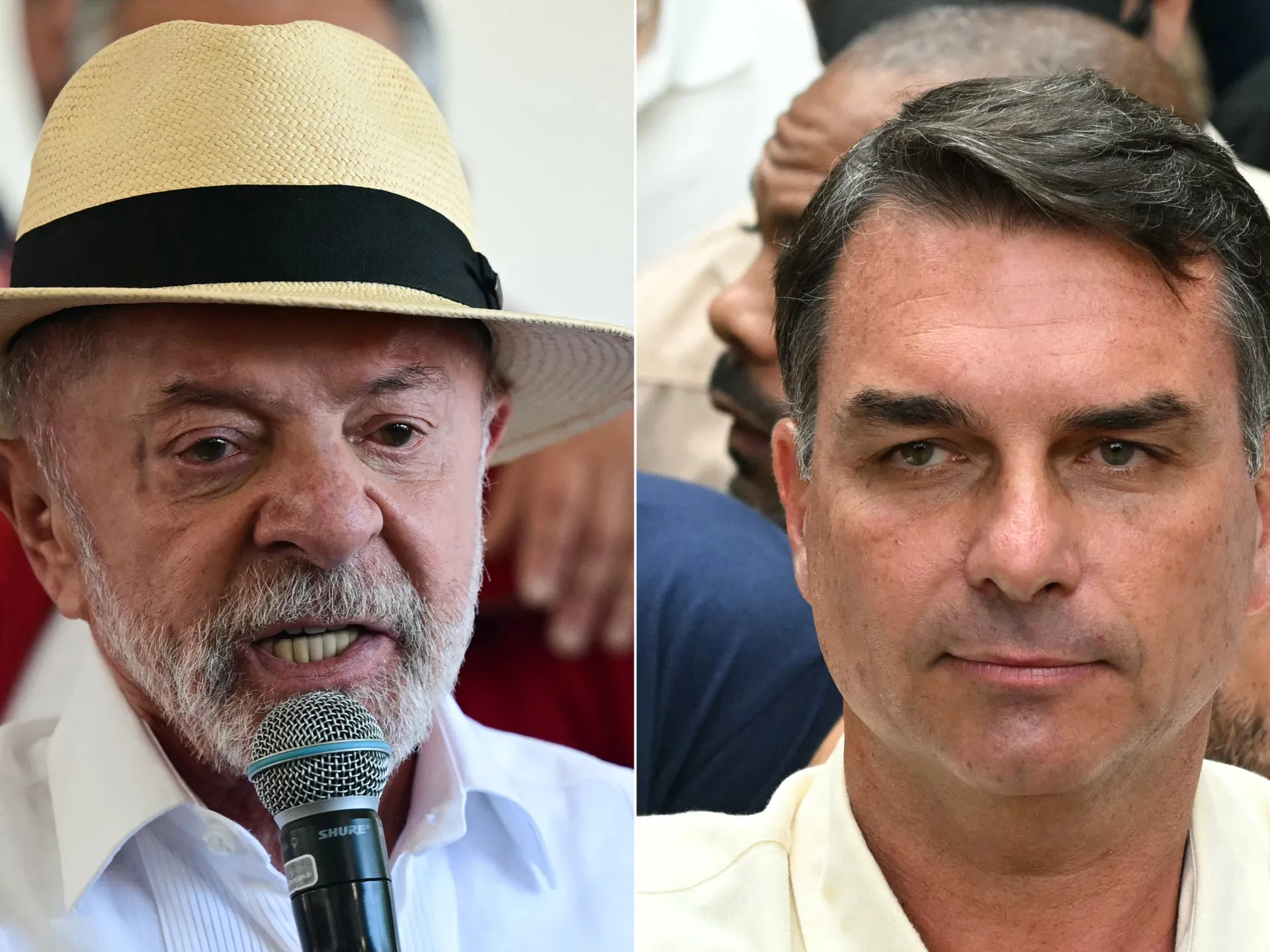
Brazil’s closely watched presidential election is heading to a second round between leftist President Luiz Inacio Lula da Silva and right-wing Senator Flavio Bolsonaro, prolonging a deeply polarised race with major implications for the country and the wider region.
Brazil’s electoral court confirmed on Sunday that the two candidates will advance to a run-off on October 25 after neither won the majority needed to secure the presidency outright, with Bolsonaro leading at 55.8 million votes to Lula’s almost 53.2 million.
Recommended Stories
list of 4 itemsend of list
Lula, 80, is seeking a fourth, non-consecutive term after a political career spanning nearly five decades.
Bolsonaro, 45, is the eldest son of former President Jair Bolsonaro and is trying to return his father’s right-wing movement to power, even as the former president serves a 27-year prison sentence for plotting a coup after losing the 2022 election.
The election comes at a pivotal time for Latin America’s largest economy. Brazilians are grappling with concerns over crime and the cost of living, while the country faces an increasingly tense relationship with the United States. The vote is also being closely watched across a region that has shifted sharply to the right in a series of recent elections.
While a second round was widely expected, the first-round result did not play out quite as pollsters had predicted.
Here are some of the key takeaways from the election so far.
Brazil is heading for another Lula-Bolsonaro run-off
With nearly 99 percent of votes reported, Bolsonaro had about 47 percent of valid votes, compared with 44.9 percent for Lula. Neither reached the 50 percent threshold needed to win in the first round.
That sets up another Lula-Bolsonaro showdown, four years after Lula narrowly defeated former President Jair Bolsonaro. This time, he will face the former president’s eldest son.
The race could be extremely close, as polling ahead of Sunday’s vote suggested Lula and Flavio Bolsonaro were roughly tied in a potential run-off.
That puts voters who backed one of the other 10 candidates in the first round at the centre of the fight for the presidency over the next three weeks.
Ronaldo Caiado and Renan Santos, who together received about 5.3 million votes, have previously said they will not endorse either candidate in the run-off.
Flavio Bolsonaro did better than polls suggested
Most polls leading up to election day predicted the race would be pushed into the second round, but had Lula finishing the first round ahead of Bolsonaro.
Instead, Bolsonaro emerged with a lead of two percentage points, raising questions about why the final polls underestimated his support.
On Sunday, Bolsonaro said the results showed that Brazilians want change.
Analysts told the Reuters news agency that Bolsonaro may have benefitted from “protest votes” from people who may have preferred another candidate but saw defeating Lula as the priority. Many had been expected to shift their support to Bolsonaro only in a second round, meaning this could have consequences for his support in three weeks.
“The protest vote foreshadows what is to come in the run-off,” political analyst Rafael Favetti told Reuters. “While this should benefit Flavio Bolsonaro now, his growth potential in the second round drops precisely because that support has already been front-loaded.”
After the results came in, Lula said the votes were “unexpected” but that he would come back stronger in the run-off.
“I admit, I was convinced I would win in the first round. The game is about to start. We are in extra time. In extra time, we will win over the Brazilian people,” the 80-year-old said.
The right had a strong night in Congress, too
Bolsonaro’s surprising performance in the first round was part of a broader show of strength for Brazil’s right.
Right-wing parties, led by Bolsonaro’s Liberal Party (PL), were performing strongly in both houses of Congress, with the PL on track to emerge as the largest force in the Chamber of Deputies and making gains in the Senate.
This included victories for other members of the Bolsonaro family, including former First Lady Michelle Bolsonaro, Flavio’s stepmother, who won a Senate seat in the Federal District, her first elected office.
His brother, Carlos Bolsonaro, was elected to the Senate in Santa Catarina.
The results show that the political movement built around former President Jair Bolsonaro – known as “bolsonarista” – remains a powerful electoral force, even with the former president barred from running himself.
“The fact that far-right candidates for the legislature have exceeded all expectations suggests a deeper popular grounding for the bolsonarista project than many expected,” Andre Pagliarini, an assistant professor of history and international studies at Louisiana State University and author of a book on Lula, told Al Jazeera.
“Millions of Brazilians right now evidently feel the right best reflects their values and vision for the future,” he added.
The congressional results matter beyond election night, too. Both houses were already dominated by conservative lawmakers, and a stronger right-wing presence could make it even harder for Lula to push through his agenda if he wins another term.
A Bolsonaro victory, meanwhile, could give him more room to pursue his own priorities, including his pledge to seek an amnesty for his father.
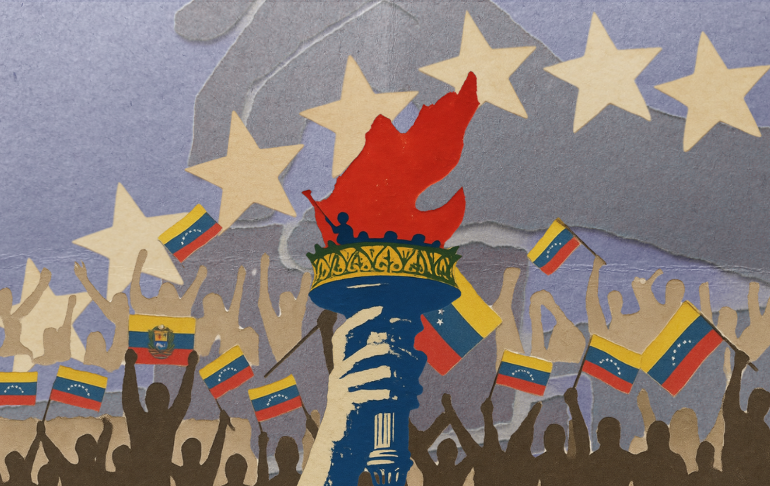
When Maduro was taken and arrested on January 3rd, many Venezuelans brought out the good stuff. The old bottle of rum or whiskey they’d been saving for a special occasion, believing the incursion would inevitably lead to the return of liberty in Venezuela. Nine months later, the “transition” has not been what most Venezuelans wanted. Hundreds of political prisoners were released, but that is not enough. A few laws are being reformed, but not the institutions that carry them out. Delcy remains in power despite no lawful statute allowing it nor any sort of popular mandate for her to be the head of the Venezuelan State.
Many who brought out the good whiskey have soured on the transition, or at the very least lost their shiny optimism. But the mistake was not just to believe in a future that now seems a bit naive, but to yearn for the return of a past which was the precursor to our current tragic state.
The quest for a more liberal society
Yes, we were better off before the 2000s, but we’ve never had a truly free society without clientelism or corruption. Chavismo may have perfected the art of corruption in Venezuela, but they certainly did not invent it. Venezuela, since its inception, has not been able to ameliorate the very Latin American issue of inequalities of power. We tend to forget about the problem during oil bonanzas. Everyone is doing better, right? Why worry? Then the oil price inevitably falls, the party stops, the lights turn on and we see the naked truth that we are in a horrible state of disrepair.
Many say that the Venezuelan problem is economic (lack of diversification or investment in non-oil industries), political (once high polarization and weak rule of law), or even cultural (a tendency towards el guiso). But within these lies a deeper philosophical issue: for a society that claims to love liberty and our libertadores as much as we do, we don’t actually understand what it takes to create a liberal society.
This is hardly a Venezuela-specific issue, but we are a unique case in that so much of our self-perception is based on the idea of a people who achieved freedom from the yoke of Spanish tyranny, only to then continue to liberate other countries in South America, making Simón Bolívar the most famous person in the history of the continent.
What room is there to become “more liberal” once all citizens are recognized by the law and there is universal suffrage?
To understand what it means to be a liberal society, perhaps it would be best to understand what it means to be a more liberal society. When the classical liberal revolutions of the 18th and 19th centuries took place, it was the divine right of kings that fell. The power was taken from an individual and shared amongst parliaments, which were at the time controlled almost exclusively by rich landowners (including our own first few republics). Still, this was unquestionably a redistribution of power from the individual to the few. It took a long time, but eventually this distribution of power from the one to the few became a distribution of power from the few to the many. Nowadays, democratic societies are expected to allow every single citizen to vote, but this is a reality that is younger than the oldest person alive today. When English supercentenarian Ethel Caterham in the UK was born in 1909, her mother would not have been allowed to vote.
Liberal societies today hardly even question the idea that all people should be equal in respect to the law and that we ought to have a voice in the decisions of our country through voting. So what room is there to become “more liberal” once all citizens are recognized by the law and there is universal suffrage?
It’s true that the distribution of power in liberal countries these days is much improved when compared to 100 years ago, but is it better than 50 years ago? The laws may say that all people are equal, but systems don’t seem to provide that result. Even in societies where they have nominally distributed power amongst all citizens, the power has not been really distributed amongst them nearly as well. Throughout the current Trump presidency, there have been a string of pardons for white-collar criminals who have paid patronage to Trump and his family, including the former president of Honduras convicted of drug trafficking, or a Venezuelan oligarch indicted for allegedly bribing a Puerto Rico governor.
This is a clear example of a two-tiered justice system in which if you put the right money in the right pockets, you get preferential treatment.
A post-WW2 recipe?
I use these examples to show that although there is nothing ontologically wrong with wealth inequality, especially if the rich earned that money honestly, in practice inequality in resources leads to inequality in power and inevitably abuse of that power. This is the state of Venezuela now, but it was also the state of Venezuela long before Chávez caught a whiff of power and what ultimately led a majority of voters to choose a murderer and traitor over the “democracy” that was in place.
The issue, after nearly three decades of chavismo, is that although they entered power on the basis of railing against resource and power inequalities, in the time since they’ve been in charge they’ve done nothing to ameliorate those same inequalities. The people in government have simply taken the seats of the previously corrupt politicians and become even more clientelist, leading to greater inequalities in power and resources than ever before (on top of just a generally poorer country).
The vast majority of Venezuelans can clearly see what chavismo is now, even many who used to vote for it. And though we are still not through with it, we ought to give serious consideration to what we want to replace it with. Do we want a return to bipartidismo and clientelism with high inequality? Just hoping that the price of oil rises so we can keep our population happy whilst oligarchs accrue more and more power? Or do we actually want to achieve the liberty we say we value so much?
We can imitate post-WWII States who decreased inequalities by taxing the incomes of extremely wealthy people at extremely high rates whilst maintaining a belief in free markets, property and the rule of law.
When we get rid of chavismo, we will have an even greater challenge ahead. We’ll have the challenge of rebuilding a country destroyed by decades of mismanagement, a country filled with people who have gotten their wealth by enchufándose into a corrupt system that has oppressed the voice of its people. And we’ll have to decide how we want to go about bringing back liberty. I suggest we act like the previous liberal revolutions we venerate, and distribute more power from the few to the many.
So what is the solution to power inequalities and resource inequalities?
Thankfully, there is no need to reinvent the wheel. We can copy the policies of post-WWII countries (US, Japan, France, UK, Germany, etc) who decreased inequalities in their countries by taxing the incomes of extremely wealthy people at extremely high rates whilst maintaining a belief in free markets, property and the rule of law. This has the added benefit of diversifying government incomes away from just oil revenue or sales taxes, which are regressive and hurt consumers and small businesses (I could go on and on about the economic benefits, but I’ll stick to the institutional ones here). I specify the post-WWII liberal societies here and not the communist ones, because although communist countries seek to ameliorate resource inequalities they end up increasing power inequalities which lead to just as much abuse, if not even more than hyper-capitalistic oligarchic societies.
But before we can consider which policies we ought to copy from which societies, we must adopt the attitudes and political beliefs which made those policies implementable in the first place.
The world, not just Venezuela, is at a crossroads between greater authoritarianism or greater liberalism. If we are leaders of liberalism in our continent, as we have historically perceived ourselves to be, then we ought to understand the nature of liberalism and how we ought to achieve it. If we do not have a vision of how to recreate our institutions and our general idea of what a liberal society even is, then we will surely return to the sad state we are in right now, even after we get rid of the kleptocrats sitting in Miraflores.
The solution is simple, but it’s not easy. Entrenched interests are just that; entrenched. But if the people of the country yearn for liberty and we manage to understand what it takes to attain it, then it can be done through hard work and dedication, as ultimately all worthwhile goals are achieved.
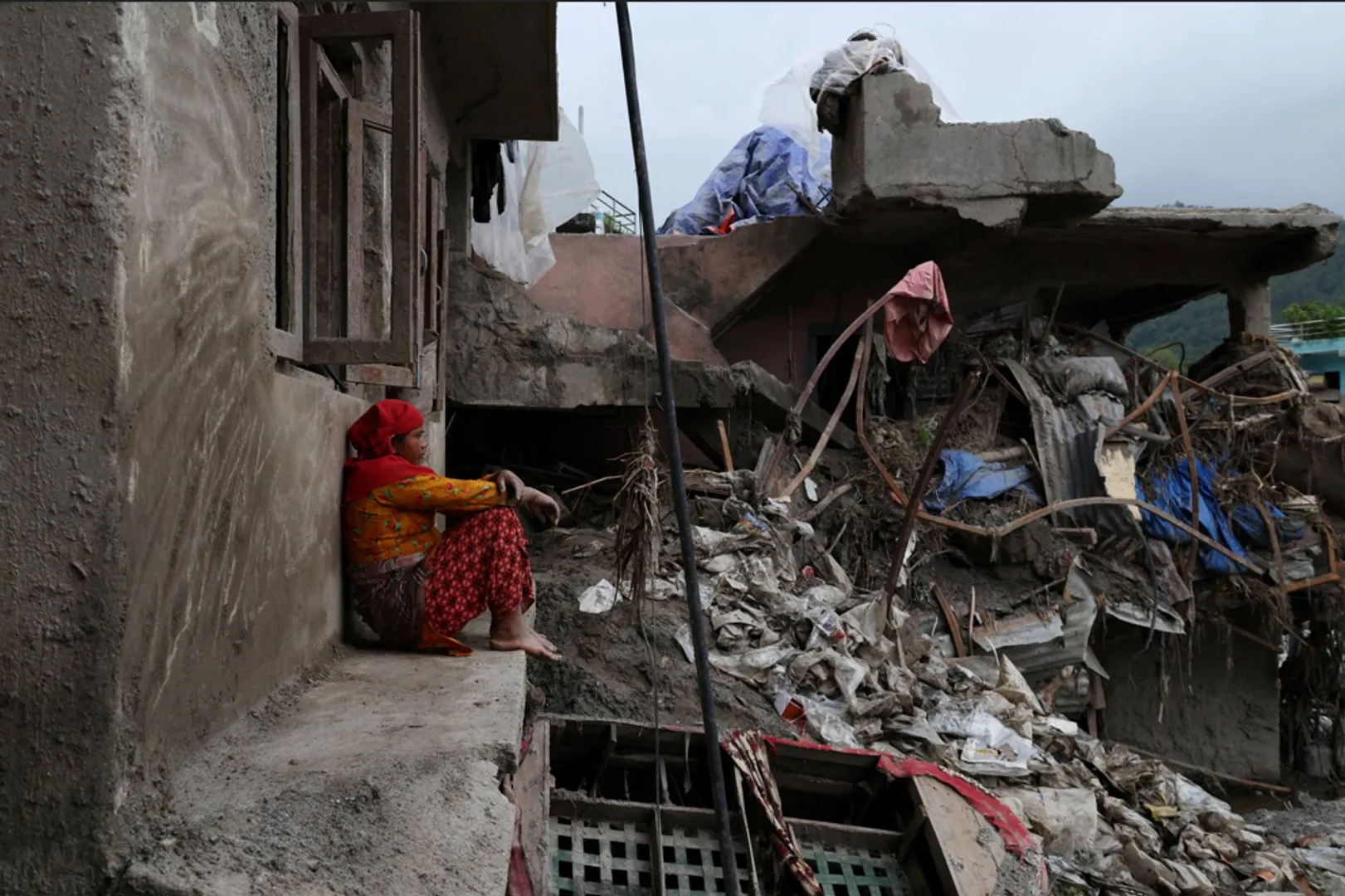
A month after catastrophic floods tore through Nepal, 5,285 people remain missing and more than 1,100 are still in holding centres. Fresh rains are now worsening conditions for displaced families living in temporary shelters, as the country faces a $4.78bn rebuilding bill.
A new burger joint in La Castellana, an affluent neighborhood in eastern Caracas. Photo: Santiago Bernal.
Any Venezuelan can tell you how unpredictable our country is. This uncertainty, almost idiosyncratic to Venezuela’s national identity, can be felt before you even arrive. You never really know what awaits you when visiting from abroad, no matter how many times you have made the trip before.
This trip, my first since Maduro was captured by US forces in January and less than two months after the deadly earthquakes that devastated parts of the country in June, was certainly unusual from the beginning.
I arrived in Valencia, a city with a small airport poorly equipped to handle the hundreds of passengers diverted from Maiquetía International Airport, the country’s largest. To reach my hometown of Mérida, I had to take a flight departing from another city, Maracay, because Valencia’s airport was too crowded with international flights to accommodate additional domestic routes. The flight departed not from a conventional commercial terminal, but from a small facility inside Venezuela’s largest Air Force base, surrounded by some of the Russian anti-aircraft equipment and fighter jets that had spectacularly failed to prevent Maduro’s extraction. The check-in process had to be done in a mall in the city, a few kilometers away from the base, to which we were transported in a small shuttle bus. The process was surprisingly efficient.
The road between El Vigía’s airport, which serves Mérida, and the city was in better condition than I expected, although the scars of decades of underinvestment remained clearly visible. In some places, sections of road that had collapsed in landslides more than two years ago were still buried under rubble.
I arrived in Caracas after a drive in a taxi equipped with a Starlink antenna, a gadget that until not too long ago could land you in prison.
As we approached Mérida, I spotted a car-carrying truck filled with brand-new Toyota models.
I could not remember the last time I had seen one of those while living in Venezuela. Maybe 15 years ago? In any case, what would be an unremarkable sight in most countries had become extremely rare in Mérida, a state whose economy depends heavily on its university and small-scale tourism, two sectors devastated by Venezuela’s decade-long economic crisis.
After arriving in Mérida, I realized that the car carrier was serving one of several car dealerships that seemed to have resurfaced across the city, all filled with new vehicles. They were also visible on the streets: hundreds of new Chinese models, alongside smaller numbers of Japanese, Korean, and American cars, were driving around Mérida for the first time I could recall in years.
This may sound banal or superficial, but Venezuela’s aging car fleet had long served as a stark reminder of the country’s economic demise. Between 2014 and 2018, car sales collapsed, reaching a historic low of just 2,000 vehicles sold nationwide in 2018. Seeing a model manufactured after the early 2010s outside Caracas had become highly unusual.
The situation has changed since 2025, when more than 38,000 cars were reportedly sold across the country. That remains a fraction of the more than 300,000 vehicles sold in pre-crisis 2007, at the height of Hugo Chávez’s oil boom, but it is enough to make a noticeable difference.
The return of (limited) consumerism
Mérida’s urban landscape has also been transformed by the hundreds of new stores that have opened across a city where economic stagnation and widespread power outages forced countless businesses to close over the past decade. The same phenomenon was evident in Caracas, where I arrived after yet another tour through Maracay’s Air Force base, and after a drive in a taxi equipped with a Starlink antenna, a gadget that until not too long ago could land you in prison and can now be purchased online through different national authorized distributors.
Beyond new cars, large sections of the city, including old Chacao in Caracas’s affluent east, appear to be undergoing an incipient but rapid process of gentrification, reminiscent in some ways of iconic European neighborhoods such as Gràcia in Barcelona, Ruzafa in Valencia (the Spanish one), or Shoreditch in London.
Chacao’s Bolívar Square is marked by a striking contrast. Its 18th-century church still bears large cracks caused by the earthquakes, while the surrounding streets are now filled with lively atmospheric restaurants and cafés that would not look out of place in Lisbon or Barcelona, and fitted with contactless payment systems charging prices that match those of many large European cities.
These businesses serve a small but very real segment of the Venezuelan population that can afford them. That group is not necessarily limited to enchufados.
This raises an obvious question: how can these businesses be profitable in a country where typical salaries remain around $220–280 a month, less than a tenth of the already meager average European salary, and where living what might be considered a relatively normal life has been estimated to cost around at least $800–1,000 a month per person?
The answer is that these businesses serve a small but very real segment of the Venezuelan population that can afford them. That group is not necessarily limited to enchufados, people who have enriched themselves through their connections to government corruption. Exact figures are difficult to establish, but managers in private companies can reportedly earn around $1,200 a month, while senior professionals in some sectors, including medicine, can make several thousand dollars a month in private practice, depending on their specialization.
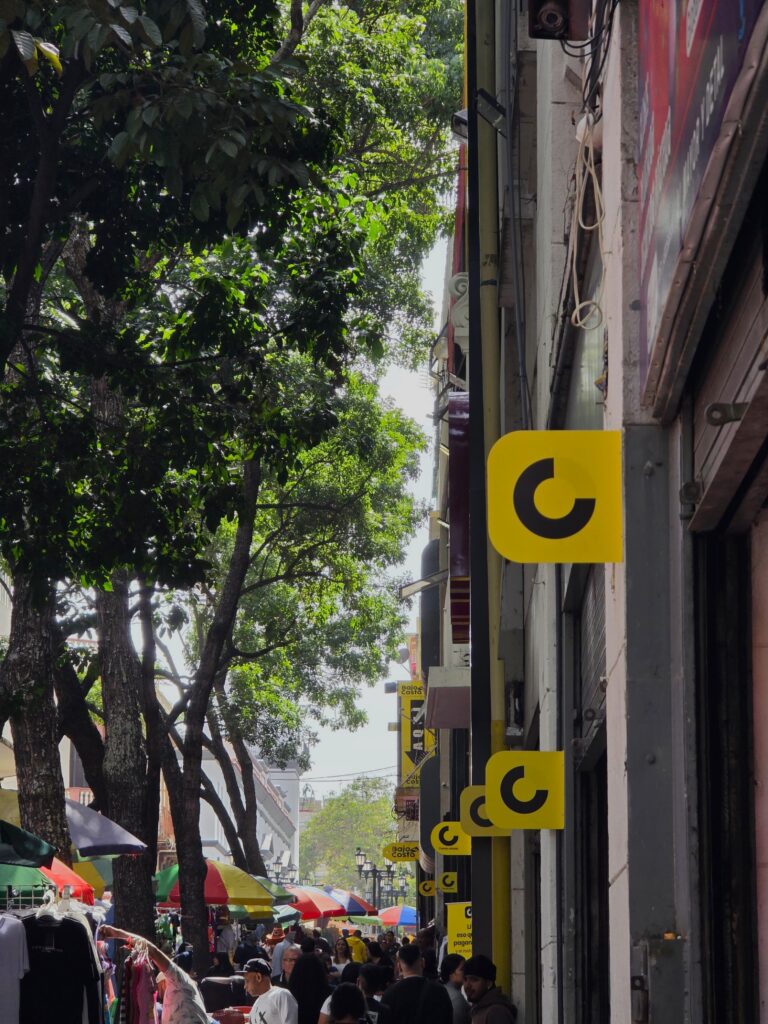
The widespread adoption of Cashea, a fintech company offering consumers interest-free microcredit for everyday purchases, has also increased the purchasing power of a broader segment of the population. Cashea’s success is visible not only in Wall Street, but also in its extraordinary penetration of everyday commerce. Its recognizable yellow logo now signals that the service is accepted in businesses ranging from large clothing stores in shopping malls to small kiosks, and funerary homes.
The thriving Venezuelan fintech is virtually everywhere. Photo: Santiago Bernal.
You can even use Cashea to pay for a ride with Yummy, Venezuela’s equivalent of Uber.
These businesses still operate within a heavily dysfunctional financial system, distorted by an artificially low exchange rate and an economy constrained by high inflation and low productivity. Yet they serve a segment of the population that is slowly turning into a small, resurgent middle class. That group is helping drive growth in specific sectors, most notably real estate, which has reportedly expanded by around 30 percent in 2026.
This modest revitalization has coincided with an important reduction in street violence. Today, around 60 percent of Venezuelans report feeling safe walking at night, according to Gallup, something difficult to imagine only a few years ago. This is one factor helping explain the revival of nightlife in places such as Chacao, Caracas’ historical center and, to a lesser extent, parts of Mérida.
A similar transformation was evident in Margarita Island, a place I had not visited in almost two decades.
Most of these changes began before the US intervention in Venezuela. But they appear to have accelerated and spread in the months following Maduro’s capture.
Known as the “Pearl of the Caribbean,” Margarita’s tropical beaches, tax-free stores and fascinating history attracted large numbers of European and Latin American as well as Venezuelan tourists during the 1990s and early 2000s. Some of my own fondest childhood memories are, in fact, on the island.
That changed dramatically after 2014, as Venezuela’s political, economic, and public-service crises deepened, leaving the island in a state of abandonment.
Today, Margarita is experiencing a modest but noticeable revival in domestic and international tourism compared with the previous decade. This has been partly fueled by significant investment from domestic and international hotel chains, which now offer a wide range of accommodation, from relatively affordable all-inclusive packages to high-end luxury experiences.
After several years in which the island received mostly Russian and Polish tourists, Margarita is once again welcoming growing numbers of international visitors, particularly from Colombia, and Brazil. Many tourism operators are already looking forward to the possible return of American visitors in the short to medium term.
Less than 15 minutes from the mall in Pampatar, I also visited a community that has gone more than six months without running water.
People I spoke to said Margarita feels more alive and prosperous than it did between 2016 and 2019, the worst years of Venezuela’s crisis, even if the situation remains vastly different from the island’s golden age thirty years ago.
Cities such as Pampatar and Porlamar are experiencing a revival similar to what I saw in Mérida and Caracas, with new restaurants and stores filled with customers. In Pampatar, I visited what was probably one of the largest and most modern shopping malls I have ever seen, comparable to those in Miami or Madrid, filled with stores selling American and European brands whose prices I often found prohibitive even by European standards.
Most of these changes began before the US intervention in Venezuela. But they appear to have accelerated and spread in the months following Maduro’s capture, as the idea that something resembling a normal life might again be possible seems to be taking hold in some.
There is, however, a large elephant in the room. Improvements remain largely cosmetic and circumscribed to a small part of the population.
Far from fixed
On the other side of the Avila, the mountain that separates Caracas’ gentrified neighborhoods from the Caribbean sea, over 12,000 people who lost their homes in the earthquakes wait for solutions in dozens of temporary camps erected among the ruins of their apartments.
But the limitations of this apparent resurgence are perhaps most obvious in the dismal state of public services. Hours-long power outages were common in Mérida and Caracas throughout my stay. Less than 15 minutes from the mall in Pampatar, I also visited a community that has gone more than six months without running water. Its residents make a living largely by collecting and selling salt from the island’s salt flats, with virtually no gear, or protection from the region’s unrelenting weather.
Businesses, hotels, and even many households have adapted to what are, in practice, nonexistent public services. Solar panels, batteries, and water tanks allow those who can afford them to maintain a large degree of independence from the State-provided services.
For most Venezuelans, however, these solutions remain unaffordable.
Ramshackle sheds on a beach in Margarita. Photo: Juan Carlos Gabaldón.
The same is true for healthcare and education. Both systems remain crippled by chronic underinvestment and neglect. The Venezuelan public health system remains severely understaffed and unable to provide adequate services to most of the population, while out-of-pocket health costs represent a large proportion of total health expenditure and less than 10% of the population can afford private insurance. In terms of education, despite a recent increase in school enrollment, the number of students has fallen by almost 2.8 million compared with figures reported in January 2024, as large numbers of high-school students continue to leave their studies to work.
Venezuela is far from fixed, and it will never truly be as long as chavismo remains in power. But it is certainly not the same country I left in 2019, nor the same country it was before January 3.
Many of the people I spoke to still want to leave, especially now that expectations of a quick transition to democracy have been tampered by the warm relationship of the Trump administration with Delcy Rodriguez. Others have decided that a somewhat normal life in Venezuela is once again possible and that, despite its uncertainties, it may be preferable to the immense challenge of migration in an increasingly hostile world.
Yes, these improvements are fragile, uncertain, and profoundly unequal. They exclude most of the country. But they are also an opportunity: Not only for some to live a relatively normal, easier life. But also a chance to build on whatever progress has been made and keep pushing towards the deep institutional and political reforms that only a democratically elected government can implement.
In a historic move last week, the United Nations General Assembly voted overwhelmingly to encourage the use of new world maps which more accurately depict continents with their true sizes.
The move followed months of lobbying by the African Union, which itself adopted a new map earlier in February. A total of 164 countries voted in favour while six abstained.
Recommended Stories
list of 4 itemsend of list
The United States was the only member to oppose it. US representative Yaryna Ferencevych said before the vote that the resolution was “the reason this institution is losing its credibility”.
“Instead of focusing on genuine problems … this body is debating map projects from the 16th century,” she said.
But since the resolution was approved, at least three other countries have voiced concerns about the changes: India, Ukraine and Japan.
None are explicitly opposed to adopting a new projection. However, they are raising concerns about how certain disputed territories should be depicted.
Here’s what we know:
Why is there a new world map?
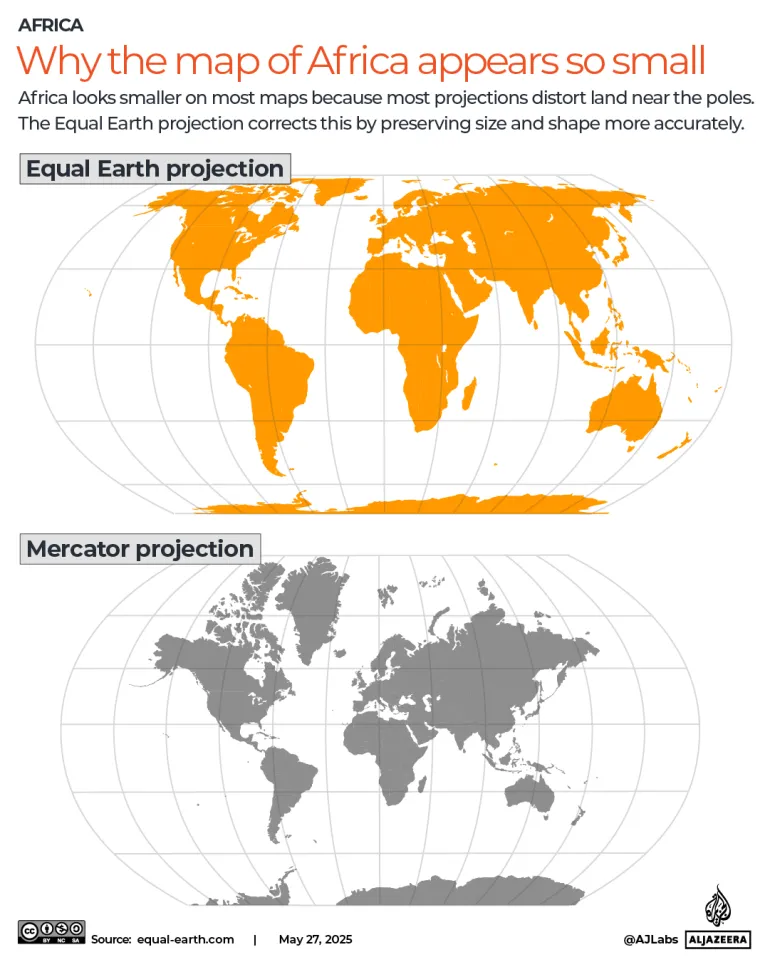
The UN endorsed a resolution promoting the Equal Earth projection of the world map, rather than the Mercator projection, which is currently widely used.
The resolution does not ban Mercator or impose a particular replacement – it merely encourages nations to adopt the Equal Earth version, which was created by three researchers in 2018.
The Mercator projection, which was produced by Flemish cartographer Gerardus Mercator in 1569 when the West was busy “conquering” new territories, attempts to show a three-dimensional globe on a two-dimensional surface. That is why countries closer to the poles appear much larger than countries at the equator.
For decades, map experts have pointed out that Mercator’s projection disproportionately shrinks the true size of the African continent and that of other developing regions, while making Europe and the US seem much larger by comparison.
For example, Greenland is shown as roughly the same size as Africa, but, in reality, it could fit into the continent 14 times over. Europe, which is portrayed as bigger than South America, is actually half its size.
Advocates from African countries pointed out that the map is problematic because of the size issues. Importantly, they argued, it reinforces negative perceptions of Africa.
Several cartographers have attempted to develop equal area maps. However, African activists specifically pushed for the Equal Earth projection map, which significantly expands Africa and shrinks Europe and the US.
Experts say while maps are inherently inaccurate because of the constraints of depicting a spherical world on a flat plane, the Equal Earth projection is as close as it gets.
Why is Ukraine worried about the new map?
Ukraine was one of six countries which abstained from the vote at the UNGA, along with Estonia, Georgia, Moldova, Serbia and Lithuania, who voted in solidarity with Ukraine.
Kyiv has complained that the Equal Earth projection depicts the Russian-occupied Crimean peninsula in a distinctly lighter shade than mainland Ukraine.
Russia illegally occupied and annexed Crimea in February 2014, a move the UN has denounced.
Although the peninsula is also shaded differently from mainland Russia on the new map, its yellowish tint appears closer to the Russian shade than Ukraine’s.
“Ukraine does not in principle oppose the core issue addressed in this draft resolution,” Andrii Melnyk, the country’s permanent representative to the UN, said in an address to the assembly.
Melnyk said Kyiv had asked for corrections before the vote but had not received positive responses. The new map, he said, could be tantamount to opening a Pandora’s box, enabling the “abuse and distortion” of the world map.
“It would be a truly fatal mistake for all of us, and for this General Assembly, to seek to correct a historical injustice in the geographical depiction of countries and continents by simultaneously allowing a deeply troubling interpretation of the text of this draft resolution,” he added.
What is Japan demanding?
Meanwhile, on Thursday, Tokyo, which voted in favour of the new map, said it had also asked for corrections to the Equal Earth projection because the map uses the same colours and shades for Russian territory as it does for the disputed Kuril Islands.
Russia and Japan have long fought over control of the four islands, known in Russia as the Southern Kurils and in Japan as the Northern Territories. In 1945, during World War II, the Soviet Union invaded and annexed the islands as part of a pact with Western Allies that stipulated the Soviets would take the disputed territory. The islands’ Japanese inhabitants were removed.
Subsequently, Japan and the US have claimed that the islands were not part of the original pact. The islands, however, remain under Russian administration.
In August this year, Russia’s President Vladimir Putin paid his first-ever visit to the islands, drawing condemnation from Japan. Prime Minister Sanae Takaichi called the visit “absolutely unacceptable”, saying it “offends the sentiments of the Japanese people”.
This week, Chief Cabinet Secretary Minoru Kihara said the Japanese embassy in the US has asked Equal Earth’s creators to change the map.
“Displays that contradict the Japanese government’s position are seen [on the map],” Kihara said at a news conference. “We need to prevent incorrect perceptions regarding our country’s territories and geographical names from spreading.”
Why is India uneasy about the map?
India also voted in favour of the Equal Earth projection, but on Sunday, the Ministry of External Affairs published a caveat regarding depictions of the disputed border territory of Kashmir.
Following the Indian partition of 1947, both Pakistan and India lay claim to the former state of Jammu and Kashmir, which had been controlled by the British through indirect rule. The region has subsequently been a flashpoint for tensions between the two rivals and has led to several wars.
Parts of Kashmir are administered by Pakistan, while other parts are administered by India. China, which also disputes some Kashmir territory with India, administers its northeastern portion.
In his statement, spokesperson Randhir Jaiswal noted that the UN vote was in favour of encouraging the use of equal area projections and that it had not made the use of any one map mandatory.
“India’s sovereign territory, including the Union Territories of Jammu and Kashmir and Ladakh, must be depicted in accordance with India’s official map,” he said. “Any inaccurate or misleading depiction is unacceptable.”