SACRAMENTO — Two state lawmakers from Los Angeles want tougher penalties for disasters caused by industrial companies after a massive fire in Boyle Heights left neighbors struggling with smoky air and the smell of rotting meat.
Assemblymember Mark González and state Sen. María Elena Durazo, both Democrats, are seeking a new law that would require any new cold storage facility to create a contingency fund for emergencies.
The fund would be used to help neighbors mitigate the fallout from a disaster.
Los Angeles Mayor Karen Bass, who is running for reelection, will appear with González and Durazo at an event Wednesday to discuss the proposed laws.
Lineage’s 500,000-square-foot food warehouse in Boyle Heights caught fire on June 17. The company blames a power company, which was working on the warehouse’s roof, for the blaze.
The company, Altus Power, has denied responsibility, stating that the cause is undetermined. The company accused Lineage of finger-pointing instead of focusing on community relief.
Noxious smoke and an influx of rats and flies attracted to rotting meat stored at the facility have tormented neighbors. The Los Angeles County Department of Public Health has cited Lineage for unsanitary and nuisance conditions related to rodent and pest control violations.
Lineage recently applied for building permits to replace the site, which Bass called “a slap in the face” to Boyle Heights families.
A press release ahead of Wednesday’s news conference said the proposal by lawmakers “will ensure that Lineage can’t rebuild without being accountable to the community.”
González and Durazo plan to insert proposed legislation related to the Lineage fire into existing bills, a process known as “gut and amend.”
The politicians also want to allow for stiffer fines against companies following a disaster.
Their proposed legislation also would ensure that anyone who sues over the fire doesn’t have to pay state taxes on any settlement, and that local jurisdictions are responsible for pest extermination efforts.
Greg Lehmkuhl, president and chief executive of Lineage, said in a quarterly earnings call last week that the company has committed $3.3 million to the community in the aftermath of the fire.
“Safety remains our top priority, and I’m incredibly proud of our team and how they’re handling this very challenging situation,” Lehmkuhl said on the call.
Industrial stocks grabbed the spotlight this week as Wall Street digested earnings reports from companies including Lockheed Martin Corporation (LMT), 3M Company (MMM), RTX (RTX), and Honeywell Technologies (HON).
The industrial sector (XLI) has gained over 17.8% so far this
Sam Dimond, owner of event production company Spotlight Sound, said he had lost his livelihood in the fire. The headquarters of his business was based on the industrial site.
He said: “It’s gone, basically. Lots and lots of people have lost their livelihoods. We’ve got customers to serve, we’ve got employees that have a job, and at the minute they don’t have a place of work to go back to.”
Locals reported hearing the explosion on Friday afternoon.
Adrian Walker, 46, from Ashingdon, said: “The ground shook, buildings shook, windows rattled, birds flew off – and I am 15 miles away.
“I’ve never heard anything like it. At first, I thought it was the MoD in Shoeburyness trying out some new ordnance, but it was heard and felt for miles around.”
A Komoto official tests the company’s solar-powered smart flow control system in Kazakhstan. Photo by Komoto
SEOUL, June 25 (UPI) — South Korea’s industrial valve maker Komoto said Thursday that it is seeking to expand into the Kazakh market after wrapping up a field demonstration project in the Central Asian country.
The company said that it completed the installation and operational tests of its solar-powered smart flow control and SCADA system at a demonstration site in Kazakhstan.
Short for supervisory control and data acquisition, SCADA is an industrial automation system that enables operators to monitor, control, and collect real-time data from infrastructure remotely.
Following the successful trial, the system received final field performance certification from Kazvodkhoz, Kazakhstan’s state-owned water resources agency, according to Komoto.
The firm noted that the project confirmed the applicability of its technology to remote agricultural waterways and irrigation facilities not only in Kazakhstan but also across Central Asia.
Komoto CEO Ryan MK Ko said that the company plans to expand its presence in overseas water industry markets, particularly in Central Asia.
“Our biggest competitive edge is that our system allows for the stable operation of water management facilities even in remote areas with limited access to commercial power and communication infrastructure, while significantly reducing costs compared with conventional options,” Ko said in a statement.
“Based on the technology and operational data accumulated through pilot projects both at home and abroad, we will further advance our automated control and intelligent water management features,” he added.
Komoto is not publicly listed. It was founded in 1988 with technology and capital support from Motoyama, one of Japan’s leading manufacturers of industrial equipment, including valves.
This once declining industrial city is on the up, but not so much that it has been ruined – yet. See it now, mid-gentrification, before its humble seafood restaurants become overpriced and its beautifully curated museums and galleries overrun.
Five miles north-west of Porto city centre, Matosinhos (pronounced mh-to-ZEE-nyosh) is a municipality built on the fishing. After the construction of the vast Port of Leixões in the 19th century, its fishing industry boomed and supported 54 canneries in its mid-20th-century heyday. Two survive, but most have been demolished, along with the textile factories and sugar refinery that occupied the district south of the harbour, next to the extensive sands of Matosinhos beach, which are fringed by surf schools and rammed with Porto residents in summer.
Luxury apartment blocks have risen from the ashes of once prosperous industries, but these stand cheek by jowl with 19th-century tiled houses, abandoned buildings daubed with graffiti and faded mid-century architectural classics championing raw concrete. The faculty of architecture at the University of Porto exerted its influence on the city’s renaissance, and sights include works by Pritzker prizewinning architect Álvaro Siza, born in Matosinhos, and the coolly contemporary Casa da Arquitetura – a cultural centre and exhibition space incorporating Siza’s remodelled family home, plus warehouses used for bottling and packing port wine in the 19th century. When I visited, it was deserted.
Where to eat and drink
The bounty of the sea is on show at the strikingly modern Mercados Municipais. Photograph: Kuki Waterstone/Alamy
In 2025 Matosinhos was recognised as a Unesco creative city of gastronomy for its long history of harvesting and preparing produce from the sea. Though Leixões port has huge container docks and a futuristic cruise terminal, part of it remains a fishing harbour with its own fish market. Behind it is Rua Heróis de França, a street packed with seafood restaurants – many dating from the 1950s, when fishers set up basic premises in which to cook and serve their catch.
Here, the air is filled with the smoky aroma of grilled sardines. Follow your nose and take your pick as most are good, affordable – from €20 for two courses and a drink – and serve not just sardines but horse mackerel, golden bream, sea bass and percebes (goose barnacles), plucked from the rocks, a nugget of salty flesh extracted from a leathery tube.
The bounty of the sea is on show at the strikingly modern Mercados Municipais, where the first floor serves as an “incubator” for design and architecture start-ups. Downstairs, you can select fish from a stall and have it cooked at an outlet on the fringes, or check out Bistrô by Vila Foz, a spin-off from the Michelin-starred Vila Foz in Porto, presided over by chef Arnaldo Azevedo. I had tuna tartare with avocado and chilli, horse mackerel escabeche, and a cataplana fish stew.
Across the Leça River is the parish of Leça da Palmeira. Next to the 17th-century Leça da Palmeira fort, Rua do Castelo has a handful of decent, reasonably priced restaurants – as well as the O Batô nightclub, a 1970s classic, one of several bars in the area. Back near the port, A Marisqueira de Matosinhos restaurant serves the most generous seafood platter I have tasted. Soup, main course and wine from €45.
Heading north up the coast, 7 miles from Matosinhos is Angeiras with its beachy, sun-drenched Atlantic vibe and small fishing community. A Casa do Gordo serves shared plates of percebes, prawns, octopus, grilled sardines and codfish tempura, and main courses including bream with arroz malandro (a soupy rice dish). Meals from €30 a head, with wine.
Cultural experiences
Álvaro Siza’s Piscina das Marés saltwater pools are shaped to follow the rocky contours of the coast. Photograph: Josef Kubes/Alamy
Here, it is all about architecture – not just signature works by Álvaro Siza and other Portuguese masters, but the pristine and pleasing spaces in which everything from art to tins of sardines is presented. One highlight is the Piscina das Marés, Siza’s stunning 1960s complex of two seawater pools, changing rooms and bar, following the rocky contours of the coast in Leça da Palmeira. Busy in high summer, it is best visited in June or September for a taste of Siza’s playful use of light, shade and ocean views and his love of weather-resistant concrete and wood.
The same materials and mischief are evident at Siza’s landmark Casa de Chá da Boa Nova, opened as a tea room in 1963 and now a two-Michelin-star restaurant with a €140-plus tasting menu. Stand on the rocky promontory outside and take in views of the coast and the Farol da Boa Nova, the second-tallest lighthouse in Portugal.
Álvaro Siza’s Casa de Chá da Boa Nova is now a two-Michelin-star restaurant. Photograph: Luso Architecture/Alamy
For a cultural one-stop shop, head to the area around the city hall, where the Galeria Municipal exhibits works by Portuguese contemporary artists. Opposite is the Museu da Memória, located in the Visconde de Trevões mansion, built between 1910 and 1913 as a home for rubber baron and philanthropist Emídio José Ló Ferreira. Beautifully restored, airy and inviting, it is now a museum celebrating the history and culture of Matosinhos, with an Archive of the First Person – recordings made by local people sitting in a soundproof booth.
On Avenida Menéres, immerse yourself in the light, space and designer ambience of Casa da Arquitetura, housed in part of the Quarteirão da Real Vinícola complex of renovated wine warehouses, with exhibition spaces, a cafe, a shop and an archive of architectural projects from Portugal and its former colonies. A couple of blocks away, Conservas Pinhais is one of two surviving canneries in the city and offers interactive tours of its sardine factory and museum – highly professional and fun.
Where to shop
Flashy stores selling designer furniture and covetable surfing gear are springing up, but in Matosinhos (as opposed to Porto) retail therapy isn’t really a thing; food is the focus. Pick up beautifully packaged tins of Pinhais or Nuri branded sardines after your factory tour, or shop for cheeses, olive oils or rice at the Mercados Municipais.
Pinhais sardines. Photograph: Godong/Alamy
Don’t miss
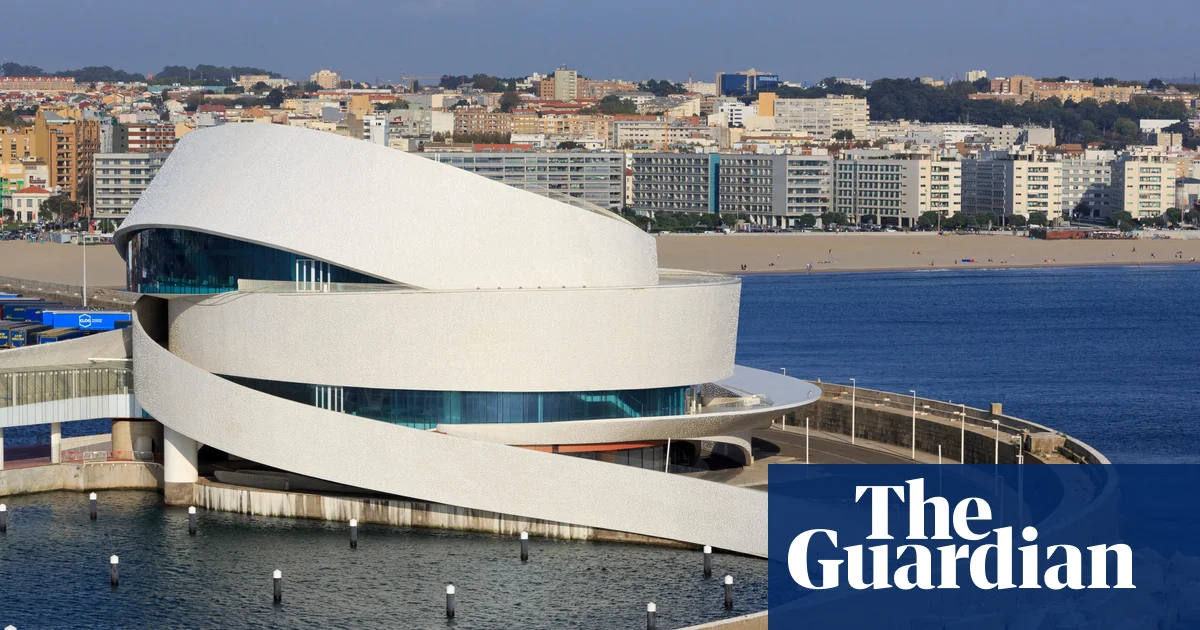
Of all the city’s architectural landmarks, the futuristic Porto Cruise Terminal is the most conspicuous. Dominating the Port of Leixões, the white circular building recalls (variously) coiled ribbons, a seashell – thanks to the play of light on the million hexagonal tiles cladding its surface – and an octopus with four “tentacles” that are actually ramps. Completed in 2015, and the catalyst for a tourism boom in Matosinhos, it houses the laboratories of CIIMAR, a University of Porto research and training institution dedicated to maritime science. The view from the rooftop is sensational and a guided tour (Sundays only) essential.
Where to stay
Totally in keeping with Matosinhos and its history is the Vintage Beach House (doubles from £111), built in 1851 and once the holiday home of Portuguese aristocrats. Faithfully restored with period details intact, including a majestic wooden staircase, the seven-bedroom guesthouse with its red facade is family-owned and near the beach, but most rooms are small and there is no restaurant. For more space and facilities but less character, consider Eurostars Matosinhos (doubles from £63) or the Sea Porto Hotel (doubles from £82).
The trip was organised by the City of Matosinhos; meals were provided by the restaurants named