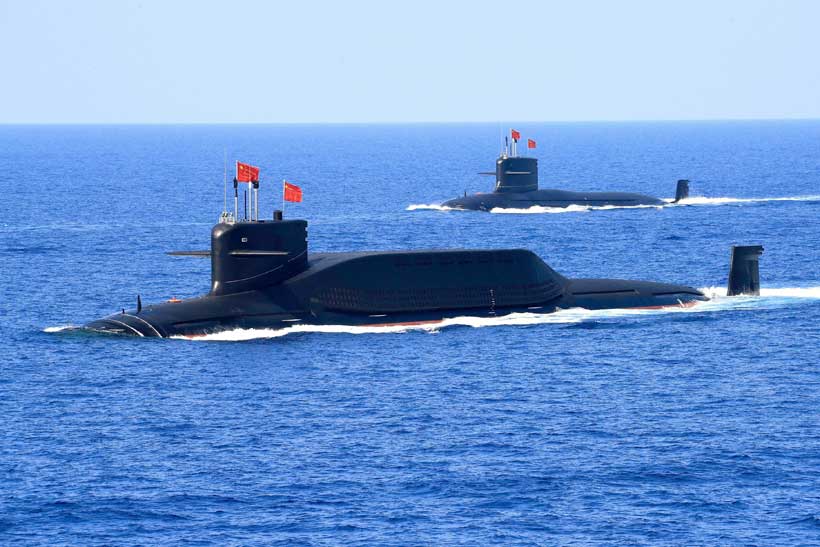
China Missile Test Raises Fears of Growing Pacific Militarisation
China’s test of a nuclear-capable missile into the Pacific has exposed the growing divisions among Pacific island nations over the increasing militarisation of a region they have sought to preserve as an “Ocean of Peace”.
The July launch, China’s first known ballistic-missile test into the Pacific since September 2024, took place just hours after Fiji and Australia signed a major defence treaty, marking Fiji’s first formal alliance. The timing highlighted the increasingly complex security environment in a region where China, the United States and their allies are competing for influence.
More than a month after the test, Pacific Islands foreign ministers were unable to agree on a collective statement condemning Beijing’s missile launch, despite individual leaders expressing concern about the growing military presence in the region.
Papua New Guinea Foreign Minister Justin Tkatchenko described the test as “totally inappropriate”, while stressing that China remained a close friend and ally of Papua New Guinea. He said Beijing had provided advance notice of the launch but had not given details about where the missile would land.
Stay ahead of the geopolitical week.
MD Briefing delivers expert analysis across five global fronts — the Indo-Pacific, energy, geoeconomics, European security, and the Middle East — every Monday morning. Free.
China defended the test, saying it had been conducted safely and urging countries not to over-interpret the launch.
Growing Military Activity in the Pacific
The missile test came after a year of increasingly visible military activity across the Pacific, a region that has become a major arena of strategic competition between the United States and China.
Chinese naval deployments and live-fire exercises in the Tasman Sea have coincided with U.S.-allied military exercises around Guam and Hawaii. Warship visits and expanding security partnerships have also increased across the region.
The United States retains a substantial military presence in the Pacific, including in Hawaii, Guam and the Marshall Islands.
For Pacific island governments, the growing military presence creates an increasingly difficult choice. Security partnerships can provide valuable capabilities for surveillance, disaster response, policing and training, but they can also increase the possibility that Pacific territory and waters become incorporated into wider strategic competition.
Tuvalu permanent foreign secretary Pasuna Tuaga expressed concern about the broader militarisation of the region, including security arrangements such as the AUKUS partnership between Australia, Britain and the United States.
Pacific Nations United in Principle but Divided in Practice
Pacific leaders endorsed the Ocean of Peace Declaration in September 2025, committing themselves to protecting the region and strengthening international peace and security.
The initiative reflected a long-standing desire among Pacific states to ensure that their security agenda is not dictated by larger external powers.
The defence agreement between Australia and Fiji, known as the Ocean of Peace Alliance, emerged from this broader regional framework.
But the growing number of security partnerships has created an inherent contradiction. Pacific governments want greater security capabilities while simultaneously opposing the militarisation of their region.
Australia and other partners argue that defence cooperation can strengthen regional resilience. Critics, however, fear that expanding bilateral arrangements could eventually leave Pacific nations with less influence over how their territory, waters and infrastructure are used.
Solomon Islands Foreign Minister Rick Houenipwela said the regional agenda must remain “conceived by the Pacific, shaped by the Pacific and only by the Pacific.”
Yet the failure to produce a unified response to China’s missile test demonstrated just how difficult that principle is to implement.
China Divides Regional Consensus
The disagreement over the missile test reflects the different political and economic interests of Pacific island nations.
Kiribati and Nauru, which have deepened their relations with Beijing after switching diplomatic recognition from Taiwan, did not support the wording of the proposed statement, according to an official familiar with the discussions.
New Zealand Foreign Minister Winston Peters blamed foreign influence for the failure to reach consensus, although he did not identify a particular country.
The disagreement demonstrates that Pacific nations do not share a uniform approach toward China.
Some governments see Beijing as an important economic and diplomatic partner, while others are increasingly concerned about its military activities and the strategic implications of its expanding regional presence.
At the same time, many Pacific governments remain wary of becoming closely aligned with either China or the Western powers.
The Security Dilemma Facing the Pacific
The central problem for Pacific nations is the tension between security and strategic autonomy.
Countries require surveillance capabilities, military training, disaster-response mechanisms and other security resources. Defence partnerships can provide those capabilities.
But greater reliance on external powers can also make it more difficult for Pacific governments to maintain an independent regional agenda.
Fiji Foreign Minister Sakiasi Ditoka acknowledged this tension, saying countries wanted to be free from “war-making paraphernalia” while also recognising that some security capabilities helped keep them safe.
Fiji’s participation for the first time in U.S.-led RIMPAC military exercises further illustrates this balancing act.
The country is simultaneously promoting the idea of an Ocean of Peace while becoming more involved in established regional security structures.
Analysis: The Pacific Is Becoming a Strategic Battleground
The significance of China’s missile test goes beyond the launch itself. It has exposed the growing gap between the Pacific’s aspiration to remain an “Ocean of Peace” and the strategic realities surrounding it.
The region is increasingly being shaped by competing security partnerships, military exercises and the expanding strategic presence of major powers. China is becoming more active militarily, while the United States, Australia and their partners are strengthening their own defence relationships.
For Pacific island states, the challenge is therefore not simply whether to oppose China’s military activities. It is how to respond to them without allowing the Pacific’s security agenda to become dominated by great-power rivalry.
The failure to agree on a common statement is particularly significant because regional unity is one of the Pacific’s strongest tools for maintaining its diplomatic autonomy. When governments cannot agree on how to respond to a major security development, external powers gain greater room to shape the regional agenda.
At the same time, completely rejecting security partnerships would leave many Pacific states without capabilities they consider increasingly necessary. The result is a difficult balancing act: accepting enough external security assistance to address genuine threats while preventing those partnerships from transforming the region into a military theatre.
China’s missile test therefore exposes a deeper strategic dilemma. The more Pacific states seek security through external alliances, the greater the risk that the region becomes militarised; yet the more they reject those partnerships, the harder it may become to respond to an increasingly competitive security environment.
The upcoming Pacific Islands Forum leaders’ meeting in Palau is likely to bring these questions back to the centre of regional diplomacy. The key issue will be whether Pacific nations can establish a collective security approach that protects their interests without allowing the strategic competition between China and Western powers to define the future of the region.
With information from Reuters.