L.A.’s district attorney changed his mind. Is that such a bad thing?
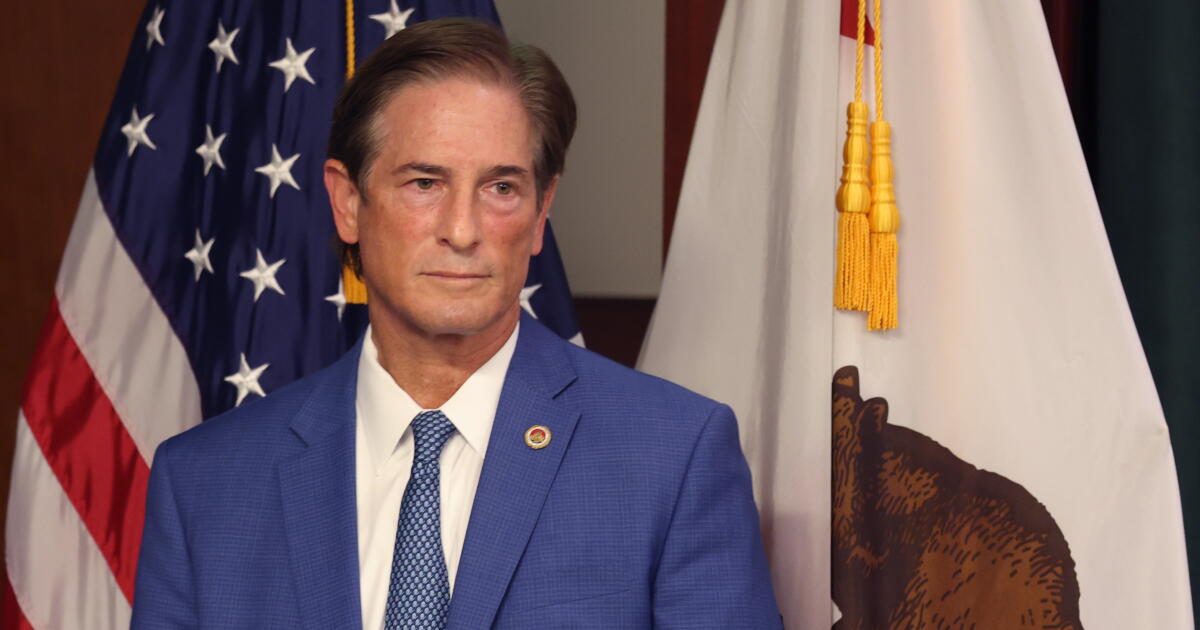
L.A. County Dist. Atty. Nathan Hochman did something last week few prosecutors ever do — changed his mind in public, swapping out felony charges for misdemeanors in the case of an LAPD officer accused of secretly taping homophobic, racist and misogynistic remarks made by colleagues.
Since then, Hochman has been slammed for playing politics, embarrassing his office and even backing down for no reason other than the pressure was too intense.
Not a stellar look for a politician relatively new to elected office.
After speaking with Hochman about the reversal, I have a more optimistic take on it — drawn from a Talmudic quote that Hochman keeps on his desk, and which his father — a tax lawyer who represented at least one mobster — kept on his desk before him.
It’s Deuteronomy 16:20, “Tzedek, tzedek, tirdof” — Justice, justice you shall pursue.
It’s that double justice that holds weight in this situation, because, as Hochman explains it, his god rarely repeats himself without reason. Hochman said he reads that echo as referring to two parts of delivering justice — the process and the result.
“We try to get the right result. We try to get it in the right way,” Hochman told me.
When things go wrong, like they did in this case, he’ll reevaluate, he said, even if it leaves him with egg on his face.
“If that means that I have to publicly come out at a press conference and say that our initial decision-making, and what went into it, turns out not to have been perfect, and it is not set in stone, and we think there’s a better way of doing something, I’m going to stand up in a press conference and say exactly that,” he said.
A prosecutor who is willing to change his or her mind is critical to delivering real justice, because people get things wrong. Hochman holds incredible power over the thousands of lives entangled in the matters his office handles. Leaving that power of process in the hands of someone who can’t admit they made a mistake (as is the case with more D.A.’s than not) puts justice on a greased slide into a cesspool of hubris.
The distinction between the two forms of justice may seem like splitting hairs, but to anyone who has ever been involved with our justice system — as a victim or defendant, innocent or guilty — being dragged into a prosecution can often feel like an avalanche of misfortune.
Don’t get me wrong. I don’t think every person charged with a crime is a victim. There are plenty of predators out there, committing violations big and small, that require accountability.
But the process of administering justice is far more subjective and messy than we often admit. Sometimes, even when the prosecutor involved almost certainly knows something other than justice is in the works, there is a momentum of ego and bureaucracy that is hard to reverse.
And it doesn’t take a guilty verdict to derail a life. Simply having charges filed can mean a job loss, losing custody of kids, incarceration for months or years waiting for a trial, financial hardship and stigma.
We like to think of an innocent verdict as a great vindication, but by the time one arrives, if it does, a lifetime of damage may already have been done — that is the unseen power of process.
Just ask Daniel Flores, the LAPD officer whose case we’re talking about. Though he likely will eventually see all criminal charges dismissed, Flores told my colleagues Libor Jany and Richard Winton that this incident has “ruined” his life.
Hochman for weeks has faced intense public anger over his initial decision to charge Flores with 16 felonies. Folks from the lofty heights of the mayor to this lowly columnist objected, pointing out that punishing whistleblowers, even ones who may have technically broken the law as Hochman said Flores likely did (though Flores’ lawyer disputes that), would chill other officers from coming forward.
Hochman at first defended the charges, pointing out that as a sworn officer, Flores had an even higher duty to adhere to the letter and spirit of the law.
But, he said, he was unprepared for how strongly the public would react to the whistleblower part of the case. Though he contends he never meant to send a message silencing those who would expose wrongdoing, he concedes that did happen.
“People interpreted it that we’re trying to discourage all whistleblowers by the way we went about this prosecution,” Hochman said.
He also acknowledges that he is still learning what it means to be in this elected office. Though he has been both a federal prosecutor and a defense attorney, this is by far the most publicly accountable and visible role he has held, and he’s still figuring out that part of the job. It’s easy to be the candidate lobbing criticisms, or even the defense lawyer arguing the facts. It is much harder to be the person answerable to the nearly 10 million people of Los Angeles County when it comes to ensuring they feel both protected and respected by the law.
In his first year in office, more than one civil liberties advocate has taken issue with his approach.
“It is a continuous learning experience. In fact, anyone who takes this job and doesn’t view this as a daily learning experience cannot possibly do the job well,” he said. “If you don’t adapt to what’s out there, you don’t listen to what’s going on … you will fail, and by failure, I mean that you won’t achieve a society where people trust that the district attorney’s office is doing its job and doing it as best as it possibly could,” he said.
He blames the media in part for distracting from his accountability message in favor of the whistleblower-chilling angle in the Flores case — likely including headlines such as the one I wrote, “Protecting the blue wall of silence is not justice in LAPD whistleblower case.”
I’m willing to stand by the process that got me to that opinion, and also to give Hochman credit for being willing to change direction on his process when it was leading our city down the wrong path.
There are plenty of places where I hope Hochman will apply that rigor in the future — issues such as the death penalty, which he has brought back to Los Angeles, or in other difficult cases such as the killing of Keith Porter Jr. by an off-duty ICE agent. Porter’s family recently asked Hochman to convene a grand jury to hear the facts.
But that Hochman thinks about process, and the power that it holds, speaks well for justice in Los Angeles — even, maybe especially, when things go awry.