GOP leaders sound increasingly confident they can pass a spending package and end partial shutdown
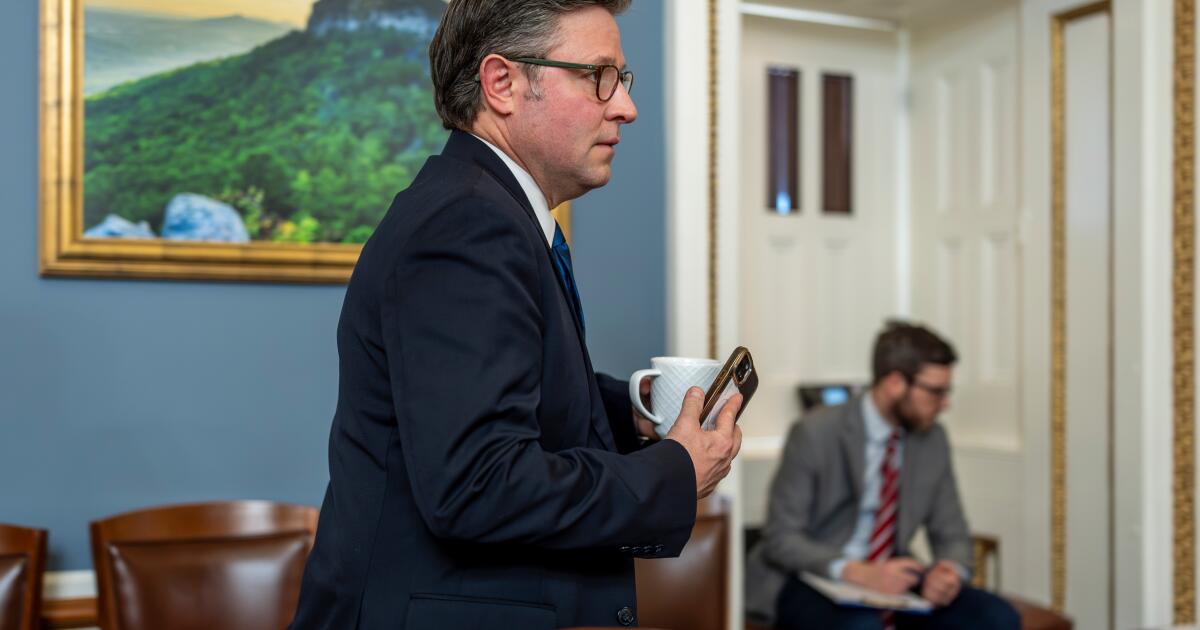
WASHINGTON — Speaker Mike Johnson’s ability to carry out President Trump’s “play call” for funding the government will be put to the test on Tuesday as the House votes on a bill to end the partial shutdown.
Johnson will need near-unanimous support from his Republican conference to proceed to a final vote, but he and other GOP leaders sounded confident during a Tuesday morning press conference that they will succeed. Johnson can afford to lose only one Republican on party line votes with perfect attendance, but some lawmakers had threatened to tank the effort if their priorities are not included. Trump weighed in with a social media post, telling them, “There can be NO CHANGES at this time.”
“We will work together in good faith to address the issues that have been raised, but we cannot have another long, pointless, and destructive Shutdown that will hurt our Country so badly — One that will not benefit Republicans or Democrats. I hope everyone will vote, YES!,” Trump wrote on his social media site.
The measure would end the partial government shutdown that began Saturday, funding most of the federal government through Sept. 30 and the Department of Homeland Security for two weeks as lawmakers negotiate potential changes for the agency that enforces the nation’s immigration laws — U.S. Immigration and Customs Enforcement, or ICE.
“The Republicans are going to do the responsible thing,” Johnson said.
Running Trump’s ‘play call’
The House had previously approved a final package of spending bills for this fiscal year ending Sept. 30, but the Senate broke up that package so that more negotiations could take place for the Homeland Security funding bill. Democrats are demanding changes in response to events in Minneapolis, where two American citizens were shot and killed by federal agents.
Johnson said on Fox News Channel’s “Fox News Sunday” it was Trump’s “play call to do it this way. He had already conceded he wants to turn down the volume, so to speak.” But GOP leaders sounded as if they still had work to do in convincing the rank-and-file to join them as House lawmakers returned to the Capitol on Monday after a week back in their congressional districts.
“We always work till the midnight hour to get the votes,” said House Majority Leader Steve Scalise, R-La. “You never start the process with everybody on board. You work through it, and you could say that about every major bill we’ve passed.”
The funding package passed the Senate on Friday. Trump says he’ll sign it immediately if it passes the House. Some Democrats are expected to vote for the final bill but not for the initial procedural measure setting the terms for the House debate, making it the tougher test for Johnson and the White House.
Democratic leader Hakeem Jeffries has made clear that Democrats wouldn’t help Republicans out of their procedural jam, even though Senate Democratic leader Chuck Schumer helped negotiate the funding bill.
Jeffries, of New York, noted that the procedural vote covers a variety of issues that most Democrats oppose, including resolutions to hold former President Bill Clinton and former Secretary of State Hillary Clinton in contempt of Congress over the Jeffrey Epstein investigation.
“If they have some massive mandate,” Jeffries said of Republicans, “then go pass your rule, which includes toxic bills that we don’t support.”
Key differences from the last shutdown
The path to the current partial shutdown differs from the fall impasse, which affected more agencies and lasted a record 43 days.
Then, the debate was over extending temporary coronavirus pandemic-era subsidies for those who get health coverage through the Affordable Care Act. Democrats were unsuccessful in getting those subsidies included as part of a package to end the shutdown.
Congress has made important progress since then, passing six of the 12 annual appropriations bills that fund federal agencies and programs. That includes important programs such as nutrition assistance and fully operating national parks and historic sites. They are funded through Sept. 30.
But the remaining unpassed bills represent roughly three-quarters of federal spending, including the Defense Department. Service members and federal workers could miss paychecks depending upon the length of the current funding lapse.
Voting bill becomes last-minute obstacle
Some House Republicans have demanded that the funding package include legislation requiring voters to show proof of citizenship before they are eligible to participate in elections. Rep. Anna Paulina Luna, R-Fla., had said the legislation, known as the SAVE Act, must be included in the appropriations package.
But Luna appeared to drop her objections late Monday, writing on social media that she had spoken with Trump about a “pathway forward” for the voting bill in the Senate that would keep the government open. Luna and Rep. Tim Burchett, R-Tenn., met with Trump at the White House.
The Brennan Center for Justice, a think tank focused on democracy and voting rights issues, said the voting bill’s passage would mean that Americans would need to produce a passport or birth certificate to register to vote and that at least 21 million voters lack ready access to those papers.
“If House Republicans add the SAVE Act to the bipartisan appropriations package it will lead to another prolonged Trump government shutdown,” said Schumer, of New York. “Let’s be clear, the SAVE Act is not about securing our elections. It is about suppressing voters.”
Johnson, of Louisiana, has operated with a thin majority throughout his tenure as speaker. But with Saturday’s special election in Texas, the Republican majority stands at a threadbare 218-214, shrinking the GOP’s ability to withstand defections.
Freking writes for the Associated Press. AP video journalist Nathan Ellgren and writer Lisa Mascaro contributed to this report.