In Pictures

Clashes in Belgrade as student-led protests demand elections | Police News

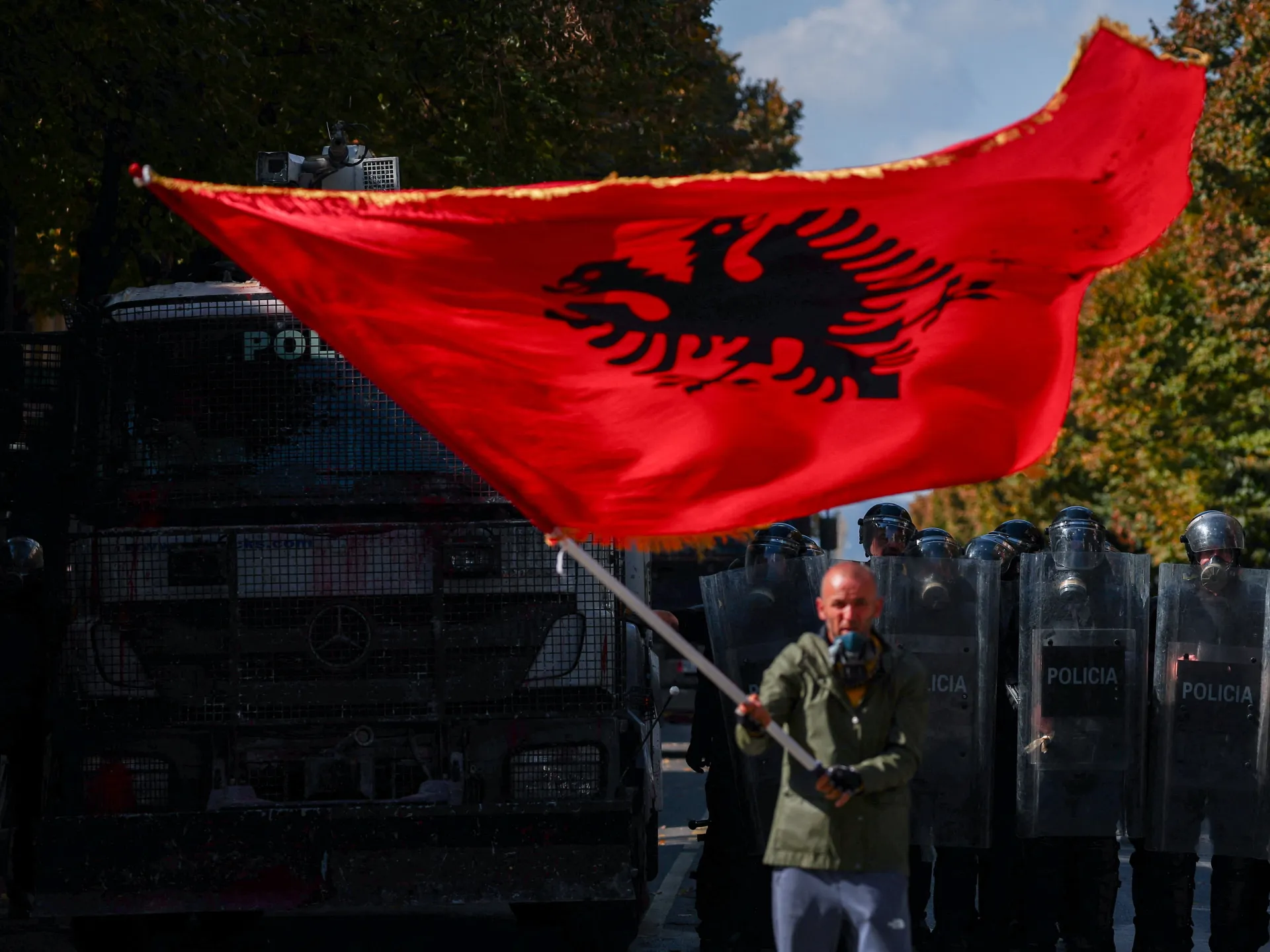
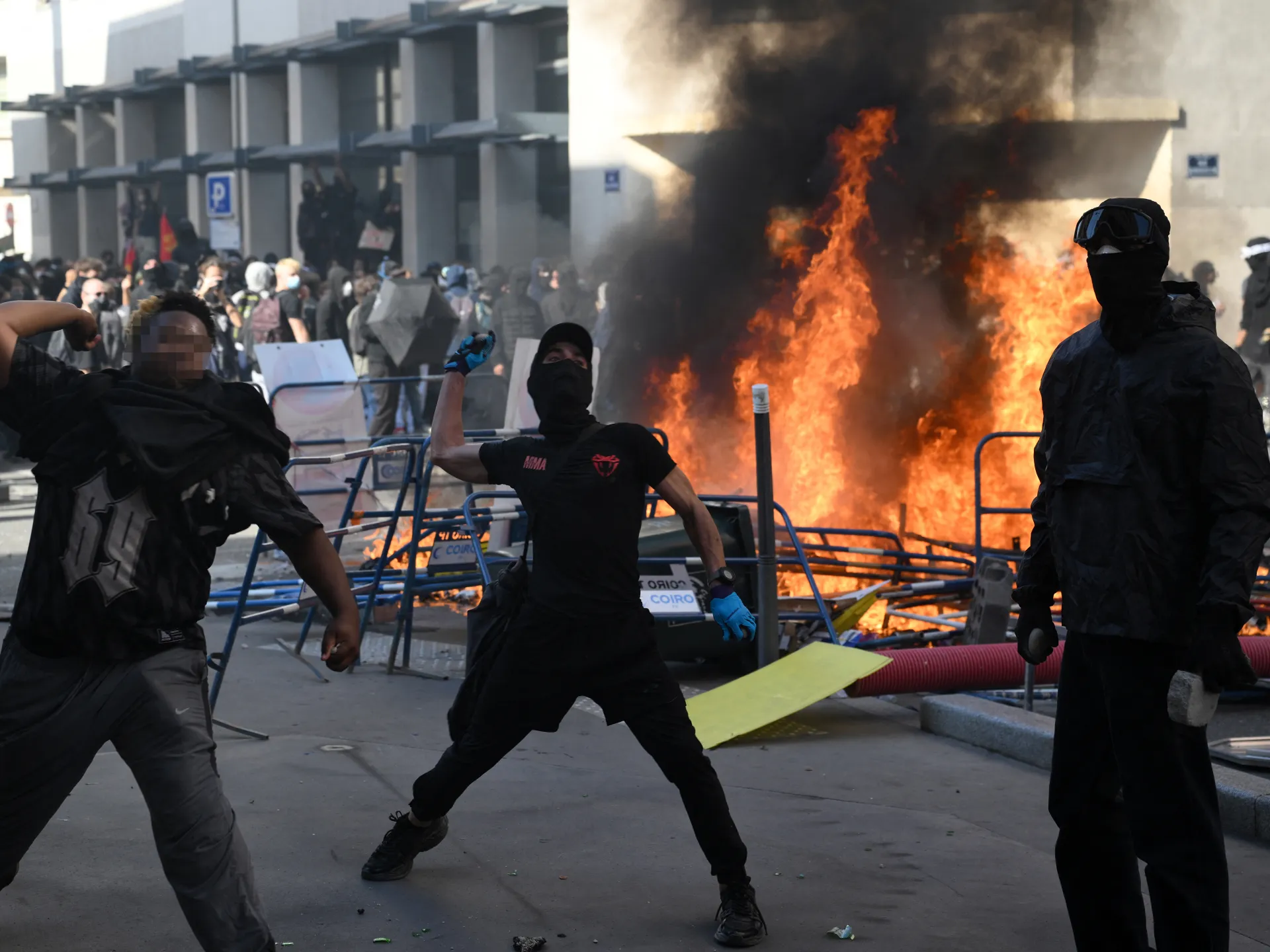
Clashes have broken out between protesters and riot police after an antigovernment rally in the Serbian capital, Belgrade.

Large crowds of demonstrators poured into central Belgrade on Saturday, many carrying banners and wearing T-shirts emblazoned with the “Students win” motto of the youth movement that organised the gathering.

Serbian President Aleksandar Vucic has sought to rein in mass demonstrations that have challenged his hardline rule in the Balkan country. The size of Saturday’s turnout suggested that dissent remains strong more than a year after protests first began with demonstrators demanding accountability for a train station tragedy in northern Serbia in November 2024 that killed 16 people.

Anticorruption protests forced then-Prime Minister Milos Vucevic to resign in January 2025 before the authorities moved to clamp down on the movement. Many in Serbia blamed the concrete canopy collapse at the station on alleged corruption-fuelled negligence during renovation work carried out with Chinese companies.

On Saturday, Serbia’s state railway company cancelled all trains to and from Belgrade in what appeared to be an effort to prevent at least some people from travelling to the capital from other parts of the country.

In a video posted on Instagram on Saturday, the president said protesters “have shown their violent nature and that they cannot stand political opponents”. Vucic, who was en route to China for a state visit, added: “The state is functioning and will continue to work in line with the law.”

Students on Saturday demanded early elections and the rule of law, accusing the government of crime and corruption. They said they now plan to challenge Vucic in this year’s elections, which they hope will unseat his right-wing populist government. Vucic said on Thursday that the parliamentary elections could be held between September and November.

Clashes were first reported near a park camp of Vucic loyalists outside the Serbian presidency building. The camp was set up before another large antigovernment rally last March as a human shield against protesters. Folk music blared from a fenced-off area surrounded by rows of riot police in full gear.

The Serbian president has come under international scrutiny for his hardline tactics against demonstrators over the past year, including arbitrary arrests and the use of excessive force. The Council of Europe’s commissioner for human rights, Michael O’Flaherty, criticised Serbia’s government in a report after he visited the country last week and said he “will monitor the situation closely”.

O’Flaherty also cited “reports of police protecting unidentified and often masked attackers of journalists and protesters”. He said the overall human rights situation has deteriorated since his previous visit in April 2025.

Serbia is seeking to join the European Union while cultivating close ties with Russia and China. Democratic backsliding under Vucic could cost the country about 1.5 billion euros ($1.8bn) in EU funding, the bloc’s top enlargement official warned last month.

Source link

Kenya transport strike paused after deadly protests | Protests News

A nationwide transport strike in Kenya over surging fuel prices, blamed on the United States-Israeli war on Iran, has been suspended for a week after four people were killed in mass protests against the increases.

Kenya, one of many African countries heavily reliant on fuel imports from the Gulf, has raised petrol prices by 20 percent and diesel by almost 40 percent since Iran in effect blocked traffic through the Strait of Hormuz, a key chokepoint that normally handles about a fifth of the world’s oil.

The strike was launched on Monday by transport operators, particularly the “matatu” bus operators who provide most of Kenya’s public transport, in response to the latest sharp fuel price hike.

“The strike that is going on is suspended for a period of one week to provide an avenue for consultations and negotiations between the government and stakeholders,” interior minister Kipchumba Murkomen told reporters on Tuesday.

Albert Karakacha, the president of Matatu Owners Association, confirmed the suspension.

Authorities said four people were killed and more than 30 were injured nationwide on Monday. Police said on Tuesday that more than 700 people had been arrested in connection with the protests over fuel price increases.

Rights groups condemned the use of lethal force by security forces, with Amnesty International calling for “maximum restraint”.

The unrest also disrupted Kenya’s main trade corridor, with local media reporting that truck drivers had refused to move cargo amid fears their vehicles could be attacked and set alight by demonstrators.

The national energy regulator said last week the government had spent $38.5m to cushion consumers from rising diesel and kerosene costs.

In a further emergency measure, Kenyan authorities last month temporarily suspended fuel quality standards in a bid to maintain supplies amid growing shortages.

Despite being one of East Africa’s most dynamic economies, Kenya still has deep structural inequalities: about a third of its roughly 50 million people live in poverty and unemployment remains high.

Source link

Scaled-back Victory Day parade held in Moscow | In Pictures News

Russia has held one of its most scaled-back Victory Day parades in years, citing the threat of attack from Ukraine, where a decisive victory for Moscow’s forces has remained elusive more than four years into the deadliest conflict in Europe since World War II.

The May 9 parade on Moscow’s Red Square is Russia’s most revered national holiday, a moment to celebrate the Soviet Union’s defeat of Nazi Germany and to commemorate the 27 million Soviet citizens, including many from what is now Ukraine, who were killed during the war.

Once used to showcase Russia’s military might, including its nuclear-capable intercontinental ballistic missiles, this year’s parade featured no tanks or other heavy military hardware rolling across the cobblestones of Red Square.

Instead, weapons including a Yars intercontinental ballistic missile, the new Arkhangelsk nuclear submarine, the Peresvet laser weapon, the Sukhoi Su-57 fighter jet, the S-500 surface-to-air missile system and a range of drones and artillery were displayed on giant screens on the square and broadcast on state television.

Soldiers and sailors, some of whom have served in Ukraine, marched and chanted as President Vladimir Putin looked on, seated alongside Russian veterans in the shadow of Vladimir Lenin’s Mausoleum. North Korean troops, who have fought against Ukrainian forces in Russia’s Kursk region, also took part in the march.

Fighter jets flew above the Kremlin’s towers and Putin delivered an eight-minute address, promising victory in the war in Ukraine, which the Kremlin refers to as a “special military operation”.

“The great feat of the victorious generation inspires the soldiers carrying out the tasks of the special military operation today,” Putin said. “They are confronting an aggressive force armed and supported by the entire NATO bloc. And in spite of that, our heroes march forward.”

Source link

Aid cuts, drought and conflict leave Somalis desperate | Drought News

Maryam watched her goats starve and her crops fail. She buried two of her children before she finally gave up hope and sought help from international aid agencies in southern Somalia.

She left her village with her remaining six children, making the long journey along the Jubba River to one of a clutch of makeshift settlements on the outskirts of Kismayo, the capital of Somalia’s Jubbaland state.

Three consecutive seasons of failed rains have doubled Somalia’s malnutrition rate. Maryam, 46, is among more than 300,000 Somalis forced to leave their homes since January alone.

Several international organisations have stopped operations in the Kismayo camp for internally displaced people (IDPs), largely due to aid cuts ordered by United States President Donald Trump last year.

“We are hungry. We need care and help,” said Maryam.

Haunted by the memory of her dead children’s swollen bellies, she says she will not return to her village, which is under the control of the al-Qaeda-linked armed group al-Shabab. Fighters there have started seizing the limited food supplies available.

Somali internally displaced children
Children play near their makeshift shelters at an IDP camp in Ceel Cad, Kismayo town [Simon Maina/AFP]

But the camp is hardly better. In March alone, five children died of malnutrition, its manager says.

Since the early 1990s, Somalia has endured near-constant civil war, armed rebellions, floods and droughts. The war-torn country ranks among the world’s most vulnerable to climate change, which scientists say is leading to more frequent and more intense episodes of extreme weather such as droughts and floods.

Africa, which contributes the least to global warming, bears the brunt.

The recent cuts in foreign aid have not helped. They have had “a huge impact on our work”, said Mohamud Mohamed Hassan, Somalia director for NGO Save the Children.

More than 200 health centres and 400 schools have closed since last year.

Farmers, whose herds and crops have been decimated, describe one of the worst droughts ever recorded in a country where a third of the population already lacked regular meals. Even if the forthcoming rainy season is normal, it will take months for affected populations to recover.

“We cannot afford to actually address all the needs of these people,” said Ali Adan Ali, a Jubbaland official managing the displaced.

At a mobile health clinic supported by Save the Children, the only one still operating for multiple camps in the area around Kismayo, a woman named Khadija tried to feed a high-calorie solution to her severely malnourished one-year-old daughter.

She came to the camp after last year’s drought killed her livestock, but here also “we have nothing to eat”, the 45-year-old said.

A newly displaced Somali woman holds her severely malnourished baby in a stabilization centre for children suffering severe accute malnutrition in Kismayo,
A displaced woman holds her malnourished baby in a stabilisation centre for children suffering severe acute malnutrition in Kismayo [Simon Maina/AFP]

A hospital in Kismayo is the only facility in the region capable of treating the most severe cases of malnutrition. But it is turning patients away due to a lack of space and staff.

Every bed is occupied by starving babies, some on ventilators with intravenous drips in their fragile arms. Cases have tripled since last year, and things are only getting worse.

The US-Israel war on Iran has increased fuel prices, affecting food and water supplies.

Those in the camp seek work in construction or cleaning jobs in Kismayo or sell firewood, but the options are limited.

Meanwhile, the United Nations Office for the Coordination of Humanitarian Affairs (OCHA) has had to steadily reduce its Somalia programme from $2.6bn in 2023 to $852m this year, especially since Washington slashed its donations. So far, only 13 percent of this year’s target has been raised.

“It’s a toxic cocktail of factors … Things are really, really desperate,” Tom Fletcher, head of OCHA, told the AFP news agency in an interview last week.

“Often we’re having to choose which lives to save and which lives not to save.”

Source link

Colombia tourist jewel plagued by violence | In Pictures News

With snow-capped peaks tumbling towards the turquoise waters of the Caribbean, the Sierra Nevada de Santa Marta National Park is one of the jewels in Colombia’s tourism crown.

But behind the picture-postcard views lies a more sinister reality.

Armed groups are holding local businesses to ransom and terrorising Indigenous communities.

The signing of a 2016 peace deal between the Colombian state and the Revolutionary Armed Forces of Colombia (FARC) ended more than half a century of war and helped propel a country long associated with druglords and rebels onto the global tourism stage.

Since then, thousands of visitors have poured into the Sierra Nevada each day, trekking through pristine jungle to white-sand beaches or climbing towards Colombia’s mountaintop Lost City, which predates Peru’s Machu Picchu.

Few notice the men in camouflage watching from a distance.

They are members of the Self-Defence Forces of the Sierra Nevada (ACSN), a group of former paramilitaries that controls cocaine trafficking routes in the region and is also involved in illegal gold mining.

Extortion has become another lucrative business for the group. The “Conquistadores”, as ACSN members are often called, demand a cut of the earnings of hotels, tour bus companies and Indigenous communities, whose hand-woven hammocks and bags are snapped up by visitors.

“We are afraid and anxious about the future,” said Atanasio Moscote, the governor of the Kogui Indigenous people, who live high up in the Sierra Nevada de Santa Marta National Park, which the Kogui consider “the heart of the world”.

In February, the government closed Tayrona National Park, a UNESCO World Heritage Site overlooking the Caribbean, for more than two weeks following threats against park rangers, allegedly issued by the ACSN.

Authorities have accused the group of pressuring Indigenous Wayuu residents in the park to resist a crackdown on illegal activities such as logging.

Together, Tayrona and the Sierra Nevada national parks received more than 873,000 visitors last year.

The influx of tourists marks a dramatic shift from the 1980s and 90s, when the region was a battleground for brutal clashes between paramilitaries and FARC rebels.

Ten years after FARC laid down its arms, the ACSN – founded by a paramilitary leader who was later extradited to the United States – holds sway in much of the area.

In recent months, Colombia’s biggest drug cartel, the Gulf Clan, has tried to muscle in, vying for control and prompting clashes with the ACSN.

Caught in the middle are Indigenous communities “who don’t speak Spanish, and who live off their crops and their traditional knowledge”, said Luis Salcedo, governor of the Arhuaco people, who also live in the Sierra Nevada.

Gustavo Petro, Colombia’s first left-wing president in modern history, included the ACSN in his bid to negotiate the disarmament of all armed groups in the country.

But four years after he launched his “Paz Total” (total peace) campaign, the ACSN still dominates the Santa Marta area, said researcher Norma Vera.

Extortion has now emerged as a key issue in the campaign to elect Petro’s successor in polls starting on May 31.

The Ministry of Defence says it has received more than 46,000 extortion complaints since 2022.

Omar Garcia, president of the hotel association in the coastal city of Santa Marta, a gateway to the Sierra Nevada, said he fears for Colombia’s fragile tourism boom.

“Any news affecting the image [of a destination] and visitor safety makes tourists think twice,” he said.

Source link

Bomb attack on Colombia highway kills 19 ahead of election | Conflict News

A highway bomb attack in southwestern Colombia has killed 19 people and injured at least 38, the latest spate of violence ahead of next month’s presidential election.

Buses and vans were left mangled in the blast Saturday on the Pan-American Highway, in the restive southwestern Cauca department.

Several cars were flipped over by the force of the explosion and a large crater was blown out of the roadway.

The department’s governor on Saturday evening provided a death toll of 14, with more than 38 injured, but the National Institute of Legal Medicine and Forensic Sciences said Sunday morning it had begun the examination of 19 bodies.

Military chief Hugo Lopez told a news conference on Saturday that the bomb had exploded after assailants stopped traffic by blocking the road with a bus and another vehicle.

The attack comes just over one month ahead of national elections, in which voters will pick a successor to President Gustavo Petro.

Petro blamed the bombing on Ivan Mordisco, the South American country’s most-wanted criminal, whom the president has compared to late cocaine kingpin Pablo Escobar.

The violence came after a bomb attack on Friday on a military base in Cali, Colombia’s third-largest city, injured two people and set off a string of attacks in the Valle del Cauca and Cauca departments.

According to Lopez, 26 attacks have been recorded in the two departments over the past two days.

Authorities have boosted military and police presence in the areas, Defence Minister Pedro Sanchez said.

Security is one of the central issues of the May 31 presidential election. Political violence was brought into sharp focus last June, when young conservative presidential frontrunner Miguel Uribe Turbay was shot in broad daylight while campaigning in the capital Bogota and later died from his wounds.

Leftist Senator Ivan Cepeda, an architect of Petro’s controversial policy of negotiating with armed groups, is ahead in polls.

He is trailed by right-wing candidates Abelardo de la Espriella and Paloma Valencia, both of whom have pledged to take a hard line against rebel groups.

All three have reported receiving death threats and are campaigning under heavy security.

Source link