Gianni Infantino’s Kushner-linked cash grab imperils his FIFA reign
When Gianni Infantino was chosen to replace Sepp Blatter as president of FIFA, he was seen as a reformer, someone who would bring transparency and openness to soccer’s international governing body, which had long been mired in scandal and deceit.
A decade later the reformer has been exposed, hoisted by his own petard after a secret partnership with a member of President Trump’s family circle to sell 20% of the World Cup to private investors was exposed. It was a deal so brazen it made past FIFA transgressions seem quaint by comparison.
Less than two weeks after Infantino closed one of the most successful World Cups in history, one that brought in a record $15 billion in revenue, The Times of London revealed that Infantino had begun bribing FIFA’s 211-member associations, giving them until Sept. 19 to accept his plan to sell a stake in the commercial and tournament rights to the World Cup and other FIFA tournaments to a private equity firm headed by Joshua Kushner, the brother of Jared Kushner, Trump’s son-in-law and an inveterate White House counselor.
Sign on, the federations were told, and you’ll get $20 million. Decline, and FIFA will give you just a fraction of that.
Under pressure, Infantino announced Friday he was withdrawing the plan, known as the FIFA Forward Enterprise. But it turns out there was more to the proposal than originally thought.
Much, much more.
Which is why Infantino’s campaign for reelection to a fourth term as FIFA president next March, a campaign which had the support of more than 200 FIFA members two weeks ago, now appears doomed.
The national federations of Serbia, Sweden and Wales on Monday withdrew their support for Infantino and England’s FA is expected to do the same. UEFA, the governing body for European soccer and the largest and most powerful of FIFA’s six continental confederations, is threatening legal action while two other confederations — CONCACAF, the largest of FIFA’s two confederations in the Americans and the AFC, which manages soccer in Asia — have issued condemnations.
Those three confederations together represent nearly 140 FIFA members, meaning if they hold together there is no path for Infantino to get the 106 votes he would need to win reelection.
So how did we get here? How did Infantino go from progressive reformer, the overseer of newly transparent and accountable FIFA, to the man who literally tried to sell the World Cup? The journey may not have been as long as it seemed because Infantino may never have been the Boy Scout he was initially perceived to be.
Days after his first election as president in 2016, his name surfaced in leaked documents indicating that, while a senior legal official at UEFA, he had co-signed a broadcast deal with a company subsequently linked to a U.S. investigation into FIFA corruption. Later that same year, a FIFA committee opened an investigation into whether Infantino breached the organization’s Code of Ethics.
Infantino was eventually cleared by that probe but another pattern soon emerged, one that saw the president morph from a soccer bureaucrat into someone who believes he should be mixing with presidents and kings.
Infantino inherited World Cups that had already been awarded to Russia and Qatar, but he aggressively downplayed the human rights abuses in the two countries. Russian President Putin rewarded that by presenting the FIFA chief with the Order of Friendship medal. Qatar did better than that, giving Infantino use of a luxury Gulfstream G650 jet from its government fleet.

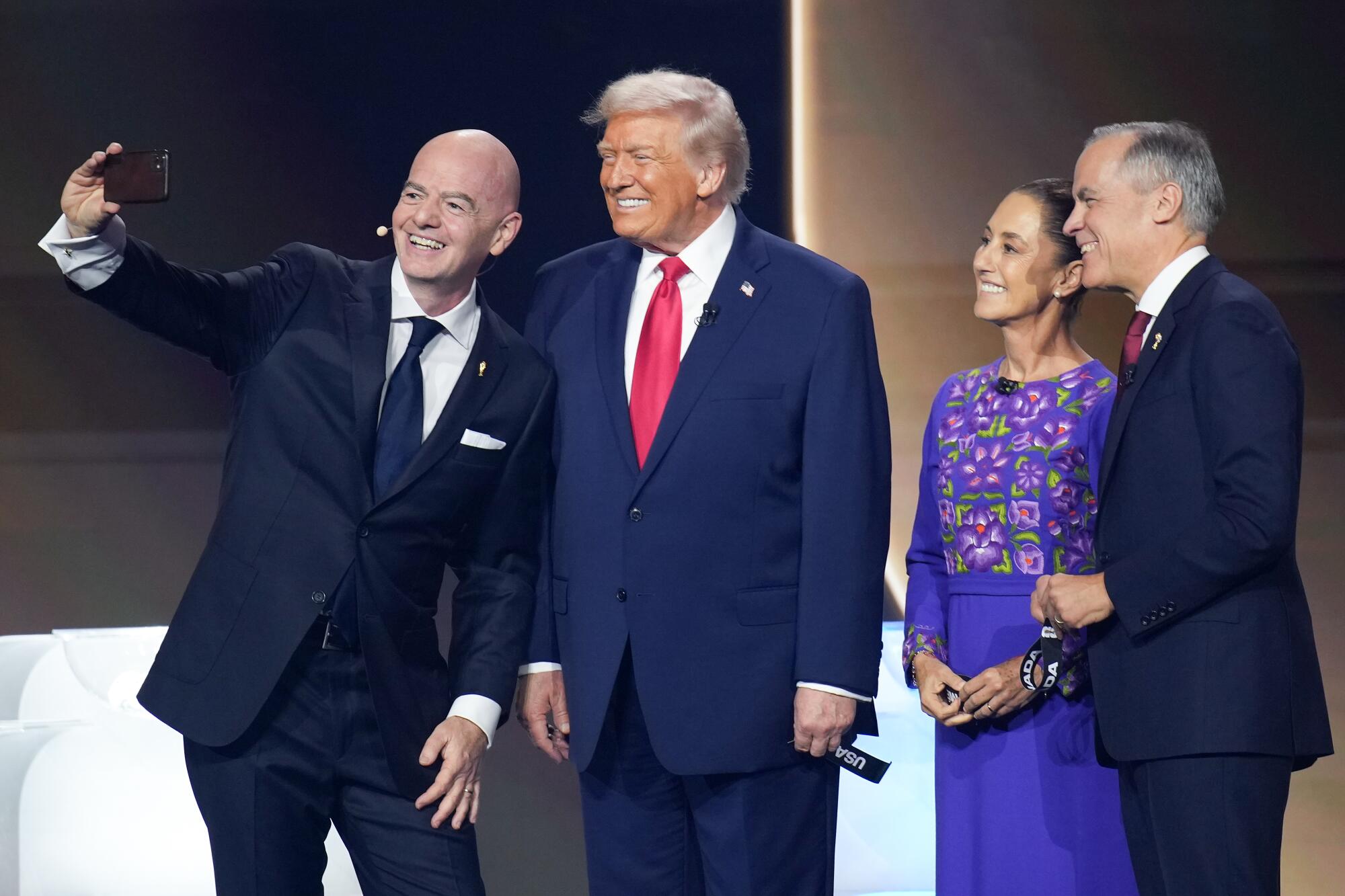
FIFA president Gianni Infantino, far left, takes a selfie with (from left) President Trump, Mexican President Claudia Sheinbaum and Canadian Prime Minister Mark Carney during the World Cup draw in Washington on Dec. 5.
(Andrew Harnik / Getty Images)
If Infantino, born to blue-collar Italian parents in Switzerland, had previously been driven by a desire for power and money, one former close associate told The Times of London that the FIFA president “views himself as one of the oligarchs now.”
And no government gave Infantino more access to the corridors of power than the Trump administration. Infantino rented office space in Trump Tower, attended Trump’s second inauguration, mingled with him and his guests at Mar-a-lago, accompanied him on diplomatic missions to the Middle East and was a frequent visitor to the White House.
Last October, Infantino took to Instagram to say that Trump “definitely deserves” the Nobel Peace Prize. When he didn’t get it, Infantino simply created his own award, presenting Trump with first FIFA Peace Prize last December.
But the access to the top levels of the U.S. government may have created Infantino’s Icarus moment. The beginning of Infantino’s fall may have started last year at the White House when he and Portuguese star Cristiano Ronaldo attended a black-tie dinner to honor Saudi Arabia’s crown prince Mohammed bin Salman.
Five days earlier Ronaldo had been given a red card and a three-game suspension for a serious foul, a penalty that would have forced him to miss the start of the World Cup. After the White House event, FIFA announced Ronaldo’s suspension had been lifted, allowing one of the World Cup’s star attractions to play in the tournament.
That was an incident Trump remembered last month when he personally — and successfully — petitioned Infantino to lift a red-card suspension for U.S. striker Folarin Balogun the day before a World Cup round-of-16 game with Belgium. It was just the second time in history a suspension was overturned during a World Cup.
Infantino also pushed through a number of other World Cup firsts for this summer’s tournament. He added three-minute hydration breaks each half, upsetting more than a century and a half of soccer tradition while giving six more minutes of advertising space to broadcasters; he introduced a halftime show for the final, nearly doubling the intermission break for the tournament’s most important game; and he pioneered a dynamic pricing scheme that more than doubled the cost of tickets from 2022.
Those moves were designed to boost FIFA revenues, and they did — as did Infantino’s push to expand the 2026 World Cup to 48 teams and 104 games. But his luck ran out with his plan to give outside investors a share of the tournament, a scheme known to the White House — Jared Kushner was originally involved, according to reports — but few others.
One damning part of the plan involved a potential future role for Infantino in the investment fund. As FIFA’s president, Infantino earns an annual salary of $6 million, but if reelected, he can serve just one more term, meaning he’d be out of a job in 2031. However, multiple reports, citing unnamed sources, said Infantino was positioned to be chief executive of the investment arm in his post-FIFA days, a job that pays $30 million a year.
FIFA said that idea was never discussed. It also denied reports that Infantino had been rebuffed Monday in efforts to contact Trump for help in saving his presidency. But should he be pushed aside and should his days as a private equity manager never come to pass, there is another job Trump thinks he could do.
The president is reportedly considering pushing Infantino to become the next United Nations secretary-general when António Guterres’ term expires in December.
⚽ You have read the latest installment of On Soccer with Kevin Baxter. The weekly column takes you behind the scenes and shines a spotlight on unique stories. Listen to Baxter on this week’s episode of the “Corner of the Galaxy” podcast.