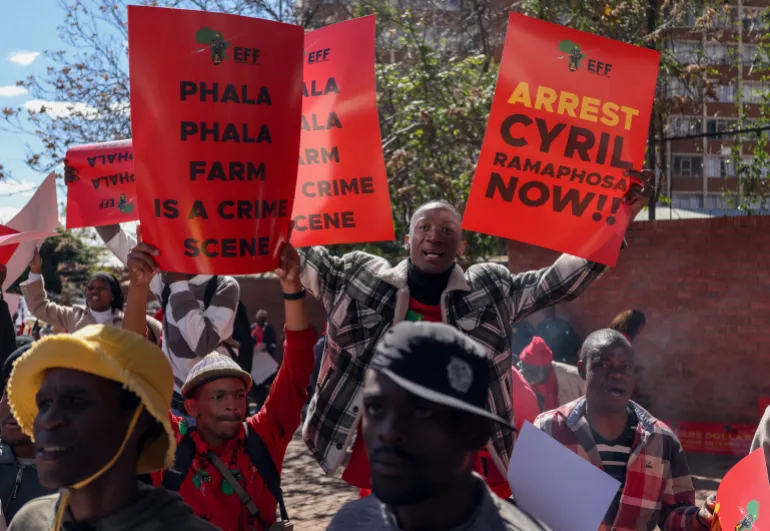
Could South Africa’s Ramaphosa be impeached over ‘cash-in-sofa’ scandal? | Corruption
South Africa’s President Cyril Ramaphosa has refused to resign over a “cash-in-sofa scandal” that continues to haunt his presidency.
Ramaphosa, who addressed the nation on Monday to declare his intention to remain in his post, is set to face a multi-party impeachment committee, which will investigate allegations that he covered up a 2020 break-in at his private ranch and the theft of more than $500,000, concealing the incident from police and tax authorities.
The committee’s findings could spell his impeachment; however, parliament has not provided a timeframe for the investigation, which has yet to commence.
Analysts say the scandal, which has been dubbed “Farmgate”, has been particularly damaging for a president who rode to power in 2018 on an anticorruption mandate, after the much-criticised presidency of Jacob Zuma. Now, eight years later, the case of the cash found stuffed in a sofa at his game ranch could be what takes Ramaphosa down.
Can the South African president survive? Here is what we know.

What’s the scandal all about?
In February 2020, burglars allegedly broke into Ramaphosa’s luxury private ranch, Phala Phala, in Limpopo province, South Africa, and stole $580,000. The cash was said to have been hidden inside furniture at the farm – hence the “Farmgate” label.
Ramaphosa has been accused of covering up the theft and keeping private efforts to trace the burglars a secret to avoid an investigation into where the money had come from – and why it was hidden in a sofa.
Corruption allegations surfaced when a former head of South Africa’s state security agency walked into a police station in 2022 and accused the president of money laundering in relation to the stolen cash.
Later that year, an independent parliamentary committee found that Ramaphosa “may have committed” serious violations and misconduct. In particular, the panel found he had failed to properly report a theft to police as required under anticorruption laws and “acted in a manner inconsistent with his office”.
At the time, the African National Congress (ANC) had a strong majority in parliament – with 230 seats out of 400. It was therefore able to reject the report and refused to open impeachment proceedings.
But the left-wing Economic Freedom Fighters (EFF) challenged this at the Constitutional Court in Cape Town, which, last week, overturned the government’s rejection of the 2022 parliamentary report and referred it to a multi-party impeachment committee for a full investigation.

What has Ramaphosa said?
Ramaphosa has always denied allegations of corruption and maintains that the stolen cash came from selling buffalo.
Since the constitutional court’s ruling last week, Ramaphosa has been facing renewed calls for his resignation, mostly from opposition leaders. In a televised address on Monday, the president refused to step down.
“While there have been calls in some circles that I should resign, nothing in the Constitutional Court judgement compels me to resign my office,” he said.
“Since a criminal complaint was laid against me in June 2022, I have consistently maintained that I have not stolen public money, committed any crime, nor violated my oath of office,” Ramaphosa said in his address, adding that he has cooperated in all investigations.
The president rejected the 2022 report from the independent panel again, saying: “The complaints against me are based on hearsay allegations. No evidence, let alone sufficient evidence, has been presented to prove that I committed any violation, let alone a serious violation of the Constitution or law, or serious misconduct as set out in the Constitution.”
If the committee does find enough evidence against him, it could direct him to be impeached.
It is unclear how long this will take, however. Ramaphosa has pledged to seek a judicial review of the report’s contents, which, in turn, could delay the investigation of the impeachment committee.

What is the process for impeachment?
If a president is found to have violated the constitution or the law, or is unable to perform the duties of office, South Africa’s National Assembly has the constitutional authority to remove him or her.
Beyond the parliamentary investigation that will now begin into the Farmgate scandal, and which can trigger a vote on impeachment, as well, any member of parliament may introduce a motion seeking the president’s removal. The speaker of the National Assembly would then refer the motion to an independent panel of legal experts to determine whether sufficient evidence exists to proceed.
If this panel decides there is a case against the president, lawmakers must vote on whether to begin impeachment proceedings. After this, a specially constituted impeachment committee is established to carry out a detailed investigation into the allegations. This is separate from the investigation beginning now and could take several months.
Once that committee recommends the removal of the president, parliament holds a final vote to impeach the president. Under Section 89 of the constitution, a two-thirds majority is required – meaning at least 267 lawmakers must vote in favour of removal in the 400-seat National Assembly.

Are there other ways to remove Ramaphosa?
Yes, the South African president can be removed from his job via a no-confidence vote in parliament.
Any member of the assembly can propose the no-confidence motion, and it only requires a simple majority of more than 50 percent.
Ramaphosa would need support from coalition partners to survive a no-confidence vote, however. This has already been proposed by at least two opposition parties in parliament.
Another way could be if his ANC party turns against him, as it did with the last president, Zuma, who came in for years of corruption allegations and was finally forced to resign in 2018.

How strong is Ramaphosa’s position?
Ramaphosa is not only the president of South Africa, but also the leader of its most popular party, the ANC. Nelson Mandela was the ANC’s first Black president after apartheid ended in 1994.
In 2024, the ANC stunningly lost its majority in parliament for the first time following more than three decades in power. Today, the ANC holds 159 of 400 seats in the national assembly, or about 40 percent of seats – and Ramaphosa is governing in a coalition with the Democratic Alliance, which has 87 seats, along with other smaller parties.
But Chris Ogunmodede, an independent analyst of African politics, security, and international affairs, based in Lagos, Nigeria, said Ramaphosa would likely survive any impeachment attempts, “simply because of the arithmetic”.
“His numbers in the parliament virtually guarantee that impeachment will not happen,” Ogunmodede told Al Jazeera.
“It hasn’t been easy, but there is a government that seems to be functional and is showing some signs of reinvigoration,” Ogunmodede added. “There’s a lot of uncertainty on the part of the other coalition parties that suggests that they would much rather be on the side of caution and go with the devil they know, and preserve the government by keeping Ramaphosa in power.”
Despite this, the cash-in-sofa scandal has been damaging, he said.
And, under Ramaphosa, the ANC’s popularity has continued to slide. The party’s national vote share fell from 57.5 percent in the 2019 election to 40.2 percent in the 2024 election, marking its worst performance since the end of apartheid.
The South African economy has shown some signs of improvement, however, and given the Ramaphosa government “something to show for the time that it’s been in power”, said Ogunmodede.
Yet the South African government still faces long-term structural concerns about the economy, the country’s institutions, corruption, crime and other issues, the analyst added.
On the back of underlying anti-incumbency, Ogunmodede said the top court’s ruling on the cash-in-sofa scandal “has resurrected many concerns that South Africans have had about the president and his party, and the political institutions of the country more broadly”.