Immigration & Border Security

DACA recipients face job losses, deportation amid renewal delays

WASHINGTON, May 14 (UPI) — Every day at 4 a.m., Cesar wakes up to sell burritos on the streets of Los Angeles. He spends a few hours preparing food in his apartment kitchen and later sets up a small canopy tent with a grill, several coolers and a large sign, made by his sister, advertising “burritos for sale.”

He has done this for the last three weeks, after finding out just over a month ago that he was terminated from his human relations job. He lost the job because of renewal delays to his status under the Deferred Action for Childhood Arrivals, or DACA, program.

Sen. Dick Durbin, D-Ill, said Tuesday that 32,000 people have lost their DACA status largely as a result of delays. The Department of Homeland Security has not released data on the number of people waiting for renewals.

More than 500,000 people rely on DACA, according to the United States Citizenship and Immigration Services. The program requires recipients to renew their status every two years.

“At first, when I was let go, I was feeling devastated, defeated,” said Cesar, who came to the United States when he was 4 and who did not want his last name used for fear of government retribution. “But, after going through those feelings, I knew I couldn’t just sit there.”

Cesar is one of many DACA recipients who have lost their jobs in recent months due to renewal delays, largely caused by increased vetting procedures. The program requires recipients to renew their status every two years.

The Obama-era immigration program provides work authorization to those who qualify, as well as protection from deportation. When their status expires, DACA recipients lose both protections. Many, like Cesar, now have been terminated from their jobs as a result and fear deportation.

Cesar applied for his renewal in early December, nearly six months ago. Like many others, he has received no communication since from USCIS. Previously, renewal applications took one to two months on average, according to the Department of Homeland Security. Last year, the median processing time was 15 days, according to DHS data.

“In its 14 years, we have certainly seen the DACA program face a whole host of attacks,” said Anabel Mendoza, a spokesperson from United We Dream, a youth-led immigrant network. “But what we’re seeing now is truly the most dangerous moment in DACA’s history.

More than 700 people attended a Zoom event hosted by United We Dream last week to help DACA recipients navigate the instability created by these delays. There was a distinct sense of anxiety among the attendees.

Participants flooded the chat feature of the call with anecdotes of losing solid jobs and questions on whether DACA recipients qualified for paid leave or unemployment.

One attendee wrote that, although he would prefer not to use unemployment, he had been waiting five months to receive his renewal. Like many others, he was worried about his ability to pay off significant bills and loans after losing his job.

One person even questioned whether they could sue the current administration.

Another asked whether they could now be deported, with many worrying whether they may even be detained at their immigration appointments.

The two central benefits of DACA, historically, have been legal protection from deportation and work authorization. However, a recent ruling by the Board of Immigration Appeals, an arm of the Department of Justice, said that judges can no longer stop deportation proceedings simply based on the plaintiff having DACA status. This marked a significant shift in immigration policy.

Organizers at the event stressed that DACA still protects recipients from deportation, but judges now have to consider DACA cases more closely. They later acknowledged that many DACA recipients were detained and deported by ICE last year, even before the ruling.

Acting ICE Director Todd Lyons confirmed in April that 343 people with DACA status were detained between January and November 2025, while 176 were deported.

Former DHS Secretary Kristi Noem said in a statement in February that most of these people had “criminal histories.” However she did not specify their crimes or whether they had been arrested, charged or convicted.

“It is part of a broader pattern of really trying to undermine DACA and erode the very protections that the program was meant to uphold,” Mendoza said.

This was a sentiment echoed by Maria Fernanda Madrigal, a mother of three who recently lost her job as an immigration attorney after losing her work permit because of the delays.

In an interview, she questioned whether the delays were an intentional strategy by the Trump administration. She explained that the renewal process had previously been very straightforward for many of her clients — sometimes taking just a week.

“I’m still trying to figure out what the goal is,” Madrigal said. “Because it’s hard, do they want us to leave?”

She highlighted Trump’s attempted termination of the DACA program in 2017 during his first term. The Supreme Court blocked him and preserved the program in 2020.

Now, she wonders whether it may be easier for her and her family to leave the United States. She explained that, unlike their parents, “a lot of us [DACA recipients] have degrees and careers, so we know that we’ll be able to build lives somewhere else.”

Madrigal now keeps the doors of her house locked at all times out of fear of being detained while she awaits her renewal. She said she and her husband have had discussions about whether their small children should share a bed with them.

“If I’m ever detained, these are the moments that I’m going to want, right? I’m going to look back and say I wish I would have cuddled with them a little longer,” Madrigal said.

As Cesar’s new business continues to grow, he faces similar fears, worrying whether he might be “taken away at any moment.”

“I know a lot of people say we’re resilient and we’ll figure it out. And that’s very true,” Madrigal said. “But, I think the main thing that our people understand is, even though we might be able to stick together and get over this, we shouldn’t have to.”

Source link

Spain says Canaries will take Hantavirus-infected ship, islands say ‘no’

Dutch cruise ship MV Hondius, which has a suspected hantavirus outbreak onboard, was due to set sail from Cape Verde for the Canary Islands on Wednesday after Spain agreed to allow passengers and crew to disembark there. File Photo by Elton Monteiro/EPA

May 6 (UPI) — A cruise ship with a hantavirus outbreak onboard that has killed at least three people and sickened more was due to set sail for the Canary Islands on Wednesday after Spain agreed to allow passengers and crew to disembark there.

The Spanish Health Ministry said in a post on X that it had agreed to “host the MV Hondius in the Canary Islands in compliance with International Law and humanitarian spirit” at the request of the World Health Organization and the European Center for Disease Prevention and Control.

It was believed that 14 Spanish citizens are among the 149 British, American and passengers from 20 other countries stranded aboard the Dutch-flagged vessel which is at anchor off the main Santiago island of Cape Verde which on Monday said it would not allow the Hondius to dock on “public health protection” grounds.

The ministry didn’t say to which port in the islands the Hondius was headed but said it would depart Cape Verde upon completion of “a thorough examination of the ship” by ECDC officials to identify those who needed to be urgently evacuated from the ship for emergency medical care.

The BBC reported two crew members, including the ship’s British doctor, and a passenger were due to be transferred to the Canary Islands by air ambulance.

“The specific port has not yet been determined. Once there, crew and passengers will be properly examined, treated, and transferred to their respective countries. The process will be carried out using a common case and contact management protocol developed by the WHO and the ECDC, and will have all the necessary safety guarantees,” said the Spanish health ministry.

“Both medical care and transfers will be carried out in special spaces and transports specifically set up for this situation, avoiding all contact with the local population and ensuring the safety of healthcare personnel at all times,” it added.

However, it was unclear if the ship would be permitted to dock in the Canaries after the island’s president, Fernando Clavijo, posted on X on Wednesday that he would not allow the Hondius to enter without “sufficient information” to guarantee the safety of residents.

“Today I have requested a meeting with [Spanish] President [Pedro] Sanchez due to the lack of coordination and information regarding the cruise ship affected by a hantavirus outbreak. The Canaries always acts with responsibility, but it cannot accept decisions taken behind the backs of the Canary Islands institutions and without sufficient information to the population,” he wrote.

Two passengers died during the Hondius’ five-week Antarctica-South Atlantic cruise and the wife of one of the deceased died in Johannesburg en route back to her home in the Netherlands. She and a 69-year-old Briton, who is being treated in hospital in South Africa, are confirmed hantavirus infection cases.

World Health Organization officials said Tuesday said there may have been human-to-human transmission of the virus as they had identified it as the South American Andes strain which, while it originates from rodent droppings in common with other Hantavirus variants, can jump between humans through close direct contact.

Prices for the Oceanwide Expeditions cruise, which starts from Ushuaia in Argentina, the world’s southernmost city, taking in the Antarctic Peninsula and the islands of South Georgia, St. Helena and Cape Verde, start from $19,025.

Wreathes are seen amongst the statues at the Korean War Veterans Memorial during Memorial Day weekend in Washington on May 27, 2023. Memorial Day, which honors U.S. military personnel who died while in service, is held on the last Monday of May. Photo by Bonnie Cash/UPI | License Photo

.

Source link

ICE enforcement action triggers protests at NYC hospital, 8 arrested

May 3 (UPI) — Enforcement actions carried out by masked U.S. immigration agents triggered an hours-long stand-off and angry protest at a New York City hospital late Saturday, resulting in eight arrests, police officials say.

Crowds gathered outside of Wyckoff Heights Medical Center in Brooklyn, N.Y., around 10 p.m. EDT after images spread online of a man arrested earlier that evening by Immigration and Customs Enforcement and brought to the hospital for treatment of injuries, witnesses told WPIX-TV.

Hospital patients reported they had seen a handcuffed Black man surrounded by ICE agents inside the facility, prompting a crowd estimated at around 200 or more people to gather outside the hospital.

Videos showed scenes of chaos as agitated protesters milled about, throwing garbage containers and fighting with New York Police Department officers as pepper spray is dispersed.

Around 2 a.m., ICE agents were seen dragging a man in handcuffs along the street near the entrance to Wyckoff Hospital while carrying a large canister of what appeared to be pepper spray, amNY reported.

The Department of Homeland Security on Sunday issued a statement to media outlets identifying the arrested man as Chidozie Wilson Okeke, a Nigerian immigrant who had allegedly overstayed his visa and had previous arrests for assault and criminal drug possession.

The DHS said Okeke has requested medical treatment after agents had used force during his arrest.

NYPD officials said eight people were arrested during the melee, adding that they did not assist ICE in the arrest, in keeping with New York’s sanctuary city policies, and responded after receiving multiple emergency calls of people blocking entrances to the hospital.

“People tried to stop the vehicles from leaving,” New York City Councilwoman Sandy Nurse told The New York Times. “That’s when the police arrived, and then it was essentially a standoff for five or six hours, because more and more people showed up from the neighborhood to try to keep that individual from being taken.”

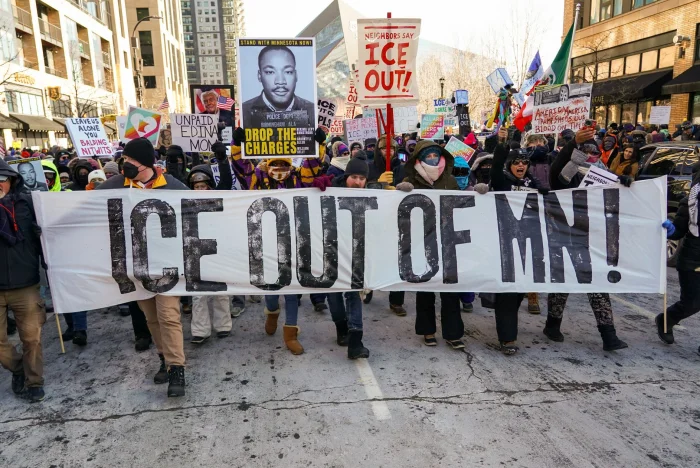
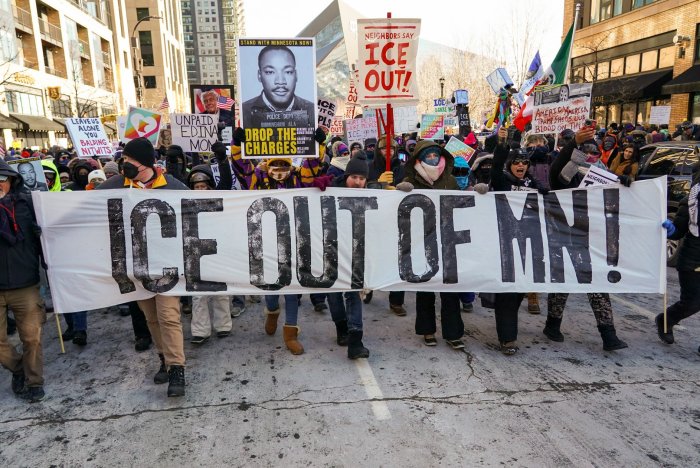
Thousands of protesters march in sub-zero temperatures during “ICE Out” day to protest the federal government’s immigration enforcement surge in Minneapolis, Minnesota on Friday. Photo by Craig Lassig/UPI | License Photo

Source link

ICE rearrests Egyptian family that was released days ago

The family of Mohamed Sabry Soliman, pictured after his arrest for attacking a group of people demonstrating in support of the release of Israeli hostages in June 2025, was rearrested early Saturday morning after being released by ICE earlier this week. Photo via Boulder Police Department/UPI | License Photo

April 25 (UPI) — An Egyptian family of six that was released from custody by Immigration and Customs Enforcement days ago was rearrested on Saturday and may be headed for a quick deportation, their lawyer said.

After an emergency appeal earlier in the day, U.S. District Court Judge Fred Biery said the family’s immediate deportation should be paused, The Guardian and The Texas Tribune reported.

Hayam El Gamal and her five children had been held in the Dilley detention center outside San Antonio, Texas, which has been criticized for lack of medical care and food, for ten months.

U.S. Magistrate Judge Elizabeth Chestney on Thursday ruled that the family, which came to the United States in 2022 on a tourist visa and applied for asylum, should be freed while they wait for a decision on their case.

After the family was arrested again on Saturday morning, El Gamal’s attorney, Eric Lee, posted on X that the family had already been put on a flight to Michigan, where they are expected to be deported to Egypt.

Calling the agency’s actions “an absolutely brazen violation of separation of powers,” Lee said the flight “constitutionally” should not be permitted to take off, posting “stop this travesty of justice from taking place.”

The family was arrested in June after El Gamal’s husband, Mohamed Sabry Soliman, allegedly threw Molotov cocktails into a crowd rallying in support of Israeli hostages being held in Gaza.

A judge already had temporarily halted their deportation in June after their arrest.

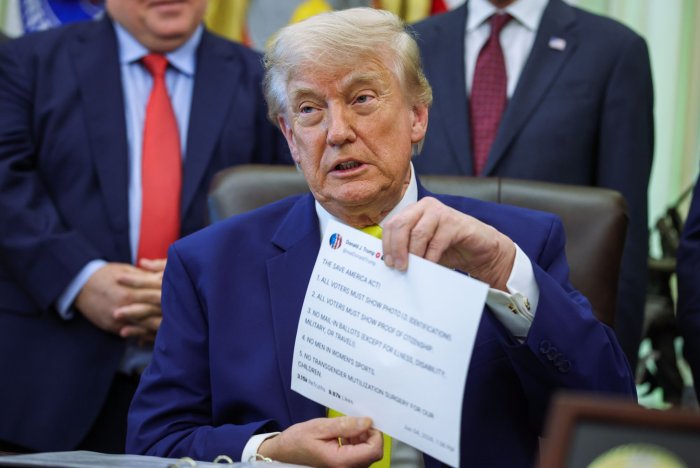
President Donald Trump speaks during a Health Care Affordability event in the Oval Office at the White House on Thursday. Trump announced announced a new drug price deal with Regeneron. Photo by Will Oliver/UPI | License Photo

Source link

‘Communities Not Cages’ anti-ICE protests planned nationwide on Saturday

April 24 (UPI) — Hundreds of rallies are planned nationwide on Saturday as part of a “Communities Not Cages” action aimed at protesting the number of people detained by Immigration and Customs Enforcement.

The protests come amid ICE’s plans to construct eight new detection centers and 16 processing centers, adding at least 116,000 beds to the number the agency has available for detaining people who are allegedly in the country illegally, Axios reported.

At the end of March, No Kings held its third protest — which saw more than 3,000 simultaneous demonstrations across the United States — since President Donald Trump retook office and engaged in a crackdown on immigration.

Detention Watch Network, the organization behind this Saturday’s rallies, called the scouting, purchasing and retrofitting of warehouses to detain between 1,500 and 10,000 people each “particularly horrifying.”

“Shockingly, ICE’s budget now exceeds many militaries around the world,” the organization said on its website.

“In the face of the administration’s unrelenting expansion of immigration detention, communities across the country are demanding to shut down detention centers and halt detention expansion,” it said.

One local group that is coordinating with Detention Watch Network’s “Communities Not Cages National Day of Action” is Shut Down Etowah, a group that previously protested the Biden administration until it stopped detaining people there, AL.com reported.

The Etowah County, Ala., facility is “too broken to be fixed,” the group said this week in a press release, noting that its’ “atrocious” conditions include bed bugs, 23-hour lockdowns and light fixtures that have not been fixed.

ICE earlier this year said it was launching a program under section 287(g) of the Immigration and Nationality Act after lauding its 2025 record of motivating 2.5 million alleged illegal immigrants to leave the country, more than 600,000 of whom were arrested and deported.

Thousands of protesters march in sub-zero temperatures during “ICE Out” day to protest the federal government’s immigration enforcement surge in Minneapolis, Minnesota on Friday. Photo by Craig Lassig/UPI | License Photo


Source link

Senate passes resolution to begin budget reconciliation to fund DHS

April 23 (UPI) — Senate Republicans were up all night voting, eventually adopting a budget reconciliation package Thursday morning to prepare to fund the Department of Homeland Security.

The Senate plans to fund the department without Democrats’ help. The resolution was adopted at around 3:30 a.m. EDT Thursday by a vote of 50-48 after about six hours.

The only Republicans to vote against the resolution were Sens. Lisa Murkowski, R-Alaska, and Rand Paul, R-Ky. The bill now goes to the House. If the House adopts the resolution, the final funding bill can be written and voted on by Congress.

They are following a deadline of June 1 set by President Donald Trump.

“We have a multistep process ahead of us, but at the end Republicans will have helped ensure that America’s borders are secure and prevented Democrats from defunding these important agencies,” said Senate Republican Leader John Thune, R-N.D.

Thune told fellow senators to keep the package narrow to ensure speedy passage.

Since the January deaths of Renee Good and Alex Pretti in Minnesota, both shot and killed by DHS officers, Democrats have refused to support funding the department without reforms. The department has been shut down since Feb, 14, though Trump told the department to use emergency funds to pay essential workers.

Just before the Easter recess, the Senate passed a bill that would fund most of DHS but not ICE and Border Patrol. But the House rejected it.

Republicans are hoping to fund the department through 2029 at a cost of between $70 and $80 billion.

The late-night vote-a-rama included votes about amendments that could be added to the resolution. Two Republican Senators who are vulnerable in the November elections — Sens. Susan Collins, R-Maine, and Dan Sullivan, R-Alaska — broke ranks on some amendments.

Collins and Sullivan voted for amendments to lower health care costs, to reverse last year’s Supplemental Nutrition Assistance Program cuts and to tackle insurance companies that delay or deny medical care. Sen. Josh Hawley, R-Mo., joined with Collins and Sullivan on the latter.

Sen. Bernie Sanders, I-Vt., also sponsored an amendment that would tell the budget committee chair to help cut prescription drug prices by half. Hawley, Collins and Sullivan supported Sanders on it. Sanders said his amendment would codify ensuring that Americans wouldn’t pay more for prescriptions than Canadians or Europeans.

The amendments wouldn’t have the power to force Republicans’ hands, but they would make Republicans go on record about their views of these items.

“This reconciliation, or this budget act, will show who’s on whose side, and clearly if Republicans vote against our amendments, they’re not on the side of the American people,” Democratic Leader Chuck Schumer, D-N.Y., said on the Senate floor.

Homeland Security Secretary Markwayne Mullin told Fox and Friends on Tuesday that the department will run out of money for salaries next month.

“I’ve got one payroll left, and there is no more emergency funds so the president can’t do another executive order because there’s no more money there,” The Hill reported he said.

The resolution does not include the SAVE America Act, the voter security bill that Trump and other Republicans have pushed for. Sen. John Kennedy, R-La., sponsored an amendment to add similar restrictions, but it failed 48-50. Collins, Murkowski, Sen. Thom Tillis, R-S.C., and Sen. Mitch McConnell, R-Ky., voted against it.

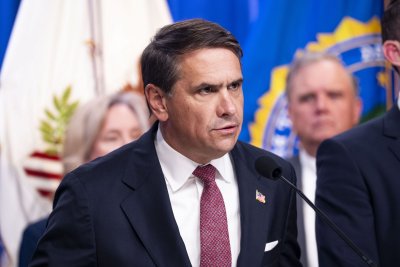
FBI Director Kash Patel speaks during a press conference at Department of Justice Headquarters on Tuesday. The Trump Administration announced charges against the Southern Poverty Law Center, which the government alleges funneled over $3 million toward white supremacist and extremists groups. Photo by Bonnie Cash/UPI | License Photo

Source link

High court to examine rights of green-card holders charged with crime

WASHINGTON, April 22 (UPI) — The Supreme Court will hear arguments Wednesday whether immigration officers can place permanent residents charged with a crime on parole if they leave and then re-enter the country.

In immigration, parole is a temporary, discretionary permission granted by the Department of Homeland Security that allows a person to enter or remain in the United States, even though they are not formally admitted.

Parole does not cancel a person’s green card, but essentially gives the Department of Homeland Security time to decide whether the person should be admitted or deported based on how the issue is resolved.

The court is poised to hear oral arguments in Blanche vs. Lau, which would determine when immigration officers can demote a permanent resident’s status to parole, a temporary status that can be revoked and result in deportation.

Lau is Chinese immigrant Muk Lau, a permanent resident with a green card. Blanche is Todd Blanche, the acting U.S. attorney general and named defendant in the case.

Typically, permanent residents are allowed to leave and re-enter the United States as they wish, with a few exceptions. If these immigrants have committed certain kinds of crimes, for example, officers can have them placed on parole when they return to the country after going abroad.

The case stems from an event on June 15, 2012, when 69-year-old Lau, who had gained permanent residency five years earlier, landed in a New York-area airport after traveling to China.

He presented his green card and passport to border control. His entry triggered an FBI match because a month earlier, Lau was charged with third-degree trademark counterfeiting for selling nearly $300,000 of fake designer shorts.

“I was arrested at a warehouse that contained some merchandise I had stored there,” Lau told the Customs and Border Protection agent, according to court documents. “I went to the warehouse to retrieve the merchandise because I had not paid rent, and when I got there, the cops were there and arrested me.”

The agent declared Lau inadmissible as a returning permanent resident due to the crime exception, and decided to let him in on parole, instead. A year later, Lau pled guilty to the counterfeiting, and in 2014, the Department of Homeland Security began deportation proceedings against him.

At the time, the Customs and Border Patrol agent did not know whether Lau was guilty — just that he had been charged with a crime. The crux of Lau’s case is whether the CBP agent needed “clear and convincing” evidence of a crime when placing him on parole or whether just charges were enough without such evidence.

Immigrant advocates argue the agent erred.

“Mr. Lau was absolutely, unequivocally, at that time, admissible,” said Jonathan Weinberg, who worked on the American Immigration Lawyers Association’s brief to the court. “He just was. He hadn’t been convicted of a crime. There was nothing else that would render him inadmissible.”

After an immigration judge and the Board of Immigration Appeals sided with the government, Lau appealed to the U.S. 2nd Circuit Court of Appeals. The appellate court, agreeing with Weinberg’s reasoning, granted Lau’s petition in March 2025.

The Federation for American Immigration Reform, a nonprofit advocating for lower immigration rates, also submitted a brief to the court. It argued that the border patrol officer did the right thing by paroling Lau into the country, and that the clear and convincing standard was too high.

“If you’re going to say that the officer in an airport is supposed to have all this information, you’re assigning that individual with an impossible task,” FAIR spokesman Ira Mehlman said. “You have thousands of people coming through the airports every day, and these are decisions that have to be made on the spot.”

Mehlman also said that the decision “shouldn’t be a problem” for green-card holders without any criminal history.

“When you come to the United States as a non-citizen, you are here on a conditional basis,” Mehlman said. “Even if you’re a green card holder, you’re subject to removal if you violate the terms of your presence here in the United States.”

There are nearly 13 million legal permanent residents in the United States. Legal immigrants, including green card holders, commit crimes at lower rates than natural-born citizens, according to research by the Migration Policy Institute. However, Weinberg said the ultimate decision would impact all legal permanent residents, including those who have not been convicted of any crime.

“If the government can admit Lau on parole, then the government can basically admit any returning green card holder on parole if it chooses to,” Weinberg said.

Lau’s case joins several immigration-related issues, including birthright citizenship and temporary protected status, which have made their way to the Supreme Court this spring.

“The immigrant advocacy community is, I think, fighting an uphill battle,” Weinberg said. “But that doesn’t mean you don’t give it your best shot.”

Source link

Canadian PM Mark Carney calls close trade ties to U.S. a ‘weakness’

April 19 (UPI) — Citing steep tariffs imposed by U.S. President Donald Trump, Canadian Prime Minister Mark Carney said Sunday his country’s historically close trade and economic ties to the United States have become a “weakness.”

In a video statement posted to YouTube, the Canadian leader asserted the United States has “fundamentally changed its approach to trade, raising its tariffs to levels last seen during the Great Depression.”

This has meant that “many of our former strengths, based on our close ties to America, have become our weaknesses — weaknesses that we must correct.”

Carney’s comments as Trump’s trade war with Canada has disrupted decades of cross border cooperation, triggered in part by a broad 10% tariff slapped by Washington onto all goods not excluded under the Canada-US-Mexico free trade agreement known as CUSMA.

Significantly higher U.S. levies have also been imposed on key strategic sectors, including a 50% tariff on Canadian products that are almost entirely made of steel, aluminum or copper, and a 25% tariff on products that are “largely” made of those metals.

Many types of Canadian heavy equipment also face a 15% tariff upon entry into the United States.

Ottawa says the effect of these measures has been profound, “displacing workers, disrupting supply chains, forcing companies to rethink where they source their materials and products, and causing uncertainty that is curbing investment.”

Although Canada still has the best deal of any U.S. trading partner in an era when Trump has used the threat of tariffs and against both allies and adversaries for strategic and political ends, “we cannot rely on our most important trade relationship as we once did. We must build our strength at home,” Carney said.

“Workers in our industries most affected by U.S. tariffs in autos and steel and lumber are under threat,” he added. “Businesses are holding back investments restrained by the pall of uncertainty that’s hanging over all of us.”

Triggered by the U.S. trade actions and Trump’s oft-repeated desire to annex Canada as the “51st state,” Carney’s Liberal Party government in January made a milestone deal with China to lower some of the tariffs imposed by one another on some of their trade goods.

Under that pact, China lowered its tariffs on Canadian agricultural products, while Canada slashed its tariffs on up to 49,000 electric vehicles that are made in China.

The deal was denounced by Trump, who threatened to impose a 100% tariff on all Canadian goods sent to the United States in response.

“China will eat Canada alive, completely devour it, including the destruction of their businesses, social fabric and general way of life,” the U.S. president asserted.

But Carney on Sunday again defended his expansion of trade away from the United States, saying, “We will attract new investment so we can build more for ourselves, striking new partnerships abroad so we can sell into new markets.

“It’s about taking back control of our security, our borders and our future.”

President Donald Trump meets with Canadian Prime Minister Mark Carney in the Oval Office of the White House in Washington on October 7, 2025. Photo by Shawn Thew/UPI | License Photo

Source link

U.S. bars entry to 26 people as visa restriction policy expands

April 16 (UPI) — The Trump administration on Thursday announced visa restrictions on 26 people across the Western Hemisphere as the State Department unveiled a “significant expansion” of an existing policy to deny entry to those accused of working with U.S. adversaries to undermine Washington’s interests in the region.

Those blacklisted were not identified in the State Department release, which said they were being punished for destabilizing U.S. regional security efforts, undermining U.S. economic interests, conducting influence operations targeting the sovereignty and stability of nations in the region or enabling adversaries to acquire or control key assets and strategic resources in the hemisphere.

“President Trump’s National Security Strategy makes clear: this Administration will deny adversarial powers the ability to own or control vital assets or threaten the security and prosperity of the United States in our region,” a State Department spokesperson said.

“The Department of State is working to advance American leadership in our hemisphere, protect our homeland and ensure access to vital routes and areas throughout our region.”

The blacklisting was permitted as the State Department said it was announcing “a significant expansion” of an existing visa restriction policy, one first announced in early September, permitting the Trump administration to deny visas to Central American nationals accused of undermining the rule of law in the region on behalf of China.

The move comes as the Trump administration seeks to expand its influence in the Western Hemisphere. Under what some administration officials have called the “Donroe Doctrine,” Trump has sought to reassert U.S. dominance in the region in the Western Hemispher and push back on foreign influence, invoking a modern corollary to the Monroe Doctrine of the 1820s.

That initial policy specifically targeted those in Central America who collaborated with the Chinese Communist Party, while the expansion includes anyone in the Western Hemisphere who aids any of the United States’ adversaries.

China protested the earlier version of the policy in November. In a statement from its embassy in Washington, Beijing said the United States imposed visa restrictions on nationals from Panama and other Central American nations over their ties to China.

“Turning visas into political leverage runs against #UN Charter and the principles of sovereign equality and non-interference,” the embassy said. “Central America is no one’s backyard.”

Secretary of Defense Pete Hegseth speaks during a press briefing at the Pentagon on Wednesday. Yesterday, the United States and Iran agreed to a two-week ceasefire, with the U.S. suspending bombing in Iran for two weeks if the country reopens the Straight of Hormuz. Photo by Bonnie Cash/UPI | License Photo

Source link

House extends deportation protection for Haitians in the United States

April 16 (UPI) — The House on Thursday passed a bill to extend temporary protected status for people from Haiti who are living in the United States through 2029.

Rep. Ayanna Pressley, D-Mass., who is co-chair of the House Haiti Caucus, introduced a discharge petition to advance a bill to extend protection for Haitian nationals.

The legislation was initially introduced by Rep. Laura Gillen, D-N.Y., whose Long Island district — as well as the rest of Long Island and New York City — have large Haitian populations, and is the first bill she introduced after her election to the House.

After the discharge petition succeeded, with bipartisan support, the bill passed the full House with 10 Republicans voting in support of it.

“This is a critical step forward in our fight for immigrant justice and delivering our Haitian neighbors the protections they deserve — and it’s a testament to the strength of our broad, diverse and bipartisan coalition,” Pressley said in a statement after the motion to discharge was agreed to.

“I am grateful to my colleagues on both sides of the aisle who supported our discharge petition,” she said.

After the vote, Gillen in a statement encouraged the Senate “to take up this measure and show the compassion and good sense to protect our Haitian community members.”

“Not only would this threaten the lives of our neighbors, it would also have a devastating effect on our economy,” Gillen said, noting that the extension protects “law-abiding and tax-paying Haitians who would face horrific condition if forced back to Haiti.”

The bill, however, faces a battle in the Republican-run Senate and, if it does get passed, the White House has indicated that it will veto the legislation, reports have said.

Although former Homeland Security Secretary Kristi Noem had attempted to end TPS for at least half a million Haitians last Fall, a judge in February blocked the Trump administration from carrying it out.

As a result of the ruling, TPS for people from Haiti expired on Feb. 3, its original expiration date, according to U.S. Citizenship and Immigration Services, which Pressley said made the discharge petition to force a vote on the bill so crucial.

The Supreme Court also is due to rule on the Trump administrations efforts to end TPS for Haitians, as well as for people from Syria, who have protected status because of the dangerous situation in that country.

First lady Melania Trump speaks during a House Ways and Means Committee roundtable discussion on protecting children in America’s foster care system in the Longworth House Office Building near the U.S. Capitol on Wednesday. The bipartisan group of lawmakers are looking to address challenges children in foster care face, including barriers to education and educational advocacy, housing, employment opportunities, financial independence, and technology. Photo by Bonnie Cash/UPI | License Photo

Source link