Immigration

Oxnard still reeling from Glass House immigration raids, deportations

A father who has become the sole caretaker for his two young children after his wife was deported. A school district seeing absenteeism similar to what it experienced during the pandemic. Businesses struggling because customers are scared to go outside.

These are just a sampling of how this part of Ventura County is reckoning with the aftermath of federal immigration raids on Glass House cannabis farms six months ago, when hundreds of workers were detained and families split apart. In some instances, there is still uncertainty about what happened to minors left behind after one or both parents were deported. Now, while Latino households gather for the holidays, businesses and restaurants are largely quiet as anxiety about more Immigration and Customs Enforcement raids lingers.

“There’s a lot of fear that the community is living,” said Alicia Flores, executive director of La Hermandad Hank Lacayo Youth and Family Center. This time of year, clients usually ask her about her holiday plans, but now no one asks. Families are divided by the U.S. border or have loved ones in immigration detainment. “They were ready for Christmas, to make tamales, to make pozole, to make something and celebrate with the family. And now, nothing.”

At the time, the immigration raids on Glass House Farms in Camarillo and Carpinteria were some of the largest of their kind nationwide, resulting in chaotic scenes, confusion and violence. At least 361 undocumented immigrants were detained, many of them third-party contractors for Glass House. One of those contractors, Jaime Alanis Garcia, died after he fell from a greenhouse rooftop in the July 10 raid.

A woman, with a mirror in the background showing a person using a hair dryer  on another person's head.

Jacqueline Rodriguez, in mirror, works on a customer’s hair as Silvia Lopez, left, owner of Divine Hair Design, waits for customers in downtown Oxnard on Dec. 19, 2025.

(Genaro Molina/Los Angeles Times)

The raids catalyzed mass protests along the Central Coast and sent a chill through Oxnard, a tight-knit community where many families work in the surrounding fields and live in multigenerational homes far more modest than many on the Ventura coast. It also reignited fears about how farmworker communities — often among the most low-paid and vulnerable parts of the labor pool — would be targeted during the Trump administration’s intense deportation campaign.

In California, undocumented workers represent nearly 60% of the agricultural workforce, and many of them live in mixed-immigration-status households or households where none are citizens, said Ana Padilla, executive director of the UC Merced Community and Labor Center. After the Glass House raid, Padilla and UC Merced associate professor Edward Flores identified economic trends similar to the Great Recession, when private-sector jobs fell. Although undocumented workers contribute to state and federal taxes, they don’t qualify for unemployment benefits that could lessen the blow of job loss after a family member gets detained.

“These are households that have been more affected by the economic consequences than any other group,” Padilla said. She added that California should consider distributing “replacement funds” for workers and families that have lost income because of immigration enforcement activity.

A woman stands in a front of a window near quinceanera dresses

An Oxnard store owner who sells quinceañera and baptism dresses — and who asked that her name not be used — says she has lost 60% of her business since the immigrant raids this year at Glass House farms.

(Genaro Molina/Los Angeles Times)

Local businesses are feeling the effects as well. Silvia Lopez, who has run Divine Hair Design in downtown Oxnard for 16 years, said she’s lost as much as 75% of business after the July raid. The salon usually saw 40 clients a day, she said, but on the day after the raid, it had only two clients — and four stylists who were stunned. Already, she said, other salon owners have had to close, and she cut back her own hours to help her remaining stylists make enough each month.

“Everything changed for everyone,” she said.

In another part of town, a store owner who sells quinceañera and baptism dresses said her sales have dropped by 60% every month since August, and clients have postponed shopping. A car shop owner, who declined to be identified because he fears government retribution, said he supported President Trump because of his campaign pledge to help small-business owners like himself. But federal loans have been difficult to access, he said, and he feels betrayed by the president’s deportation campaign that has targeted communities such as Oxnard.

A woman poses for a portrait.

“There’s a lot of fear that the community is living,” said Alicia Flores, executive director of La Hermandad Hank Lacayo Youth and Family Center in downtown Oxnard, on Dec. 19, 2025.

(Genaro Molina/Los Angeles Times)

“Glass House had a big impact,” he said. “It made people realize, ‘Oh s—, they’re hitting us hard.’ ”

The raid’s domino effect has raised concerns about the welfare of children in affected households. Immigration enforcement actions can have detrimental effects on young children, according to the American Immigration Council, and they can be at risk of experiencing severe psychological distress.

Olivia Lopez, a community organizer at Central Coast Alliance United for a Sustainable Economy, highlighted the predicament of one father. He became the sole caretaker of his infant and 4-year-old son after his wife was deported, and can’t afford child care. He is considering sending the children across the border to his wife in Mexico, who misses her kids.

In a separate situation, Lopez said, an 18-year-old has been suddenly thrust into caring for two siblings after her mother, a single parent, was deported.

Additionally, she said she has heard stories of children left behind, including a 16-year-old who does not want to leave the U.S. and reunite with her mother who was deported after the Glass House raid. She said she suspects that at least 50 families — and as many as 100 children — lost both or their only parent in the raid.

“I have questions after hearing all the stories: Where are the children, in cases where two parents, those responsible for the children, were deported? Where are those children?” she said. “How did we get to this point?”

Robin Godfrey, public information officer for the Ventura County Human Services Agency, which is responsible for overseeing child welfare in the county, said she could not answer specific questions about whether the agency has become aware of minors left behind after parents were detained.

“Federal and state laws prevent us from confirming or denying if children from Glass House Farms families came into the child welfare system,” she said in a statement.

The raid has been jarring in the Oxnard School District, which was closed for summer vacation but reopened on July 10 to contact families and ensure their well-being, Supt. Ana DeGenna said. Her staff called all 13,000 families in the district to ask whether they needed resources and whether they wanted access to virtual classes for the upcoming school year.

Even before the July 10 raid, DeGenna and her staff were preparing. In January, after Trump was inaugurated, the district sped up installing doorbells at every school site in case immigration agents attempted to enter. They referred families to organizations that would help them draft affidavits so their U.S.-born children could have legal guardians, in case the parents were deported. They asked parents to submit not just one or two, but as many as 10 emergency contacts in case they don’t show up to pick up their children.

A man with a guitar.

Rodrigo is considering moving back to Mexico after living in the U.S. for 42 years.

(Genaro Molina/Los Angeles Times)

With a district that is 92% Latino, she said, nearly everyone is fearful, whether they are directly or indirectly affected, regardless if they have citizenship. Some families have self-deported, leaving the country, while children have changed households to continue their schooling. Nearly every morning, as raids continue in the region, she fields calls about sightings of ICE vehicles near schools. When that happens, she said, she knows attendance will be depressed to near COVID-19 levels for those surrounding schools, with parents afraid to send their children back to the classroom.

But unlike the pandemic, there is no relief in knowing they’ve experienced the worst, such as the Glass House raid, which saw hundreds of families affected in just a day, she said. The need for mental health counselors and support has only grown.

“We have to be there to protect them and take care of them, but we have to acknowledge it’s a reality they’re living through,” she said. “We can’t stop the learning, we can’t stop the education, because we also know that is the most important thing that’s going to help them in the future to potentially avoid being victimized in any way.”

Jasmine Cruz, 21, launched a GoFundMe page after her father was taken during the Glass House raid. He remains in detention in Arizona, and the family hired an immigration attorney in hopes of getting him released.

Each month, she said, it gets harder to pay off their rent and utility bills. She managed to raise about $2,700 through GoFundMe, which didn’t fully cover a month of rent. Her mother is considering moving the family back to Mexico if her father is deported, Cruz said.

“I tried telling my mom we should stay here,” she said. “But she said it’s too much for us without our dad.”

Many of the families torn apart by the Glass House raid did not have plans in place, said Lopez, the community organizer, and some families were resistant because they believed they wouldn’t be affected. But after the raid, she received calls from several families who wanted to know whether they could get family affidavit forms notarized. One notary, she said, spent 10 hours working with families for free, including some former Glass House workers who evaded the raid.

“The way I always explain it is, look, everything that is being done by this government agency, you can’t control,” she said. “But what you can control is having peace of mind knowing you did something to protect your children and you didn’t leave them unprotected.”

For many undocumented immigrants, the choices are few.

Rodrigo, who is undocumented and worries about ICE reprisals, has made his living with his guitar, which he has been playing since he was 17.

While taking a break outside a downtown Oxnard restaurant, he looked tired, wiping his forehead after serenading a pair, a couple and a group at a Mexican restaurant. He has been in the U.S. for 42 years, but since the summer raid, business has been slow. Now, people no longer want to hire for house parties.

The 77-year-old said he wants to retire but has to continue working. But he fears getting picked up at random, based on how abusive agents have been. He’s thinking about the new year, and returning to Mexico on his own accord.

“Before they take away my guitar,” he said, “I better go.”

Source link

Wilson Expands on Plan for ID Card : Immigration: Governor wants the state to be a testing ground for the tamper-proof documents. But he admits that it would probably be impossible to come up with a foolproof system.

Gov. Pete Wilson challenged President Clinton on Thursday to make California a test market for a tamper-proof federal identification card designed to keep illegal immigrants from receiving public benefits or getting jobs in the United States.

Later, a Wilson aide said one option might be a national identification card that would be carried by every legal resident of the United States, including U.S. citizens.

Wilson’s news conference at U.S. Immigration and Naturalization Service offices at Los Angeles International Airport was billed as the forum for a “major announcement regarding immigration.” In fact, Wilson’s statement expanded on his Aug. 9 program by only a small step–the proposed California test–while raising even more questions about his plan for the proposed identification card.

The governor acknowledged to a reporter that it probably is impossible to come up with a foolproof card because counterfeiters could fake birth certificates, passports or other documents that would be needed to get the card.

Wilson left unclear just who might have to possess the card: just foreign nationals living in the country legally or all U.S. citizens?

Asked who would have to carry the card, Wilson said: “Those who are applicants for employment and those who are applicants for benefits.”

Later, Wilson aide Dan Schnur said one possibility that arose during policy discussions in the governor’s office was a national identification card issued to all U.S. citizens and legal residents.

“A universal card is one option, but we’re not looking at it as an absolute condition,” Schnur said in telephone calls to reporters.

The form and scope of any card would be worked out in negotiations with the Clinton Administration, he said.

There have been periodic proposals for a national ID card, but they have always run up against strong opposition on civil liberties grounds.

Wilson was quoted by the Santa Monica Outlook while running for the U.S. Senate in 1982 that a proposed national identification card was “a lousy idea” because it would create a massive new bureaucracy. He also said he had some philosophical objections to the concept.

Schnur had no comment on that report, but he said conditions have changed greatly since the passage of immigration reform in the late 1980s and the heavy influx of illegal immigrants into California in recent years.

Thursday’s billing of a major new initiative drew a dozen television cameras and perhaps a score of reporters, a big turnout for any political event in Los Angeles. Although it turned out that Wilson’s statement was more of an expansion on a previous proposal than a major new initiative, the session did give the governor a platform for responding to critics of his Aug. 9 announcement.

Wilson said an identification card is the key to the enforcement of any of the sanctions written into federal law against employers who hire illegal immigrants for jobs in the United States. Without it, such sanctions are unenforceable, he said.

“Until we deal with the problem of document fraud, anyone proposing additional employer sanctions is simply blowing hot air,” Wilson said after examining stacks of phony passports, Social Security cards and other false documents confiscated by the INS.

Critics, including potential Democratic gubernatorial challenger Kathleen Brown, have said Wilson’s plan cracks down on illegal immigrants but not on the employers who also violate the law by hiring them.

Last week, Brown, the state treasurer, endorsed a national tamper-proof Social Security card that would have to be presented to a prospective employer before the cardholder could be hired.

In his lengthy Aug. 9 letter to Clinton, Wilson called on the federal government to compensate California for the cost of services to illegal immigrants, called for stricter enforcement of the California-Mexico border, and said children born on U.S. soil to undocumented immigrants should not automatically become U.S. citizens or be eligible to attend public schools in California.

Wilson made no mention of stronger enforcement against employers. He proposed an identification card as something that foreign nationals in the country legally would present to qualify for state services.

Wilson said California’s modern holographic drivers licenses could be the model for a federal card, but a reporter wondered if even they could be forged, since a photographic blowup of one was among the fake IDs on display.

“You know, I don’t dispute the ingenuity of counterfeiters. . . . I think it is possible to stay technologically ahead of even expert counterfeiters,” Wilson said.

“The question really is not whether you’re going to have an entirely foolproof system, but whether you have one that works to achieve its major goal, which is to screen out the vast majority of counterfeit documents.”

Later in the day, Democratic state Chairman Bill Press chided Wilson for intervening with the INS in 1989 on behalf of a San Diego supporter, Anne Evans, whose hotels were under investigation for hiring illegal immigrants. At the time, Wilson was a U.S. senator.

Evans ultimately was accused of 362 violations of employer sanctions provisions and fined $70,000.

Schnur described Wilson’s letter, which sought a conciliation between the INS and Evans, as a routine constituent service.

Source link

Immigration crackdown leaves teens to care for siblings after parents get detained

Vilma Cruz, a mother of two, had just arrived at her newly leased Louisiana home this week when federal agents surrounded her vehicle in the driveway. She had just enough time to call her oldest son before they smashed the passenger window and detained her.

The 38-year-old Honduran house painter was swept up in an immigration crackdown that has largely targeted Kenner, a Latino enclave just outside New Orleans, where some parents at risk of deportation had rushed to arrange emergency custody plans for their children in case they were arrested.

Federal agents have made more than 250 arrests this month across southeast Louisiana, according to the Department of Homeland Security, the latest in a series of enforcement operations that have also unfolded in Los Angeles, Chicago and Charlotte, N.C. In some homes, the arrests have taken away parents who were caretakers and breadwinners, leaving some teenagers to grow up fast and fill in at home for absent mothers and fathers.

Cruz’s detention forced her son, Jonathan Escalante, an 18-year-old U.S. citizen who recently finished high school, to care for his 9-year-old sister, who has a physical disability. Escalante is now trying to access his mother’s bank account, locate his sister’s medical records and doctors, and figure out how to pay bills in his mother’s name.

“Honestly I’m not ready, having to take care of all of these responsibilities,” Escalante told the Associated Press. “But I’m willing to take them on if I have to. And I’m just praying that I get my mom back.”

Fearful families made emergency custody plans

The crackdown dubbed “Catahoula Crunch” has a goal of 5,000 arrests. DHS has said it is targeting violent offenders but has released few details on whom it is arresting. Records reviewed by AP found that the majority of those detained in the first two days of the effort had no criminal histories.

This week, Louisiana Lt. Gov. Billy Nungesser, a Republican, became the first state official to break with his party over the operations. He criticized them for undermining the regional economy by triggering labor shortages because even immigrants with valid work permits have stayed home out of fear.

“So I think there needs to be some clarity of what’s the plan,” Nungesser said. “Are they going to take every person, regardless if they got kids, and they’re going to leave the kids behind?”

DHS said Cruz locked herself in the car and refused to lower the window and exit the vehicle as ordered, which forced agents to break the window to unlock the door. She is being held in federal custody pending removal proceedings, officials said.

Immigrant rights groups say the operation is applying a dragnet approach to racially profile Latino communities.

In the weeks before the crackdown began, dozens of families without legal status sought to make emergency custody arrangements with relatives, aided by pro bono legal professionals at events organized by advocacy groups in Kenner and throughout the New Orleans region.

“Children are going to school unsure whether their parents will be home at the end of the day,” Raiza Pitre, a member of the Hispanic Chamber of Commerce of Louisiana, told a city council meeting Wednesday in Jefferson Parish, which includes Kenner.

Juan Proaño, CEO of the League of United Latin American Citizens, said he receives dozens of calls daily from Louisiana families worried about being separated from their children. His organization is helping Escalante navigate life without his mother, and he wants to prepare her son for the worst.

“He thinks she’ll be home in a couple of days, but it could be weeks or months, or she could be deported,” Proaño said.

Police chief praises enforcement crackdown

Cruz’s family was supposed to move into their new home next month. She leased it so that her son could finally sleep in his own room.

Kenner resident Kristi Rogers watched masked agents detain Cruz, a soon-to-be neighbor whom she had not yet met. Rogers said her heart went out to Cruz, and she wondered why she was targeted.

“I’m for them trying to clean up the criminals in our area, but I’m hoping that’s all they are detaining and deporting — the criminals,” Rogers said.

Jefferson and Orleans Parish court records did not reveal any criminal history for Cruz, and her son said she had a clean record.

In conservative Kenner, where Latinos make up about a third of residents and President Trump won the last three presidential elections, Police Chief Keith Conley said last week that the federal immigration operation is a “prayer answered.”

As evidence of violence committed by immigrants in his city, Conley shared around a dozen press releases issued since 2022 documenting crimes in which the suspect was identified as being in the U.S. illegally, including sex offenses, a killing, gang activity and shootings. He said residents were also at risk from immigrant drivers who are unlicensed and uninsured.

“I think that missions like this, by the government, are welcome because it’s going to change the landscape of the city and make improvements,” Conley said.

Teenagers try to protect younger siblings

Jose Reyes, a Honduran construction worker and landscaper whose family says he has lived in the U.S. for 16 years, stayed home for weeks to avoid federal agents. But the father of four had to pay rent, so last week he drove to the bank around the corner.

Unmarked vehicles began following Reyes and pulled up alongside his car as he parked in front of his house in Kenner. A video reviewed by AP showed several agents leaping out and removing Reyes from his car as his sobbing daughters screamed for mercy.

“We were begging that they let him go,” said his eldest daughter, 19-year-old Heylin Leonor Reyes. “He’s the one who provides for food, pays bills, pays the rent. We were begging them because they’re leaving a family totally in the dark, trying to figure out what to do, figuring out where to get money to get by.”

Asked about the arrest, DHS said Jose Reyes committed an unspecified felony and had previously been deported from the U.S. The agency did not elaborate.

His daughter, who works at a local restaurant, said her salary is not enough to keep a roof over the heads of her three younger siblings, two of whom she says were born in the U.S. and are American citizens. Her mother is caring for the youngest, a 4-year-old, who watched agents grab her father from the doorway.

Reyes said she is also seeking a lawyer for her father’s case. But they need to locate him first.

“We were not given that information,” Reyes said. “We were given absolutely nothing.”

Reyes has tried to shield her siblings from the stress surrounding their father’s detention.

Escalante has not yet told his sister about their mother’s arrest, hoping Cruz can be released before he has to explain her absence.

“I’m technically the adult of the house now,” he said. “I have to make these hard choices.”

Brook and Cline write for the Associated Press. Cline reported from Baton Rouge, La.

Source link

Kilmar Abrego Garcia freed from US immigration detention, returns home | Migration News

The Department of Homeland Security has pledged to appeal the latest ruling, slamming it as ‘naked judicial activism’.

Kilmar Abrego Garcia, whose case has become a flashpoint in the Trump administration’s immigration crackdown in the United States, has been freed from detention on a judge’s order and returned to his home, according to reports.

Abrego Garcia was due to check in with US immigration officials on Friday, The Associated Press news agency reported, a day after returning to his home following his release from an immigration processing centre in the latest twist in a convoluted case of deportation and detention targeting the Maryland man.

Recommended Stories

list of 4 itemsend of list

In a ruling on Thursday, US District Judge Paula Xinis in Maryland ordered Immigration and Customs Enforcement to let Abrego Garcia go immediately, writing that federal authorities had detained him again after his return to the US without any legal basis.

The face of Trump’s hardline immigration policies

Abrego Garcia has an American wife and children and has lived in Maryland for years, under protected legal status since 2019, when a judge ruled he should not be deported because he could be harmed in his home country by a gang that targeted his family. He originally moved to the US without documentation as a teenager.

He then became the highest-profile case among more than 200 people sent to the notorious El Salvador’s CECOT mega-prison as part of President Donald Trump’s crackdown on refugees, migrants and asylum seekers in the US.

He was wrongfully deported by the Trump administration to El Salvador in March. A court later ordered his return to the US, where he was detained again, as immigration officials sought to deport him to a series of African countries instead of El Salvador.

‘Judicial activism’

The Department of Homeland Security slammed Thursday’s ruling and said it would appeal, labelling the decision as “naked judicial activism” by a judge appointed during President Barack Obama’s administration.

“This order lacks any valid legal basis, and we will continue to fight this tooth and nail in the courts,” said Tricia McLaughlin, the department’s assistant secretary.

Abrego Garcia’s lawyer, Simon Sandoval-Moshenberg, said he expected his client’s ordeal was far from over, and he was preparing to defend him against further deportation efforts.

“The government still has plenty of tools in their toolbox,” Sandoval-Moshenberg said.

“We’re going to be there to fight to make sure there is a fair trial.”

The lawyer said the judge’s ruling had made it clear that the government could not detain a person indefinitely without legal authority, adding that Abrego Garcia had already “endured more than anyone should ever have to”.

Abrego Garcia has filed a federal lawsuit claiming the Trump administration is illegally using the deportation process to punish him due to the attention his case received.

Since his return, federal authorities have also filed charges against Abrego Garcia for alleged human smuggling related to a 2022 traffic stop.

He has pleaded not guilty and filed a motion to dismiss the charges, claiming the prosecution is vindictive.

In her ruling on Thursday, Judge Xinis said Trump lawyers “affirmatively misled” the court, including falsely claiming that Costa Rica had rescinded an offer to accept Abrego Garcia.

Abrego Garcia has said he was willing to resettle there in the event he was deported from the US.

In a separate proceeding, Abrego Garcia has also petitioned to reopen his immigration case to seek asylum in the US.

Source link

Trump’s handling of the economy is at its lowest point in AP-NORC polling

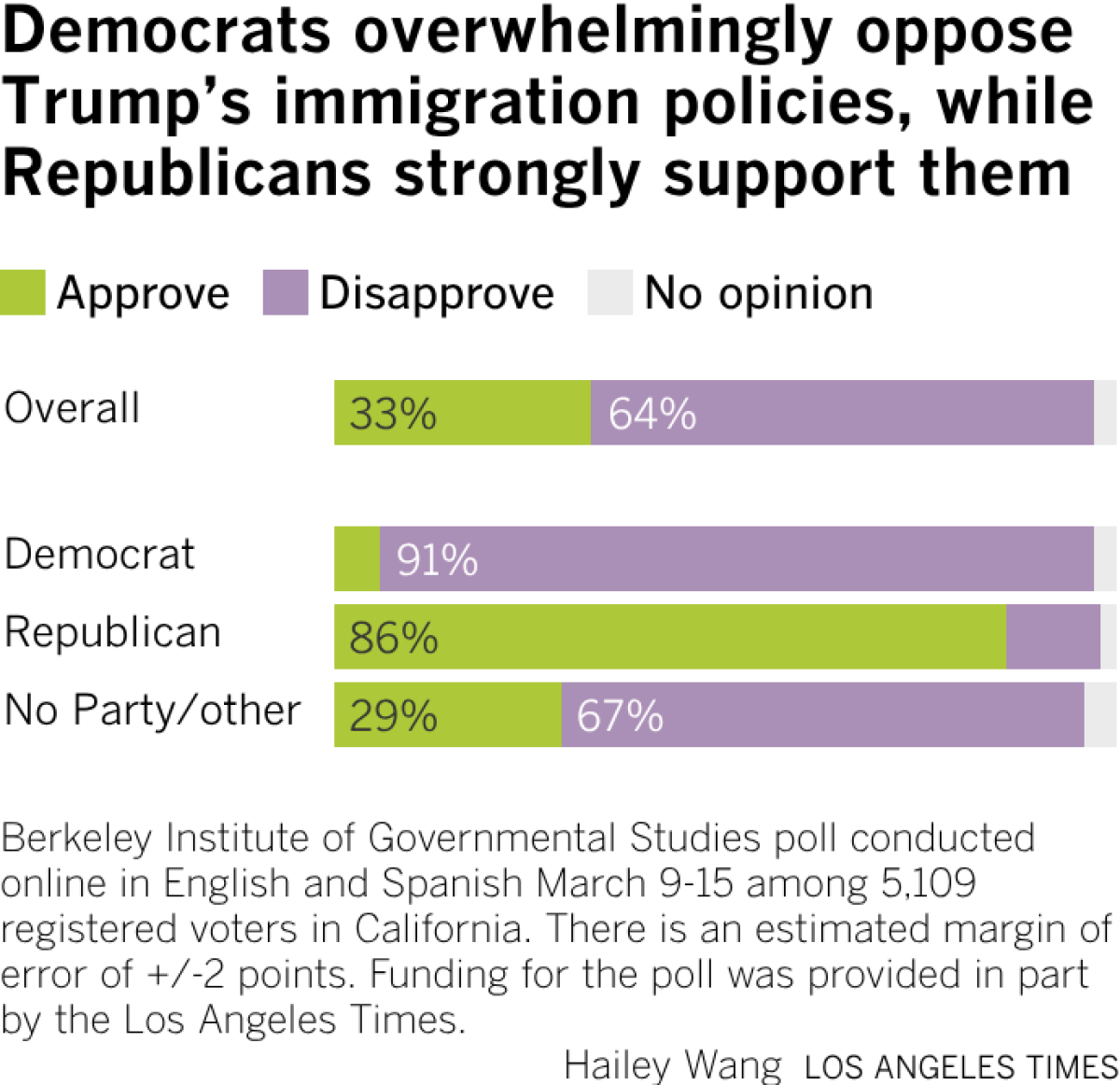
President Trump’s approval on the economy and immigration have fallen substantially since March, according to a new AP-NORC poll, the latest indication that two signature issues that got him elected barely a year ago could be turning into liabilities as his party begins to gear up for the 2026 midterms.

Only 31% of U.S. adults now approve of how Trump is handling the economy, the poll from The Associated Press-NORC Center for Public Affairs Research finds. That is down from 40% in March and marks the lowest economic approval he’s registered in an AP-NORC poll in his first or second term. The Republican president also has struggled to recover from public blowback on other issues, such as his management of the federal government, and has not seen an approval bump even after congressional Democrats effectively capitulated to end a record-long government shutdown last month.

Perhaps most worryingly for Trump, who’s become increasingly synonymous with his party, he’s slipped on issues that were major strengths. Just a few months ago, 53% of Americans approved of Trump’s handling of crime, but that’s fallen to 43% in the new poll. There’s been a similar decline on immigration, from 49% approval in March to 38% now.

The new poll starkly illustrates how Trump has struggled to hold onto political wins since his return to office. Even border security — an issue on which his approval remains relatively high — has declined slightly in recent months.

The good news for Trump is that his overall approval hasn’t fallen as steeply. The new poll found that 36% of Americans approve of the way he’s handling his job as president, which is down slightly from 42% in March. That signals that even if some people aren’t happy with elements of his approach, they might not be ready to say he’s doing a bad job as president. And while discontent is increasing among Republicans on certain issues, they’re largely still behind him.

Declining approval on the economy, even among Republicans

Republicans are more unhappy with Trump’s performance on the economy than they were in the first few months of his term. About 7 in 10 Republicans, 69%, approve of how Trump is handling the economy in the December poll, a decline from 78% in March.

Larry Reynolds, a 74-year-old retiree and Republican voter from Wadsworth, Ohio, said he believes in Trump’s plan to impose import duties on U.S. trading partners but thinks rates have spiraled too high, creating a “vicious circle now where they aren’t really justifying the tariffs.”

Reynolds said he also believes that inflation became a problem during the coronavirus pandemic and that the economy won’t quickly recover, regardless of what Trump does. “I don’t think it’ll be anything really soon. I think it’s just going to take time,” he said.

Trump’s base is still largely behind him, which was not always the case for his predecessor, President Joe Biden, a Democrat. In the summer of 2022, only about half of Democrats approved of how Biden was handling the economy. Shortly before he withdrew from the 2024 presidential race two years later, that had risen to about two-thirds of Democrats.

More broadly, though, there’s no sign that Americans think the economy has improved since Trump took over. About two-thirds of U.S. adults, 68%, continue to say the country’s economy is “poor.” That’s unchanged from the last time the question was asked in October, and it’s broadly in line with views throughout Biden’s last year in office.

Why Trump gets higher approval on border security than immigration

Trump’s approval ratings on immigration have declined since March, but border security remains a relatively strong issue for him. Half of U.S. adults, 50%, approve of how Trump is handling border security, which is just slightly lower than the 55% who approved in September.

Trump’s relative strength on border security is partially driven by Democrats and independents. About one-third of independents, 36%, approve of Trump on the border, while 26% approve on immigration.

Jim Rollins, an 82-year-old independent in Macon, Georgia, said he believes that when it comes to closing the border, Trump has done “a good job,” but he hopes the administration will rethink its mass deportation efforts.

“Taking people out of kindergarten, and people going home for Thanksgiving, taking them off a plane. If they are criminals, sure,” said Rollins, who said he supported Trump in his first election but not since then. “But the percentages — based on the government’s own statistics — say that they’re not criminals. They just didn’t register, and maybe they sneaked across the border, and they’ve been here for 15 years.”

Other polls have shown it’s more popular to increase border security than to deport immigrants, even those who are living in the country illegally. Nearly half of Americans said increasing security at the U.S.-Mexico border should be “a high priority” for the government in AP-NORC polling from September. Only about 3 in 10 said the same about deporting immigrants in the U.S. illegally.

Shaniqwa Copeland, a 30-year-old independent and home health aide in St. Augustine, Florida, said she approves of Trump’s overall handling of the presidency but believes his immigration actions have gone too far, especially when it comes to masked federal agents leading large raids.

“Now they’re just picking up anybody,” Copeland said. “They just like, pick up people, grabbing anybody. It’s crazy.”

Health care and government management remain thorns for Trump

About 3 in 10 U.S. adults approve of how Trump is handling health care, down slightly from November. The new poll was conducted in early December, as Trump and Congress struggled to find a bipartisan deal for extending the Affordable Care Act subsidies that will expire at the end of this month.

That health care fight was also the source of the recent government shutdown. About one-third of U.S. adults, 35%, approve of how Trump is managing the federal government, down from 43% in March.

But some Americans may see others at fault for the country’s problems, in addition to Trump. Copeland is unhappy with the country’s health care system and thinks things are getting worse but is not sure of whether to blame Trump or Biden.

“A couple years ago, I could find a dentist and it would be easy. Now, I have a different health care provider, and it’s like so hard to find a dental (plan) with them,” she said. “And the people that do take that insurance, they have so many scheduled out far, far appointments because it’s so many people on it.”

Sanders and Weissert write for the Associated Press. The AP-NORC poll of 1,146 adults was conducted Dec. 4-8 using a sample drawn from NORC’s probability-based AmeriSpeak Panel, which is designed to be representative of the U.S. population. The margin of sampling error for adults overall is plus or minus 4 percentage points.

Source link