immigrant

San Francisco immigration court has shut; asylum cases in chaos

There are no immigrants waiting for rulings anymore at San Francisco’s main immigration court, no lawyers making arguments.

The court, which had 21 judges when President Trump was sworn in last year, had only two left when it closed May 1. The rest had been fired, retired or resigned amid a White House purge of federal immigration judges.

The closing is one more reflection of the turmoil that has upended the immigration court system as the administration looks for ways to churn through its massive backlog of 3.8 million asylum cases and deport as many people as possible.

Asylum denial rates have soared as the administration has fired almost 100 judges deemed to be too liberal, and approved using hundreds of military lawyers to replace them. Immigrants have been arrested when they arrive at courthouses or government offices for scheduled appearances.

But amid the nationwide upheaval, San Francisco is the first major city to be left without a primary immigration court, leaving chaos and dysfunction in a region long known for its friendliness to asylum seekers. The two remaining judges will work from another federal building in the city but will be part of an immigration court across the bay.

That reputation, court insiders say, might have led to its downfall.

“It was a vibrant legal scene and so I think if you were looking to target a court you would have to look at what San Francisco stands for,” said Jeremiah Johnson, an immigration judge in the city until he was fired in November. He is now executive vice president of the National Assn. of Immigration Judges.

Most of the court’s 117,000 immigration cases have been moved to a courthouse in Concord, a city about 30 miles away that opened two years ago to help with San Francisco’s backlog of cases. But turmoil has also reached that city. A courthouse that had 11 judges at the start of 2025 is down to five after a series of firings. It had a caseload of 60,000 cases even before the San Francisco cases were shifted over.

San Francisco’s immigration court, which had the third-highest number of asylum cases in the nation, was long considered one of the most favorable to people seeking asylum. From 2019 to 2024, almost 75% of petitioners received some form of relief, compared with 43% nationwide, according to data compiled by the Transactional Records Access Clearinghouse, a nonprofit data research center based at Syracuse University.

That’s partly because San Francisco, with its vast network of pro-immigrant organizations and pro bono or low-cost legal services, had one of the country’s highest rates of legal representation for immigrants.

The Executive Office of Immigration Review, the Department of Justice branch that oversees immigration courts, announced in March that it would close the San Francisco courthouse in 2027 as a cost-saving measure and move its cases to Concord. But the end came early after nearly all the San Francisco judges left or were fired. The Executive Office provided no detailed explanation for the changes, saying in a statement only that it had decided not to renew its lease for the court, and doesn’t comment on personnel matters.

Tight security in Concord courts

Security is tight at the Concord courthouse, perhaps because of the new influx of cases. Armed security guards ask every person if they are carrying weapons or explosives, and they watch as each person turns off their cellphone. Even coffee is not allowed in. Only water is acceptable, and then only if it’s in a transparent bottle.

Judah Lakin, an immigration attorney based in Oakland who also teaches at UC Berkeley School of Law, said the closure of the San Francisco court has made cases more time-consuming since it’s harder for his clients, who often travel from hours away, to reach Concord on public transportation.

One recent 10-minute hearing in Concord took him more than two hours of travel, he said.

But beyond logistics, Lakin said the chaos in immigration courts under the Trump administration has created a fraught court atmosphere. Mass firings have led to last-minute hearing cancellations, cases have been reset with little notice, and clients are often left in prolonged legal limbo, leaving them vulnerable to deportation.

One of his clients, he said, was provisionally granted asylum by a judge, who was then fired before signing the decision. The case was transferred to a second judge, who was also fired. Now on their third judge, his client is still waiting.

“The ground is constantly shifting underneath your feet, whether it’s judges being fired and hearings getting canceled, whether it’s your clients getting arrested, whether it’s getting denials on things that used to be standard and routine,” Lakin said.

“I think that’s on purpose. That’s by design. It’s part of the strategy,” he added.

‘Heartbreaking’

San Francisco’s immigration court was one of the first in the nation to hire judges with non-prosecutorial backgrounds, with many having previous experience working with immigrants at nonprofits or defending them in court.

To see the court close is “heartbreaking,” said Dana Leigh Marks, a former San Francisco immigration judge who retired in 2021 after 35 years on the bench and who was among the first judges in the nation to be hired from private practice.

She sees the Trump administration’s decision to close the largest immigration court in Northern California as part of an effort to undermine due process and eventually dismantle the path to asylum.

“It’s all a part of big ways and little ways that the Trump administration is trying to get noncitizens out of the country,” she said.

Johnson, the fired San Francisco judge, was appointed during the first Trump administration. He believes he was targeted because he granted asylum in 89% of the cases he heard.

“You don’t fire judges if you disagree with the way they’re handling a case; that’s not how courts work. If you disagree, you appeal that decision,” he said.

Johnson, who is the executive vice president of the National Assn. of Immigration Judges, defended his judicial record, pointing out that over eight years, only about 10 of his cases were appealed by the Department of Homeland Security, and very few were sent back for further hearings by the Board of Immigration Appeals.

Unlike federal courts, where there are strict rules of procedure and judges have lifetime tenure, the Justice Department runs immigration courts, and the attorney general can fire the judges with fewer constraints.

There were 754 immigration judges across the country at the start of Trump’s second term. Now, there are about 600, including some temporary judges, according to data collected by the judges’ union. Widespread courthouse arrests of immigrants have caused hundreds of people not to even show up for hearings, leading to deportation orders in absentia.

Nidaa Pervaiz came to the Concord court on a recent day to represent a client from Nepal. She prefers the new courthouse in some ways, since it’s closer to her home.

But, she said, she and her clients are already feeling the impact of the changes. Fewer judges leads to fewer hearings. That means more delays for her clients, whose paperwork can expire even before they can appear before a judge.

“Their whole lives are at stake, and they are coming to make a plea for their future” she said.

Rodriguez writes for the Associated Press.

Source link

Trump won over more Latino voters in 2024. Can he keep them?

As Sandra Ramirez watched footage of immigration officers cracking down on migrants over the past year, she knew her 2024 vote for Donald Trump was a mistake.

“There are a lot of people who are being harassed for the color of their skin, and that’s not right,” said Ramirez, who broke from her Democrat-voting family to cast a ballot for Trump.

“I’ll never go Republican again,” she said.

Trump made inroads with Latino voters like Ramirez during the 2024 elections, earning support that helped propel him to a second term in the White House.

As Republicans gear up for midterms this fall and look ahead to presidential elections in 2028, all eyes are on whether they can hold on to that key support or whether the administration’s sweeping immigration crackdown and an economy beset by high prices may drive Latino voters away.

In a sign of looming danger, recent polling from the Pew Research Center shows support for Trump falling fast among that electorate.

Support among Latino Trump voters shows signs of softening

Latino voters have historically been largely aligned with the Democratic Party but during the 2024 election, they shifted significantly toward Trump. A majority still supported Democrat Kamala Harris for president, but Trump made big gains: 43% of Latino voters nationally voted for him, compared with 35% in the 2020 presidential election, a change attributed in part to their concerns about the economy.

Trump returned to office pledging to crack down on immigration, a promise that prompted arrest sweeps, often against Latino migrants, in homes, workplaces and schools, among others. According to an AP-NORC poll, more than half of Latino adults report knowing someone impacted by the Trump administration’s aggressive immigration enforcement.

More than a year into Trump’s second term, polling suggests a significant drop in support for the president among Latinos who voted for him in 2024, although a majority still supports him.

According to a Pew Research Center poll conducted in April, support for the president fell among non-Latino voters from 95% to 79% between February of last year and April of 2026. But among Latino voters who cast their ballot for Trump, the drop-off was more dramatic: 66% approved of his job performance in April compared with 93% at the beginning of his second term.

That national drop could prove crucial in a tight election in swing counties like Maricopa, the largest battleground county in the nation, which encompasses Phoenix and its suburbs. A third of Maricopa County residents are Latino, and one in four of them is an immigrant, according to the Latino Data Hub at UCLA.

Arizona, which also saw a slight increase in Latino support for Trump in 2024, has been a flashpoint in the immigration debate for years. Maricopa County Sheriff Joe Arpaio conducted high-profile raids in Latino communities and, later, the state saw large influxes of migrants during the Biden administration.

In outh Phoenix, opinions on Trump reflect deep divisions

On a warm afternoon in the predominantly Latino neighborhood of south Phoenix, a vendor at a street fair sold shirts imprinted with phrases like “Lowriders Sunday” while car club members polished their Chevrolets. The parking lot of the nearby Catholic church was full of parishioners attending Spanish-language Sunday Mass.

Albert Rodriguez, a Phoenix tattoo artist, said he once supported Trump. But then he saw how the administration was carrying out enforcement operations in Chicago, Minneapolis and Los Angeles.

He said the president promised to go after immigrants who were criminals, but instead Immigration and Customs Enforcement agents have been “hitting the paleta man,” referring to ordinary people trying to make a living from selling frozen treats.

“Big time, I regret it,” Rodriguez said of his 2024 vote for Trump.

Phoenix resident Ronnie Martinez, an Army veteran, backs Trump’s effort to stem crossings at the southern border.

“The border is only a hop, skip and a jump to our south. And I don’t want illegal alien criminals coming from Guatemala, Venezuela, Central America,” he said.

He didn’t like some of the images he’d seen of ICE arresting people in front of their children. But he was also sympathetic to ICE officers, who he said were doing the best they could in difficult situations, and he blamed Democratic officials who weren’t cooperating with immigration enforcement. He also cited economic initiatives as a reason for his continued support for the president, including the removal of taxes on tips and overtime.

Guadalupe Alaffa, another Phoenix resident, blamed President Biden’s policies for prompting Trump’s immigration crackdown.

“He left that damn border wide open,” said Alaffa.

Arizona battleground politics shaped by Latino voter influence

The growing influence of Latino voters is one of several factors that have eroded the GOP’s decades-long dominance in Arizona, putting the state at the center of congressional and presidential elections. Both of Arizona’s senators are now Democrats, along with the top three state officials.

Winning back some of the Latinos who shifted to Trump will be crucial to the reelection prospects of Gov. Katie Hobbs, Secretary of State Adrian Fontes and Atty. Gen. Kris Mayes, all Democrats first elected in 2022.

Democrats in Maricopa County have benefited from more than a decade of political organizing among Latinos mobilizing against hard-line immigration enforcement. The Republican-controlled Legislature in 2010 passed a state law known as SB1070, which required police to check the immigration status of anyone they suspected of being in the country illegally.

Around the same time, Arpaio was building a national profile on the right with immigration sweeps in largely Latino neighborhoods.

Some activists see the nationwide crackdown on immigrants as an extension of what Latinos in Arizona endured under Arpaio.

“We were the lab where they implemented a lot of this with Sheriff Joe and now it’s all over the United States,” said Salvador Reza, a longtime activist in Phoenix who advocates for the rights of day laborers.

For more than two decades, Arpaio was repeatedly elected while his department faced accusations of racially profiling Latino drivers and conducting sweeps in Latino neighborhoods and day labor areas. Deputies often stopped residents for traffic violations and turned noncitizens over to ICE, according to rights groups.

In 2013, a federal judge ruled his office had illegally profiled and detained Latinos, and a 2011 Justice Department report found widespread discrimination. After losing reelection in 2016, Arpaio was convicted of criminal contempt for defying court orders. He was later pardoned by Trump.

Rising prices and immigration enforcement erode Latino support

The GOP is at risk of losing some of the Latinos that Trump won over, said former Republican Gov. Jan Brewer, who signed the controversial 2010 bill. She cited economic concerns as a possible reason for the drop in support.

“With the inflation and the cost of living and the gasoline and the wars, I don’t know if they can afford to be a Trump Republican,” Brewer said.

Earl Wilcox, a longtime activist and restaurant owner in Phoenix, said between affordability issues and immigration enforcement, he believes Latino support for Trump is waning. Wilcox’s restaurant hosted Biden in 2024 when he launched an initiative meant to rally Latino support for the Democratic ticket.

“I don’t think the Republican Party will have the support it did the second time around,” Wilcox said, “and I think it started with the raids.”

Santana writes for the Associated Press. AP writers Jonathan J. Cooper and Amelia Thomson DeVeaux contributed to this report.

Source link

Immigrant rights advocates rally for more state healthcare funding, criticize Newsom

Human rights advocates on Tuesday rallied outside the state Capitol to push back on Gov. Gavin Newsom’s proposed budget plan to reduce state-sponsored healthcare coverage for undocumented immigrants.

“We are here to demand a budget that protects California’s values,” said Kiran Savage-Sangwan, executive director of California Pan-Ethnic Health Network. “We are fighting for a budget that rejects Medi-Cal cuts, seeks new revenues and strengthens our safety net reserve to keep families whole.”

Newsom last week unveiled his revised budget proposal, which would further move away from his previous policy to provide free healthcare coverage to all low-income undocumented immigrants.

His proposal would require monthly premiums for undocumented immigrants receiving coverage from Medi-Cal, the state’s version of the federal Medicaid program. It would also continue to block new adult applications, a cutback imposed last year.

The governor has explained that his original policy was more costly than expected and that difficult decisions must be made as the state could soon face an economic downturn.

Speakers at Tuesday’s rally argued this was unacceptable.

The cuts would force many immigrants to choose between putting food on the table or visiting a doctor, said Savage-Sangwan. She said certain groups, including refugees, older adults and those with disabilities, would be left especially vulnerable.

“These are the kinds of actions we would expect from a federal government that scapegoats immigrants and sends violent ICE forces to terrorize our community,” she said. “Instead, these proposals were made by our own governor in a state that claims to value immigrant communities. We know California is better than this.”

The governor’s office did not respond to a request for comment about the rally.

The event drew about 100 attendees, including Anahi Araiza, a policy researcher with Imperial Valley Equity and Justice. She told The Times that many immigrants in their community struggle to afford medical care and subsequently put off doctor visits.

“They wait until it’s an absolute emergency,” she said. “We’ve heard stories where people delay care and then get diagnosed with Stage 4 cancer.”

The event was supported by several organizations, including California Pan-Ethnic Health Network, Survivors of Torture International, Communities Organized for Relational Power in Action, Health4All Coalition, and Organizing Rooted in Abolition, Liberation and Empowerment.

One man carried a large sign with an image of the Virgin Mary that read “Safety Net For All.” Other marchers donned flowing monarch butterfly wings. The orange-and-black insect became a symbol for the pro-migrant movement years ago because it travels long distances between Mexico and the United States.

Meanwhile, another group gathered outside the Capitol for a news conference to raise awareness about the instability caused by federal healthcare cuts.

Assemblymembers Patrick Ahrens (D-Sunnyvale), Robert Garcia (D-Rancho Cucamonga) and Tina S. McKinnor (D-Hawthorne) joined several doctors and nurses to call for a $500-million state investment into public hospitals.

“Public hospitals are the backbone of our healthcare system,” Ahrens said. “It is estimated that federal cuts will strip over $3 billion a year from the California public hospital system — we cannot balance our budget on the backs of the most vulnerable Californians.”

The Republican-backed “Big Beautiful Bill” signed by President Trump last year shifted federal funding away from safety-net programs and toward tax cuts and immigration enforcement. During a legislative hearing this year, healthcare professionals warned state lawmakers the cuts would harm all patients, including those with private insurance.

Source link

Conditions at California immigrant detention centers worse under Trump

A new report by the California Department of Justice found that conditions at immigrant detention facilities in the state have worsened as surging arrests under the Trump administration’s mass deportation campaign led to overcrowding and insufficient medical care.

For the 175-page report, which was released Friday, California Justice Department staff, along with correctional and healthcare experts, toured all seven facilities that existed in 2025 (an eighth facility, the Central Valley Annex in McFarland, began receiving detainees in April). The team analyzed internal documents and detainee records, and interviewed detention staff and 194 detainees.

“This is the federal government paying for-profit, private companies to run these detention centers, and they are running these detention centers with inhumane, cruel, and unacceptable conditions, “ California Atty. Gen. Rob Bonta said at a news conference Friday.

Department of Homeland Security spokesperson Lauren Bis, in a statement, defended the treatment of those held at detainment centers.

“No lawbreakers in the history of human civilization have been treated better than illegal aliens in the United States,” she said.

Bis added, “This is the best healthcare many aliens have received in their entire lives. Meals are certified by dietitians. Ensuring the safety, security, and well-being of individuals in our custody is a top priority at ICE.”

The inspections were possible because California enacted a law during the first Trump administration requiring state oversight and public reports detailing the conditions of immigrant detention facilities. Bonta said California is the only state in the country with such a law.

Such detailed reports have taken on outsized significance as the Trump administration has whittled down the Department of Homeland Security’s own oversight mechanisms.

The agency said it would respond later to a request for comment.

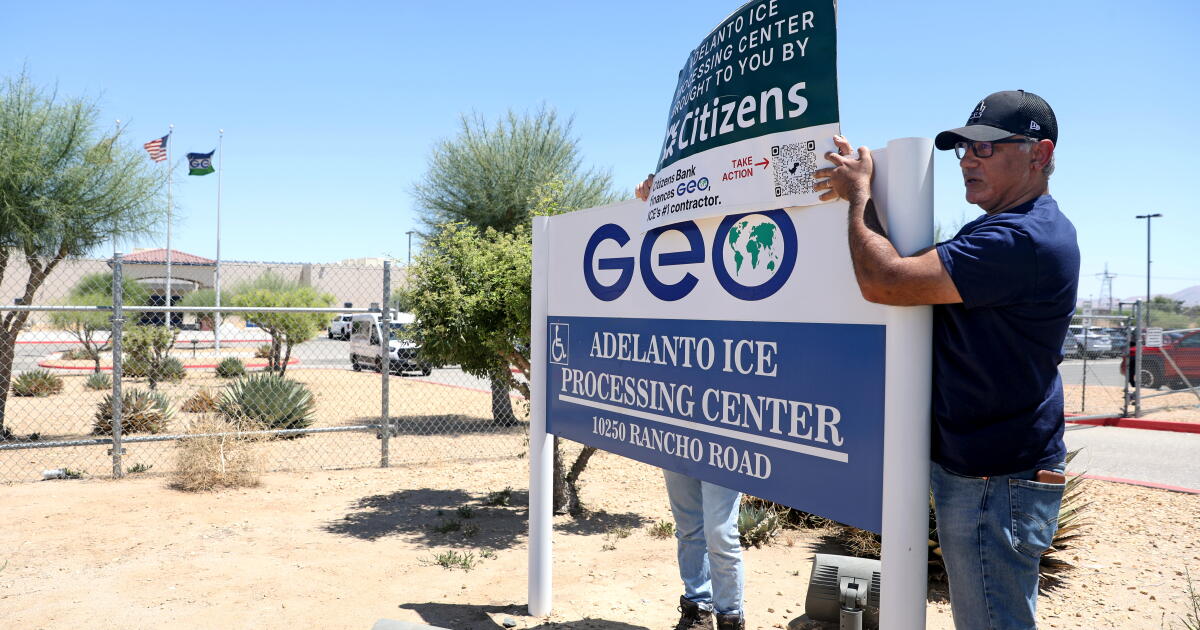
Christopher Ferreira, a spokesperson for The Geo Group, said the company’s services are monitored by DHS to ensure compliance with federal detention standards and contract requirements regarding detainees. The company oversees four facilities in California, including the Adelanto ICE Processing Center north of San Bernardino.

“The support services GEO provides include around-the-clock access to medical care, in-person and virtual legal and family visitation, general and legal library access, translation services, dietitian-approved meals, religious and specialty diets, recreational amenities, and opportunities to practice their religious beliefs,” Ferreira said.

He added that of the company’s immigration facilities are independently accredited by the American Correctional Assn. and the National Commission on Correctional Health Care.

CoreCivic operates the California City Detention Facility north of Lancaster and Otay Mesa Detention Center in San Diego. Spokesperson Ryan Gustin said the company had not been provided a copy of the report or reviewed its findings.

“The safety, health and well-being of the individuals entrusted to our care is our top priority,” Gustin said. He added that the company’s ICE-contracted facilities are “subject to multiple layers of oversight by our government partners” and auditors.

The report notes that CoreCivic did not make requested documents available to investigators, including records on use of force at the California City facility.

“The decision to deny Cal DOJ access to these files was remarkable in light of the serious legal claims that have been made against the facility, which allege that staff routinely engage in abusive behavior and unreasonable use of force against detainees, including deploying pepper spray, hitting a detainee with riot shields and holding him down with their knees on his back, and aggressively pushing a detainee,” the report states.

According to the report, the detainee population in California grew 162%, from 2,300 to more than 6,000 detainees, between site visits in 2023 and those in 2025. Most detainees had no criminal history and were classified as low-security.

Collectively, the facilities have the capacity to hold up to nearly 8,200 detainees.

Six people have died in ICE custody in California since the start of 2025 — four at Adelanto and two at Imperial Regional Detention Facility. In all of the Adelanto cases, family members alleged that the facility’s medical response was inadequate, the report said.

Inspectors found that staffing failed to keep pace with the growing numbers of detainees, particularly at Adelanto and at California City, where they saw “crisis-level healthcare understaffing.”

At Mesa Verde ICE Processing Center in Bakersfield, the report says, “Medical care delays, including specialty care and referrals, were widespread and appeared to be caused by delays in approvals by ICE Health Service Corps and canceled or dropped referrals due to transfers between facilities.”

The intake process for new detainees, which includes a medical and mental health screening, is supposed to take place within 12 hours of their arrival. But detainees at several facilities reported waiting days or weeks before receiving their housing assignment and medical screening, the report says. While waiting, some slept on the floor without access to water.

In its statement, the Department of Homeland Security said detainees undergo medical, dental, and mental health intake screening within 12 hours of arriving at each detention facility, a full health assessment within 14 days of entering ICE custody or arrival at a facility, and access to medical appointments and 24-hour emergency care.

Gustin, the CoreCivic spokesperson, said its facilities adhere to detention standards on staffing and medical care. Emergency care is available 24 hours a day, he said, and the facilities work closely with local hospitals and providers for specialized care.

Ferreira, the Geo Group spokesperson, said detainees have access to teams of medical professionals and off-site specialists, imaging facilities and emergency services.

At the Adelanto facility, detainees said water coolers remained empty for hours. Justice Department staff saw murky drinking water come out of the tap in the women’s housing unit.

At the Golden State Annex in McFarland and at Mesa Verde, detainees said they spent at least $50 per week on commissary items so they wouldn’t go hungry. Across most facilities, detainees reported undercooked food, a lack of dietary or allergy accommodations and irregular mealtimes.

Basic necessities are also an issue, according to the report. At the California City facility, detainees said they got so cold that they cut the ends off socks to make improvised sleeves and covered the air vents in their cells with sheets of paper.

According to the report, Otay Mesa is the only detention center in California with a policy requiring that detainees be strip searched after being visited by anyone other than their attorney. Detained women recounted being told strip in front of male officers, even when menstruating, the report said.

Gustin said CoreCivic follows federal detention standards regarding searches of detainees.

The report did highlight some improvements, including at the Imperial Regional Detention Facility in Calexico, which inspectors said appeared better staffed with medical and mental health care providers compared to their 2023 visit. Still, the review “identified concerns regarding the facility’s management of detainees with severe mental health issues, including two detainees who experienced extended stays in restrictive housing of over 200 days.”

Emily Lawhead, a spokesperson for Management & Training Corp., which oversees the Imperial facility, said the company takes the report seriously. She noted that the report also highlights prompt responses to sick-call requests, meaningful access to programming and recreation and expanded attorney access through 36 private phone booths.

But Lawhead said the company will examine the concerns raised in the report.

“If our review identifies gaps, delays, or missed standards, we will address them,” she said.

The state law requiring the detention facility inspections expires next year. A bill by state Sen. María Elena Durazo (D-Los Angeles) would make the inspections permanent. Another state bill, by Sen. Steve Padilla (D-San Diego), would prevent the excessive markup of products sold at detention center commissaries.

Source link

How Trump’s immigration crackdown is affecting everyday Americans, according to a new AP-NORC poll

Most U.S. adults say the United States is no longer a great place for immigrants, according to a new AP-NORC poll, as about one-third of Americans report knowing someone impacted by the Trump administration’s aggressive immigration enforcement.

A new survey from The Associated Press-NORC Center for Public Affairs Research of more than 2,500 U.S. adults finds about 6 in 10 say the country used to be a great place for immigrants but is not anymore. About one-third of U.S. adults — and more than half of Hispanic adults — say that over the last year they, or someone they know, have started carrying proof of their immigration status or U.S. citizenship, been detained or deported, changed travel plans, or significantly changed routines, such as avoiding work, school or leaving the house, because of their immigration status.

The poll comes as the Supreme Court is considering whether the Trump administration should be allowed to restrict birthright citizenship, as well as following months of sweeping immigration enforcement and mass deportations of immigrants.

Missouri retiree Reid Gibson, an independent, is furious about the Trump administration’s treatment of immigrants. He hopes America eventually becomes more welcoming to immigrants again, but he worries “it may take many years to reverse the damage that the Trump administration has inflicted” with its policies.

The poll finds that many Americans know someone who has been affected by Trump’s approach. That includes Gibson’s stepdaughter, who he says started carrying her passport because of concerns that her darker skin would make her a target in immigration crackdowns.

“It’s just plain wrong,” Gibson, 72, added. “This is not a good country for immigrants anymore.”

Americans’ personal connections to immigration enforcement

Many U.S. adults have adapted their lives to heightened immigration enforcement over the last year, as Trump increased detentions and sought to conduct the largest deportation operation in American history.

Democrats are more likely than independents or Republicans to know someone affected, and those with a personal connection are more likely to say the U.S. is no longer a great place for immigrants.

Kathy Bailey, a 79-year-old Illinois Democrat, has seen the administration’s immigration policies seep into the small-town swim class she regularly attends. She said two women in the class — both naturalized U.S. citizens — have begun carrying their passports when they leave home. Bailey says one of the women, who is from Latin America, has been especially worried about sticking out in an overwhelmingly white community.

“She’s an American citizen now, but she’s so scared that she has to carry her passport,” said Bailey. “She’s just another sweet old grandmother swimming at 5 in the morning.”

About 6 in 10 Hispanic adults say they or someone they know has been impacted by immigration enforcement in this way, much higher than among Black or white adults.

“This is terrible for these women!” Bailey said. “I’m just stunned at what we are coming to.”

Most believe the U.S. used to be a great place for immigrants

Nick Grivas, a 40-year-old from Massachusetts, said his own grandfather’s immigration to the U.S. from Greece has made him feel the impact of the president’s policies. It’s part of why he believes the U.S. stopped being a promising place for people seeking a new life.

“We can see how we’re treating children and the children of the immigrants, and we’re not viewing them as potential future Americans,” Grivas said.

Roughly 3 in 10 U.S. adults say the U.S. is a great place for immigrants, according to the poll, while about 1 in 10 say it never was. The belief that America is no longer great for immigrants is more common among Democrats and independents, as well as among those born outside the U.S.

Grivas, a Democrat, worries that federal policies against immigration could stunt the country by discouraging new arrivals from investing in their local communities, especially if they don’t believe they will be allowed to remain.

“You’re less willing to commit to the project if you don’t think that you’re gonna be able to stay,” he said.

Most support birthright citizenship, but also hold nuanced views

The Supreme Court recently heard arguments in President Trump’s efforts to restrict birthright citizenship by declaring that children born to parents who are in the country illegally or temporarily are not American citizens.

About two-thirds of U.S. adults in the poll say automatic citizenship should be granted to all children born in the country, a view that most Democrats and independents back. Republicans are more doubtful: just 44% support birthright citizenship. The poll also shows that some people are conflicted, saying in general that they support birthright citizenship but also that they oppose it in some specific circumstances.

Among those who object to automatic citizenship is Linda Steele, a 70-year-old from Florida, who believes that only children born to American citizens should be granted citizenship. Steele, a Republican, does not believe foreigners living legally in the U.S. — whether for work or other reasons — should be able to have a child who automatically becomes a U.S. citizen.

“That shouldn’t be allowed,” she said. “They’re just here visiting or going to school.”

When asked about some specific circumstances, about 6 in 10 U.S. adults say they support birthright citizenship for children born to parents on legal U.S. tourist visas, while only about half support it for those born to parents who are in the country illegally. An even higher share, 75%, support automatic citizenship for children born in the U.S. to parents who are in the country legally on work visas, with much of that increased support coming from Republicans saying this was an acceptable situation.

Kevin Craig, a 57-year-old from Wilmington, North Carolina, does not believe citizenship should be automatically granted. Craig, who leans conservative, believes there should be “at least some opportunity for intervention by a human being who can make some sort of a judgment.”

But he added: “I think my personal opinion is that I can’t think of a situation where it would not be granted.”

Sanders, Sullivan and Catalini write for the Associated Press. Sullivan reported from Minneapolis. Catalini reported from Morrisville, Pa. The AP-NORC poll of 2,596 adults was conducted April 16-20 using a sample drawn from NORC’s probability-based AmeriSpeak Panel, which is designed to be representative of the U.S. population. The margin of sampling error for adults overall is plus or minus 2.6 percentage points.

Source link

How I learned to stop worrying about noncitizens voting in L.A. elections

¿Qué en la fregada?

What the hell?

That’s what I muttered after learning that Los Angeles Councilmember Hugo Soto-Martínez wants to allow noncitizens to vote in city and school board elections.

Talk about a solution in search of a problem, considering everything Angelenos are facing right now.

While the specter of la migra continues to haunt the city, far more crushing are problems that affect everyone — affordability, housing, traffic, pollution. Maybe Soto-Martínez and his colleagues should double down on fixing those things first and sell their message better to voters instead of picking up a new issue?

I know the first-term council member comes from a good place. His parents were formerly undocumented, just like my dad, and he has been a fierce advocate for immigrants going back to his labor organizing days. I have friends without legal status and others in the DACA program for people who came to the U.S. illegally as children. I think giving them, as well as green card holders and others with papers, a chance to participate in elections is a righteous idea.

But to paraphrase the Book of Ecclesiastes, there’s a time and a place for everything. In 2026, Angelenos should be focused on electing people and approving initiatives that will improve the city for everyone, not a narrow plank benefiting a slice of the population.

So I called up Soto-Martínez and challenged him to convince this doubting Tomás.

He hopes his proposal will reach the City Council later this month for a vote on whether to place it on the November ballot. If voters pass the measure, it goes back to the council to decide when — if ever — to enfranchise the immigrants.

The proposal, already vilified in conservative media, isn’t as radical as it seems. Noncitizens are already prohibited from voting in federal elections, but there’s a well-established history of their participation in local ones, including in Vermont and Maryland. They can already vote in L.A. neighborhood council elections, and in San Francisco school board elections if they have a child in the district.

Besides, L.A. has long led the way in weaving undocumented immigrants into the fabric of civic life.

This is a sanctuary city where Mayor Karen Bass has stood up to President Trump’s xenophobia. Where eight of the 15 council members are immigrants or the children of immigrants. Where LAUSD Supt. Alberto Carvalho — himself formerly undocumented — has striven to make local schools as welcoming as possible (Carvalho is on paid leave after the FBI raided his home and office earlier this year). Even the LAPD learned decades ago that it’s better to embrace undocumented immigrants than castigate them for their lack of legal status.

“If you’re contributing to this economy, you should have the right to decide who represents you,” Soto-Martínez told me.

Fair point. But isn’t thumbing our noses at Trump asking for more of what he has already inflicted on L.A., making life even more miserable for undocumented immigrants? Could he use the noncitizen voter rolls as a list of whom to deport? Besides, doesn’t extending the franchise to noncitizens give fuel to his crazy conspiracies about stolen elections?

“You always hear, ‘Don’t poke the bear, don’t instigate them,’ but that’s not how you deal with a bully,” Soto-Martínez replied. “They’re coming at us already. While they’re removing people’s right to vote in the Supreme Court, we’re expanding it. … And it has nothing to do with Trump. It’s about fairness.”

Tell that to Trump.

I mentioned that Santa Ana — a city far more Latino than Los Angeles, though not as liberal — decisively rejected a similar measure in 2024. Soto-Martínez’s fellow Democratic Socialist council members, Ysabel Jurado and Eunisses Hernández, have voiced their support for his measure. But I wonder whether the full council will move it along to voters in a year when some members, including Soto-Martínez, are running for reelection.

I couldn’t get a comment from Bass. Councilmember Nithya Raman, who’s running against her, said in a statement that Soto-Martínez’s push “is worth taking seriously” but that it’s “critical to getting this right, and we must not make decisions lightly or quickly.”

“We’re going to have to organize,” Soto-Martínez acknowledged. “But we live in a political moment where it’s the right conversation to have about what this city stands for.”

Nilza Serrano is president of Avance Democratic Club

Avance Democratic Club President Nilza Serrano at Mariachi Plaza in Boyle Heights in 2022.

(Irfan Khan / Los Angeles Times)

He’s going to have to convince people like Nilza Serrano. She’s president of Avance, L.A. County’s largest Latino Democratic club, and heads the California Democratic Party’s Latino caucus. Serrano is no wokosa — she supported Rick Caruso in the last mayoral election and is now siding with Bass.

While Serrano thinks Soto-Martínez is on to something, she said that voting rights for noncitizens are a nonissue for the people she’s trying to get to the polls for the June primary and November general elections. The economy and Trump’s deportation deluge are more on their minds.

I asked if Soto-Martínez’s proposal would cheapen citizenship for people like her. Serrano and her family came here legally from Guatemala in the 1980s before becoming U.S. citizens, a process that took years.

“Not for me,” she replied. “But it’s hard to say for others. I’d have to do a little bit more research.”

So I continued with my own research, calling someone I was sure would have a fit about the idea: Los Angeles County Hispanic Republican Club President David Hernandez.

“Isn’t San Francisco already doing it?” the Navy veteran cracked.

I thought Hernandez would go on an anti-liberal rant, but.…

“I believe there’s a strong argument,” he said, “that if someone has established residency and is a member of the community and suffered the consequences of whatever local policies will be enacted, they should have a say in who gets elected.”

Did the ghost of Joaquin Murrieta, California’s original avenging Latino, suddenly possess Hernandez? To make sure I was hearing right, I asked again if noncitizens voting in L.A. elections is a good thing.

How could he support that, as a Trump-voting Republican?!

“We have to be pragmatic,” he replied. He approves of noncitizens voting in L.A. neighborhood council elections, because that’s true local control.

He understands that allowing them to vote in municipal elections might come off as an insult to the memory of civil rights activists who lost their lives fighting for that right for Black Americans. But U.S. citizens are already taking it for granted, he noted — turnout in the November 2022 L.A. mayoral election was a pitiful 44%.

“Maybe noncitizens will appreciate voting more than citizens,” he said.

I’m still not fully convinced that Soto-Martínez’s push is wise right now, but I like that he’s being careful.

“We need to get in the weeds of this,” he said of the City Council’s deliberations, which he characterized as attempting to ensure maximum benefit and minimum fallout.

Let’s see what they come up with in a few weeks.

Source link

Push to shield immigrant aid workers raising 1st Amendment concerns

The debate over immigration issues has reached a fever pitch nationwide, and Angelica Salas said it’s putting her employees at risk.

Salas, executive director of the Coalition for Humane Immigrant Rights, said her staff experiences harassment and death threats.

“They ask themselves, what if someone who disagrees with our work can find where I live, will my family be safe?” Salas said, addressing state lawmakers at a recent legislative hearing.”People begin to self-censor; they step away from their work and some leave the field entirely.”

Salas was speaking in support of Assembly Bill 2624, which would provide privacy protections for those facing harassment for working or volunteering with organizations that offer legal and humanitarian aid to immigrants. The bill would create an address confidentiality program, like the one already offered to reproductive healthcare workers, and prohibit people and businesses from selling or posting images or personal information about the protected individuals on the internet.

The measure has drawn ire from Republicans, who argue it could have a chilling effect on free speech and the media. Assemblymember Carl DeMaio (R-San Diego) dubbed it the “Stop Nick Shirley Act” and said it would prevent right-wing social media influencers like Shirley from conducting immigrant-related investigations in California.

Assemblymember Mia Bonta (D-Alameda), who authored the legislation, said the proposed law would help keep people safe — but several 1st Amendment experts this week told The Times the bill could have unintended consequences.

“There could be grounds for concern,” said Jason Shepard, a media law and communications professor at California State Fullerton. “It reflects a legitimate and important state interest in protecting people from harassment and threats. But at the same time, this bill punishes the publication of information.”

The legislation defines “personal information” as anything that identifies, describes or relates to the protected individuals, including their names, addresses, telephone numbers, physical descriptions, driver’s licenses, financial information, license plate numbers and places of employment.

Shepard said the potential new law could be applied unevenly, and the language could have a chilling effect on investigative journalism.

Given the polarized political environment, Shepard said the legislation also could prompt other groups to request similar protections, as those working in a range of professions are facing increasingly heated rhetoric or attacks.

“This is not unique to people who are working in immigration support services; this really could apply to anybody engaged in public debate today,” he said.

Carolyn Iodice, the policy director for the Foundation for Individual Rights and Expression, known as FIRE, said the organization has noted an uptick in laws nationwide implementing privacy protections for those in certain professions.

She pointed to a statute enacted a few years ago in New Jersey that protects the addresses of judges, prosecutors and police officers. The law was used in 2023 to block an editor with New Brunswick Today from publishing an article about the police chief living two hours outside of the city.

“It was obviously newsworthy, but this officer was able to wield the law against this journalist, and that is the kind of thing we are worried about,” Iodice said. “When you think about handing what could be a huge number of people the ability to just block anything from being posted about them online — it could easily be abused.”

David Loy, the legal director for the nonpartisan First Amendment Coalition, said the measure would censor the free speech of all citizens, not just those who defamed or threatened immigrant aid workers.

“Someone might have a legitimate dispute with them and wants to refer to it online,” he said. “But they could then basically silence [that person] from referring to them on a Yelp review or Facebook posts that has nothing to do with threatening them — and that is going way beyond the narrow exceptions of the 1st Amendment.”

Loy said the coalition reached out to Bonta’s office and hopes to help tweak the bill.

Meanwhile, the legislation continues to face scrutiny from Republicans.

“We exposed CA Democrats for the ‘Stop Nick Shirley’ Act that silences citizen journalists who expose their fraud and corruption,” DiMaio wrote this week on social media.

Shirley released a viral video last year alleging fraud in Somali-run immigrant daycare centers in Minneapolis. He recently shared videos of himself in Sacramento confronting Democrats who support Bonta’s bill.

“The enemy is truly within,” Shirley wrote on Instagram. “When our politicians would rather protect fraudsters and illegal migrants, it’s time for us to stand up or face mass oppression from the traitors.”

Bonta dismissed the assertion that the bill is intended to deter journalists, stating in a news release that “right-wing agitators” and “ineffective legislators” were intentionally spreading misinformation.

Bonta spokesperson Daniel McGreevy said the bill has a straightforward goal of protecting immigrant service providers. He said the office is working to refine the legislation to address concerns and welcomes good-faith dialogue.

The bill is progressing through the state Legislature and most recently was referred to the Assembly Appropriations Committee.

Source link

DACA renewal wait times leave ‘Dreamers’ at crossroads

Every two years for more than a decade, Melani Candia has gotten approved to stay in the U.S. with her husband and two cats and — more recently — continue to work in special education in Florida.

But this year, delays in Deferred Action for Childhood Arrivals, a program that has shielded her and hundreds of thousands of others from deportation, led to her missing her renewal deadline, losing her job and fearing detention in the country she has called home since she was 6 years old.

She said that as an immigrant in the U.S., fear has become her “new baseline.” “But now, having a new level of vulnerability, it was a very quick increase in the fear,” said Candia.

Renewal wait times for the Obama-era program that allows people who were brought to the U.S. as children to temporarily remain in the country and work have increased to levels not seen since 2016 when there were significant technical issues.

Some of the program’s more than 500,000 beneficiaries, often referred to as “Dreamers,” have waited months for an answer only to see their deadline pass without a decision. Now they’re stuck in a type of limbo in which their work authorization disappears, oftentimes along with their driver’s license, and their ability to stay in the U.S. is at risk.

“It’s not just anecdotal; it’s happening at a larger scale than we’ve ever seen before,” said Greisa Martinez Rosas, executive director of United We Dream, an immigrant youth-led network.

No numbers were available on how many people have recently missed their renewal deadline despite applying 120 to 150 days before their DACA lapses, which is what U.S. Citizenship and Immigration Services, or USCIS, recommends.

“Under the leadership of President Trump, USCIS is safeguarding the American people by more thoroughly screening and vetting all aliens, which can lengthen processing times,” Zach Kahler, an agency spokesperson, said in a statement.

Wait times nearly 5 times longer

DACA grants those who qualify two-year, renewable permits to live and work in the U.S. It does not confer legal status but is meant to offer protection from deportation.

From October 2025 through the end of February 2026, the median wait time for renewals was about 70 days, compared with about 15 days in fiscal year 2025, according to USCIS. This is the longest median wait time since 2016, when it was about 79 days, according to the agency’s data, which did not include 2020 because of the pandemic.

The Department of Homeland Security attributed the 2016 delays to technical issues that emerged as it transitioned to fully processing DACA renewals in its electronic immigration system.

At the end of April, USCIS was reporting that the majority of renewal requests were being completed within about 122 days. That marked a two-week increase from the processing times listed earlier that month.

Federal lawmakers and immigrant groups say some applicants recently have had to wait six months — about 183 days — or longer.

“The delays that people are concerned about used to be sort of a matter of weeks at a time,” Sen. Alex Padilla (D-Calif.) said in an interview. “Now it’s from a few months to many, many months.”

He is one of dozens of lawmakers behind letters sent to federal agencies that question the inflated wait times and whether people who have missed their renewal deadline are being targeted for arrest or deportation.

More than five months after Elsa Sanchez submitted her DACA renewal request, she is still waiting for an answer. When the deadline passed at the beginning of April, she was put on leave at her job at a healthcare IT company and now, as a single mother of a college freshman, has no income.

It’s made her worried about everything from traveling to spending money on pricier household products like shampoo and detergent.

“I’m like, ‘I don’t know, maybe I can cut down on that. Maybe I don’t need this,’” she said. “Because I’m saving every penny.”

Sanchez said something similar happened about a decade ago, but this time she’s scared of the possible repercussions amid Trump’s mass deportation agenda.

Since DACA’s introduction in 2012, it’s faced myriad legal battles, including two that made it to the Supreme Court. And now, though the government is still approving renewals, a 2025 federal court decision means it isn’t processing first-time applications and has left the door open for another possible trip to the Supreme Court.

Hundreds of ‘Dreamers’ arrested

In the first 11 months of 2025, more than 250 DACA recipients were arrested and 86 deported, then-Homeland Security Secretary Kristi Noem said earlier this year. She said the majority of those arrested had “criminal histories,” without indicating the nature of the crimes or if they were arrests, charges or convictions.

In a separate response to a Democratic congresswoman’s inquiry, Homeland Security reported conflicting numbers, saying that 270 were arrested and 174 DACA applicants were removed in the first nine months of 2025.

Their eligibility is dependent in part on not having a felony conviction, a significant misdemeanor or three misdemeanors. Previously, if their status was in jeopardy, they would get a warning and still have the chance to fight it before immigration officers detained them and began efforts to deport them.

Kahler of USCIS said that DACA recipients are not automatically protected from deportation.

“Any illegal alien who is a DACA recipient may be subject to arrest and deportation for a number of reasons — including if they committed a crime,” he said, using an outdated term for immigrants widely considered disparaging.

U.S. Immigration and Customs Enforcement did not respond to questions about whether DACA beneficiaries were being targeted after missing their renewal deadlines.

But federal lawmakers have recently noted people picked up by Immigration and Customs Enforcement after their DACA lapsed.

Their protections may have been further eroded with a precedent decision recently in which the Board of Immigration Appeals determined that DACA status alone is not enough to stop deportation.

Losing DACA eligibility, and a job

Experts have suggested the longer wait times could be related to the restarting of biometric appointments, which were paused during the COVID-19 pandemic emergency. Some may also not be getting approved by their deadline because they’re not sending it in by the recommended time.

Maria Fernanda Madrigal is an immigration attorney and DACA recipient who submitted her renewal application about a month and a half before the deadline because she said that’s all the processing time that’s been needed in the past. She said she was also waiting for her job to hold a DACA workshop so she could get the more than $550 fee for renewal waived.

Her DACA lapsed recently, and the mother of three was let go from her job.

“My first concern was my cases, to be honest, because I knew I was going to have to hand off everything, and my team is already overworked,” said Madrigal.

Immigration attorneys have also said that USCIS has paused processing renewals for people from dozens of countries the agency described in recent policy memorandums as “high-risk” following presidential proclamations. The National Immigration Law Center estimated that as many as 3,000 to 4,000 people could be impacted.

“This process that has no timeline is leading to people from certain countries experiencing a pause. And we don’t know how long that pause will be in place,” said Ignacia Rodriguez Kmec, attorney at the National Immigration Law Center.

Every day, Candia checks on her renewal. She said she’s most afraid of being locked up in bad conditions in an ICE detention facility, but also thinks about what it would be like returning to Bolivia after more than 25 years.

“If God forbid that happened, it would break my heart because I’ve been in this country since I was 6,” she said. “My entire life is here.”

Golden writes for the Associated Press.

Source link

Supreme Court leans in favor of Trump’s bid to end protections for Syrian, Haitian migrants

The Supreme Court’s conservative majority sounded ready Wednesday to rule that the Trump administration may end the temporary protection that has been granted to more than 1.3 million immigrants from troubled countries.

Congress in 1990 authorized Temporary Protected Status, or TPS, for noncitizens who could not safely return home because their native country was wracked by war, violence or natural disasters. If those people passed a strict background check, they could stay and work legally in this country.

But President Trump came to office believing too many immigrants had been granted permission to enter and stay indefinitely.

Last year, his Department of Homeland Security moved to cancel the temporary humanitarian protection for immigrants from 13 countries, including Venezuela, Haiti, Syria, Honduras and Nicaragua. Court challenges on behalf of Haitians and Syrians were consolidated into a single case, Mullin vs. Doe, which the justices heard Wednesday.

Immigrant-rights advocates challenged those decisions as political and unjustified, and they won orders from federal judges that blocked the cancellations.

But Trump’s lawyers filed an emergency appeal at the Supreme Court arguing the judges had overstepped their authority. They pointed to a provision in the 1990 law that bars “judicial review” of the government’s decision to end temporary protection for a particular country.

The justices ruled for the administration and set aside the lower court rulings in a series of 6-3 orders.

Faced with criticism over its brief and unexplained orders, the justices agreed to hear arguments on the TPS issue on the last day of oral arguments for this term.

But the ideological divide appeared to be unchanged.

Solicitor Gen. D. John Sauer said Congress had prohibited “judicial micromanagement” of these decisions, and none of six conservatives disagreed.

UCLA law professor Ahilan T. Arulanantham, representing several thousand Syrians, said the Homeland Security secretary had failed to consult the State Department, which says it is unsafe to travel there.

He said the government “reads the statute like it’s a blank check … to give the secretary the power to expel people who have done nothing wrong.”

Chicago attorney Geoffrey Pipoply, representing more than 350,000 Haitians, said the cancellations were driven by “the president’s racial animus toward non-white immigrants.”

The court’s three liberals argued the administration failed to follow the procedural steps required under the law. But that argument failed to gain traction.

Justice Amy Coney Barrett and her husband adopted two children from Haiti who are citizens. Like most of the conservatives, she asked few questions during the argument.

Source link

Supreme Court will hear Trump’s bid to end legal protection for up to 1.3 million immigrants

The Supreme Court will hear arguments this week over whether the Trump administration may revoke temporary protected status for about 350,000 Haitian and 6,100 Syrian immigrants.

TPS allows people who are already in the United States to legally reside and work here if they are unable to safely return to their home country because of a sudden emergency such as war or a natural disaster. The humanitarian program, enacted by Congress in 1990, has since been used by Republican and Democratic administrations alike.

Since President Trump returned to office last year, his administration has terminated such protections for immigrants from 13 countries. Court challenges on behalf of Haitians and Syrians have been consolidated into a single case, Mullin vs. Doe, which the justices will hear Wednesday.

The high court’s ruling could eventually have sweeping repercussions for all 1.3 million immigrants from the 17 countries that were designated for TPS at the start of this administration. That’s because the federal government is arguing that decisions regarding the program are almost entirely immune from review by courts.

“Temporary means temporary and the final word will not be from activist judges legislating from the bench,” a Department of Homeland Security spokesperson, who did not provide their name, wrote in response to a request for comment.

Lower courts have repeatedly deemed the administration’s actions improper.

“We’re seeing clear gamesmanship from government to insulate all TPS decision-making from any oversight,” said Emi MacLean, a senior staff attorney at the American Civil Liberties Union of Northern California, who is counsel in the case for Syrians and in other cases challenging five of the terminations. “They’ve created a farce of a process to justify the ends that they sought, which was to strip humanitarian protections from over a million people.”

In the Trump administration’s appeal, Solicitor Gen. D. John Sauer argued that Congress gave the Homeland Security secretary the power to grant or end the temporary protected status for troubled countries and barred judges from intervening.

He pointed to a provision that says: “There is no judicial review of any determination of the [secretary] with respect to the designation, or termination or extension of a designation, of a foreign state.”

Citing this hands-off provision, Trump’s lawyers won brief emergency orders last year that allowed the administration to strip legal protections from about 600,000 Venezuelans. In that case, then-Homeland Security Secretary Kristi Noem had quickly reversed an extension granted by the Biden administration three days before Trump was sworn in.

The circumstances surrounding the Syria and Haiti cases are different. Advocates for the immigrants argue that the administration failed to conduct the required process to properly evaluate each country’s conditions.

They point to emails in July from a Homeland Security official to a State Department official. The Homeland Security official listed TPS designations coming up for review — Syria, South Sudan, Myanmar and Ethiopia. In response, the State Department official wrote: “I confirm that State has no foreign policy concerns with ending these TPS designations.”

State Department travel advisories for both countries warn people against traveling to either because of the risk of terrorism, kidnapping and widespread violence. U.S. citizens are advised to prepare a will.

For Syria, the advisory cites active armed conflict since 2011. For Haiti, it says the country has been under a national state of emergency since March 2024.

But Federal Register notices announcing the terminations said country conditions had sufficiently improved. The notice for Syria, for example, says “the Secretary has determined that, while some sporadic and episodic violence occurs in Syria, the situation no longer meets the criteria for an ongoing armed conflict that poses a serious threat to the personal safety of returning Syrian nationals.”

If the government loses, Homeland Security officials would have to reevaluate the TPS decisions in consultation with the State Department and make a decision based entirely on the country conditions themselves.

The government could start over, in that case, and still find that TPS is no longer warranted — if the process bears that out.

In a friend-of-the-court brief led by immigration law scholars at Georgetown and Temple universities, they explained that before TPS existed, similar forms of humanitarian relief were determined by the executive branch “without reference to any statutory criteria or constraints, and with little if any explanation for why nationals of certain countries received protection while others did not.”

With TPS in 1990, Congress sought to end that “unfettered discretion,” they wrote. Instead, the statute requires the Homeland Security secretary to terminate TPS if the review finds that conditions justifying the designation no longer exist. Otherwise, the law states, it “is extended.”

“The point of the TPS statute was to depoliticize humanitarian decisions,” said MacLean, the ACLU attorney. “Secretary Noem in all of her TPS decisions has completely undermined that fundamental goal.”

Ahilan Arulanantham, who is arguing for the Syria case on Wednesday, added that if the government wins, “it also means they could probably grant TPS to countries that don’t deserve it.” Arulanantham, co-director of the Center for Immigration Law and Policy at UCLA, has represented the National TPS Alliance in separate litigation during this administration and Trump’s first.

Top Homeland Security and State Department officials from the George W. Bush, Obama, Trump and Biden administrations filed a brief arguing that the Trump administration’s terminations of TPS for Syria and Haiti were “not based on evidence and sharply departed from past inter-agency practices.”

Haiti was originally designated for TPS in 2010 after a massive earthquake devastated the country and redesignated because of subsequent natural disasters and gang violence. In November, Noem announced that she would terminate TPS for Haiti, effective Feb. 3. She wrote in the Federal Register that “there are no extraordinary and temporary conditions in Haiti” that prevent Haitians from safely returning.

But even if there were, she continued, “termination of Temporary Protected Status of Haiti is still required because it is contrary to the national interest of the United States.”

The Homeland Security spokesperson said TPS for Haiti “was never intended to be a de facto amnesty program, yet that’s how previous administrations have used it for decades.”

Syria, meanwhile, “has been a hotbed of terrorism and extremism for nearly two decades,” the spokesperson wrote, “and it is contrary to our national interest to allow Syrians to remain in our country.”

In the Federal Register notice for Syria, Noem added that maintaining its TPS designation would “complicate the administration’s broader diplomatic engagement with Syria’s transitional government” by undermining peace-building efforts.

The Supreme Court will take up the question of whether the Homeland Security secretary can use national interest as a reason to revoke TPS. Attorneys for the TPS holders believe any decision to revoke TPS must come down to the country conditions alone.

Syria and Haiti are among the countries for which the Trump administration has also paused processing all immigration benefits. If their TPS protections expire, those immigrants would become vulnerable to detention and deportation even if they are eligible for other forms of relief.

U.S. Solicitor Gen. D. John Sauer attends a press briefing at the White House.

U.S. Solicitor Gen. D. John Sauer argued that Congress gave the Homeland Security secretary the power to grant or end the temporary protected status for troubled countries and barred judges from intervening.

(Aaron Schwartz / Getty Images)

Attorneys for the TPS holders say the terminations were also driven by racial animus. They point to various statements by Trump over the years, including his false claim that Haitians were eating the pets of people in Springfield, Ohio, that they “probably have AIDS” and that Haiti is among the “shithole countries” from which he would permanently pause migration.

Among those affected is a 35-year-old Haitian woman who has lived in the U.S. since 2000 and is raising her four U.S. citizen children in a Southern state. The woman requested to be identified by her middle and last initials, B.B., out of concern for her immigration case.

After graduating high school, B.B. got into nursing school but couldn’t attend because she didn’t qualify for financial aid. She said later getting TPS allowed her to become a certified nursing assistant, and she now works as a medical coordinator while owning a nail salon and three real estate properties.

Though B.B.’s TPS remains active because of the court proceedings, her driver’s license expired Feb. 3 and she has since had to rely on friends and rideshares to get around while repeatedly requesting a renewal.

She said she worries most about her children. If she were deported back to Haiti, she said, she would leave them in the U.S. for their own safety.

“It’s like planning your death,” she said. “I’m 35 and I already have a will — not because I’m going to die but because of the situation.”

On a call with reporters, attorneys and advocates, a Syrian man said he earned his master’s degree in the U.S. and now works in the healthcare industry. The man, who was identified by a pseudonym, said he and his wife are afraid of what their future will look like.

“TPS gave us something we had not had in years: a place to settle and a moment to grieve,” he said, later adding that “telling Syrians to go back right now is not a policy — it’s abandonment.”

Among the public, there is broad support for TPS and other humanitarian programs. According to a poll conducted last month by the firm Equis Research, 68% of Latino and 65% of non-Latino voters support fighting to give back legal protection to those who have lost their temporary protected status or asylum protections as a result of the current administration’s actions.

Earlier this month, the House voted in favor of a bill that would require new Homeland Security Secretary Markwayne Mullin to redesignate Haiti for TPS. Among those who crossed the political aisle to support it were 10 Republicans and Rep. Kevin Kiley, an independent from Rocklin, Calif., who caucuses with Republicans. The measure faces an uphill battle in the Senate.

In an interview with The Times, Kiley said his vote was about common sense and being humane.

“It’s particularly dangerous for people that would be returning where the gangs that are ravaging the country are just lying in wait outside the airport in Port-au-Prince,” he said, referring to the Haitian capital.

And because most won’t return willingly, Kiley added, “really all you’d be doing is removing work authorization from 350,000-some people who are going to mostly remain in the country, who will not be able to work anymore and may end up being more reliant on public assistance in states where they’re eligible.”

At the same time, Kiley said, the TPS system hasn’t worked as intended because most so-called temporary designations drag on.

“The system needs to be reformed,” he said. “But that’s all separate and apart from what we do with the folks who were already given this designation.”

Times staff writer David G. Savage in Washington contributed to this report.

Source link

Ordered free, still locked up: Judges fume over ICE detentions

Judge Troy Nunley was fed up.

Federal immigration officials had once again flouted his authority by keeping a man locked up in a California City detention center after Nunley ordered him released. When he was finally set free, the man was booted onto the street with no passport, driver’s license or other personal effects. The judge’s demand that the items be returned were met with silence.

And so on Tuesday, Nunley, the chief judge of the Eastern District of California, slapped Department of Justice attorney Jonathan Yu with an official sanction and a $250 fine.

In a scathing order, Nunley laid out why he was compelled to take such a rare step. The fine may have been less than some traffic tickets, but it’s nearly unheard for a judge to formally admonish a government lawyer.

By Yu’s own admission, he was drowning in work. In his order, Nunley recounted the attorney’s claim he’d been assigned more than 300 nearly identical cases in the last three months, all of immigrants in detention who argued they were being held without cause.

Court filings show many California cases involve longtime U.S. residents unexpectedly hauled off to jail after routine check-ins with immigration officials. One was an Afghan who’d helped the American war effort. Another a Cambodian grandmother of eight who fled Pol Pot’s killing fields as a girl nearly 50 years ago.

Until last year, most would have fought deportation on bond after a brief hearing with an immigration judge. Now, their only hope of release is to file a petition for writ of habeas corpus — a legal maneuver once typically reserved for death row inmates and suspected terrorists — inundating the country’s busiest federal courts with thousands of emergency suits.

The Trump administration attorney said he was trying to “triage” the situation, but Nunley found he repeatedly failed to comply, leaving people with the right to walk free stuck behind bars.

“The Court is not persuaded,” he wrote, issuing the sanctions.

The order came days after Nunley took the unusual step of announcing a “judicial emergency” in the district, which covers nearly half of California, stretching from the Oregon border to the Mojave Desert in the inland part of the state, including Fresno, Bakersfield and Sacramento.

In the last year, the Eastern District has received more petitions from immigration detainees than almost any other jurisdiction in the United States: More than 2,700 since January, compared to fewer than 500 last year and just 18 in 2024. Similar crises are playing out elsewhere, with federal courts in Minnesota briefly paralyzed amid the Trump administration’s enforcement blitz there last winter.

People detained are seen behind fences

People detained are seen behind fences at an ICE detention facility in Adelanto, California on July 10, 2025.

(Patrick T. Fallon/AFP via Getty Images)

In an interview with The Times, Nunley said dealing with the surge of activity since last summer has been “like being hit over the head with a bat.”

“We’re up all night doing these cases,” he said.

So far this year, the Eastern District’s six active judges have ordered almost people 2,000 freed.

“The majority of the cases that we see are cases where people should not be detained,” Nunley said. “They should be receiving hearings to determine whether or not they are to remain in this country, and until they receive those hearings, they should be free.”

Since last July, the Department of Homeland Security has ordered that all immigrants it arrests are subject to “mandatory detention” — a policy that had previously only applied to those caught at the border.

The change came four days after President Trump signed a spending bill that earmarked $45 billion to expand the federal network of immigrant lockups.

“This has been a sea change in the way the government has read the law,” said My Khanh Ngo, a senior staff attorney at the ACLU Immigrants’ Rights Project. “Almost every judge who has looked at this has agreed these people should get bond, and yet thousands of people are still sitting in detention.”

high school students protest immigration raids

Elizabeth Vega, 15, right, and Darlene Rumualdo, 15, from Torres High School join labor organizers, clergy leaders and immigrant rights groups to protest immigration raids nationwide at La Placita Olvera in downtown Los Angeles on January 23, 2026.

(Genaro Molina/Los Angeles Times)

Longtime U.S. residents who might once have fought removal from home — where they can more easily gather evidence to support their case and confer with lawyers — are instead being held indefinitely.

Many have no criminal record. Some have been in the U.S. so long that the countries they came from no longer exist.

“People are locked up in the same facilities as people accused of crimes, people who’ve been convicted of crimes … and then you’re telling people, you have no shot of getting out,” Ngo said. “Detaining people and not giving them the chance to get out of detention is a way of coercing people to give up their claims.”

The habeas process can take weeks or months depending on the judge and the district.

“When the immigration cases dropped on our district, we got hit harder than any other outside West Texas,” Nunley said. “Initially we had more cases than anyone else.”

Today, data compiled by ProPublica and legal activist groups including the Immigration Justice Transparency Initiative show almost a quarter of the roughly 30,000 active habeas petitions in the United States are in California courts. Nunley’s own tabulations show half the California cases are in his district, where a perfect storm of stepped-up enforcement, a large population of immigrant workers and a concentration of detention centers produced a flash flood of habeas petitions.

The cases rely on the Constitution’s guarantee of due process before being deprived of life, liberty or property. But according to court filings, in some instances the government has argued “the Fifth Amendment does not apply” to detained immigrants.

DOJ lawyers responding to the bids for freedom now regularly complain they’re being crushed under paperwork.

Judges accustomed to having government lawyers comply with their orders have been left fuming.

In California’s Central District, which includes L.A. and surrounding areas, Judge Sunshine Sykes wrote a fiery decision earlier this year that said the Trump administration is inflicting “terror against noncitizens.”

Sykes is one of several federal judges across the country that have tried to compel the government to resume bond hearings. The 9th U.S. Circuit Court of Appeals blocked that decision in March, leaving the habeas system in place for now. But with challenges or recent decisions across multiple circuits, experts say the fight is fated for the Supreme Court.

“ICE has the law and the facts on its side, and it adheres to all court decisions until it ultimately gets them shot down by the highest court in the land,” a Homeland Security spokesperson said in an email to The Times.

A woman holds a "ICE not welcome here!" sign at a vigil in San Pedro in January.

A woman holds a “ICE not welcome here!” sign at a vigil in San Pedro in January.

(Gina Ferazzi/Los Angeles Times)

The lawyers fighting to free those jailed under the Trump administration’s mandatory detention policy say they were not initially equipped for these legal battles because they used to be exceedingly rare.

Most federal judges had only seen a handful of habeas petitions before last summer — then suddenly they had hundreds of requests for urgent relief, according to Jean Reisz, co-director of the USC Immigration Clinic.

Reisz said there are efforts to get pro bono law groups trained on how to effectively argue habeas cases, “but it takes a while to get up to speed.”

A Federal agent asks residents to move back at the scene of a shooting

A federal agent asks residents to move back after a shooting during an immigration enforcement operation in Willowbrook on January 21, 2026.

(Genaro Molina/Los Angeles Times)

At the same time, Reisz said, lawyers are pushing judges who oversee the cases to act swiftly, since interminable procedural delays ensure people remain incarcerated.

“Most of the habeas petitions include a motion for temporary restraining orders, and that requires emergency decisions from the courts, which requires the courts to act very fast,” Reisz said.

In California’s federal district courts, the backlog remains thousands deep. Nunley said the system is struggling to keep up with the crush of cases.

“There’s nothing that says that noncitizens should not be entitled to due process,” Nunley said. “These are our people, they reside in our district. They’re entitled to the same due process that you and I are entitled to.”

Source link