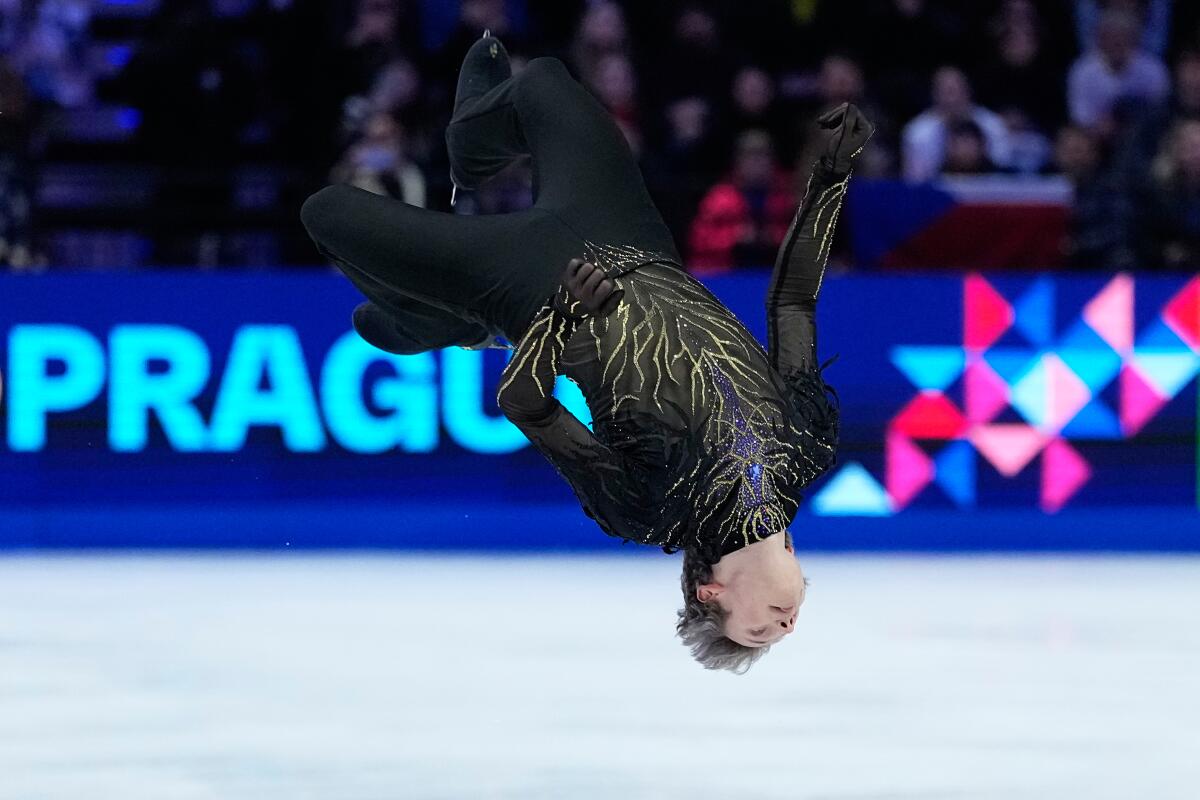
ilia malinin

Ilia Malinin’s collapse: Olympics are a different kind of pressure

When she skated, Tara Lipinski was always nervous. But it was different before the free skate of the 1998 Olympics. The teenager cried that morning. She called her parents after the six-minute warmup and said she couldn’t do it. Her legs were physically shaking in her beginning pose. She didn’t know what to do.

“When you go to the Olympics, there’s no training for that,” said Lipinski, now an analyst for NBC. “You don’t know what it’s going to feel like ‘til you’re actually feeling it.”

The awe-inspiring dream that often starts as a child can quickly turn into a nightmare for athletes who get blinded by the bright Olympic spotlight. While Lipinski realized her dream, becoming Olympic champion in Nagano, she knows the suffocating feeling of competing under the Olympic rings.

She knows the stress that devoured Ilia Malinin on Friday in Milan.

Malinin’s meltdown from favorite to eighth place underscored the unpredictability of the Olympic stage. The 21-year-old dubbed “the Quad God” was supposed to unleash the first quadruple axel in Olympic history. The four-and-a-half twisting jump he successfully executed when he was 17 has been the talk of the Olympic cycle.

Battling nerves and the conditioning needed for a long Olympic competition, he didn’t use it during the team competition or his individual short program. The free skate would be the last opportunity. It felt like the perfect coronation for the soon-to-be Olympic champion.

Then he bailed midair.

“I think that, for me, I would be like, ‘Oh, man, I just missed what everyone was waiting for,’” Lipinski said. “You go through that minute of being rattled and you have to come back to [the program]. … The next jump [he] wasn’t able to completely reset and shake it off. And then once that next mistake happened — and for Ilia, who doesn’t make mistakes — I think that was probably very difficult for him.”

The standing-room-only crowd gasped when Malinin gave up on the quad axel. Fans grew more uneasy when he fell two jumps later. They tried to urge him on as the mistakes piled up. Instead of joyful encouragement, the clapping felt like desperation in the arena.

Ilia Malinin falls during his free skate at the Milan-Cortina Games on Friday.

Ilia Malinin falls during his free skate at the Milan-Cortina Games on Friday.

(Robert Gauthier / Los Angeles Times)

Eight years ago, when Nathan Chen bent under the Olympic pressure in Pyeongchang, the crowd’s gasps each time he stumbled through his short program only made one of the hardest moments of his career even more difficult.

“That just hurts you to your gut,” Chen said in a video for Yahoo Sports. “You get up and mentally you have to refresh … but also the energy just changes in the arena. You can tell there’s tension now.”

Chen, then 18 years old in his Olympic debut, bounced back in a fearless free skate that moved him into fifth overall. He became almost unbeatable for the next Olympic cycle. At the Beijing Games, he set the world record for the short program, exorcised the demons from 2018 and became the United States’ first Olympic gold medalist in men’s singles in 12 years.

Malinin was a contender to be at those Games four years ago. He finished second in the 2022 U.S. championships, but was left off the Olympic team in a controversial decision. Then just 17, he was only in his first full season of senior competition.

But Malinin was already poised to be the future of the sport. Simply going to the Games as an understudy to Chen’s leading role would have been valuable experience.

Instead, U.S. Figure Skating selected third-place finisher Vincent Zhou and fourth-place Jason Brown.

Sitting with his coaches while waiting for his score Friday, a frustrated Malinin said if he had been sent to Beijing, he “wouldn’t have skated like that.”

“It’s not easy,” he said as cameras zoomed into his face.

He shrugged. He reset.

“It’s done,” he said.

“I think if I went to ’22 then I would have had more experience and know how to handle this Olympic environment,” a composed Malinin said in the mixed zone interview area. “But also, I don’t know what the next stages of my life would look like if I went there. So now all I can do is just regroup from this and really just take in the information that happened and just figure out how to manage in the future.”

Malinin has said he wants to skate for three Olympic cycles. The first attempt ended in shattering disappointment. That could only make the comeback sweeter.

“He will dominate the sport for years to come,” Lipinski said. “This was a huge, obviously, heartbreak for him, but we will see him rise again.”


Source link

Ilia Malinin talks crippling anxiety that cost him an Olympic medal

He popped the quad axel. He stumbled across the ice. He tried to hide the pained expression.

Ilia Malinin fell apart in the men’s free skate, tumbling from near lock to win the gold medal to eighth place after a disastrous performance Friday. After his music ended, Malinin covered his anguished face. He put his hands on his knees, shook his head in disbelief and scrunched his face, hoping to hold back the tears.

It was the first time since November 2023 that he hadn’t won a competition.

“I just thought that all I needed to do was go out there and trust the process that I’ve always been doing with every competition,” Malinin said with tear-stained cheeks. “But, of course, it’s not like any other competition. It’s the Olympics.”

American Ilia Malinin reacts after stumbling through the men's singles free skate at the Winter Olympics on Friday.

American Ilia Malinin reacts after stumbling through the men’s singles free skate at the Winter Olympics on Friday in Milan.

(Robert Gauthier/Los Angeles Times)

Malinin skated four times at the Milan-Cortina Games, helping the United States to a team gold medal with a clutch free skate that clinched the one-point win. But the 21-year-old had just one clean skate in his first Games experience. He explained his slow start during the team event as “Olympic nerves.”

There was no explaining away Friday’s flop.

“I think people only realize the pressure and the nerves that actually happen from the inside,” said Malinin, whose technical advantage was supposed to be insurmountable for his opponents. “It was really just something that overwhelmed me. I just felt like I had no control.”

After Malinin’s score was announced, Kazakhstan’s Mikhail Shaidorov covered his mouth in shock. He was the new Olympic champion. Shaidorov claimed his country’s first Olympic gold in figure skating. His coach held his arm up like a boxing champion as a legion of Kazakh fans seated in the corner above the kiss-and-cry booth where skaters wait for their score waved their country’s teal and yellow flags. Malinin hugged him. He pointed to Shaidorov’s chest.

“You deserve it,” Malinin said.

Japan’s Yuma Kagiyama shook off several falls in his program to fight for his second consecutive Olympic silver. His countryman Shun Sato was in tears after learning he took the bronze.

Ilia Malinin's father, Roman Skorniakov, holds his head in his hands during his son's stumbles at the Olympics

Ilia Malinin’s father, Roman Skorniakov, reacts during his son’s performance at the men’s singles free skate at the Winter Olympics on Friday in Milan.

(Robert Gauthier/Los Angeles Times)

The United States’ Andrew Torgashev finished 12th with his season’s best 259.06-point total. Maxim Naumov stumbled through several jumps in his free skate to finish 20th overall with a 223.36 point total. The 24-year-old who lost both parents in a plane crash last year earned a standing ovation from actor Jeff Goldblum, who was in the stands behind the judges.

As the groups progressed toward the medal contenders, the crowd filled Milano Ice Skating Arena to the brim. Fans in suites in the rafters leaned over glass panes to get a better look. Volunteers and arena workers stood at the top of the concourse with no open seats left to claim.

While rising to the top of the sport with his stunning jumps and crowd-pleasing backflip, Malinin said his mission was to boost the popularity of figure skating to get this kind of attention outside of just the Olympic stage.

But standing at the center of the ice as fans waved U.S. flags from every corner, Malinin, the “Quad God” who looked invincible just three months ago when he became the first person to land seven quadruple jumps in one program, felt scared.

“Especially going into that starting pose, I just felt like all the just traumatic moments of my life really just started flooding my head,” Malinin said. “It was just like so many negative thoughts that just flooded into there, and I just did not handle it.”

He started off the program with a strong quad flip. Then he bailed mid-air on his signature quad axel that he had yet to attempt in the Olympics. The crowd gasped. Panic started when Malinin downgraded a planned quadruple loop to a double two jumps later.

American Ilia Malinin falls while competing in the men's singles free skate at the Winter Olympics in Milan on Friday.

American Ilia Malinin falls while competing in the men’s singles free skate at the Winter Olympics in Milan on Friday.

(Robert Gauthier/Los Angeles Times)

Behind the boards, his father and coach, Roman Skorniakov covered his face. Coach Rafael Arutyunyan, who has worked with Malinin part-time since 2021, paced back and forth. He hit the padded boards for encouragement before Malinin lined up for a three-jump combination.

Malinin fell again.

The program couldn’t end soon enough just to allow the 21-year-old a chance to hide after years of being in the spotlight as the presumed next Olympic champion.

“Being the Olympic gold hopeful is really just a lot to deal with,” Malinin said, “especially for my age.”

Malinin’s free skate music includes self-narrated voiceovers telling the story of his personal journey growing in the sport. As it begins, he uncovers his face. His words echo over the speakers.“The only true wisdom,” Malinin says in the program, “is in knowing you know nothing.”

After this result, that couldn’t be more true.

Source link

Winter Olympics: Ilia Malinin, U.S. win gold in team figure skating

Believe in the Quad God.

Ilia Malinin’s clutch free skate that scored 200.03 points gave the United States its second consecutive team figure skating gold medal Sunday at the Milan-Cortina Olympic Games.

After Amber Glenn fought through a shaky free program that finished third and lost the United States its two-point lead, Malinin stepped up as only he could. He executed five quad jumps and won by nearly six points, even if he did not perform his signature quad axel. He even put his hand down after a jump, but the mistake only seemed to fuel him as he finished with a flourish, changing the back-half of his program to earn back extra points.

His U.S. teammates, cheering from the sideline box rose to their feet and pumped their fists after each of Malinin’s jumping passes. When he landed his back flip, skating flawlessly through one foot, the packed crowd at Milano Ice Skating Arena roared.

While Japan’s Shun Sato scored a season’s best to finish the competition, he could not match the technical prowess of Malinin, who is also the favorite to win individual gold this week.

In front of a raucous home crowd, Italy held off Georgia for the bronze medal behind a dazzling free skate from Matteo Rizzo, who dropped to his knees on the ice and cried after his performance had fans chanting “Italia!” before he even finished. He cried into the Italian flag in the kiss-and-cry after his season’s best 179.62 points.

With the first figure skating medal of the Milan-Cortina Games on the line, every skater fought for every fraction of a point. U.S. pairs skater Ellie Kam went deep into a one-legged squat to hold on to the first throw jump. The United States led by five points entering the final day, but still had no room for error as Japan finished first in qualifying in all of Sunday’s disciplines. With the dominance of Japan’s Riku Miura and Ryuichi Kihara in pairs, Kam’s partner Danny O’Shea knew the strategy for the U.S. pair was to simply try to stay as close as possible.

Ellie Kam and Danny O'Shea perform in pairs figure skating during the team competition at the Milan-Cortina Games.

Ellie Kam and Danny O’Shea perform in pairs figure skating during the team competition at the Milan-Cortina Games on Sunday.

(Stephanie Scarbrough / Associated Press)

Kam fought for the landing on a throw loop so hard that she could feel her leg cramping.

“I was like, ‘I’m not going down,’” Kam said, “I got this. We got this.”

They looked at each other before their next element and said “calm.” Their message cut through the energized crowd that cheered louder and louder with each jump. At the end, Kam’s and O’Shea’s celebratory screams simply joined the crowd’s roar. As they saluted the crowd, O’Shea pointed toward Kam to acknowledge her effort.

The pair’s fourth-place finish in the free program was a one-point improvement from their qualifying spot, earning a slim, but vital cushion entering the men’s and women’s free skates.

Instead of sending world champion Alysa Liu back for the free skate after she performed the short program, the U.S. selected the three-time national champion Glenn. The 26-year-old was making her Olympic debut.

On the Olympic stage for the first time, Glenn has tried to embrace the opportunity while treating the competition as if it were any other one. But the larger stage has created additional stress for Glenn after she was asked in a news conference about President Trump’s approach to the LGBTQ+ community in recent years and how it’s affected her personally.

U.S. figure skater Amber Glenn competes during the team competition on Sunday at the Milan-Cortina Games.

U.S. figure skater Amber Glenn competes during the team competition on Sunday at the Milan-Cortina Games.

(Ashley Landis / Associated Press)

Glenn, who identifies as bisexual and pansexual, encouraged people in the queer community to “stay strong in these hard times” and recognized that it wasn’t the first time the community had to unite to “fight for our human rights.” Glenn then received threats on social media after the news conference and posted on Instagram that she would be taking a break from social platforms to focus on the competition.

But it wasn’t the social media hate that rattled Glenn, she insisted. She was simply tired, sore and disoriented from the unfamiliar Olympic team competition format.

All of Glenn’s other competitors did the short program portion of the competition on Friday. She came in with several good days of training at the venue, but did not get the same kind of opportunity to get used to the stage. Glenn fought through a shaky triple axel to open her program and stepped out of a triple flip that prevented her from completing a planned combination for her second jumping pass.

Waiting in the kiss-and-cry, Glenn bowed her head and stared at the ground. She struggled to muster even a fake smile.

“I’m grateful that the team is so supportive.” said Glenn, who finished behind Japan’s Kaori Sakamoto and Italy’s Lara Naki Gutmann. “But I do feel guilty that I could be the reason that we don’t win the gold, and I don’t know how I will ever apologize for that.”

Glenn clasped her hands in her lap waiting for Sato’s score after the Japanese skater performed a clean program that had his teammates in tears. But his technical score was about five points less than Malinin’s. Glenn was the first skater to hug Malinin in the United States’ team celebration, lifting him off the ground as he extended arms out wide.

Source link

Ilia Malinin conserves energy, but U.S. still leads Olympic team skate

Ilia Malinin leaned his head back and wagged his tongue. This perhaps wasn’t the start to his Olympic career that he wanted.

The 21-year-old took it easy in the short program of the team figure skating competition Saturday, forgoing his signature quad axel, but even with a watered-down routine, the “Quad God” looked shockingly mortal.

He finished second in the short program after struggling on multiple jumps, trailing Japan’s Yuma Kagiyama’s electrifying performance by almost 10 points. The United States still enters the final day of the team competition with a five-point lead after Madison Chock and Evan Bates dazzled in the free dance with 133.23 points that earned first place.

The three-time reigning world champions swept both dance programs in the team event to pace the United States to a 44-point team total. The Americans lead second-place Japan (39 points) and third-place Italy (37) before Sunday’s medal event that will feature men’s, women’s and pairs free programs. The United States has not named the skaters who will perform Sunday’s long programs.

Ilia Malinin said he simply was managing his energy to prepare for the individual event, which begins Tuesday.

Ilia Malinin said he simply was managing his energy to prepare for the individual event, which begins Tuesday.

(Matthew Stockman / Getty Images)

Bates pumped his fist at the end of the free dance. The seven-time U.S. champions have increased their scores for the bull and matador-themed program at each international competition they’ve performed at this season. Malinin, sitting in the U.S. box on the side of the rink, high-fived his teammates at the end of the stellar program and waved a large American flag along with singles skaters Alysa Liu and Isabeau Levito.

Almost as much as his own performances, the unique environment of an Olympic Games is what he has been dreaming about since he started his rise to the top.

“It was such an unreal moment coming to the Olympics,” Malinin said. “Everyone has been talking about the Olympics for years, ever since I started skating from a young age. … Really just being out there on that Olympic ice was just the best moment of itself.”

Malinin, who earned nine team points for his second-place finish in the short program, entered his first Olympics as the overwhelming favorite to win individual gold. With his unmatched technical skill, it likely would take multiple mistakes from Malinin and perfect performances from his competitors for him not to claim the United States’ second consecutive men’s singles gold medal.

But to become just the second skater to win two golds in the same Games, Malinin may need help from his teammates after he fell short of the lofty expectations Saturday.

Malinin planned to open with his quad axel in combination with a triple toe loop but settled only for a quad flip. He got a negative grade of execution on his triple axel. He underrotated a quad lutz that he connected to the previously left out triple toe loop.

“Of course, it wasn’t the perfect ideal 100% skate that I would [have] wanted to have,” Malinin said, “but for the standard I set myself today, I think I achieved that.”

Malinin’s Olympic standard is a slow-play progression, he said. He wanted to be at about 50% of his capacity in the team event to manage his energy to prepare for the individual event, which begins Tuesday.

Kagiyama highlighted Japan’s performances Saturday, pumping both fists after his program. As the crowd showered him with applause, he spread his arms wide and threw his head back. When he looked at his teammates cheering from the sideline he jumped in excitement. He stood up in shock when his score of 108.67 flashed across the screen.

Waiting for his turn to finish the competition, Malinin appreciated Kagiyama’s moment. He wasn’t intimidated by his opponent’s success.

“So inspired,” Malinin said. “He just went out there. He looked so happy. He looked like he was enjoying every single moment. I’m so happy for him. It’s just so unreal that all of us come out here on this Olympic stage and really feel so much energy, so much excitement.”

While Malinin is undefeated in individual events since November 2023, he hasn’t been perfect. He was third after the free program in the Grand Prix Final in December, the last major international competition before the Olympics.

He answered in the free skate by becoming the first person to land seven clean quad jumps in a single program.

Source link