ice officer

Judge denies Minnesota bid to extradite ICE officer from Texas, paving way for his release

A federal judge on Wednesday refused to order Texas to extradite an Immigration and Customs Enforcement officer charged with shooting a man and lying about it during the immigration crackdown in Minneapolis.

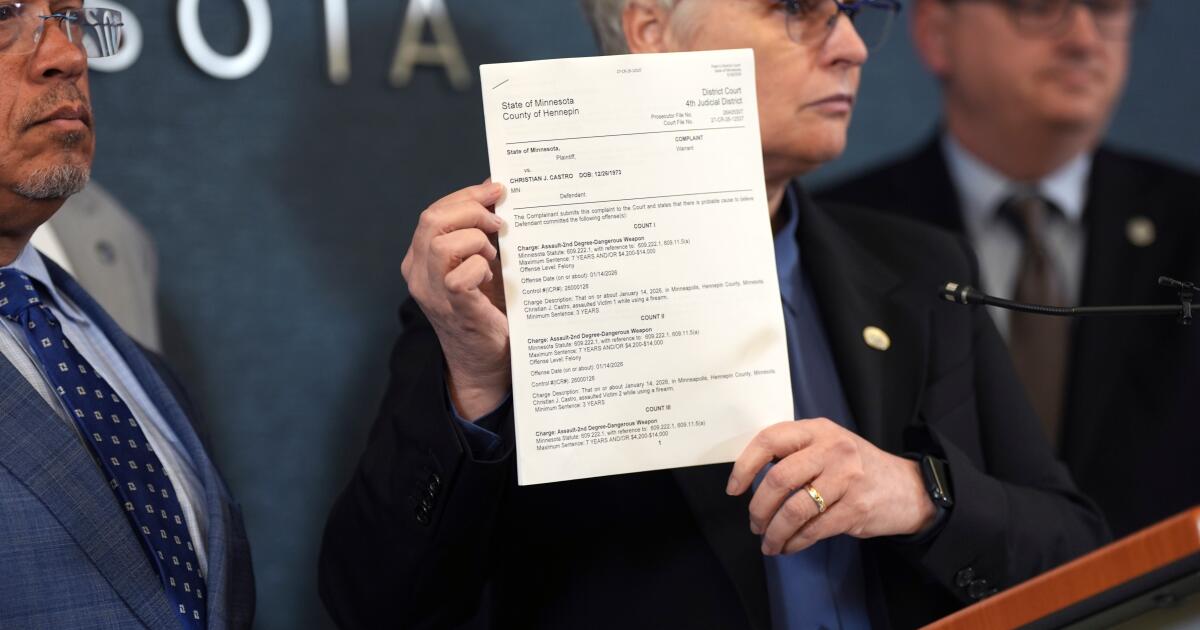
Christian Castro is charged in Minnesota with assault and falsely reporting a crime in the Jan. 14 shooting of 24-year-old Julio Cesar Sosa-Celis. Minnesota authorities have sought his extradition since his arrest, but he remains in custody in Brownsville, Texas, a city bordering Mexico.

Under Texas law and barring extradition, Castro must be released after 90 days of detention, which is Thursday.

Minnesota Atty. Gen. Keith Ellison filed a request for a temporary restraining order last week, asking a federal judge to prevent the sheriff in Cameron County, Texas, from releasing Castro, and to order Texas Gov. Greg Abbott to sign his extradition warrant.

Minnesota officials believe Castro could flee the country, citing calls he made from jail to a woman in Mexico, talking “about marrying her and buying a house in Mexico when he is released,” according to the lawsuit.

Castro is accused of firing a gun through the front door of a Minneapolis home, shooting Sosa-Celis in the leg. Prosecutors say Castro also falsely accused Sosa-Celis and another man of attacking an ICE officer with a broom handle and a snow shovel.

At a federal hearing in Brownsville on Tuesday, attorneys with the Minnesota attorney general’s office argued it would be hard to compel Castro to face charges in their state if he was released, and they fear Castro may flee the country, citing his phone conversations.

Texas Gov. Greg Abbott said last week he would not respond to the extradition request, citing the ongoing investigation into fraud in government social service programs in Minnesota, which President Trump used to justify his immigration crackdown there.

Gonzalez writes for the Associated Press.

Source link

World Cup final protesters give red cards to Trump, FIFA president

Protesters are inviting soccer fans to join them in issuing referee-style red cards during the World Cup final.

A coalition of artists, community organizers and advocacy groups will be handing out tens of thousands of specially designed commemorative red cards to those headed to Sunday’s championship showdown between Argentina and Spain at MetLife Stadium in East Rutherford, N.J.

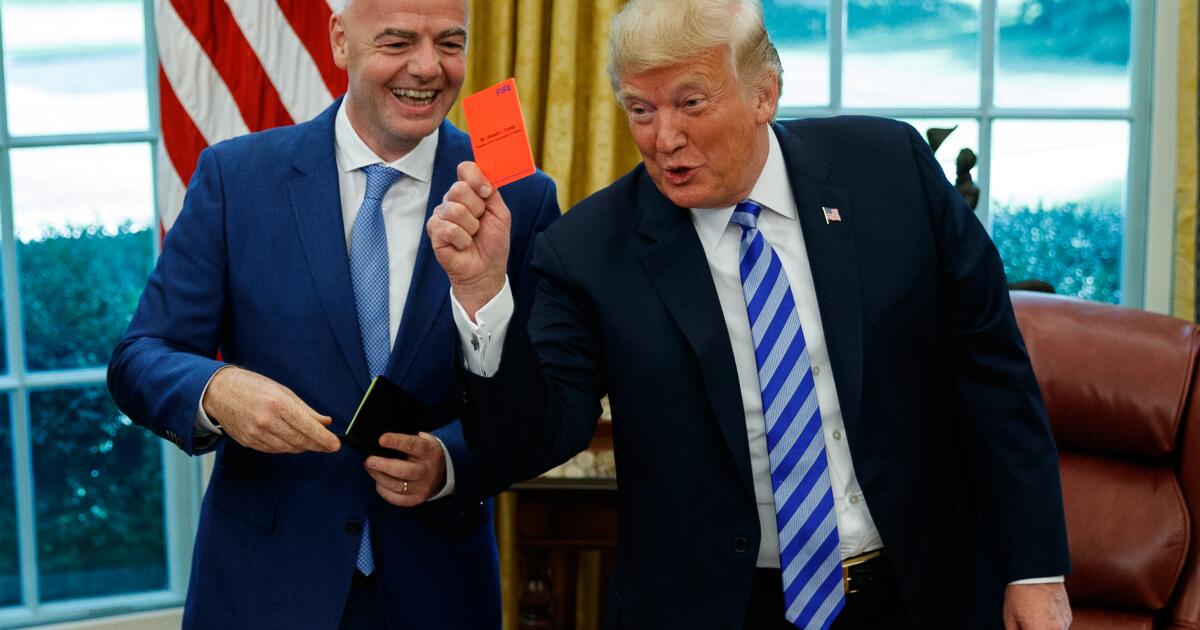
In addition to the slogan “Unitas Mundi” — Latin for “unity of the world” — the mock referee cards direct people to a website explaining the coalition’s campaign and invite them to participate in a collective demonstration inside the stadium to denounce FIFA President Gianni Infantino and President Trump.

The action comes amid increased scrutiny around Infantino and Trump‘s relationship. Infantino has announced that Trump will join him at the final to present the trophy to the winner. He also awarded Trump the first-ever FIFA Peace Prize — created after the U.S. leader was not awarded the Nobel Peace Prize — in December.

And it was after Trump called Infantino to ask for a review of a red card issued to U.S. striker Folarin Balogun that the star forward’s suspension was delayed to allow him to play in the next game. The controversial move prompted an international uproar and accusations that Infantino has violated established rules around political neutrality.

FIFA has strict rules prohibiting political messaging on flags, banners and other items displayed by players and attendees in and around stadiums.

Organizers of the Final Red Card demonstration are also calling out the Trump administration’s immigration and mass deportation policies, which are back in the spotlight after three people were killed within a week during separate encounters with Immigration and Customs Enforcement officers. The fatalities include two people who were shot and killed by ICE officers in Houston and Maine during immigration operations, and another killed in a car crash while fleeing ICE officers in Florida.

At least 10 people have been killed during the Trump administration’s immigration crackdowns.

The coalition behind the campaign includes Contra-ICE, the arts collective that was also a part of the Flags in the Stands Super Bowl action that involved the “ICE OUT” rally towels. Partner organizations also include Make the Road New Jersey, 50501, People vs the Machines and South Asians for America, according to a press release.

Source link

Texas prosecutor offers details casting doubt on ICE account of fatal encounter

A federal prosecutor in Texas has shared new details about the moments before an immigration officer shot and killed Lorenzo Salgado Araujo that cast doubt about the government’s claim that the man struck an ICE vehicle before he was shot.

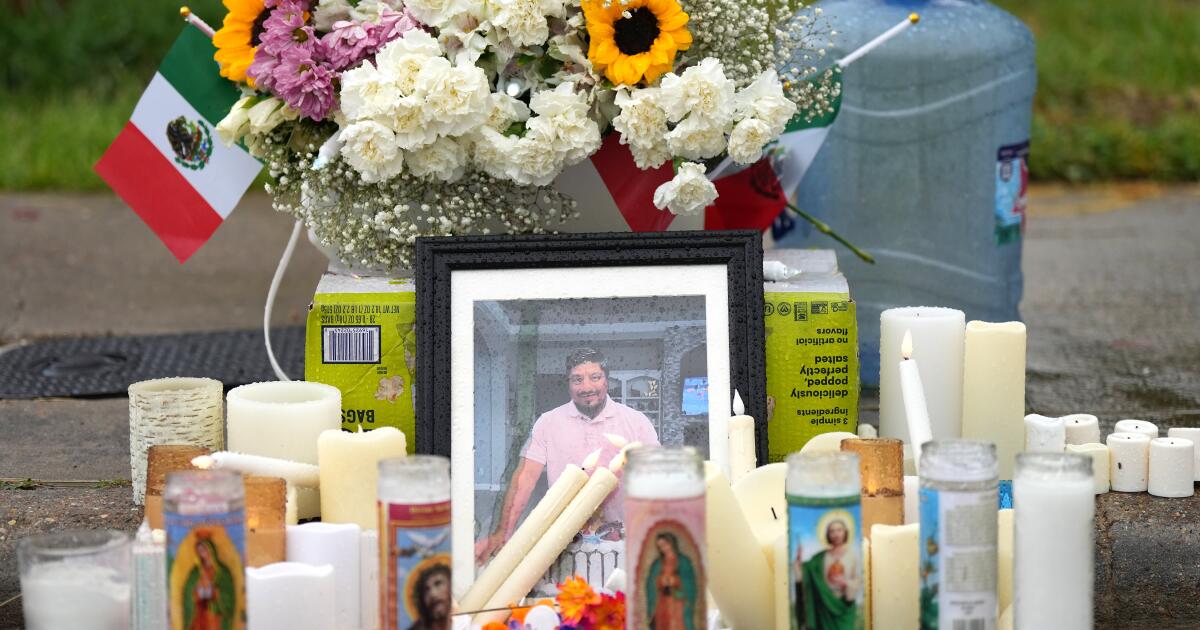
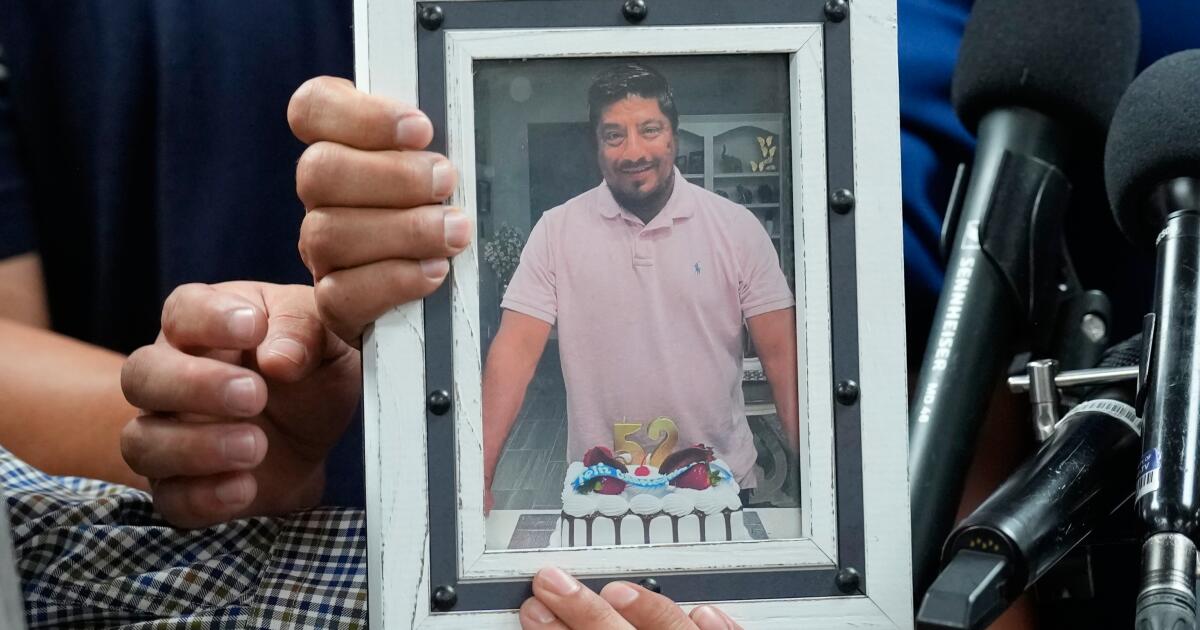
A U.S. Immigration and Customs Enforcement officer killed Salgado Araujo, a 52-year-old Mexican national and longtime American resident, on July 7 as he was driving to a Houston construction job site with three co-workers, including his brother. ICE has acknowledged he was not the target of the operation.

The shooting sparked protests in the nation’s fourth-largest city, echoing Salgado Araujo’s family’s calls for transparency. The family describes him as a hardworking father who was close to obtaining legal status in the U.S. after living in the country for 35 years.

The shooting came just days before two other men were killed, in Florida and Maine, in confrontations in President Trump’s federal immigration crackdown, renewing scrutiny on the Department of Homeland Security’s law enforcement tactics.

Aaron Reitz, the U.S. attorney for the Southern District of Texas, said for the first time Thursday that ICE officers were targeting two Guatemalan men who were potentially subject to deportation. He said they were driving a van similar to the one Salgado Araujo was driving when he was killed. In an earlier statement released the day Salgado Araujo was killed, Homeland Security said he was targeted in an immigration enforcement operation and he was living in the country without legal permission.

Reitz also said that the officers believed that Salgado Araujo and the passengers in his car fit the description of the Guatemalan men the agents were looking for.

Four officers driving two separate law enforcement vehicles attempted to pull over Salgado Araujo’s van using their police lights. Salgado Araujo then made a U-turn and drove over a median to evade getting pulled over, Reitz said.

Later that morning, the officers again encountered Salgado Araujo’s van and for the second time tried to pull him over, this time essentially surrounding the vehicle, Reitz said. Two of the four agents got out of their cars and told Salgado Araujo to put the vehicle in park. Just before he was shot, one of the agents was “partially inside the van or immediately next to it” when Salgado Araujo tried to reverse the van and then drive forward again, Reitz said.

An earlier Homeland Security statement accused Salgado Araujo of “weaponizing” his vehicle. The agency said he rammed his van into a law enforcement vehicle and said an officer opened fire in self-defense. The most recent statement from the U.S attorney’s office, however, didn’t mention any collision between Salgado Araujo’s van and a law enforcement vehicle. It also didn’t explicitly say that the officer feared for his life. There are no reported injuries among the officers involved.

The latest statement didn’t name the officer who killed Salgado Araujo, nor did it specify whether the officer who fired the shot was the same person who was next to, or partially inside, the van.

Reitz also said in the statement that officers “saw in plain view several small bags of a white, crystal-like substance inside the van” and that the FBI later executed a search warrant to investigate for possible illicit substances.

Salgado Araujo’s brother, who was in the van when the shooting happened, has been in ICE detention since the incident. His attorney said the white substance was a salt mixture that the men used as electrolytes to stay hydrated while doing manual labor in the grueling Texas heat.

Few photos or videos surrounding the shooting in Houston have emerged on social media, unlike other deaths involving federal immigration officers.

Riddle writes for the Associated Press.

Source link

ICE officer in Maine shooting has history of terrifying, violent behavior, family and records say

The Immigration and Customs Enforcement officer who shot a Colombian man in Maine this week is an Army veteran who has struggled with serious mental health issues since early childhood and never should have been given a badge and gun to patrol American streets, several of his close relatives told the Associated Press.

David Brouillette has a history of terrifying and violent behavior, according to those relatives. They accuse him of attacking women in his life over the years, and one shared a voicemail with the AP from last winter in which he told her that he thought someone should slit her throat.

Brouillette’s troubling past further challenges how thoroughly the Department of Homeland Security has vetted recruits as it went on a hiring spree to help carry out President Trump’s immigration crackdown.

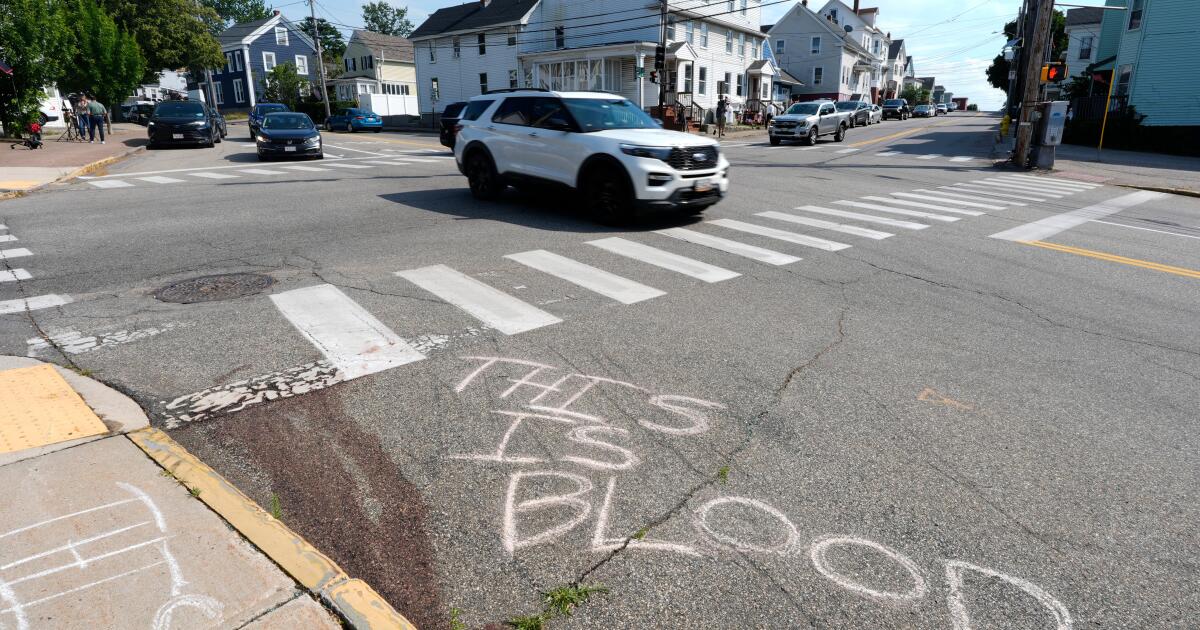
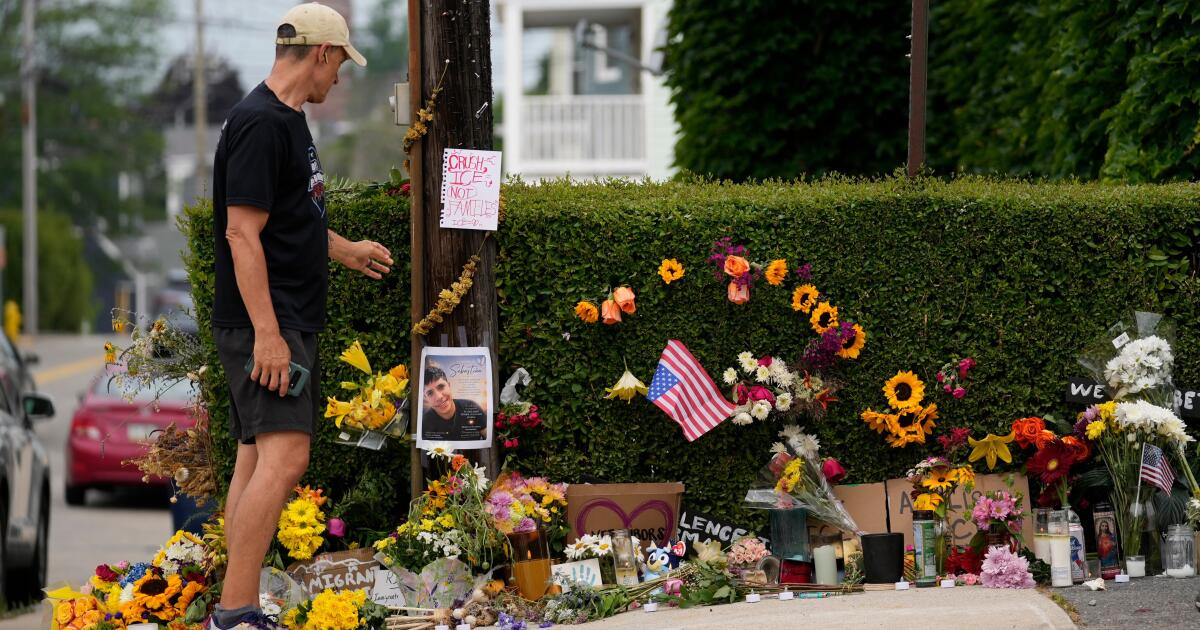
At least 10 people have died in encounters with immigration agents since Trump launched the crackdown after retaking office, including 25-year-old Johan Sebastián Durán Guerrero, a Colombian national who was shot and killed by Brouillette on Monday while in his car near his home in the coastal Maine city of Biddeford.

DHS, which hasn’t released the name of the officer who killed Durán Guerrero, has said the “vehicle attempted to flee the scene and, fearing for public safety, an officer discharged his weapon.”

Brouillette didn’t respond to text messages or an email seeking comment. Three relatives who said they had spoken to him since the shooting, including an ex-wife and daughter, said he told them he acted in self-defense.

When reached for comment about Brouillette’s record and his role in Monday’s shooting, ICE spokesperson Lauren Bis said in a statement that “[w]e will never confirm or deny attempts to dox our law enforcement officers,” and that “[t]he ICE officer in question has nearly a decade of federal law enforcement experience with required training including use of force training.”

The White House referred all questions about the shooting and Brouillette to ICE.

A new career in ICE

Brouillette, 37, told his ex-wife Ashley Brouillette late last year that he had been hired by ICE. She said that because of his long history of psychiatric issues, she thought he was having a mental health episode and she didn’t believe him. She didn’t realize he’d been telling the truth until this week, when videos began circulating online of the moments surrounding the shooting.

Ashley Brouillette told the AP that she spoke to her ex-husband in a Facebook audio call, and he acknowledged that he had killed Durán Guerrero. Their 18-year-old daughter, Madison Brouillette, also told the AP that her father called her Wednesday and said that he shot and killed Durán Guerrero.

David and Ashley Brouillette were high school sweethearts who got married in 2007. She said she divorced him in 2009 because he had become physically violent with her, which began after she got pregnant with their daughter.

According to Ashley Brouillette, he once threw boiling water at her while she was holding their child — an incident her mother, Avis Collins, also recounted.

The abuse continued after she left him, she said.

David Brouillette doesn’t appear to have a criminal record in Maine, as a check with the Maine Department of Public Safety returned no records for him.

But hundreds of family court records obtained from the Augusta District Court clerk’s office detail years of allegations of physical and verbal abuse raised by his second ex-wife on behalf of herself and his daughters.

The ex-wife — whom the AP is not identifying because she fears retaliation — alleged that he had stalked and harassed her and physically and verbally abused his daughter, according to multiple requests for temporary protection orders. Brouillette tackled his teenage daughter and smashed spaghetti in her hair, and during another outburst, he dragged his daughter around the house as she cried, she said.

“Dave needs counseling or something for his PTSD & depression,” she wrote in an application for a temporary protective order on behalf of his teenage daughter that a judge granted in 2021.

In court filings, David Brouillette said that his second ex-wife had slandered him.

His oldest daughter, Madison Brouillette, said she also witnessed her dad’s volatility.

“I watched my dad struggle a lot with a lot of things,” she told the AP. She said she came home from school once and he told her he had been sitting on a tree stump with a gun to his head.

“If you don’t really, truly take care of yourself, there’s no way you can protect other people. And with my dad, he never wanted to get help,” she said.

An immediate relative of David Brouillette who spoke on the condition that their name not be used said he was diagnosed with severe bipolar disorder and attention deficit disorder as a child — a diagnosis that Ashley Brouillette confirmed. The immediate relative described him as “extremely mentally ill” and said he attempted suicide twice at age 12 and was hospitalized multiple times.

The relative said they’d been estranged for years after they broke off contact because they feared he would harm them. He did not respond to their outreach this week, the relative added.

A military deployment and law enforcement aspirations

Growing up in Gardiner, a city of about 6,000 people roughly 60 miles northeast of Biddeford, where Monday’s shooting occurred, David Brouillette was enchanted by law enforcement and the military, his relatives said.

High school yearbook photos show he was a member of the school’s Naval Junior ROTC, and he wrote that he planned to go to college and become a police officer.

Brouillette was initially rejected by military recruiters because of his mental health diagnoses, but recruiters encouraged him to go off his medications for a year and reapply, which he did, his immediate relative said.

He was eventually able to enlist.

According to U.S. military records, Brouillette enlisted as a chemical equipment repairer in the Maine Army National Guard but then changed jobs to be a medical logistics specialist. He was in the Guard from November 2007 until January 2010, according to records provided by the Pentagon.

A 2009 article in the Kennebec Journal listed Brouillette as a private in the Maine Army National Guard’s 152nd Maintenance Company in Augusta.

In January 2010, he joined the regular Army as a human intelligence collector. Brouillette deployed to Afghanistan from May 2012 to February 2013 and eventually left the Army as a sergeant in December 2015.

His immediate relative believes Brouillette’s time abroad worsened his emotional struggles: “Afghanistan destroyed him — trained him to be a killing monster, a machine. They took someone who was extremely mentally ill and turned him into a killing machine.”

Life after the Army

After his discharge, Brouillette held a hodgepodge of jobs — some in or adjacent to law enforcement — and was injured in an accident while training to become a firefighter, public records and court documents show.

Brouillette worked for the Maine Correctional Center — a medium-security prison — and for the state’s Health and Human Services Department, spending less than a year at each.

In 2019, court documents show, he was a police officer at a Department of Veterans Affairs medical center near the state capital, Augusta. A Veterans Affairs department spokesperson on Thursday referred questions about Brouillette’s employment to DHS.

But by the end of 2021, he wrote in a text message included in court filings, he was broke, going to school full time and making money delivering food for DoorDash.

Brouillette was enrolled in a firefighting program at Southern Maine Community College and was struck in the head by a steel beam while unloading a trailer at a training facility, according to a lawsuit he filed over his injury.

He sustained a concussion and post-concussive syndrome, with symptoms including impaired memory, cognitive deficits, headaches, vertigo and light sensitivity, and was unable to complete the program, according to the lawsuit, which was settled out of court.

In recent years, court filings show, he was collecting disability pay through the VA. He also drove a truck but quit in January 2025, citing health issues.

In March 2025, Brouillette passed an exam to become a real estate sales agent. His license was active until December. In a Facebook post, Realty of Maine announced Brouillette would be working in the firm’s Bangor office.

“David lives in Maine after retiring from the United States Army,” said the post, which has since been deleted. Brouillette is no longer listed as an agent on the firm’s website. Messages seeking comment were left for Realty of Maine.

In March, the Maine agency that handles child support matters filed a lien against him, public records show. The filing suggests that Brouillette may have been in line for a permanent impairment or disability settlement.

‘I don’t think he sees himself as a killer’

In late 2025, around the time he joined ICE, his ex-wife Ashley said he left a three-minute voicemail mocking her for taking out a restraining order against him. According to the message she shared with the AP, he repeatedly called her “disgusting” and suggested that she and the other women and girls in her “bloodline” should die.

“And all of you should have your f— throats cut,” the voicemail said. “Yeah, you should. Am I threatening that I’m gonna do that? Nope. Nope. But do I think that you should have your f— throats cuts? Or should have had them cut? Yep.”

She said she broke off contact with him until Wednesday, when his picture began circulating online.

Ashley Brouillette reached out to his current wife on Facebook and they spoke on the phone for several minutes. Her ex-husband spoke with her, according to cellphone screenshots of the phone exchange she shared with the AP. He acknowledged he had fatally shot Durán Guerrero.

“He was asking if I could tell them that he was a good person and not to talk about the abuse and stuff that I had endured while with him and he said that the most important thing is his character right now,” she said.

She said he told her he is now hiding in protective custody.

“I asked him why he did it,” she said. “He said it was a justified shooting. The guy was trying to run him over with a car.”

His daughter also said he told her it was justified.

“I don’t think he sees himself as a killer,” Madison Brouillette said.

“I think he thinks that he genuinely did the right thing,” she added. “All he said was that he did what he had to do. He said that he had to protect himself.”

Brook, Sisak, Swinhart and Galofaro write for the Associated Press. AP reporter Will Weissert contributed to this report.
Source link

Maine Democrats running to replace Platner as Senate nominee scramble to woo his voters

The tight timeline to replace former Maine Senate nominee Graham Platner has left Democratic hopefuls scrambling to woo his progressive base while trying to turn the focus from the disgraced oysterman to defeating Republican Sen. Susan Collins in November.

It’s a delicate balance for the candidates, who are vying to face Collins in a contest that could decide control of the Senate as Platner’s shadow hangs over the race. In their first debate Thursday night, one of the first questions candidates were asked was: What was Graham Platner’s best idea?

Moving past Platner is just one of the challenges facing Democrats. The never-before-used process to pick a new nominee means candidates have less than three weeks to pull off what typically takes campaigns months or years, from organizing volunteers to raising money and preparing for debates.

The whiplash many of the candidates are facing was on display Thursday.

Asked by debate moderators about President Trump’s decision to capture Venezuelan President Nicolás Maduro and his wife earlier this year, Secretary of State Shenna Bellows gave inaccurate information about Collins not pushing back against Trump, a Republican. When a moderator called her on it, Bellows said she was on vacation on the Kennebec River last week after previously focusing on her unsuccessful gubernatorial campaign and hadn’t expected to be running for the Senate.

“When I need to know the facts, I will. I’ll do my homework,” said Bellows, who lost to Collins in 2014.

The field of 12 candidates also includes former public health leader Nirav Shah and union-backed logger Troy Jackson, who campaigned alongside Platner in a failed bid for governor.

Platner’s exit means the clock is ticking

Platner quit the Senate race last week after he was accused of rape, which he denies, and his campaign quickly imploded as supporters revoked their endorsements and resources.

Democrats have until July 27 to choose a new nominee, according to state law. The Maine Democratic Party’s succession plan calls for a state party convention at which 601 delegates will meet on July 25 and vote for Platner’s replacement. The majority of the convention delegates will be selected this weekend from each of the state’s 16 counties.

Candidates hoping to replace Platner have been recruiting delegates who will vote for them at the convention. The candidates also must collect 500 voter signatures needed to qualify for the convention vote.

“I don’t think anyone’s happy that we’re in this situation,” said Dan Jenkins, a Maine Democrat who has applied to be a delegate. “We would have preferred that this had broken many, many months ago and then Graham had exited the race when there was a time for a democratic process. But it’s where we are.”

Some candidates might see a boost from prior campaigns

Jackson is among the handful of candidates pivoting to the Senate race after running for other political offices, likely giving them a leg up in not having to launch from scratch.

Our Revolution, a progressive organization founded by Sen. Bernie Sanders of Vermont that had originally backed Platner, has thrown its support behind Jackson, the former Maine Senate president. Sanders, an independent who caucuses with Democrats, has not endorsed in the race.

Shah, former director of Maine’s Center for Disease Control and Prevention, also unsuccessfully ran in this year’s Maine Democratic governor’s primary. He has been pitching Platner’s supporters that he’s also an outsider who can unify a fractured Democratic Party.

“You have an important place in this campaign, and we welcome your voices,” Shah said earlier this month speaking to Platner’s base.

Bellows also ran for governor. She’s hoping that her previous battles with Trump will bolster her argument that she’ll be an advocate for the working class.

Bellows previously attempted to run against Collins in 2014 as the Senate Democratic nominee and lost in a landslide. She later went on to win a seat as a state senator before becoming Maine’s secretary of state. She’s since downplayed her prior loss to Collins by pointing to the Democratic establishment’s unwillingness to take on the Republican in 2014.

Another candidate, Jordan Wood, initially announced his intent to run in the Maine Democratic Senate primary. He dropped out last fall to run in the state’s 2nd District but lost that race.

Candidates seize on recent ICE shooting

The fatal shooting by Immigration and Customs Enforcement in Maine this week has been top of mind among the potential Senate nominees.

The Embassy of Colombia has identified the man killed Monday in Biddeford, roughly 15 miles southwest of Portland, as Johan Sebastián Durán Guerrero, a 26-year-old Colombian national. The Department of Homeland Security has since said an ICE officer fired his weapon when the man officers were pursuing attempted to flee the scene, threatening “public safety.”

Many have rushed to connect Collins to the embattled federal agency.

All the candidates who debated Thursday said they agreed with the call to “abolish ICE,” though Wood stopped short of saying the agency should be completely dissolved.

“I believe that when I say we have to abolish it, what I mean is that we need a new law enforcement agency that has the trust of the people,” Wood said.

Jackson disagreed, calling ICE a “rogue agency that goes around doing things that they’re being told to on high.”

Candidates asked about Platner’s best ideas

Platner attracted more than 150,000 votes during the June 9 primary, an eye-opening number that signaled a progressive base eager to support a candidate known for his promise to defend the working class and ability to rally large crowds.

With little more than a week until the state convention to find Platner’s replacement, it still remains unknown just who will be able to capture that same excitement seen among Platner’s base.

When pressed during Thursday’s debate about Platner’s best idea on the campaign trail, Jackson pointed to his commitment to “Medicare for All.” As a gubernatorial candidate, Jackson also voiced support for replacing job-based and individual private health insurance with a government-run plan that guarantees coverage for all with no premiums, no deductibles and only minimal copays for certain services.

Bellows said that she agreed with Platner’s description that democracy in the U.S. has been corrupted by those in power.

Shah said he would take up Platner’s commitment to “abolish ICE,” while Wood said he admired Platner’s decision to say that Israel is committing genocide in Gaza, something Israel denies.

“Graham got into this race saying, ‘this is genocide.’ And I learned that it is so important in these moments to draw those moral lines,” Wood said.

Kruesi writes for the Associated Press.

Source link

ICE should do traffic stops despite recent shootings, Trump says, seeming to oppose new suspension

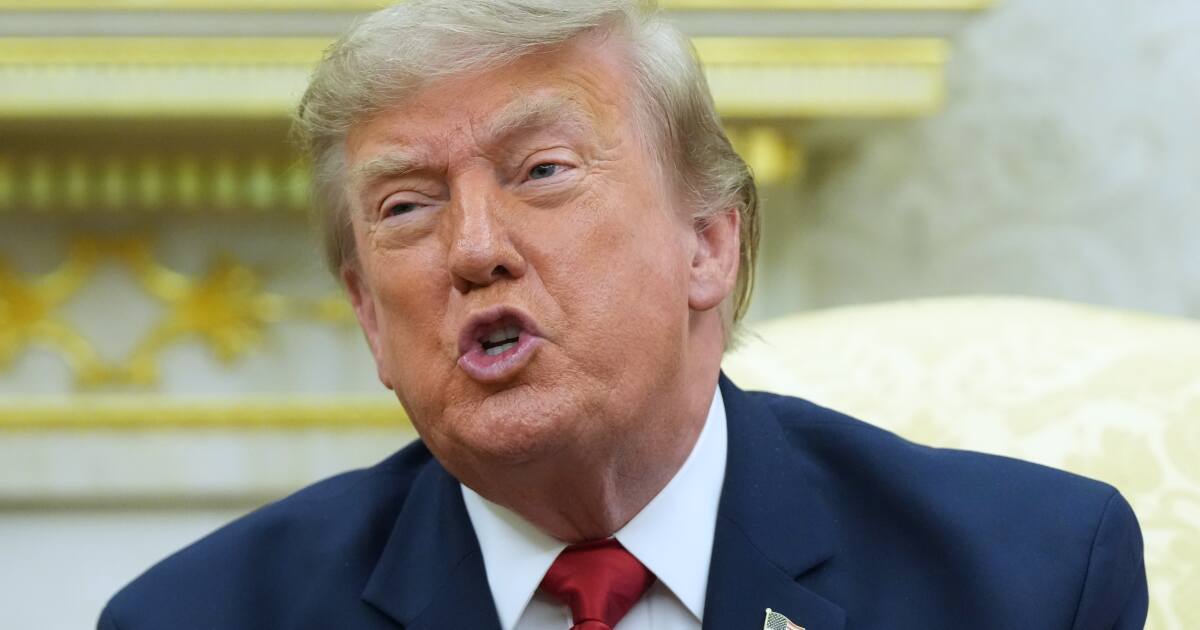
The Immigration and Customs Enforcement agency should continue vehicle stops after recent fatal shootings, President Trump said on Wednesday, seeming to oppose a new suspension of the practice used as part of his immigration crackdown.

ICE is “doing a GREAT job, one that has to be done,” Trump wrote on his social media site.

The Republican president said that to remove criminals he claims were let into the country under the previous Democratic administration “we must be strong, tough, and smart, and we CANNOT give up one of ICE’s most important and effective Crime Fighting tools, THE TRAFFIC STOP!” Trump said, “Once we do, we are playing right into the criminal’s hands.”

Trump administration officials have told Immigration and Customs Enforcement officers to suspend most vehicle stops after two deadly shootings within a week, people familiar with the decision said Tuesday.

The suspension was ordered after an ICE officer shot and killed a Colombian driver Monday in Maine and a week after another officer shot and killed a motorist in Houston, renewing criticism of the agency’s enforcement tactics that were widely condemned last winter after the killings of Alex Pretti and Renee Good in Minnesota.

In Florida on Tuesday, a third man in roughly a week died during an encounter with immigration officers. This time, a 28-year-old man was killed after he was hit by a tractor trailer while running from immigration and other federal officers, authorities said.

It’s a narrative that has been repeated again and again since the Trump administration’s immigration crackdown began, with federal officers confronting drivers and then saying they opened fire when the drivers’ vehicles became a danger. That’s despite decades of warnings from policing experts that shooting into moving cars presents a danger of its own and should almost always be avoided.

At least 10 people have been killed during immigration operations since the start of the Trump administration’s mass deportation campaign. At least four of those deaths involved people in vehicles, including the one last week in Houston, a trend so troubling that U.S. Sen. Susan Collins, R-Maine, said Tuesday that she had urged Department of Homeland Security Secretary Markwayne Mullin “to cease all non-urgent vehicle stops.”

John Sandweg, who was acting director at ICE, which is part of DHS, during President Obama’s Democratic administration, estimated recently that there have been roughly 18 traffic stop shootings during the Trump immigration crackdown.

The office of Maine Sen. Angus King, an independent who caucuses with Democrats, was told by DHS that ICE was suspending traffic stops, office spokesperson Matthew Felling said.

ICE, which has been under pressure to beef up arrest and deportation numbers, often says people it’s trying to arrest are increasingly resistant to leaving their homes. ICE officers blame immigration advocates who advise immigrants to stay in their homes unless ICE produces a warrant signed by an independent judge instead of the administrative warrants the agency generally uses that are signed by another ICE officer. So, ICE officers say, they’re forced to find other areas in which to make arrests.

Shooting angers Maine

Hundreds of people in Maine protested Tuesday over the fatal shooting of Johan Sebastián Durán Guerrero, a 25-year-old Colombian national. Advocacy groups said Guerrero, who had a wife and a young daughter, was authorized to work in the United States.

DHS said Monday that an officer, “fearing for public safety,” shot and killed Durán Guerrero while officers were watching the home of someone they believed was in the U.S. illegally and facing a final order of removal from the country. It said in a post on X that when ICE tried to stop a car driven by someone who came from the home, the person attempted to flee in the vehicle and the officer fired.

That was a shift from how King earlier described the encounter, when he said Mullin told him the officer opened fire after the man tried to use his vehicle as a weapon. King said Mullin told him the officers were trying to serve an arrest warrant but not for the man who was shot.

In a scathing post on X, outgoing Colombian President Gustavo Petro called the shooting a targeted killing “at the hands of the U.S. government.”

Petro, who has openly quarreled with Trump, urged Trump to provide an explanation and accused ICE officers of treating Durán Guerrero as “an inferior being without rights.”

In Wednesday’s social media post, Trump told ICE to be “judicious, fair and smart, and go back and do your very important job.”

Maine’s congressional delegation on Tuesday demanded a “comprehensive, transparent, and expedited investigation.”

Questions surround the shooting

Photos showed bullet holes in Durán Guerrero’s car windshield, but the officers involved in the shooting didn’t have body cameras, leaving many questions. Among them are how close the officer was to the vehicle when shooting, whether officers told Durán Guerrero to stop and why ICE believes he had put the public in danger.

Border czar Tom Homan told reporters Tuesday that the investigation needs to play out and that officers will be held accountable if they are found to have acted inappropriately or illegally.

Maine’s attorney general’s office, which said it is working with federal agencies to investigate, said initial statements suggest the driver was trying to flee in the direction of the officer, whose name hasn’t been released and who was placed on leave.

Collins said Mullin told her the DHS inspector general is investigating in cooperation with the FBI.

Democrats seeking to unseat Collins in November have sought to connect her with ICE’s methods, which have drawn public scrutiny and derision. Collins later said in a statement that although ICE needs to improve, eliminating the agency would make the nation less safe.

Maine Secretary of State Shenna Bellows, a Democrat who is vying for Collins’ seat, called the ICE officers at the shooting “thugs” during a vigil Tuesday in Lewiston.

Superville, Whittle, Brook, Santana and Sisak write for the Associated Press.

Source link

ICE will suspend most vehicle stops in the wake of two deadly shootings

U.S. Immigration and Customs Enforcement has temporarily ordered officers to avoid, in most cases, making vehicle stops in the wake of two deadly shootings.

The tactical shift comes a day after an ICE officer shot and killed a Colombian man in Biddeford, Maine, and a week after an ICE officer fatally shot another man in Houston. Both men were driving at the time of the shootings, and the incidents have renewed criticism over the agency’s immigration enforcement tactics.

Multiple news outlets and a former federal immigration official said early Tuesday that the order allows for exceptions if officers are executing a criminal warrant and working with partner law enforcement agencies. The directive, later confirmed by a top official, is a temporary pause while ICE officers receive more training on vehicle stops.

An ICE spokesperson said that the agency wouldn’t discuss law enforcement tactics but that “we are always evaluating our procedures to keep our officers safe and criminals off our streets.”

But on Fox News on Tuesday afternoon, Tom Homan, a top White House immigration official, said the decision to halt most vehicle stops was made by Homeland Security Secretary Markwayne Mullin and top ICE leadership. But he emphasized that “it’s not a policy change, it’s a temporary pause” while officials review the incidents and decide whether training could be improved.

Homan said the pause won’t affect ICE arrests. He said officers could, in some instances, make an arrest before someone gets into their vehicle or after they arrive at their destination.

“I think it’s going to be a short pause,” he said. “I’m confident that ICE is well trained in vehicle stops and you’re going to see us keep moving forward.”

Reacting to ICE’s policy change, Rep. Christian Menefee (D-Texas) said in a statement that training won’t solve the agency’s deeply ingrained issues.

“Immigration enforcement shouldn’t be heavily militarized and chasing people through our streets,” he said. “The American people deserve competent leadership and law enforcement that is transparent, accountable, and worthy of the public’s trust.”

Sen. Susan Collins (R-Maine) said she had urged Mullin to “cease all non-urgent vehicle stops” in the wake of the Biddeford shooting.

“I am encouraged that the Department has agreed to do so,” she wrote on X.

Hundreds of people protested in Biddeford on Tuesday over the killing Monday of Johan Sebastián Durán Guerrero, a 26-year-old Colombian. Protests similarly broke out in Houston last week after the killing of Lorenzo Salgado Araujo, a 52-year-old from Mexico.

The Department of Homeland Security alleged that the men killed in both incidents resisted arrest and that the officers fired their weapons defensively as the men attempted to flee. Neither man was the intended target of the ICE officers.

Local officials in Houston and Biddeford are calling for independent investigations into the shootings. In both instances, the officers involved were not wearing body cameras.

Homeland Security said the officer who shot Durán Guerrero was “fearing for public safety.” The agency said Salgado Araujo had “weaponized his vehicle in an attempt to run over an ICE law enforcement officer.”

Durán Guerrero’s shooting marked at least the ninth such death since President Trump began his immigration crackdown. In a scathing post on X, outgoing Colombian President Gustavo Petro called the shooting an assassination “at the hands of the U.S. government.”

Durán Guerrero is survived by his wife and young daughter. Advocacy groups said he was authorized to work in the U.S.

Daniel Boucher, who lives near where Durán Guerrero was shot, said he “clearly heard the victim say, ‘I tried to stop.’”

The two shootings come as immigration arrests have surged again amid a Trump administration push to carry out its mass deportation agenda. Over five days at the end of June, ICE arrested more than 10,000 people.

The Associated Press contributed to this report.

Source link

Trump administration orders ICE to suspend most vehicle stops after two deadly shootings, AP source says

Trump administration officials have told Immigration and Customs Enforcement officers to suspend most vehicle stops after two deadly shootings in little over a week, according to a person familiar with the matter.

The order came a day after an ICE officer shot and killed a Colombian man in Maine, renewing criticism of the agency’s tactics during enforcement operations.

The suspension is not absolute and there’s room for exceptions when executing a criminal warrant or working with partner agencies, according to a person who spoke Tuesday on condition of anonymity to discuss sensitive law enforcement operations.

The Department of Homeland Security said an ICE officer, “fearing for public safety,” shot and killed the man Monday in the city of Biddeford while officers were watching the home of someone they believed was in the U.S. illegally and had a final order of removal from the country.

This is a developing story and will be updated.

Whittle, Brook and Sisak write for Associated Press.

Source link

Mexican-born builder fatally shot by an ICE officer is mourned

The builder got up every morning long before dawn, left home to pick up his construction crew and then headed out to work on yet another house somewhere across the sprawl of Houston.

Fourteen hours later, Lorenzo Salgado Araujo would return to the wife he’d met as a teenager in Mexico and the modest house he’d built for his family on the city’s east side.

It’s what he’d done for decades, according to Ronaldo Salgado, his oldest son. He said his father built hundreds of houses over 35 years, creating a life for his family and watching as his three sons headed off to college.

On Tuesday, a U.S. Immigration and Customs Enforcement officer fatally shot Salgado Araujo, 52, after he was pursued by federal agents driving unmarked vehicles while he was taking his crew to their latest job site. The shooting has outraged Houston leaders and renewed public scrutiny over ICE and Trump’s immigration crackdown.

Four Democratic members of Congress who represent the Houston area said at a vigil Saturday that they would push for an independent investigation into the shooting.

“We are never going to forget that his blood is on Donald Trump’s hands,” Rep. Christian Menefee said. “We are not at war. Lorenzo Salgado Araujo was not a casualty. He was a human being who was murdered by our government.”

ICE was looking for someone else

Federal agents were looking for someone else when they tried to stop Salgado Araujo’s white van, Garcia said, citing a briefing she received from ICE’s acting director. The Department of Homeland Security has said an ICE officer fired at the van in self-defense after Salgado Araujo, whom officials described as an “illegal alien,” rammed an ICE vehicle. They have provided no evidence.

After some previous shootings by federal immigration agents, Homeland Security authorities have given accounts that were contradicted by video evidence. No video showing the moment of the shooting this time has emerged, and the agents at the scene were not wearing body cameras.

The three men that Salgado Araujo was driving said he was shot through a passenger window and that the ICE officer who fired was not in front of the van or even in danger, a lawyer who has spoken with them said Friday.

His family has also disputed the account from ICE. They said lawyers, who were helping him apply for a work permit, had explained how he should behave if immigration agents stopped him. Salgado Araujo was close to obtaining legal status when he was killed, they said.

“He knew what to do,” Ronaldo Salgado told reporters this week. “He knew not to sign anything. He knew that the first phone call he should make should be either to myself or to my mom. So that way we can get the process started of getting him out.”

He believes his father may have been scared that he was being followed by unmarked vehicles, worried someone was planning to steal his van or his tools.

The shooting in the largely Latino neighborhood is at least the eighth death connected to the Trump administration’s immigration enforcement campaign.

A kind, present husband and father

Salgado Araujo entered the U.S. more than 30 years ago, settling in Houston with his wife where they raised their three children.

Education was a constant focus in the house, said Ronaldo Salgado, who is now a teacher. One of his brothers is an engineer. The other is in college studying engineering.

Several childhood friends of Salgado recalled that his father was kind and soft-spoken, always inquiring after a long workday about his wife’s day and how his sons’ friends were doing.

“We didn’t really see him until the end of the day when he came home to have dinner, but that just shows how much of a hard worker he was,” said neighbor Jessica Alanis Magdaleno. “Everything they have now is thanks to the dedication to that.”

Josué Flores, a friend of Ronaldo Salgado since their freshman year of high school, said he first saw Lorenzo Salgado Araujo at his son’s football game.

“I think it speaks volumes of the kind of person that he was,” Flores said, recalling how Salgado Araujo showed up for his son even after an arduous day of work.

Salgado Araujo’s wife, a relative said, is “inconsolable.”

“She is very upset … angry, sad, disoriented,” Jose Torres Ramon, a nephew who lives in Mexico, told the Associated Press in a Facebook message.

Ronald Salgado, his oldest son, said at the Saturday vigil that he hoped he was making his father proud.

“I’ll keep fighting for him,” he said.

His brother Lorenzo Salgado Jr. said the shooting of his father was “a hard moment to be an American.”

“Even though my government, my federal government took away my father, we the people will bring justice,” he said. “We the people are America.”

After coming home in the evening, Salgado Araujo liked to listen to music on the porch and pet the family dog. His family has described him as a simple man of routine.

“He did not deserve to die,” Ronaldo Salgado said. “He dedicated his life in the United States to giving his family the American dream.”

Sullivan writes for the Associated Press. AP reporters Jack Brook in New Orleans, Valerie Gonzalez in McAllen, Texas, and Scott Bauer in Madison, Wis., contributed to this report.

Source link

New Jersey state police set up protest zone at ICE center

New Jersey state police set up designated protest zones and vehicle checkpoints outside an immigration detention center in Newark on Friday, replacing federal immigration enforcement agents who have been clashing with protesters for days.

Gov. Mikie Sherrill said she sent in state police to bring order outside Delaney Hall as the demonstrations have intensified, with violence and arrests increasing as night falls.

“It has grown unsafe, and that’s completely unacceptable,” the Democratic governor said at a news conference announcing the new measures. “We need to take this opportunity to lower the temperature.”

As police erected protest barriers, U.S. Immigration and Customs Enforcement agents who had formed a line in front of protesters moved inside the building’s perimeter fence.

New Jersey State Police Lt. Col. David Sierotowicz said ICE officers agreed to stand down with state police assuming responsibility.

Demonstrators had mixed reactions. Some staged a sit-in and refused to move into one of the new protest areas police set up using metal barriers and concrete blocks.

Rachel Cohen worried that demonstrators exercising their 1st Amendment rights were being silenced.

“It is not helpful to quell protest for the sake of a false peace,” she said. “There is no peace while we are torturing our neighbors on [the] government dime inside this facility.”

U.S. Homeland Security Secretary Markwayne Mullin, on social media, called the measures a “win for law and order” and noted that Sherrill had resisted sending state police for days.

The protests began a week earlier after immigrant advocates said detainees inside launched a hunger strike over poor living conditions at the 1,000-bed facility, which opened last May.

Demonstrators have been attempting to block people and vehicles from entering and exiting, linking their arms in a human chain and using trash cans, umbrellas and other items as makeshift shields and barricades.

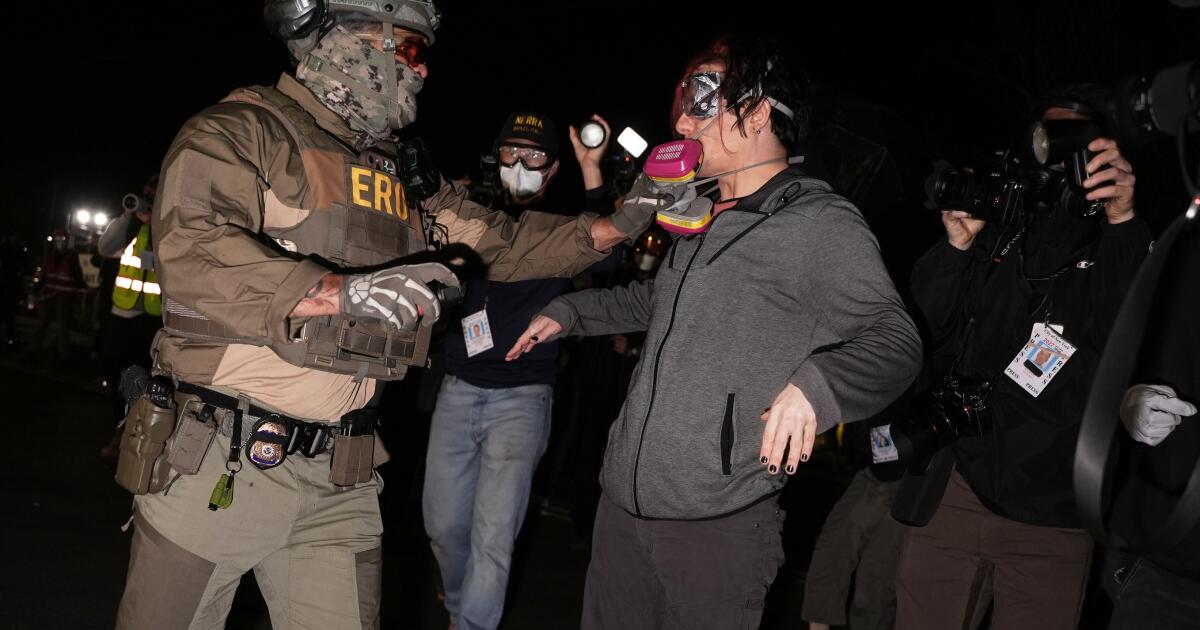
ICE officers wearing helmets and tactical vests have used pepper spray and batons to try to disperse the protesters and clear the roadway for vehicles.

At least six demonstrators were arrested and accused of assaulting law enforcement officers Wednesday night, and more have been arrested on other nights, according to the Department of Homeland Security.

Acting U.S. Atty. Gen. Todd Blanche shared images online Friday of bloody wounds and bruises sustained by ICE officers.

“These riots are clearly not ‘peaceful protests’ as you can see from the photos of these horrific wounds,” he said. “Assault a federal officer, you’ll be held accountable.”

Another demonstrator, Lisa O’Dwyer, said she was fine with the designated protest areas.

“I like to get my point across and stay safe at the same time,” the Westfield resident said.

Eyesha Marable, pastor at Mt. Zion AME Church in Millburn, agreed, even while acknowledging that there were “different schools of thought” among protesters.

“There are people here who are angry. Their family members are inside. Their friends are inside. People have been taken off the streets, out of their communities,” she said.

“We have to keep the peace,” Marable said. “The goal is to get our people free, to get them liberated, and we cannot do that if we’re fighting out here.”

State Atty. Gen. Jennifer Davenport said it was important to “de-escalate” the situation as “violence, either against protesters or by protesters, is unacceptable.”

Sherrill said she did not want to give ICE a pretext to expand operations in the state, noting that federal immigration officers around the country have killed and injured protesters in recent months.

“We all need to do everything we can to cool things down now,” she said.

The governor and other Democratic officials tried to visit detainees Monday but were denied entry.

Democratic members of Congress from New York City, however, were able to tour Delaney Hall the day after that. They reported dire conditions, with detainees being fed small portions of often spoiled food and their varied medical needs going ignored.

Families and supporters of detainees also say their loved ones have also been subjected to pepper spray and physical force in retaliation for their hunger strike and the protests outside.

Marcelo and Shaffrey write for the Associated Press and reported from New York and Newark, respectively.

Source link