
ice

U.S. Atty. Gen. Pam Bondi announces 2 more arrests in the St. Paul church protest

U.S. Atty. Gen. Pam Bondi on Monday announced two more arrests following a protest at a Minnesota church against the immigration crackdown, bringing the number of people arrested to nine.

The nine were named in a grand jury indictment unsealed Friday. Independent journalists Don Lemon and Georgia Fort were among four people arrested Friday. Three others were arrested earlier in the week, including prominent local activist Nekima Levy Armstrong.

A grand jury in Minnesota indicted all nine on federal civil rights charges of conspiracy and interfering with the 1st Amendment rights of worshippers during the Jan. 18 protest at the Cities Church in St. Paul. A pastor at the church is also a U.S. Immigration and Customs Enforcement official. The protest generated strong objections from the Trump administration.

In a social media post Monday, Bondi named the latest two arrestees as Ian Davis Austin and Jerome Deangelo Richardson. She gave no details of their arrests.

Lemon, who was fired from CNN in 2023 following a bumpy run as a morning host, has said he had no affiliation to the group that disrupted Sunday service by entering the church. He has described himself as an independent journalist chronicling protesters.

The indictment alleges that Richardson traveled to the church with Lemon while he was streaming and that Richardson told Lemon they needed to catch up to the others. It also alleges that Austin stood in the aisles of the church and loudly berated a pastor with questions about Christian nationalism.

Online jail records show Austin was arrested Friday. It wasn’t immediately clear when Richardson was taken into custody.

Austin’s attorney, Sarah Gad, did not immediately return a call seeking comment. Court records don’t list an attorney for Richardson who could comment on his behalf.

The Justice Department began its investigation after the group interrupted services by chanting, “ICE out” and “Justice for Renee Good,” referring to the 37-year-old mother of three who was fatally shot by an ICE officer in Minneapolis.

Cities Church belongs to the Southern Baptist Convention and lists one of its pastors as David Easterwood, who leads ICE’s St. Paul field office.

Karnowski writes for the Associated Press.

Source link

Inside a Minneapolis school where 50% of students are too afraid of ICE to show up

For weeks, administrators at this charter high school have arrived an hour before class, grabbed neon vests and walkie-talkies, and headed out into the cold to watch for ICE agents and escort students in.

Lately, fewer than half of the 800 sudents show up.

“Operation Metro Surge,” the immigration crackdown in Minnesota that led to nationwide protests after federal agents shot and killed two U.S. citizens, has had students, parents and teachers on edge regardless of their immigration status.

Signs of a fearful new normal are all over the school. Green craft paper covers the bottom of many first-floor windows so outsiders can’t peer in. A notice taped outside one door says unauthorized entry is prohibited: “This includes all federal law enforcement personnel and activities unless authorized by lawful written direction from appropriate school officials or a valid court order.”

Students in a classroom

Students at a Minneapolis high school classroom with many empty seats on Jan. 29, 2026.

Staff coordinate throughout the day with a neighborhood watch group to determine whether ICE agents are nearby. When they are, classroom doors are locked and hallways emptied until staff announce “all clear.”

Similar tactics have been utilized by schools in other cities hit by immigration raids across the country. The Los Angeles Unified School District established a donation fund for affected families and created security perimeters around schools last summer.

But it appears nowhere have students felt the repercussions of local raids more than in Minneapolis.

Many schools have seen attendance plummet by double-digit percentages. At least three other, smaller charter schools in Minneapolis have completely shut down in-person learning.

At this high school, which administrators asked The Times not to identify for fear of retaliation by the Trump administration, 84% of students are Latino and 12% are Black. Staff and students are being identified by first or middle names.

A balloon sits in a hallway at the high school.

A balloon sits in a hallway at the high school.

Doors and windows are covered

Doors and windows are covered at the school so outsiders can’t see in.

Three students have been detained — and later released — in recent weeks. Two others were followed into the school parking lot and questioned about their immigration status. Several have parents who were deported or who self-deported. Latino staff said they have also been stopped and questioned about their legal status.

“Our families feel hunted,” said Noelle, the school district’s executive director.

Students returned from winter break on Jan. 6, the same day 2,000 additional immigration agents were dispatched to Minneapolis to carry out what Immigration and Customs Enforcement Acting Director Todd Lyons called the agency’s “largest immigration operation ever.” The next day, an ICE officer fatally shot Renee Good, a 37-year-old mother of three.

“I describe that day as if you’re on an airplane and it’s really bad turbulence, and you have to keep your cool because, if you don’t, you lose the entire building,” said Emmanuel, an assistant principal. “It felt like we went through war.”

Attendance dropped by the hundreds as parents grew too afraid to let their children leave home. School leaders decided to offer online learning and scrambled to find enough laptops and mobile hotspots for the many students who didn’t have devices or internet. Some teachers sent packets of schoolwork to students by mail.

a teacher at a high school

A teacher at the Minneapolis high school that administrators asked The Times not to identify for fear of retaliation by the Trump administration. Teachers and students there also asked not to be identified.

Noelle said in-person attendance, which had dropped below 400 students, increased by around 100 in the third week of January. Then federal agents shot and killed 37-year-old intensive care nurse Alex Pretti, and attendance plummeted again.

Rochelle Van Dijk, vice president of Great MN Schools, a nonprofit supporting schools that serve a majority of students of color, said many schools have redirected tens of thousands of dollars away from other critical needs toward online learning, food distribution and safety planning. For students still attending in person, recess has frequently been canceled, and field trips and after-school activities paused.

Even if students return to school by mid-February, Van Dijk said, they will have missed 20% of their instructional days for the year.

“A senior who can’t meet with their college counselor right now just missed support needed for major January college application deadlines. Or a second-grader with a speech delay who is supposed to be in an active in-person intervention may lose a critical window of brain plasticity,” she said. “It is not dissimilar to what our nation’s children faced during COVID, but entirely avoidable.”

At the high school, administrators said they tried to create “a security bubble,” operating under protocols more typical of active shooter emergencies.

Students take part in gym class

Gym class at the Minneapolis school, where many students are so afraid of ICE that they won’t go to the campus.

If agents were to enter the building without a judicial warrant, the school would go into a full lockdown, turning off lights, staying silent and moving out of sight. That hasn’t happened, though ICE last year rescinded a policy that had barred arrests at so-called sensitive locations, including schools.

Tricia McLaughlin, assistant secretary for the Department of Homeland Security, said that blaming ICE for low school attendance is “creating a climate of fear and smearing law enforcement.”

“ICE does not target schools,” McLaughlin said. “If a dangerous or violent illegal criminal alien felon were to flee into a school, or a child sex offender is working as an employee, there may be a situation where an arrest is made to protect the safety of the student. But this has not happened.”

Alondra, a 16-year-old junior who was born in the U.S., was arrested after school Jan. 21 near a clinic where she had gone with a friend, also 16, to pick up medication for her grandmother.

She said that as she was about to turn into the parking lot, another car sped in front of her, forcing her to stop. Alondra saw four men in ski masks with guns get out. Scared, she put her car in reverse. Before she could move, she said, another vehicle pulled up and struck her car from behind.

Alondra shared videos with The Times that she recorded from the scene. She said agents cracked her passenger window in an attempt to get in.

“We’re with you!” a bystander can be heard telling her in the video as others blow emergency whistles.

She said she rolled her window down and an agent asked to see her ID. She gave him her license and U.S. passport.

“Is it necessary to have to talk to you or can I talk to an actual cop?” she asks in the video. “Can I talk to an actual cop from here?”

“We are law enforcement,” the agent replies. “What are they gonna do?”

In another video, an agent questions Alondra’s friend about the whereabouts of his parents. Another agent is heard saying Alondra had put her car in reverse.

“We’re underage,” she tells him. “We’re scared.”

a staff member holds a sign for a bus

A sign directs students to line up for their school bus route. Bus pickups are staggered, with one group of students escorted outside at a time. This way, the children can be taken back inside the school or onto the bus more easily if ICE arrives.

A Minneapolis Public Radio reporter at the scene said agents appeared to have rear-ended Alondra’s car. But Alondra said an agent claimed she had caused the accident.

“It’s just a simple accident, you know what I mean?” he says in the video. “We’re not gonna get on you for trying to hit us or something.”

“Can you let us go, please?” her friend, visibly shaken, asks the agent at his window.

Alondra and her friend were handcuffed and placed in a U.S. Customs and Border Protection vehicle as observers filmed the incident. At least two observers were arrested as agents deployed tear gas and pepper spray, according to an MPR report.

The agents took the students to the federal Whipple Building. Alondra said the agents separated the friends, looked through and photographed her belongings and had her change into blue canvas shoes before chaining her feet together and placing her in a holding cell alone.

“I asked at least five times if I could let my guardian know what was happening, because I was underage, but they never let me,” she said.

Finally, around 7 p.m., agents released Alondra — with no paperwork about the incident — and she called her aunt to pick her up. Her friend was released later.

Meanwhile, school administrators who saw the MPR video called Alondra’s family and her friend’s.

Alondra said officers didn’t know what had happened to her car and told her they would call her when she could pick it up. But no one has called, and school administrators who helped her make calls to Minneapolis impound lots haven’t been able to locate it either.

Though Alondra could attend classes online, she felt she had to return to campus.

“I feel like if I would have stayed home, it would have gone worse for me,” she said, her lip quivering. “I use school as a distraction.”

The backstage of the auditorium, dubbed the bodega, has been turned into a well-stocked pantry for families who are too afraid to leave their homes.

A volunteer organizes donated items for distribution

A volunteer organizes donated items for distribution to families at the Minneapolis high school.

a teacher makes a delivery to a family

A teacher makes a delivery to a family in Minneapolis.

Teachers and volunteers sort donations by category, including hygiene goods, breakfast cereals, bread and tortillas, fruit and vegetables, diapers and other baby items. Bags are labeled with each student’s name and address and filled with the items their family has requested. After school, teachers deliver the items to the students’ homes.

Noelle said some students, particularly those who are homeless, are now at risk of failing because they’re in “survival mode.” Their learning is stagnating, she said.

“A lot of these kids are — I mean, they want to be — college-bound,” Noelle said. “How do you compete [for admission] with the best applicants if you’re online right now and doing one touch-point a day with one teacher because that’s all the technology that you have?”

On Thursday afternoon, 20 of 44 students had shown up for an AP world history class where the whiteboard prompt asked, “Why might some people resort to violent resistance rather than peaceful protest?”

Upstairs, in an 11th-grade U.S. history class, attendance was even worse — four students, with 17 others following online. The topic was what the teacher called the nation’s “first immigration ban,” the Chinese Exclusion Act of 1882.

students walk to a bus

Students head to their bus at the high school.

Morgan, the teacher, asked the students to name a similarity between the Chinese exclusion era and current day.

“Immigrants getting thrown out,” one student offered.

“Once they leave, they can’t come back,” said another.

“The fact that this is our first ban on immigration also sets a precedent that this stuff can happen over and over and over again,” Morgan said.

Sophie, who teachers English language learners, led the effort to organize the online school option. She is from Chile and says she has struggled to put her own fear aside to be present for the students who rely on her. Driving to school scares her, too.

“It’s lawless,” she said. “It doesn’t matter that I have my passport in my purse. The minute I open my mouth, they’re going to know that I’m not from here.”

Sophie said she once had to call a student’s mother to say her husband had been taken by immigration agents after another school staffer found his car abandoned on a nearby street.

“Having to have that conversation wasn’t on my bingo card for that day, or any day,” she said. “Having to say that we have proof that your husband was taken and hearing that woman crying and couldn’t talk, and I’m like, what do I say now?”

Close to the 4:15 p.m. dismissal, administrators again donned their neon vests and logged on to the neighborhood Signal call for possible immigration activity.

Students walk to a bus

Students walk to a bus Thursday. Dismissal used to be a free-for-all, with large numbers of students rushing outside as soon as the bell rang.

Dismissal used to be a free-for-all — once the final bell rang, students would rush outside to find their bus or ride or to begin the walk home.

Now pickups are staggered, with students escorted outside one bus at a time. Teachers grab numbered signs and tell students to line up according to their route. If ICE agents pull up, administrators said, they could rush a smaller group of students onto the bus or back inside.

In yet another example of how the immigration raids had crippled attendance, some buses were nearly empty. On one bus, just two students hopped on.

Source link

The Grammys had one villain this year—ICE raids

In speech after speech, this year’s Grammy-winning artists returned to one message—ICE is a menace that must be stopped.

After dramatic, violent escalations in federal raids on immigrant communities and their supporters in Minneapolis and across the country, Americans have been shocked into despair and action. Many artists up for top Grammys have been vocal about their opposition to these raids, but at Sunday’s Grammys, the topic was front and center for many winners in their speeches.

“I want to dedicate this to all the people who had to leave their home, their country, to follow their dreams,” Bad Bunny said in his mostly-Spanish acceptance speech for the Grammys top prize, Album of the Year.

Earlier in the night, he joked with host Trevor Noah about Puerto Rico not being a great place for Noah should flee to, the island still being an American territory and all. But Bad Bunny made his point clearly even before taking home his biggest prize yet. “Ice out,” he said. “If we fight, we have to do it with love.”

With a Super Bowl halftime show coming next week, he’ll take the stage as the most important musician on earth right now, an urgent message brought to the heart of the most aggressively American live event.

As musicians around the country and the globe use their platforms to organize and speak out against the ICE raids, many acts wore pins on the red carpet Sunday—from Joni Mitchell and Carole King to Olivia Rodrigo, Brandi Carlile and Justin and Hailey Bieber.

Yet it was striking just how many artists used the acceptance speeches to decry the agency’s actions under President Trump.

Billie Eilish, an upset winner with brother Finneas for song for “Wildflower,” was even more direct. “No one is illegal on stolen land,” she said. “It’s hard to know what to say and what to do, but we need to keep fighting and speaking up and protesting. Our voices really do matter.” Then came a long, bleeped moment on the CBS broadcast—presumably something urgently profane directed at a similar target.

That sentiment spanned genres and cultures. New artist winner, the U.K. R&B singer Olivia Dean, acknowledged the gifts of being “the granddaughter of an immigrant. I’m a product of bravery and I think these people deserve to be celebrated.”

“Immigrants built this country, literally,” said country star Shaboozey, a descendant of Nigerian immigrant parents, winning for country duo/group performance. “This is also for those who came to this country in search of better opportunity to be part of a nation that promised freedom for all and equal opportunity to everyone willing to work for it. Thank you for bringing your culture your music, your stories and your traditions here.”

Kehlani, a winner for R&B song and performance, said that “Together, we’re stronger in numbers to speak out against all the injustice going on in the world right now. I hope everyone is inspired to come together as a community of artists ad speak out against what’s going on.”

” F— Ice,” Kehlani added, walking off the stage.

Recording Academy chief Harvey Mason Jr. also used his speech to underscore the “uncertainty and real trauma,” of the environment in America now. “It can be easy to feel overwhelmed, even helpless in challenging times. But music never stands still,” he said. “When we’re exhausted, music restores us. When were grieving, music sits with us.”

Alongside the night’s words of warning and rage, singer SZA offered what amounted to reassurance in her speech after winning record for “Luther,” her Hot 100-dominating collaboration with Kendrick Lamar.

“Please don’t fall into despair,” she said. “I know algorithms tell us it’s so scary and all is lost. But we can go on, we need each other. We’re not governed by the government, we’re governed by God.”

Source link

Portland mayor demands ICE leave the city after federal agents gas protesters

The mayor of Portland, Ore., demanded U.S. Immigration and Customs Enforcement leave his city after federal agents launched tear gas at a crowd of demonstrators — including young children — outside an ICE facility during a weekend protest that he and others characterized as peaceful.

Witnesses said agents deployed tear gas, pepper balls and rubber bullets as thousands of marchers arrived at the South Waterfront facility on Saturday. Erin Hoover Barnett, a former OregonLive reporter who joined the protest, said she was about 100 yards from the building when “what looked like two guys with rocket launchers” started dousing the crowd with gas.

“To be among parents frantically trying to tend to little children in strollers, people using motorized carts trying to navigate as the rest of us staggered in retreat, unsure of how to get to safety, was terrifying,” Barnett wrote in an email to OregonLive.

Mayor Keith Wilson said the daytime demonstration was peaceful, “where the vast majority of those present violated no laws, made no threat and posed no danger” to federal agents.

“To those who continue to work for ICE: Resign. To those who control this facility: Leave,” Wilson wrote in a statement Saturday night. “Through your use of violence and the trampling of the Constitution, you have lost all legitimacy and replaced it with shame.”

The Portland Fire Bureau sent paramedics to treat people at the scene, police said. Police officers monitored the crowd but made no arrests Saturday.

The Portland protest was one of many demonstrations nationwide against the Trump administration’s immigration crackdown in cities including Minneapolis, where in recent weeks federal agents killed two residents, Alex Pretti and Renee Good.

Federal agents in Eugene, Ore., deployed tear gas on Friday when protesters tried to get inside the federal building near downtown. City police declared a riot and ordered the crowd to disperse.

President Trump posted Saturday on social media that it was up to local law enforcement agencies to police protests in their cities. But he said he has instructed Homeland Security Secretary Kristi Noem to have federal agents be vigilant in guarding U.S. government facilities.

“Please be aware that I have instructed ICE and/or Border Patrol to be very forceful in this protection of Federal Government Property. There will be no spitting in the faces of our Officers, there will be no punching or kicking the headlights of our cars, and there will be no rock or brick throwing at our vehicles, or at our Patriot Warriors,” Trump wrote. “If there is, those people will suffer an equal, or more, consequence.”

Wilson said Portland would be imposing a fee on detention facilities that use chemical agents.

The federal government “must, and will, be held accountable,” the mayor said. “To those who continue to make these sickening decisions, go home, look in a mirror, and ask yourselves why you have gassed children.”

Source link

Five-year-old boy and father detained by ICE return home to Minnesota | Migration News

Liam Conejo Ramos and his father, Adrian, were accompanied home by Texas Democratic Representative Joaquin Castro.

A five-year-old boy and his father, who were detained as part of United States President Donald Trump’s aggressive immigration raids and held at a detention facility in Texas, have returned to their home in Minnesota.

Liam Conejo Ramos and his father, Adrian, who are asylum seekers from Ecuador, spent 10 days in the Dilley detention centre until US District Judge Fred Biery ordered their release on Saturday.

Recommended Stories

list of 3 itemsend of list

US Representative Joaquin Castro, a Texas Democrat, wrote in a social media post that he picked them up on Saturday night at the detention facility and escorted them home on Sunday.

“Liam is now home. With his hat and his backpack,” Castro wrote, including photos of the child. “We won’t stop until all children and families are home.”

Immigration and Customs Enforcement (ICE) agents arrested Liam and his father on January 20 as the boy arrived home from preschool.

Images of the boy with a blue bunny hat and backpack being held by officers spread around the world and added fire to public outrage at the federal immigration crackdown, during which agents have shot dead two US citizens.

Liam was one of four students detained by immigration officials in a Minneapolis suburb, according to the Columbia Heights Public School District.

In a statement, Department of Homeland Security (DHS) Assistant Secretary Tricia McLaughlin said ICE did not target or arrest Liam, and that his mother refused to take him after his father’s apprehension. His father told officers he wanted Liam to be with him, she said.

“The Trump administration is committed to restoring the rule of law and common sense to our immigration system, and will continue to fight for the arrest, detention, and removal of aliens who have no right to be in this country,” McLaughlin said.

Neighbours and school officials say that federal immigration officers used the preschooler as “bait” by telling him to knock on the door to his house so that his mother would answer.

DHS called the description of events an “abject lie”. It said the father fled on foot and left the boy in a running vehicle in their driveway.

Biery said in a scathing opinion that “the case has its genesis in the ill-conceived and incompetently-implemented government pursuit of daily deportation quotas, apparently even if it requires traumatizing children”.

He criticised what he called the government’s apparent “ignorance” of the US Declaration of Independence, which “enumerated grievances against a would-be authoritarian king over our nascent nation”.

Biery also cited the Fourth Amendment of the US Constitution, which protects the right against “unreasonable searches and seizures”.

US Representative Ilhan Omar, a Democrat from Minnesota, posted a photo to social media of her with Liam, his father and Castro, with her holding Liam’s Spider-Man backpack.

“Welcome home Liam,” she posted with two hearts.

Source link

Johnson says no quick House vote to end shutdown, blames Democrats

House Speaker Mike Johnson said Sunday that it will be a few days before a government funding package comes up for a vote, all but ensuring the partial federal shutdown will drag into the week as Democrats and Republicans debate reining in the Trump administration’s divisive immigration enforcement operations.

Johnson signaled he is relying on help from President Trump to ensure passage. Trump struck a deal with Democratic senators to separate out funding for the Department of Homeland Security from a broader package after public outrage over two shooting deaths during protests in Minneapolis against the immigration crackdown there. The measure approved Friday by the Senate would fund Homeland Security for two weeks, setting up a deadline for Congress to debate and vote on new restrictions on Immigration and Customs Enforcement operations.

“The president is leading this,” Johnson (R-La.) said on “Fox News Sunday.”

“It’s his play call to do it this way,” the speaker said, adding that the Republican president has “already conceded that he wants to turn down the volume” on federal immigration operations.

Johnson faces a daunting challenge ahead, trying to muscle the funding legislation through the House while Democrats are refusing to provide the votes for speedy passage. They are demanding restraints on ICE that go beyond $20 million for body cameras that already is in the bill. They want to require that federal immigration agents unmask and identify themselves and are pressing for an end to roving patrols, amid other changes.

Democrats dig in on ICE changes

“What is clear is that the Department of Homeland Security needs to be dramatically reformed,” House Democratic leader Hakeem Jeffries of New York said Sunday on ABC’s “This Week.”

Jeffries said the administration needs to begin negotiations now, not over the next two weeks, on changes to immigration enforcement operations.

“Masks should come off,” he said. “Judicial warrants should absolutely be required consistent with the Constitution, in our view, before DHS agents or ICE agents are breaking into the homes of the American people or ripping people out of their cars.”

It’s all forcing Johnson to rely on his slim House GOP majority — which will narrow further after a Democrat was elected to a vacant House seat in a Texas special election Saturday — in a series of procedural votes, starting in committee Monday and pushing a potential House floor vote on the package until at least Tuesday, he said.

House Democrats planned a private caucus call Sunday evening to assess the next steps.

Partial government shutdown drags on

Meanwhile, a number of other federal agencies are snared in the funding standoff as the government went into a partial shutdown over the weekend.

Defense, health, transportation and housing are among those that were given shutdown guidance by the administration, though many operations are deemed essential and services are not necessarily interrupted. Workers could go without pay if the impasse drags on. Some could be furloughed.

This is the second time in a matter of months that federal operations have been disrupted as Congress digs in, using the annual funding process as leverage to extract policy changes. In the fall, Democrats sparked what became the longest federal shutdown in history, 43 days, as they protested the expiration of health insurance tax breaks.

That shutdown ended with a promise to vote on proposals to extend the Affordable Care Act tax credits. But the legislation did not advance and Democrats were unable to achieve their goal of keeping the subsidies in place. As a result, insurance premiums have soared in the new year for millions of people.

Trump wants quick end to shutdown

This time, the administration has signaled its interest in more quickly resolving the shutdown.

Johnson said he was in the Oval Office last week when Trump, along with border advisor Tom Homan, spoke with Senate Democratic leader Chuck Schumer of New York to work out the deal.

“I think we’re on the path to get agreement,” Johnson said Sunday on NBC’s “Meet the Press.”

Body cameras for immigration agents, which are already provided for in the package, and an end to the roving patrols are areas of potential agreement, Johnson said.

But he said taking the masks off and putting names on agents’ uniforms could lead to problems for law enforcement officers as they are being targeted by the protesters and their personal information posted online.

“I don’t think the president would approve it — and he shouldn’t,” Johnson said on Fox.

Democrats, however, said the immigration operations are out of control, and it is an emergency situation that must end in Minneapolis and other cities.

Growing numbers of lawmakers are calling for Homeland Security Secretary Kristi Noem to be fired or impeached.

“What is happening in Minnesota right now is a dystopia,” said Sen. Chris Murphy (D-Conn.), who led efforts to hold the line for more changes.

“ICE is making this country less safe, not more safe today,” Murphy said on “Fox News Sunday.”

“Our focus over the next two weeks has to be reining in a lawless and immoral immigration agency.”

Mascaro writes for the Associated Press.

Source link

IOC president calls Casey Wasserman emails, ICE sad distractions

Two years before the Los Angeles Olympics, the United States is already dominating the narrative in the run-up to the opening ceremony of the Milan-Cortina Winter Games.

International Olympic Committee officials, including President Kirsty Coventry, couldn’t avoid questions relating to ICE and the Jeffrey Epstein files at a news conference in Milan, Italy, on Sunday.

Coventry tried to fend them off by saying it was not the IOC’s place to comment on the issues, but when pressed remarked it was “sad” that such stories were deflecting attention away from the upcoming Olympics.

“I think anything that is distracting from these Games is sad, right? But we’ve learned over the many years … there’s always been something that has taken the lead, leading up to the Games,” Coventry said. “Whether it has been Zika, COVID, there has always been something.

“But what is keeping my faith alive is that when that opening ceremony happens and those athletes start competing, suddenly the world remembers the magic and the spirit that the Games have and they get to suddenly remember what’s actually important and they get to be inspired, and so we’re really looking forward to that.”

Hundreds of demonstrators gathered Saturday in Milan to protest the deployment of U.S. Immigration and Customs Enforcement agents during the upcoming Winter Olympics, although agents would be stationed in a control room and not operating on the streets.

Meanwhile, the latest collection of government files released on Epstein includes emails from 2003 between Casey Wasserman, the head of the Los Angeles Olympics organizing committee, and Epstein’s one-time girlfriend, Ghislaine Maxwell.

“From all the information that we have and I believe that the U.S. authorities, as the other authorities, have made all the clarifications needed, so from our side that’s not for us to further comment on that part of the security. But we’re really looking forward to the Games,” Coventry said when asked about the presence of ICE agents in Milan.

She was even less responsive when asked about Wasserman.

“We didn’t discuss it yesterday and I believe Mr. Wasserman has put out his statement and we now have nothing further to add,” said Coventry, who was elected just over 10 months ago as the first female IOC president.

The upcoming Olympics run from Friday through Feb. 22. U.S. Vice President JD Vance will lead an American delegation to the Milan-Cortina Games and attend the opening ceremony.

Matar writes for the Associated Press.

Source link

5-year-old Liam Conejo Ramos and father, upon judge’s order, freed by ICE and back in Minnesota

Five-year-old Liam Conejo Ramos and his father, who were detained by immigration officers in Minnesota and held at an ICE facility in Texas, have been released a day after judge’s order, which excoriated the Trump administration for its conduct in the case. They have returned to Minnesota, according to the office of Texas Rep. Joaquin Castro.

The two were detained in a Minneapolis suburb on Jan. 20. He and his father were taken to a detention facility in Dilley, Texas.

Katherine Schneider, a spokesperson for Castro, a Democrat, confirmed that the two had arrived home. She said Castro picked them up from Dilley on Saturday night and escorted them home Sunday to Minnesota.

The Associated Press emailed the Department of Homeland Security for comment on the father and son’s release. There was no immediate response.

Images of the young boy wearing a bunny hat and Spider-Man backpack and surrounded by immigration officers drew outrage about the Trump administration’s crackdown in Minneapolis.

Neighbors and school officials say that federal immigration officers used the preschooler as “bait” by telling him to knock on the door to his house so that his mother would answer. The Department of Homeland Security has rejected that description. It said the father fled on foot and left the boy in a running vehicle in their driveway.

Castro wrote a letter to Liam while they were on the plane to Minnesota, in which he told the young boy he has “moved the world.”

“Your family, school and many strangers said prayers for you and offered whatever they could do to see you back home,” Castro wrote. A photo of the letter was posted on social media. “Don’t let anyone tell you this isn’t your home. America became the most powerful, prosperous nation on earth because of immigrants not in spite of them.”

In a social media post, U.S. Sen. Amy Klobuchar (D-Minn.) welcomed the boy back to Minnesota, saying that he “should be in school and with family — not in detention,” adding, “Now ICE needs to leave.”

Source link

Alexander Skarsgård and dad Stellan help ‘SNL’ hit 1,000th episode

Some actors who appear right on the edge of becoming household names and who happen to be hosting “Saturday Night Live” for the first time might be leery of letting a famous relative steal their spotlight.

Alexander Skarsgård let it happen twice in the same “SNL” episode when his father Stellan Skarsgård appeared in a returning sketch about immigrant fathers (in which Cardi B also appeared) and one about a Scandinavian film’s giggly production. To be fair, though, his dad is currently Oscar-nominated in the supporting actor category for “Sentimental Value.”

If the Alexander of the Skarsgård was bothered, it sure didn’t show; the first-time host of the 1,000th episode of “SNL” was loose and committed throughout, even if not all the sketches hit. And yes, before you go racing to Peacock to confirm, Alexander gave his father Stellan a big ol’ hug in the closing goodbyes. Aww.

If “SNL” shied away last week from directly addressing the quickly devolving situation in Minneapolis last week, it found its footing with a cold open about ICE that didn’t rely on James Austin Johnson’s impression of President Trump. Instead, it featured former cast member Pete Davidson as border czar Tom Homan taking over command of clueless ICE officers. This was followed, after the monologue, by a well-executed sketch about a mom (Ashley Padilla) slowly changing her mind about the Trump administration.

Elsewhere, the guest host played a coach to a skittish Olympics luge athlete (Jane Wickline), a preteen girl with aggression issues, a Viking who feels like everyone is forming cliques during a bloody raid, a guy who uses Cards Against Humanity jokes to make himself seem funny, and Tarzan trying to get out of a relationship with Jane (Sarah Sherman).

As the younger Skarsgård’s career has shown (“Murderbot,” “True Blood,” “The Northman”), he’s used to playing odd, extreme characters and “SNL” was a nice fit.

Musical guests Cardi B performed “Bodega Baddie” and “ErrTime.” A tribute card for Catherine O’Hara, who died on Friday, was shown before the goodbyes. O’Hara hosted “SNL” in 1991 and 1992 and appeared in a short “SNL” film (with Laurie Metcalf!) in 1988.

For the first time in a while, Trump didn’t dominate the cold open of the show; instead, Davidson came back to the show, wearing a bald cap to portray Homan. Homan points out the irony that things have gotten so bad in Minneapolis with ICE that he’s now considered the voice-of-reason adult in the room. ICE commanders (Kenan Thompson, Andrew Dismukes, Johnson, Ben Marshall, Mikey Day and Jeremy Culhane) claimed their orders were “wildin’ out” and wondered if they’re supposed to be releasing the Epstein files. As Homan pointed out, the ICE raids were to distract from those, but now the Epstein files are being released to distract from ICE. Davidson is remembered more for his “Weekend Update” segments and his Chad character on “SNL,” but he does some nice work here even if he breaks character at one point.

Skarsgård’s could have spent his monologue discussing his TV and movie roles, like his upcoming film “Wicker” or his role in the new Charli XCX mockumentary “The Moment,” but instead he focused on the band members who appear on stage but rarely get to speak on the show. He interviewed some of the band members, poorly, and then grabbed a saxophone to do some inspired fake playing. It was silly and fun, a nice start to Skarsgård’s night.

Best sketch of the night: Mom’s having a change of heart, but you can’t say anything

For most of this season you can count on at least one sketch to feature a standout performance from featured player Ashley Padilla, who has become a ringer for playing women who are either very deluded and are trying to pretend they’re not, or who are trying to manage other people’s reactions to her odd behavior. For this sketch, she gets to do both, playing a mother who, after a lengthy preamble, reveals to her adult children and husband (Skarsgård) that she’s starting to change her opinion about Trump’s policies, from immigration to guns to trans people. As her kids struggle to hold back their reactions, lest she swing back the other way, her husband just wants to go to Red Robin for his birthday scoop. Best line: “If I hear a single ‘I told you so,’ I will go see the ‘Melania’ movie tonight!”

Also good: Having the right body shape for Olympics-level luge, even if it’s a corpse

Wickline, another featured player, has become a polarizing cast member among fans, some of whom simply don’t get her humor or appreciate her performances, while others love her quirky songs and see her as bringing a unique vibe to the show. For this Olympics-themed pre-taped piece, she gets to have a lot of fun as a reluctant luge competitor who is terrified to go down the mountain and tries to fake being sick to avoid going to Milan. This might remind you of Patti Harrison’s perfect performance in the “Capital Room” sketch on “I Think You Should Leave,” but Wickline manages to make the character her own.

‘Weekend Update’ winner: They scored again ahead of the Super Bowl

Sherman was promoted to “Weekend Update” weather correspondent in a segment that included a surprise appearance from “30 Rock” star Jack McBrayer, but it was Dismukes and Padilla as a couple who just had sex winning the week with their awkward, infatuated banter, which tied in nicely to a discussion about next week’s big game between the New England Patriots and the Seattle Seahawks. The couple predict that the Patriots will be on top the first half, but at some point the Seahawks will come from behind and dominate the Patriots for a little while. “Maybe the Patriots get tired and ask the Seahawks to play themselves for a while,” Dismukes suggests. Things go off the rails when he says no matter what happens, someone’s getting a ring, which puts tension on the budding relationship. “I didn’t say that night!” he explains to a disappointed Padilla. The two previously hooked up for the first time in the Glen Powell episode.

Source link

US judge orders release of five-year-old and father from ICE detention | Migration News

A federal judge in the United States has ordered the release of a five-year-old boy and his father from a facility in Texas amid an outcry over their detention during an immigration raid in Minnesota.

In a decision on Saturday, US District Judge Fred Biery ruled Liam Conejo Ramos’s detention as illegal, while also condemning “the perfidious lust for unbridled power” and “the imposition of cruelty” by “some among us”.

Recommended Stories

list of 4 itemsend of list

The scathing opinion came as photos of the boy – clad in a blue bunny hat and Spider-Man backpack as Immigration and Customs Enforcement (ICE) officers took him away in a suburb of the city of Minneapolis – became a symbol of the immigration crackdown launched by President Donald Trump’s administration.

“The case has its genesis in the ill-conceived and incompetently-implemented government pursuit of daily deportation quotas, apparently even if it requires traumatizing children,” Biery wrote in his ruling.

“Ultimately, Petitioners may, because of ‌the arcane United States immigration system, return to their home country, involuntarily or by self-deportation. But that result should occur through a more orderly ‌and humane policy than currently in place.”

The judge did not specify the deportation quota he was referring to, but Stephen Miller, the White House chief of staff for policy, has previously said there was a target of 3,000 immigration arrests a day.

The ongoing crackdown in the state of Minnesota is the largest federal immigration enforcement operation ever carried out, according to federal officials, with some 3,000 agents deployed. The surge has prompted daily clashes between activists and immigration officers, and led to the killings of two American citizens by federal agents.

The deadly operation has sparked nationwide protests as well as mass mobilisation efforts and demonstrations in Minnesota.

According to the Columbia Heights Public School District in Minneapolis, Liam was one of at least four students detained by immigration officials in the suburb this month.

Columbia Heights Public Schools Superintendent Zena Stenvik said ICE agents took the child from a running car in the family’s driveway on January 20, and told him to knock on the door of his home, a tactic that she said amounted to using him as “bait” for other family members.

The government has denied that account, with Department of Homeland Security (DHS) spokesperson Tricia McLaughlin claiming that an ICE officer remained with Liam “for the child’s safety” while other officers apprehended his father.

Vice President JD Vance, who has vigorously defended ICE’s tactics in Minnesota, told a news conference that although such arrests were “traumatic” for children, “just because you’re a parent, doesn’t mean that you get complete immunity from law enforcement”.

The Trump administration has said that Conejo Arias arrived in the US illegally in December 2024 from Ecuador, but the family’s lawyer says they have an active asylum claim that allows them to remain in the country legally.

Following their detention, the boy and his father were sent to a facility in Dilley in Texas, where advocacy groups and politicians have reported deplorable conditions, including illnesses, malnourishment and a fast-growing number of detained children.

Texas Representatives Joaquin Castro and Jasmine Crockett visited the site earlier this week. Liam slept throughout the 30-minute visit, Castro said, and his father reported that he was “depressed and sad”.

Biery’s ruling on Saturday included a photo of the boy, as well as several Bible quotes: “Jesus said, ‘Let the little children come to me, and do not hinder them, for the kingdom of heaven belongs to such as these’,” and “Jesus wept”.

The episode, Biery wrote, made apparent “the government’s ignorance of an American historical document called the Declaration of Independence”. Biery drew a comparison between Trump’s administration and the wrongdoings that then-author, future President Thomas Jefferson, mounted against England’s King George, including sending “Swarms of Officers to harass our People” and creating “domestic Insurrection”.

There was no immediate comment from the Department of Justice and DHS.

The Law Firm of Jennifer Scarborough, which is representing Liam and his father, Adrian Conejo Arias, said in a statement that the pair will soon be able to reunite with the rest of their family.

“We are pleased that the family will now be able to focus on being together and finding some peace after this traumatic ordeal,” the statement said.

Minnesota officials have been calling on the Trump administration to end its immigration ‍crackdown in the state. But a federal judge on Saturday denied a request from Minnesota Attorney General Keith Ellison and other officials to issue a preliminary injunction that would have halted the federal operation.

Trump, meanwhile, has ordered DHS to, “under no circumstances”, get involved with protests in Democratic-led cities unless they ask for federal help, or federal property is threatened.

Source link

Judge orders 5-year-old Liam Ramos and his dad released from ICE detention

A 5-year-old boy and his father must be released by Tuesday from the Texas center where they’ve been held after being detained by immigration officers in Minnesota, a federal judge ordered Saturday in a ruling that harshly criticized the Trump administration’s approach to enforcement.

Images of Liam Conejo Ramos, with a bunny hat and Spider-Man backpack being surrounded by Immigration and Customs Enforcement officers, have been a rallying point in the outcry over the Trump administration’s immigration crackdown in Minnesota. It also led to a protest at the Texas family detention center and a visit by two Democratic members of Congress.

U.S. District Judge Fred Biery, an appointee of President Clinton, said in his ruling that “the case has its genesis in the ill-conceived and incompetently-implemented government pursuit of daily deportation quotas, apparently even if it requires traumatizing children.”

Biery had previously ruled that the boy and his father, Adrian Conejo Arias, could not be removed from the U.S., at least for now.

In his order Saturday, Biery wrote: “Apparent also is the government’s ignorance of an American historical document called the Declaration of Independence,” suggesting the Trump administration’s actions echo those that Thomas Jefferson enumerated as grievances against England.

Biery also included in his ruling a photo of Liam Conejo Ramos and references to two lines in the Bible: “Jesus said, ’Let the little children come to me, and do not hinder them, for the kingdom of heaven belongs to such as these,’” and “Jesus Wept.”

He’s not the only federal judge who has been tough on ICE recently. A Minnesota-based judge with a conservative pedigree said this week that ICE had disobeyed nearly 100 court orders in the last month.

Stephen Miller, the White House chief of staff for policy, has said there’s a target of 3,000 immigration arrests a day. It’s that figure that the judge seemed to describe as a “quota.”

Spokespersons from the departments of Justice and Homeland Security did not immediately reply to requests for comment.

Neighbors and school officials say that federal immigration officers in Minnesota used the preschooler as “bait” by telling him to knock on the door to his house so that his mother would answer. The Department of Homeland Security has called that description of events an “abject lie.” It said the father ran off and left the boy in a running vehicle in their driveway.

The government says the elder Arias entered the U.S. illegally in December 2024. The family’s lawyer says he has a pending asylum claim that allows him to remain in the country.

During a visit Wednesday to the South Texas Family Residential Center in Dilley, Texas, by U.S. Reps. Joaquin Castro and Jasmine Crockett, the boy slept in the arms of his father, who said Liam was frequently tired and not eating well at the detention facility housing about 1,100 people, according to Castro.

Detained families report poor conditions including worms in food, fighting for clean water, and poor medical care at the detention center since its reopening last year. In December, a report filed by ICE acknowledged it held about 400 children longer than the recommended limit of 20 days.

Source link

Minnesota nurses doubt ICE claim about man’s shattered skull

Intensive care nurses immediately doubted the word of federal immigration officers when they arrived at a Minneapolis hospital with a Mexican immigrant who had broken bones in his face and skull.

Immigration and Customs Enforcement agents initially claimed Alberto Castañeda Mondragón had tried to flee while handcuffed and “purposefully ran headfirst into a brick wall,” according to court documents filed by a lawyer seeking his release.

But staff members at Hennepin County Medical Center determined that could not possibly account for the fractures and bleeding throughout the 31-year-old’s brain, said three nurses familiar with the case.

“It was laughable, if there was something to laugh about,” said one of the nurses, who spoke to the Associated Press on condition of anonymity because they were not authorized to discuss patient care. “There was no way this person ran headfirst into a wall.”

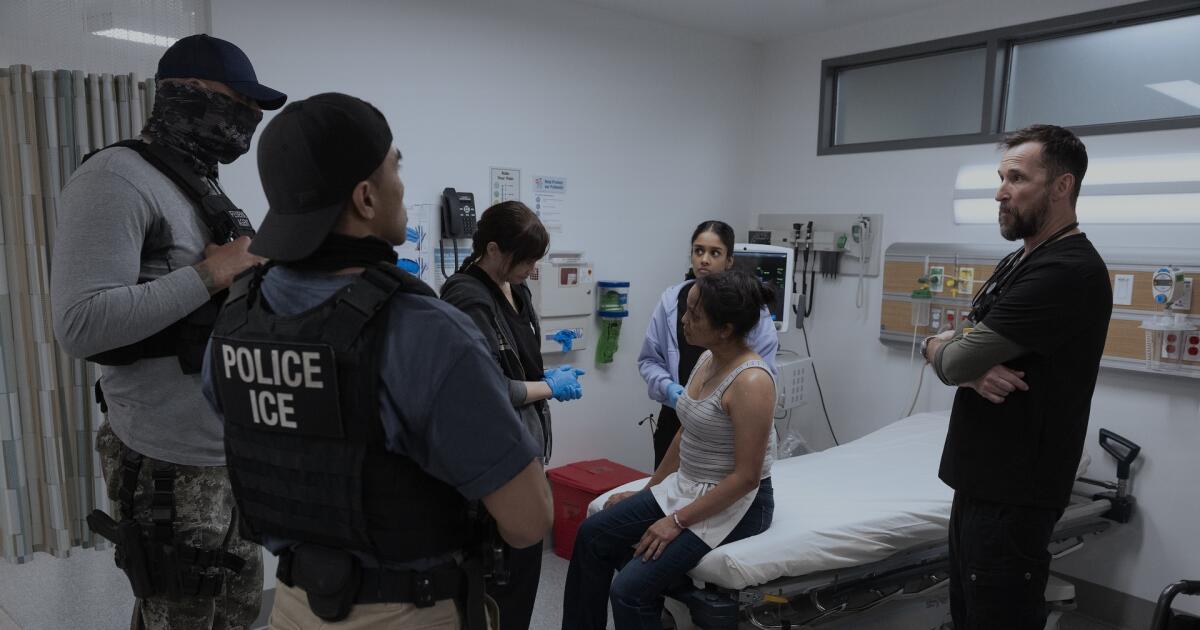
The explanation from ICE is an example of recent run-ins between immigration officers and healthcare workers that have contributed to mounting friction at Minneapolis hospitals. Workers at the Hennepin County facility say ICE officers have restrained patients in defiance of hospital rules and stayed at their sides for days. The agents have also lingered around the campus and pressed people for proof of citizenship.

Since the start of President Trump’s immigration crackdown in Minnesota, dubbed Operation Metro Surge, ICE officers have become such a fixture at the hospital that administrators issued new protocols for how employees should engage with them. Some employees complain that they have been intimidated to the point that they avoid crossing paths with agents while at work and use encrypted communications to guard against any electronic eavesdropping.

Similar operations have been carried out by federal agents in Los Angeles, Chicago and other cities, where opponents have criticized what they say are overly aggressive tactics. It’s not clear how many people have required hospital care while in detention.

Injuries appeared inconsistent with ICE account

The AP interviewed a doctor and five nurses who work at Hennepin County Medical Center who spoke on condition of anonymity to talk about Castañeda Mondragón’s case and conditions inside the hospital. The AP also consulted with an outside physician who affirmed his injuries were inconsistent with an accidental fall or running into a wall.

ICE’s account of how he was hurt evolved during the time that federal officers were at his bedside. At least one ICE officer told caregivers that Castañeda Mondragón “got his [expletive] rocked” after his Jan. 8 arrest near a St. Paul shopping center, the court filings and a hospital staff member said. His arrest happened a day after the killing of Renee Nicole Good, the first of two fatal shootings in Minneapolis by immigration officers.

The situation reached a head when ICE insisted on using handcuffs to shackle his ankles to the bed, prompting a heated encounter with hospital staff, according to the court records and the hospital employees familiar with the incident.

At the time, Castañeda Mondragón was so disoriented he did not know what year it was and could not recall how he was injured, one of the nurses said. ICE officers believed he was attempting to escape after he got up and took a few steps.

“We were basically trying to explain to ICE that this is how someone with a traumatic brain injury is — they’re impulsive,” the nurse said. “We didn’t think he was making a run for the door.”

Security responded to the scene, followed by the hospital’s chief executive and attorney, who huddled in a doctor’s office to discuss options for dealing with ICE, the nurse said.

“We eventually agreed with ICE that we would have a nursing assistant sit with the patient to prevent him from leaving,” the nurse said. “They agreed a little while later to take the shackles off.”

The Department of Homeland Security, which includes ICE, did not respond to repeated requests for comment on Castañeda Mondragón’s injuries. A deportation officer skirted the issue in the court documents, saying that during the intake process at an ICE detention center, it was determined he “had a head injury that required emergency medical treatment.”

Gregorio Castañeda Mondragón said his older brother is from Veracruz, Mexico, and worked as a roofer. He has a 10-year-old daughter living in his hometown he helps support.

According to his lawyers, Alberto Castañeda Mondragón entered the U.S. in 2022 with valid immigration documents. Minnesota incorporation filings show he founded a company called Castañeda Construction the following year with an address listed in St. Paul.

He appears to have no criminal record. His lawyers told a court that Castañeda Mondragón was racially profiled during the crackdown, and that officers determined only after his arrest that he had overstayed his visa.

“He was a brown-skinned, Latino Spanish speaker at a location immigration agents arbitrarily decided to target,” his lawyers wrote in a petition seeking his release from ICE custody.

Eight skull fractures

Castañeda Mondragón was initially taken to an ICE processing center at the edge of Minneapolis. Court records include an arrest warrant signed upon his arrival by an ICE officer, not an immigration judge.

About four hours after his arrest, he was taken to a hospital emergency room in suburban Edina with swelling and bruising around his right eye and bleeding. A CT scan revealed at least eight skull fractures and life-threatening hemorrhages in at least five areas of his brain, according to court documents. He was then transferred to Hennepin County Medical Center.

Castañeda Mondragón was alert and speaking, telling staff he was “dragged and mistreated by federal agents,” though his condition quickly deteriorated, the documents show.

The next week, a Jan. 16 court filing described his condition as minimally responsive and communicative, disoriented and heavily sedated.

AP shared the details of Castañeda Mondragón’s injuries with Dr. Lindsey C. Thomas, a board-certified forensic pathologist who worked as a medical examiner in Minnesota for more than 30 years. She agreed with the assessment of hospital staff.

“I am pretty sure a person could not get these kinds of extensive injuries from running into a wall,” Thomas said, adding that she would need to see the CT scans to make a more definitive finding.

“I almost think one doesn’t have to be a physician to conclude that a person can’t get skull fractures on both the right and left sides of their head and from front to back by running themselves into a wall,” she said.

ICE officers stay with hospitalized detainees for days

ICE officers have entered the hospital with seriously injured detainees and stayed at their bedside day after day, staffers said. The crackdown has been unsettling to hospital employees, who said ICE agents have been seen loitering on hospital grounds and asking patients and employees for proof of citizenship.

Hospital staff members said they were uncomfortable with the presence of armed agents they did not trust and who appeared to be untrained.

The nurses interviewed by AP said they felt intimidated by ICE’s presence in the critical care unit and had even been told to avoid a certain bathroom to minimize encounters with officers. They said staff members are using an encrypted messaging app to compare notes and share information out of fear that the government might be monitoring their communications.

The hospital reminded employees that ICE officers are not permitted to access patients or protected information without a warrant or court order.

“Patients under federal custody are first and foremost patients,” hospital officials wrote in a bulletin outlining new protocols. The hospital’s written policy also states that no shackles or other restraints should be used unless medically necessary.

“We have our policies, but ICE personnel as federal officers don’t necessarily comply with those, and that introduces tension,” said a doctor who spoke on condition of anonymity because they were not authorized to comment for the hospital.

Hospital spokeswoman Alisa Harris said ICE agents “have not entered our facilities looking for individuals.”

On Saturday, more than two weeks after Castañeda Mondragón was arrested, a U.S. District Court judge ordered him released from ICE custody.

“We are encouraged by the court’s order, which affirms that the rule of law applies to all people, in every corner of our country, including federal officers,” said Jeanette Boerner, director of Hennepin County Adult Representation Services, which filed the lawsuit on Castañeda Mondragón’s behalf.

To the surprise of some who treated him, Castañeda Mondragón was discharged from the hospital Tuesday. A hospital spokeswoman said she had no information about him.

The Justice Department filed court documents this week affirming Castañeda Mondragón is no longer in custody. Prosecutors did not respond to a request for comment on the man’s injuries.

Castañeda Mondragón has no family in Minnesota and co-workers have taken him in, the man’s brother said. He has significant memory loss and a long recovery ahead. He won’t be able to work for the foreseeable future, and his friends and family worry about paying for his care.

“He still doesn’t remember things that happened. I think [he remembers] 20% of the 100% he had,” said Gregorio Castañeda Mondragón, who lives in Mexico. “It’s sad that instead of having good memories of the United States, you’re left with a bad taste in your mouth about that country because they’re treating them like animals.”

Brook, Mustian and Biesecker write for the Associated Press and reported from Minneapolis, New York and Washington, respectively. AP reporters Steve Karnowski and Sarah Raza in Minneapolis; Valerie Gonzalez in McAllen, Texas; and Joshua Goodman in Miami contributed to this report.

Source link

2026 Winter Olympics: Ice hockey venue still being built five days before Games

Santagiulia is due to host many of the biggest ice hockey fixtures at the Games, including the men’s and women’s gold medal matches.

The first match is due to be held there on Thursday, 5 February, when hosts Italy face France in their first game of the women’s competition.

However, the stadium, less than a week before that game, is far from ready to host matches.

The stadium has been the centre of concerns throughout the build-up to the Games, including resulting in a boycott warning from the National Hockey League (NHL).

The rink in Milan, approved by the International Ice Hockey Federation, is shorter than the minimum requirement in the NHL, leading to suggestions there could be an increase in high-speed collisions. The quality of the ice has also been questioned.

“Obviously, if the players feel that the ice is unsafe, we’re not going to play,” NHL deputy commissioner Bill Daly said in November. “It’s as simple as that.”

The NHL said it was “pleased” with the test event at the arena in January, although that did not pass without incident. During the event there was a short delay while a small hole in the ice had to be repaired.

Santagiulia is one of two ice hockey venues for the Games, with the Milano Rho Arena staging some group-stage matches.

The Rho Arena, a temporary venue constructed in the Fiera Milano exhibition centre, has a capacity of 5,800 – 6,000 fewer than Santagiulia.

BBC Sport visited all four venues in the Milan Cluster which will host events during the Games, which officially run between 6 and 22 February.

As well as the ice hockey venues, speed skating will take place at a temporary venue in Fiera Milano to the west of the city, while short track and figure skating are at Unipol Forum on the southern outskirts.

The International Olympic Committee (IOC) has been contacted for comment.

Source link

Growing ICE criticism leads to scrutiny of LAPD relationship with feds

After the recent shootings of U.S. citizens Renee Good and Alex Pretti by federal agents in Minneapolis, some police chiefs have joined the mounting criticism of the Trump administration’s immigration blitz.

One voice missing from the fray: LAPD Chief Jim McDonnell.

This week, the chief reiterated that the department has a close working relationship with federal law enforcement, and said he would not order his officers to enforce a new state law — currently being challenged as unconstitutional — that prohibits the use of face coverings by U.S. Immigration and Customs Enforcement and other federal agents.

Top police brass nationwide rarely criticize their federal partners, relying on collaboration to investigate gangs, extremist groups and other major criminals — while also counting on millions in funding from Washington each year.

McDonnell and the LAPD have found themselves in an especially tough position, longtime department observers say. The city has been roiled by immigration raids and protests, and local leaders, including Mayor Karen Bass, have blasted the White House. But with the World Cup and Olympics coming soon — events that will require coordination with the feds — the chief has been choosing his words carefully.

Over the past year, McDonnell has fallen back on the message that the LAPD has a long-standing policy of not getting involved in civil immigration enforcement. Unlike his counterparts in Minneapolis, Portland and Philadelphia, he has largely avoided public comment on the tactics used by federal agents, saving his strongest criticism for protesters accused of vandalism or violence.

In a radio interview last spring, the chief said that “it’s critical that in a city as big, a city that’s as big a target for terrorism as Los Angeles, that we have a very close working relationship with federal, state and local partners.” He boasted that the LAPD had “best relationship in the nation in that regard.”

McDonnell stood beside FBI Director Kash Patel on an airport tarmac last week to announce the capture of a Canadian former Olympic snowboarder accused of trafficking tons of cocaine through Los Angeles. Then, at a news conference Thursday in which city officials touted historically low homicide totals, McDonnell said LAPD officials were as “disturbed” as everyone else by events in other parts of the country, alluding to Pretti’s shooting without mentioning him by name. He said the department would continue to work closely with federal agencies on non-immigration matters.

Explaining his stance on not enforcing the mask ban, McDonnell said he wouldn’t risk asking his officers to approach “another armed agency creating conflict for something that” amounted to a misdemeanor offense.

“It’s not a good policy decision and it wasn’t well thought out in my opinion,” he said.

Elsewhere, law enforcement leaders, civil rights advocates and other legal experts have decried how ICE agents and other federal officers have been flouting best practices when making street arrests, conducting crowd control and maintaining public safety amid mass protests.

After a shooting by agents of two people being sought for arrest in Portland, Ore., in mid-January, the city’s chief of police gave a tearful news conference saying he had sought to understand Latino residents “through your voices, your concern, your fear, your anger.”

Philadelphia Sheriff Rochelle Bilal set off a social media firestorm after she referred to ICE agents as “made-up, fake, wannabe law enforcement.”

In Minneapolis, where the Trump administration has deployed 3,000 federal agents, police Chief Brian O’Hara reportedly warned his officers in private that they would lose their jobs if they failed to intervene when federal agents use force. And in a news conference this week, New Orleans’ police superintendent questioned ICE’s arrest of one of the agency’s recruits.

The second-guessing has also spread to smaller cities like Helena, Mont., whose city’s police chief pulled his officers out of a regional drug task force over its decision to collaborate with U.S. Border Patrol agents.

Over the weekend, the International Assn. of Chiefs of Police, the nation’s largest and most influential police chief group, called on the White House to convene local, state and federal law enforcement partners for “policy-level discussions aimed at identifying a constructive path forward.”

McDonnell’s backers argue that the role of chief is apolitical, though many of his predecessors became national voices that shaped public safety policy. Speaking out, the chief’s supporters say, risks inviting backlash from the White House and could also affect the long pipeline of federal money the department relies on, for instance, to help fund de-escalation training for officers.

Assemblyman Mark González (D-Los Angeles) was among those who opposed McDonnell over his willingness to work with ICE while serving as Los Angeles County sheriff, but said he now considers him a “great partner” who has supported recent anti-crime legislation.

So he said was disappointed by McDonnell’s unwillingness to call out racial profiling and excessive force by federal agents in Minneapolis and elsewhere.

“We have to trust in a chief who is able to say ICE engaging and detaining 5-year-old kids and detaining flower vendors is not what this system was set up to do,” said González, the Assembly’s majority whip. “It would help when you’d have law enforcement back up a community that they serve.”

Inside the LAPD, top officials have supported McDonnell’s balancing act, suggesting that promises by officials in other cities to detain ICE agents rang hollow.

“Have you seen them arrest any? No,” said Deputy Chief Alan Hamilton.

LAPD officers serve on nearly three dozen task forces with federal officials, where they share information and resources to track down criminals, said Hamilton, the department’s chief of detectives. Cooperating with federal partners is essential to tasks including combating “human trafficking on Figueroa” and dismantling international theft rings, he said. As part of these investigations, both sides pool intelligence — arrangements that some privacy rights groups warn are now being exploited in the government’s immigration crackdown.

Hamilton said that “there’s nothing occurring right now that’s going to affect our relationship with the federal government across the board.”

Art Acevedo, a former chief in Houston and Miami, said that for any big-city chief, taking an official position on an issue as divisive as immigration can be complicated.

Being seen as coming out against President Trump comes with “some political risks,” he said.

But chiefs in immigrant-rich cities like Houston and L.A. must weigh that against the potentially irreparable damage to community trust from failing to condemn the recent raids, he said.

“When you don’t speak out, the old adage that silence is deafening is absolutely true. You end up losing the public and you end up putting your own people at risk,” he said. “The truth is that when you are police chief you have a bully pulpit, and what you say or fail to say is important.”

Those with experience on the federal side of the issue said it cuts both ways.

John Sandweg, the former director of ICE under President Obama, said that federal authorities need local cops and the public to feed them info and support operations, but the immigration agency’s “zero tolerance” approach was putting such cooperation “in jeopardy.”

“Ideally, in a perfect world, ICE is able to work within immigrant communities to identify the really bad actors,” he said. “But when you have this zero tolerance, when the quantity of arrests matters far more than the quality of arrests, you eliminate any ability to have that cooperation.”

Times staff writers Brittny Mejia, Ruben Vives and the Associated Press contributed to this report.

Source link

Trump officials have tried to justify ICE shootings. Is it backfiring?

Just a few hours after Border Patrol agents shot and killed Alex Pretti in Minneapolis, the U.S. Department of Homeland Security issued a statement that said, without evidence, that the 37-year-old registered nurse “wanted to do maximum damage and massacre law enforcement.”

Homeland Security Secretary Kristi Noem would later imply Pretti had been “asked to show up and to continue to resist” by Minnesota’s governor.

Multiple videos from the scene immediately undercut those claims, and there has been no indication in the days since that Pretti threatened or planned to hurt law enforcement.

Several high-profile use-of-force incidents and arrests involving federal immigration agents have involved a similar cycle: Strident statements by Trump administration officials, soon contradicted by video footage or other evidence. Some law enforcement experts believe the repeated falsehoods are harming federal authorities both in the public eye and in the courtroom.

The top federal prosecutor in Los Angeles, Bill Essayli, has taken five defendants to trial on charges of assaulting officers — and his office has lost each case. Court records and a Times investigation show grand juries in Chicago, Washington, D.C., and Los Angeles have repeatedly rejected criminal filings from prosecutors in similar cases.

Despite the repeated judicial rebukes, administration officials have continued to push for criminal charges against people at protest scenes, including the controversial arrest of former CNN anchor Don Lemon on Friday.

“When top federal law enforcement leaders in the country push false narratives like this, it leads the public to question everything the government says going forward,” said Peter Carr, a former Justice Department spokesman in Washington who served in Democratic and Republican administrations. “You see that in how judges are reacting. You’re seeing that in how grand juries are reacting. You’re seeing that in how juries are reacting. That trust that has been built up over generations is gone.”

The credibility concerns played out in a downtown L.A. courtroom in September, when Border Patrol Cmdr. Greg Bovino served as the key witness in the assault trial of Brayan Ramos-Brito, who was accused of striking a Border Patrol agent during protests against immigration raids last summer. Video from the scene did not clearly capture the alleged attack, and Bovino was the only Border Patrol official who testified as an eyewitness.

Under questioning from federal public defender Cuauhtémoc Ortega, Bovino initially denied he had been disciplined by Border Patrol for calling undocumented immigrants “scum, filth and trash,” but later admitted he had received a reprimand. The jury came back with an acquittal after deliberating for about an hour. A juror who spoke to The Times outside court said Bovino’s testimony detailing his account of the alleged assault had “no impact” on their decision.

Last year, a Chicago judge ruled Bovino had “lied” in a deposition in a lawsuit over the way agents used force against protesters and journalists.

Spokespersons for Essayli and the Department of Homeland Security did not respond to requests for comment.

Essayli’s prosecutors have seen four additional cases involving allegations of assault on a federal officer end in acquittals, a nearly unheard of losing streak. A Pew study found fewer than 1% of federal criminal defendants were acquitted throughout the U.S. in 2022.

The credibility of the prosecutor’s office and the credibility of the law enforcement officers testifying is key,” said Carley Palmer, a former federal prosecutor in L.A. who is now a partner at Halpern May Ybarra Gelberg. “That is especially true when the only witness to an event is a law enforcement officer.”

Jon Fleischman, a veteran Republican strategist and former spokesman for the Orange County Sheriff’s Department, said federal law enforcement officials have a responsibility to be the “mature, responsible player in the room” and remain as apolitical as possible. While he is a firm supporter of President Trump’s immigration agenda and said the Biden administration shares some blame for politicizing federal law enforcement, Noem’s handling of Pretti’s killing was problematic.

“What she said really doesn’t bear out in terms of what the facts that are available tell us,” Fleischman said. “I think it undermines the credibility of the justice system.”

Fleischman added that he feared some of the government’s recent missteps could dull approval of the platform that twice carried Trump to the White House.

“One of the main reasons I’ve been so enthusiastic about this president has been his stance on immigration issues,” he said. “When you see unforced errors by the home team that reduce public support for the president’s immigration agenda, it’s demoralizing.”

Another top Trump aide, White House Deputy Chief of Staff Stephen Miller, also spoke out after the Minnesota shooting, calling Pretti an “assassin.”

Responding to a Times reporter on X, Miller said recent legal defeats in Los Angeles were the result of “mass judge and jury nullification, deep in blue territory, of slam-dunk assault cases.”

Accounts from inside L.A. courtrooms paint a different picture.

Carol Williams, a jury foreperson in the most recent assault trial which federal prosecutors lost in L.A., said the people she served with steered clear of conversations about the news or ICE raids.

“We didn’t talk about the protests in L.A. and we didn’t talk about the protests that were in Minnesota or anything,” Williams said. “People, I’m sure, probably keep up with the news, but in terms of bringing that into the jury room, we did not.”

Last year, Essayli and Tricia McLaughlin, the chief Homeland Security spokesperson, accused Carlitos Ricardo Parias of ramming immigration agents with his vehicle in South L.A., causing an agent to open fire. Video made public after the assault charges were dismissed last year, however, do not show the vehicle moving when the ICE agent opens fire, injuring Parias and a deputy U.S. marshal.

After being presented with the body-camera footage, McLaughlin reiterated the claim that Parias weaponized his vehicle and said officers “followed their training and fired defensive shots.”

McLaughlin also labeled Keith Porter Jr. — a Los Angeles man shot and killed by an off-duty ICE agent in Northridge on New Year’s Eve — an “active shooter” in initial media comments about the case, using a term that typically refers to a gunman attempting to kill multiple people.

Los Angeles police said nobody else was injured at the scene and have not used the “active shooter” wording in statements about the case.

Porter’s family and advocates have argued that force was not warranted. They said Porter was firing a gun in the air to celebrate the new year, behavior that is illegal and discouraged as dangerous by public officials.

A lawyer for the agent, Brian Palacios, has said there is evidence Porter shot at the agent.

Carr, the former Justice Department spokesman, said the Trump administration has broken with years of cautious norms around press statements that were designed to protect the credibility of federal law enforcement.

“That trust is eroded when they rush to push narratives before any real investigations take place,” he said.

In one case, the refusal of Homeland Security officials to back down may cause video footage that further undercuts their narrative to become public.

Last October, Marimar Martinez was shot five times by a Border Patrol agent in Chicago who alleged she was following him in a car and interfering with an operation. In a statement, McLaughlin accused Martinez of ramming a law enforcement vehicle while armed with a “semiautomatic weapon.”

Federal prosecutors in Chicago dropped the charges, but McLaughlin and others continued to describe Martinez as a “domestic terrorist.” As a result, Martinez filed a motion to revoke a protective order that has kept hidden video of the incident and other evidence.

“While the United States voluntarily dismissed its formal prosecution of her with prejudice … government officials continue to prosecute Ms. Martinez’s character in the court of public opinion,” the motion read.

Source link

Trust in ICE plummets, even when agents target serious criminals

The ICE officers descended on Compton, targeting immigrants convicted of theft, child abuse and selling drugs.

There were no protesters. No whistles alerting targets to the officers’ presence. No face masks. In some cases, residents opened their doors to let the officers inside their homes. One man thanked them for not arresting him in front of his children.

The Los Angeles area operation ended with 162 arrests, including a Mexican national convicted of rape and a Salvadoran national convicted of voluntary manslaughter. Immigration and Customs Enforcement said almost 90% of the people arrested had criminal convictions.

It was June 2018, more than a year into Donald Trump’s first term as president. More than seven years later, carrying out the same operation in L.A. or other U.S. cities feels almost impossible without drawing angry crowds and requiring multiple officers, at times across federal agencies, to detain a single target.

In the years since Trump’s first term, ICE and the government’s immigration enforcement apparatus expanded raids well beyond those against known criminals or suspected ones. Increasingly, immigrants with no criminal records and even legal residents and U.S. citizens found themselves stopped and sometimes arrested.

The uncertainty over who is being targeted has fueled a growing pattern of community protests and rapid response mobilizations, even when officials say they are targeting convicted felons, reflecting a widening gap between how enforcement is described and how it is experienced. That gap has become most visible on the ground.

In recent months, sightings of ICE or other federal agents have drawn crowds of protesters, legal observers and community organizers. In many cases, residents say they can’t distinguish between targeted enforcement actions — against child molesters, human smugglers and other serious criminals — and broader sweeps, responding instead to the mere presence of agents whose role and authority are no longer clearly understood.

Experts say the Trump administration’s hostile rhetoric against immigrants and often seemingly indiscriminate targeting of people in neighborhoods has hurt the reputation of its immigration enforcement agencies, including ICE and Border Patrol, like never before. And it has inspired a mass movement of resistance that has seen Americans shot by federal immigration officers. In the last month, two U.S. citizens — Renee Nicole Good and Alex Jeffrey Pretti — were shot dead by ICE and Border Patrol agents in Minneapolis.

The fatal shootings forced Trump to recalibrate his immigration enforcement tactics, in part by sidelining Border Patrol Cmdr. Gregory Bovino, who first launched the aggressive raids in California, and putting border policy advisor Tom Homan in charge.

“I’m not here because the federal government has carried out this mission perfectly,” Homan said during a Thursday news conference. “Nothing’s ever perfect, and anything can be improved on. And what we’ve been working on is making this operation safer, more efficient, by the book.”

He said street operations in Minnesota would “draw down” if the agents were given access to local jails and that agents would focus on specific targets.

“We will conduct targeted enforcement operations — targeted,” he added. “That has traditionally been the case and that’s what we’re going to continue to do and improve upon that with the priority on public safety threats.”

An internal memo reviewed by Reuters showed ICE officers operating in the state were directed to avoid engaging with “agitators” and only target “aliens with a criminal history.”

Even if the Trump administration were to pull back ICE and Border Patrol’s aggressive tactics to focus more on known criminals, experts question whether too much damage has been done to their reputations.

“The brand of the agency is becoming so toxic,” said John Sandweg, who headed ICE under President Obama. “It’s going to impact the agency for years to come. It’s going to take a long time for that trust to rebuild.”

Another former ICE official, who asked not to be named out of fear of retaliation, said the agency used to be able to say it was focused on criminals and wasn’t conducting random sweeps.

“For years we always said, ‘We don’t have the resources to go after everybody, so we’re going to focus on just the worst of the worst,’” he said. “They can’t say that now. They’re still trying to do that, but it’s getting overshadowed by Home Depot and car washes and all this other stuff and Border Patrol’s heavy-handed tactics. Now it’s leading to shootings and all these other things. It’s just horrible.”

In Willowbrook, an unincorporated neighborhood nestled in South L.A., just blocks from Compton city limits, federal agents found themselves locked between angry crowds recording them last week. Two people held a sign that read: “ICE / Soldiers off our streets.”

Federal agents clear the way for an authorized car to pass in Willowbrook.

Federal agents clear the way for an authorized car to pass while investigating a shooting involving a federal agent in Willowbrook.

(Genaro Molina/Los Angeles Times)

The agents were there to arrest a man they say had been “involved in human trafficking” and had a final removal order. They alleged the man had two prior arrests for domestic violence. Homeland Security officials later said the man used his vehicle to ram federal agent vehicles in an attempt to evade arrest, prompting an agent to open fire.

But as news spread that the operation was targeting a suspected criminal living in the country illegally, most residents shrugged it off. They said federal officials had made false claims against other people they had arrested or shot at, including labeling Good and Pretti as domestic terrorists.

“They’ve shown us that they’re not trustworthy,” Rosa Enriquez, 39, said while holding a Mexican flag.

Similar scenes have played out across the country. This month, a journalist posted a video of agents — who she identified as working for ICE — calling out a driver for honking during an operation St. Paul, Minn.

“We’re here to arrest a child sex offender and you guys are out here honking,” the agent said. “That’s who you guys are protecting. Insane.”

“Just go. You’re lying!” a woman shouts.

Homeland Security has made it a point to tout the arrests of criminals across the country. The “worst of the worst arrests” in L.A. this month, according to the agency, included a man convicted of second-degree murder, another for voluntary manslaughter and one with multiple convictions for driving under the influence and disorderly conduct.

“We will not let rioters or agitators slow us down from removing murderers, rapists, pedophiles, gang members, and terrorists,” Homeland Security spokesperson Tricia McLaughlin said in a statement.

But experts say the general public has clearly witnessed a shift in who is being targeted.

In May, White House Deputy Chief of Staff Stephen Miller reportedly directed top ICE officials to go beyond target lists and have agents make arrests at Home Depot or 7-Eleven convenience stores as they sought to crank up their daily arrest numbers to 3,000.

Aug. 2025 photo of Gregory Bovino.

Border Patrol commander Gregory Bovino, center, marches with federal agents to the Edward R. Roybal Federal Building.

(Carlin Stiehl/Los Angeles Times)

The following month, Border Patrol agents led by Bovino were on the ground in L.A., tackling car wash workers, arresting street vendors and chasing down day laborers.

“The pressure of those numbers on enforcement agencies and mobilizing the whole of government and other law enforcement agencies, well beyond the traditional ICE and CBP, has created pressures that have led to extensive overreach,” said Doris Meissner, a senior fellow at the Migration Policy Institute, a nonpartisan think tank in Washington. Customs and Border Protection, or CBP, is the agency that includes ICE and Border Patrol.

At the peak of arrests in L.A in June, around 75% of people had no criminal conviction. A Times analysis found that in the administration’s first nine months, from Jan. 1 to Oct. 15, of the more than 10,000 Los Angeles residents who were arrested in immigration operations, about 45% had a criminal conviction and an additional 14% had pending charges.

In November the Cato Institute, a libertarian think tank, reported that, nationwide, 5% of detainees from Oct. 1 to Nov. 15 had been convicted of violent crimes. Most detainees with convictions were found guilty of vice, immigration or traffic infractions.

“They’ve painted to the American people that they were going after the worst of the worst, and that is nothing like what is happening,” said Assemblymember Mike A. Gipson (D-Carson), who represents the district where the recent shooting in L.A. unfolded. “We have seen all across America where they have harassed, they have murdered, assassinated not only citizens but also people who have not had any arrest, who have not fit the bill or the description of what they have painted to the American people.

“When you turn on the news right now, the trust is absolutely gone. We don’t trust the White House, we don’t trust ICE, and the people are afraid because the trust is gone.”

Santa Maria Councilmember Gloria Soto echoed that sentiment, in part because she has seen raids in her Central Coast town.

“That’s part of the frustration,” Soto said. “There’s no transparency. There’s no information being shared before or after these enforcements have taken place.”

“We know for a fact that there are individuals who are getting picked up who did not have a criminal record, whose only quote-unquote crime was, you know, either having an expired visa, or crossing without the required immigration documentation that is needed, so it makes it really difficult for us, for me as an elected official, to trust what this agency is doing because so far there is no communication,” she said.

The challenges ICE officers are facing appear to center on cities that have been targeted with surge operations — like in Minneapolis, Sandweg said. Across the country, he said, officers are conducting operations “but not with the same amount of controversy.”

People take part in a vigil at a memorial for Alex Pretti in Minneapolis.

People take part in a vigil at a memorial for Alex Pretti in Minneapolis.

(Eric Thayer/Los Angeles Times)

“In Minneapolis we’re at the point now when, if agents are going to go after someone with a very serious violent criminal history, they’re likely to pick up observers and a lot of attention,” he said. “The way in which they wanted to do these operations in such an overt, in-your-face kind of fashion, has created a dynamic that makes it really hard for the agents to execute their duties. … You have these protests following the agents everywhere they go.”

While there has always been consternation over immigration enforcement, Sandweg said that “the widespread tactics and the targeting of people with no criminal record just really galvanized people in a way they’ve never been galvanized before.”

“To where now it probably is starting to bleed into and impeding operations that most of those protesters are probably not opposed to — the idea of ICE getting someone with a violent criminal history off the streets,” he said. “I think it’s created an environment where it puts the officers and the public in harm’s way.”

This week, protesters came out in force when word spread that ICE officers were eating at a restaurant in Lynwood. A video shows the crowd jeering at the officers as they’re being escorted out of the area by Los Angeles County sheriff’s deputies.

Almost immediately, Lynwood City Councilmember Luis Gerardo Cuellar posted a video on Instagram to inform the public.

“This was not ICE, these were … TSA air marshals.”


Source link

Shutdown nears as lawmakers brace for next round of ICE negotiations

A budget impasse in Congress is poised to halt large swaths of federal operations early Saturday as lawmakers in Capitol Hill turn to the next flashpoint in negotiations to reopen the government: whether to impose new limits on federal immigration authorities carrying out President Trump’s deportation campaign.

Over the next two weeks, Democrats and Republicans will weigh competing demands on how the Department of Homeland Security should carry out arrests, detention and deportations after the fatal shootings of two U.S. citizens by federal immigration agents this month in Minnesota.

Seeking to rein in the federal agency, Senate Democrats late on Thursday were able to strike a deal with the White House that would temporarily fund the Department of Homeland Security but fund the Pentagon, the State Department, as well as the health, education, labor and transportation agencies through Sept. 30.

The agreement is intended to give lawmakers more time to address Democratic demands to curb ICE tactics while averting a partial government shutdown.

The Senate finalized the deal Friday evening on a 71-29 vote, hours before a midnight deadline to avert a government shutdown. Passage of the deal was delayed by Sen. Lindsey Graham (R-S.C.), who objected to parts of the package.

The House expected to take up the legislation as early as Monday. The partial government shutdown will occur until the measure clears the House and Trump signs it into law.

The president supports the deal, which came after Senate Democrats said they would not vote to fund Homeland Security unless reforms for the agency were approved. Among the demands: banning federal agents from wearing masks, requiring use of body cameras and requiring use of judicial warrants prior to searching homes and making arrests.

Democrats have also demanded that local and state law enforcement officials be given the ability to conduct independent investigations in cases where federal agents are accused of wrongdoing.

The deal, however, does not include any of those reforms; it includes only the promise of more time to negotiate with no guarantee that the new restrictions will be agreed to.

Both of California’s Democratic senators, Adam Schiff and Alex Padilla, voted against the Senate deal. They both opposed giving more funding to Homeland Security without reforms in a vote Thursday.

Schiff voted no because he said he promised to not “give another dime for ICE until we saw real reforms — and not just promised reforms but statutory requirements.”

“I want to see those reforms before I am prepared to support any more funding for these agencies,” Schiff said in a video message posted on X, and added that he did not see the White House acting in “good faith. “I want it in writing and statute.”

After voting against the measure, Padilla said in a statement: “I’ve been clear from the beginning: No more money for ICE and CBP without real oversight and accountability.”

House Minority Leader Hakeem Jeffries (D-N.Y.) told reporters Friday morning that Democrats will find out whether two weeks is enough time to reach a compromise.

“We will evaluate whether that is sufficient time,” Jeffries said. “But there is urgency to dealing with this issue because ICE as we have seen is out of control.”

Meanwhile, the absence of reforms in the Senate deal has already drawn concerns from some progressives, who argue the deal falls short of what is needed to rein in federal immigration enforcement.

“First of all, I’m actually disappointed that Senate leadership is not right now demanding more,” Rep. Robert Garcia, a top-ranking House Democrat from Long Beach, told reporters Friday. “This idea that we’re somehow going to continue to fund this agency and somehow just extend the pain, I think is absolutely wrong.”

Garcia said it was “outrageous” that the Senate deal would extend funding for Homeland Security for two weeks without any new requirements.

“This idea that we’re somehow not demanding immediately the removal of masks and body cameras and all the other reforms while eliminating this agency that’s causing harm, I think, is outrageous,” Garcia said.

Democratic Rep. Judy Chu of Pasadena said in a statement that she had not yet decided whether to support the Senate deal once it reaches the House floor.

But, Chu added: “I cannot support legislation that increases funding to this agency while delivering no accountability measures.”

Rep. Kevin Calvert (R-Corona) said in a statement that it is “critical” for lawmakers to pass the bipartisan spending package, in part because it included funding for the U.S. military.

“As Chairman of the [House] Defense Appropriation Subcommittee, I’m especially concerned about the negative impacts of a shutdown at a time when we have a buildup of American military assets in the Middle East,” Calvert said.

Calvert added that Homeland Security operations will continue even in the shutdown because lawmakers provided an influx of funding for the agency in last year’s “One Big Beautiful Bill.” But he said he worried that any lapse in funding would affect other operations by the agency, including disaster funding and security assistance for major events, such as the upcoming World Cup.

“We need to get these priorities funded,” he said.

Other Republican lawmakers have already signaled the possible hurdles Democrats will face as they try to rein in ICE.

Graham held up consideration of the Senate deal, in part because he wanted the Senate to vote to criminalize local and state officials in sanctuary cities — a term that has no strict definition but that generally describes local jurisdictions that limit cooperation with federal immigration authorities.

“You can convince me that ICE can be better, but I don’t think I will ever convince you to abandon sanctuary cities because you’re wedded to it on the Democratic side,” Graham said.

Graham also delayed passage of the deal because it included a repeal of a law that would have allowed senators — including himself — to sue the government if federal investigators gained access to their phones without notifying them. The law required senators to be notified if that were to happen and sue for up to $50,000 in damages per incident.

“We’ll fix the $500,000 — count me in — but you took the notification out,” Graham said. “I am demanding a vote on the floor of the United States Senate.”

Other Senate Republicans also expressed concern with Democrats’ demands, even as Trump seemed to try appease them.

Sen. Eric Schmitt (R-Mo.) said the demand for federal agents to remove their masks during operations was a “clear and obvious attempt to intimidate and put our federal agents in harm’s way.”

“When enforcement becomes dangerous for enforcers, enforcement does not survive,” Schmitt said in a Senate floor speech. “What emerges is not reform, it is amnesty by default.”

Despite the GOP opposition, most Senate Republicans were poised to join Democrats on Friday and vote for the deal. But there is no certainty that they will join the minority party when negotiations resume in the coming weeks.

Recent history suggests that bipartisan support at the outset does not guarantee a lasting deal, particularly when unresolved policy disputes remain. The last government shutdown tied to a debate over healthcare exposed how quickly negotiations can collapse when no agreement is reached.

In November, a small group of Democrats voted with Republicans to end the longest government shutdown in U.S. history with the promise of negotiating an extension to healthcare tax credits that were set to expire in the new year.

Rep. Nancy Pelosi (D-San Francisco), a former House speaker, reminded the public on Friday that Democrats were unable to get Republican support for extending the tax credits, resulting in increasing healthcare costs for millions of Americans.

“House Democrats passed a bipartisan fix, yet Senate Republicans continue to block this critical relief for millions of Americans,” Pelosi wrote in a post on X.

Times staff writer Seema Mehta contributed to this report.

Source link

Fearing ICE, Native Americans rush to prove their right to belong in the U.S.

When U.S. Immigration and Customs Enforcement flooded Minneapolis, Shane Mantz dug his Choctaw Nation citizenship card out of a box on his dresser and slid it into his wallet.

Some strangers mistake the pest-control company manager for Latino, he said, and he fears getting caught up in ICE raids.

Like Mantz, many Native Americans are carrying tribal documents proving their U.S. citizenship in case they are stopped or questioned by federal immigration agents. This is why dozens of the 575 federally recognized Native nations are making it easier to get tribal IDs. They’re waiving fees, lowering the age of eligibility — ranging from 5 to 18 nationwide — and printing the cards faster.

It’s the first time tribal IDs have been widely used as proof of U.S. citizenship and protection against federal law enforcement, said David Wilkins, an expert on Native politics and governance at the University of Richmond.

“I don’t think there’s anything historically comparable,” Wilkins said. “I find it terribly frustrating and disheartening.”

As Native Americans around the country rush to secure documents proving their right to live in the United States, many see a bitter irony.

“As the first people of this land, there’s no reason why Native Americans should have their citizenship questioned,” said Jaqueline De León, a senior staff attorney with the nonprofit Native American Rights Fund and member of Isleta Pueblo.

The U.S. Department of Homeland Security didn’t respond to more than four requests for comment over a week.

Native identity in a new age of fear

Since the mid- to late 1800s, the U.S. government has kept detailed genealogical records to estimate Native Americans’ fraction of “Indian blood” and determine their eligibility for healthcare, housing, education and other services owed under federal legal responsibilities. Those records were also used to aid federal assimilation efforts and chip away at tribal sovereignty, communal lands and identity.

Beginning in the late 1960s, many tribal nations began issuing their own forms of identification. In the last two decades, tribal photo ID cards have become commonplace and can be used to vote in tribal elections, to prove U.S. work eligibility and for domestic air travel.

About 70% of Native Americans today live in urban areas, including tens of thousands in the Twin Cities, one of the largest urban Native populations in the country.

There, in early January, a top ICE official announced the “largest immigration operation ever.”

Masked, heavily armed agents traveling in convoys of unmarked SUVs became commonplace in some neighborhoods. By this week, more than 3,400 people had been arrested, according to Immigration and Customs Enforcement. At least 2,000 ICE officers and 1,000 Border Patrol officers were on the ground.

Representatives from at least 10 tribes traveled hundreds of miles to Minneapolis — the birthplace of the American Indian Movement — to accept ID applications from members there. Among them were the Lac Courte Oreilles Band of Ojibwe of Wisconsin, the Sisseton Wahpeton Oyate of South Dakota and the Turtle Mountain Band of Chippewa of North Dakota.

Turtle Mountain citizen Faron Houle renewed his tribal ID card and got his young adult son’s and his daughter’s first ones.

“You just get nervous,” Houle said. “I think [ICE agents are] more or less racial profiling people, including me.”

Events in downtown coffee shops, hotel ballrooms, and at the Minneapolis American Indian Center helped urban tribal citizens connect and share resources, said Christine Yellow Bird, who directs the Mandan, Hidatsa and Arikara Nation’s satellite office in Fargo, ND.

Yellow Bird made four trips to Minneapolis in recent weeks, putting nearly 2,000 miles on her 2017 Chevy Tahoe to help citizens in the Twin Cities who can’t make the long journey to their reservation.

Yellow Bird said she always keeps her tribal ID with her.

“I’m proud of who I am,” she said. “I never thought I would have to carry it for my own safety.”

Some Native Americans say ICE is harassing them

Last year, Navajo Nation President Buu Nygren said that several tribal citizens reported being stopped and detained by ICE officers in Arizona and New Mexico. He and other tribal leaders have advised citizens to carry tribal IDs with them at all times.

Last November, Elaine Miles, a member of the Confederated Tribes of the Umatilla Indian Reservation in Oregon and an actress known for her roles in “Northern Exposure” and “The Last of Us,” said she was stopped by ICE officers in Washington state who told her that her tribal ID looked fake.

The Oglala Sioux Tribe this week banned ICE from its reservation in southwestern South Dakota and northwestern Nebraska, one of the largest in the country.

The Standing Rock Sioux Tribe of North and South Dakota said a member was detained in Minnesota last weekend. And Peter Yazzie, who is Navajo, said he was arrested and held by U.S. Immigration and Customs Enforcement in Phoenix for several hours last week.

Yazzie, a construction worker from nearby Chinle, Ariz., said he was sitting in his car at a gas station preparing for a day of work when he saw ICE officers arrest some Latino men. The officers soon turned their attention to Yazzie, pushed him to the ground, and searched his vehicle, he said.

He said he told them where to find his driver’s license, birth certificate, and a federal Certificate of Degree of Indian Blood. Yazzie said the car he was in is registered to his mother. Officers said the names didn’t match, he said, and he was arrested, taken to a nearby detention center and held for about four hours.

“It’s an ugly feeling. It makes you feel less human. To know that people see your features and think so little of you,” he said.

Homeland Security did not respond to questions about the arrest.

Mantz, the Choctaw Nation citizen, said he runs pest-control operations in Minneapolis neighborhoods where ICE agents are active and he won’t leave home without his tribal identification documents.

Securing them for his children is now a priority.

“It gives me some peace of mind. But at the same time, why do we have to carry these documents?” Mantz said. “Who are you to ask us to prove who we are?”

Brewer, Peters and Huntington write for the Associated Press. Brewer reported from Oklahoma City and Peters from Edgewood, N.M.

Source link

Journalist Don Lemon arrested in connection to Minnesota ICE protest | Protests News

Press freedom groups decry arrest of former CNN anchor as lawyer pledges to fight charges ‘vigorously’.

Journalist Don Lemon has been arrested in connection with his coverage of a protest against United States President Donald Trump’s deadly immigration enforcement operation in Minnesota.

Lemon’s lawyer, Abbe Lowell, said on Friday that the journalist had been arrested in Los Angeles, where he was covering the Grammy Awards.

Recommended Stories

list of 3 itemsend of list

It was not immediately clear what charges Lemon was facing. In recent weeks, however, the Department of Justice indicated it would target Lemon for his attendance at a January 18 protest, in which demonstrators disrupted a church service in the city of St Paul, Minnesota.

“Don has been a journalist for 30 years, and his constitutionally protected work in Minneapolis was no different than what he has always done,” Lowell said in a statement.

He pointed to the First Amendment of the US Constitution, which protects the freedom of the press.

“The First Amendment exists to protect journalists whose role it is to shine light on the truth and hold those in power accountable,” Lowell said. “Don will fight these charges vigorously and thoroughly in court”.

US Attorney General Pam Bondi confirmed the arrest on Friday, saying Lemon had been taken into custody with three others in connection with what she described as the “coordinated attack on Cities Church in St Paul, Minnesota”.

Lemon was part of a series of arrests that morning, all related to the church demonstration. They included independent journalist Georgia Fort, as well as activists Jamael Lydell Lundy and Trahern Jeen Crews.

Federal authorities had previously arrested Minneapolis civil rights lawyer Nekima Levy Armstrong and two others in connection with the protest.

Press freedom groups swiftly condemned the action, which they called a major escalation in the administration’s attacks on journalists.

“The unmistakable message is that journalists must tread cautiously because the government is looking for any way to target them,” Seth Stern, the chief of advocacy at the Freedom of the Press Foundation, said in a statement.

The National Press Club also denounced the arrests in a statement. “Arresting or detaining journalists for covering protests, public events, or government actions represents a grave threat to press freedom and risks chilling reporting nationwide,” it wrote.

Lemon had previously been an anchor for the CNN news network, but he was fired in 2023. He has since worked as an independent journalist, with a prominent presence on YouTube.

‘I’m here as a journalist’

During his online report from the church protest, Lemon repeatedly identified himself as a reporter as he interviewed both demonstrators and church attendees.

“I’m not here as an activist. I’m here as a journalist,” he told those present.

Protesters had targeted the church, which belongs to the Southern Baptist Convention, due to its pastor, David Easterwood, who also holds a role as the head of a field office for Immigration and Customs Enforcement (ICE).

Critics have questioned why the Justice Department swiftly opened a probe into the church protest, while it declined to open a civil rights investigation into an ICE agent’s killing of Renee Nicole Good in Minneapolis on January 7.

The department has not yet said if it will open an investigation into the January 24 killing of US citizen Alex Pretti by border patrol agents in Minneapolis.

“Instead of investigating the federal agents who killed two peaceful Minnesota protesters, the Trump Justice Department is devoting its time, attention and resources to this arrest, and that is the real indictment of wrongdoing in this case,” Lowell said in his statement.

Friday’s arrest comes after a federal judge in Minnesota took the rare move last week of refusing to sign an arrest warrant for Lemon. Justice Department officials nevertheless promised to continue pursuing charges.

Source link