ICBM-Guarding Security Forces Will Need Fresh Tactics To Defend New Sentinel Silos
The construction of new silos for the U.S. Air Force’s future LGM-35A Sentinel intercontinental ballistic missiles (ICBM) means that units charged with defending them will have to update their tactics, techniques, and procedures (TTPs). Air Force Security Forces personnel regularly train to protect existing silos housing LGM-30G Minuteman III ICBMs, as well as associated launch facilities, or even recapture them if necessary. The need for totally new silos and other infrastructure has been a major issue for the Sentinel program, contributing significantly to delays and cost overruns that triggered a total restructuring that is still ongoing.
The Government Accountability Office (GAO), a congressional watchdog, highlighted how Sentinel will impact Air Force Security Forces units in a brief report released earlier today. This comes a day after the Air Force put out its own update on the new ICBM program, stating that the current goal is for the restructuring effort to wrap up before the end of the year and for the first launch of a prototype LGM-35A to occur in 2027. The hope now is that Sentinel will begin entering operational service sometime in the early 2030s. The original schedule had called for the missiles to reach initial operational capability in 2029.

“DOD will need to complete Sentinel launch facility test and evaluation activities early in the transition to inform DOD and Air Force security policy updates,” the GAO report says. “Because security forces incorporate these updates into unit-level operating instructions, these policy updates will be needed to train Air Force security forces for the transition.”

The report does not elaborate on the changes that will be required. As noted, Security Forces personnel currently assigned to Air Force Missile wings train to protect the Minuteman III force above and below ground. There are currently 400 LGM-30Gs loaded into silos spread across five states. Sentinel is said to offer greater range and improved accuracy, as well as reliability and sustainability benefits, over the aging Minuteman IIIs, which first entered service in 1970. The development of a new ICBM also offers the opportunity for the inclusion of survivability improvements and other additional capabilities.

An Air Force news release from 2019 describes one potential “recapture and recovery” scenario used in a routine training:
“The training simulated a hostile’s attempt to capture a nuclear asset. Security forces Airmen, who arrived by both Humvee and helicopter, began to combat the threat and worked their way toward retaking control of the launch facility. After neutralizing the threat, recapturing and securing the launch facility, the Airmen performed self-aid buddy care and tactical combat casualty care.”
The video below shows scenes from a recapture and recovery exercise conducted as part of the larger Global Thunder 23 exercise.

91st Missile Wing participates in Global Thunder 23
Terrorists or other hostile actors could also seek to break into silos or launch facilities just to damage or destroy them. Even if they could not trigger a nuclear detonation, blowing up an ICBM inside its silo would have significant operational, environmental, and other ramifications.
The Air Force had originally said it would reuse Minuteman III silos and other existing infrastructure for Sentinel, but subsequently determined that was no longer a viable course of action. As such, new silos and launch control facilities could easily come with substantially different physical layouts that would affect the tactics, techniques, and procedures for securing them. The LGM-35A missiles will also be completely different from the existing LGM-30Gs, and there could be additional notable differences in how the Sentinels are married together with their new ground-based infrastructure. All of this could further impact how Security Forces personnel prepare themselves for a variety of contingencies, including any potential for accidental detonations or launches.


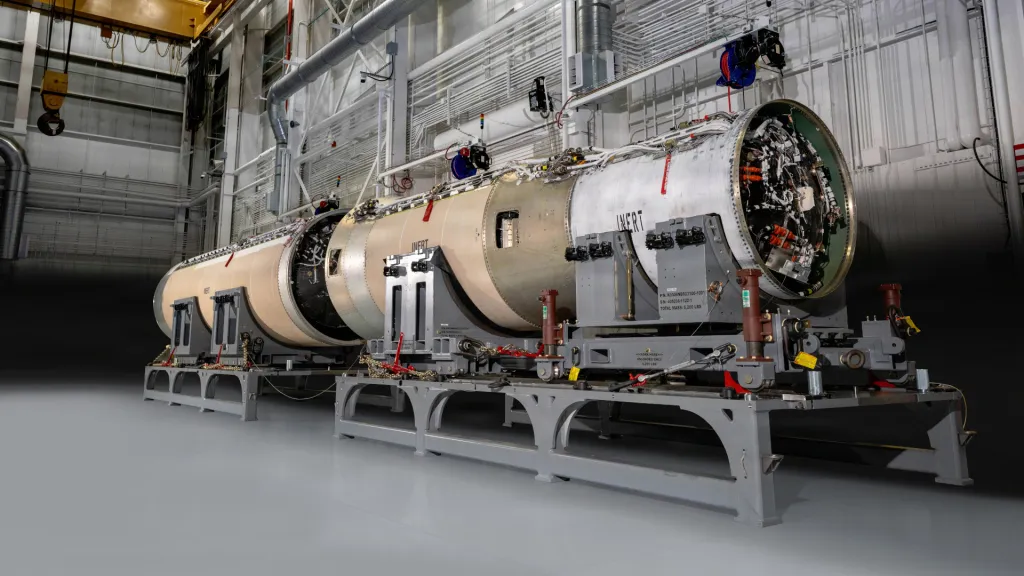
In its update about Sentinel yesterday, the Air Force shared that prime contractor Northrop Grumman is set to start building a prototype launch silo at the company’s facility in Promontory, Utah, this month. “This crucial effort will allow engineers to test and refine modern construction techniques, validating the new silo design before work begins in the missile fields,” according to the release.
There’s a strong possibility that a prototype silo could also be used to help develop and refine new Security Forces TTPs in future, as well.
Site defense is also just one aspect of the elaborate and costly security ecosystem in place now for the Minuteman III force. This includes protection for ICBMs while they are being transported via transporter-erector trucks, as well as loaded or unloaded into silos. All of this will also have to adapt to the future Sentinel missiles and their new facilities. The Air Force has already been modernizing certain aspects of nuclear force protection capabilities, including the acquisition of new MH-139A Grey Wolf helicopters to replace aging UH-1Ns used to provide air support over the silo fields and for convoys on the move. An MH-139A was used to escort a Minuteman III convoy for the first time in January.

In terms of other Sentinel-related infrastructure work, “this summer, prototyping activities at F.E. Warren AFB [Air Force Base, in Wyoming] will validate innovative utility corridor construction methods, which are key to streamlining the installation of thousands of miles of secure infrastructure and fielding the system faster,” the Air Force’s release added. “Meanwhile, foundational construction on permanent facilities is already well underway. The first of three new Wing Command Centers is taking shape at F.E. Warren AFB, and critical test facilities are being erected at Vandenberg SFB [Space Force Base, in California] to support the future flight test campaign.”
So-called Site Activation Task Force (SATAF) detachments are also helping lay the groundwork for the transition from Minuteman III to Sentinel at F.E. Warren and Vandenberg, as well as Malmstrom Air Force Base in Montana and Minot Air Force Base in North Dakota. It should be noted that Vandenberg does not currently host operational ICBMs, and is not set to do so in the future, but is used for routine test launches. The Air Force also says that the planned first launch of a Sentinel in 2027 will be from a pad rather than a silo.

US Air Force launches Minuteman III ICBM from Vandenberg in unarmed test
The Air Force is otherwise hopeful that the ongoing restructuring effort will reduce the chance for further schedule risks to the Sentinel program and, by extension, cost growth.
“We certainly have not lowered the bar, and we certainly have not taken on any risk by doing this,” Air Force Gen. Dale White, the new Direct Reporting Portfolio Manager (DRPM) for Critical Major Weapon Systems (CMWS), told Breaking Defense in an interview published yesterday. The DRPM CMWS role was established last August to create a “single empowered leader” to manage Sentinel and other top-priority Air Force weapon systems programs, including the F-47 sixth-generation fighter and B-21 Raider stealth bomber.
“The restructured program incorporates key lessons learned to ensure maximum efficiency,” the Air Force’s release explained. “The decision to build new silos, for example, avoids the unpredictable costs and safety hazards of excavating and retrofitting 450 unique structures built over 50 years ago, and is a prime example of choosing a path that delivers capability with greater speed and less risk.”
“Sentinel program officials continue to evaluate options to potentially redesign portions of the weapon system for cost reductions and are looking at avenues to minimize further schedule delays,” GAO’s report today also noted. “For example, the Air Force is reevaluating system requirements and evaluating changes to the acquisition strategy – both of which could limit further cost and schedule growth.”
GAO’s report did still highlight continued concerns about potential challenges for Sentinel, including in relation to software development for the missiles and work on the extensive new ground infrastructure. As noted, the need for all-new silos has already been a central factor in delays and cost overruns, despite the hope that this will prove less risky in the long run. There are also concerns about sustaining the Minuteman III force beyond 2036, when the transition to Sentinel was originally supposed to be complete. A seamless replacement process is critical to ensuring that the land-based leg of America’s nuclear triad remains a credible deterrent capability throughout.

“I think Sentinel is going to be a bit easier with some of the things we’re designing into the program, the digital infrastructure, the open architecture,” Air Force Gen. Stephen Davis, head of Air Force Global Strike Command (AFGSC), told TWZ in an interview last month. “I think it will make it easier to upgrade and keep that missile relevant. I don’t have any worries about being able to do that in the future.”
Overall, the Sentinel is categorized as “megaproject” by GAO, defined as something that “costs $1 billion or more, affects 1 million or more people, and runs for years.” Such efforts “are extremely risky ventures, notoriously difficult to manage, and often fail to achieve their original objectives,” according to the Congressional watchdog.
A revised cost for Sentinel has yet to be released. However, when the Air Force announced the restructuring effort back in 2024, the total acquisition costs were projected to rise to approximately $140.9 billion, an 81 percent increase over the original estimates.
Even if the restructured Sentinel plan holds going forward, the program will still be immensely complex and resource-intensive, and have many different facets, including changes to how Security Forces units operate going forward.
Contact the author: joe@twz.com