HybridElectric

MV250 Hybrid-Electric VTOL Combat Cargo Drone Unveiled

A new hybrid-electric heavy-lift cargo drone has been unveiled by the defense arm of U.S. company BETA Technologies. The MV250 debuted in the static display at the Farnborough International Airshow 2026, taking place in England this week. The vehicle shown at the airshow hasn’t flown, BETA Technologies confirmed, although it is described as being built using “all-flyable components.”

The new drone is a military adaptation of BETA Technologies’ Alia 250 electric vertical takeoff and landing (eVTOL) aircraft, which can carry five passengers or an equivalent load of cargo, plus the pilot. TWZ and other journalists today spoke to officials from BETA Technologies at Farnborough.

“The basic physics of the MV250 enable significantly longer range, higher speed, and a lower cost of operations when compared to tiltrotor and legacy platforms,” said Kyle Clark, founder and CEO of BETA Technologies. However, the claim that the MV250 exceeds the performance of a tiltrotor doesn’t stack up, based on published figures. “I believe we should be offering our military the most robust and best equipment in the world to maintain superiority and thus deterrence,” Clark added.

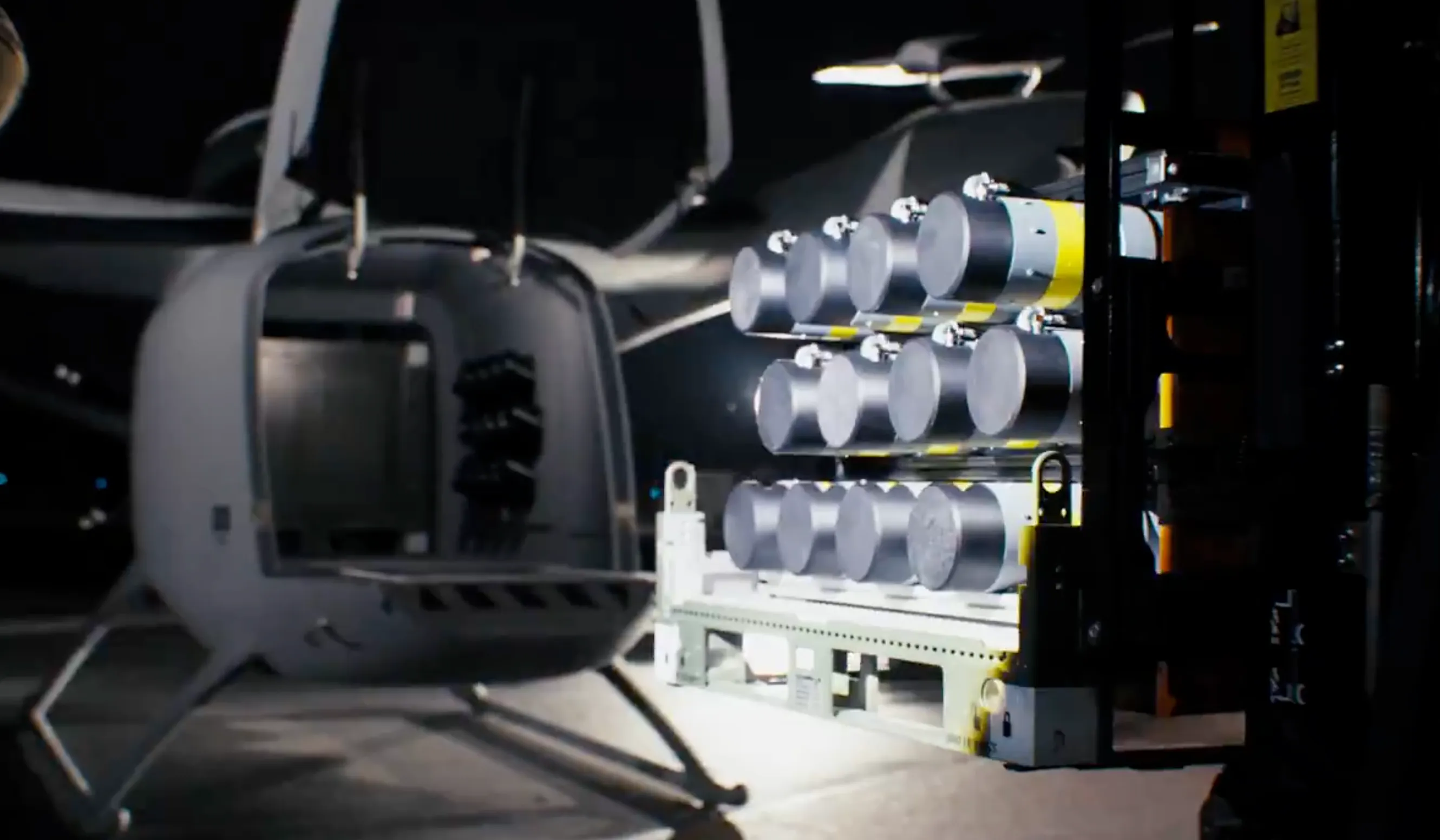
The uncrewed MV250 is primarily intended for cargo transport, with freight loaded and unloaded through an upward-opening nose visor. It can also deploy air-launched effects (ALEs) from a set of side-mounted launch tubes. A similar concept is currently being pitched by Sikorsky, with its uncrewed version of the Black Hawk helicopter, dubbed the U-Hawk, which is also intended to be able to fire dozens of ALEs, such as surveillance and reconnaissance drones and loitering munitions.

A pack of ALEs about to be loaded into the MV250. BETA Technologies

Other roles include casualty and medical evacuation, and intelligence, surveillance, and reconnaissance (ISR).

BETA Technologies has also proposed that the drone can be used as a forward-located tactical power source, providing up to 500 kilowatts to troops on the ground for command and control, counter-drone, electronic warfare, or directed energy weapon applications.

In terms of cargo capacity, the MV250 has a cabin volume of 250 cubic feet for a payload of 2,000 pounds.

The MV250 with its upward-opening nose visor raised to reveal the cargo area. BETA Technologies

Published performance specifications include an operational radius of more than 250 nautical miles, a cruising speed in excess of 170 knots, and a ferry endurance of 12 hours at 20,000 feet.

The propulsion system involves four fixed-pitch propellers which provide for the VTOL capability. These are mounted on long booms that connect the 50-foot-span wings with the V-shaped tail.

Meanwhile, forward propulsion is provided by a single variable-pitch pusher propeller mounted in the rear of the fuselage.

Since it has a hybrid-electric drive, the turbine engine — mounted above the rear fuselage — doesn’t directly power the various propellers. Instead, it directly feeds a high-voltage bus, recharging the batteries, and powering the electric motors that spin the propellers. The engine can also be stopped, and the battery can provide power, which is highly reliable.

A demonstration of the MV250 used as a forward-located tactical power source, here charging an electric motorbike. Jamie Hunter

The MV250’s turbogenerator has been developed with GE Aerospace and is compatible with a range of NATO-compatible fuels.

Proving hybrid-electric concepts in military aviation has long been a goal, as operators seek to harness the benefits promised by the combination of fuel efficiency, reduced emissions, and enhanced operational flexibility. The last of these points is reinforced by the reduction in the number of moving parts compared to more conventional configuration, including losing the traditional drive train, reducing the risk of component failure and easing the burden on spare parts and maintenance man-hours.

Hybrid-electric propulsion offers inherent advantages when it comes to reducing infrared and acoustic signatures.

The drone relies on Sikorsky’s MATRIX system to provide full autonomy. At a minimum, the MV250 should be capable of autonomously navigating along predetermined routes using programmed waypoints, establishing a practical baseline for uncrewed logistics operations. Beyond this, more advanced autonomous capabilities — such as dynamically replanning flight paths and responding in real time to emerging threats, obstacles, or changing mission conditions — would significantly enhance operational effectiveness, particularly during resupply missions in contested or high-risk environments.

BETA x Sikorsky thumbnail

BETA x Sikorsky


Like other disruptors in the defense sector, BETA Technologies is looking to leverage its experience in the commercial realm to shake up the development cycles that the U.S. Army, Marines, and Air Force have previously relied on.

“Those organizations would wait years for external defense government funding to then build a very complicated and expensive, bespoke defense-only project,” Larry Smith of BETA Technologies said. “That typically will result in it being over schedule and over budget. Well, alternatively, what BETA is doing is using internal funding to rapidly create viable prototypes, not mockups, based on our commercial core technologies.”

Rear three-quarter view of the MV250 during its debut at Farnborough. Jamie Hunter

Also speaking today, Kyle Clark emphasized how BETA Technologies can use advanced design and manufacturing techniques to influence the speed and scalability of production. He described “a really thoughtful composites integration,” in which all the components are bonded using something much like “a big panini press.” Clark continued: “There are no fasteners in that fuselage, so we can make it inexpensively and meet the demands of the military. When the call comes and says, ‘Can you give us 600 of these aircraft?’ The answer is yes, and the cycle time is graduated in hours and not months.”

As an example of how the design and manufacturing process has been refined, Clark noted how the company went from 14,000 fasteners and 580 parts in the wing, to fewer than 300 parts and zero fasteners. Consequently, the manufacturing time was cut from six weeks to a matter of hours.

Although distinguished by its hybrid-electric propulsion system, the MV250 enters an increasingly crowded market for VTOL-capable cargo drones.

Established helicopter manufacturers also have a stake here, with conversions of existing crewed rotorcraft.

These include the MQ-72C Lakota Connector, which is stated to carry a maximum payload of around 4,000 pounds, including slung loads, and the Airbus U145, adapted from the H145 light helicopter, with a payload of up to 2,600 pounds. You can read more about the MQ-72C in our previous coverage of that aircraft, here and here.

At the smaller end of the scale is the R66 Turbinetruck, based on the proven Robinson R66 airframe, which can carry a load of 1,300 pounds internally, or external loads supported via a cargo hook. The Turbinetruck uses the same MATRIX autonomy system as used in the MV250 and others. In a similar category to the Turbinetruck is the Uncrewed 505, a development of the Bell 505. Both those aircraft are set to be tested by the U.S. Marine Corps as that service seeks to field platforms that can rapidly resupply Marines in contested environments.

Robinson Unmanned | The Future of Autonomous Rotorcraft is Here thumbnail

Robinson Unmanned | The Future of Autonomous Rotorcraft is Here


Based on published figures, the MV250 would seem to fall between the Lakota Connector and the U145 at one end of the scale, and the Turbinetruck and Uncrewed 505 at the other.

As for the Marines, they have been very much at the forefront of exploring the potential of uncrewed rotary-wing aircraft for use in future fleets of autonomous cargo drones. The Marine Corps considers uncrewed aerial and seagoing logistics “connectors” to be critical enablers of future expeditionary and distributed operations, particularly in a potential high-end conflict with China in the Indo-Pacific.

The U.S. Army is also looking at similar concepts, albeit currently at the larger end of the scale. Work includes optionally crewed and uncrewed versions of the H-60 Black Hawk series. The U-Hawk demonstrator, a fully uncrewed version of the Black Hawk helicopter, is intended to carry cargo and deliver launched effects and features clamshell doors in the nose. At the heavier end of the scale, Boeing has said its future plans for the H-47 Chinook include creating a path toward an uncrewed version of the aircraft.

Introducing the S-70UAS™ U-Hawk™ thumbnail

Introducing the S-70UAS™ U-Hawk™


However, these capabilities are also attracting growing interest from military services around the world.

Based on a commercial design, the MV250 — or a version of it — also has significant potential in the civilian space. Missions here could include disaster response and firefighting, but it would be equally well suited to cargo transport, particularly for remote resupply operations and logistics support to offshore platforms and isolated inland locations.

Overall, this is another example of emerging eVTOL capabilities bleeding into traditional rotary-wing defense segments, and we are likely to see much more of it in the future.

While the MV250 remains in the prototype stage, it reflects a broader shift in military aviation toward autonomous logistics platforms derived from commercial technology. As armed forces seek faster, more flexible ways to sustain distributed operations, aircraft like the MV250 could help redefine how cargo, supplies, and even combat capabilities are delivered on future battlefields, but it will also be entering an increasingly competitive marketplace.

Contact the author: thomas@thewarzone.com
Thomas Newdick is a staff writer at TWZ, where he covers military aviation, defense technology, weapons systems, and international security. Based in Berlin, Germany, he reports on conflicts, military modernization efforts, and emerging aerospace technologies around the world, with a particular interest in airpower and its role in contemporary warfare. His reporting is informed by deep expertise in modern and historical airpower, particularly in Europe, with a focus on military aviation, air campaigns, and aerospace developments across the continent and beyond.


Source link

DARPA’s XRQ-73 Hybrid-Electric Flying Wing Drone Has Flown

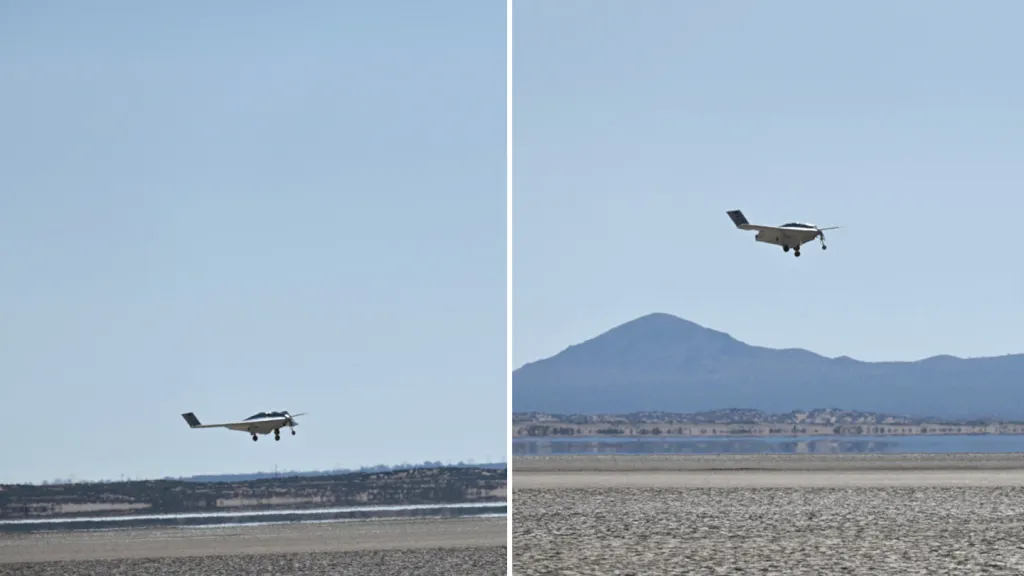
Northrop Grumman’s experimental XRQ-73 Series Hybrid Electric Propulsion AiRcraft Demonstration (SHEPARD) hybrid-electric drone has now taken to the skies. Newly released pictures show that the flying wing-type uncrewed aircraft’s design has also evolved since it first broke cover in 2024. A core goal of SHEPARD is to prove out high-efficiency and very quiet propulsion technology that could pave the way for new operational capabilities.

DARPA announced the XRQ-73 test flight, which was conducted in April from Edwards Air Force Base in California, in a press release today. The Air Force Research Laboratory (AFRL) was also involved in the milestone event.

Two very wide shots of the XRQ-73 in flight that were released today. Northrop Grumman

Scaled Composites, a ‘bleeding edge’ boutique aircraft design house and wholly-owned subsidiary of Northrop Grumman, has been heavily involved in the development of the XRQ-73. The drone evolved directly from the XRQ-72A, another Scaled Composites design developed for the Intelligence Advanced Research Projects Activity (IARPA), which TWZ was first to report on in detail.

“This milestone is not just about a single flight,” Air Force Lt. Col. Clark McGehee, the SHEPARD program manager at DARPA, said in a statement. “The architecture proven by the XRQ-73 paves the way for new types of mission systems and delivered effects. We look forward to advancing this technology through the flight test program and delivering new capabilities for our warfighters.”

“This flight is a step forward in demonstrating the military utility of hybrid-electric propulsion,” DARPA’s press release adds. “Hybrid electric propulsion architectures will drive the development of revolutionary new aircraft designs by offering a combination of fuel efficiency, reduced emissions, and enhanced operational flexibility.”

“Developed to advance propulsion technologies for the Defense Advanced Research Projects Agency (DARPA) Series Hybrid Electric Propulsion AiRcraft Demonstration (SHEPARD) program, the XRQ-73 advances next-generation propulsion for lightweight autonomous aircraft,” Northrop Grumman said in its own brief press release. “The XRQ-73’s innovative hybrid-electric propulsion system combines fuel efficiency, reduced emissions and enhanced operational flexibility – enabling new mission possibilities and supporting the evolution of new aircraft designs.”

The XRQ-73 in its current guise, seen on the ground around the time of the flight test in April. Northrop Grumman

DARPA had originally hoped to see the XRQ-73 make its maiden flight before the end of 2024, and what caused the subsequent delay is unknown. TWZ has reached out to DARPA for more information. What is clear is that the XRQ-73’s design has changed in notable ways since 2024.

Northrop Grumman released this image of the XRQ-73 back in 2024. Northrop Grumman

Most immediately eye-catching is the addition of two vertical stabilizers, one on top of each wing. They are positioned near, but not at the very tips of the wings. It is possible that these might be removed as flight testing expands. The preceding XRQ-72A design also had vertical wingtip stabilizers.

A close-up look at one of the new vertical stabilizers. Northrop Grumman

In addition to the two large air intakes on top of the central section of the fuselage, there is now another, much smaller auxiliary dorsal intake in between. Details about the exact configuration of the drone’s hybrid propulsion system remain limited. There are also at least two new black-colored blade antennas on top of the fuselage.

The new auxiliary intake is seen here on top of the XRQ-73’s fuselage. The two new black-colored blade antennas are also seen here. Northrop Grumman

A fairing with what appears to be a forward-facing camera system is also now present at the front of the center of the fuselage. This is likely intended to at least provide visual inputs for control and additional situational awareness during flight testing. The fairing also sits in between two additional rectangular ‘nostril’ intakes. We have noted in the past that they could help cool the hybrid powerplant and the aircraft’s electronics, or help provide additional clean airflow to the powerplant during takeoff and landing.

A close-up look at the XRQ-73’s nose showing the new fairing that looks to hold a forward-facing camera system. Northrop Grumman

The XRQ-73’s design looks to be otherwise unchanged. A large, faceted fairing, very likely intended as a sensor enclosure, is notably still present below the central section of the fuselage. Test instrumentation and other systems could also be installed in that space to support the drone’s ongoing development.

DARPA has shared some other information about the design in the past, as TWZ has previously reported:

No details about the XRQ-73’s expected performance appear to have been released so far, but DARPA says it is a Group 3 uncrewed aerial system (UAS) weighing approximately 1,250 pounds, which will include “operationally representative … mission systems.” By the U.S. military’s definitions, a Group 3 UAS weighs between 55 and 1,320, can fly at altitudes between 3,500 and 18,000 feet, and has a top speed of between 100 and 250 knots.

At 1,250 pounds, the XRQ-73 is set to be substantially larger than the XRQ-72A, the requirements for which called for a drone weighing between 300 and 400 pounds. The XRQ-72A also had a 30-foot wingspan, a length of 11.2 feet measured from the nose to the ends of the wingtips, and a height of four feet when including the vertical wingtip stabilizers, according to schematics The War Zone previously obtained via the Freedom of Information Act.

What the future might now hold for the XRQ-73 is unclear. DARPA has previously talked about wanting to demonstrate a capability that could be operationalized relatively quickly with SHEPARD. The “RQ” intelligence, surveillance, and reconnaissance (ISR) designation is a clear reflection of that, although the drone could be configured to perform other missions. Hybrid-electric propulsion offers inherent advantages when it comes to reducing infrared and acoustic signatures, and the XRQ-73’s overall design has low-observable characteristics that could help it evade detection by radar.

DARPA

However, a cursory review of DARPA’s proposed Fiscal Year 2027 budget does not appear to show a request for new funding for this effort. It is possible that it has been reorganized and/or rebranded, or has otherwise evolved in scale and/or scope, which is not uncommon for DARPA projects.

Last May, AFRL also awarded General Atomics a contract for a very similar-sounding “hybrid-electric propulsion ducted fan next-generation intelligence, surveillance, reconnaissance/strike unmanned aerial system,” or GHOST. That deal was valued at just over $99 million.

“We’ve been promising something impressive related to hybrid-electric propulsion, and now I can’t talk about it anymore,” C. Mark Brinkley, a spokesperson for General Atomics, told TWZ at that time when asked for more information. “That’s how it goes with these things. Contrary to what you see on the news, the revolution won’t be televised.”

Other relevant hybrid-electric development efforts could be ongoing in the classified realm.

If nothing else, DARPA’s announcement today does show that work has continued on the XRQ-73 since 2024, and that the evolved design has now reached flight test.

Update: 4:46 PM EST –

DARPA has confirmed to TWZ that XRQ-73 flight testing began in April.

“X-plane programs are designed to push the extreme limits of aerospace engineering, integrating entirely unproven concepts and revolutionary designs,” Air Force Lt. Col. Clark McGehee, the SHEPARD program manager, also told TWZ in response to a question about why the first flight timeline was delayed. “As with the XRQ-73, this effort involved resolving complex, unforeseen technical challenges during ground testing and integration.”

“DARPA will continue maturing the hybrid electric propulsion system through a short flight test campaign currently underway,” Lt. Col. McGehee added.

Contact the author: joe@twz.com

Joseph has been a member of The War Zone team since early 2017. Prior to that, he was an Associate Editor at War Is Boring, and his byline has appeared in other publications, including Small Arms Review, Small Arms Defense Journal, Reuters, We Are the Mighty, and Task & Purpose.


Source link