Contributor: Arts hubs like the Kennedy Center sustain the nation
Like any other building from 1971, or a democracy created in 1776, the Kennedy Center could use some attention and possibly some structural repair. But I was a vice president at that arts center in Washington, and I can tell you that maintenance is almost certainly not why it closed its doors last month.
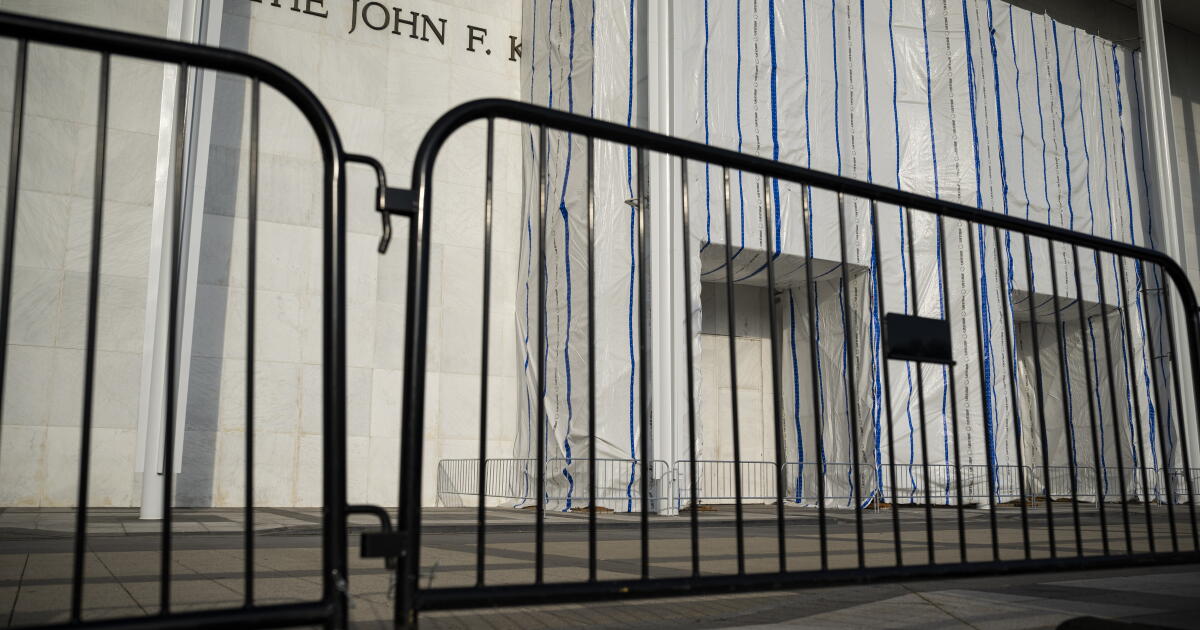
Officially, it’s closed because a section of the Grand Foyer ceiling gave way in a storm, plaster crashing to the floor, and the building needed to be shut down for safety. The Justice Department itself has argued in court filings that there is no real emergency requiring the closure. The board, meanwhile, has approved a quarter-billion-dollar renovation plan, put together without competitive bidding, while the president muses openly about tearing the building down altogether if his own name isn’t affixed to it. This administration is effectively bulldozing arts infrastructure in an attempt to abolish an infrastructure of the imagination.
I watch all of this from the outside now. When the new “leadership” took over last year, my team and I were among the first let go. My department worked on free public programming, on creative equity, on cross-sector community development and on measuring the social impact of art. That we were among the first out the door probably tells you everything you need to know about who was put in charge of the place.
As an American, as an artist and as a former member of its labor force, I understand that the Kennedy Center is more than a building. It is a living memorial to a president who was taken from us too soon, a man who had the audacity to aim for the moon before the science existed to get us there. To honor that kind of visionary, this country built a center for the creative impossible, and gave it his name.
And true to that name, my job at the Kennedy Center was to investigate the correlation between the arts economy and the economy of civic aspiration. As a team, we believed that inspiration erodes apathy and yields empathy. The building is a container of federal infrastructure, but the arts that imbue the Kennedy Center make the argument that inspiration itself is part of the infrastructure of our democracy. An arts center is built to ask: “What are the conditions necessary to dream together in public?”
Who, if not artists, are the authors of the public imagination? When a baby is born, or your daughter gets married, do you read a piece of legislation to commemorate the occasion or do you quote a poem, or dedicate a song? Who, if not artists, might light the path to a post-fear economy?
So why invade an arts center? What could possibly be gained by shuttering a national citadel for creative excellence? How perverse that a president whose policies have underfunded education and the arts would gut a national sanctuary for curiosity, and then demand that his name be emblazoned on the shell of what was. This president has used executive orders to intimidate artists, banned writers and journalists, sabotaged arts education, created oppressive red lines within the National Endowment for the Arts and threatened philanthropic organizations that fund arts and culture, and then he turns around and wants his name on our national cultural center.
When I worked there, the Kennedy Center wasn’t perfect. No institution is. But the business was viable, the staff was talented and reliable, and the work we made together would, often enough, touch something close to the sublime. Our job, like those of so many arts workers across the country, was to activate creative magic in service of social cohesion and well-being.
This is what gets lost in the noise of storms and lawsuits and renovation budgets: Entertainment is everywhere, but inspiration is rare. Sometimes you are sitting in a dark theater with strangers and the right note gets struck, and you hear it with your ears but you feel it somewhere else entirely. In the gut and heart. And the person next to you, a stranger, feels it too, at the exact same moment. You can practically feel the room change. All that magic can happen in one theater, and the Kennedy Center has nine of them. If a solar panel uses the energy of the sun to power a building, an intentionally run theater can use the energy of its inspired audiences to power a city.
Art holds memory. It also holds the horizon, the sense of what a country could still become. Patriotism as enacted by the creative community takes the American experiment seriously enough to question, examine, remember what we’ve forgotten and catalyze collective American dreaming. That is what the Kennedy Center was named for: a president who dreamed of a country unafraid of beauty, unafraid of grace.
Thankfully, America’s creative labor force tirelessly stewards that sense of creative provocation and patriotic inquiry. It is alive everywhere, including in the work of individual artists such as Carrie Mae Weems or in the work of collectives such as For Freedoms and their “America, the Beautiful” initiative.
We, the chronically underwhelmed citizenry of the United States, can’t afford one less pillar of creativity. We should be fighting to reconstitute any and all artistic institutions with an eye toward an inspired future.
Marc Bamuthi Joseph, a spoken-word artist and actor, was vice president for social impact at the Kennedy Center.