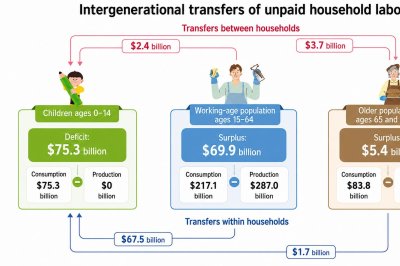
A chart illustrates how the estimated value of unpaid household labor is transferred among children, working-age adults and older people in South Korea. Information from Ministry of Data and Statistics. Infographic by Asia Today and translated by UPI
June 23 (Asia Today) — The estimated value of unpaid household services consumed by South Korean children totaled 116.6 trillion won ($75.3 billion) in 2024, with parents and grandparents providing much of the work, government data showed Tuesday.
The Ministry of Data and Statistics published the findings in South Korea’s 2024 National Time Transfer Accounts, which measure how unpaid household work is produced, consumed and transferred among age groups.
The account covers services that are generally excluded from gross domestic product, including cooking, cleaning, household management, caregiving and volunteer work.
The figure does not represent money that families paid for child care. It estimates the market value of unpaid services by using the time spent on household work, population figures and the wages that would be required to hire someone to perform similar tasks.
Children ages 14 and younger recorded a household-work lifecycle deficit of 116.6 trillion won because they consumed unpaid services but did not produce them.
A lifecycle deficit occurs when the value of household services consumed by an age group exceeds the value it produces.
About 107.3 trillion won ($69.3 billion), or 92% of the children’s deficit, was covered through transfers within the same household. This category largely represents time and labor provided by parents and other family members living with the children.
An additional 9.4 trillion won ($6.1 billion) came through transfers between households, which can include care provided by relatives living separately.
Working-age people between 15 and 64 produced unpaid household services valued at 444.4 trillion won ($287 billion) and consumed services worth 336.1 trillion won ($217 billion).
That left the group with a surplus of 108.3 trillion won ($69.9 billion).
The working-age population transferred a net 104.6 trillion won ($67.5 billion) in unpaid services to other members of the same households, primarily children.
The data show that people in their 30s and 40s, who are often raising young or school-age children, were at the center of the transfer system.
On a per-person basis, the household-work surplus reached its highest level at age 39, at 10.35 million won ($6,700).
Older South Koreans also made a net contribution.
People ages 65 and older produced household services valued at 138 trillion won ($89.1 billion) while consuming 129.7 trillion won ($83.8 billion), leaving a surplus of 8.3 trillion won ($5.4 billion).
They transferred a net 5.7 trillion won ($3.7 billion) in services between households. The ministry said the pattern reflects contributions such as grandparents caring for grandchildren who live in separate households.
Per-person household production peaked at age 40, declined and then increased again after retirement, producing what the ministry described as an M-shaped pattern.
Unpaid housework and care for grandchildren contributed to the later increase.
The lifecycle deficit was highest at birth, reaching 37 million won ($23,900) per person.
The balance shifted into a surplus at age 28, reached its peak at age 39 and returned to a deficit at age 82.
Those ages do not indicate when income begins to exceed personal spending. They show when the estimated value of unpaid household services a person produces becomes greater or smaller than the value of services the person consumes.
Household-service consumption was highest at birth and lowest at age 19, forming an L-shaped pattern.
Compared with 2019, the total deficit for children declined by 7.5 trillion won ($4.8 billion). Surpluses among working-age and older people also decreased.
The results provide a broader measure of the economic contributions made inside families, including work performed by parents and grandparents that does not appear in conventional income or production statistics.
— Reported by Asia Today; translated by UPI
© Asia Today. Unauthorized reproduction or redistribution prohibited.
Original Korean report: https://www.asiatoday.co.kr/kn/view.php?key=20260623010008145