
horvath

L.A. is getting four more years of Councilmember Monica Rodriguez

Good morning, and welcome to L.A. on the Record — our City Hall newsletter. It’s David Zahniser, with an assist from Howard Blume and Noah Goldberg, giving you the latest on city and county government.

She’s blunt. She’s combative. She doesn’t go along to get along.

And now, Los Angeles City Councilmember Monica Rodriguez is almost certainly getting four more years in office.

On Wednesday, with the deadline past, no one filed a petition to challenge Rodriguez in the June 2 primary election. That makes her the only official at City Hall to be in that coveted position this year.

One caveat: Someone could still run as a write-in, waging a long-shot campaign. But realistically, Rodriguez has a free ride to continue representing her northeast San Fernando Valley district.

Rodriguez, who lives in Mission Hills, said she had been prepping for “another fight,” raising money and giving endorsement interviews. Now, she’s started talking about what her third and final term could look like.

“Giddyup. Everyone better buckle up,” she said, cackling.

You’re reading the L.A. on the Record newsletter

For an elected official, nothing can bolster one’s confidence like a reelection victory or two. Newly elected council members tend to keep a low profile their first few years. The longer they stay, the more outspoken they become.

Rodriguez, on the other hand, has been willing to speak her mind for quite some time.

She’s been a longstanding critic of Mayor Karen Bass’ Inside Safe program, which moves homeless people indoors. She has pushed, without success, for the city to yank its money from the embattled Los Angeles Homeless Services Authority, or LAHSA. Last fall, she told a mayoral aide that Bass’ team “botched” the Palisades fire recovery in the first few months.

Rodriguez frequently expresses her views in vivid terms, and in ways that can annoy her colleagues.

Last year, she warned a proposal to hike the minimum wage for hotel and airport workers to $30 per hour would trigger job losses, leaving the city with “the best paid unemployed workforce in America.”

She denounced the city’s plan to upgrade the Convention Center, saying the council was continuing to “fund failure.” She regularly drops the phrase “merry go round from hell” — shorthand for her struggle to get her colleagues to pull out of LAHSA, the city-county homeless agency that’s been the subject of blistering audits.

With the election approaching, the zingers have only gotten zingier.

Six weeks ago, City Councilmember Nithya Raman launched a last-minute bid to rewrite Measure ULA, the city’s tax on high-end property sales, saying it had chilled development of much-needed apartments. Raman wanted her proposal to go on the June ballot but failed to garner support from her colleagues, who said it hadn’t been vetted.

Rodriguez, in a screed delivered on the council floor, compared Raman to “the arsonist that comes showing up as a firefighter.”

That was a not-so-veiled reference to the fact that Raman promoted Measure ULA in 2022 — and downplayed concerns that it would affect housing production.

“Ms. Raman, you supported and endorsed the false notion to voters that [Measure ULA] was going to be the panacea — without study, without any of the verified proof,” she said. “We knew that these were the implications.”

Raman, in a statement on Friday, said she endorsed Measure ULA after reading through research suggesting that the tax, which generates money for housing programs, would not affect housing production. Newer analysis, she said, found that the measure “indeed resulted in less investment in multi-family housing.”

“That is a huge concern to me and should be to everyone in L.A., a City that is still very much facing a housing shortage,” said Raman, who is now running for mayor. “I am willing to take some heat to get the best outcomes for the City and to secure support for these crucial revenues.”

Stuart Waldman, president of the Valley Industry and Commerce Assn., a San Fernando Valley-based business group, said he appreciates Rodriguez’s direct approach, even when he disagrees with her.

“A lot of councilmembers, if they don’t agree with you, they won’t even meet with you,” he said. “There are council members who say they’ll listen and take [an issue] under advisement, even though they’ve made up their mind. They just don’t want to tell someone to their face that they disagree.”

Rodriguez’s approach doesn’t always reap political dividends.

Last year, Council President Marqueece Harris-Dawson removed her from a number of high-profile committees, including those that oversee homeless programs, public safety and the city budget.

Despite her warnings, the council hiked the minimum wage for tourism workers and approved the $2.6-billion Convention Center project. She championed the creation of a new youth development department, only for it to wind up on the chopping block in last year’s budget.

Rodriguez, 52, grew up in Arleta, the daughter of a U.S. Marine veteran who served in Vietnam while holding a green card, and later became one of the city’s earliest Latino firefighters in the wake of a federal consent decree on hiring. She graduated from San Fernando High School in 1992, one year after Assemblymember Luz Rivas and two years after U.S. Sen. Alex Padilla.

She worked for former Mayor Richard Riordan and former Councilmember Mike Hernandez and later ran unsuccessfully against former Councilmember Richard Alarcon. She joined the Board of Public Works in 2013, running for council a second time four years later.

With a third term looming, Rodriguez wants to take a program she launched in her district — moving homeless people out of RVs and into housing — and take it citywide. She’s excited about expanding a program for fixing sidewalks that also teaches job skills to young people.

Rodriguez acknowledged that her stances, and her remarks, can rub people the wrong way, noting that it’s “more comfortable to walk in a group than to walk alone.” Nevertheless, she doesn’t intend to change her approach.

“I know what I’m here to do, and I’m just going to continue,” she said.

State of play

— SCRAMBLE FOR SIGNATURES: The deadline for candidates for city office to turn in petitions arrived on Wednesday, and the signatures are still being counted. By Friday, 12 mayoral candidates had qualified to run against Bass, including Raman, reality television star Spencer Pratt and tech entrepreneur Adam Miller. The City Clerk’s office is still reviewing the petitions of several other mayoral hopefuls, all of them political unknowns.

— ANOTHER FREE RIDE: L.A. Unified School board member Kelly Gonez is also running unopposed in the June 2 election. On Wednesday, her one potential opponent, JP Perron, announced he was dropping out. Like Rodriguez, Gonez represents part of the San Fernando Valley.

— A HELPING HAND: For a hot minute, things were touch and go for Sylvia Robledo, a former council aide looking to unseat Councilmember Eunisses Hernandez. After filing her petitions, Robledo learned Tuesday that she was short 14 voter signatures. Raul Claros, one of her rivals in the race, stepped in to help close the gap, gathering some signatures himself. “People want options,” he said later on Instagram. “People want anybody but Eunisses Hernandez.”

Two of Robledo’s other opponents — entrepreneur Nelson Grande and nonprofit executive Maria Lou Calanche — added their own names to her petition. On Wednesday, she qualified for the ballot.

“We may have a different vision or path, but we all want new leadership,” Robledo said.

— JANISSE JETS OFF: The top executive at the Department of Water and Power, Janisse Quiñones, announced this week that she has taken a job as CEO of a privately owned electrical company in her native Puerto Rico. Quiñones, who was hired at $750,000 a year, faced criticism over the DWP’s decision to drain a reservoir shortly before the Palisades fire broke out. Her first day in the new job is March 30.

— TRUMP ON LINE 1: Bass spoke on the phone this week with President Trump to request FEMA reimbursements for the Palisades fire, KNX News reported. Bass told the station that the president was “very receptive.”

“I was reluctant to call because there are a few other things going on, like what’s happening overseas, and I didn’t think, given all that was happening internationally, that he would actually return my call,” she told the station.

— OVERDUE BILLS: The county Board of Supervisors voted this week to fund a financial review of the Los Angeles Homeless Services Authority, after finding that the agency owes tens of millions of dollars to nonprofits that oversee interim housing for the region’s homeless population. Supervisor Lindsey Horvath said her phone was “ringing off the hook” from groups needing to get paid by LAHSA.

— TIT FOR TAT: Meanwhile, the long-running feud between Bass and Horvath continued to boil over, with the two taking digs at each other over the future of the region’s homeless programs. Bass, in a statement, said pulling out of LAHSA too quickly would bring “unintended consequences” and leave “more Angelenos to die on our streets.”

“When the County created their new Department of Homeless Services and Housing, they also created a $300 million gap, which they had to close by prioritizing bureaucracy rather than services,” Bass said.

Horvath shot back, saying she is already conferring with council members on a strategy to have the city pay the county to provide homeless services.

“I’m ready to work with the City Council and show the Mayor what locking arms actually looks like,” she said, swiping one of Bass’ signature phrases.

— PALISADES BOWL IN PERIL: The owners of a mobile home park destroyed last year in the Palisades fire are marketing the site as a potential “mixed use” project — housing plus commercial space, which would result in permanent displacement of residents. City Councilmember Traci Park said any developer looking to take the sellers up on their offer should “pound sand.”

“What we are interested in doing is restoring this property as a mobile home park for the people who were there and remain displaced,” she said.

— PURSUING POT PROCEEDS: L.A. cannabis companies owe the city more than $400 million in business taxes, late fees and interest. Hoping to recoup $30 million of that total, the council voted this week to set up an amnesty program for those pot businesses that still owe money and haven’t already shuttered.

— JAIL DEATHS: Ten people have died in L.A. County jails so far this year, putting the county on track for another record-setting year of in-custody deaths. Now, county supervisors want the Sheriff’s Department to reverse that trend by beefing up safety checks, more closely monitoring cameras and increasing access to the overdose reversal drug Naloxone.

— FOR FLOCK’S SAKE: The Police Commission wants to know how data captured by the controversial license plate reader Flock Safety are being stored and shared. Commissioner Jeff Skobin asked for the information following reports that federal agencies had repeatedly accessed Flock’s surveillance data as part of Trump’s ongoing immigration crackdown.

QUICK HITS

  • Where is Inside Safe? The mayor’s signature program to fight homelessness went to a stretch of Laurel Canyon Boulevard in North Hollywood, underneath the 170 Freeway. About three dozen people went inside, according to Bass’ team.
  • On the docket next week: The council’s Planning and Land Use Management Committee meets Tuesday to take up a proposal to hike the penalties for putting up illegal billboards and other unpermitted signs.

Stay in touch

That’s it for this week! Send your questions, comments and gossip to LAontheRecord@latimes.com. Did a friend forward you this email? Sign up here to get it in your inbox every Saturday morning.


Source link

Mayor Karen Bass is pulling Nithya Raman from her post at the AQMD.

Good morning, and welcome to L.A. on the Record — our City Hall newsletter. It’s Noah Goldberg, with an assist from David Zahniser, giving you the latest on city and county government.

When Los Angeles City Councilmember Nithya Raman launched her bid for mayor, her decision stunned many of the city’s political players, in large part because she had endorsed Karen Bass’ reelection a few weeks earlier.

Since Raman jumped into the race, those politicos have been searching for clues as to why Raman broke so completely with Bass, going from ally to opponent.

Now, an additional data point has emerged that, at minimum, signals that Bass and Raman were not as simpatico as they seemed.

Last month, Bass quietly took steps to drop Raman from the powerful board that oversees the South Coast Air Quality Management District. Raman had been serving in that role since 2022, when she was appointed by then-Mayor Eric Garcetti.

Bass’ team said they notified Raman’s office on Jan. 16 that the mayor planned to select someone else to represent her on the AQMD’s 13-member board, which works to ensure that more than 17 million people across four counties — Los Angeles, Orange, Riverside and San Bernardino — have cleaner air.

You’re reading the L.A. on the Record newsletter

Raman’s term expired last month, and Bass has not announced a replacement. Until that happens, Raman will continue to serve in the post.

Bass spokesperson Amanda Crumley did not provide an explanation for Bass’ decision but said it was not prompted by any policy disagreements between the two.

“The Mayor has 60 days to appoint a new council member to the AQMD, and she and her team started conversations with council members weeks ago in planning for the end of the term,” Crumley said. “As has been the plan for weeks, Mayor Bass will be moving forward with an appointment soon.”

Raman, in a statement, said that losing the AQMD seat was not a factor in her decision to run for mayor.

“During my time on the Board, I’ve been able to meaningfully push for cleaner air, stronger accountability for major polluters, and real progress on zero-emission freight and building standards that protect the health of Angelenos,” Raman said.

Raman said she learned she was being “removed” from her post in mid-January. On Jan. 27, Bass announced that Raman had endorsed her bid for a second term. A few days before that, the mayor’s team informed Raman’s office that they would be going public with her endorsement, according to a Bass campaign aide.

Raman launched her own mayoral campaign on Feb. 7, hours before the filing deadline, saying the city “can’t seem to manage the basics.”

Bass and Raman have mostly been in sync over the last three years, frequently appearing together and only occasionally revealing points of contention.

Raman, who lives in Silver Lake, opposed a package of pay increases for police officers, saying it was financially reckless. Bass, who resides in Windsor Square, said the raises and bonuses were needed to boost recruitment at the Los Angeles Police Department, which has lost 1,300 officers since 2020.

Last year, Raman also opposed a $2.6-billion plan to upgrade the Convention Center. She called the project a budget buster, while Bass said it is needed to revitalize downtown and the region’s economy.

The mayor’s move at the AQMD suggests the two may have disagreed in another policy area. But the back story is tough to decode.

One possible clue: the AQMD’s recent approval of a major agreement to bring zero-emissions technology to the ports of Los Angeles and Long Beach. The agreement commits the ports to add electric truck chargers, hydrogen fuel pumps and other technology aimed at eliminating diesel pollution.

At one point, Raman pushed for a more aggressive “rulemaking” approach that would give the AQMD enforcement power if the ports failed to meet certain emissions goals, according to a source with knowledge of the process, who asked to remain unnamed.

Bass favored a less regulatory approach — a cooperative agreement between AQMD and the ports, the source said. That strategy was also favored by the shipping industry and organized labor.

In the end, Raman voted in favor of the cooperative agreement, while acknowledging outside criticism of the decision. She said she supported the agreement to keep the AQMD from “continuing a decade of inaction.”

Environmental groups were disappointed. Bill Magavern, policy director for the Coalition for Clean Air, said the AQMD “adopted a weak, unenforceable agreement when what the board had committed to doing for years was an actual enforceable limit on emissions.”

Magavern said he thinks there were times that Raman, as a Bass appointee, “felt compelled to go along with the mayor’s wishes.” At the same time, he expressed some concern about Raman’s departure.

“We are sorry to see her leave the board because we think the AQMD needs to face up to our air pollution challenges,” Magavern said. “We certainly hope that Bass will appoint someone who is willing to stand up for clean air and take on polluting special interests.”

For now, Raman’s name still appears on the AQMD website as a member of the board. Its next meeting is on Friday.

State of play

— BIGGER IS BETTER: The city’s Charter Reform Commission recommended this week that the City Council grow to 25 members, up from 15. The citizens panel also called for the city to switch to ranked-choice voting, with voters choosing their candidates in order of preference. Both proposals could wind up on the city’s ballot in November, depending on the wishes of the council.

— FEDS SWOOP IN: The FBI raided the home and office of L.A. Unified schools Supt. Alberto Carvalho this week, in what appears to be a probe involving a company that developed an AI chatbot for the nation’s second-largest school system. Two days later, the school board placed Carvalho on paid leave.

— HEADING TO COURT: Former Fire Chief Kristin Crowley sued the city of Los Angeles this week, saying the mayor retaliated against her in an attempt to shift blame over the city’s handling of the Palisades fire. A Bass aide said the lawsuit has no merit. The council decided to pay Crowley’s successor, Fire Chief Jaime Moore, nearly $474,000 per year.

— ‘RED HOT COALS’: Meanwhile, a Los Angeles firefighter said in sworn testimony that he sounded the alarm about the inadequate mop-up of the Lachman fire — and was blown off by a captain — days before the embers reignited into the deadly Palisades fire.

— SIGNATURE SEARCH: Wednesday’s deadline for candidates to turn in their petitions for the June 2 primary election is fast approaching. So far, six mayoral candidates have qualified for the ballot — Bass, Raman and four others: housing advocate Rae Huang, engineering manager Asaad Alnajjar, political scientist Juanita Lopez and technical architect Andrej Selivra.

— WHO ELSE IS IN? All of the incumbents have qualified: City Atty. Hydee Feldstein Soto, City Controller Kenneth Mejia and Councilmembers Eunisses Hernandez, Katy Yaroslavsky, Monica Rodriguez, Traci Park, Hugo Soto-Martínez and Tim McOsker.

According to the City Clerk’s latest update, the challengers so far are Deputy Atty. Gen. Marissa Roy, running for city attorney; real estate executive Zach Sokoloff, running for city controller; and council candidates Maria Lou Calanche, Nelson Grande, Jose Ugarte and Faizah Malik.

— GIVING BACK GRANTS: About $100 million in state funding for transportation projects in Boyle Heights, Wilmington and Skid Row is now in jeopardy because the city doesn’t have the staff to complete the projects. The issue is part of the fallout from last year’s $1-billion budget shortfall, when city leaders cut hundreds of vacant positions.

— RIDING THE RAILS: The long-awaited extension of the Metro D Line subway, once known as the Purple Line, will finally make its debut on May 8. The extension will take subway riders west from Koreatown to La Cienega Boulevard, with brand-new stations at La Brea and Fairfax avenues.

— ANIMAL ATTACK: A jury has awarded $5.4 million to a woman who was mauled by a dog at an L.A. animal shelter, the latest in a string of such cases. The woman said neither the shelter nor the rescue group she worked for told her about the dog’s bite history.

— BAR FIGHT: Downtown LA Law Group, the firm at the center of the scandal over Los Angeles County’s $4-billion sex abuse settlement, is fighting to keep thousands of documents out of the hands of state bar investigators. The bar launched its probe after The Times reported that nine DTLA clients said they had been paid to sue the county over alleged sex abuse.

— DON’T JUMP: An LAPD officer who went on disability and then was caught skydiving now faces criminal charges. Christopher Brandon Carnahan, 43, committed insurance fraud by exaggerating the extent of an on-duty work injury, according to the D.A.’s office.

— SIDELINED SUPERVISORS: L.A. County Supervisor Kathryn Barger recently sounded off on the governance overhaul coming to the county. Appearing at the Los Angeles Current Affairs Forum, Barger said the powerful new position of elected countywide CEO would relegate the supervisors to the realm of ribbon-cutting and little else.

“You’ll see a CEO that has autonomy to do what he or she wants with no term limits, veto power,” Barger said. “Quite frankly, I think the supervisors are going to be in name only.”

QUICK HITS

Stay in touch

That’s it for this week! Send your questions, comments and gossip to LAontheRecord@latimes.com. Did a friend forward you this email? Sign up here to get it in your inbox every Saturday morning.

Source link

A new wedge issue appears in L.A. City Council races

Good morning, and welcome to L.A. on the Record — our City Hall newsletter. It’s Noah Goldberg, with an assist from David Zahniser and Sandra McDonald, giving you the latest on city and county government.

There was a brief discussion on the L.A. City Council floor, with hardly any disagreement, before a motion brought by Councilmember Monica Rodriguez passed on Tuesday.

Rodriguez wants to allow city officials to enter hillside properties in “Very High Fire Hazard Severity Zones,” even without an owner’s permission, to clear hazardous materials and homeless encampments. The goal is to stop encampment fires that could grow into wildfires.

Councilmembers Hugo Soto-Martínez and Ysabel Jurado voted against the proposed change to the city’s municipal code, citing details they wanted addressed, but said they agreed with its spirit.

A third councilmember, Eunisses Hernandez, also voted against the measure, though she did not speak during the meeting.

The political implications of the seemingly routine vote could play out more bitterly over the next several months as Soto-Martínez and Hernandez, both members of the council’s four-person “progressive bloc,” run for reelection in their districts, which include fire-prone hillsides.

The proposal could become another wedge issue on homelessness for the two members, just as the city’s controversial anti-encampment law, Municipal Code section 41.18, was in the 2022 election.

That year, it was Soto-Martínez and Hernandez who were running against incumbents and took a progressive stance against 41.18, which allows council members to designate areas near schools, libraries, senior centers and other sensitive areas as no-camping zones. The two said they believed the law was ineffective at solving homelessness, merely shuffling people around without addressing the root issues.

Now, as the two council members defend their seats, Rodriguez’s proposal has already spurred similar attacks from would-be incumbent-busters.

Maria Lou Calanche, a nonprofit leader seeking to unseat Hernandez in District 1, lives in a “Very High Fire Hazard Severity Zone” at the bottom of a hill by Debs Park. The area is full of dry brush, and Calanche said in an interview that parts of the park catch fire every summer.

“The council district has a lot of hillside property and open space. Debs Park has encampments in it that have not been cleared and that’s public property,” said Calanche, who formerly served on the city Police Commission. “I’m concerned that the current council member puts ideology over the safety of the citizens and residents.”

Calanche said she would consider highlighting Hernandez’s “no” vote on campaign mailers.

“This is such a simple way to make a difference,” Calanche said. “It just seems incredible they would not be supportive.”

Hernandez said she is open to supporting Rodriguez’s proposal but that it fails to define the type of hazard that would allow city officials to enter private property without permission.

“When you expand government authority without tight definitions and guardrails, you end up with inconsistent enforcement and expensive lawsuits,” she said in a statement.

She said she hopes to work with the city attorney’s office, Fire Department and others to make sure the policy is “precise, intentional, legally sound and actually focused on reducing fire risk.”

In District 13, Dylan Kendall, a nonprofit founder and entrepreneur who is running against Soto-Martínez, said she supports the “common-sense” proposal and that her opponent’s vote was “irresponsible.”

The district, which stretches from Hollywood to Atwater Village, includes high fire-risk areas like Elysian Heights and parts of Silver Lake.

“We know what [firefighters are] seeing on the ground: encampments on or adjacent to private property with exposed wiring, pressurized fuel canisters and dense vegetation, and a maze of legal questions about who controls the site when they respond to a call,” she said in a statement. “If a private owner cannot or will not remove combustible materials and encampments that clearly increase wildfire risk, the city should be able to step in, clear the danger.”

Before Tuesday’s vote, Soto-Martínez said he would have supported the proposal had it included a definition of what exactly a fire hazard is, making the same point that Hernandez later did.

Soto-Martínez had supported Rodriguez’s initial proposal at the council’s Public Safety Committee, which was to ask for a report on what municipal code changes would be needed.

But on Tuesday, Rodriguez amended her motion to go straight to the city attorney’s office to change the municipal code. She said she wanted to accelerate the change because of the importance of preventing encampment fires.

Soto-Martínez also expressed an underlying concern that echoed his earlier statements about 41.18, which he fiercely opposed.

“What I don’t want to see is this being used as a tool to push homeless folks from one side of the street to the other side of the street,” he said.

Notably, Councilmember Nithya Raman, who is running for mayor against incumbent Karen Bass, voted in favor of Rodriguez’s motion.

“The problem that this motion is identifying — gaining permission to access private property in Very High Fire Severity Zones — is one that needs to be resolved to ensure that we are mitigating the risk for a serious fire to our fullest capacity,” Raman, who opposed 41.18 and is a member of the council’s progressive bloc along with Jurado, said in a statement.

Former Councilmember Mike Bonin, who runs the Pat Brown Institute for Public Affairs at Cal State LA, said the hillside encampment issue is less clear-cut than 41.18 but could still prove to be divisive.

“This is the kind of thing political consultants salivate over,” he said. “It’s an example of taking an issue that even from the council debate seemed to appreciate the shades of gray and making it black and white.”

You’re reading the L.A. on the Record newsletter

State of play

— KARATE KAREN: Bass said at a rally in Leimert Park on Sunday that she is ready to fight off a challenge from Raman, invoking her training in karate to remind Angelenos that she is not too nice to battle. “I was trained to fight physically,” she said, stooping into a bow. “But if you know the martial arts, you know to bow before you kill somebody. You know to smile to throw them off.”

The mayor said she was joking, adding, “But seriously, we know how to fight and we know how to organize.”

— SCHOOL LAYOFFS: The Los Angeles Unified School District board — confronted with deficit spending and a forecast of insolvency in three years — narrowly voted to send out 3,200 notices of possible layoffs. The move, which is ultimately expected to result in 657 job cuts, is strongly opposed by labor unions as unnecessary and harmful to students.

— UCLA AX: UCLA fired its chief financial officer, Stephen Agostini, saying he inaccurately described the school’s budget deficit. The termination comes after Agostini told the school newspaper, the Daily Bruin, that “financial management flaws and failures” predating his arrival led to a $425-million deficit. The school claimed his comments were inaccurate.

— PRESSURE ON WASSERMAN: Casey Wasserman faced more calls to step down as chair of the 2028 Los Angeles Olympics over racy emails with convicted sex Ghislaine Maxwell from decades ago. Bass, along with some gubernatorial candidates, was among those joining the chorus.

“My opinion is that he should step down,” Bass said in a CNN interview.

STRICTLY BUSINESS: A coalition of business and hotel industry leaders submitted more than 79,000 signatures in support of a measure to repeal the gross receipts tax on L.A. businesses. The measure, proposed for the November ballot, would punch an $800-million hole in the city budget if approved by voters.

— WRITE IT RIGHT: Angelenos hoping to write arguments for or against three city ballot measures — dealing with cannabis and hotel taxes — can apply by Friday with the office of Council President Marqueece Harris-Dawson. The arguments will be published in the Voter Information Pamphlet mailed out before the June 2 election.

— PUSHING FOR PARK: The union that represents rank-and-file police officers is putting $278,000 into efforts to reelect Councilmember Traci Park, according to a filing submitted to the city’s Ethics Commission. The money from the Los Angeles Police Protective League will go toward polling and canvassers in Park’s coastal district.

— SLAP ON THE WRIST: City Council candidate Jose Ugarte, who is running to replace his boss Curren Price in District 9, has agreed to pay $25,000 for committing a city ethics violation. Ugarte admitted that on his financial interest forms, he failed to disclose a consulting firm he owns and income he made. He has called it a “clerical reporting error.

QUICK HITS

  • Where is Inside Safe? The mayor’s signature program was in Skid Row in Councilmember Ysabel Jurado’s district providing assistance to homeless people during the heavy rains this week.
  • On the docket next week: The Charter Reform Commission will meet Thursday to address City Council expansion, ranked choice voting, mayoral powers and more.

Stay in touch

That’s it for this week! Send your questions, comments and gossip to LAontheRecord@latimes.com. Did a friend forward you this email? Sign up here to get it in your inbox every Saturday morning.

Source link

L.A. County wants a healthcare sales tax. Cities are in revolt.

It’s one thing most everyone agrees on: federal funding cuts have left the Los Angeles County health system teetering toward financial collapse.

But the supervisors’ chosen antidote — a half-cent sales tax to replenish county coffers — is being condemned by a slew of cities as its own form of financial catastrophe.

“I heard from every city in my district,” said Kathryn Barger, the only supervisor who voted against putting the sales tax on the June ballot.

The resounding reaction? “Absolutely not,” she says.

“People are fatigued,” Barger said. “I’m not convinced that it’s going to pass.”

You’re reading the L.A. on the Record newsletter

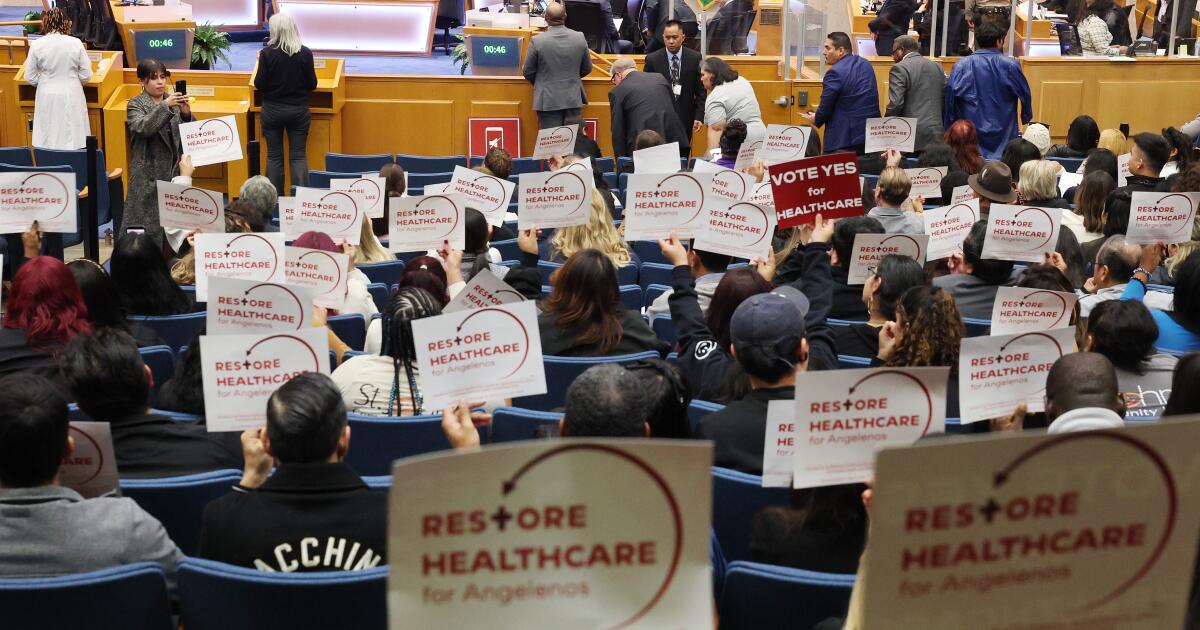
Observers wouldn’t have sensed that fatigue from the rowdy crowd of supporters that filled the board meeting Tuesday, along with seldom-used overflow rooms. The supervisors voted 4-1 at the meeting to put the tax on the ballot.

“There really are no other viable and timely options,” said Supervisor Holly Mitchell, who introduced the measure along with Supervisor Hilda Solis. “Trust me, I looked high and low.”

The goal, supervisors say, is to generate $1 billion per year to backfill the dwindling budgets of local hospitals and clinics battered by federal funding cuts.

The county’s already bracing for impact. The Department of Public Health announced Friday it would shutter seven clinics. Officials say it’s just the beginning, with the county poised to lose more than $2 billion in funding for health services over the next three years. Hospitals could be down the road, they warn.

But many cities, some of which could have local sales tax hit more than 11%, are revolting on the plan.

“I have been getting calls and texts and letters like honestly I have not gotten in a long time,” Supervisor Janice Hahn told the audience as a message from Jeff Wood — the vice mayor of Lakewood — pinged on her phone. “They are really diving in on this one.”

In a series of opposition letters, the cities unleashed a torrent of criticism. Norwalk called the tax “rushed.” Palmdale said it had “significant flaws.” Glendale found it “deeply troubling and fundamentally unfair.”

Some bristled at the cost to consumers. Palmdale and Lancaster — some of the poorest cities in the county — could wind up with some of the highest sales tax rates in the state if the measure passes.

Some cities say the bigger issue is they don’t trust the county. They point to its checkered history of pushing ballot measures that don’t live up to their promises.

Measure B, a special parcel tax, was passed in 2002 to fund the county’s trauma center network. An audit more than a decade later found the county couldn’t prove it used the money for emergency medical services.

Measure H, the homelessness services tax measure, was passed in 2017 as a temporary tax. Voters agreed in 2024 to make the tax permanent and to double the rate — though some cities insist they’ve never gotten their fair share of the funds.

“It’s a historical issue,” said Glendora mayor David Fredendall, whose city opposes the sales tax. “We don’t trust it.”

The county decided to put the sales tax on the ballot as a general tax, meaning the money goes into the general fund. Legally, supervisors could use the money for whatever services they desire.

“They say ‘No, this is our plan’, but we’re going to expand from five to nine supervisors over the next few years before this tax expires,” said Marcel Rodarte, the head of the California Contract Cities Assn., a coalition of cities inside the county. “They may say we need to use these funds for something else.”

A general tax also is easier to pass, since it needs only a majority vote. Special taxes — levies earmarked for a specific purpose — need two-thirds of the vote.

The measure also asks voters to approve the creation of an oversight group that would monitor where the money goes. The supervisors also voted on a spending plan for the tax money, which would dedicate the largest portion of funds for uninsured residents over the next five years.

Some opponents predict the tax will stick around longer than advertised.

“A temporary tax is like Bigfoot,” said Jon Coupal, president of the Howard Jarvis Taxpayers Assn., a group that advocates for lower taxes. “It exists in fantasy.”

State of play

FRIENDLY FIRE: Three hours before the filing deadline, L.A. City Councilmember Nithya Raman jumped into the race for mayor, challenging her former ally Karen Bass. Her candidacy will be Bass’ most serious threat.

— DEFUND DETOUR: Shortly after, Raman staked out her position on cops, saying she doesn’t want the LAPD to lose more police. Raman called for department downsizing when she first ran for city council in 2020.

— LOYAL LABOR: The head of the AFL-CIO, the county’s powerful labor federation, blasted Raman as an “opportunist.” Federation president Yvonne Wheeler said her organization will “use every tool” at its disposal to get Bass reelected.

— PETITION PUSH: Scores of candidates for L.A. city offices picked up their petitions Feb. 7, launching their effort to collect the signatures they need to qualify for the ballot. The first to turn in a petition was Councilmember Traci Park, who is facing two challengers while running for reelection in a coastal district.

— EYES ON ICE: Los Angeles police officers must turn on their body cameras if they’re at the scene of federal immigration enforcement operations, according to a new executive directive issued by Bass. LAPD officers also must document the name and badge number of the agents’ on-scene supervisor.

— CONTESTING CLEANUPS: A federal judge ruled this week that the city of L.A. violated the constitutional rights of homeless people by seizing and destroying their personal property during encampment cleanups. Lawyers for the plaintiffs want U.S. District Judge Dale S. Fischer to issue an injunction requiring the city to give homeless people the opportunity to contest the seizure of their property.

— HOTEL HIKE: Voters in the June 2 election will be asked to hike the city’s tax on nightly hotel stays — increasing it to 16% from 14% — for the next three years. The tax would then drop to 15% in 2029.

— PAYDAY POLITICS: The county is considering a proposal that would remove supervisors’ final decision-making power in contract disputes involving sheriff’s deputies and firefighters. Supporters say it’ll take politics out of labor negotiations while opponents warn of bloated labor costs.

QUICK HITS

  • Where is Inside Safe? The mayor’s signature homelessness program went to Los Angeles City Council District 13, bringing 50 unhoused Angelenos indoors from an encampment.
  • On the docket next week: The county’s back to its marathon budget briefings. Tune in Tuesday for presentations from the sheriff, district attorney and probation department.

Stay in touch

That’s it for this week! Send your questions, comments and gossip to LAontheRecord@latimes.com. Did a friend forward you this email? Sign up here to get it in your inbox every Saturday morning.

Source link