South Korea’s LG, Honda start Ohio storage battery output

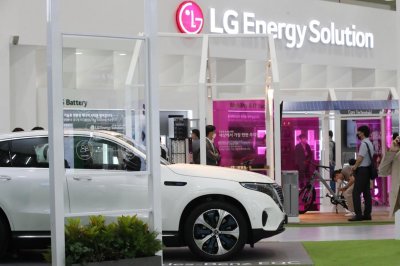
Visitors look around an LG Energy Solution booth at the InterBattery 2021 at COEX in Seoul, South Korea. Photo by YONHAP / EPA
July 3 (Asia Today) — A U.S. battery joint venture between South Korea’s LG Energy Solution and Honda has begun mass-producing lithium-ion cells for energy storage systems at its Ohio plant, the company said.
L-H Battery Company began production Thursday at its factory in Jeffersonville, Fayette County.
The cells will be supplied through LG Energy Solution Vertech, the South Korean company’s North American energy-storage system integration subsidiary.
They are expected to be used in utility power grids as well as commercial, industrial and residential energy-storage systems across the United States.
The Ohio plant was originally built primarily to manufacture batteries for Honda electric vehicles.
The partners adjusted the factory’s production strategy as growth in the electric-vehicle market slowed and changes in the U.S. regulatory and policy environment increased uncertainty for automakers and battery manufacturers.
The joint venture decided to prioritize the faster-growing energy-storage market while maintaining the flexibility to produce cells for other applications.
It plans to consider manufacturing batteries for hybrid-electric vehicles at the plant as market conditions evolve.
Honda said in May that it would convert part of the joint venture’s electric-vehicle battery production lines to make batteries for hybrid vehicles.
The company also said it would use the Ohio battery facilities for other applications as it restructures its North American vehicle and battery production network.
Honda canceled plans in March to develop and launch three electric-vehicle models that had been scheduled for production in North America, citing changes in the business environment.
The start of storage-battery production marks a significant step in LG Energy Solution’s strategy to manufacture more energy-storage products within North America.
Demand is rising as utilities add renewable-energy capacity and seek batteries that can store electricity when supply exceeds consumption.
Artificial intelligence data centers are also increasing electricity demand and creating a need for additional power-generation, transmission and storage infrastructure.
Energy-storage systems can help stabilize power grids by storing electricity during periods of low demand and releasing it when demand rises.
LG Energy Solution has been converting or adapting electric-vehicle battery facilities to produce storage batteries as manufacturers respond to slower electric-vehicle growth.
The company plans to operate five energy-storage battery manufacturing sites in North America.
The network includes plants in Holland and Lansing, Mich., the NextStar Energy facility in Windsor, Ontario, the Ultium Cells factory in Spring Hill, Tenn., and the L-H Battery Company plant in Ohio.
LG Energy Solution said it aims to secure more than 50 gigawatt-hours of annual energy-storage battery production capacity in North America by the end of 2026.
The company said batteries manufactured in Ohio will support projects serving power grids, businesses and homes.
BloombergNEF has projected that the U.S. energy-storage market could expand to 485 gigawatt-hours in 2030 and 976 gigawatt-hours in 2035.
“Energy storage systems are an important future business for L-H Battery Company and will become a core business pillar along with the production of battery cells for hybrid-electric vehicles,” L-H Battery Company Chief Executive Officer Koo Ja-hoon said.
Chief Operating Officer Rick Riggle said the company has hired employees and begun production since the joint venture was established in 2023.
“This start of mass production is significant because it goes beyond simply operating a plant and establishes a stable production base for our North American business,” Riggle said.
LG Energy Solution and Honda formally established L-H Battery Company in 2023 to manufacture lithium-ion batteries in Ohio.
The joint venture was initially designed to support Honda’s expanding electric-vehicle production in North America.
The revised production strategy allows the companies to use the plant for energy storage and hybrid vehicles while retaining the ability to respond if electric-vehicle demand recovers.
— Reported by Asia Today; translated by UPI
© Asia Today. Unauthorized reproduction or redistribution prohibited.
Original Korean report: https://www.asiatoday.co.kr/kn/view.php?key=20260703010001209