Homeland

Hundreds at Ohio church back extending protected status for Haitians

In a church crowded to overcapacity, two-dozen faith leaders and their audience of hundreds sang and prayed together in unity Monday as a sign of support for Haitian migrants, some of whom fear their protected status in the United States may be ended this week.

Religious leaders representing congregations from across the United States attended the event at Springfield’s St. John Missionary Baptist Church, demanding an extension of the Temporary Protection Status that allowed thousands of Haitian migrants to legally arrive in Springfield in recent years fleeing unrest and gang violence in their homeland. The TPS designation for Haiti is set to expire Tuesday, and those gathered were hoping that a federal judge might intervene and issue a pause.

“We believe in the legal system of this country of ours, we still believe. We believe that through the legal ways, the judge hopefully will rule in favor of current TPS holders today that will allow them to stay while we continue to fight,” Guerline Jozef, executive director of the Haitian Bridge Alliance, told the packed church.

“We have been called for such a time as this to protect those who have nowhere else to go. They cannot go back to Haiti,” she said.

So many people turned up for the church event that a fire marshal had to ask 150 to leave because the building had exceeded its 700-person capacity.

Hundreds joined a choir clapping and singing: “You got to put one foot in front of the other and lead with love.”

They also observed a moment of silence for people who died in federal immigration detention and for Alex Pretti and Renee Good, who were shot and killed by federal officers in Minneapolis. Some of the speakers evoked biblical passages while appealing for empathic treatment of migrants.

Federal immigration crackdown and TPS

The Department of Homeland Security announced last June that it would terminate TPS for about 500,000 Haitians in the U.S., including some who had lived in the country for more than a decade. DHS said conditions in the island nation improved enough to allow their safe return.

“It was never intended to be a de facto asylum program, yet that’s how previous administrations have used it for decades. The Trump administration is restoring integrity to our immigration system to keep our homeland and its people safe,” DHS spokesperson Tricia McLaughlin said in a statement, noting there were no new enforcement operations to announce.

A federal judge in Washington is expected to rule any day on a request to pause the TPS termination for Haitians while a lawsuit challenging it proceeds.

TPS allows people in the U.S. to stay and work legally if their homelands are deemed unsafe. Immigrants from 17 countries, including Haiti, Afghanistan, Sudan and Lebanon, had the protective status before President Trump’s second term started.

The uncertainty over TPS has deepened worries for an already embattled Haitian community in Springfield.

Trump denigrated the community while campaigning in 2024 for a second term, falsely accusing its members of eating their neighbors’ cats and dogs as he  pitched voters  on his plans for an immigration crackdown. The false claims exacerbated fears about division and anti-immigrant sentiment in the mostly white, working class city of about 59,000 people.

In the weeks after his comments, schools, government buildings and the homes of elected officials received  bomb threats.

Since then Springfield’s Haitians have lived in constant fear that has only been exacerbated by the federal immigration crackdowns in Minneapolis and other cities, said Viles Dorsainvil, leader of Springfield’s Haitian Community Help and Support Center.

“As we are getting close to the end of the TPS, it has intensified the fear, the anxiety, the panic,” Dorsainvil said.

Sunday church service

Some of Springfield’s estimated 15,000 Haitians also sought comfort and divine intervention in their churches Sunday.

At the First Haitian Evangelical Church of Springfield, its pastor estimated that half of the congregants who regularly attend Sunday service stayed home.

“They don’t know the future; they are very scared,” Rev. Reginald Silencieux said.

Flanked by the flags of Haiti and the United States, he advised his congregation to stay home as much as possible in case of immigration raids. He also offered a prayer for Trump and the Haitian community and reminded congregants to keep their faith in God.

“The president is our president. He can make decisions. But he is limited,” he said. “God is unlimited.”

After the service Jerome Bazard, a member of the church, said ending TPS for Haitians would wreak havoc on his community.

“They can’t go to Haiti because it’s not safe. Without the TPS, they can’t work. And if they can’t work, they can‘t eat, they can’t pay bills. You’re killing the people,” he said.

Many children in the Springfield Haitian community are U.S. citizens who have parents in the country illegally. If they are detained, Dorsainvil said, some parents signed caregiver affidavits that designate a legal guardian in hopes of keeping their kids out of foster care.

“They’re not sending their kids to school,” he said.

Volunteers from nearby towns and from out of state have been calling the Haitian community center offering to deliver food for those afraid to leave home, Dorsainvil said. Others have been stockpiling groceries in case immigration officers flood the community.

Some, he said, have been receiving desperate calls from family members abroad asking them to leave. “They keep telling them that Springfield is not a safe place now for them to stay.”

Henao writes for the Associated Press. AP reporter Julie Carr Smyth in Columbus, Ohio, contributed to this report.

Source link

Homeland Security ramps up surveillance in immigration raids, sweeping in citizens

Luis Martinez was on his way to work on a frigid Minneapolis morning when federal agents suddenly boxed him in, forcing the SUV he was driving to a dead stop in the middle of the street.

Masked agents rapped on the window, demanding Martinez produce his ID. Then one held his cellphone inches from Martinez’s face and scanned his features, capturing the shape of his eyes, the curves of his lips, the exact quadrants of his cheeks.

All the while, the agent kept asking: Are you a U.S. citizen?

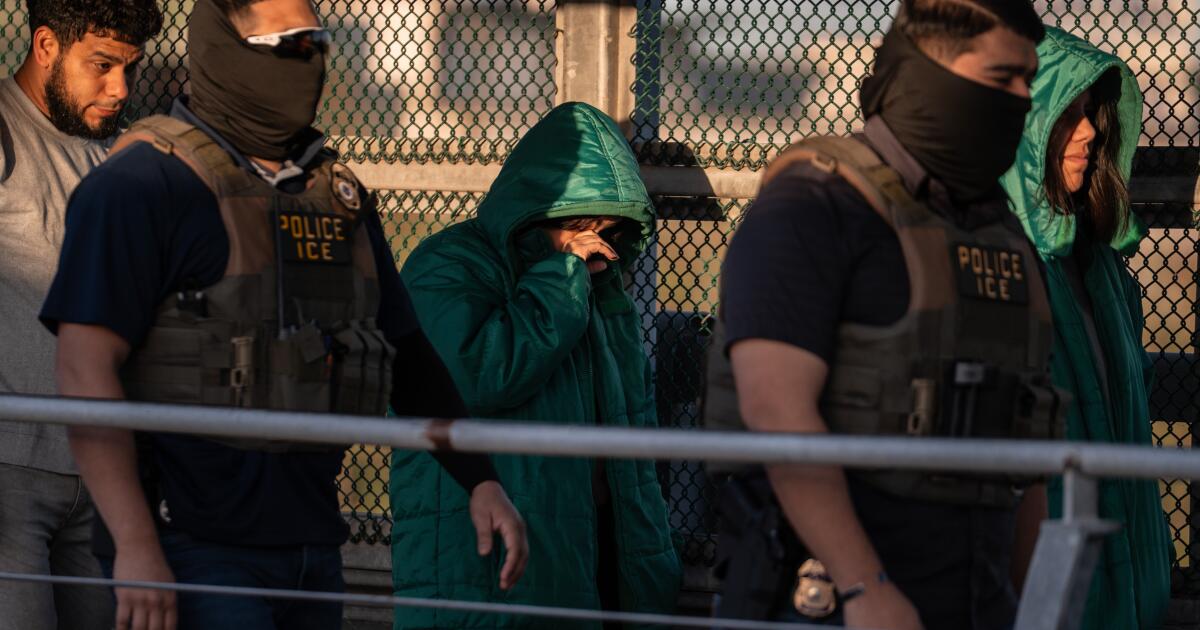
The encounter in a Minneapolis suburb this week captures the tactics on display in the Trump administration’s immigration crackdown in Minnesota, which it describes as the largest of its kind and one that has drawn national scrutiny after federal agents shot and killed two U.S. citizens this month.

Across Minnesota and other states where the Department of Homeland Security has surged personnel, officials say enforcement efforts are targeted and focused on serious offenders. But photographs, videos and internal documents paint a different picture, showing agents leaning heavily on biometric surveillance and vast, interconnected databases — highlighting how a sprawling digital surveillance apparatus has become central to the Trump administration’s immigration crackdown.

Civil liberties experts warn the expanding use of those systems risks sweeping up citizens and noncitizens alike, often with little transparency or meaningful oversight.

Over the past year, Homeland Security and other federal agencies have dramatically expanded their ability to collect, share and analyze people’s personal data, thanks to a web of agreements with local, state, federal and international agencies, plus contracts with technology companies and data brokers. The databases include immigration and travel records, facial images and information drawn from vehicle databases.

In Martinez’s case, the face scan didn’t find a match and it wasn’t until he produced his U.S. passport, which he said he carried for fear of such an encounter, that federal agents let him go.

“I had been telling people that here in Minnesota it’s like a paradise for everybody, all the cultures are free here,” he said. “But now people are running out of the state because of everything that is happening. It’s terrifying. It’s not safe anymore.”

Together with other government surveillance data and systems, federal authorities can now monitor American cities at a scale that would have been difficult to imagine just a few years ago, advocates say. Agents can identify people on the street through facial recognition, trace their movements through license-plate readers and, in some cases, use commercially available phone-location data to reconstruct daily routines and associations.

When asked by the Associated Press about its expanding use of surveillance tools, the Department of Homeland Security said it would not disclose law enforcement sensitive methods.

“Employing various forms of technology in support of investigations and law enforcement activities aids in the arrest of criminal gang members, child sex offenders, murderers, drug dealers, identity thieves and more, all while respecting civil liberties and privacy interests,” it said.

Dan Herman, a former Customs and Border Protection senior advisor in the Biden administration who now works at the Center for American Progress, said the government’s access to facial recognition, other personal data and surveillance systems poses a threat to people’s privacy rights and civil liberties without adequate checks.

“They have access to a tremendous amount of trade, travel, immigration and screening data. That’s a significant and valuable national security asset, but there’s a concern about the potential for abuse,” Herman said. “Everyone should be very concerned about the potential that this data could be weaponized for improper purposes.”

Facial recognition

On Wednesday, Homeland Security disclosed online that it has been using a facial recognition app, Mobile Fortify, that it said uses “trusted source photos” to compare scans of people’s faces that agents take to verify their identity. The app, which Customs and Border Protection said is made by the vendor NEC, uses facial comparison or fingerprint-matching systems.

The app was in operation for CBP and ICE before the immigration crackdown in the Los Angeles area in June, when website 404Media first reported its existence.

In interactions observed by reporters and videos posted online, federal agents are rarely seen asking for consent before holding their cellphones to people’s faces, and in some clips they continue scanning even after someone objects.

In two instances seen by an AP journalist near Columbia Heights, Minn., where immigration officials recently detained a 5-year-old boy and his father, masked agents held their phones a foot away from people’s faces to capture their biometric details.

The technology resembles facial recognition systems used at airports, but unlike airport screenings, where travelers are typically notified and can sometimes opt out, Martinez said he was given no choice.

According to a lawsuit filed against the department by the state of Illinois and the city of Chicago this month, Homeland Security has used Mobile Fortify in the field more than 100,000 times. The Department of Homeland Security told AP that Mobile Fortify supports “accurate identity and immigration-status verification during enforcement operations. It operates with a deliberately high-matching threshold,” and uses only some immigration data.

Without federal guidelines for the use of facial recognition tools, the U.S. Commission on Civil Rights warned in a September 2024 report their deployment raises concerns about accuracy, oversight, transparency, discrimination and access to justice.

Body-camera footage

Last year, the Trump administration scaled back a program to give Immigration and Customs Enforcement officials body cameras, but administration officials said some agents tied to the fatal shooting of Minneapolis ICU nurse Alex Pretti were wearing them and that footage is now being reviewed.

Gregory Bovino, who was the administration’s top Border Patrol official charged with the immigration crackdown in Minneapolis until Monday, began wearing a bodycam in response to a judge’s order late last year.

Body-camera video could help clarify events surrounding federal agents’ killing of Pretti, who was filming immigration agents with his cellphone when they shot him in the back.

Administration officials shifted their tone after independent video footage emerged raising serious questions about some Trump officials’ accusations that Pretti intended to harm agents.

Emerging technologies

Homeland Security and affiliated agencies are piloting and deploying more than 100 artificial intelligence systems, including some used in law enforcement activities, according to the department’s disclosure Wednesday.

Congress last year authorized U.S. Customs and Border Protection to get more than $2.7 billion to build out border surveillance systems and add in AI and other emerging technologies.

In recent weeks, Homeland Security requested more information from private industry on how technology companies and data providers can support their investigations and help identify people.

Meanwhile, longtime government contractor Palantir was paid $30 million to extend a contract to build a system designed to locate people flagged for deportation. On Wednesday, the Trump administration disclosed it’s using Palantir’s AI models to sift through immigration enforcement tips submitted to its tip line.

Homeland Security has also been exploring partnerships with license-plate reader companies like Flock Safety to expand their tracking capabilities.

Rachel Levinson-Waldman, who directs the Brennan Center for Justice’s Liberty and National Security Program, said more funding for government surveillance tools changes the landscape.

“We are developing these technologies for immigrant enforcement,” she said. “Are we also going to expand it or wield it against U.S. citizens who are engaging in entirely lawful or protest activity?”

Burke and Tau write for the Associated Press. AP freelance photojournalist Adam Gray contributed to this report from Minneapolis.

Source link