Holiday Companies

Travellers can bag ‘free premium hotel room upgrade’ during this 90-minute window

Turning up at the hotel check-in desk straight away might be harming your chances of getting a more premium holiday experience

Checking into your holiday at the earliest possible opportunity might seem like the savvy move at first, but it could be ruining your chances of getting a luxury hotel room free-of-charge. According to industry analysis from travel experts, checking-in during a specific 90-minute window could be the ultimate strategy.

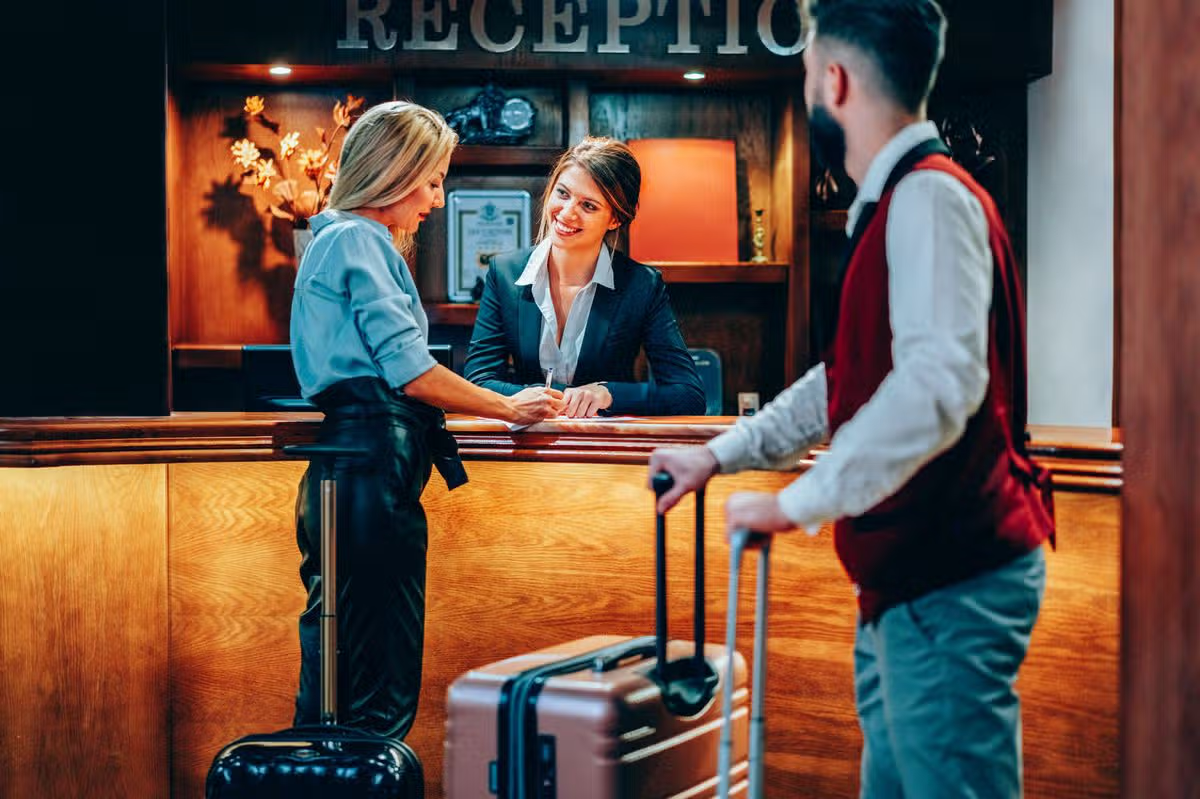
Graziano Gagliardi at Private Italy Tour claims that turning up at the front desk between 4.30pm and 6pm gives reception staff a much clearer picture of the premium suites that remain available. Arriving too early, say 2pm for instance, means housekeeping is likely still preparing and cleaning rooms, which leaves workers unable to confirm what higher-tier options are unoccupied for the night.

Gagliardi said: “If standard check-in begins at 2pm or 3pm, arriving immediately may not give you the best chance of an upgrade. Housekeeping may still be preparing rooms, while reception staff may not yet know which guests are arriving, cancelling or requesting changes.

“By around 4.30pm, the hotel usually has a much clearer picture of its room availability. If a larger room, a better view or a higher category is likely to remain empty, staff may have more flexibility to offer it.”

Turning up extremely late can also backfire, he claims, particularly at smaller boutique properties that operate limited front desk hours. He said: “Turning up at 10pm without warning is not a clever upgrade trick. If you expect to arrive late, always notify the hotel in advance.”

Holidaymakers booking shorter stays of one or two nights stand a significantly higher chance of being bumped up to a better class of room. Terms outlined by major hotel chains like Hilton confirm that complimentary upgrades strictly depend on space being continuously available for the entire duration of a guest’s stay.

A similar policy is enforced by Marriott, which explicitly states that room improvements are determined upon physical arrival at the front desk. Experts warn that travellers should remain realistic, as an upgrade often means securing a quieter location, higher floor, or better balcony view rather than the top luxury suite.

To maximise your chances, Private Italy Tour recommends using a specific phrase to politely ask front desk staff without sounding overly demanding or entitled. The travel guru suggests asking: “I understand it depends entirely on availability, but if there are any complimentary upgrades available this evening, I would be very grateful to be considered.”

Joining a hotel’s free membership scheme prior to travel can also boost your odds, as many major operators prioritize enrolled guests for empty premium spaces. However, guidelines published by Hilton Honors clarify that simply signing up does not guarantee a better room without holding eligible membership status or rates.

Guests celebrating genuine milestones such as birthdays, anniversaries, or honeymoons are advised to notify the hotel a few days before their arrival date. Mentioning a real special occasion often encourages reception teams to offer a complimentary perk or a room improvement.

Finally, the experts strongly warn holidaymakers against manufacturing fake complaints or inventing faults with their original room just to pressure staff into moving them. Dishonesty is far more likely to harm your chances than help them, meaning a polite, well-timed request during that crucial 90-minute window remains your absolute best bet.
Source link

Foreign Office air travel warning over ‘national emergency’ for EU destination

The advice is to check with your travel provider for the latest information

Families heading abroad on their summer holidays are urged to keep a close eye on travel updates. The Foreign Office has published fresh travel guidance for a popular sunny EU destination. The latest advice urges travellers to “check with your travel provider” for the latest information in light of a “national emergency”.

This comes as many flights were disrupted recently to the south of Italy, after eruptions from Mount Etna caused clouds of ash to be thrown into the air. The Foreign Office has since updated its guidance for Italy on Tuesday, August 11, with new information regarding ‘Volcanoes’ in the ‘Safety and security’ section. The latest guidance informs visitors: “There are several active volcanoes in southern Italy. National emergency planning is in place for the Phlegraean fields, an area that remains active experiencing regular tremors.”

People heading to the Mediterranean country are warned that “airspace can be affected during eruptions”. The Phlegraean fields (Campi Flegrei) is an area just west of Naples and so is close to Naples Airport.

‘Heightened activity’

The guidance includes a word of warning for another airport in the region. You may need to take action ahead of your trip: “If you are travelling to or from Catania, during a period of heightened activity, check with your travel provider or with Catania airport.”

State Pensioners to face major tax change

The Government body also advises: “Read what to do in the event of a volcanic eruption and follow the instructions of the local authorities.” The guidance includes a link to more information on the Civil Protection Department website of the Italian Government.

This information reminds visitors that Italy has “the greatest concentration of active volcanoes in Europe” along with Iceland. The guidance sets out that there is a “varying degree of hazard” for these volcanoes.

‘Wrong information’

People trying to find the latest guidance in the media are warned that “wrong information” can be sent out in times of crisis. The guidance urges: “For this reason it is important to follow the civil protection authorities’ instructions transmitted by radio, TV, in the daily press, on Internet and by the various toll-free numbers that will be set up.

“During eruptions, it is also important not heed the forbidden to enter signs at the areas involved by the eruption. It is dangerous to approach the crater area even if there is no eruptive activity as sudden explosive phenomena or gas emissions are always possible.”

You can read the full travel guidance for Italy on the Foreign Office website.

Source link

Jet2 clarifies luggage allowance rules that apply to all customers

There are several Jet2 rules to note when planning your trip

Jet2 has clarified its baggage allowances after an enquiry from a holidaymaker. The customer asked for help as they got ready for their summer getaway.

The person contacted the provider over social media on June 23. The traveller had booked their journey through Jet2holidays, and was due to jet off the following week.

They posed a question about their luggage entitlement. The customer wrote: “We have 3 x 22kg baggage allowance. Assume we are good to check in just two bags provided weight doesn’t exceed allowance?”

They went on to ask if they could check in one suitcase weighing 23kg and another at 25kg while remaining within their total allocation. Jet2 replied to set out the options available to the customer.

Combining your baggage allowance

The airline confirmed: “You can pool your luggage into two suitcases as opposed to three, as long as this doesn’t exceed your combined allowance of 66kg, and that no single article of luggage exceeds 32kg. I hope this helps.”

State Pensioners to face major tax change

According to Jet2’s official guidance: “Any baggage that exceeds your total weight allowance will be carried subject to availability and at our discretion. You’ll also need to pay an excess baggage fee, which is £12 per kg. Please note that no single item of baggage can weigh more than 32kg.”

You can add extra luggage when you book or through the Manage My Booking facility. Simply enter your booking reference, surname and departure date, then navigate to ‘Add Holiday Essentials’.

Query over 10kg allowance

Jet2 was also recently asked another question about its baggage weight rules after a passenger reported receiving contradictory information. The person had a booking for two adults and a six-month-old infant.

They explained: “Told we get two extra carry ons such as a buggy and travel cot that will be checked into the hold at the gate.”

They said they had two 22kg checked bags and that on a prior Jet2 holiday they had been told they qualified for “an extra 10kg for the baby”. According to Jet2’s official website guidance for bookings with children, passengers receive “an extra 10kg allowance for infants” plus “up to two items per child or infant free of charge”.

The passenger asked whether the additional 10kg could be combined with one of the 22kg cases, creating a 32kg allowance. They described receiving mixed messages on their last Jet2 journey. The customer recalled: “On the way out with you we were told it’s fine to have a 32kg case (22kg + the 10kg).

“On the way back we were told the 10kg should be a separate small checked case. Please can you clarify which it is and what the rules are because on our last holiday with you we were told different things.”

Setting the record straight, Jet2 responded to the passenger: “The additional 10kg is applied to one adult’s baggage, allowing for a total of one bag at 32kg and one bag at 22kg.”

Source link

Simon Calder urges anyone with package holiday booked to do task ‘immediately’

Important message for anyone with a package holiday booked

Travel expert Simon Calder has shared important advice for anyone with a package holiday booked, as people are being urged to act ‘as soon as possible’. His message comes ahead of the peak travel season, and as new research by Citizens Advice has revealed that four million people have faced issues with their package holiday over the last year.

On today’s (June 8) episode of ITV’s Good Morning Britain, TV host Kate Garraway spoke to correspondent Nick Dixon about the findings. He said: “The complaints that we’ve been hearing about were involving all-inclusive holidays, with many saying they just didn’t ultimately match up to the glossy brochures we see online, or indeed at the travel agents.

“Citizens Advice say that they found 33% of holiday-related complaints ultimately were about things like poor quality hotels, bad food, facilities being unavailable as well – 19% down to customer service.” He added: “Things like long waits on the phone, complaints ignored and administration errors, and 25% of complaints ultimately led to stress, anxiety or upset.

“And if your dream holiday does turn into a wee bit of a nightmare, there are steps you can take… Many of us with these kinds of complaints about our holidays end up trying to fight for compensation, which is why it is so important to keep a record of everything just in case to have any chance of getting money back.”

British travel journalist and broadcaster Simon Calder then spoke to viewers, sharing a crucial message for those with a package holiday, especially if they encounter problems during their trip. He urged holidaymakers to act ‘immediately’.

Content cannot be displayed without consent

He said: “If you get to your destination and things aren’t right, maybe there’s a problem with your room, maybe the facilities are simply not as described, then you have to give the travel company immediate notice and allow them the opportunity to sort things out.”

How can I claim compensation for a holiday?

Reporting a problem right away is a legal concept called “mitigating your losses”. If you don’t allow the travel provider to address the room or facilities issue while you’re there, you could really hurt your chances of receiving a full refund or compensation.

Citizens Advice says: “If you’re still on holiday, tell the company or travel agent about the problem as soon as possible. You might be able to get it sorted quicker – like if there’s a problem with the room. If you don’t say anything until you get home, you might get less compensation or none at all.”

The person you need to contact depends on how you arranged your holiday. If you went for a package holiday, reach out to the customer service team of the tour operator you chose.

However, if you organised it yourself or set up a linked travel arrangement, you should contact the accommodation or service provider directly, such as the hotel or the company offering excursions. Make sure you include:

  • your booking reference
  • clear details of what went wrong
  • copies any evidence you have – like photos
  • copies of receipts
  • how much compensation you want

Citizens Advice adds: “It’s a good idea to send the letter by registered post and keep a copy, so you have proof that the holiday company received it. You can also email them – some of them have online forms. Keep a copy of what you send. If the company makes you an offer that you think is too low, you can ask for more. They might come back to you with a higher offer.”

Source link