hold

Olympic dreams on hold: Swiss bobsledder opens up about cancer fight

World-class athletes, thrilling events, stirring medal ceremonies, I will remember all of those from the Winter Olympics. But what I experienced Sunday on my 45-minute bus ride from my hotel to Cortina will stay with me longer.

There was a young woman sitting across the aisle. She looked to be in her mid-20s, about the age of my daughter, and was wearing a knit cap with a Switzerland logo. Her dark hair was in long, thin braids and framed her friendly face.

“How’s it going?” I asked, setting down my backpack.

“Nervous,” she said with a faint smile.

That started the conversation, one that would have me repeatedly wiping my eyes with my sleeve.

Her name was Michelle Gloor. She’s 25 and from a small town outside of Zurich. Her boyfriend, Cedric Follador, is pilot of the Swiss bobsled team and has races throughout the week. She was heading to watch him practice.

Michelle knows all about the sport. In fact, she had been the brake woman on the Swiss national team and had hoped to be competing in these Olympics herself. She grew up as a track-and-field athlete, a sprinter, and only took up bobsled in 2022.

Women’s bobsled — or bobsleigh, as Europeans call it — is a two-person operation with a pilot in front and brake woman in back.

“The first responsibility is pushing the sled as fast as I can, together with my pilot,” she said in a German accent and near-flawless English. “I have to sit still and count the curves until we reach the finish line, when I have to pull the brakes. I’m responsible that the sled won’t crash into something.”

Her best friend had made the transition from track to bobsled, was looking for a brake woman, and convinced Michelle to give it a try.

“My first bobsleigh ride was in St. Moritz and I was so nervous,” said Gloor, a third-year law student at the University of Zurich. “I think I was crying in the back of the sled because I’d never felt anything like that, all the G-forces and you don’t have any cushion in the sled. It all hurts.

“But after the second run, I felt the adrenaline and it was great. It caught me from then. It took me two runs.”

She was 22 and the future was bright. They entered the Swiss championships and won. Michelle got serious about her new sport, training every day, eating right, building muscle.

Immersed in that world, she met Cedric but for the first 1½ years they were just casual friends. Their conversations were all bobsled-related.

“Then in spring 2024 he texted me and asked, ‘How are you?’” she said. “More personal stuff.”

They had been dating for about six months when a discovery would dramatically change their lives.

In November 2024, during a routine check-up, a gynecologist found evidence of cancer in Michelle’s ovaries. If there were signs she was ill, Michelle hadn’t noticed them. She had been tired the prior summer, yes, but she attributed that to her training.

“It was pretty advanced,” she said of the cancer. “I went to the women’s doctor every year and they couldn’t explain why they couldn’t see it earlier. I don’t know. I’m not questioning that anymore. It’s just … yeah.”

There was no time to wait. By December, she was in surgery. Doctors opened her abdomen from her breast bone down, looking for more growths. They deemed the operation a success, and six months of chemotherapy began in February.

“I lost my hair,” she said. “I had long, black hair. Losing that wasn’t bad. But I lost the hair on my face — my eyebrows, my eyelashes — that was hard. But I always knew it just had to be.”

Her doctor told her her cancer was Stage 3.

“That means it’s on the other organs too,” she said. “But the difference between Stage 3 and Stage 4 is it’s not in my lungs. It’s in my tummy area but not more upwards.”

“Women or even men my age, you live in your world, you are following your dreams. And you don’t think about something happening in your life.”

— Michelle Gloor, on being diagnosed with cancer at a young age

Cedric was by her side.

“I asked him after the diagnosis if he wants to join me in this journey or not,” she said. “I can understand if he won’t because we were together not even half a year, and I can understand if he said, ‘Hey, it’s too much for me. I can’t do that.’

“Then he took time for himself, and he came back and said he wants to stay with me. He wants to support me in every imaginable way.

“He drove me to therapy when he was in town because he had a bobsleigh season going on from November until March, in my toughest time. Every time he was home, he was there for me. When he wasn’t there, we were phoning every day. He was there all the time, even when he wasn’t there physically.”

Her parents and younger brother were there for her too, of course, but she wanted to give them some time to themselves. Cedric was her rock.

There are elements in his job as a driver that both help him in his sport, and her in her disease.

“As a driver, you really need to focus on what’s going on straight ahead of you,” she explained. “You can’t really switch away your thoughts. You have one minute of full concentration. I think you can compare it to Formula One because you only see the next curve in front of you.

“He’s very calm and I think that helps him in a sporting way to not overreact emotionally and stuff like that. But also for me as a partner, I’m very emotional. When I’m too excited or too sad or too angry, he can calm me down to a normal level. On a stress-less level, and to be stress-free is very important for someone who has cancer.”

Switzerland's Cedric Follador, right, and Luca Rolli compete in two-man bobsled at the Milan-Cortina Olympics on Monday.

Switzerland’s Cedric Follador, right, and Luca Rolli compete in two-man bobsled at the Milan-Cortina Olympics on Monday.

(Richard Heathcote / Getty Images)

Michelle, petite and pale, has lost about 40 pounds over the past year. Mostly muscle.

“I was avoiding sugar in the beginning of the illness,” she said. “You read so much stuff. But after losing so much weight, doctors told me just eat what you want to eat. Because having energy is more important than eating too much sugar.”

In August, doctors discovered more cancer in her. Another surgery to open her abdomen.

“They said it’s still there,” she said. “Those microcells which they couldn’t remove because they couldn’t see them, they grew. But once all those microcells have grown up and been removed, or have been killed by therapy and medication, there won’t be any new cells because the ovaries have been removed, so they don’t produce any more.”

She tries not to Google her illness anymore. It doesn’t help her frame of mind. She’s changed in other ways, too.

“I was a very direct person before my illness,” she said. “Now I’m even more direct and straight-forward. I say no, and I don’t explain myself. If I don’t want to do something, I don’t have to. I just say no.

“Before that, I had a bad feeling about myself and explained myself just because I say no. I don’t do that anymore.”

In December, she began radiation. She has another scan after the Olympics.

There are times she just can’t believe this is happening.

“Women or even men my age, you live in your world, you are following your dreams,” she said. “And you don’t think about something happening in your life. I only know young people in Switzerland, so I can only speak for them. But they don’t talk about that.

“They are not sensible about what can happen, and that’s why it’s important for me to speak out about it. For example, with a women’s doctor, you have to go. It can happen to anyone.

“I’m a young woman. I do sports since I’m 10 years old. I don’t drink alcohol. I don’t smoke. But it still can happen.”

Her illness has shined a spotlight on her friendships. Lots of her old friends showed concern at first, then went on with their lives. A handful checked in on her frequently. Some are new.

“I got in touch with a woman during chemotherapy, she was there too,” Michelle said. “She has breast cancer. She saw my cross necklace, and we were talking about faith and how it helped in those hard times.

“We are still in contact now. We are writing letters to each other. We’re not texting or phoning, just writing letters and sending postcards. She’s as old as my mom, but it’s very cool to have someone with almost the same story.”

How will that story end? Michelle has her hopes, this fearless young woman who took to bobsledding on her second time down the track.

“My goal is to be in the Olympics in four years,” she said. “I’ll be 29 by then. The age is still good — even better than now for a bobsleigh athlete. And I have a great team. My bobsleigh pilot is very supportive and she said she always has a place for me in the sled.”

This week, Michelle is supporting Cedric — just a sliver, she said, of the way he has supported her. They got engaged in December. It happened at sunset in his little hometown in the Swiss Alps.

“He was talking about himself and us, and then he proposed to me,” she said. “I said yes. Of course.”


Source link

Syrian army enters Kurdish city of Hasakah as ceasefire takes hold | Syria’s War News

The Syrian army has deployed to the northeastern city of Hasakah, previously controlled by the Kurdish-led Syrian Democratic Forces (SDF), implementing the first phase of a United States-backed ceasefire agreement.

A large convoy of military trucks entered Hasakah on Monday, hours after the SDF imposed a curfew. Syrian forces arrived as part of the newly brokered agreement between Damascus and the SDF announced last Friday.

The agreement aims to solidify the ceasefire that halted weeks of conflict during which the SDF lost substantial territory in northeastern Syria.

It establishes a framework for incorporating SDF fighters into Syria’s national army and police forces, while integrating civilian institutions controlled by the group into the central government structure.

Under the terms of the agreement, government forces will avoid entering Kurdish-majority areas. However, small Interior Ministry security units will take control of state institutions in Hasakah and Qamishli, including civil registries, passport offices and the airport.

Kurdish local police will continue security operations in both cities before eventually merging with the Interior Ministry.

The government forces’ entry into Hasakah occurred without incident and as scheduled.

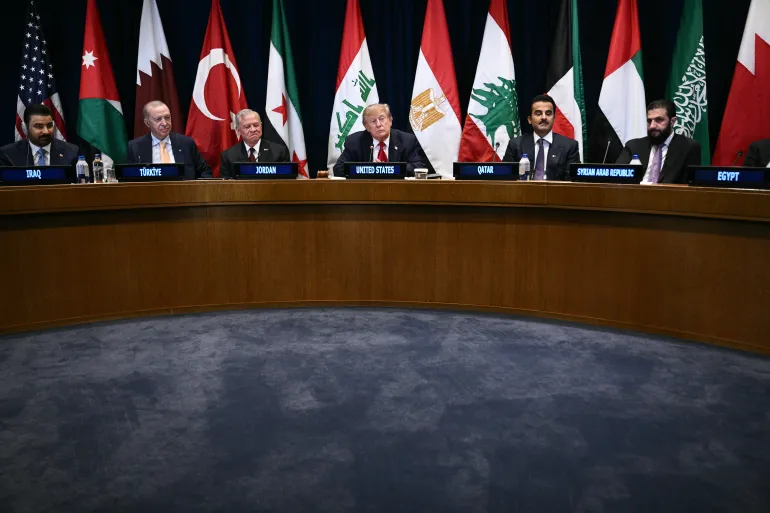
Turkish President Recep Tayyip Erdogan – whose government has long viewed the SDF as an extension of the Kurdish-led armed rebellion in Turkiye – issued a stern warning to Kurdish forces.

“With the latest agreements, a new page has now been opened before the Syrian people,” Erdogan said in a televised address. “Whoever attempts to sabotage this, I say clearly and openly, will be crushed under it.”

Friday’s agreement includes provisions for establishing a military division incorporating three SDF brigades, plus an additional brigade for forces in the group-held town of Ain al-Arab, also known by its Kurdish name Kobane, which will operate under the state-controlled Aleppo governorate.

The arrangement also provides for the integration of governing bodies in SDF-held territories with state institutions.

According to Syria’s state news agency SANA, Interior Ministry forces began deploying in rural areas near Kobane on Monday.

Since the overthrow of longtime ruler Bashar al-Assad 14 months ago, interim President Ahmed al-Sharaa’s efforts to unify the fractured nation under central authority have been hampered by deadly clashes with the SDF and other groups.

Source link

Lives on hold for two years: Hope, fear stuck behind Gaza’s Rafah crossing | Israel-Palestine conflict News

Deir el-Balah and Khan Younis, Gaza – For the past two years, Khitam Hameed has clung to the hope of a single sliver of news that could fundamentally change the fate of her entire family.

The reopening of the Rafah crossing, shut and controlled by Israel as part of its genocidal war on Gaza in spite of a ceasefire agreement, would allow her family to travel and reunite with her husband outside Gaza.

Recommended Stories

list of 4 itemsend of list

But for this family, the reopening is not just about freedom of movement. It represents both a chance for reunion after a long separation, and an opportunity to secure treatment for their son, whose life, schooling, and normal childhood have all been destroyed by the two-year Israel-Palestine war.

With the United States pushing a deeply intransigent Israel to progress to phase two of the ceasefire that began on October 10, the reopening of the Rafah crossing was directly tied by the far-right government to the recovery of the remains of the final Israeli captive, and only partially for pedestrian use under strict military supervision.

On Monday, the retrieval of the last Israeli captive’s body appeared to open that locked door, with thousands in urgent need of treatment or family reunification in a state of anxious anticipation.

From her family’s displacement site in the Nuseirat refugee camp near Deir el-Balah in central Gaza, Khitam, 50, a mother of six, sits trying to organise her thoughts as news circulates about Rafah.

Next to her is her 14-year-old son, Yousef, unable to walk, suffering from a rare genetic disorder called Ehlers-Danlos Syndrome (EDS), a painful condition primarily affecting his bone development, with potential cardiac complications.

“Yousef has been undergoing treatment for this syndrome since he was very young … he has had around 16 surgeries,” Khitam tells Al Jazeera.

“We got used to hospitals, but before the war, there was some monitoring and a little hope.”

Since long before October 2023, the Rafah crossing between Gaza and Egypt has been a lifeline for Palestinians, not only as a natural exit and entry point, but also as a symbol of connection with the outside world.

Before the war, the crossing was heavily used by patients seeking medical treatment, families visiting relatives abroad, and the movement of goods and supplies that helped ease Gaza’s economic pressure under Israeli blockade.

Its closure, beginning in May 2024 after Israeli forces took control, marked a dramatic turning point in the humanitarian crisis.

The shutdown affected not just the movement of people, but also significantly reduced the flow of medical aid and essential supplies, impacting thousands of patients waiting for treatment outside Gaza, including children and the wounded, amid a severe shortage of health services and medical equipment.

‘Opening the crossing shouldn’t be a miracle’

Before the war, Khitam and her family monitored Yousef’s condition regularly, and he could walk and move.

But the war halted everything. Hospitals were routinely bombed by Israel, and most ceased functioning. Medics were killed by the hundreds, medications ran out, and medical checkups became nearly impossible.

“Since the war, Yousef’s condition has deteriorated. His legs are weaker, walking is harder, he uses crutches,” Khitam pauses before continuing: “He falls often… and my heart is in my throat every time.”

The mother no longer knows the full extent of her son’s health. “I don’t know if he has heart complications, or if his spine has worsened … we are living with him with no answers.”

The war also separated the family. Weeks before the conflict erupted, Khitam’s 52-year-old husband, Hatim, had left Gaza for Egypt, as an initial step to secure a chance for the family to migrate and access advanced medical care for Yousef.

“Since then, I’ve been alone. Six children, one with a special medical condition, war, displacement, hunger,” Khitam says, her voice exhausted.

“Being displaced alone is so difficult. You don’t know where to go, how to protect your children, how to provide food or safety. The constant anxiety and fear have affected everyone, but Yousef suffers the most.”

“No school, no play, no outings, no treatment … even psychologically, he is exhausted. A child his age should be living his life, not caught between war and illness.”

But, she adds, “just the idea of travelling eases us a bit psychologically. It feels like a door might open” for treatment outside of the besieged enclave.

She still fears how the crossing will operate, even as hope keeps her going.

“Even if the crossing opens, not everyone can leave, and not every case will be approved,” she adds. “Opening the crossing shouldn’t be a miracle… it’s a right.”

Yousef’s story intersects with those of hundreds of families of sick children in Gaza, for whom Rafah is not just a crossing, but a lifeline.

‘The family started a new battle against time’

Local estimates indicate that more than 22,000 patients and injured people, including about 5,200 children, are unable to travel for treatment due to the Israeli closure, with thousands more waiting for approved medical transfers that cannot be executed.

Among them is Hur Qeshta, a newborn girl only 15 days old, born with a large, unusual tumour in her neck, affecting breathing and swallowing.

She requires urgent surgery outside Gaza, according to doctors at Nasser Hospital in Khan Younis, in southern Gaza.

Her mother, Doaa Qeshta, 32 and a mother of five, tells Al Jazeera, “From the first moment she was born, the family started a new battle against time to ensure she could urgently travel for treatment.”

Hur was delivered via Caesarean section and now lies in the Nasser Hospital neonatal ICU, on oxygen and fed via a tube from her abdomen.

“She can’t breastfeed, everything is through a tube, and the mass is growing rapidly … all within 15 days,” says her mother.

Doctors confirmed that surgery inside Gaza is currently impossible due to a lack of facilities.

Doaa links her daughter’s condition to the circumstances during her pregnancy, including displacement in a tent in al-Mawasi, exposure to nearby shelling, smoke, gunpowder, hunger, and lack of nutrition.

“I was pregnant during famine … no food, no vitamins, no safety,” she recalls. “Shelling was nearby, 300 metres (980 feet) away… the tent shook; we thought we were dead.”

“Opening the crossing means saving my daughter’s life,” she says. “I’ve registered the whole family as companions … the most important thing is Hur goes, gets treatment, and survives.”

Of the reopening of the Rafah crossing, Doaa says, “We hear news and live on hope, but we are really in a limbo… we don’t know what’s happening or when. We just pray this is true.”

‘Our lives and futures hang on a hope’

The effects of Rafah’s closure go beyond medical access, affecting an entire generation of youth whose education has been halted at a closed gate.

Among those affected is Rana Bana, a 20-year-old from the Daraj neighbourhood in Gaza City.

She graduated from high school in 2023 with a 98 percent average in the science track, with a focus on pharmacy. Within a single year, she received multiple opportunities abroad, but none materialised due to Rafah’s closure.

“In 2024, I was accepted for a scholarship in Egypt, ready to leave, but the crossing closed. A year later, I got a scholarship to Turkiye, did the online interviews, was accepted, and since then I’ve been stuck,” Rana tells Al Jazeera.

Her Turkish scholarship includes 220 students from Gaza, all from different disciplines, most with high academic grades.

Over the past two years, Rana tried not to stagnate, taking Turkish language courses and exploring alternatives like local universities. But she would hold back each time she heard news of Rafah possibly reopening.

“Every time there’s news the crossing might open, I tell myself, ‘Let me wait a bit’… but it turns out to be just talk, and my hopes are dashed,” she adds. “A lot of our time and life has been wasted waiting … our lives and futures hang on a hope.”

Rana is displaced with her family of eight. They returned briefly to northern Gaza during the first ceasefire, found their home intact, but fled again after fighting resumed, and are now settled in Deir el-Balah.

“My biggest fear is leaving and not being able to come back,” she says. “Before, they [her family] were 100 percent supportive. Now there’s fear because the travel process is unclear, and they don’t know how many will be allowed or registered to travel.”

Many Palestinians fear leaving Rafah would be a one-way ticket as part of an openly touted Israeli plan to permanently expel the population from Gaza.

“We students and youth are the most affected group during the war,” Rana says. “Our years have gone by silently, our studies destroyed by war, and no one talks about us. All we want is education — not travel for tourism or anything else.”

Source link