The Uffizi Galleries, home to Italy’s most precious art, were hit by a cyberattack, the museum said. The museum claims there was no data stolen. File Photo by Claudio Giovannini/EPA
April 3 (UPI) — The Uffizi Galleries in Florence, Italy, said Friday it suffered a cyberattack, but not a breach of data earlier this year.
The country’s top art museum said nothing had been damaged or stolen in the attack.
Italian newspaper Corriere della Sera reported that hackers had infiltrated the museums’ IT systems and taken access codes, internal maps and the locations of closed-circuit cameras and alarms, then demanded ransom.
But the museum disputed that report, saying its security systems are inaccessible from outside the museum, the BBC reported.
Corriere reported that the attackers moved through interconnected systems, computers and phones, learning the museum’s operations. It said a ransom demand was later sent to museum director Simone Verde’s personal phone threatening to sell data on the dark web.
The Uffizi houses priceless masterpieces by Michelangelo, Sandro Botticelli, Leonardo da Vinci and Raphael. It’s the home of The Birth of Venus, by Botticelli; Venus de’ Medici, a Greek sculpture by an unknown artist; and Annunciation by Leonardo.
Italian media have reported that the attack forced authorities to move some of the museum’s collection into secure vaults. But the Uffizi stressed in a note shared with Politico that the attack was “nothing like the Louvre,” referencing the $100 million jewel heist last year that eventually forced its director to resign. The items stolen from the Louvre have not been recovered.
The movement of items to vaults, which included Medici-era treasures, was because of ongoing renovations, the museum said.
Former Prime Minister and former Florence Mayor Matteo Renzi criticized Culture Minister Alessandro Giuli, an ally of Prime Minister Giorgia Meloni, for not protecting the important museum.
“Hackers are attacking the Uffizi Gallery and threatening our cultural heritage. I wonder: what is Minister Giuli doing and what has he done?” Renzi posted on X Thursday. “Did he notice or is he too busy playing the flute in honor of the god Pan … ? And what is the National Cybersecurity Agency doing? Or is Italians’ money just going into software like Paragon that spies on journalists? I’ll submit a question. I’m curious to see if anyone will have the courage to respond.”
On March 22, a three-minute heist resulted in the loss of three paintings by Renoir, Cezanne and Matisse from the Magnani-Rocca Foundation in Parma, Italy.
It was Brady Murrietta’s silence rounding the bases, then his Darth Vader-like stare directed at St. John Bosco pitcher Jack Champlin after touching third base on Thursday and slowly jogging toward home plate that sent a clear message: Don’t poke the bear.
His two-run home run in the bottom of the sixth inning broke a 3-3 tie and keyed a 5-4 win to prevent the No. 1-ranked Lancers from suffering a three-game Trinity League baseball sweep by No. 2 St. John Bosco.
One day earlier, the intensity level between the two teams reached such a crescendo that after the fiery Champlin got the final out in a 4-1 win at Hart Park, he decided to offer a taunt.
“I was hearing them all game at third base,” Champlin said. “I pointed to the ground and was saying, ‘This is my field.’ A bunch ran out of the dugout toward me and it got bigger than it needed to be.”
There was pushing and shoving as St. John Bosco went nuclear on security for Thursday’s home game, so much so that a security person refused to let a 5-foot-4 sportswriter walk into the Orange Lutheran bullpen after the game until calmer heads prevailed.
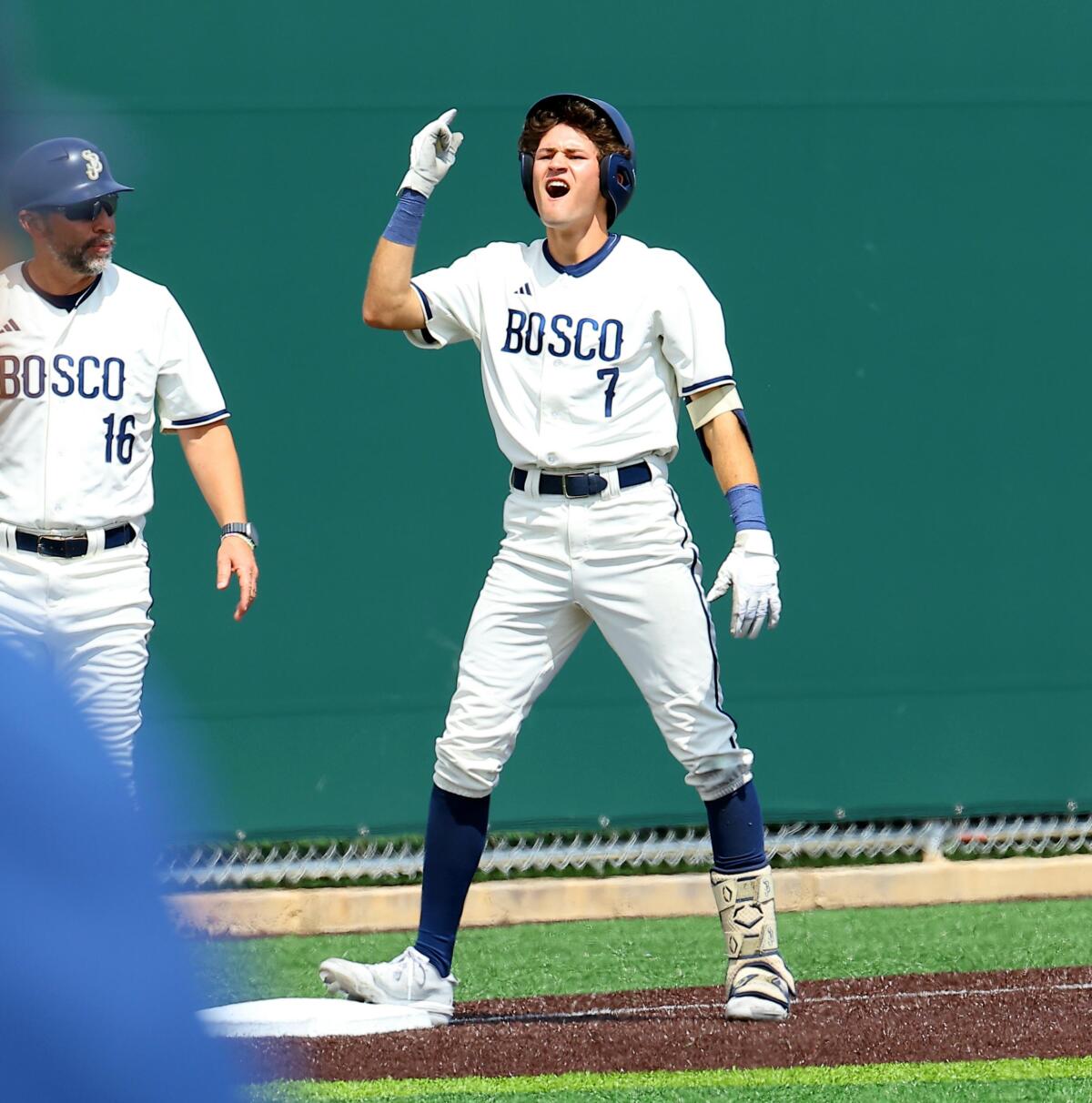
Jack Champlin of St. John Bosco is fired up after a two-run triple on Thursday against Orange Lutheran.
(Nick Koza)
The two teams declined to shake hands in a precautionary measure. It was almost comedic, since Orange Lutheran pitcher Gary Morse has played with St. John Bosco pitcher Julian Garcia since they were 8 and texted him Thursday morning to congratulate him on his Wednesday pitching performance. And Murrietta intended to text his friends on the Braves, too.
“It was more to get my boys hyped up,” Murrietta said of staring at Champlin.
Wednesday’s game was particularly important with each team’s ace on the mound. The 6-foot-8 Morse had a 95 mph fastball and gave up two hits and one run with eight strikeouts over six innings. Garcia, who missed his junior season after arm surgery, touched 97 mph while striking out 10 and giving up three hits in six innings. The Braves broke the 1-1 tie with three runs in the seventh inning, keyed by a two-run single from James Clark.
On Tuesday, in St. John Bosco’s 7-4 win, Clark had another big game with two hits and three RBIs.
“Two best teams in the country,” Morse said.
Orange Lutheran (8-3, 1-2) was coming off a championship at the National High School Invitational in North Carolina. It showed off a top pitcher to join Morse in Cooper Sides, a senior transfer from Red Buff who struck out eight in five innings on Thursday in front of dozens of pro scouts.
Asked what he learned about his 11-3 defending Division 1 championship team this week, St. John Bosco coach Andy Rojo said, “I think it continues what we already know that it’s a tough team, a resilient team. We’ve had a lot of high-pressure, high-level games. A ton of one-run games.”
Said Garcia: “It pushed us to show we’re a great team.”
Orange Lutheran coach RJ Farrell saw his team fight back from adversity, and in the Texas-bound Murrietta, he has an MVP candidate capable of igniting the Lancers with his bat, glove and leadership skills.
The two teams could meet again next week during the Boras Classic in Orange County. Otherwise, it would come during a new-look Southern Section Division 1 playoff format that will have 16 teams and start with a best two-out-of-three series to advance. Both teams have shown they have the pitching to advance.
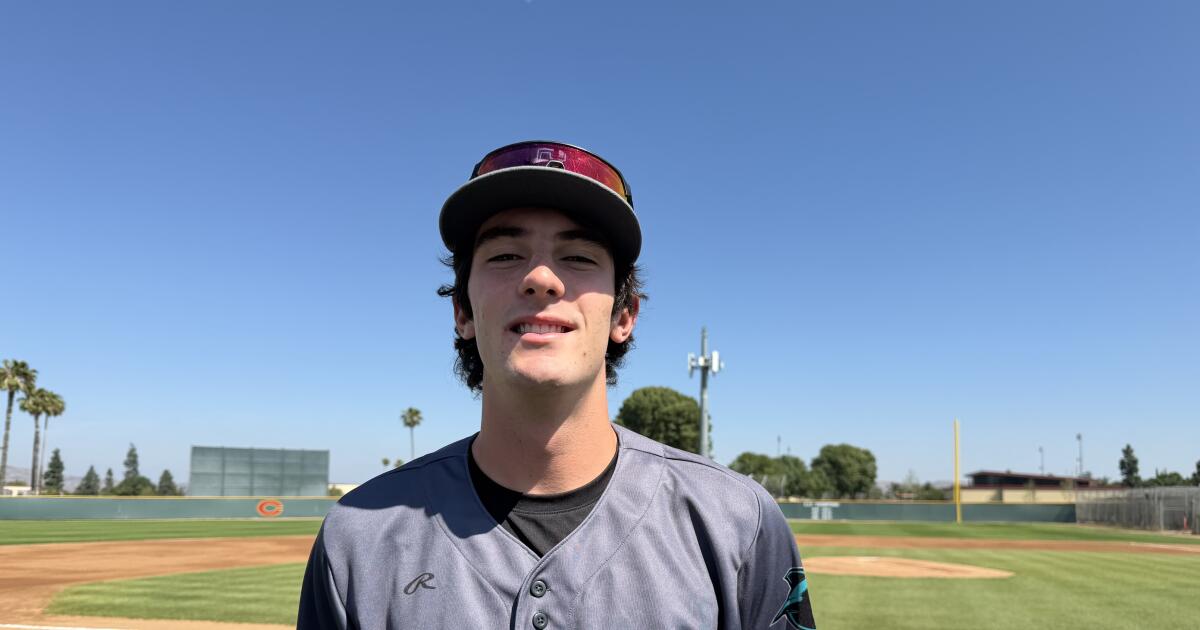
Determined to avoid a three-game sweep at the hands of rival St. John Bosco on Thursday, No. 1-ranked Orange Lutheran turned to Texas-bound catcher Brady Murrietta, who came through with a memorable individual performance in a 5-4 road victory.
Let’s count the ways Murrietta made an impact.
In the top of the first inning, he had a double. In the bottom of the first, he threw out the speedy James Clark trying to steal second. In the fifth, he drove in a run with a sacrifice pop fly. In the top of the sixth, he broke a 3-3 tie by sending a hanging slider from closer Jack Champlin over the fence in left field for a two-run home run. In the bottom of the sixth, he tagged out the potential tying run at the plate.
Pro scouts were out en masse to see Orange Lutheran pitcher Cooper Sides, whose fastball touched 95 mph. He struck out eight in five innings.
Champlin had a two-run triple in the first inning against Sides. Champlin had given up only one earned run all season until Orange Lutheran scored three runs (one earned) in 2⅔ innings of relief. The Lancers were particularly excited because Champlin taunted them after saving Wednesday’s 4-1 win, leading to shoving and pushing after the game. As a precautionary measure, the teams did not shake hands after Thursday’s game.
Orange Lutheran improved to 8-3 and 1-2 in the Trinity League. No. 2 St. John Bosco is 11-3 and 5-1. The teams could meet again next week at the Boras Classic.
Cypress 6, Sherman Oaks Notre Dame 2: Tate Belfanti allowed one hit in four innings and struck out four for Cypress, which finished third at the National Classic.
Concord De La Salle 6, Corona Centennial 3: The Spartans won the National Classic. Devin Bishop and Michael Nonis hit home runs for Centennial, which became the first team in four days to score against De La Salle.
Bell 1, Las Vegas Southeast Career Tech 0: The Eagles improved to 16-1 and went 4-0 in San Diego. Manuel Pasillas threw five scoreless innings and AJ Esquivel threw two scoreless innings for the save.
West Ranch 6, Saugus 5: A four-run rally in the bottom of the seventh lifted West Ranch to the Foothill League win. Ty Diaz had two RBIs.
Hart 7, Golden Valley 4: Hayden Rhodes delivered two hits and three RBIs for Hart.
Valencia 9, Castaic 7: Justin Gaisford had a two-run home run for Valencia.
Corona Santiago 3, Aquinas 0: Troy Randall struck out 10 in five innings and Max Eldridge hit a home run to lead Santiago.
Foothill 2, La Habra 1: Caden Lauridsen struck out four with no walks while giving up two hits in a complete-game performance.
Agoura 6, Oak Park 0: Tyler Sterling had three RBIs for the Chargers.
Newbury Park 3, Thousand Oaks 0: Ben Miller and Chase Renzo combined on the shutout and Carson Richter had a three-run home run to lead the Panthers.
Oaks Christian 2, Westlake 1: Luke Puls had a solo home run and Gave Geyer threw three innings of scoreless relief.
Long Beach Millikan 4, Lakewood 0: Daunte Bell struck out eight with no walks in throwing the shutout.
Villa Park 4, Temecula Valley 2: Ezra Ornelas had two hits for Villa Park.
Softball
Norco 9, Corona del Sol 0: Leighton Gray and Isabella Ray hit home runs and Peyton May allowed three hits in a five-inning win at the Michelle Carew Classic.
PIANO Man Billy Joel has recorded a special interview to air during Eurovision thanks to his song named after host city Vienna, I can reveal.
Afterwards, Austrian singer Cesar Sampson, who finished third in 2018, will cover the song before the results are revealed.
Sign up for the Showbiz newsletter
Thank you!
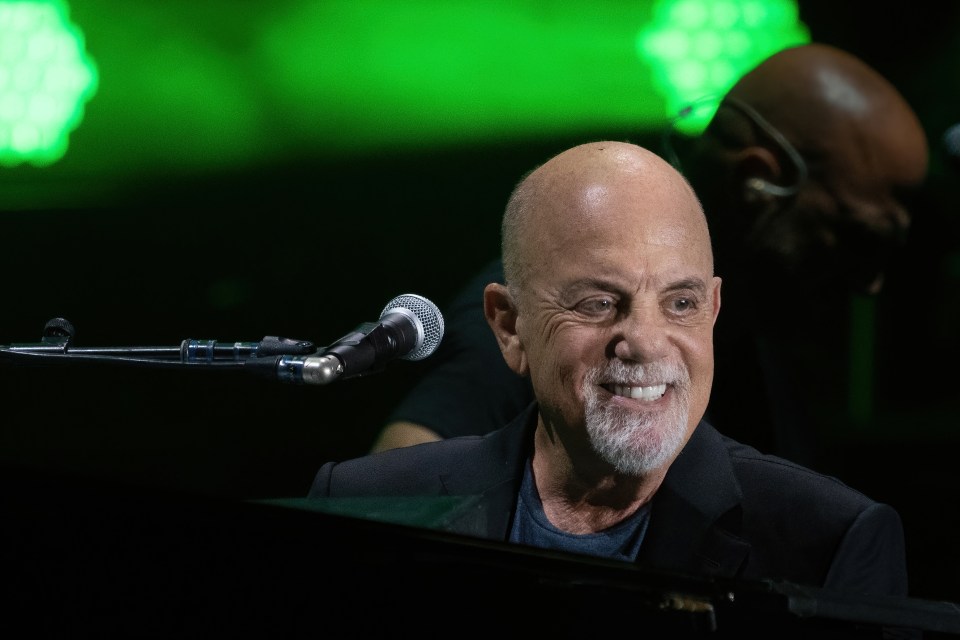
Billy Joel has recorded a special interview to air during Eurovision thanks to his song named after host city ViennaCredit: AFP
I’m told there were hopes Billy could fly over to make a surprise appearance at the contest.
But it was ruled out on health grounds.
Billy was diagnosed last May with a rare neurological disorder that can cause issues with hearing, balance and vision, although he is having physical therapy to treat it.
The musician has already cancelled all of his 2026 concerts, including shows in Edinburgh and Liverpool.
However, he did make a surprise appearance in Florida on January 2.
A source close to the singer, who will turn 77 a week before the final on May 16, said: “Billy has recorded an interview talking about his love for Vienna and his links to the city, which is all tied into his song.
“Organisers originally hoped he could perform but that was ruled out. They will be making a big deal of this very rare interview with him.”
He has sold more than 160million records and is one of the best-selling artists of all time.
Vienna was released in 1977 as the B-side to Just The Way You Are, and is now among his most popular tracks.
Ultravox’s 1980 hit, also called Vienna, is arguably even more popular.
But frontman Midge Ure certainly won’t be there, as he will be in the middle of a UK tour.
The 70th edition of the contest will take place at the Wiener Stadthalle arena after 166million tuned in to see Austrian singer JJ win with Wasted Love last year.
Celine Dion had been in talks to perform at the 2025 event in Switzerland, but it didn’t happen as she continued to battle Stiff Person Syndrome.
I’ll have to keep my fingers crossed that the Eurovision entries themselves provide plenty of entertainment instead.
The much anticipated pitching duel between Gary Morse of Orange Lutheran and Julian Garcia of St. John Bosco on Wednesday under the lights at Hart Park exceeded expectations.
With both hitting 95 mph, Morse gave up two hits in six innings with eight strikeouts. Garcia struck out 10 and also gave up two hits, but one was a leadoff home run by Ricardo Hurtado.
St. John Bosco (11-2, 5-0) broke a 1-1 tie with three runs in the seventh to defeat Orange Lutheran 4-1. It was the second consecutive Braves win. Orange Lutheran, which came into the week ranked No. 1 by The Times after winning the National High School Invitational, dropped to 7-3 overall and 0-2 in the Trinity League.
Closer Jack Champlin came in after a leadoff single in the seventh to pick up the save.
The Braves loaded the bases with two outs in the seventh, then scored two runs on a wild pitch and added a third on James Clark’s single. The teams close out their three-game series in a 1:30 p.m. game Thursday at St. John Bosco.
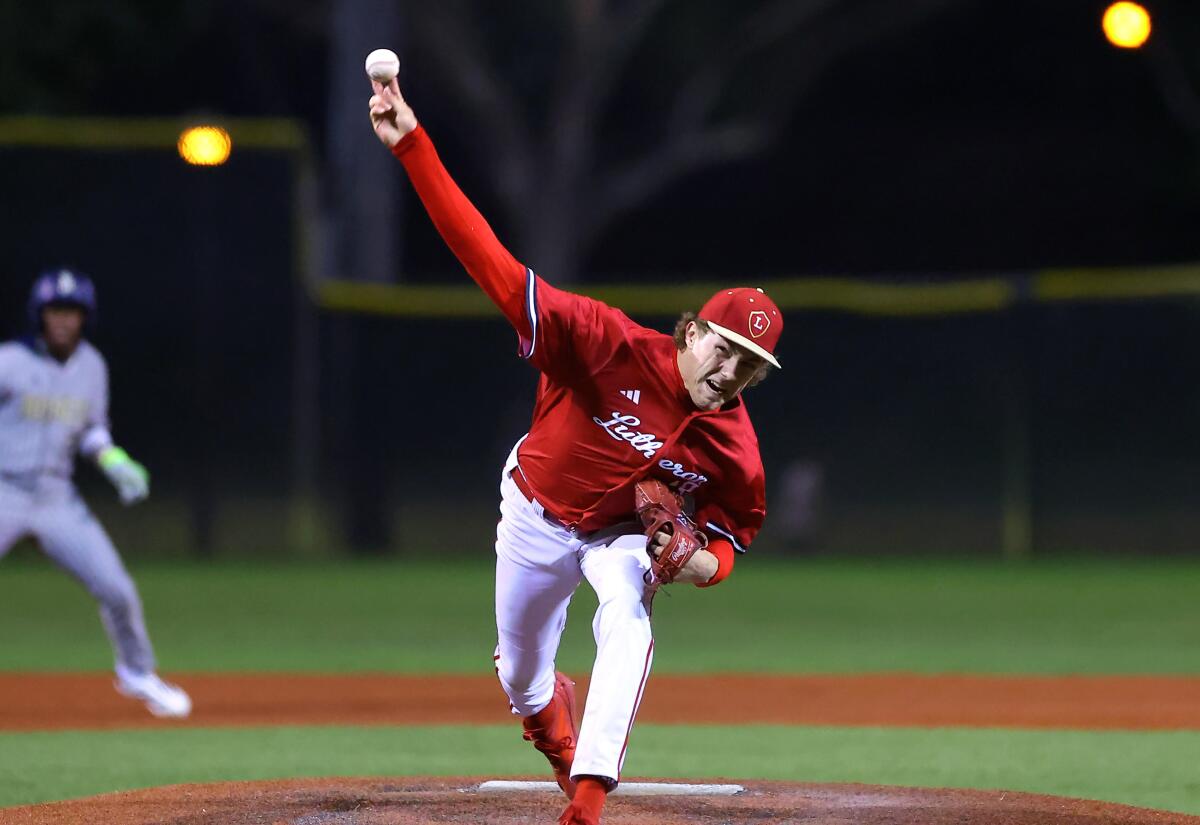
Gary Morse of Orange Lutheran struck out eight against St. John Bosco in six innings Wednesday.
(Nick Koza)
With two outs in the top of the seventh inning Sam Lakey hits a home run to give De La Salle 1-0 lead over Notre Dame. Lachlan Clark struck out 10 in 6 2/3 innings. pic.twitter.com/8kEvkZ1nlR
Concord De La Salle 1, Sherman Oaks Notre Dame 0: Sam Lakey hit a two-out solo home run in the top of the seventh inning to break up a pitching duel and send De La Salle into Thursday’s championship game of the National Classic. It was the third consecutive shutout by De La Salle pitchers. Notre Dame’s Lachlan Clark made no mistakes other than giving up the home run. He struck out 10 in 6⅔ innings. Notre Dame twice had bases-loaded situations but failed to take advantage, including hitting into a double play in the bottom of the sixth.
Corona Centennial 5, Cypress 1: Jacob Torres threw a complete game with nine strikeouts and Aiden Simpson homered to lead the Huskies in a semifinal game of the National Classic. They will face De La Salle on Thursday at 4 p.m. at El Dorado in the tourney final.
Vancouver (Wash.) Union 1, El Dorado 0: The Golden Hawks gave up a run in the bottom of the seventh. Julian Rodriguez gave up three hits in 6⅔ innings.
Fountain Valley 5, Edison 0: Four pitchers combined for the shutout. Ethan Cortez had two doubles.
Harvard-Westlake 7, Loyola 1: James Tronstein homered, Jake Kim had two RBIs and Evan Alexander struck out 10 in 5⅓ innings.
Bell 7, Chula Vista Olympian 3: The Eagles (15-1) received four RBIs from Eric Medina, including a two-run single in the seventh to break a 3-3 tie.
Sylmar 5, San Francisco Lincoln 2: Tim Sepulveda had two hits and three RBIs while Rickee Luevano went three for three to lead Sylmar.
El Camino Real 6, La Costa Canyon 4: Michael Spancer and Shane Bogacz each had three hits while Blake Dubin had a two-run single for the Royals.
Cleveland 9, Marshall 3: The Cavaliers won their eighth consecutive game. Shiloh Wickliffe had two hits and three RBIs.
Quartz Hill 13, Palmdale 0: Parker White had three hits and threw a no-hitter in the Golden League win over Palmdale.
Ayala 4, Bonita 2: Easton Sarmiento struck out seven in 5⅓ innings for Ayala (11-1).
Bishop Alemany 10, Chatsworth 0: Mikey Martinez, a transfer from Crespi, had three hits in his Alemany debut.
Carson 9, Classical 7: Nate Ruan had three hits, including a two-run home run. Skylar Vinson also had a two-run home run.
Foothill 6, Irvine 0: Jackson Phillips threw the shutout, striking out nine and giving up two hits.
Villa Park 5, Arcadia 2: Aidan Young had two hits for Villa Park. Logan Hoppie threw a complete game with six strikeouts.
Mira Costa 13, Torrance 4: Connor Collins drove in four runs for the Mustangs.
Oaks Christian 5, Westlake 1: Dane Disney and Carson Sheffer each had two hits in the Marmonte League win.
Thousand Oaks 3, Newbury Park 1: Jake Ange continued his hot hitting with a home run, single and two RBIs.
Palos Verdes 7, Redondo Union 2: Franco Correa and Jackson Alba each finished with three hits for Palos Verdes.
Huntington Beach 8, Corona del Mar 2: Jared Grindlinger had four hits and four RBIs and Owen Bone homered for the Oilers.
Newport Harbor 7, Los Alamitos 3: Henry Mann was three for three with two RBIs for Newport Harbor.
Norco 17, King 2: The Cougars (12-1) received four hits from Zion Martinez and three hits and three RBIs from Jacob Melendez to stay unbeaten in the Big VIII League. Jordan Ayala struck out seven and gave up one hit in four innings, setting him up to pitch against St. John Bosco on Tuesday in the Boras Classic.
Santa Margarita 6, Mater Dei 0: Tyler Unter struck out nine in six scoreless innings and Andre Owens had two doubles for the Eagles.
Servite 6, JSerra 4: Jaden Liu had two RBIs in Servite’s Trinity League win.
South Hills 5, McClatchy 2: Christian Santoyo threw a complete game for South Hills.
Mission Viejo 1, Tesoro 0: Jackson Krause, Caleb Tucker and Jackson Stonebarger combined for the shutout. Aiden Chapuis had three hits.
Chaminade 4, Granada Hills 3: Nicholas Penaranda had three hits for the Highlanders in the loss. Isaac Hearn had two hits and two RBIs for Chaminade.
Corona Santiago 9, Las Vegas Basic 2: Jonathan Thornton had three hits and Striker Pence struck out six in five innings.
Softball
Orange Lutheran 2, King 1: The Lancers won their first-round game of the Michelle Carew tournament. Rylee Silva struck out seven. Carlie Snyder had two hits.
Garden Grove Pacifica 13, Long Beach Poly 6: Matte Stern had a triple, single and four RBIs for Pacifica.
Sherman Oaks Notre Dame 7, Camarillo 2: Jackie Morales hit a two-run home run for the Knights.
Fullerton 7, Chino Hills 5: Hayley Brock had a home run, double, two singles and four RBIs for 13-1 Fullerton. Malaya Majam-Finch struck out nine. Milena Medyn led Chino Hills with three hits.
Norco 4, Long Beach Millikan 0: Coral Williams struck out nine in the shutout. Angelina Gonzales hit a home run.
Marina 8, Rio Mesa 0: Mia Valbuena threw two no-hitters, first against Rio Mesa, then in a 1-0 win over Los Altos. She had 18 strikeouts against Los Altos.
Song Chi-young, chairman of small business association, left, and Small and Medium Business Minister Han Sung-sook pose for a photo at a meeting on the impact of the Middle East war in Seoul on Tuesday. Photo by Asia Today
April 1 (Asia Today) — South Korean small businesses are facing sharp increases in packaging costs and supply shortages, with some warning they are struggling to operate as disruptions linked to the Middle East conflict ripple into the domestic economy.
At a government meeting held in Seoul on Tuesday, business owners described severe difficulties securing basic materials, including packaging containers and even pay-as-you-throw garbage bags.
“I can’t even find trash bags, let alone packaging materials,” one participant said, describing the situation as a direct impact of global disruptions reaching local businesses.
Officials and industry representatives said prices for key materials have surged in recent days. The cost of plastic egg trays rose from 81 won to 131 won, a 61.7% increase, while plastic capsules for smaller packaging climbed 46.9%. Supplies of plastic wrap and binding materials have also dropped to about half of normal levels, creating what participants described as a “supply shock.”
The impact is spreading across sectors. A business owner operating both a factory and a restaurant said waste disposal has been disrupted due to shortages of garbage bags, raising hygiene concerns. An interior industry official warned that rising raw material costs could lead to monthly losses of about 10 million won (approximately $7,400) once existing contracts expire.
Song Chi-young, head of a small business group, said plastic bag prices have doubled within a week and called for stronger government action against hoarding and broader support measures.
In response, Small and Medium Business Minister Han Sung-sook said the government would strengthen emergency response systems and expand support for small businesses. Plans include prioritizing liquidity assistance in a supplementary budget and launching a nationwide consumption campaign beginning April 11.
Delivery platform companies were also urged to share the burden. Representatives from major food delivery firms said they are reviewing additional support measures, including expanding eco-friendly packaging initiatives and exploring ways to reduce plastic use.
Han said the crisis requires coordinated action across the economy, stressing that businesses and platforms must work together alongside the government to mitigate the impact of rising costs and supply disruptions.
The developments highlight how global geopolitical tensions are increasingly affecting everyday business operations, particularly for smaller firms with limited capacity to absorb sudden cost increases.
The life of a showgirl wouldn’t be complete without a few lawsuits, and who knows that better than Taylor Swift and Elizabeth Taylor?
On Monday, the “Bad Blood” singer was hit with a trademark infringement lawsuit regarding her most recent album, “The Life of a Showgirl.” Real-life Las Vegas showgirl and writer Maren Wade, born Maren Flagg, alleges that Swift knowingly disregarded her claim to a similar name.
According to the lawsuit, Wade launched the column “Confessions of a Showgirl” in the Las Vegas Weekly in 2014. The column eventually became a live show, which became a touring production. “Over the course of a decade, Confessions of a Showgirl grew into a brand encompassing performances, writing, and digital media — built by one person, city by city and show by show,” reads the lawsuit, which adds that Wade took the show across the country, and used the brand when appearing on television and podcasts.
Wade as a performer herself respects Swift’s right to creative expression, according to the suit, “and nothing in this action challenges it.” The filing argues that “whatever [legal] protection might attach to creative expression, it does not immunize Swift’s separate decision to adopt a confusingly similar designation as a trademark, affix it to goods, and deploy it as a source identifier in commerce.”
In 2015, the U.S. Patent and Trademark Office registered “Confessions of a Showgirl” and named Maren Flagg as the owner. And according to the suit, in November 2025, the office refused an attempt by Swift’s team to register “The Life of a Showgirl” based on a likelihood of confusion with Wade’s established brand.
Patent attorney JD Harriman told The Times in a statement that although the trademark office did reject Swift’s mark, she voluntarily suspended the “Life of a Showgirl” application while a separate trademark application for “Showgirl” moved forward.
“This case isn’t about the music, and it may not even be about confusion,” Harriman said. “Wade’s own complaint concedes she’s not challenging the album itself — only merchandise. And before filing, she was publicly hashtagging Swift’s album and calling herself a fan.”
Jaymie Parkkinen, an attorney for Wade, told The Times in an emailed statement that Maren spent more than a decade building Confessions of a Showgirl.
“She registered it. She earned it. When Taylor Swift’s team applied to register The Life of a Showgirl, the Trademark Office refused, finding Swift’s mark confusingly similar,” Parkkinen said. “We have great respect for Swift’s talent and success, but trademark law exists to ensure that creators at all levels can protect what they’ve built. That’s what this case is about.”
Wade’s team argues that since Swift’s 12th album dropped last year, search results are dominated by Swift, and even though Wade established her own showgirl brand a decade ago, her brand is now seen as affiliated with Swift’s.
“The Life of a Showgirl is one designation among more than 170 active or pending trademark registrations managed by Defendant TAS on behalf of Swift, spanning names, phrases, and commercial designations across one of the most extensive trademark portfolios in the entertainment industry,” reads the suit.
Swift’s broader enterprise “does not depend on the continued use of any single designation,” the suit continues. “By contrast, Confessions of a Showgirl is the sole trademark under which [Wade] has built her professional identity for more than a decade. It is not one mark among hundreds. It is the only one she has. The continued erosion of that mark threatens the entirety of Wade’s brand.”
In other Swift news, the Grammy winner dropped the music video for “Elizabeth Taylor” on Tuesday.
The video, which has been exclusively released via Spotify Premium and Apple Music, includes scenes from “Father of the Bride,” “Rhapsody,” “Cat on a Hot Tin Roof,” “Cleopatra,” and “Who’s Afraid of Virginia Woolf?” among other classic films starring Taylor. The homage also has old press footage of the Oscar winner.
Back in October, Swift told BBC radio that if she mentions a real person in her songs, she warns them ahead of time, and in the case of someone like the late movie star, she asked the Taylor estate for permission to pay homage with the song.
“If it’s Elizabeth Taylor,” she said, “we go to their family and her estate and let them know, and they were lovely about it.”
CHICAGO — Matthew Boyd struck out 10 while pitching into the sixth inning, and the Chicago Cubs beat the Angels 6-2 on Wednesday.
Nico Hoerner had three hits for Chicago on a chilly and windy afternoon at Wrigley Field. Matt Shaw had two hits and two RBIs, and Alex Bregman reached three times in the rubber game of the three-game series.
Boyd (1-1) yielded two runs, one earned, and two hits over 5 2/3 innings in his second start of the season. The left-hander was tagged for six runs in 3 2/3 innings in a 10-4 loss to Washington on opening day.
Zach Neto had two of the Angels’ four hits. Yusei Kikuchi (0-1) was charged with five runs and six hits in 5 1/3 innings.
Chicago grabbed control with five runs in the third inning. Miguel Amaya walked and scored from first on Hoerner’s double into the gap in left-center. Bregman singled in Hoerner, and Dansby Swanson drove in Ian Happ with a sacrifice fly. Shaw and Pete Crow-Armstrong contributed two-out RBI singles.
It looked as if first-year Angels manager Kurt Suzuki wanted a replay review of the play at the plate when Amaya scored but was denied because he took too long to decide on the challenge.
The Angels chased Boyd while scoring two runs in the sixth. Jo Adell singled in Neto, and Mike Trout scampered home on an error on Bregman at third.
The Cubs tacked on an unearned run in the seventh. Trout dropped Carson Kelly’s leadoff fly ball to center for an error, and Kelly scored on Shaw’s one-out single.
Up next
Angels: Following an off day, LHP Reid Detmers (0-0, 5.79 ERA) starts for the Angels in their home opener on Friday night. RHP Bryan Woo (0-0, 3.00 ERA) takes the mound for Seattle.
Cubs: RHP Cade Horton (1-0, 2.84 ERA) starts the opener of a weekend series at Cleveland on Friday. LHP Joey Cantillo (0-0, 4.91 ERA) gets the ball for the Guardians.
Digital asset investment products saw outflows for the first time in five weeks, recording ~$414M, with total AuM falling to ~$129B. This flip from inflows to outflows reflected growing caution among investors due to the ongoing Iran conflict, as it could lead to higher inflation, reported by
HOUSTON — Carlos Correa and Isaac Paredes each drove in two runs and sparked an eight-run sixth inning for the Houston Astros in an 11-9 victory over the Angels on Saturday night.
Trailing 6-4, the Astros tied it on a single by Correa and a throwing error by Angels catcher Logan O’Hoppe. Houston took a lead on a single from Christian Walker.
The Astros tagged Angels reliever Walbert Ureña (0-1) for six runs on four hits in one inning.
Houston blew it open off a two-run single by Yainer Diaz and a two-run double off the right field wall from Jake Meyers to make it 11-6. The eight runs is the most scored in the sixth inning by Houston since scoring 10 against the Dodgers on July 4.
An Angels bullpen that had registered 7⅔ innings of scoreless baseball to start the season gave up eight runs between Ureña and Joey Lucchesi in the sixth inning alone.
Houston trailed 6-0 in the fifth, but a two-run double by Paredes chased Angels starter Reid Detmers.
Detmers, who was making his first regular-season start since Sept. 27, 2024, gave up three runs on six hits and struck out nine in 4⅔ innings.
Kai-Wei Teng (1-0) made his Astros debut in the fifth inning. Teng was acquired from the San Francisco Giants in January. He gave up no runs on one hit, struck out two and walked one in 2⅓ innings to register his first win.
Oswald Peraza and Jorge Soler homered in back-to-back innings to make it 3-0. Nolan Schanuel hit a three-run homer in the ninth to make it 11-9. The Angels have eight homers as a team, which tops the majors.
Cristian Javier gave up six runs on four hits, striking out one and walking four in 4⅔ innings.
It’s an hour before Monroe High’s baseball team takes infield practice. In the dugout dressed in his uniform, Miguel Gonzalez has his scissors out giving a free haircut to a teammate.
“Ten out of 10,” infielder Alexander Hernandez said when describing Gonzalez’s barber skills.
His pitching skills aren’t bad either. He struck out 12 in six innings in his season debut. He’s 5-0 with a 0.69 ERA. He’s a four-year varsity player for the surprising Vikings, who are 13-1 to start this season under second-year coach Eddie Alcantar.
The fact that Gonzalez is still playing might come as the biggest surprise if you knew all the responsibilities he faces as an 18-year-old.
Alcantar was getting worried last January when Gonzalez didn’t show up for winter workouts.
“I have a rule if you don’t show up for practice, you don’t play,” Alcantar said.
They finally met and Gonzalez revealed he’s been too busy working as a barber. And then came the big news: He’s going to become a father in July.
The Monroe High baseball team is off to an 13-1 start.
(Eric Sondheimer / Los Angeles Times)
It’s a delicate balancing act between work, school, baseball and the seriousness of being a parent as a teenager.
“I’ve been able to figure scheduling little by little,” Gonzalez said. “I do sleep. Maybe five hours.”
Gonzalez said he worked seven days a week as a barber during the summer. He’s been saving for his future while also making sure he did not have to ask his parents for money. He works weekends and sometimes has to leave practice after an hour for work.
As far as baseball, he added a slider this season, picked up some velocity and tries to throw three pitches for strikes.
Against Eagle Rock, he struck out 10 and gave up two hits in a 3-1 win. Against Arleta, he struck out 10 in six innings during a 6-1 victory with one walk. Against Westchester, he got two outs — both strikeouts — in a 3-1 win. Against Vaughn, he gave up two hits in six innings of a 2-0 victory..
Pitcher Miguel Gonzalez has helped Monroe to an 13-1 start with a 5-0 record and 0.69 ERA.
(Eric Sondheimer / Los Angeles Times)
He said his parents have been supportive: “They have told me it’s a really big responsibility.”
After high school, he plans to go to an occupational school to learn more about being a barber. He’d love to continue playing baseball, but that will depend on his development and his priorities. So far, his balancing act is keeping him levelheaded and determined.
He’s been working since he was 5 when he helped his father in landscaping. He switched to cutting hair and loves it. His clients swear by him.
The Israel Defense Forces (IDF) confirmed it had killed Ali Shoeib, who worked for the Hezbollah-affiliated Al Manar TV, describing him as a “terrorist” from Iranian-backed Hezbollah’s elite Radwan Force who had “operated for years under the guise of a journalist”.
WASHINGTON — With the Iran war in its fifth week, support for President Trump is at its lowest point ever, with a growing body of recent polling showing him losing ground with key voting blocs that helped power his 2024 victory.
While public dissatisfaction is evident among many groups surveyed, the decline in support for the president has been most pronounced among Latino voters.
A Reuters/Ipsos poll released March 24 found 36% of voters approve of the president’s job performance, the lowest it has been during his second term. The poll found 62% disapproved.
Other polls, such as the AP-NORC poll, placed the figure at 38%.
In all, the president is underwater on almost every single public policy issue. With the exception of crime, which sits around 47% approval, he has recorded no gains in any polled category, according to experts.
On immigration, the president’s marquee issue, approval fell from roughly 45% in late 2025 to 39% in February, according to Reuters.
About 1 in 4 respondents approved of Trump’s handling of the economy, Reuters found, as domestic gas prices surged by more than $1 per gallon after fighting commenced last month. The share of Republicans who disapprove of his handling of cost-of-living issues rose 7 points in one week to 34%.
The shift comes amid growing economic unease and amplified backlash over the war in Iran. About 1 in 3 Americans approve of the military operation, according to a Reuters survey.
And a growing divide among prominent conservatives has emerged over the U.S. involvement in the Middle East.
The clashes have played out in public and are exposing tensions within the Republican Party, with conservative commentators such as Megyn Kelly openly questioning whether the war is in America’s best interest.
“This is not a foreign policy that makes sense and it is not what Trump ran on. It is, in many ways, a betrayal of his campaign promises, what he sold himself as and of his MAGA base,” Kelly said earlier this month.
Other conservative pundits, including Candace Owens, Tucker Carlson and Nick Fuentes, are also opposed.
But the real damage is showing up in the one place Trump can’t afford to lose: his base.
Trump entered his second term buoyed by historic gains with Latino voters. Exit polls indicated he improved his standing with them by more than 20 percentage points in 2024 compared with his 2016 victory, fueling widespread narratives that the demographic was undergoing a durable shift toward Republicans. In all, 48% of Latinos gave him their support in the last election.
Since then, his approval among Latino voters has plummeted to 22%, according to a March 2026 analysis by the Economist.
In a bipartisan poll by UnidosUS released in November, 14% of Latino voters said their lives were better after Trump took office, while 39% said they had gotten worse.
The president’s rapport with Latinos reflects a deep dissatisfaction with economic conditions, according to Mike Madrid, a veteran California Republican political consultant and expert on Latino voting trends.
“Overwhelmingly, this is a function of the economy and affordability,” he said. “Latino voters moved away from Biden-Harris for the exact same reasons that they’re moving away from Donald Trump right now.”
Research and polling suggests Latino voters prioritize cost-of-living issues — such as housing, wages and inflation — over immigration, a topic often emphasized in national messaging.
“It’s not even close,” Madrid said. “Immigration is not even a top 5 issue for Latino voters.”
Madrid suggested the demographic rallying is less a “reversion” and more a reflection of a rapidly changing electorate.
“Latinos have emerged as the only true swing vote in America,” he said. “And they’re rejecting whichever party is in power.”
These volatile, double-digit voting shifts directly contrast more stable voting patterns among other major demographic groups, including the Black and white electorates, where shifts from cycle to cycle tend to be just a few points.
The reason: dramatic turnout fluctuations. Who decides to show out or stay home on election day tends to change by the year. It’s compounded by the fact that there are far more first-time Latino voters than in any other category.
Polling this month suggests Trump is also losing ground among young voters, another group that contributed to his 2024 gains.
More than half of men under the age of 30 supported Trump in that election, helping him turn several swing states.
In just a year, that demographic has cratered by 20 points.
“Trump won in 2024 because of men. They are abandoning him right now,” CNN senior data analyst Harry Enten said Tuesday.
The reversals could have massive implications for the November midterm elections, particularly in competitive congressional districts where small swings could determine control of the House.
Republicans have warned that if they lose hold of their narrow congressional majority, Trump is likely to face a third impeachment.
UCLA political scientist Matt Barreto said movement away from Republicans is already visible in real-world election outcomes, not just polling.
“We’ve already seen in the Virginia and New Jersey legislative and gubernatorial elections really large shifts in the Latino vote, 25 points back to the Democratic Party,” Barreto said. He added that similar patterns have emerged in places such as Miami and Texas, where Democratic candidates have outperformed expectations with strong Latino support.
Latino Democrats who sat out the 2024 election are returning to the electorate, while some Latino Republicans are disengaging, he said.
That dynamic could prove decisive in November. There are more than 40 congressional districts where the number of registered Latino voters exceeds the margin of victory in 2024, Barreto said. Many of them are closely divided between the parties.
“At the district level, the Latino vote is going to make a huge impact,” he said.
There is bad news and good news to report on the Kings’ push for a fifth straight playoff berth.
First, the bad.
With a chance to move into a playoff position Saturday, the Kings came out flat and were routed 6-2 by the Utah Mammoth at Crypto.com Arena, leaving them a point out of postseason position.
It was the Kings’ most one-sided loss in more than a month, not exactly the way it wanted to start its final sprint to the postseason. And that left coach D.J. Smith with more questions than answers with nine games left in the season.
“We were not sharp in any facet of the game. It’s not good enough,” said Smith, after Utah scored two goals on the power play and three in transition.
“We’re going to ask ourselves why. Why we weren’t ready. What didn’t we do? The excuses really don’t matter. We’ve got to be way better than we were tonight.”
But wait, it gets worse.
Saturday’s game was also the first of a seven-game homestand, matching the Kings’ longest in 15 years. But that’s not the advantage it would appear to be since only the Vancouver Canucks and New York Rangers have been worse at home than the Kings this season.
“I don’t know what it is,” Smith said. “Last year we couldn’t lose here. Right now, we don’t lose very much on the road. That’s in your head. People say it’s luck. You make your own luck.
“We didn’t come ready to play today. And whether it’s our building or the road or wherever we played this game, that isn’t good enough.”
The Kings are also bucking history since 18 of their losses have come in either overtime or a shootout. Just one team — the 2012 Florida Panthers — have lost that many games after regulation and made the playoffs since the shootout was adopted 21 years ago.
Kings forward Quinton Byfield tries to shoot in front of Utah Mammoth defenseman Nate Schmidt during the second period Saturday.
(Jae C. Hong / Associated Press)
If the Kings had won just half those overtime games, they’d be a point back of the Pacific Division-leading Ducks. Instead, they appear to be going backward at the worst possible time, dropping seven of their last 10 games and nine of 14 since Smith replaced Jim Hiller behind the bench.
And suddenly there’s traffic in their rear-view mirror, with four teams bunched no more than three points behind them in the Western Conference standings.
Despite all that, the Kings took the ice against Utah with a chance to control their own playoff destiny, only to play with little urgency, falling behind for good 2½ minutes after the opening faceoff on the first of two goals by fourth-line winger Alexander Kerfoot.
Kerfoot entered with three goals on the season and nearly doubled that in two periods against the Kings. For a team with everything to play for, the Kings looked distracted and disinterested.
“I don’t know what it was,” defenseman Drew Doughty said. “There’s no excuses for the way we performed.”
Now for the good news — and there is some.
Despite the loss, the Kings are still just a point out of the second wild-card berth — with two of their final six regular-season home games coming against Nashville, the team that currently owns that final playoff berth. Win those two, and the Kings are back in the driver’s seat.
“We’re still in the thick of things,” said captain Anze Kopitar, whose career ends when the Kings’ season does. “We’re not out by any means. But we’re going to have to play much better.”
Added Doughty: “Take it one [game] at a time and win every one.”
A wild-card is no longer the Kings’ only — or even clearest — path to the postseason, however. The Vegas Golden Knights, the team directly ahead of the Kings in the Pacific Division standings, have lost six of their last 10, whittling their lead to four points over the Kings in the battle for the division’s third and final postseason berth.
Pass them and the Kings will likely face the Edmonton Oilers — again — in the first round of the playoffs. The opportunities are there for the taking. But the Kings need to play like they want them.
“We’ve got three days to figure it out, and then we’ve got nine games [left],” Smith said. “We’re going to turn the page and find a way to be better for the next one. It’s got to be a playoff mentality.
“You can’t dwell on it. You’ve got to move on. But you’ve got to get better and you have to learn from why we lost the way we lost tonight.”
Thick, black smoke rose from Kuwait International Airport Saturday after suspected Iranian drone strikes damaged radar systems and fuel storage facilities, state media said. No fatalities were reported. The airport has been repeatedly targeted since the US-Israeli war on Iran erupted.
This week began with Orange Lutheran having played in only four baseball games while others had played in 10 or more. The Lancers were saving their best to come and it certainly showed when they won four consecutive games to capture the National High School Invitational on Saturday in Cary, N.C.
After needing consecutive walk-off hits to win in the quarterfinals and semifinals, Orange Lutheran (7-1) had more nerve-racking moments before knocking off defending champion Venice (Fla.) 7-6. In the bottom of the seventh, Venice put two runners on with two outs before Anthony Tomminelli got a strikeout to secure the win.
Orange Lutheran started fast with a two-run triple by CJ Weinstein in the first inning. Eric Zdunek finished with two hits and two RBIs while Brady Murrietta added two hits. The Lancers have about 24 hours to celebrate because next week they face St. John Bosco in a critical three-game series in the Trinity League.
Harvard-Westlake 10, Arizona Casteel 8: Jake Kim flexed his muscles for the second consecutive game, hitting a home run and double to finish with three RBIs. Ethan Price had a two-run double. Freshman Nate Englander had two hits and three RBIs.
Jacksonville (Fla.) Trinity Christian 5, St. John Bosco 0: The Braves return home from North Carolina with a 9-2 record and set to face Orange Lutheran this week in a three-game Trinity League series. Jack Champlin had two hits in the loss.
Aquinas 4, Gloucester 0: Eli Martinez threw the shutout with seven strikeouts.
In his second game with the Angels, Lowe broke a 1-1 tie in the second when he hit a first-pitch fastball from Mike Burrows for a three-run homer. Lowe was acquired by the Angels in a trade from the Tampa Bay Rays on Jan. 16.
Trout’s fifth inning solo home run was part of a three-hit game, and it marks the first time in his 16-year major league career that he’s gone deep in his first two games of a season.
Neto added a solo shot leading off the ninth inning for his second extra base hit of the night.
The long balls were in support of an Angels staff led by Yusei Kikuchi, who allowed two runs on eight hits over 4⅓ innings. The bullpen quartet of Chase Silseth, Ryan Zeferjahn (1-0), Sam Bachman and Jordan Romano combined for 4⅔ scoreless innings.
Burrows (0-1), who was making his Astros debut after he was traded from the Pittsburgh Pirates on Dec. 19, surrendered five runs on nine hits over 5⅔ innings. He struck out six.
Yordan Alvarez hit a home run for the Astros, while Carlos Correa went two for three with a walk.
The Angels are off to a 2-0 start for the first time since 2007. The Astros have started 0-2 for the second time in three seasons under manager Joe Espada.
Up next: Astros RHP Cristian Javier faces Angels LHP Reid Detmers when the series continues Saturday.
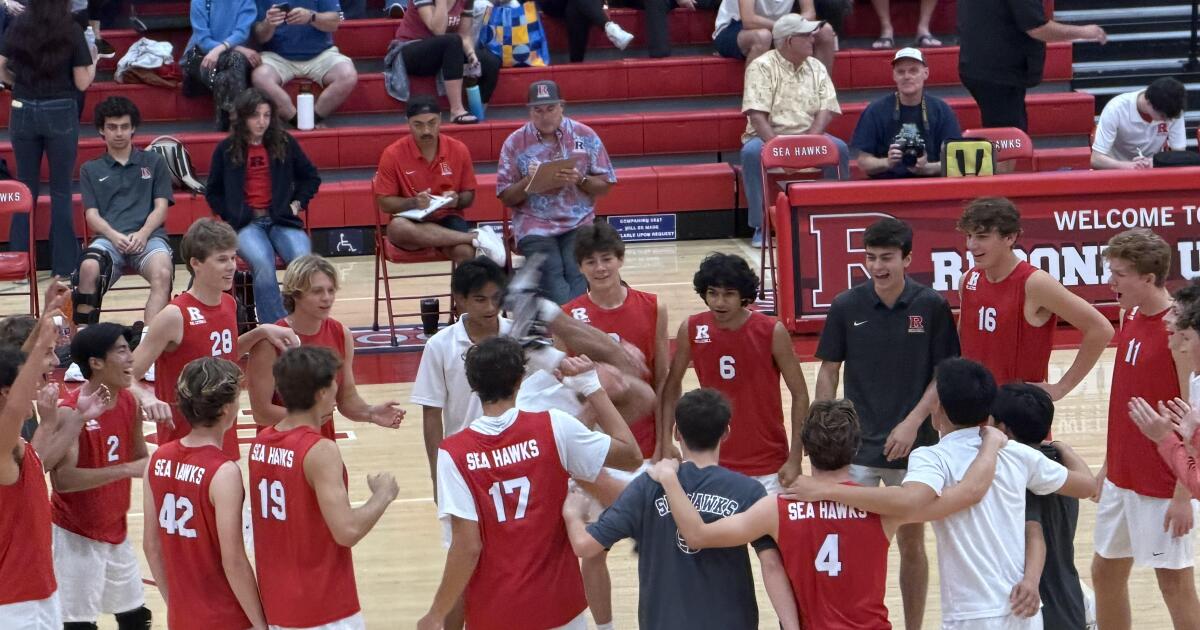
Redondo Union didn’t care that Mira Costa’s volleyball team was ranked No. 1 in California. This was their South Bay rival coming to their gym Thursday night, and anything can happen when a team digs deep and doesn’t fear losing.
The Sea Hawks (14-2) were aggressive from the outset and came away with a 27-25, 21-25, 25-22, 21-25, 15-13 victory.
At one point on back-to-back plays, Carter Mirabal had a block and Vaughan Flaherty followed with a kill off an assist from Spalding. Chemistry.
JR Boice, a Long Beach State commit, was delivering kills, and Cash Essert’s serving and all-around play kept Mira Costa’s Mateo Fuerbringer looking frustrated. The Sea Hawks’ focus was on Fuerbringer, who came alive in the fifth set with six kills, but Redondo was able to come back from an 11-9 deficit.
It was only Mira Costa’s second loss in 25 matches. Redondo Union took over first place in the Bay League.
Baseball
Orange Lutheran 3, Jacksonville (Fla.) Trinity Christian 2: The Lancers advanced to the semifinals of the National High School Invitational in Cary, N.C., behind a walk-off single in the eighth inning by Andrew Felizzari. Brady Murrietta had tied the score with a squeeze bunt in the bottom of the seventh. CJ Weinstein had two doubles for the Lancers.
Venice (Fla.) 12, Harvard-Westlake 0: The Wolverines were limited to three hits at the National High School Invitational in Cary, N.C.
Casteel (Queen Creek, Ariz.) 3, St. John Bosco 2: The Braves suffered their first defeat in North Carolina. Jack Champlin threw five innings and also had two RBIs.
Chatsworth 6, Taft 3: Tony Del Rio Nava threw six innings and had two RBIs in the West Valley League win.
Granada Hills 4, El Camino Real 3: A two-run single by Nicholas Penaranda in the seventh inning keyed a three-run inning for the Highlanders in their West Valley League upset. JJ Saffie had three hits for ECR.
Cleveland 4, Birmingham 3: The Cavaliers pushed across a run in the top of the 10th inning to break a 3-3 tie in the West Valley League win. Joshua Pearlstein finished with three hits, including a home run.
Sun Valley Poly 4, San Fernando 2: Fabian Bravo gave up four hits in 6 2/3 innings for the Parrots, who are tied with Sylmar for first place in the Valley Mission League. Ray Pelayo struck out eight for San Fernando.
Verdugo Hills 15, Kennedy 1: Cutlor Fannon had two doubles and four RBIs in the five-inning win. Anthony Velasquez added two singles and four RBIs.
Westlake 9, Agoura 4: Jaxson Neckien hit a three-run home run to power the Warriors.
Thousand Oaks 7, Calabasas 5: Gavin Berigan, Jeff Adams and Cru Hopkins each had two hits for the Lancers.
Oaks Christian 11, Newbury Park 2: Dane Disney contributed three hits in the Marmonte League win. Carson Sheffer had two doubles and three RBIs.
Santa Monica 12, Simi Valley 4: Ryan Breslo and Johnny Recendez had two RBIs and a triple for Santa Monica. Ravi Chernack had three RBIs.
Dana Hills 7, Corona Santiago 0: Gavin Giese finished with eight strikeouts over six innings and gave up one hit for Dana Hills.
Softball
Sherman Oaks Notre Dame 10, Sierra Canyon 0: Kelsey Luderer contributed three hits and two RBIs while freshman Ainsley Jenkins threw five scoreless innings.
Chaminade 15, Louisville 2: Norah Pettersen had two hits and four RBIs.
Carson 10, San Pedro 0: Atiana Rodriguez finished with three hits, including a double and triple, and three RBIs.
Huntington Beach 6, El Modena 2: Willow Kellen had three hits for the Oilers.
Murrieta Mesa 15, Chaparral 0: It’s a 16-0 start for the Rams. Tatum Wolff hit two home runs.
One month into the high school baseball season, it’s clear that junior third baseman and relief pitcher Troy Randall of Corona Santiago is headed to standout status.
So far, he’s batting .444 with 20 hits and only two strikeouts in 45 at-bats. As a pitcher, he’s given up no earned runs in eight innings with 13 strikeouts.
“He’s just been maturing,” coach Ty De Trinidad said.
Randall showed up as a 6-foot freshman and played junior varsity. Now he’s 6-2 and healthy after a broken foot last year interrupted his first season on varsity.
He made two terrific defensive plays on Wednesday in a loss to Corona and also had two hits.
His development has been important for Santiago, which is 10-3.
This is a daily look at the positive happenings in high school sports. To submit any news, please email eric.sondheimer@latimes.com.
The Iranian Red Crescent Society released video showing rescuers in Tehran lowering a man strapped to a stretcher from the wreckage of a building severely damaged in an airstrike.