Hillary Clinton

How Honduras helped vice presidential candidate Tim Kaine find his mission in life

Not long after Jesuit priest Jack Warner met a bearded, 22-year-old Midwesterner in 1980, the two Americans bonded, drawn together by the goals and questions that led them both to El Progreso, a small city not far from vast banana fields — the campos bananeros.

Warner was 35 and had arrived a year earlier to form the Teatro La Fragua, a theater company for Hondurans. As the young priest looked to forge a relationship with the campesinos, his friendship blossomed with Tim Kaine, who had taken a year off from Harvard Law School to join the Jesuit mission.

“He was 22 years old,” Warner said, “and it was the typical thing that a 22-year-old would do: What do I do with my life?”

Kaine, now a 58-year-old U.S. senator from Virginia and the Democratic vice presidential nominee, has often said that his time in Honduras helped him answer that question, giving him “a North Star” to guide his life toward public service. It’s central to his biography and likely to arise Tuesday night when he debates his Republican opponent, Mike Pence.

Election 2016 | Live coverage on Trail Guide | Sign up for the newsletter

When Kaine traveled to Honduras, the nation was in the throes of turmoil, flanked by countries torn by civil war and ruled by the heavy hand of a U.S-backed military bent on stamping out what it perceived to be communism spreading in the region.

“I got a firsthand look at a system — a dictatorship — where a few people at the top had all the power and everyone else got left out,” Kaine said in July at the Democratic National Convention.

He also witnessed extreme poverty. His experiences, coupled with the Jesuit goal of being “men for others,” led him to become a civil-rights lawyer for 17 years, specializing in housing-discrimination cases. Honduras convinced him, he said, “that we’ve got to advance opportunity for everyone.”

Kaine now serves on the Senate Committee on Foreign Relations and this year co-sponsored a bill that would increase aid to Central America’s “Northern Triangle” — Guatemala, El Salvador and Honduras.

Key to his experiences in Honduras was the friendship and example of Warner and a handful of other Jesuits. And a Christmastime visit to a poor man’s house taught him a lesson that resonates decades later.

During his time in El Progreso, Kaine lived in a barracks, along with Warner and other Jesuits. After their work days wrapped up about 5 p.m., he and Warner frequently commiserated over office duties, students, the teatro and the poetry Kaine was writing. Warner, a former English teacher, worked with Kaine on his verse. Over time, they became confidants.

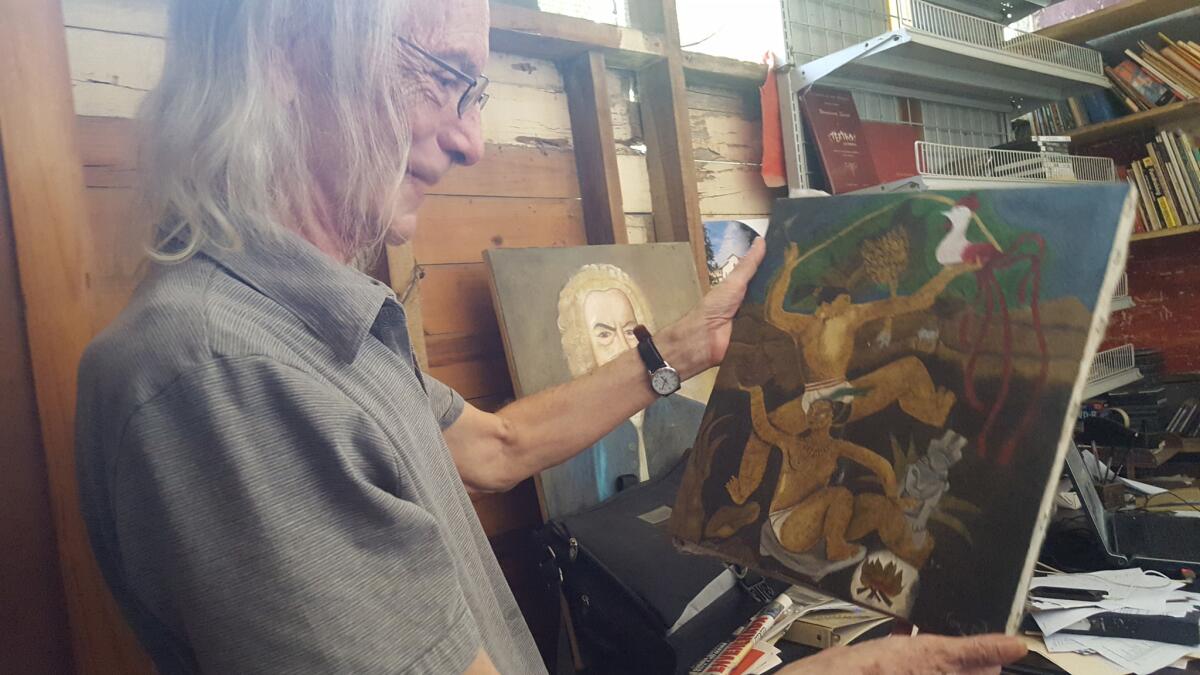
Father Jack Warner admires a painting created by an actor who performs in the Teatro la Fragua in El Progreso, Honduras.

Father Jack Warner admires a painting created by an actor who performs in the Teatro la Fragua in El Progreso, Honduras.

(Veronica Rocha / Los Angeles Times )

Both men grew up in the Midwest — Kaine in the Kansas City, Kan., suburb of Overland Park; Warner in St. Louis — and had been drawn to the Jesuit mission of social justice from an early age.

Kaine attended Rockhurst High School for boys, run by Jesuit priests who ran a demanding schedule of daily Masses, theology classes and community service activities with retreats.

Kaine, who earned a bachelor’s degree in economics at the University of Missouri, was at Harvard Law when he began to question his faith and the path he should take in life, he says. Because he had made a brief trip to Honduras in 1974 to deliver donations to the Jesuits, he decided to write them and see whether they could use some help. They said yes.

“He took a rather strong decision to seek out an answer — not everyone comes to Progreso,” Warner said.

Kaine had to tell his law school dean, and his parents, of this new direction. “The dean, not to mention my parents and friends, were confused about what I was doing and even questioned whether I would come back,” Kaine once recalled in a Virginia Tech speech.

By September 1980, Kaine was rumbling along in a bus into northern Nicaragua, where he visited another American Jesuit, Father James Carney. In Honduras months earlier, Carney had encouraged peasants to fight for their land, and he was expelled by the Honduran military, which saw him as one of the leftist priests who embraced liberation theology and the Sandinista revolution in Nicaragua.

Activists, some of them priests or the peasants they worked with, would be banished or killed by authorities. Carney would later disappear in what was believed to be a clandestine Honduran military operation backed by the CIA.

“It was a time when anytime the police stopped you, you got really nervous. You never knew what was going to happen,” Warner recalled. “We were under a military dictatorship at the time and very heavy military control. It was scary, and one had to live very carefully.”

We were under a military dictatorship at the time and very heavy military control. It was scary, and one had to live very carefully.

— Father Jack Warner, on Honduras in the 1980s

In El Progreso that September, Kaine soon met another Jesuit, Brother James O’Leary, a missionary also from Missouri.

O’Leary, who died in 2002, was often described as an outspoken, occasionally cranky but also skilled carpenter, painter and electrician who built houses and chapels for the poor. Kaine worked with him at his Loyola Technical Vocational Center, helping to boost the school’s enrollment and teaching carpentry and welding. As a youngster, Kaine had picked up skills working in his father’s ironworking shop in the Kansas City area.

Kaine declined to be interviewed for this story, but in a speech at the 2008 Democratic National Convention, he recalled what O’Leary taught him.

“I learned from a great mentor there, Brother Jim O’Leary, that faith is about more than words or doctrine — it’s about action,” he said. “And that led me to spend my life in public service.”

One of Kaine’s former students at the vocational center, Alex Hernandez Monroy, recalled the daily lessons in carpentry and welding from the shaggy-haired young American.

“His Spanish wasn’t very good, but despite all that he interacted with us,” said Hernandez Monroy, then 13 and now 48. Although Kaine couldn’t pronounce certain words, the students appreciated his efforts.

“Something very important that he did was that he visited the families of the students,” he said. “We were not used to interacting with Americans, so it had an impression on us to see someone like him educating us.”

Their debate might not matter much, but Mike Pence and Tim Kaine would be key White House players »

Using some of the skills he learned from Kaine and O’Leary, Hernandez Monroy teaches carpentry to a group of 15 students at the school. “They taught us that we could help our kids,” he said. “The majority of our youth are at risk, so that left an impression on us.”

::

About 35,000 people lived in El Progreso in 1980, when it was dominated by the presence of the United Fruit Co., the world’s largest — and often exploitative — banana company. Today it has a population of about 200,000, and the winding roads leading to the city are lined by brightly colored, one-story concrete homes.

During Kaine’s time there, however, it was a collection of dusty, rural villages and banana camps, with mountaintop towns accessible only by foot or mule. As a center for union activity, it became a target of the communism-fearing Reagan administration.

While war raged in neighboring El Salvador and Nicaragua, Honduras remained calm — but was gripped in fear. It was the staging ground for many of the United States’ clandestine operations aimed at toppling other governments.

People dared not speak about activism or union organizing lest they risk being among those who “disappeared.” More than a dozen priests were killed in the 1970s and 1980s after being associated with liberation theology, considered a Marxist-tinged doctrine that preached to the poor.

While Catholic priests in Central America were attacked for advocating on behalf of the poor, Kaine maintained a low profile and didn’t attract notice from the military.

Warner, a slender man with gray shoulder-length hair, recalled Kaine’s time in Honduras during a recent interview at the theater in El Progreso.

“His interest was in the students and what he was doing in his work, which is what we were all doing,” Warner said. “Trying to figure how we can do the work without being kicked out of the country for exploring it.”

Kaine also saw poverty and expressed his feelings about it through writing, as did Warner.

The priest maintained a daily newsletter with accounts of poverty and life in El Progreso. “We all have our defenses to shut out the existence of human misery, most of which consist of closing our eyes and pretending it doesn’t exist,” Warner wrote in a December 1980 newsletter. “Hopelessness then becomes a way of life for both parties.”

Warner published one of Kaine’s poems, titled “Still Life,” in which he described the “thick misery” of the town of San Pedro Sula. “In the saddest slum of San Pedro, lives are played out in the shade of a highway where buses glide like lost thoughts overhead.”

He likened the challenges, or “questions marks” facing the town to fingers testing the wind. “Each predicts change that just won’t come.”

Kaine spent nine months in El Progreso before returning to Harvard. He has kept in occasional touch with Warner and has returned to Honduras several times, most recently last year. This year, he and 25 senators called for an end to immigration raids in the U.S. targeting women and children who were fleeing violence in Honduras, Guatemala and El Salvador.

When he accepted the nomination for vice president, Kaine said that the three basic values he absorbed in Honduras hold true today: “Fe, familia y trabajo.” Faith, family and work.

Students take a break before heading to class to learn carpentry at Loyola Technical Vocational Center, where Tim Kaine volunteered, in El Progreso, Honduras.

Students take a break before heading to class to learn carpentry at Loyola Technical Vocational Center, where Tim Kaine volunteered, in El Progreso, Honduras.

(Veronica Rocha / Los Angeles Times )

“I came to understand the power of faith and communal worship,” Kaine said at Virginia Tech in 2006. “I learned how to speak Spanish and began to understand how the things which can seem to divide us — like language and skin color — were so much smaller than the dreams and fears that unite us.

Kaine also has repeatedly recalled what became one of his most indelible memories of Honduras.

He and Father Jarrell Wade, a Jesuit known as Father Patricio, had traveled by mule to visit a dirt-poor family around Christmas. As they prepared to leave, the husband handed Wade a bag. “Merry Christmas, padre,” he said.

Inside the worn bag were fruits and vegetables he had saved for the priest. Wade took the bag and thanked him.

Kaine was appalled and angered that the priest would take food from such a poor family — “I was fuming” — until Wade imparted the lesson: “You must be really humble to accept a gift of food from a poor person, and the most important thing in life is the ability to give.”

veronica.rocha@latimes.com

Twitter: @VeronicaRochaLA

Times staff writer Tracy Wilkinson in Washington contributed to this report.

ALSO

Tax troubles threaten Trump as election day nears, and so does his own approach to campaigning

These donors gave to Trump’s GOP rivals. Now 95% are sitting out the general election

Trump wanted to fire women who weren’t pretty enough, say employees at his California golf club


Source link

Trump’s remarks about the parents of a fallen Army captain become the latest trouble spot in his campaign

The father of an Army captain who died a hero in Iraq looked incredulous.

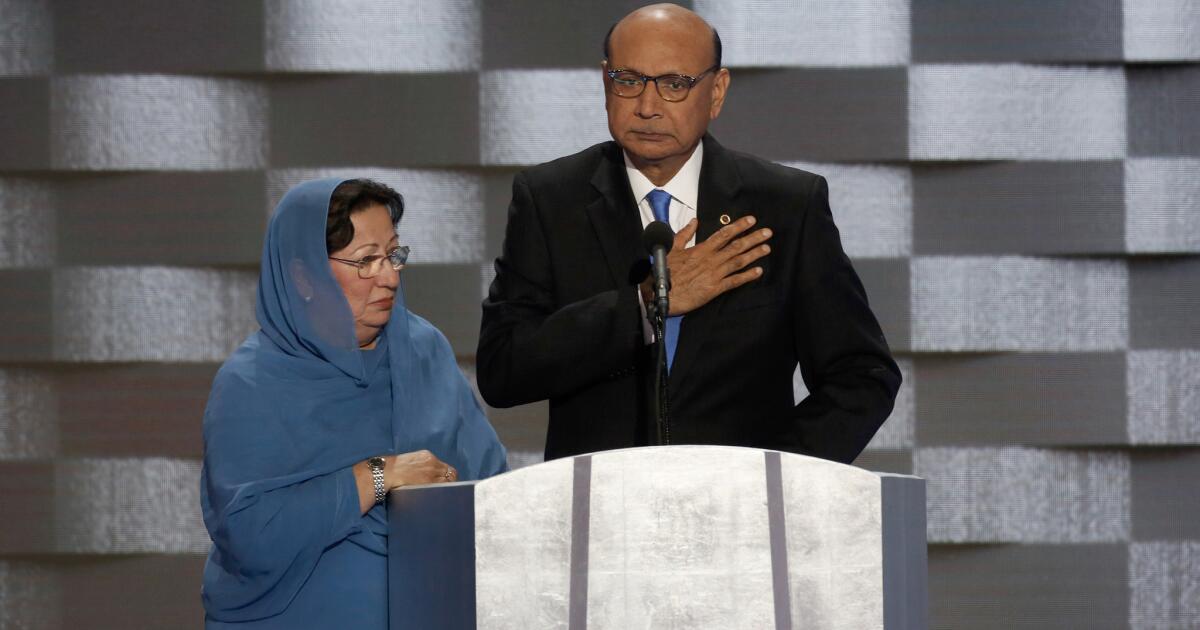
Donald Trump had seemed to criticize his wife on national television, suggesting that her Muslim faith might be the reason she stayed silent during the couple’s high-profile appearance at the Democratic National Convention last week, when Khizr Khan criticized the GOP presidential nominee.

Speaking to CNN on Sunday, Khan said his wife was simply too grief-stricken to speak that night. Then the father said something that may sum up Trump’s biggest challenge between now and November: “He had to take that shot at her.”

Trump has built an unlikely presidential campaign on his combative style and language. He can’t seem to resist taking a shot or responding to an attack, even when the political fight seems unwinnable.

That instinct arguably has served Trump well so far, allowing him to win a crowded Republican primary and stay competitive in national polls with Hillary Clinton.

But it has also caused him unneeded political wounds, playing into the Clinton campaign’s argument that he lacks the temperament to lead the country and sometimes stealing attention from Clinton’s own political liabilities.

The public feud with the Khans looks to stir up the biggest self-inflicted controversy since Trump criticized a federal judge in a fraud lawsuit against Trump University. Trump repeatedly questioned the judge’s ability to be fair because his parents were born in Mexico.

The Khan flap may also linger because Trump’s words were directed at grieving parents whose son died while serving the United States, rather than the politicians he usually targets.

“It violates almost every hallmark of traditional politics, but I guess that’s Donald Trump,” said Reed Galen, a veteran Republican consultant who is not supporting Trump or Hillary Clinton. “The way to get to a guy like Trump — and the Hillary campaign is now finally understanding this — this is a guy who can’t let slights, major or minor, go by.”

Trump’s puzzling engagement with the Khans not only inspired an unusually pointed rebuke from Clinton on Sunday, it also sparked broad condemnation from many Republicans.

For much of the weekend, Trump found himself squaring off against the Khans, whose convention appearance was an emotional high point for many Democrats. During the last night of the convention, Khizr Khan, his wife, Ghazala, beside him, recounted the loss of their son, Humayun. Then he questioned Trump’s call to ban Muslims from entering the U.S., pulling out a pocket Constitution and asking whether Trump had even read the document.

Trump could have let the moment pass, or simply praised their sacrifice without confronting them, as other politicians have done when met by military families who have rendered the highest sacrifice.

See the most-read stories in National News this hour >>

Instead, Trump, in an ABC interview broadcast Sunday, said Khizr Khan looked like a “nice guy,” but he questioned why Ghazala Khan did not speak during the convention, saying “maybe she wasn’t allowed to.”

He pushed back against Khizr Khan’s assertion that Trump’s proposal to ban Muslims from entering the country would have kept his son out. “He doesn’t know that,” Trump said. Then the businessman, who avoided the draft during the Vietnam War, said he too had made “sacrifices,” citing his hiring of “thousands and thousands of people.”

After the ABC transcript from the taped interview was released Saturday, Trump’s campaign attempted to correct course. In a statement released late Saturday, Trump called Humayun Khan “a hero to our country” and said “the real problem here are the radical Islamic terrorists who killed him.”

Yet he still could not resist keeping the fight alive.

“While I feel deeply for the loss of his son, Mr. Khan, who has never met me, has no right to stand in front of millions of people and claim I have never read the Constitution, (which is false) and say many other inaccurate things,” Trump added.

On Sunday, as the controversy festered, Trump complained on Twitter that “I was viciously attacked by Mr. Khan at the Democratic Convention.”

“Am I not allowed to respond? Hillary voted for the Iraq war, not me!” he said.

The Khans proved formidable and sympathetic foes as they granted multiple rounds of nationally televised interviews. Ghazala Khan wrote an emotional essay Sunday for the Washington Post, recounting her 12 years of grief since her son died, her inability to enter a room where his picture is displayed because of the pain, and the fact that she could not even bring herself to clean out his closet.

“I don’t think he knows the meaning of sacrifice, the meaning of the word,” Ghazala Khan said of Trump on ABC. “Because when I was standing there, all of America felt my pain. Without saying a single word. Everybody felt that pain, but I don’t know how he missed that.”

While trying to remain above the partisan swamp, they looked shaken yet defiant — casting Trump as someone who lacks a moral compass and the capability for empathy. They challenged Republican leaders to denounce Trump.

As the pressure simmered, Senate Majority Leader Mitch McConnell issued a statement of support for the Khans, saying he agreed “that a travel ban on all members of a religion is simply contrary to American values.”

House Speaker Paul D. Ryan also called out Trump’s proposed ban on Muslim travel and praised the “many Muslim Americans [who] have served valiantly in our military, and made the ultimate sacrifice. Capt. Khan was one such brave example. His sacrifice — and that of Khizr and Ghazala Khan — should always be honored. Period.”

Other Republicans were even more forceful.

“There’s only one way to talk about Gold Star parents: with honor and respect,” Ohio Gov. John Kasich, who lost to Trump in the primary and has withheld his endorsement, wrote on Twitter. “Capt. Khan is a hero. Together, we should pray for his family.” (Gold Stars are awarded to the family members of soldiers who die serving in the U.S. armed forces.)

Tim Miller, a former aide to Mitt Romney, wrote on Twitter that Trump’s words were a “grotesque slander of a dead soldier.” He contrasted them with George W. Bush’s response to an antiwar protest in 2005 by Cindy Sheehan, whose son died in Iraq.

“I grieve at every death,” an emotional Bush said at the height of the protest. “It breaks my heart to think about a family weeping over the loss of a loved one.”

Bush said he recognized and thought about the “sincere desire” of those who wanted to pull out of Iraq while laying out his case to keep troops there.

Clinton faced a similar question Sunday on Fox News. She was asked about the assertion by two parents who lost their sons in the 2012 attack on a U.S. compound in Benghazi, Libya, that Clinton had come to them on the day their bodies were returned to the United States and claimed their deaths were the result of an inflammatory video, rather than terrorism.

“My heart goes out to both of them,” she said, bemoaning their loss and praising them as “extraordinary men.”

“As other members of families who lost loved ones have said, that’s not what they heard — I don’t hold any ill feeling for someone who in that moment may not fully recall everything that was or wasn’t said,” Clinton added.

Clinton spoke directly about the controversy later Sunday at a church in Ohio.

“Mr. Khan paid the ultimate sacrifice in his family, didn’t he? And what has he heard from Donald Trump?” Clinton said. “Nothing but insults, degrading comments about Muslims, a total misunderstanding of what made our country great — religious freedom, religious liberty.”

Clinton has made Trump’s reactive style central to her critique. “A man you can bait with a tweet is not a man we can trust with nuclear weapons,” she said during her convention speech.

Even in defending against that charge, Trump showed his instinct to counterpunch, something many of his supporters admire.

“She’s a very dishonest person. I have one of the great temperaments,” he said on ABC. “I have a winning temperament. She has a bad temperament. She’s weak. We need a strong temperament.”

Trump’s campaign manager, Paul Manafort, blamed the controversy on Clinton, a tactic he has used after previous blowups.

“This is the Clinton narrative,” Manafort said on NBC, when asked about Trump’s comments about Khan. “Mr. Trump, of course, feels sorry for what the Khan family has gone through.”

The controversy came just a few days after another headline-grabbing moment, when Trump on Wednesday effectively baited Russia to hack Clinton’s old email account to try to recover more than 30,000 emails she deleted from the private server she used when she was secretary of State.

“He’s going off down these rabbit trails,” said Ron Nehring, a former national spokesman for Texas Sen. Ted Cruz’s presidential campaign and former chairman of the California Republican Party. “Every day that is spent on these manufactured non-issues is another day he is not training fire on Hillary Clinton’s vulnerabilities.”

Such controversies tend to overshadow issues that might otherwise gain broader attention, experts say, such as Friday’s disappointing economic growth figures.

During Sunday’s interview with ABC, for example, Trump tried to sidestep questions about his failure to release his tax returns and raised concerns about the timing of three upcoming presidential debates, complaining that two dates overlap with NFL games.

Times staff writer Chris Megerian in Columbus, Ohio, contributed to this report.

noah.bierman@latimes.com

Twitter: @noahbierman

MORE NATIONAL NEWS

Here’s how Democrats are trying to reclaim patriotism from Republicans — and how Trump helps

Shooting in downtown Austin leaves 1 dead, 3 wounded; suspect sought

A sparkling new Sandy Hook school arrives, with high-tech features and security ‘second to none’


UPDATES:

3:15 p.m.: The story was updated with additional reaction.

The story was originally published at 12:15 p.m.


Source link

Chicago’s ‘The People’s Celebration’ for the Rev. Jesse Jackson begins

Pall bearers carry the casket containing the body of the Rev. Jesse Jackson as it arrives for the public service at the House of Hope church in Chicago on Friday. The public service is for people to pay respects and honor Jackson. Jackson, a well known advocate for civil rights and for the poor, and two time presidential candidate, died Feb. 17 after suffering from progressive supranuclear palsy. Photo by Tannen Maury/UPI | License Photo

March 6 (UPI) — The public funeral for the Rev. Jesse Jackson began Friday morning, with state, religious and local dignitaries attending.

Former presidents Bill Clinton, Barack Obama and Joe Biden are scheduled to attend along with former Secretary of State Hillary Clinton and First Lady Jill Biden. Illinois Gov. JB Pritzker, Chicago Mayor Brandon Johnson, U.S. Rep. Maxine Waters, D-Ill., and Chicago Cubs owner Tim Ricketts are also scheduled to attend.

Musical guests scheduled are pop singer and actor Jennifer Hudson, and gospel singers Bebe Winans and Pastor Marvin Winans.

The event, called “The People’s Celebration,” is at House of Hope, a south side venue that can hold 10,000 people.

By 8 a.m. CT Friday, thousands were waiting outside the House of Hope to pay respects to Jackson, USA Today reported.

“This is an occasion for all of us – not only the African American community, but the rest of the world, to celebrate the accomplishments of a great man,” Eric Williams, a Chicago resident and member of the House of Hope church, told USA Today. “He will be greatly missed.”

Jackson died Feb. 16 at 84 of complications from progressive supranuclear palsy.

The civil rights activist lay in state in the Capitol Rotunda in Columbia, S.C., the state where he was born, and there were public and private services held in his honor there.

A service planned for Washington, D.C., has been postponed.

“The Jackson Family looks forward to honoring Rev. Jackson’s work and life in Washington, a city that held rich friendships and deep meaning for the Reverend,” Jackson’s family said in a press release.

Neil Sedaka

American singer/pianist Neil Sedaka performs at the “BBC Proms In The Park” in Hyde Park in London on September 11, 2010. Photo by Rune Hellestad/UPI | License Photo

Source link

Bill Clinton: ‘I saw nothing, and I did nothing wrong’ with Epstein

Feb. 27 (UPI) — Former President Bill Clinton testified in front of the House Oversight Committee in New York Friday, and said he didn’t know about Epstein’s crimes at the time he knew him.

It was the first time a former president has been compelled to testify to Congress.

“I had no idea of the crimes Epstein was committing,” Clinton said in a statement, which he posted on X. “No matter how many photos you show me, I have two things that at the end of the day matter more than your interpretation of those 20-year-old photos. I know what I saw, and more importantly, what I didn’t see. I know what I did, and more importantly, what I didn’t do. I saw nothing, and I did nothing wrong.”

He added that his childhood history of experiencing domestic violence would have pulled him away from Epstein if he’d known.

“As someone who grew up in a home with domestic abuse, not only would I not have flown on his plane if I had any inkling of what he was doing — I would have turned him in myself and led the call for justice for his crimes,” Clinton said of Epstein.

Rep. Anna Paulina Luna, R-Fla., walked out of the deposition after noon and said the former president “is being very cooperative.”

“I don’t have any reason to believe right now that he’s hiding the ball,” she said. “On everything, he’s been pretty transparent.”

The former president was deposed about his involvement with the late sex offender Jeffrey Epstein. His wife, former Secretary of State Hillary Clinton was deposed on Thursday.

Bill Clinton admitted knowing and traveling with Epstein, but he said his wife had “nothing to do with Jeffrey Epstein” and “no memory of even meeting him.”

“Whether you subpoena 10 people or 10,000, including her was simply not right,” he wrote in his statement.

“Since I am under oath, I will not falsely state that I am looking forward to your questions. But I am ready to answer them to the best of my abilities, consistent with the facts as I know them: the legitimate, the logical and even the outlandish.”

Rep. Robert Garcia, D-Calif., said Democrats have “real questions that deserve serious answers” from Clinton, but said the questioning of Hillary Clinton became a “sideshow” with a “series of bizarre questions” about UFOs and conspiracy theories. He said the committee should call for Trump to testify.

“Republicans are now setting a new precedent, which is to bring in presidents and former presidents to testify,” Garcia said. “We are now asking and demanding that President Trump officially come in and testify in front of the Oversight Committee.”

President Clinton testified on Friday in front of the House Oversight Committee after his wife, former Secretary of State Hillary Clinton did so on Thursday.

The testimony happened in Chappaqua, N.Y., in the town’s performing arts center, where he was asked about his involvement with the late sex offender Jeffrey Epstein.

Bill Clinton has denied any wrongdoing and has not been accused of any crimes in relation to the Epstein files.

“No one’s accusing, at this moment, the Clintons of any wrongdoing. They’re going to have due process,” committee chair James Comer, R-Ky., said before the deposition.

Epstein visited the White House at least 17 times in the early part of Clinton’s presidency, White House visitor records say. But Bill Clinton said he cut ties with Epstein around 2005.

On Thursday, Hillary Clinton testified that she never really knew Epstein, that she doesn’t remember meeting him and that she has “no knowledge” that would help the panel’s investigation. She called the deposition “political theater.”

The Clintons have asked for open testimony, but the committee has said they must have a closed-door deposition first. When subpoenaed, they didn’t comply for several months until the House nearly voted to find them in contempt.

While Hillary Clinton testified, a photo of the testimony was posted on X Thursday, sent to far-right influencer Benny Johnson by committee member Lauren Boebert, R-Colo. When she was asked by reporters why she did it, she answered: “Why not?” The proceedings were stopped for a short time while the committee tried to determine how the photo was leaked from the closed-door deposition.

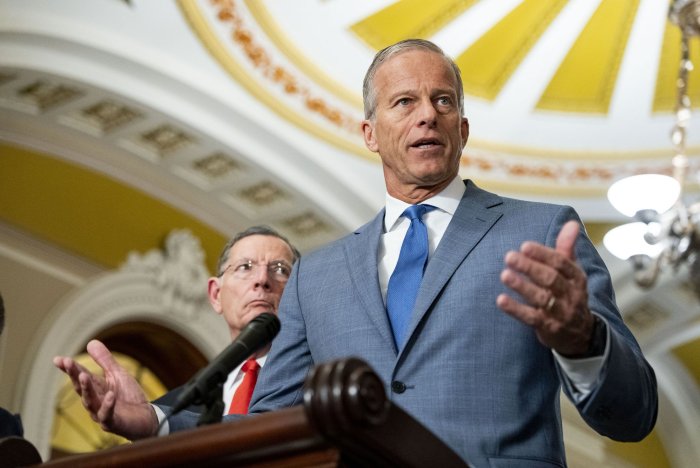
Senate Majority Leader John Thune, R-S.D., speaks during a press conference after the weekly Republican Senate caucus luncheon at the U.S. Capitol on Wednesday. Photo by Bonnie Cash/UPI | License Photo

Source link

Lutnick may be called to testify about Jeffrey Epstein

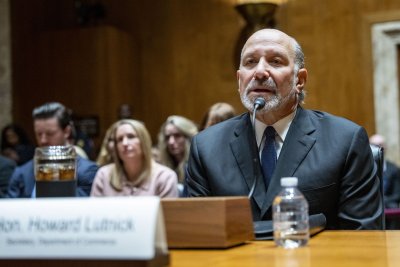
Secretary of Commerce Howard Lutnick, pictured during a hearing of the Senate Appropriations Committee earlier this month, may be called to testify before a House committee over his ties to deceased sex predator Jeffrey Epstein. Photo by Bonnie Cash/UPI | License Photo

Feb. 27 (UPI) — Commerce Secretary Howard Lutnick may be called to testify before the House Oversight and Government Reform Committee about his ties to deceased sex predator Jeffrey Epstein.

Rep. Nancy Mace on Friday said that Lutnick should testify after a picture of him with Epstein emerged in the Department of Justice database one day after Committee Chair Rep. James Comer, R-Ky., told reporters it is “very possible” the commerce secretary would be questioned.

Comer’s comments came at a press conference before the committee’s hearing with former Secretary of State Hillary Clinton, with Mace adding that calling Lutnick before the committee would “be on my list.”

“Howard Lutnick should take questions from the Oversight committee,” Mace said in a post on X, while a photograph that appears to be Lutnick standing behind Epstein, along with Lutnick’s friend Michael Lehrman and two other unidentified men.

The photo appeared to have been removed from the DOJ database, but has been restored, CNBC reported.

Rep. Ro Khanna, D-Calif., told reporters on Friday that he believes there are enough votes on the committee to subpoena Lutnick, who has acknowledged that he interacted with the disgraced financier after he’d been convicted of soliciting a prostitute, including visiting Epstein’s Caribbean island with his family.

Former Secretary of State Hillary Clinton on Thursday testified before the committee, saying in her opening statement that she has “no knowledge” that would assist the committee, which she posted on her social media accounts ahead being questioned.

“You have compelled me to testify, fully aware that I have no knowledge that would assist your investigation, in order to distract attention from President Trump’s actions and to cover them up despite legitimate calls for answers,” she said.

President Donald Trump has acknowledged his nearly two-decade friendship with Epstein and his name appears frequently in the documents released by the DOJ in December and January.

Neither Lutnick or Trump have been accused of any wrongdoing connected to Epstein’s trafficking and sex abuse of children.

Source link

Hillary Clinton says she has no knowledge to help Jeffrey Epstein investigation

Feb. 26 (UPI) — Former Secretary of State Hillary Clinton said she has “no knowledge” that would assist the House Oversight Committee in its investigation involving late sex offender Jeffrey Epstein in her opening statement before the panel Thursday.

Clinton posted the prepared statement on her social media account ahead of the closed-door deposition.

She said the committee didn’t ask President Donald Trump under oath about his appearances in the Epstein files or demand information from Florida or New York prosecutors about the plea deal Epstein made in 2008 that allowed him to avoid federal sex trafficking charges.

“Instead, you have compelled me to testify, fully aware that I have no knowledge that would assist your investigation, in order to distract attention from President Trump’s actions and to cover them up despite legitimate calls for answers,” Clinton said, according to the statement she posted on X.

“This institutional failure is designed to protect one political party and one public official, rather than to seek truth and justice for the victims and survivors, as well as the public who also want to get to the bottom of this matter,” Clinton said. “My heart breaks for the survivors. And I am furious on their behalf.”

Clinton gave a sworn declaration to the Oversight Committee on Jan. 13 in which she said she had no knowledge of crimes committed by Epstein and Ghislaine Maxwell, his convicted accomplice, and said she did not remember ever meeting Epstein.

The testimony Thursday at the Chappaqua, N.Y., Performing Arts Center, was interrupted during the first hour after right-wing influencer Benny Johnson shared an image on X from the closed-door proceedings.

“This is the first time Hillary has had to answer real questions about [Jeffrey] Epstein,” Johnson wrote on the post with the photo, which he attributed to Rep. Lauren Boebert, R-Colo. “Clinton does not look happy.”

Nick Merrill, a Clinton adviser, told reporters that the post caused the testimony to go off the record, “while they figure out where the photo came from and why possibly members of Congress are violating House rules,” Politico reported.

Before the testimony began, Rep. James Comer, R-Ky., gave a press conference outside of the venue.

“No one’s accusing, at this moment, the Clintons of any wrongdoing. They’re going to have due process,” The Hill reported Comer said

“But we have a lot of questions,” Comer said. “And the purpose of the whole investigation is to try to understand many things about Epstein. How did he accumulate so much wealth? How was he able to surround himself with some of the most powerful men in the world? Was he an asset for our government or any other government?”

Clinton and her husband, former President Bill Clinton, initially said they would testify in a public hearing, but committee chair Comer said the committee’s practice is to do interviews behind closed doors first, then hold hearings.

The House of Representatives was close to holding a bipartisan vote to hold them in contempt for ignoring a subpoena when the Clintons relented and agreed to be questioned in private.

Bill Clinton’s deposition is scheduled for Friday. Neither Clinton has been accused of any crimes, and both have called for the full release of the Epstein files.

At least 10 Republican members and nine Democrats were expected to attend the event, which was in the town where the Clintons now live, CBS News reported.

Clinton has said that she and her husband have little information to offer the committee.

“Other witnesses were asked to testify. They gave written statements under oath. We offered that,” she told the BBC last week. “Why do they want to pull us into this? To divert attention from President [Donald] Trump. This is not complicated.”

There are undated photos of Bill Clinton in the Epstein files with Epstein, who died by suicide in prison in 2019.

Bill Clinton’s spokesperson, Angel Ureña, has said he flew on Epstein’s plane four times in 2002 and 2003. The flights were for trips for the Clinton Foundation.

Hillary Clinton has said she doesn’t believe she ever met Epstein, but she was familiar with Maxwell. Maxwell is serving 20 years in prison for her sex trafficking conviction.

Maxwell told Deputy Attorney General Todd Blanche last year that, “President Clinton was my friend, not Epstein’s friend,” NBC News reported. She said she offered the plane to the former president. She also said that Bill Clinton was a close friend of billionaire Ted Waitt, founder of Gateway computers, whom she dated from 2003 to 2010. Maxwell and Waitt attended Chelsea Clinton’s wedding in 2010.

Senate Majority Leader John Thune, R-S.D., speaks during a press conference after the weekly Republican Senate caucus luncheon at the U.S. Capitol on Wednesday. Photo by Bonnie Cash/UPI | License Photo

Source link

Hillary Clinton testifies she has no information on Epstein’s crimes and doesn’t recall meeting him

Former Secretary of State Hillary Clinton told U.S. House lawmakers on Thursday that she had no knowledge of Jeffrey Epstein’s or Ghislaine Maxwell’s crimes at the start of two days of depositions that will also include former President Clinton.

“I had no idea about their criminal activities. I do not recall ever encountering Mr. Epstein,” Hillary Clinton said in an opening statement she shared on social media.

The closed-door depositions in the Clintons’ hometown of Chappaqua, a typically quiet hamlet north of New York City, come after months of tense back-and-forth between the former high-powered Democratic couple and the Republican-controlled House Oversight Committee. It will be the first time that a former president has been forced to testify before Congress.

Yet the demand for a reckoning over Epstein’s abuse of underage girls has become a near-unstoppable force on Capitol Hill and beyond.

President Trump, a Republican who has expressed regret that the Clintons are being forced to testify, bowed last year to pressure to release case files on Epstein, who killed himself in a New York jail cell in 2019 while awaiting trial. The Clintons, too, agreed to testify after their offers of sworn statements were rebuffed by the Oversight panel and its chairman, Rep. James Comer, R-Ky., threatened criminal contempt of Congress charges against them.

“We have a very clear record that we’ve been willing to talk about,” Hillary Clinton said in an interview with the BBC earlier this month. She added that her husband had flown with Epstein for charitable trips and that she did not recall meeting Epstein but had interacted with Maxwell, Epstein’s former girlfriend and confidant, at conferences hosted by the Clinton Foundation.

Maxwell, a British socialite, also attended the 2010 wedding of their daughter, Chelsea Clinton.

“We are more than happy to say what we know, which is very limited and totally unrelated to their behavior or their crimes, and we want to do it in public,” Hillary Clinton said.

Bill Clinton, however, has emerged as a top target for Republicans amid the political struggle over who receives the most scrutiny for their ties to Epstein. Several photos of the former president were included in the first tranche of Epstein files released by the Department of Justice in January, including a number of him with women whose faces were redacted. Clinton has not been accused of wrongdoing in his relationship with Epstein.

Comer has also pointed to Hillary Clinton’s work as secretary of state to address sex trafficking as another reason to insist on her deposition. The committee’s investigation has sought to understand why the Department of Justice under previous presidential administrations did not seek further charges against Epstein following a 2008 arrangement in which he pleaded guilty to state charges in Florida for soliciting prostitution from an underage girl but avoided federal charges.

Yet conspiracy theories, especially on the right, have swirled for years around the Clintons and their connections to Epstein and Maxwell, who argues she was wrongfully convicted. Republicans have long wanted to press the Clintons for answers.

“I mean if you’re the wife of Bill Clinton, aren’t you going to have some questions about your husband’s activities?” said Rep. Scott Perry, R-Pa., a member of the House Oversight Committee. “We only go where the facts take us. We didn’t put the president and the secretary in this position. They put themselves in it.”

Democrats, now being led by a new generation of politicians, have prioritized transparency around Epstein over defending the former leaders of their party. Several Democratic lawmakers joined with Republicans on the Oversight panel to advance the contempt of Congress charges against the Clintons last month. Several said they had no relationship with the Clintons and owed no loyalty to them.

Rep. Robert Garcia of California, the top Democrat on the Oversight panel, said that both Republican and Democratic administrations “have failed survivors in not getting more information out to the public.” He also said he wanted to ask about Epstein’s possible ties to foreign governments.

Democrats are also coming off an effort this week to confront Trump about his administration’s handling of the Epstein files by taking women who survived Epstein’s abuse as their guests to Trump’s State of the Union address. Even senior Democrats, such as former Speaker Nancy Pelosi of California, said it was appropriate for the committee to interview anyone, including the former president, who was connected to Epstein.

“We want to hear from everyone,” Pelosi said, adding that she did not see why Hillary Clinton was being interviewed and that it was important to “believe survivors.”

Groves writes for the Associated Press.

Source link