Without a doubt, St. John Bosco (9-3) playing Corona Centennial (9-3) on Friday night at the Coliseum for the Southern Section Division 1 championship is the game of the year. Two programs in peak form guided by elite coaches with fans who expect nothing less than championships.
Centennial, one of the few public schools to annually stay competitive with the top private schools, is the last public school to win a Division 1 championship in 2015. The Huskies’ Matt Logan has 314 victories and is nearing the end of a Hall of Fame coaching career. During the regular season, the Huskies played with an offensive line that wasn’t at full strength. In the playoffs, completely healthy, Centennial has scored 87 points in two playoff wins.
Way back in August, St. John Bosco was the preseason No. 1 team. Then came stumbles and losses to Bishop Gorman, Santa Margarita and Mater Dei. Coach Jason Negro, in reaching his 11th final in 17 years, was trying to figure out why the defense was giving up too many big-play touchdowns on passes. There were turnovers, interceptions and crazy penalties.
Corona Centennial coach Matt Logan will get to wear his shorts again in Friday’s Southern Section Division 1 final against St. John Bosco at the Coliseum.
(Craig Weston / For The Times)
Everything changed in the playoffs. The real St. John Bosco showed up. The defense hasn’t allowed any points in wins over Orange Lutheran and Santa Margarita. The running game is gaining momentum and quarterback Koa Malau’ulu is gaining confidence.
“We have two great programs that have battled for many years,” Logan said.
Said Negro: “Centennial probably brings a little bit more challenge to us and our program because of how well coached they are. [Coach Logan] is obviously the gold standard when it comes to high school football in Southern California.”
It all sets up what should be a wonderful night of high school football, matching best against best. If you watch the game, you’ll understand how much different Division 1 football is in Southern California. The amount of talent on the field is real. These two programs have been sending players to college and the NFL for decades. Centennial was blown out in last year’s final at the Rose Bowl. This is a different team now that the versatile Jaden Walk-Green is healthy.
Let’s examine some other fun matchups this weekend.
FRIDAY
City Section Division II
Marquez vs. San Fernando at Birmingham, 7 p.m.
It could be the final game for interim coach Johnny Sanders of San Fernando. He has been selected head coach at Pasadena. Marquez was the No. 12 seed but has come on strong behind linebacker/tight end Elyjah Staples.
Southern Section Division 3
Villa Park vs. Long Beach Poly at El Modena, 7 p.m.
The longtime Division 1 power Jackrabbits started the season 2-4 but have been rolling ever since sophomore quarterback Trevor Scott became eligible. Defensive back Donte Wright is a Miami commit well known for making big plays. Sophomore quarterback Jacob Titchenal has been a surprise for Villa Park, passing for 2,492 yards and 23 touchdowns.
SATURDAY
City Section Open Division
Carson (11-1) vs. San Pedro (9-2) at L.A. Southwest College, 5 p.m.
It’s a rematch of the Marine League game won by Carson 35-0. Quarterback Seth Solorio will have to perform at its his best. Few teams have been able to contain Carson quarterback Chris Fields III. You get to pick your poison because he’s good running or passing. The City Section has a history of teams losing during the regular season and coming back to win the rematch. San Pedro needs to embrace that culture.
City Section Division I
Hamilton (8-5) vs. Wilmington Banning (7-6) at L.A. Southwest College, 1 p.m.
The chance to see sophomore quarterback Thaddeus Breaux of Hamilton will be entertaining enough. This program has been turned around quickly by coach Elijah Asante, who must respect a Banning team that upset top-seeded Granada Hills Kennedy in overtime. Quarterback Noa Tuvalu has passed for nearly 1,800 yards and 18 touchdowns for Banning.
Southern Section Division 2
Palos Verdes (12-1) at San Juan Hills (11-2), 7 p.m.
The fantastic duo of quarterback Ryan Rakowski and receiver Jalen Flowers gets tested against a San Juan Hills defense that made all the weapons of top-seeded Chaparral suddenly look average in an upset win last week. In his first season as a kicker, soccer player Trevor Koko is 13 of 14 on field-goal attempts. The winner should be in good position to go for a state championship.
Surprise guests, all-star performances and heartfelt speeches are staples when it comes to the Rock and Roll Hall of Fame induction ceremony experience and this year’s edition, held at the Peacock Theater in downtown Los Angeles Saturday night, delivered.
Phil Collins, Billy Idol, Iron Maiden, Joy Division/New Order, MC Lyte, Oasis, Queen Latifah, Rick Rubin, Sade, Luther Vandross and Wu-Tang Clan were among the new class of inductees while Oprah Winfrey, Neil Young, Bob Odenkirk, Travis Barker and Megan Thee Stallion brought star power, heart and musical history to their celebratory speeches.
From the Red Hot Chili Peppers performing in costume to Barker and Cynthia Erivo crushing the Collins classic “In the Air Tonight,” catch up on the highlights of the ceremony here before it airs Dec. 8 on ABC (streaming on Hulu and Disney+ the next day).
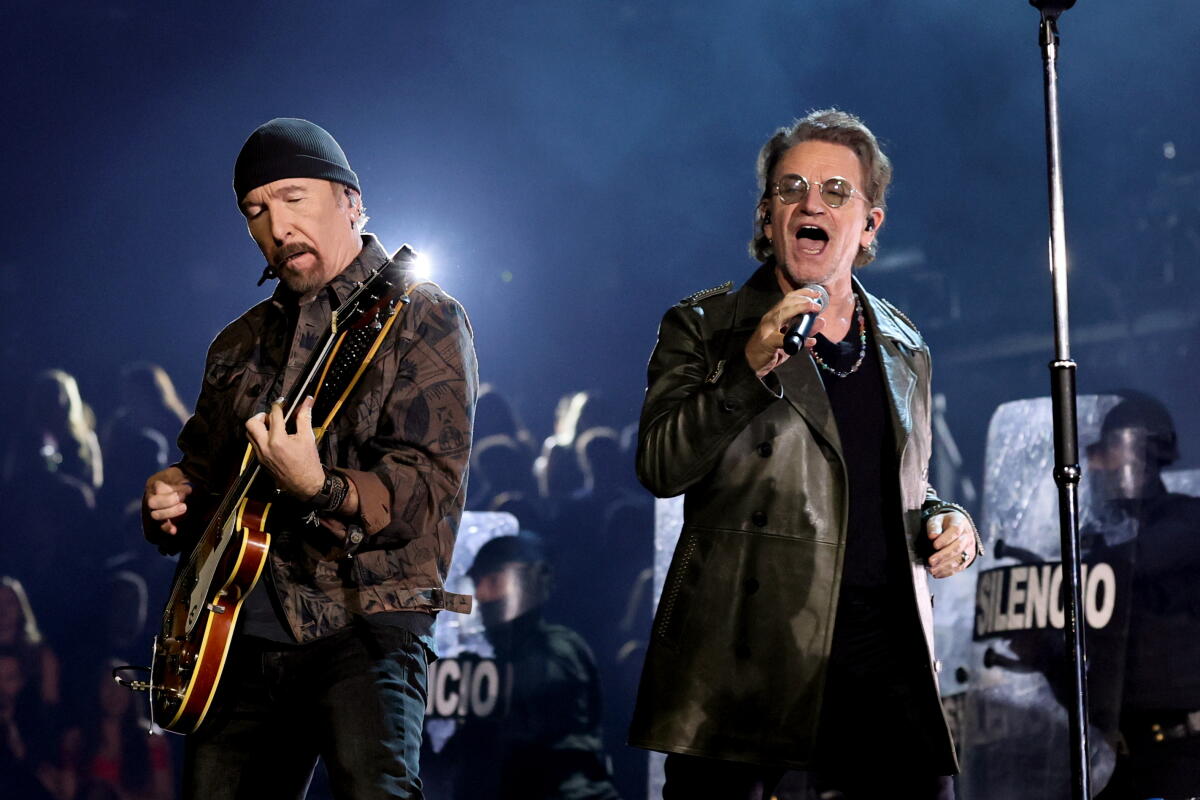
The Edge and Bono of U2 perform onstage during the 2026 Rock & Roll Hall of Fame Induction Ceremony.
(Theo Wargo / Getty Images for RRHOF)
U2’s opening surprise
The Rock Hall got one of the biggest rock bands in the world to open Saturday night’s show: U2. The band performed “Silencio” from new album “Carnaval de Luz” while surrounded by guys dressed as riot cops, which with the choreography kicked off the night in true Rock Hall fever dream fashion. They followed up by playing hit “Pride (In the Name of Love).” It’s also notable that the band, not obviously connected to this year’s class, got two performance slots.
Flea and Anthony Kiedis of Red Hot Chili Peppers perform during the 2026 Rock & Roll Hall of Fame Induction Ceremony.
(Theo Wargo / Getty Images for RRHOF)
Rick Rubin’s trio of tributes
Mega-producer Rick Rubin was inducted by Neil Young, who leafed through a legal pad as he enumerated some of the many acts whose vibes Rubin has helped protect decade by decade — including Tom Petty, Johnny Cash, Adele and the Chicks — at times Neil Young-ishly looking down at an audience full of music execs and talking about how sacred the recording studio is from business people. (By contrast to Young’s long induction, here’s Rubin’s speech in its entirety: “Can’t kill rock and roll.”)
The comedic highlight of the night was a performance of “Give It Away” by the Red Hot Chili Peppers — all dressed like Rick Rubin with long white hair, white beards and orange-tinted sunglasses. In the first verse the song comes to an abrupt stop because there wasn’t any bass coming through.
The traditional all-star jam to close the night was eschewed in favor of another performance with ties to Rubin: what Public Enemy’s Chuck D introduced as a historic attempt to be “badass and funky at the same time.” It was Aerosmith and Run-DMC doing — what else? — “Walk This Way.”
Inductee Phil Collins and Travis Barker speak onstage during the 2026 Rock & Roll Hall of Fame Induction Ceremony.
(Theo Wargo / Getty Images for RRHOF)
Phil Collins’ unlikely tribute partners
The biggest response from the crowd early in the night came as Phil Collins made his way onstage, aided by a pair of canes, after a speech from Travis Barker.
“I’m really not as bad as it looks,” he joked in regards to his medical challenges over the last few years. He also shouted out his assistant, without whom he says he’d “be in a box,” and his ex-wives and their kids.
“You haven’t heard the last of me,” Collins said, regarding the rumors of tours and performances.
Barker was back behind the kit to perform “In the Air Tonight” with Cynthia Erivo. Chris Rock offered an appraisal of Cynthia Erivo’s performance moments later with “She f— did that s—.”
Inductees MC Lyte and Queen Latifah perform onstage during the 2026 Rock & Roll Hall of Fame Induction Ceremony.
(Theo Wargo / Getty Images for RRHOF)
Ladies first: Queen Latifah teams up with MC Lyte
MC Lyte and Queen Latifah performed together, and though it’s worth asking why none of the men had to share slots, these two traded songs back and forth with clear love and respect. The medley-closer of “Ladies First” got cameos by Megan Thee Stallion and Remy Ma, who inducted Queen Latifah and MC Lyte, respectively — and ended in a group hug.
Before that, they also praised each other during their speeches. “If it wasn’t for Lyte, I wouldn’t know that this was really possible,” Queen Latifah said.
During her speech, MC Lyte gave a parting shot of wisdom for the crowd that seems ever more important: “Build multiple streams of income, because one is not enough.”
Chris Rock, and Inductees the Wu-Tang Clan speak onstage during the 2026 Rock & Roll Hall of Fame Induction Ceremony.
(Theo Wargo / Getty Images for RRHOF)
Wu-Tang Clan brings the ruckus — and the thank yous — to the Rock Hall
Wu-Tang Clan’s nine MCs “were on a mission to open people’s minds,” Chris Rock said in his induction speech. And it went beyond music — it was about “the slang, the attitude, the hoodies, the Timbs.” The group “built a whole world and invited everyone in.”
RZA ran down a long list of the record execs who’ve worked with the group. “Shout out to our legal team as well.” In contrast, Method Man thanked his family: “I love y’all like cooked food.” Inspectah Deck said he was having a ball: “I partied with Billy Idol,” before the group’s speech was cut off, with boos from the crowd, before it reemerged to do a medley heavy on “36 Chambers (Enter the Wu-Tang).”
Gwen Stefani and Inductee Billy Idol perform onstage during the 2026 Rock & Roll Hall of Fame Induction Ceremony.
(Theo Wargo / Getty Images for RRHOF)
Billy Idol: Motivational speaker
No Doubt’s Gwen Stefani and Tony Kanal inducted Billy Idol, who made sure guitarist Steve Stevens got his flowers too. Kanal said Idol turned a “fist pump into a philosophy.”
After Idol and Stevens performed “Rebel Yell,” Stefani joined them for “Eyes Without a Face,” which she said she remembered hearing out of every boombox on the beach in 1984.
“We are beautiful because we are true to ourselves. Rock and roll gave me the ability to understand that and to live it,” Idol said in his motivational induction speech.
“Find out who you are, and be it,” he told his younger fans to end his speech. “And now, I’m gonna party with the Wu-Tang Clan!”
Inductee Peter Hook of Joy Division/New Order performs onstage Saturday during the 2026 Rock & Roll Hall of Fame Induction Ceremony at Peacock Theater.
(Theo Wargo / Getty Images for RRHOF)
Joy Division/New Order induction becomes a new wave dance party
Trent Reznor inducted New Order and the band’s earlier incarnation, Joy Division.
The only member of the groups in attendance was bassist Peter Hook, but he joined Deftones and Lauren Mayberry (of Churches) on Joy Division’s “Love Will Tear Us Apart” and New Order’s “Bizarre Love Triangle” that had the Peacock Theater up and dancing.
“For me, it’s been a wild 50 years — I’ve been happy, I’ve been mad, I’ve been heartbroken in equal measure,” Hook said. “But I’m still f— here.”
He also gave a plug to his group, Peter Hook and the Light, which he noted plays both Joy Division and New Order songs.
Bob Odenkirk speaks onstage during the 2026 Rock & Roll Hall of Fame Induction Ceremony.
(Theo Wargo / Getty Images for RRHOF)
The loud absences of the induction class
A few members of this year’s class didn’t attend the ceremony, notably Oasis, Sade and Iron Maiden.
Bob Odenkirk, on hand to induct the former, said he played Oasis songs every day before going on set as Saul Goodman, calling them “a dose of Viagra for the ego,” before country-rock singer Stephen Wilson Jr. turned “Wonderwall” into an Appalachian death march.
“There will only ever be one Sade,” Andra Day said in her induction speech before introducing Sienna Spiro to perform “Smooth Operator.”
Since British metal icons Iron Maiden were on tour in Australia, they didn’t perform at the ceremony. In their place we got a dynamite supergroup: Metallica’s Kirk Hammett and Robert Trujillo, John 5, Rage Against the Machine/Audioslave’s Brad Wilk and St. Vincent performing “The Trooper.” Jack Black, clad in a Maiden shirt, jumped in on the chorus after giving the induction speech.
Meanwhile, Luther Vandross, who died in 2005, was feted by Oprah Winfrey in a heartfelt speech. “Luther never once over-sang a feeling,” she said. He “sang songs for weddings and heartbreaks and late nights and Sunday mornings.” Put on “A House Is Not a Home,” she suggested, and suddenly you’re “standing in the doorway of every love you ever lost.”
Usher performed a musical tribute medley of “So Amazing” and “Here and Now” — gorgeous ballads that Vandross used to show off how good he was at taking his time with a melody — and “Never Too Much,” which proved he also knew how to keep it moving.
Kuala Lumpur, Malaysia – Southeast Asian leaders are preparing to hold their flagship annual summit as US President Donald Trump embarks on an Asia Pacific trip that will focus attention on his upending of trade and traditional alliances.
Leaders of the Association of Southeast Asian Nations (ASEAN) are gathering in Manila, the Philippines, for a series of multilateral and bilateral meetings running from Sunday until Tuesday.
Recommended Stories
list of 4 itemsend of list
Trump is scheduled to meet Philippine President Ferdinand Marcos Jr during a brief stop in Manila on Tuesday, before heading to the Asia Pacific Economic Cooperation (APEC) summit in Shenzhen, China, where he will have his fourth face-to-face meeting with Chinese President Xi Jinping in just over a year.
It will also be the first time that Trump, Xi and Russia’s President Vladimir Putin will meet for trilateral talks, the White House has confirmed.
Trump’s visit to Southeast Asia – his second since his return to the White House after his attendance at the 2025 ASEAN summit in Malaysia – comes after his administration announced new tariffs on dozens of trade partners, including most of the region’s economies, in July.
Trump’s administration announced the duties of between 10 and 12.5 percent after the US Supreme Court struck down his steeper “reciprocal” tariffs in February.
The Office of the US Trade Representative said it was imposing the tariffs on 60 trade partners over their alleged failure to clamp down on forced labour.
The Trump administration is also conducting trade probes over alleged national security and “excess” manufacturing concerns that could result in yet more tariffs for Southeast Asian trade partners.
Exports up – but can it last?
Southeast Asia has weathered Trump’s trade salvoes relatively unscathed until now, in part as a result of the diversion of billions of dollars of Chinese trade through the region.
US imports from ASEAN rose more than 29 percent to $453.6bn in 2025, expanding the trade deficit between the sides to $327.4bn, according to the Office of the US Trade Representative.
Deborah Elms, head of trade policy at the Hinrich Foundation in Singapore, said, however, that Southeast Asian countries cannot guarantee that their luck will continue.
“ASEAN has had mixed success in navigating US tariffs. Overall exports are up. But this is primarily driven by shipments of electronics which are largely exempt from tariffs,” Elms told Al Jazeera.
“These shipments are also strongly tied to the AI buildout. If that falters, ASEAN will feel it,” she said.
While ASEAN leaders have provided few details about the summit agenda, trade is likely to be among the main topics of discussion.
For a bloc that often faces accusations of being a talking shop, one of the most anticipated tangible outcomes is the signing of the Digital Economy Framework Agreement, a pact aimed at easing cross-border data transfers and electronic payments.
Initiated in 2023, the framework has been billed as a step towards building an ASEAN digital economy worth $2 trillion by 2030.
Waiting for Trump’s next move
Jayant Menon, a senior fellow at the ISEAS-Yusof Ishak Institute in Singapore, said Southeast Asian leaders will be concerned about “what comes next” from Trump on trade.
“So far, the recent tariffs appear to have had a limited impact on competitiveness of ASEAN exports. But this may change in the future, with more sectoral tariffs, in particular, or other measures such as export controls,” Menon told Al Jazeera.
“Trump still retains significant autonomous authority over trade policy despite losing control of both houses, and could double down rather than back off,” Menon said, referring to the Republicans’ crushing defeat in the US midterm elections on November 3.
Boosting regional trade
Phar Kim Beng, a professor of ASEAN studies at the International Islamic University of Malaysia, said Southeast Asian leaders are likely to reiterate calls for increased trade within the region, a goal that has lagged aspirations despite decades of trade liberalisation in the bloc.
“Whether measured from 1970 or 2025, intraregional trade remains paltry at 23 percent. In contrast, the European Union can cross intraregional trade of 67 percent easily,” Phar told Al Jazeera.
Phar said he does not expect ASEAN to announce any significant measures to spur trade within the bloc, but its leaders will continue to “mouth the mantra of better and bigger” trade volumes.
“Regardless of the tariffs intended by President Donald Trump, ASEAN will continue to muddle through by speaking of the importance of trade and more trade,” he said.
France hold their nerve to beat South Africa by just two points, winning 21-19 at the Stade de France, to make it four wins from five in the Nations Championship and putting the home side in a strong position to top the northern hemisphere standings.
Arsenal extend their unbeaten start to four matches in the Uefa Women’s Champions League, as they produce a dogged display to hold Barcelona to a 1-1 draw at the Camp Nou.
The point moves Renee Slegers’ side into the top four, putting them in a great position to automatically qualify for the knockout stages.
“The third quarter was productive on all fronts, marked by continued regulatory progress, important technical milestones, new partnerships and perhaps most notably, highly visible market validation of the increasing value and strategic importance low-band spectrum
Seeking Alpha’s Disclaimer:This article was automatically generated by an AI tool based on content available on the Seeking Alpha website, and has not been curated or reviewed by humans. Due to inherent limitations in using AI-based tools, the accuracy, completeness, or timeliness of such articles cannot be guaranteed. This article is intended for informational purposes only. Seeking Alpha does not take account of your objectives or your financial situation and does not offer any personalized investment advice. Seeking Alpha is not a licensed securities dealer, broker or US investment adviser or investment bank.
League One side, and 2021 champions, Leicester City avoid an upset as they beat sixth-tier Oxford City 4-2 at the MGroup Stadium, to reach the second round of the FA Cup.
Porto score three goals in the final 20 minutes of the game to pull away and seal a comfortable victory against Napoli, who are unable to match their Portuguese opponents in the second half.
Victims of the Oct. 29 hack that stole approximately $6.3 billion in digital assets from crypto exchange operator Binance will be made whole using company funds, the exchange operator announced the day after the hack.
Richard Teng, Co-CEO of Binance, said in a video statement posted on X that the company has already used $5 billion to purchase the affected digital assets, including USDC, USDT, BTC, and others, through market and over-the-counter purchases.
“Most of what we earn from day-to-day operations is held in crypto assets and then is reinvested into the business and security,” he said. “Because we believe in crypto and the long-term value of this industry, this is precisely why we are able to absorb a loss of this size immediately with our own money.”
Binance plans to release a full proof-of-reserves report by Nov. 2. Until then, it has paused withdrawals to investigate, rebuild, and retest its entire infrastructure. The move has frozen an estimated $3 billion in digital assets, including $2.3 billion in stablecoins such as USDT and USDC, according to CoinDesk.
Anatomy of a Hack
Binance initially said the hacker gained access to its system via a compromised laptop belonging to a DevOps engineer, but further investigation revealed that the hot wallet hack, which is used for regular transactions, was far more complex and involved multiple breach points.
“The attacker used a self-destruct mechanism that destroyed tooling and tracers as they ran, which makes it more difficult for us to trace and investigate,” said Teng. “The attacker used a known multi-signature protocol, EIP 7702, to obtain on-chain execution approval of a hot wallet. The delegation did not pass through our normal approval controls.”
“The attacker sold about 325 million USDT to market makers within minutes of receiving it,” said Ari Redbord, global head of policy at TRM Labs. “This shows how quickly stolen funds can reach unsuspecting counterparties.”
An Ounce of Prevention
CFOs of firms with stablecoins frozen by Binance should prepare to prove that the frozen assets belong to their companies by providing copies of account agreements, every deposit and withdrawal address, transaction hashes, statements, and approval logs.
“Treasury should own that file, and copies should live on your own systems, since a custodian’s platform can go dark during an incident,” said Redbord. “When issuers like Tether and Circle freeze funds, the paper trail decides who gets them back.”
He also suggested that every corporate treasury have its custodian commit to five things in writing: a set time to inform you of an incident, clear legal title to the company’s assets that is separate from the custodian’s title, reviewable insurance and audit controls, systems divided by chain and wallet type, and round-the-clock cooperation with stablecoin issuers and law enforcement.
“This hack showed what that cooperation can do, because issuers froze about $2.7 billion within hours,” said Redbord. “Test it before you need it.”
Rob Daly writes about the economy and fintech. You can reach him at rdaly@gfmag.com
WASHINGTON — After spending a month asking voters to treat the midterms as a vote on him, President Trump closed his monthlong campaign sprint on Monday sounding like a man bracing for defeat.
“For some reason, the sitting president doesn’t win the midterms,” Trump said. “But we gave this a very strong shot.”
Still, Trump said he hopes Americans are “ready to do the right thing” and insisted that Republicans could hold on to Congress if voters who buoyed his 2024 victory turn out again. He urged voters to do so, calling this election “the most important midterm, I believe, in our lifetime.” The alternative, he warned, will be a “radical agenda” in Washington as he finishes his last two years in office.
“With your vote, we will decide if these extremists will be given power or not,” Trump said, claiming that the Democratic Party has “nominated the most extreme and dangerous slate of candidates in American history.”
The message capped a dizzying campaign push in which Trump made himself the focus of the midterms as he held dozens of rallies in mostly Republican states. In those rallies, he promised $5,000 checks and brighter days ahead to Americans who vote to keep Republicans in control of Congress. But heading into Tuesday, most polls are predicting a Democratic wave amid a voter backlash to Trump’s handling of the economy and a war in Iran.
Democrats are heavily favored to retake power of the House and are leading in all the key states that would be the likeliest to decide which party will control of the Senate, according to a New York Times/Siena University poll released Sunday. But polling can be flawed, as evidenced by forecasts that underestimated Trump’s support in the 2016 and 2020 elections.
Trump’s approval rating is near historic lows this time around, the poll found. A separate NBC News poll released Sunday found nearly two-thirds of voters are seeking a change from the direction Trump is leading the country.
This year, early voting has already seen strong turnout, outpacing the last midterm election cycle, a trend that could mean bad news for Republicans. If a Democratic surge materializes, party leaders have vowed to use their potential congressional powers to investigate Trump and his family’s business dealings, with a focus on alleged corruption and economic harm to the American people.
Trump told Fox News on Sunday that if Democrats win control of both chambers he will “become Mr. Veto” and “make deals” with them, but hopes he won’t have to “worry about that.”
On the eve of the election, Trump’s message once again seemed to acknowledged that possibility, but his focus was largely focused on the numerous beautification projects his administration is leading in the nation’s capital.
President Trump holds up an image of algae in the Reflecting Pool as he delivers remarks Monday.
(Andrew Harnik / Getty Images)
His final pitch to voters was made in front of the Lincoln Memorial Reflecting Pool, a landmark his administration has spent months trying, and at times failing, to repair. For the first 20 minutes, he did not mention the election at all. Instead, he flipped through photos of the damaged pool, describing in detail how crews resurfaced and re-caulked its granite, and worked to address the “tremendous algae” that covered the pool.
“Look, it is not an easy thing. The algae is brutal. It forms easily and I don’t think you’ll see too much,” Trump said as he showed a picture of the algae layered over the water. “The green, that’s not grass, that’s algae. It took over the entire pool.”
Trump spent time listing numerous other renovation projects around the capital, arguing that the construction work shows how his presidency is delivering for the American people.
“Our country is strong, respected and prosperous once more and our capital is cleaner and safer and more spectacular than ever,” Trump said.
His focus on renovation projects drew the attention of Democrats, who argued his message was out of touch with what American voters want from leaders now.
“This is just [what] the median voter wants to hear — an update on various capital improvement projects in the District of Columbia,” Ashley Schapitl, a former Biden Treasury official, posted on X.
It was not the first time Democrats had poked fun at the president’s for being too focused on construction projects. At a rally last week, former President Obama said Trump “should be on HGTV,” ridiculing his ballroom project and the changes he has made to the Rose Garden and the Oval Office.
“He has the White House looking like Saddam Hussein opened a Cheesecake Factory,” Obama said. “There’s just gold everywhere.”
Trump has bristled at such criticism, insisting that renovations relax him and that he gets them done quickly.
His message on Monday struck a similarly dismissive tone as in other campaign events. Even as voters say they are struggling with the cost of living, Trump has insisted the economy is “booming” and brushed off higher gas prices as a “very small price to pay” for the war in Iran.
The contrast was on display over the weekend at a glitzy Halloween party at Mar-a-Lago, the president’s private club in Florida. As hundreds gathered in the club’s ballroom, eating Alaskan king crab and caviar, Trump showed off the crowd to reporters.
“Look at all my rich members,” Trump told reporters. “They spent all day getting ready. Look at these guys.”
Arsenal win at Anfield for the first time since 2012 to earn a three-point lead at the top of the Premier League table following an end-to-end match that leaves Liverpool frustrated to have taken nothing.
Christian Pulisic, Adrien Rabiot and Diego Moreira score in the first-half to help AC Milan to a 3-1 victory over city rivals Inter Milan in the first Milan derby of the season in Serie A.
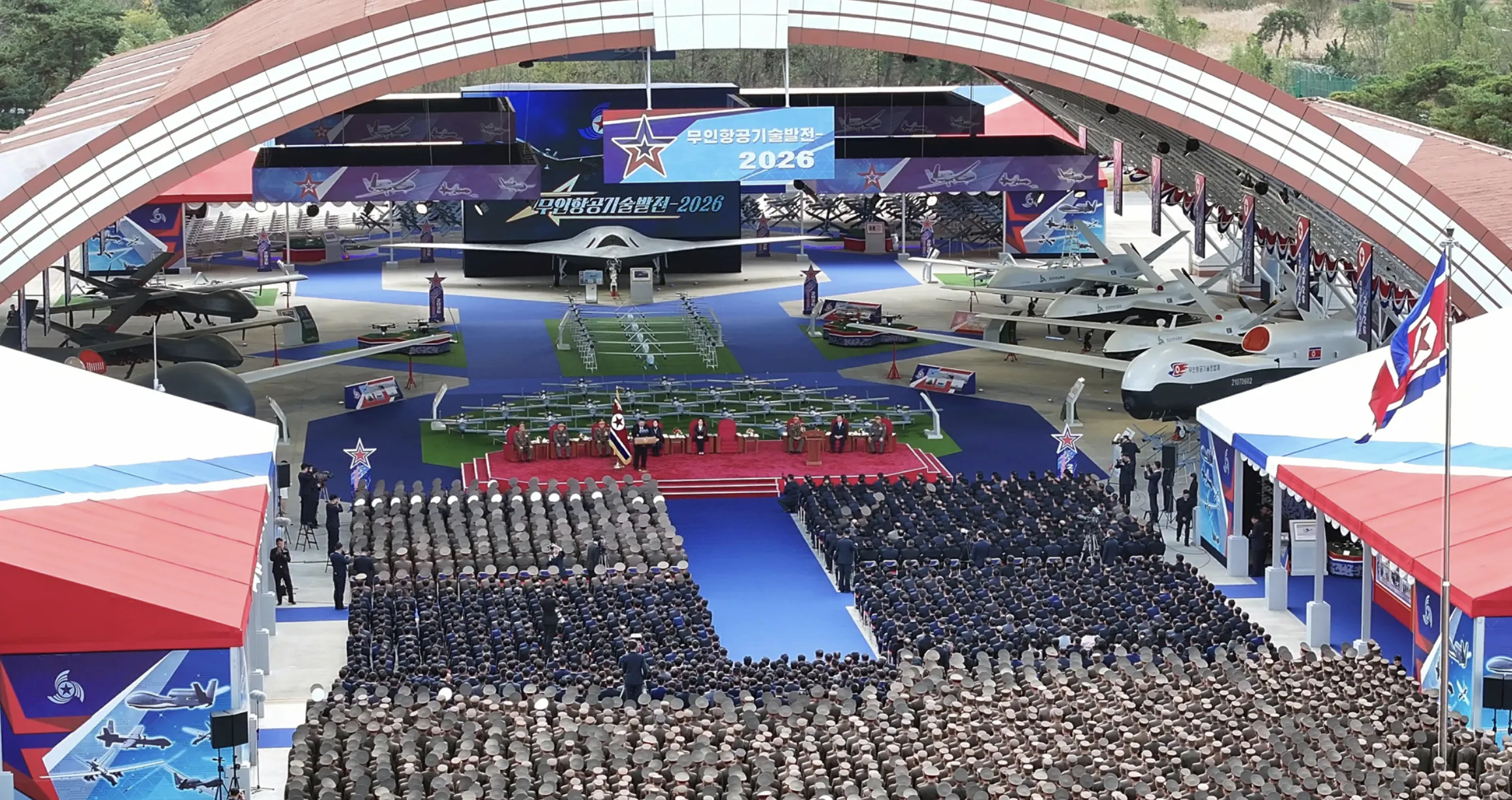
North Korean leader Kim Jong Un presided over a major exhibition of uncrewed aerial vehicles (UAVs) on Thursday. A mockup of an apparent new large stealth drone was displayed prominently alongside an increasingly diverse collection of reconnaissance drones, armed UAVs, loitering munitions, and small attack drones. While there is no evidence that North Korea is capable of getting a stealthy flying-wing drone flying, let alone operating as a operationally relevant low-observable platform, there are no doubts that the country has an increasingly impressive uncrewed aircraft arsenal, with the smaller, lower-end types being of greatest importance.
An overview of the Unmanned Aeronautical Technology Development-2026 exhibition, with the “stealth drone” in pride of place. KCNA
As for the “stealth drone,” photographs released by North Korean state media show a mockup of a tailless flying-wing design. In terms of appearance, there are clear parallels with advanced uncrewed combat aerial vehicles (UCAVs) developed by the United States, China, and Russia.
However, huge questions remain as to what degree the mockup is part of a realistic program. We have no details of the program’s development status and planned capabilities. It is highly questionable if Pyongyang is able to produce a functional prototype. Even if it can get it into the air, there is no evidence that it possesses the capabilities to master meaningful stealth technologies, let alone the command-and-control functions and other elements needed for it to operate in a tactically relevant manner.
The exhibition, titled Unmanned Aeronautical Technology Development-2026, was held on Thursday, with images published by the ruling Workers’ Party newspaper Rodong Sinmun today. Kim called for the country to achieve “absolute superiority” in drone technology and announced unspecified measures to accelerate the development of uncrewed aviation systems and military artificial intelligence.
Kim Jong Un walks past rows of quadcopter drones at the exhibition. Rodong Sinmun
An Ambitious New Flying-Wing Design
The mockup of the new aircraft was positioned prominently in the exhibition hall, suggesting that Pyongyang considers it at least indicative of its broader ambitions.
Based on the available photographs, Hong Min, a senior research fellow at the Korea Institute for National Unification, interviewed by NK News, estimated the wingspan at roughly 56 to 66 feet and its height at around 10 to 11.5 feet. Standout features include a dorsal air intake, a relatively large center fuselage section integrated into the flying wing, and retractable tricycle landing gear.
Another view of North Korea’s apparent new stealth drone. KCTV
In terms of general arrangement, there are similarities to Northrop Grumman’s X-47B, the U.S. Navy’s experimental carrier-based UCAV. There are also visual similarities with China’s GJ-11 Sharp Sword and Russia’s S-70 Okhotnik, two other large flying-wing UCAV designs.
X-47B during carrier operations. U.S. NavyGJ-11 Sharp Sword UCAV. via Chinese internet
At this point, North Korea has not provided any technical information about the aircraft’s propulsion system, payload, intended mission, or flight performance.
Critically, while the external shape is consistent with a stealthy UCAV, a flying-wing configuration on its own is only one part of a far more complex puzzle in achieving a genuinely low radar signature. Other factors include the engine inlet and exhaust arrangements, radar-absorbing materials, surface treatments, manufacturing tolerances, and the alignment of individual edges and surfaces, low probability of intercept communications and much more.
Officials inspect the new flying-wing UCAV design. Rodong Sinmun
The Iranian RQ-170 Precedent
Overall, there are many good reasons to be extremely cautious about North Korea’s apparent ambitions in this area.
Iran is another country that has displayed a drone that resembles an advanced Western stealth platform, without actually reproducing its capabilities. It has, however, gotten a UCAV-lookalike into the air.
After recovering a U.S. RQ-170 Sentinel reconnaissance drone that came down inside Iranian territory in 2011, Tehran announced that it had successfully reverse-engineered the aircraft. In 2014, Iranian authorities displayed what they presented as a domestically produced copy of the American drone, claiming that it would soon undertake a test flight.
The actual RQ-170 Sentinel Iran recovered on display. Iranian State Media
Outside observers questioned whether the displayed aircraft was anything more than a non-functional replica, noting apparent shortcomings in its construction and the use of components inconsistent with a sophisticated operational aircraft.
Iran subsequently presented a family of aircraft derived from the RQ-170 concept, including the Shahed-171 Simorgh and the smaller Shahed-191. Iran has demonstrated flying examples of these designs, but they fall far short of replicating the RQ-170’s actual low-observable qualities, let alone its sensors and avionics.
Iran’s self-proclaimed RQ-170-like long-range UCAVs. AP
In the case of Pyongyang, however, the possibility of Russian assistance is at least worth considering.
An S-70 taxiing after landing. Russian Ministry of Defense
In particular, North Korea would welcome Russian assistance in developing and manufacturing propulsion, flight control, sensor, and materials technologies.
However, there is so far no proof of technology transfer from Russia. Even if it were to be provided, it is far from clear that this would suffice to get a true UCAV into the air anytime soon, although an Iran-style knockoff with far reduced capabilities cannot be ruled out entirely. It’s also worth noting that Russia’s own UCAV program has been anything but a smooth and rapid advancement to an operational state.
Overall, the new flying-wing concept does not represent a realistic technological undertaking — at least for now. Very few countries have managed to develop and fly drones in this class, and fewer still have been able to field them operationally.
North Korea’s Drone Development Effort
The flying-wing aircraft was only one part of a much larger display. More than 30 types of UAVs reportedly appeared at the exhibition, reflecting North Korea’s efforts to diversify its uncrewed aviation capabilities.
Kim Jong Un inspects an armed Saetbyol-9. Rodong Sinmun
Imagery released of the Saetbyol-9 showed it carrying — and firing — several types of air-to-ground weapons. These include a Hellfire-like laser-guided missile, along with smaller rockets and other possible guided munitions.
Saetbyol-9 fires a rocket or missile. Rodong Sinmun
Other exhibits included loitering munitions resembling Israel’s Harop and Russia’s Lancet, as well as smaller drones with configurations similar to the U.S.-made Switchblade family.
Kim Jong Un inspecting Switchblade-style loitering munitions. Rodong Sinmun
Hundreds of small quadcopter drones were also displayed on storage racks. Some appeared to carry cylindrical containers associated with fiber-optic control systems, a technology that has become increasingly prominent in the Russia-Ukraine war. Unlike conventional radio-controlled drones, fiber-optic systems are largely immune to conventional radio-frequency jamming of their control links. These drones would be a major feature in a cross-DMZ conflict.
North Korean interest in artificial intelligence was another recurring theme. Kim called for the development of increasingly intelligent uncrewed weapons, although there is no indication of how advanced the country’s existing autonomous navigation, target recognition, or engagement systems actually are.
The exhibition was accompanied by live-fire demonstrations involving UAVs, cruise missiles, and multiple rocket launchers. North Korean state media claimed that missiles launched from drones and other systems struck an island target “with 100 percent accuracy.”
A barrage of rockets fired by a large-caliber multiple rocket launcher. Rodong Sinmun
From Ambition To Operational Capabilities
North Korea’s rapidly expanding interest in drones should also be seen against the shortcomings of its aging crewed combat aviation fleet. Relatively inexpensive UAVs offer opportunities for reconnaissance and attacks against military infrastructure without exposing pilots to enemy air defenses. At the same time, Pyongyang has failed to introduce new crewed combat aircraft to modernize its air force, the capabilities of which are thoroughly outmatched by those of South Korea.
The war in Ukraine (as well as lessons from conflicts in the Middle East) also provides Pyongyang with an opportunity to study the use of drones on a large scale. North Korean troops deployed to Russia will have gained first-hand experience of drone warfare, including the integration of reconnaissance UAVs, FPV attack drones, and electronic warfare systems.
That experience could help accelerate the development of North Korea’s own uncrewed platforms, particularly relatively simple systems that can be produced in large quantities.
An attack drone in the Shahed/Geran class, for example, could be produced relatively easily in very large numbers (and that is likely already happening to some degree) and could saturate South Korean air defenses, which are generally tailored to address more conventional threats. North Korea doesn’t need the long range that the Shahed/Geran typically provides, since many of its primary targets are much closer. The shorter distances involved could permit a greater proportion of a drone’s weight to be allocated to its warhead, depending on the design. Alternatively, a drone with the roughly 1,000-mile reach of the Shahed/Geran could fly a very complex route to reach targets in the South, including approaching via the coast. At the very least, expanding North Korean efforts in this area could tilt the balance of power on the peninsula, providing Seoul with a major interdiction problem and forcing the development of new countermeasures, such as directed-energy weapons and cheap interceptors.
A typical Russian Shahed-136/Geran-2-series kamikaze drone over Ukraine. via X
The possibility of Russian assistance via its own Geran development effort is likely bringing enhanced technologies within reach of North Korea. Indeed, that kind of expertise is already being gained by tens of thousands of North Korean workers who have been sent to Russia as additional labor for its drone-production efforts.
A look inside a Russian factory where licensed production of Iranian Shahed-series one-way attack drones is taking place. via X
And once again, it’s these one-way attack munitions and smaller drones that can be mass-produced and rapidly iterated upon that pose a real threat to South Korea. It is likely that North Korea will continue to ramp-up its investment in these systems, building them in very large tranches in order to create an asymmetric advantage — one that has proven challenging to counter in real conflicts around the globe. At the same time, they will also continue to build high-tech-looking clones of far more advanced systems which will have little tactical or strategic impact but work well for propaganda purposes.