NFL mock draft: Tom Brady’s Raiders won’t pass on quarterback
NFL teams are living on the edge.
Sure, it’s a quarterback’s league, but a major focus of the upcoming NFL draft will be about getting to the quarterback. This class is loaded with talented pass rushers, and teams figure to take advantage of that early and often. This mock draft has edge rushers off the board with the second, third and fourth selections.
How appropriate that the April 23-25 draft will be held for the first time in Pittsburgh, birthplace of the Steel Curtain.
The Steelers, incidentally, take a receiver in this mock — and there are lots of talented prospects at that spot, too. This contemplates the Rams selecting USC receiver Makai Lemon, although it’s entirely possible that the sure-handed Trojans star will already be gone by the time the 13th pick rolls around.
The Chargers, meanwhile, take an offensive lineman to address the need that haunted them all last season after they were ravaged by injuries up front.
One look at how the draft could unfold:
1. Las Vegas Raiders: QB Fernando Mendoza (Indiana) — Tom Brady loves him. The Raiders are trying to build something, and this Heisman winner figures to be a cornerstone.
2. New York Jets: Edge Arvell Reese (Ohio State) — Jets had zero interceptions and four takeaways last season, both NFL records, and think Reese has some Micah Parsons qualities.
3. Arizona Cardinals: Edge David Bailey (Texas Tech) — As pass rushers go, the Cardinals have Josh Sweat, who isn’t particularly happy, and a bunch of young guys who have struggled to stay healthy.
4. Tennessee Titans: Edge Rueben Bain Jr. (Miami) — Although they have been collecting defensive linemen, the Titans still need help at the edge. Also could use a supporting cast for Cam Ward.

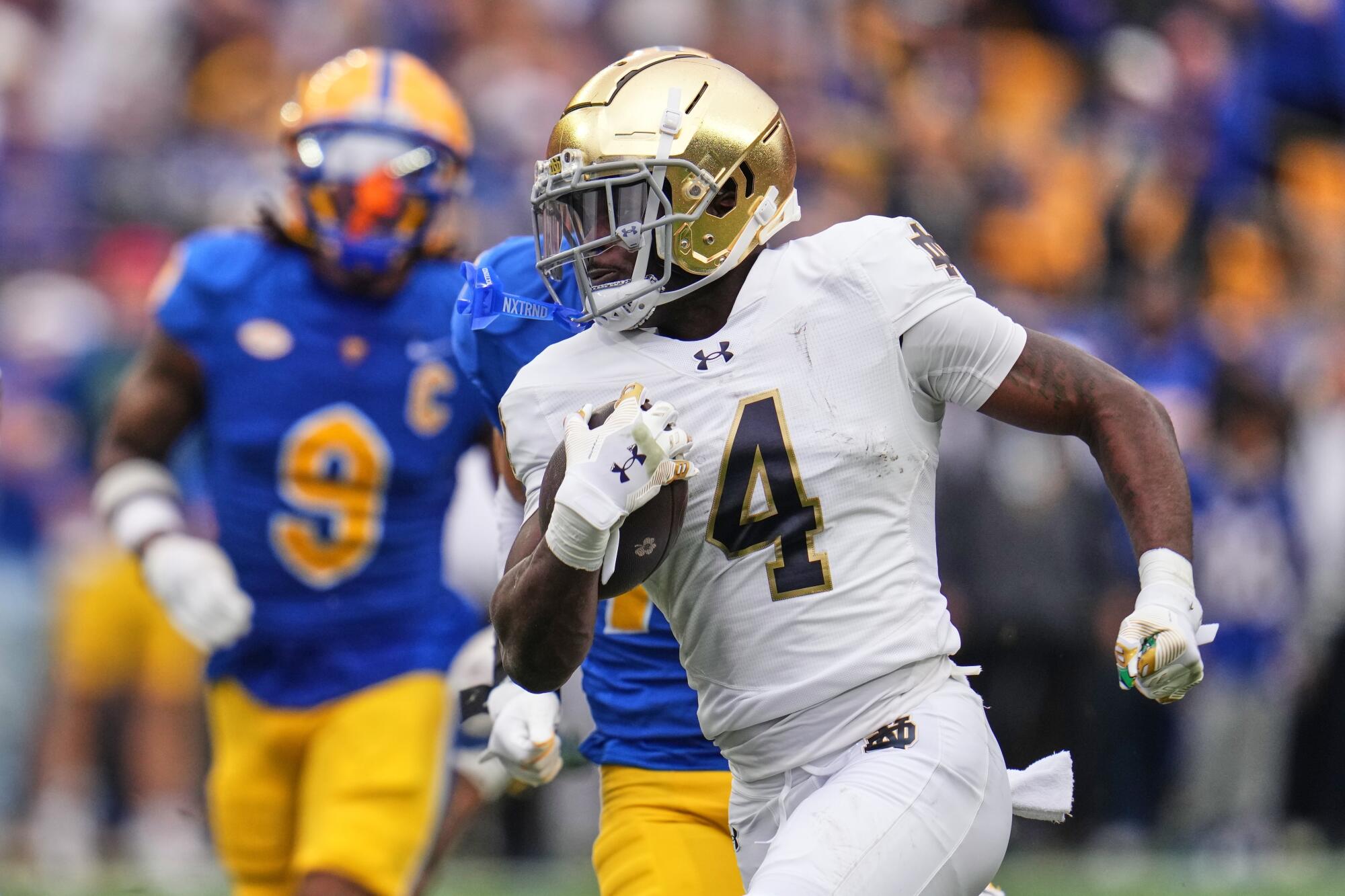
Notre Dame running back Jeremiyah Love carries the ball against Pittsburgh in November.
(Gene J. Puskar / Associated Press)
5. New York Giants: RB Jeremiyah Love (Notre Dame) — John Harbaugh doesn’t always draft for need, and he loves to pound defenses with a running game. Love is the best in this class.
6. Cleveland Browns: OT Monroe Freeling (Georgia) — The Browns are completely rebooting their offensive line and had hoped to sign Packers free agent tackle Rasheed Walker, instead nabbed by Carolina.
7. Washington Commanders: S Caleb Downs (Ohio State) — The Commanders could use help at virtually every position — everything but QB — and a game-changing defensive back would get a warm welcome.
8. New Orleans Saints: LB Sonny Styles (Ohio State) — Saints might go receiver here, but Saints need a defensive stalwart too. If Love and Downs are gone — as they are in this mock — Styles would be a fit.
9. Kansas City Chiefs: WR Carnell Tate (Ohio State) — The cupboard is bare at receiver with just Xavier Worthy and Jalen Royals, so the Chiefs are desperate for some help there. Not the first time.
10. Cincinnati Bengals: CB Mansoor Delane (Louisiana State) — The Bengals are bringing back virtually their entire offense and have spent the offseason coming up with ways to improve their historically bad defense.
11. Miami Dolphins: WR Jordyn Tyson (Arizona State) — The Dolphins are trading Jaylen Waddle to Denver for another pick, so they immediately address their need for another playmaking receiver.
12. Dallas Cowboys: CB Jermod McCoy (Tennessee) — The Cowboys traded for Rashan Gary, which addressed their need at edge. Here’s a chance to upgrade at corner.

Wide receiver Makai Lemon runs with the ball during USC’s pro day on March 12.
(Kyusung Gong / Associated Press)
13. Rams: WR Makai Lemon (USC) — Having raided Kansas City’s defensive backfield, the Rams can stay put and take a receiver, or maybe trade up for a long-term bookend to Puka Nacua.
14. Baltimore Ravens: G Olaivavega Ioane (Penn State) — The Ravens have an opening at both guard and center, so they turn their attention to the interior of their offensive line.
15. Tampa Bay: Edge Keldric Faulk (Auburn) — The Buccaneers are sorely lacking when it comes to generating pressure off the edge, and Haason Reddick hasn’t been the answer.
16. New York Jets: WR Omar Cooper Jr. (Indiana) — The Jets need a No. 2 receiver to line up opposite Garrett Wilson and command some attention on the outside.
17. Detroit Lions: Edge Akheem Mesidor (Miami) — The Lions need someone they can pair with Aidan Hutchinson to put pressure on opposing quarterbacks, and Mesidor has a lot of potential.
18. Minnesota Vikings: S Dillon Thieneman (Oregon) — Harrison Smith is 37 and the Vikings need to start planning for the future at that position; they need another defensive back.
19. Carolina Panthers: OL Spencer Fano (Utah) — Fano can play all five positions on the offensive line, and that’s awfully enticing for a franchise with an injured left tackle and in need of a center.
20. Dallas Cowboys: LB Jacob Rodriguez (Texas Tech) — Micah Parsons is gone, and the Cowboys allowed 6.1 yards per play last season, second worst in the league. They need help all over.
21. Pittsburgh Steelers: CB Avieon Terrell (Clemson) — A receiver would be nice, but the Steelers can get one later. Terrell gives the Steelers depth and potentially a long-term bookend to Joey Porter Jr.

Miami offensive lineman Francis Mauigoa prepares for a snap against Louisville in October.
(Doug Murray / Associated Press)
22. Chargers: OL Francis Mauigoa (Miami) — With all the problems the Chargers have had cobbling together an offensive line, they need to focus on protecting Justin Herbert.
23. Philadelphia Eagles: S Emmanuel McNeil-Warren (Toledo) — Reed Blankenship, a fixture in Philadelphia’s defense and a QB in the secondary, signed with Houston as a free agent.
24. Cleveland Browns: CB Colton Hood (Tennessee) — The Browns addressed their offense with the sixth pick and now can focus on a defensive position of need. Corner is key.
25. Chicago Bears: CB Chris Johnson (San Diego State) — Tyrique Stevenson is the fourth-most-targeted corner in the league. The Bears need to upgrade at that spot opposite Jaylon Johnson.
26. Buffalo Bills OL Kadyn Proctor (Alabama) — Buffalo wants to run the ball, and Proctor is an outstanding downhill run blocker. He can also move inside and benefit a team that needs interior help.
27. San Francisco 49ers: OT Blake Miller (Clemson) — The 49ers have to plan for their future at both tackle spots. Miller is durable and a particularly adept pass blocker.
28. Houston Texans: OT Caleb Lomu (Utah) — Houston’s offensive line has been a problem for years and that’s not going away. Lomu is young but terrific in pass protection. Good news for C.J. Stroud.
29. Kansas City Chiefs: Edge Cashius Howell (Texas A&M) — Kansas City’s pass rush has declined two years in a row. The Chiefs need help in a lot of areas, but getting to passer is vital.
30. Miami Dolphins: Edge T.J. Parker (Clemson) — The Dolphins have an underwhelming cluster of pass rushers, led by Chop Robinson. They need help pressuring the quarterback so they will be looking for an edge rusher.
31. New England Patriots: TE Kenyon Sadiq (Oregon) — Mike Vrabel has already tipped his hand about his interest in this class of tight ends. Give Drake Maye another weapon at the position.
32. Seattle Seahawks: RB Jadarian Price (Notre Dame) — Two ball carriers from the same college backfield in the opening round? The defending Super Bowl champions need to start reconstructing a backfield.