Heathrow Airport

Banned food and drink that’ll get you stopped at every UK airport

Holidaygoers returning home need to be careful about what they bring back

With the February half-term still underway for many regions across the country, plenty of families will be eagerly packing their bags for some much-needed winter sun. For anyone keen to bring back goodies for their friends and relatives, there are certain rules they need to follow to avoid being stopped at UK airports.

In a recent warning by the Department for Environment, Food and Rural Affairs (DEFRA), the government agency urged holiday-goers to be mindful of what they try to bring back home. In a post on Facebook, a statement reads: “Travelling back from a half term trip abroad?

“To protect UK farmers and animals from diseases like Foot and Mouth, meat and dairy products can’t be brought into Great Britain. Check the rules before travelling.”

There are numerous guidelines on the Gov.uk website regarding bringing food into Great Britain, including rules on meat, dairy, fish, fruit, vegetables, nuts, seeds, and pet food. You can bring the following into Great Britain from any country without any restrictions:

  • bread, but not sandwiches filled with meat or dairy products
  • cakes without fresh cream
  • biscuits
  • chocolate and confectionery, but not those made with a lot of unprocessed dairy ingredients
  • pasta and noodles, but not if mixed or filled with meat or meat products
  • packaged soup, stocks and flavourings
  • processed and packaged plant products, such as packaged salads and frozen plant material
  • food supplements containing small amounts of an animal product, such as fish oil capsules

There are restrictions on bringing meat, dairy, fish and animal products and fruit, vegetables, nuts and seeds into Great Britain from abroad. If you’re bringing in any food or animal products protected by the Convention on International Trade in Endangered Species of Wild Fauna and Flora (CITES), you may need to apply for a CITES permit.

Meat, dairy, fish and animal products

The rules on bringing meat, dairy, fish and other animal products depend on the country you’re bringing it from. From the EU, Switzerland, Norway, Iceland, Liechtenstein, the Faroe Islands and Greenland, you can bring in the following for personal use:

  • fish
  • poultry, for example, chicken, duck, goose and any other products made from these meats
  • other animal products, for example, eggs and honey

Due to recent and ongoing outbreaks of animal diseases in the EU, there are rules about bringing in most meats and all dairy products. You are allowed to bring in a maximum of 2kg per person of powdered baby milk, baby food, or special food required for medical reasons. You can only bring these items if they don’t need to be kept cold before using, and they must be in branded, unopened packages (unless you are currently using them).

There are restrictions on meat, dairy and animal products for human consumption. You cannot bring in any of the following:

  • cheese, milk and dairy products like butter and yoghurt
  • pork
  • beef
  • lamb
  • mutton
  • goat
  • venison
  • other products made from these meats, for example sausages

If you’re bringing food from a country outside the EU, Switzerland, Norway, Iceland, Liechtenstein, the Faroe Islands and Greenland, the following rules apply. You cannot bring in:

  • meat or meat products
  • milk or milk-based products, except powdered infant milk, infant food or special food needed for medical reasons

You can bring in up to 2kg per person of:

  • honey
  • powdered infant milk, infant food, or special food (including pet food) needed for medical reasons – you can only bring it in if it does not need to be refrigerated before use, and is in branded, unopened packaging (unless in current use)
  • live mussels or oysters
  • snails – these must be preserved or shelled, cooked and prepared
  • frogs’ legs – these must be the back (hind) part of the frog with the skin and internal organs removed
  • insect protein

You can bring in up to 20kg per person in total of fish, including:

  • fresh fish – must be gutted
  • fish products
  • processed fish – must be dried, cooked, cured or smoked
  • lobsters
  • prawns

You cannot bring in caviar unless you have a CITES permit.

Fruit, vegetables, nuts and seeds

The rules on bringing fruit, vegetables, nuts and seeds depend on the country you’re bringing it from. From the EU, Switzerland or Liechtenstein, you can bring in the following for personal use:

  • fruit
  • vegetables
  • nuts and seeds

From other countries outside the EU you cannot bring in most fruit or vegetables unless you have a ‘phytosanitary’ (plant health) certificate for them. You can get a certificate from the plant health authorities in the country you’re leaving. You can only bring in the following without a phytosanitary certificate:

  • pineapple
  • kiwi
  • coconut
  • citrus fruits, such as oranges, lemons, limes and grapefruit
  • kumquat
  • persimmon
  • durian
  • curry leaves
  • banana and plantain
  • mango
  • dates
  • passion fruit
  • guava
  • processed and packaged plant products, such as packaged salads or frozen plant material
  • peeled and processed nuts or nut butters
  • certain grains, such as rice

Pet food

The rules on bringing pet food depend on the country you’re bringing it from. From the EU, Switzerland, Norway, Iceland, Liechtenstein, the Faroe Islands and Greenland. You cannot bring in pet food if it contains meat or other animal products from pig, cow, sheep, goat or deer.

You can bring in pet food made with other ingredients (for example, chicken) if it is commercially packaged with the manufacturer’s name and address. You can bring up to 2kg per person. From countries outside the EU you cannot bring in pet food, unless your pet needs it for health-related reasons.

You can bring in up to 2kg per person of pet food needed for health-related reasons, from any country. The pet food must:

  • not need to be refrigerated before use
  • be in branded, unopened packaging (unless it is currently in use)

Your pet must be travelling with you. You should have evidence that the pet food is needed for health-related reasons, such as a letter from your vet. Contact the Animal and Plant Health Agency (APHA) if you want to bring in more than 2kg of health-related pet food per person.

You’ll need to provide:

  • details of why you cannot buy the specific pet food in Great Britain
  • a letter from your vet confirming your pet needs this specific food

Check if you need a CITES permit

You may need to apply for a permit or certificate if you’re bringing any food or animal products protected by the Convention on International Trade in Endangered Species of Wild Fauna and Flora (CITES) into Great Britain. This includes foods such as caviar and eel fillets and beauty products containing caviar extract. Check if you need a CITES permit.

You can apply for a CITES permit online. When travelling to Great Britain, you’ll need to arrive at one of the ports or airports that handles CITES items. Border Force can seize your items if you do not have a CITES permit and they think you’ve brought them into the country illegally.

Source link

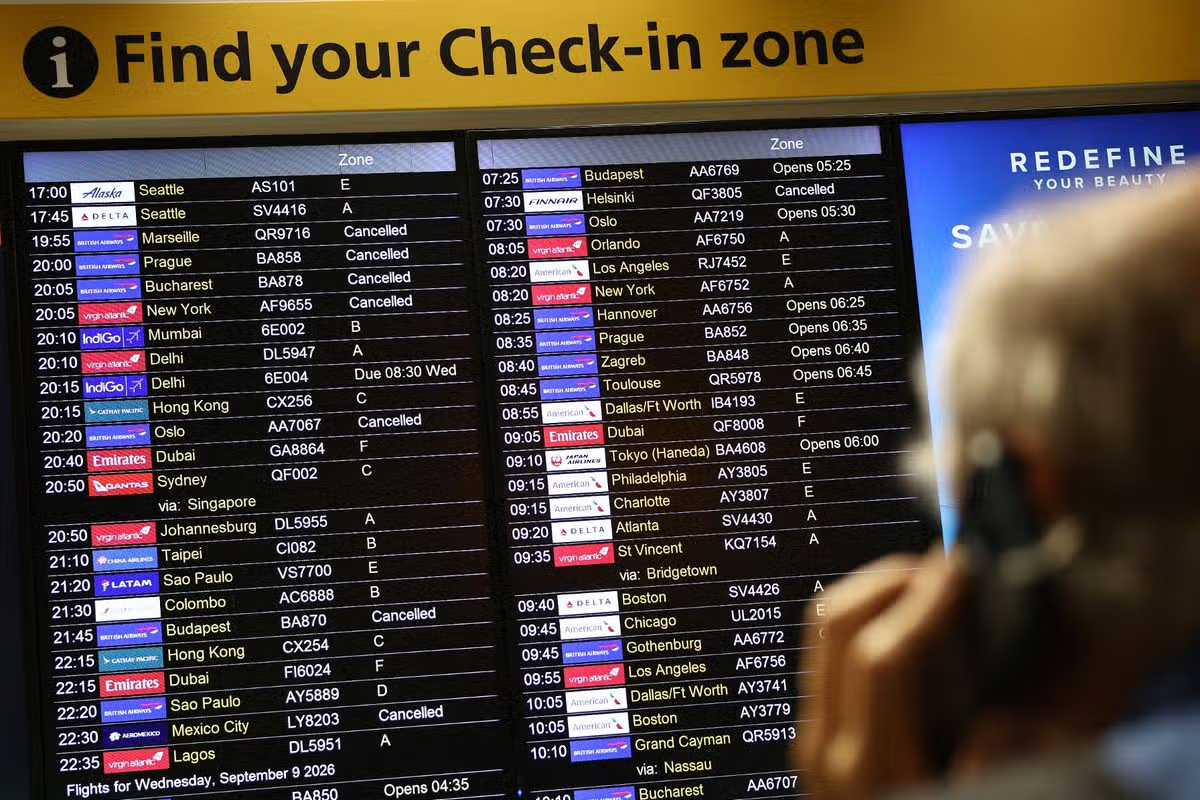
Storm Hernando: Travel chaos as flights cancelled at major UK airports

Hundreds of flights departing and arriving in the UK have been cancelled across several airports due to dangerous weather conditions with passengers advised to contact their airlines

Flights departing and arriving at several UK airports have been cancelled due to dangerous weather conditions.

Storm Hernando is causing chaos in the USA and, as a result, hundreds of flights have been cancelled on Monday, February 23.

The weather conditions on the east coast of the USA have already caused thousands of flights to and from the region to be cancelled.

Ensure our latest headlines always appear at the top of your Google Search by making us a Preferred Source. Click here to activate or add us as your Preferred Source in your Google search settings.

Flights from London Heathrow, London Gatwick, Manchester Airport, Edinburgh Airport and Dublin Airport have all been impacted by the storm.

The National Weather Service has warned: “A major winter storm is expected to bring heavy snow, strong winds, and coastal flooding across the Mid-Atlantic and north-east that may cause impossible travel conditions and power outages.”

Flights to JFK airport in New York, Newark airport in New Jersey and Boston airport are affected.

A huge 32 flights leaving from London Heathrow to JFK on Monday, February 23 have been cancelled. As well as departing flights, arrivals from the US destination have also been cancelled.

Three direct flights from Manchester have also been impacted. In Scotland, 35 flights that depart from Edinburgh have the second leg of their flight cancelled.

Posting on X, Dublin Airport said: “Due to adverse weather (Storm Hernando) on the east coast of the US, airlines have cancelled a number of flights due to operate to/from Dublin Airport on Monday.”

Dublin Airport said airlines had cancelled seven outbound and six inbound flights so far as a result of the storm.

Passengers have been advised to contact their airlines for the latest updates.

Source link

Heathrow Airport £7 fee that must be paid – or travellers face fine up to £80

Visitors can either pay a single fee or pre-pay for multiple online or over the phone

London Heathrow has reminded travellers of a fee that must be paid when using a certain part of the airport. Failure to pay this could result in an £80 fine, reduced to £40 if paid within a fortnight.

On X, formerly Twitter, the London airport explained: “Terminal Drop-Off Charge applies to vehicles dropping off passengers on the terminal forecourts. Use short-stay parking for pick-up; free pick-up/drop-off remains available in Park & Ride car parks. No waiting/picking up is allowed in the drop-off area, and any unattended vehicles may be towed. Blue badge holders are eligible for a 100% discount.”

Drop-off zones are situated immediately outside each terminal, providing the most convenient and fastest option for dropping off passengers. Visitors can either pay for a single drop-off or pre-pay for multiple drop-offs online or over the phone.

Nonetheless, anyone who uses a drop-off zone must pay by midnight the next day. Further online guidance from Heathrow adds: “When you pay in advance, your prepayments last for 12 months. Any prepaid funds that remain unused 12 months from the date of purchase will expire.

“You cannot pay for drop-offs at an airport ticket machine or in the terminal drop-off zones. There are no barriers; you incur a charge when you enter the drop-off zone.”

Anyone with questions about the fee or who requires a refund should contact refunds.heathrowdropoff@apcoa.com, chat to an agent via webchat, or call customer services on 0333 200 7459.

Content cannot be displayed without consent

London Heathrow’s two-bag policy

You might not realise that the capital’s airport also implements a ‘two-bag policy’ at security to prevent hold-ups. This rule means travellers are permitted to take just two items of hand baggage through the screening zone.

London Heathrow explains: “To avoid delays, Heathrow operates a two-bag policy at airport security. Only two items of hand baggage may be taken through security control, and they must be no larger than 56cm x 45cm x 25cm (22in x 18in x 10in).

“Items larger than this must be checked in as hold luggage – you can check your bag size using the gauges at check-in. Handbags and laptop bags count as a piece of hand baggage.”

Beyond this, it’s important to understand what items are suitable for your hand luggage. For instance, only specific electronic equipment is permitted on flights leaving from the UK.

While individual airlines may have varying requirements, the UK Government outlines nine essential items you’re able to include in both your hand luggage and hold luggage:

  • Hairdryers
  • Straighteners
  • Travel iron
  • Electric shaver
  • Most cameras
  • Mobile phones
  • Laptops
  • Tablet devices
  • MP3 players

Those travelling with e-cigarettes are required to store them in hand luggage rather than checked bags. When going through security checks, electronic items should be positioned in a separate tray, allowing security staff to examine them and ensure no prohibited items are hidden.

Get all the hottest shopping deals, cash saving tips and money news straight to your phone by joining our new WhatsApp Community – The Money Saving Club. Just click this link to join https://crnch.it/eutplxS1

We also treat our community members to special offers, promotions, and adverts from us and our partners. If you don’t like our community, you can check out any time you like. If you’re curious, you can read our Privacy Notice here https://crnch.it/jeQqC872

Source link

TUI launches new route to gorgeous city that looks like nowhere else in Spain

While this lesser-known region in Spain is growing in popularity, it still gets only a fraction of visitors that other cities see, and it allows you to enjoy a completely different type of Spanish culture

TUI has added a new city break destination to its roster for spring, and it’s in a part of Spain that’s growing in popularity with Brits and has a unique look.

If you’re bored of the Spanish Costas and want to escape the usual packed tourist spots, then Northern Spain is becoming an alternative for Brits who want to see a different part of the country. The Basque Country alone saw a 40% increase in visitors last year, although this still only puts the area at 182,000 tourists a year- a fraction of the visitors to Southern Spain.

At the heart of the Basque Country is Bilbao, and if you’ve never been to this part of Spain, it’s an excellent starting point for immersing yourself in the area’s unique beauty and culture.

TUI will offer city breaks to Bilbao from four major UK airports this spring: Bristol, London-Gatwick, London-Heathrow, and Manchester. With flights from London taking just under two hours, it’s ideal for a long weekend or mini break.

Have a story you want to share? Email us at webtravel@reachplc.com
In a Lonely Planet article, one travel writer wrote: “When your plane banks toward Bilbao Airport for the final approach, the lush forest passing below looks nothing like the Spain you thought you knew.”

The climate and landscapes of this region are worlds away from the dry, sunny south, with milder weather that can be a respite from summer heatwaves. In March and April, daily highs are around 17C, while over the summer, it hits around 26C, and the south often bakes in temperatures in the mid-30s. It also gets more rain than the south, giving the surrounding area a fresh green look.

Bilbao sits on the banks of the Nervión River, and one of its most popular spots is its old town, also known as Casco Viejo. With colourful buildings dating back to medieval times, a grand cathedral, and the beautiful neoclassical Plaza Nueva, full of bars and restaurants, it’s the perfect city break destination.

In contrast, the Guggenheim Museum, with its unique Frank Gehry-designed exterior, looks different from anything else in the city, yet draws people in with its vast collection of contemporary art. Even if you don’t venture inside, it’s worth walking past to see its titanium-clad exterior shining in the sun.

In addition to its cultural delights, Bilbao is known for its colourful food scene, and as you wander the streets, you’ll find plenty of pintxos bars. A northern alternative to tapas; pintxos are bite-sized pieces of bread topped with ingredients from jamón to seafood or cheese, held together by a cocktail stick.

Another famous product of Northern Spain is its Rioja wines, which are the perfect pairing for a plate of pintxos. You can enjoy a day trip to wineries near the city, or simply visit one of the many wine bars for a tasting.

TUI’s deals include a 7-night stay 4T NYX Hotel Bilbao by Leonardo Hotels on a room only basis from £583 per person. Price is based on two adults sharing a Double or Twin Comfort Room departing from London Gatwick on the 14th of April 2026 with hand luggage only.

Or you can book a seven-night holiday staying at Hotel Sirimiri on a room-only basis from £451 per person. Price is based on two adults sharing a Double or Twin Standard Room departing from London Heathrow on the 21st of April 2026 with hand luggage only. Prices are subject to availability and may change. To find out more, visit the TUI website or download the official app.

Ensure our latest headlines always appear at the top of your Google Search by making us a Preferred Source. Click here to activate or add us as your Preferred Source in your Google search settings.

Source link

Cheapest month of the year to travel – and when to book for the best deals

Expedia’s Air Hacks Report shows how holidaymakers can save hundreds on flights – including the cheapest day to fly, best time to book and most affordable month to travel

New figures from travel agency Expedia have uncovered how holidaymakers can knock hundreds of pounds off their flight costs, with Friday now officially crowned the most budget-friendly day to jet off. Expedia has put together a comprehensive guide of “Air Hacks” to help travellers secure the best bargains throughout the year.

The latest Air Hacks Report shows that travellers can pocket an average saving of 18% by departing on a Friday rather than a Saturday. Despite being the busiest travel day of the week, Friday delivers the strongest value for money. Meanwhile, Tuesday emerges as the quietest day for flying but most expensive to book.

According to the report, the best day to book is Sunday, as this gets you the best deal and June is the most affordable month to fly, with flights 68% cheaper on average than December, which represents a potential saving of £250 per ticket.

For optimal booking, the most affordable window for domestic economy flights is between 31 and 45 days before departure, which will save people around £38 compared to booking six months out.

For international travel, adults can save an average of £93 by booking between 15 and 30 days ahead of time instead of six months, though purchasing tickets 31 to 45 days before can still yield a saving of £85.

Regarding UK airports, the cheapest to fly from, on average, are Belfast (£170), Liverpool (£171), and Bournemouth (£171). Conversely, the most expensive airports to fly from are London Heathrow (£533), Humberside (£420), and Manchester (£404).

Melanie Fish, a spokesperson from Expedia, said: “We are very excited to release these new findings and share our top air hacks for 2026 to ensure holidaymakers get the best value for money, as well as an enjoyable travelling experience.

The report also uncovered emerging travel trends. Twenty percent of travellers have booked an “extreme day trip,” which involves a roundtrip flight within 24 hours to visit a new destination.

Over half (51%) of international flyers now opt for morning departures, with only 15% choosing an evening flight. Furthermore, a third of travellers now fly with only a carry-on bag, and 29% admit they wear extra layers to avoid baggage fees.

The company, which launched a ‘Flight Deals’ feature to help users find flights 20% below the norm, hopes these insights will help holidaymakers navigate the overwhelming and expensive process of planning a trip.

Source link

Major UK travel fee change effective from next week – are you affected?

Most UK visitors will need a key document to enter the UK, but this will depend on your nationality and reasons for travel

Travellers regularly encounter changes in regulations when navigating international borders. Now London Heathrow Airport has issued a reminder regarding new rules coming into force in days

Under the changes an Electronic Travel Authorisation (ETA), will be a legal requirement for certain people from this month. This £16 fee allows travellers to enter the UK for tourism, family visits, and other purposes for up to six months.

On X, formerly Twitter, the major airport said this week: “Starting 25 February, whether your final destination is the UK or you are connecting via Heathrow, eligible visitors will need an ETA (Electronic Travel Authorisation). Find out more on http://GOV.UK.”

While most UK visitors will need an ETA or visa to enter the UK, this will depend on your nationality and reason for travel. For instance, an ETA is generally required if you’re coming from Europe, the USA, Australia, Canada and certain other countries.

Content cannot be displayed without consent

Each person travelling is required to have an ETA, including babies and children. So, for a family of four, you’ll likely need to pay £64 in total, while a family of six will typically pay £96. Visitors can apply for an ETA on behalf of other people.

Anyone who has a British or Irish passport, or has permission to work, live or study in the UK, will not need an ETA. According to official Government advice, other exemptions include:

It’s important to remember that having an ETA does not guarantee entry to the UK. Those with a criminal record or who have previously been denied entry should consider applying for a Standard Visitor visa instead.

Beyond this, the UK Government highlights exactly what can and can’t be done with an ETA. For instance, the ETA allows:

Meanwhile, these five things are not permitted with an ETA:

  • Staying in the UK for longer than six months
  • Doing paid or unpaid work for a UK company or as a self-employed person, unless you’re doing a permitted paid engagement or event or work on the Creative Worker visa concession
  • Claiming public funds (benefits)
  • Living in the UK through frequent or successive visits
  • Marrying or registering a civil partnership, or giving notice of marriage or civil partnership – a Marriage Visitor visa is needed

Visitors can apply for the £16 ETA online or via the UK ETA app. To do so, they must have a passport, an email address, and a payment method, including Apple Pay and Google Pay. The payment is non-refundable once an application has been made.

For more information, head to GOV.UK here.

Source link

Man orders vegan meal on Virgin flight and gets ‘three slices of mouldy veg’

Paul says the flight attendant admitted it was ‘unacceptable’

A vegan plane passenger has slammed Virgin Atlantic after being served ‘the worst meal’ he’s ever had – a pitiful sandwich with three slices of ‘mouldy’ veg. Paul Booker was flying from Cancun, Mexico, to London Heathrow after a 10-day holiday with his friend.

The 55-year-old was towards the end of his 10-hour flight when he was served breakfast, included as part of the flight, and opted for the vegan sandwich. However, when he was given the meal, Paul was appalled at the standard and quality of what he was served, and claims a red-faced flight attendant said it was ‘unacceptable’.

Shocking photos show two slices of courgette and a solitary slice of ‘rotten-looking’ pepper slapped on the bread. Retired civil servant Paul, who has been vegan for 10 years, claims he was left hungry after being served the ‘pitiful’ sarnie on the £600 flight, with the only alternative being a fruit salad pot.

Virgin Atlantic have apologised and said all customers, including those with specific dietary requirements, ‘should receive food that meets our usual high standards’. Paul, from Minehead, Somerset, said: “There was no way that was going anywhere near my mouth because it looked like it was rotten.

“I have had bad food on a flight before but not from this country but this was a joke. I showed it to my friend, and to be honest it was almost like shock laughter. The first thought was how little there was in there, it wasn’t until then we looked at it closer and we saw the state of the vegetables that were in there and [I felt] just disgust, absolute disgust.

“It is certainly up there as the worst meal I have ever had, it’s certainly the worst offering I have ever had.”

Disgusted, Paul showed the sandwich to the flight attendant who he claims was embarrassed by it before handing him a pot of fruit salad instead. Paul said: “I called her [the flight attendant] over and I said ‘is this all you’ve got? Have you got an alternative I can have?’ and I showed her and she was absolutely shocked by that.

“She looked at it and said, ‘that’s terrible, that’s not acceptable at all’ and to contact Virgin when I got home. It had this amusing writing on the box, ‘we found love in a hungry place’. I thought ‘there’s an irony for you’. I certainly didn’t find love there, but I was certainly in the hungry place, it was more of a kick in the teeth.

“Then in front of me, thin strips of courgette and a bit of pepper that just looks rotten. The problem is that when you are on a flight they only take a limited amount of food with them and then they will only take a limited amount of specialist meals with them.

“If that meal isn’t quality checked before they send it out onto the plane and you are 10,000 feet in the air then you haven’t got any other choice.”

Disgusted, Paul shared a picture of his sarnie on social media branding it ‘pitiful’ and ‘mouldy’. Paul wrote: “This was the pitiful vegan offering that I got on a £600 Virgin Atlantic flight from Cancun to London today.

“The piece of red pepper actually looks mouldy. Even the stewardess was shocked, and seemed genuinely embarrassed. Needless to say, I didn’t eat it!”

After lodging a complaint Paul was offered a £100 voucher to use on Virgin holidays and flights. Paul said: “£100 isn’t going to go anywhere on a Virgin holiday or flight. I just wanted some acknowledgement from their in-flight catering team, and something properly financial would be nice.

“Something to make me feel a bit more valued. Their £100 voucher, not only is it not a lot of benefit to me but also doesn’t cost them anything. They could’ve given me £500 and it wouldn’t be a drop in the ocean to them.”

A Virgin Atlantic spokesperson said: “We never want to disappoint our customers, which is why it’s disheartening to hear that Mr Booker was unhappy with the meal served on his flight from Cancun to London Heathrow. All customers, including those with specific dietary requirements, should receive food that meets our usual high standards.

“We take complaints like this seriously and we have offered Mr Booker a £100 voucher. We have also shared all feedback with our catering teams to ensure standards are upheld.”

Source link

New 100ml rules at UK airports after 2 key changes

Regulations surrounding the carriage of liquids on aircrafts have changed and there are two main alterations to the 100ml rule at UK airports.

Regulations surrounding carrying liquids at airports have been changing recently and it’s important to know where you stand because different airports have different rules.

Multiple British airports have relaxed the stringent 100ml liquid restriction, with Britain’s busiest airport, London Heathrow, the latest to confirm the significant update on January 23, 2026. The modification has been made possible through newly installed computed tomography (CT) scanners which give security personnel detailed 3D imagery of luggage, enabling passengers to keep liquids of up to two litres in their bags during security checks.

This recent development at Heathrow represents the final stage of its £1 billion security transformation that’s been underway over recent years. Furthermore, travellers no longer need to take out laptops, tablets, and liquids from their hand luggage at Heathrow, where the advanced scanners are now in operation.

A statement released by Heathrow on the same day said: “Passengers travelling through all terminals at Heathrow no longer need to remove liquids or electronics from their hand luggage, or juggle plastic bags at security. The UK’s hub has become the largest airport in the world to fully roll out next-generation CT (computed tomography) security scanners – a move that promises faster queues, less stress and a smoother start to journeys for millions of travellers.”

These new rules for carrying liquids at UK airports began to take effect on July 17, 2025. The two main changes mean:

  • Travellers can now carry up to two litres in their hand luggage
  • Passengers no longer need to separate them into a clear plastic bag when passing through security.

All UK airports, including Heathrow, were mandated to install new CT scanners by summer 2025, enabling passengers to carry up to two litres of liquids in their cabin bags and keep all electronic devices in their hand luggage. However, not all airports have made the changes in that timeframe.

In fact, 2019 saw Boris Johnson vow that the liquid rules at major UK airports would ease by 2022, which would allow passengers to carry larger quantities. Rishi Sunak’s government then extended that deadline to June 1, 2024.

From summer 2025 onwards, individual airports that pass Department for Transport (DfT) inspections have been permitted to ease the 100ml restriction.

UK airports that have ditched the 100ml rule

  • Belfast International
  • Belfast City
  • Birmingham
  • Bristol
  • Edinburgh
  • London Gatwick
  • London Heathrow

The switch hasn’t been rolled out at every UK airport, with some still enforcing the 100ml limit or less. Certain airports also require liquids to be taken out and placed in a clear plastic bag during security checks.

UK airports that still require you to remove liquids over 100ml

  • Aberdeen
  • Bournemouth
  • Cardiff
  • East Midlands
  • Glasgow International
  • Glasgow Prestwick
  • Inverness
  • Isle of Man
  • Leeds Bradford
  • Liverpool
  • Luton
  • London City Airport
  • Manchester
  • Newcastle
  • Newquay
  • Norwich
  • Southampton
  • Southend
  • Stansted
  • Teesside

Exemptions apply for essential medicines, baby food or milk, and special dietary requirements.

It’s crucial to verify your airport’s requirements before travelling, especially ahead of the February half-term, to prevent delays or having liquid items seized at security.

A spokesperson for the Department for Transport said: “Airports are responsible for the installation and operation of security equipment. Passengers should continue to check security requirements with airports before they travel and come prepared with liquids in containers no larger than 100ml in hand baggage unless advised otherwise.”

Why did the 100ml liquid ban come into force?

The 100ml liquid ban and other rules surrounding liquids in airports were introduced worldwide almost overnight, in August 2006. The aviation sector and travellers woke up to the news that airport authorities had foiled an attempted terrorist conspiracy to destroy transatlantic flights travelling from Heathrow to North America.

The suspects allegedly planned to smuggle the components for homemade explosive devices onto multiple aircrafts, which would be concealed in soft drink bottles. While a massive tragedy was stopped from occurring in 2006, it also meant that the aviation industry was changed forever.

Full list of items you can’t take through UK security

  • Bleach
  • Catapults
  • Compressed gas
  • Corrosives
  • Creosote, quicklime, oiled paper
  • Crossbows
  • Darts
  • Diving equipment – check with your airline
  • Explosives ammunition, detonators and related equipment
  • Firearms (including replicas)
  • Fireworks and pyrotechnics
  • Flammables (fire lighter, lighter fuel, paints, thinners)
  • Golf clubs
  • Harpoon or spear guns
  • Heavy bats and sticks (including baseball, softball and cricket bats)
  • Ignitable gas devices
  • Incapacitating sprays
  • Infectious substances (e.g. live virus materials)
  • Instruments containing magnets
  • Liquids and gels – with certain restrictions
  • Magnetrons. Instruments containing mercury
  • Martial arts equipment (including knuckledusters, clubs, coshes, rice flails and nunchuks)
  • Non-safety matches
  • Oxidisers
  • Poisons, arsenic, cyanide, weedkiller
  • Radioactive materials, acids, corrosives, alkalis, caustic soda
  • Sharp items (including scissors with blades over six inches)
  • Smoke canisters and smoke cartridges
  • Toxic
  • Vehicle fuel system components which have contained fuel
  • Walking / hiking poles
  • Wet-cell car batteries

Source link

British Airways passengers’ ‘rude’ behaviour amid Jamaica flight divides opinion

Passengers on a busy British Airways flight from London Heathrow to Jamaica divided opinion with their behaviour, which some described as “inconsiderate” and “rude”

Some British Airways passengers divided opinion online after footage emerged of them chanting and preaching during a flight.

Clips posted on social media show a woman standing in the aisle and singing while waving and shouting at fellow passengers until they join in and clap along during the journey from London Heathrow to Jamaica this month. Further footage captures a man loudly preaching while standing at his seat until staff announce the seat belt signs have been turned on and he sits back down.

Maxine Munroe, who was on the flight and shared a clip on TikTok, described her bizarre experience as “almost like being in church,” and fierce debate followed on the social media platform. Maxine, a 56-year-old nurse, said the antics early into the flight and continued for nearly three hours.

“It was almost like we were at church…. I think I was just surprised that this was happening 40,000ft in the air. At some point I was thinking we need to settle down and we need to rest. There were a lot of people (online) who say they don’t think they could cope on a flight like that,” Maxine, who is from Croydon, south London, said.

READ MORE: Frequent Ryanair flyer turns heartbreak into comedy with ingenious tattoo fixREAD MORE: TUI tourist denied boarding Thailand flight due to ‘stamp smudge’ on passport

Indeed, some online who blasted the behaviour, describing it as “inconsiderate” and “rude”. One Tiktoker posted: “I’d have found this so rude, they’re making a show of themselves and not thinking of others at all.” Another said: “As a nervous flyer this would send me over the edge.”

The clips show no obvious backlash from other passengers onboard the flight. Maxine, who regularly visits family in Jamaica, continued: “You will be on flights and people will pray before the flight takes off or if there’s turbulence you might hear somebody pray but not to that scale… It was fine while it lasted but it’s got its limit and I can understand when someone says that it is too much.

“I did think how long it would be until the crew had had enough. They need to be able to do their job and have the flight under control and it was a bit of an obstacle.

“A lot of people thought alcohol was related and actually there was no alcohol involved. It was more high on the godly spirit than they were on the alcohol, which is why I don’t think it affected the flight attendants as much as people drinking and being rowdy.”

British Airways has not faced direct criticism online following the emergence of the videos. Social media users were, though, angry at the passengers themselves for their decisions. One said: “Looks a nightmare.” Another stated: “It’s inconsiderate. I would’ve been so cross.”

But others were entertained and applauded the joyful tourists. One TikToker posted: “It was a lovely thing to see and f**k what anyone else says.” Another shared: “This would be the best flight. I like it when people are happy.” The Mirror has contacted British Airways for comment.

Source link