When the first two seasons of HBO’s teen drama “Euphoria” aired on Sunday nights, 25-year-old actor and singer Al-akhir Fletcher remembers racing online the second each episode ended, toggling between X (then Twitter) and FaceTime just to keep up with the collective reaction.
“I felt like I had to watch because I didn’t want any spoilers,” he recalled. “I didn’t want anyone to tell me about it. There was maybe one week I tried to wait to binge-watch it, and I couldn’t. Everybody was talking about it.”
That anticipation for Season 3, premiering Sunday, still lingers for Fletcher, though it’s tempered now by doubt and distance, thanks to a four-year gap between seasons. Nevertheless, Fletcher said he’ll finish the show.
“Only because I feel like I’ve invested so much already into the show and into the characters and in their stories,” he said. “So I do want to see it through. I want to know what happens, but there is a little bit of hesitation, especially with hearing about all of the politics and the behind-the-scenes drama of what’s happened with the show.”
When Euphoria last aired in 2022, it turned Maddy Perez’s cutout dresses into a going-out uniform, transformed Cassie Howard’s unraveling into a meme with a saying that everyone understood (“I have never, ever been happier”), and sent Labrinth’s score ricocheting across TikTok in slow-motion edits and tear-streaked montages. It also made bona fide stars out of its cast: Zendaya became an Emmy winner, in-demand actor and fashion icon; similarly, Sydney Sweeney has become an onscreen mainstay, and Jacob Elordi, an Oscar nominee this year.
And, crucially, for a stretch, “Euphoria” made HBO feel like a destination again, with episodes that demanded to be seen in real time and dissected instantly before the night was over.
In the four years since its previous season, though, Hollywood has endured dual labor strikes, streamers have tightened budgets and audiences have fractured into increasingly niche viewing habits. The monoculture that once lifted “Euphoria” has thinned, if it even exists at all.
So as the show returns after an unusually long hiatus, the question isn’t just what happens next for Rue and the gang, but whether “Euphoria” can still hit the way it once did. What we do know is the series isn’t picking up where it left off. Season 3 leaps forward five years, aging its characters out of high school and into a much murkier version of adulthood. Maddy (Alexa Demie) is working for a talent agent and navigating the blurry line between managing actors, influencers and potentially sex work-adjacent clients. Cassie (Sweeney) and Nate (Elordi) are set to marry, all while Cassie is attempting to start an OnlyFans account. And then there’s Rue (Zendaya), whose story can’t outrun the looming debt she owes a drug dealer.
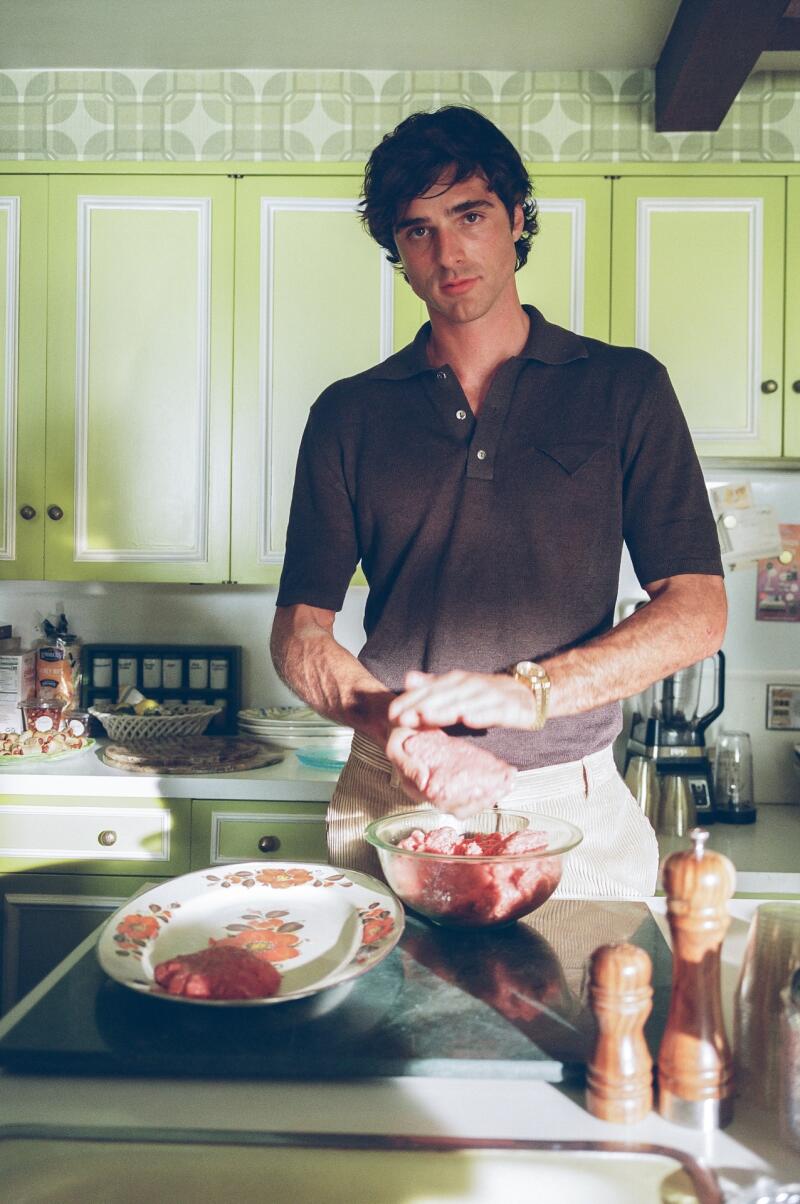
“Euphoria’s” Season 3 returning cast, clockwise from left: Jacob Elordi, Alexa Demie and Sydney Sweeney.(Partick Wymore / HBO)(Jeremy Colegrove / HBO)(HBO)
Can a series disappear for four years and reclaim its choke hold on the culture?
Interviews with fans and media experts suggest there’s no consensus on whether viewers will flock back like before. Some see “Euphoria” as too big to fail, a brand with enough residual heat to dominate conversation on arrival. Others aren’t so sure, pointing to the long hiatus, the off-screen turmoil and a television landscape that no longer moves in lockstep.
What made the show a breakout hit
Part of what makes questions around the show so difficult to answer is how singular “Euphoria” felt when it first arrived in 2019. At the time, HBO wasn’t in the business of teen dramas. The network had long built its identity on adult prestige — crime sagas, antiheroes and sprawling family epics — not stories centered on high schoolers. “Euphoria” marked a strategic shift, one that aimed to pull in younger viewers without diluting the network’s edge.
“I think this was supposed to be their first foray into quote-unquote young adult programming,” said Michel Ghanem, who writes about television. “They were interested in capturing a younger viewership who maybe hadn’t watched that much HBO up until then.”
What emerged didn’t resemble the traditional teen drama playbook. “Euphoria” was moodier and leaned into storylines rooted in addiction, sex and emotional volatility. HBO began experimenting more broadly with shows like “The Sex Lives of College Girls” and “Generation,” but “Euphoria” stood apart in both tone and ambition. The risk paid off.
“It grabbed on to an audience that loved the cast and the performances and the soundtrack and the cinematography,” Ghanem said. “So I think all of those elements together sort of made it into appointment television.”
Hunter Schafer, left, and Zendaya in Season 1 of “Euphoria.” The show premiered in 2019, becoming a hit for HBO.
(Eddy Chen / HBO)
Beneath the glitter and surreal visuals, some viewers saw versions of people and situations they already knew.
“I found a lot of familiarity in it because of being from L.A.,” said Darryl McCrary, a creative artist who is based here. “I felt like I knew the teenagers. I knew the secret drug addict and the out drug addict and the drug dealers. It felt very familiar. It felt like home in a way.”
Aspiring actor and “Euphoria” fan Cheyenne Washington, who grew up in a small town in Connecticut, also recognized the characters. “I went to high school with people like this. My high school isn’t like how it is on Disney Channel. My high school was ‘Euphoria.’”
By its second season, “Euphoria” had become one of HBO’s most-watched series, with episodes drawing millions of viewers. The Season 2 finale pulled in more than 6 million viewers across platforms, cementing the show as a crossover hit.
“That was the show that my students were talking about,” said Jason Mittell, professor of film and media culture at Middlebury College. “‘Euphoria’ is the buzz show amongst younger people, amongst people who were sort of hyper-online, amongst critics; it was something that was really talked about. That’s the thing that sort of raises it up.”
Why production stalled
While the dual Hollywood strikes were one factor in the delay in production, “Euphoria” was also affected by the sudden deaths of actor Angus Cloud, who played Fezco, and executive producer Kevin Turen, who was considered a key force in the show. There were reports of creative tension between Zendaya and Levinson. At the same time, its young cast had transformed into a roster of in-demand movie stars, with schedules and expectations that look very different from when the show began.
“This new season has to kind of do something new and really break new ground to gain the buzz,” Mittell said. “There is a scenario, depending on how they market it, that it actually could get pretty good viewership. But I think that it’s also just ripe for disappointment. Can you just imagine all the takes that are being written right now? Like, ‘Why “Euphoria” shouldn’t have come back.’ There’s so many people eager to write that.”
And yet, the show’s scale and the fame of the people in it may insulate it from outright failure. “Jacob Elordi, Sydney Sweeney — these are some of the biggest actors on the planet now,” Ghanem said. “Even if the show ends up being a creative flop, I think we’re all going to tune in because we want to see those actors together again and see what storyline Sam Levinson will come up with. There’s no possible world where this third season isn’t a massive hit. There’s just no way.”
Angus Cloud, who played Fezco in “Euphoria,” died in 2023 after an overdose. (Evan Agostini / Invision / AP)
“Euphoria” executive producer Kevin Turen also died in 2023. (Jack Plunkett / Invision / Associated Press)
What has shifted more dramatically is how the show and its creator are perceived, experts and fans said. Since “Euphoria” first aired in 2019, Levinson’s profile has evolved, particularly following the backlash to his HBO series “The Idol,” which was widely panned by critics and plagued by reports of behind-the-scenes turmoil. That scrutiny has extended back to “Euphoria,” with renewed criticism around its portrayal of sex, nudity and teenage characters.
“Since 2019, when the first season aired, there have been a lot of conversations around what Gen Z really wants to see on screen,” Ghanem said. “The show’s reputation isn’t unscathed. And I think people are more critical of Sam Levinson’s work.”
That shift may be especially pronounced among younger viewers, who may have been turned off by “The Idol’s” gratuitousness.
“We’ve had all of these recent studies about younger people who don’t necessarily want to see sexually explicit material anymore,” said Brandy Monk-Payton, assistant professor at Fordham University. “They want to see more development of platonic relationships and asexual connections.”
Can a time gap still lead to success?
Long breaks aren’t unheard of on TV, but they’re rarely this long for a show that’s still trying to hold on to cultural urgency. And history suggests that returning is one thing, but recapturing the same intensity of viewership and fandom is another.
Several recent dramas have tested that gap. “Stranger Things” stretched years between seasons as its young cast aged into adulthood, returning to massive viewership, but, some critics and fans argued, with an ending that felt obligatory.
“They weren’t reckless enough with their characters,” McCrary said.
“The Handmaid’s Tale,” once a defining show of the late 2010s, continued after extended pauses but struggled to maintain the cultural grip it once held.
“I think because of the social and political climate of that show, the interest in it waned,” Monk-Payton said. “We didn’t want to be in the world of Gilead anymore. So do fans want to reenter the world that is ‘Euphoria,’ that sensational world of drug addiction and sex and violence?”
Even “Severance,” which earned critical acclaim and awards recognition after its long-awaited second season, sparked debate among viewers about whether it matched the precision and novelty of its first. The pattern, experts say, is less about whether the audience comes back and more about what they come back expecting.
For Monk-Payton, that expectation functions almost like an unwritten agreement between a show and its viewers.
“It has to retain its contract with the audience,” she said, pointing to the balance between continuity and change. “There has to be some kind of familiarity in the characters and relationships, but also growth — something new that justifies coming back.”
That balance, she argues, is where many returning shows falter. Monk-Payton said in the case of “Severance,” what began as a sharply observed workplace sci-fi story expanded into denser mythology in its second season. Though Apple TV announced that “Severance” had become its No. 1 series, she said the show’s evolution didn’t land the same way for all viewers.
“When shows come back after a gap, they can misread what audiences connected to in the first place,” she said.
The risk for “Euphoria” is similar. If its return leans too far away from the emotional core that defined it, or reshapes its characters beyond recognition, it could strain the connection.
“If we don’t recognize Rue or the others in some fundamental way, that’s risky,” Monk-Payton said. “Some viewers will keep watching to see how it ends because they’re completionists. But others may feel that disconnect.”
With hit medical drama The Pitt finally available to watch in the UK on HBO Max, leading man Noah Wyle has shared some tantalising insight into its future beyond season two
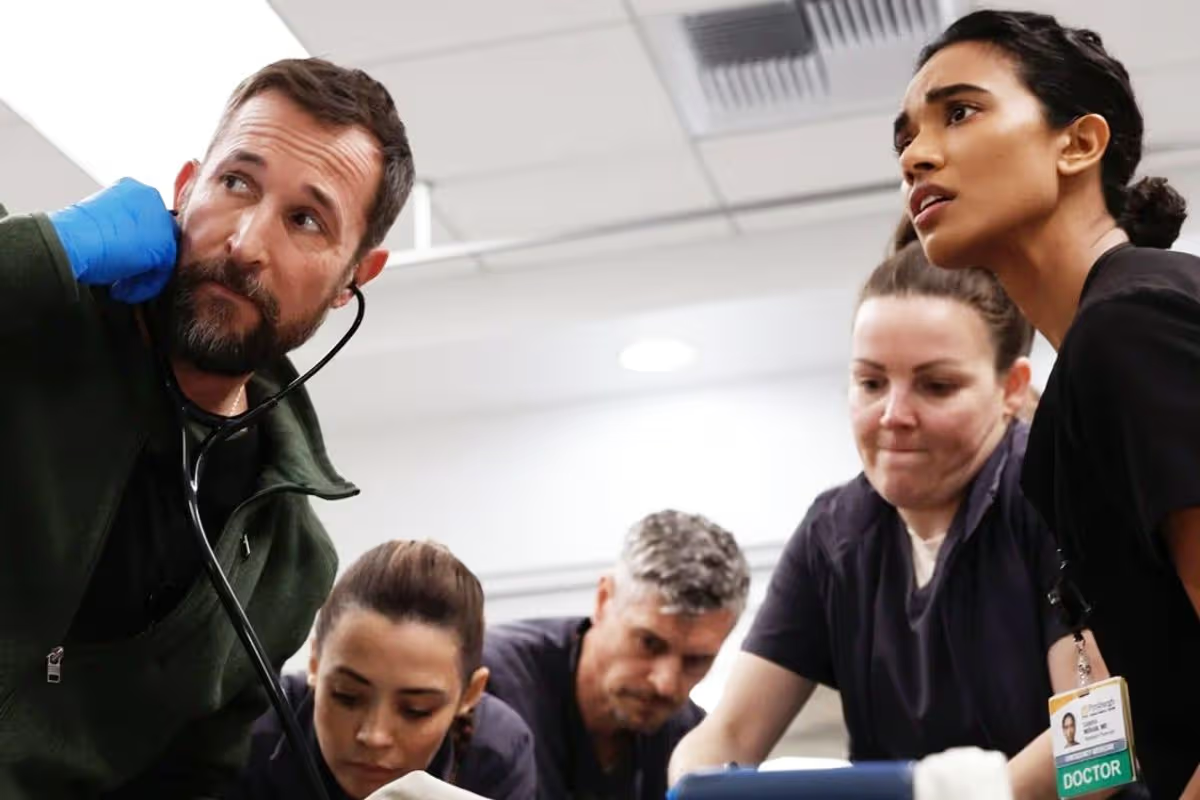
The Pitt’s Noah Wyle drops thrilling update on season 3(Image: HBO)
The Pitt’s Noah Wyle has delivered an exciting update on the third season of HBO’s smash-hit medical drama.
He also teased his hopes for the future of the drama, hinting it could run “forever” if audiences are still tuning in.
Wyle portrays Dr Michael ‘Robby’ Robinavitch, a senior attending physician working in a crowded and underfunded emergency room in Pittsburgh.
Throughout each season, Dr Robby, along with a team of doctors, nurses, and medical students, experience a single 15-hour shift, with the second instalment taking place during a busy 4th of July.
The former ER star was in London this week for the UK launch of the series where he spilled two important rules that every episode of the hit series must follow.
Speaking to HBO Max Chairman Casey Bloys, Wyle was asked how soon the cast and crew will be ready to start up production on season three.
“Very soon, boss, very soon,” Wyle joked. “We are in the process of writing character arcs for season three for everybody.”
He went on to explain how the series’ unique storytelling format presents a compelling challenge for the writers, which includes himself and creator R. Scott Gemmill.
“It’s a very interesting show to break because, unlike a lot of shows that are 22 episodes that may play over a calendar year, this is 15 hours of one day,” he continued. “So you’re painting with a much finer brush.
“The character’s arc is not really enough to go through the courtship of a romance, but it’s enough to get your head turned.
“It’s maybe enough to lose faith, maybe enough to find faith, but these are really small arcs that happen over the course of the day but can be really satisfying if you’re engaged with that character.”
Thankfully, The Pitt quickly found a devoted audience in the States, with the second season premiere amassing an impressive 7.2 million US viewers within its first week of release.
“We have these characters who seem to be resonating on a one-to-one with audiences,” Wyle added.
“Everyone’s feeling, ‘I’m a little Javadi (played by Shabana Azeez), I’m a little Samira (Supriya Ganesh), and I have a little Langdon (Patrick Ball) in me, or I know a Whitaker (Gerran Howell)’, and that makes it really exciting to see where they’re going to go next, and to write for where they’re going to go next.”
Hinting at the third season’s narrative, Bloys and Wyle revealed that the upcoming instalment is also building to an explosive and potentially life-changing event in much the same way as the first two seasons.
“We’ve built a pressure cooker where every hour we turn up the temperature, we add more ingredients, then just when it’s about to explode we drop a piano on it,” Wyle revealed.
“You’ve done that successfully for season two and now you’re thinking about it for season three?” Bloys clarified, and Wyle confirmed “Yes”.
Get HBO Max free with Sky
This article contains affiliate links, we will receive a commission on any sales we generate from it. Learn more
Sky is giving away free subscriptions to HBO Max with its £22 Ultimate TV bundle, which also includes Netflix, Disney+, discovery+, Hayu, and around 135 channels at no extra cost.
“One of the gratifying things about season two is that we realised we don’t need a big ‘deus ex machina’ plot device to keep this engaging,” he said. “There’s something really satisfying about watching everyday people trying to get through the course of the day, beset by all the trials and tribulations that come over the course of that day.
“If that is satisfying television then this show could run forever, because we don’t need a helicopter to come down in the ambulance bay, we don’t need to jump the shark.”
The Pitt is available to stream on HBO Max with new episodes on Thursdays.
Fans now know when they can look forward to the new adaptation
20:06, 25 Mar 2026Updated 20:10, 25 Mar 2026
Content cannot be displayed without consent
Fans of Harry Potter admit that they are ‘dancing in their room’ after the first ‘incredible’ trailer finally landed for the upcoming HBO series.
We have known for some time now that a new adaptation based on the series of books written by J.K. Rowling has been on the way. Most have welcomed the news with cautious optimism. Some have said to be unsure we need another version after the much admired film series.
This new iteration is set to be a faithful adaptation of the iconic novels, with the author credited as an executive producer. Each season of Harry Potter will be introduced to both new and existing fans, exclusively streaming on HBO Max which finally launches in the UK this month.
The original classic films will continue to be accessible for viewing globally. While fans should be able to stream the new series on HBO’s dedicated platform, Sky and NOW users should also have access providing they have the correct subscription.
It’s been previously suggested that the studio is optimistic about the series being as successful and well-received as the films, with hopes of it running for a minimum of 10 years. The series is penned and executive produced by Francesca Gardiner, known for her work on Killing Eve and His Dark Materials. Multiple episodes will be directed by Mark Mylod, renowned for directing several episodes of the HBO hit series Succession.
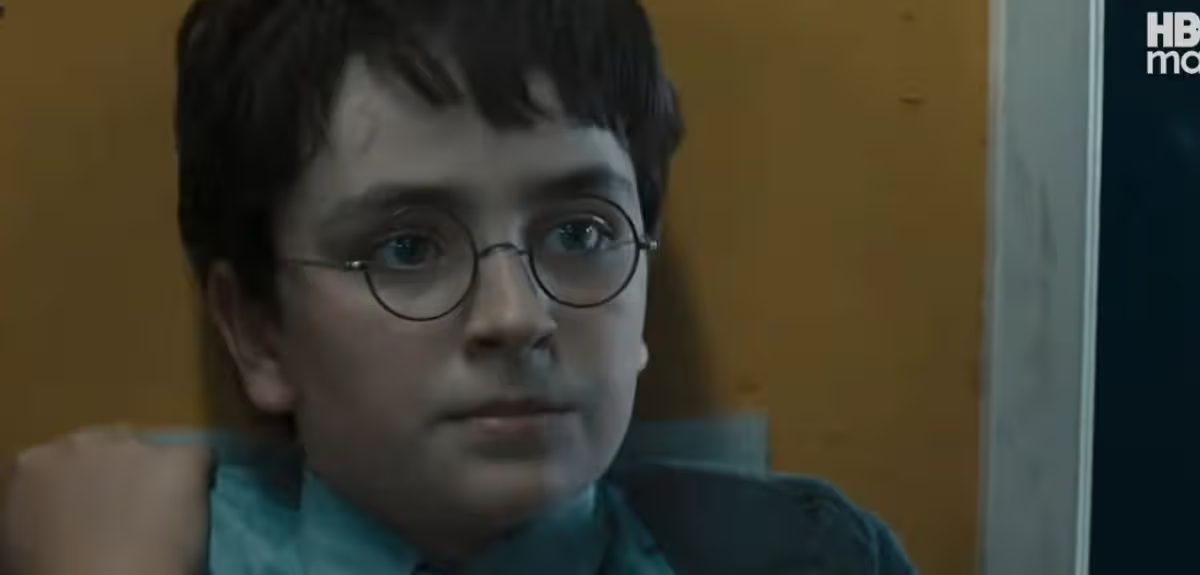
Last year it was confirmed that emerging talents, Dominic McLaughlin, Arabella Stanton, and Alastair Stout, will take on the legendary roles of Harry Potter, Hermione Granger, and Ron Weasley, respectively. We now have a first glimpse of their much anticipated performances.
That also includes the new portrayals of other beloved characters. This includes Hagrid played by Nick Frost and Professor Dumbledore, with Hollywood star John Lithgow taking on the responsibilities of the role.
Fans now also know when they can expect to start watching the series and it is sooner than many think. The caption for the video as shared on YouTube states: “A new era of Hogwarts begins. The HBO Original series Harry Potter and the Philosopher’s Stone premieres this Christmas.”
As expected, fans were quick to share their thoughts and opinions on the first footage shared from the series. Many were actually surprised at how much they enjoyed it.
One person replied: “This actually looks incredible! I love that they’re going to show more of Harry’s life with the Dursleys!” Another added in a similar vein: “THIS LOOKS INCREDIBLE!!! God Bless HBO!! THIS CHRISTMAS.”
Someone else confessed: “I’m dancing in my room right now.” While one person noted: “I actually love the take on Harry trying to be a muggle student at a school.”
Surprised by how the first episode seems to be approaching faster than first anticipated, one said: “Also, Christmas??? YESSS!!! I thought we’d have another year!!”
Plenty of others recognised that the series will allow them to explore more events of the book and reflect on characters more deeply. Some fans even admitted that they were left emotional and even in tears at the thought that the series could allow them to relive their childhoods. One person commented: “I shed a tear…my childhood is coming back to me again.”
One person posted: “I’m sobbing this is incredible” and another “I’m literally crying.”
Harry Potter is streaming on HBO Max this Christmas.
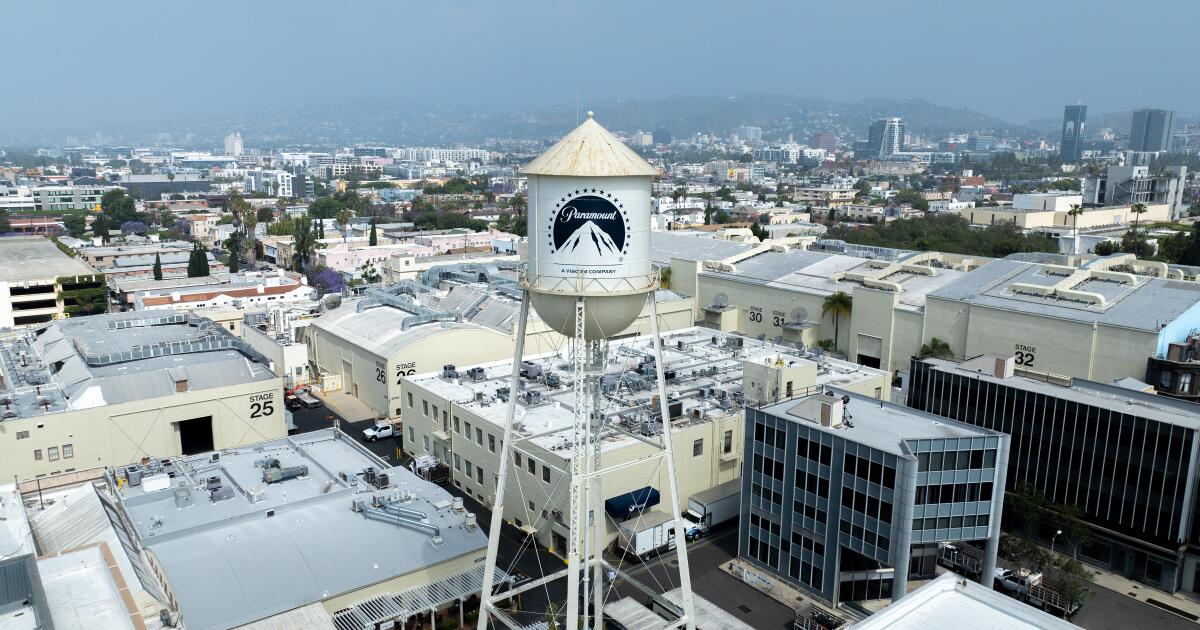
Should Paramount Skydance prevail in its $111-billion takeover of Warner Bros. Discovery, the Larry Ellison family would control two historic Hollywood film studios, dozens of cable channels, HBO and two legendary newsrooms, CBS News and CNN.
Concerns about the potential loss of more Hollywood jobs, and questions about newsroom independence dominated a hearing Friday to address Los Angeles’ crisis of shrinking film and TV production jobs.
Paramount wants to wrap up its Warner merger by September — a rapid timetable. The takeover deal, which was struck last month after Netflix bowed out, would put HBO and CNN under the control of Larry Ellison and his son David, the chairman of Paramount, which includes CBS.
Both Ellisons maintain friendly relations with President Trump. Those bonds, along with challenges to legacy media and changes at CBS News in recent months, sparked handwringing during the hearing called by Sen. Adam Schiff (D-Burbank) and Rep. Laura Friedman (D-Glendale).
“The questions surrounding this merger go beyond jobs, contracts and consumers,” Schiff said. “They also go to editorial independence of two of America’s most significant news organizations, CNN and CBS News.”
Trump has long agitated for changes at CNN, and members of his cabinet, including War Secretary Pete Hegseth, have openly cheered for an Ellison takeover of CNN.
To pave the way for the Ellisons’ purchase of Paramount, the company paid $16 million to Trump last summer to settle his lawsuit over edits to a “60 Minutes” interview with Kamala Harris in October 2024. Most 1st Amendment experts had deemed Trump’s suit “frivolous.”
Since the Ellisons took the helm, there has been a change in direction at CBS News and a reduction in its size and scope. Staff members at CNN are bracing for similar changes, including to the tone of its newscasts.
In addition to the long-term health of Los Angeles’ film economy, the merger’s fate could determine “whether we have state sponsored media … or whether we have journalists who can truly follow the story,” Friedman said.
Paramount Chairman David Ellison has vowed to “build a stronger Hollywood,” by increasing the creative output of the two legendary movie studios — Paramount and Warner Bros. — to 30 theatrical releases a year. Warner Bros., which owns such prominent franchises as “The Matrix,” Batman, Harry Potter, “The Big Bang Theory,” and “Friends,” has long been one of Hollywood’s most prolific studios.
But Paramount has suffered from years of under-investment and Ellison and his team have been working to boost the film pipeline.
“HBO will continue to operate independently under our ownership, enabling it to create more of the world-class content it is renowened for,” Ellison wrote in the Feb. 28 letter to Schiff and Friedman, responding to their concerns about consolidation.
During Friday’s hearing, the lawmakers turned to former CNN anchor Jim Acosta, who famously jousted with Trump during his first term, for his reflections. He was asked whether any “guardrails” could protect against potential merger harms.
“If this merger goes through, the guard-rails are gone,” Acosta said bluntly. “If we continue to go down this road it will be lights-out for the news industry… We need media options that are not controlled by the wealthiest and most powerful people in the country.”
The hearing occurred the same day that CBS News imposed another sweeping round of layoffs and disbanded its CBS News radio network. It also came the same week as Trump’s Federal Communications Commission approved a massive television station merger, which will allow Texas-based Nexstar Media Group to control more than 250 stations, despite a legal challenge from state attorneys general.
The proposed Paramount-Warner merger would prompt at least $6 billion in cost savings, according to Paramount. Industry veterans warn that billions more in cuts may be necessary to make the deal math work.
A combined Paramount-Warner would carry nearly $80 billion in debt, a legacy of the proposed leveraged buyout and the mergers that came before it.
The hearing at Burbank City Hall —“Lights, Camera, Competition”: Promoting American Film Production,” — was wide-ranging. Award-winning actor Noah Wyle, the star and a producer of Warner Bros.’ “The Pitt,” discussed the need to bring more productions back to Los Angeles where thousands of out-of-work film professionals have been suffering. “The Pitt” is filmed in Burbank.
“Over the last six years, the aggregate effect of projects leaving the state in search of tax credits, the pandemic and last year’s fires has been a near cratering of our once thriving industry,” Wyle said. “We lost 42,000 film and TV jobs between 2022 and 2024.”
The hearing unfolded down the road from the massive Warner Bros. studio complex, and was held to explore ways to boost the Hollywood economy, including the potential for a national tax credit under consideration in Congress. The campaign is intended to keep film jobs in the U.S. amid an increased migration to Britain, where Warner Bros. maintains an expansive studio complex in London, and other countries that offer generous subsidies.
“Work in the entertainment industry is precarious,” said Matthew D. Loeb, International President of the International Alliance of Theatrical Stage Employees (IATSE). “Past studio mergers have meant fewer jobs.”