
Hart

Dying to be a rock star? How Lestat sunk his teeth into rock stardom

In early June, hundreds of fans dressed to the nines were in attendance at a rock star’s sold-out show at New York’s Beacon Theatre. There was lace everywhere and leather too. Chains dangled from belt loops and wrists. Some attendees arrived with dyed crimson hair, others with orange or pink.

Sheer black outfits that looked pulled from the pages of a gothic romance novel were draped on bodies. If “The Rocky Horror Picture Show” had collided with a modern concert, it might have looked something like this.

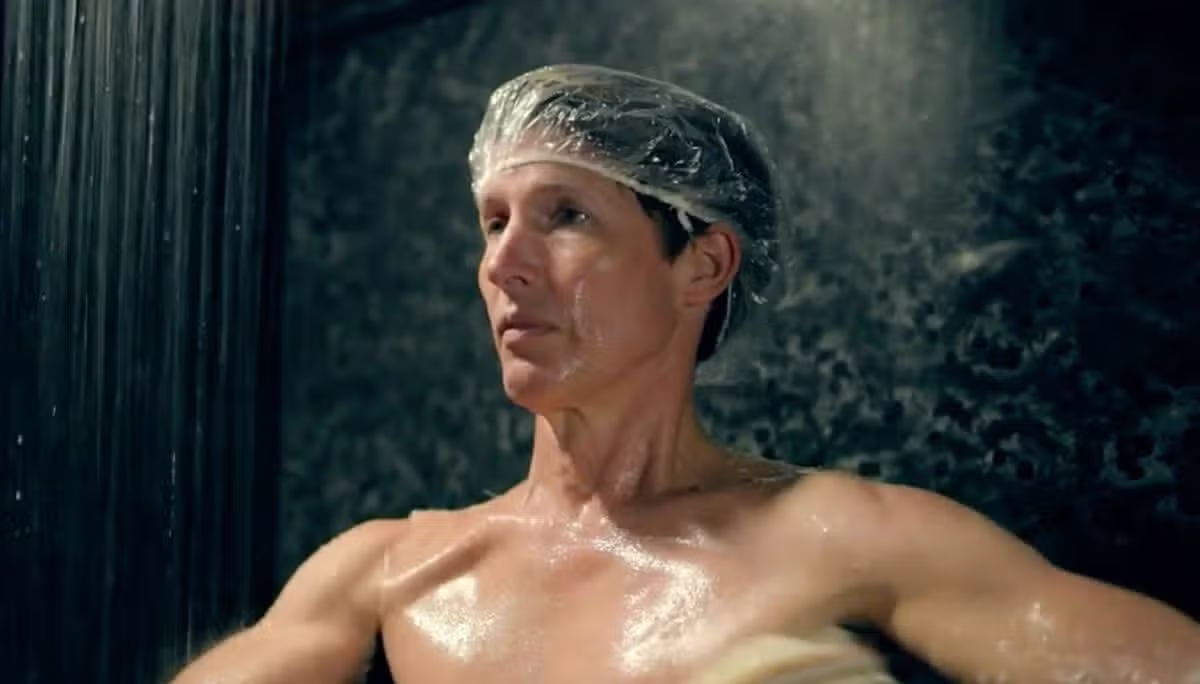
Then a man took the stage. Was it Lestat de Lioncourt, the immortal vampire-cum-rock star, or was it actor Sam Reid?

Moments earlier, attendees had watched the first episode of AMC’s “The Vampire Lestat,” the rebranded third season of “Interview With the Vampire” that premiered earlier this month. This season adapts Anne Rice’s novel of the same name, which is told from the perspective of Lestat, played by Reid, and transforms him into a touring musician.

Now Reid, dressed in black with his chest partially exposed beneath an open jacket revealing a scar, stepped on stage and into the role of Lestat in front of the audience. As he moved across the stage, phones shot into the air. Fans screamed. People sang along to a slew of songs, and for a moment, the line between actor and character seemed to disappear.

At first glance, the assignment to turn Lestat into a rock star seemed straightforward. The vampire at the center of Rice’s beloved novels has flirted with music before. In 2002’s “Queen of the Damned,” he emerged as a leather-clad nu-metal frontman capable of commanding massive crowds. But bringing Lestat into the present introduced a different challenge. Rock music no longer occupies the same place in popular culture. Fame is fragmented. Audiences are skeptical of celebrity. Social media can build a star overnight and tear them down just as quickly.

Yet “The Vampire Lestat” asks viewers to believe something as audacious as a centuries-old vampire still being able to captivate people, launch a music career and inspire a movement. Reid thinks part of what drives the character is something surprisingly modern.

“Nobody cares that I exist, nobody cares that I’m not relevant,” Reid said of Lestat’s mindset entering the season. “It’s really fun to see him struggle with that and see him try to find his place in the world and not immediately get world domination.”

Making that fantasy feel believable required far more than putting Lestat in leather and handing him a microphone. To pull it off, the show’s creative team had to build a rock star from the ground up, crafting a visual identity, creating music that could stand on its own outside the series, and transforming Reid into a performer capable of owning a crowd rather than simply acting in front of one.

Sam Reid's Lestat de Lioncourt crowd-surfs in "The Vampire Lestat."

Sam Reid’s Lestat de Lioncourt crowd-surfs in “The Vampire Lestat.”

(Sophie Giraud / AMC)

“Dropping Lestat down into 2025 and making the decision for him to play rock ‘n’ roll was a really great dramatic switch because while there are many great rock bands that are alive and kicking right now, their hold of the cultural landscape is quite small,” showrunner Rolin Jones said. “You couldn’t think of a worse way to get your message out than going to be a rock star right now.”

That challenge became the foundation of the season.

Step 1: Making the music

A polished aesthetic, marketing and, in Lestat’s case, book buzz can only take a musician so far. It’s the music that had to make diehard fans believe he’s an artistic genius, or at least a star in the making.

That challenge landed with composer Daniel Hart long before a single script was finished. In an unusual twist, many of the songs that would eventually appear throughout the season were written before the writers’ room fully mapped out the story.

“There were so many unknowns when we started,” Hart said. To find a way in, Hart and Jones started with their familiar reference point: David Bowie.

“We settled, I think sort of obviously, on David Bowie as the launch pad for our Lestat,” Hart said. “The way that Bowie was so mercurial, and he was a chameleon. He reinvented himself throughout his career.”

Hart also looked to artists as varied as Kurt Cobain and Chappell Roan, while drawing inspiration from classical music, blues and the old-world sound Lestat would have absorbed over his long life. One early writers’ room exercise even involved breaking down the influences embedded within “Long Face,” the Bowie-coded first single released from Lestat’s fictional album.

“‘Long Face’ feels like a Bowie rip-off to Daniel Molloy [played by Eric Bogosian], and so then Lestat breaks the song down for him and goes into all the other influences that are in there,” Hart said. “ ‘Long Face,’ you could say, was in some way influenced by Bach, and then [he] talked about Willie Dixon, and how the blues had influenced Lestat when he was around the … 1920s and ‘30s.”

“He’s been alive for 250 years,” Hart continued. “He’s seen and heard a lot of music.”

The creative team never set out to replicate the hard-rock sound that defined “Queen of the Damned.” If anything, Jones felt trying to outdo that soundtrack would have been a losing battle.

A rock star playing a violin during a live rock concert

In “The Vampire Lestat,” Sam Reid sings every song himself, including “Long Face,” “Butterscotch Bitch,” “Your Biggest Fan,” “All Fall Down” and “Black Licorice.”

(Sophie Giraud / AMC)

“I mean, that soundtrack is deservedly very famous,” Jones said. “And I think if we decided to out-Korn Korn, we were going to be in trouble.”

Instead, their Lestat was a musician still searching for his voice. Jones says the season begins in a more performative glam-rock space before gradually evolving into something more personal.

“We thought ‘70s Bowie is where we would start, and that we would musically make a journey with him as we went deeper and deeper,” he said. “He would put his band on one tour, what a normal band would do, over four albums. The music just keeps changing. And as he gets more and more vulnerable, the songs begin to change. They get more raw. They get more exposure, and the music style evolves.”

Reid sang every song himself, including “Long Face,” “Butterscotch Bitch,” “Your Biggest Fan,” “All Fall Down” and “Black Licorice.”

“The more bombastic, the more over-the-top songs — he doesn’t seem to like them by the end of this season,” Hart said. “The more introspective songs that come later on are more in his new wheelhouse.”

That journey also shaped how Reid approached the material. While audiences will ultimately see the songs unfold within the context of the show, Reid encountered many of them before he fully understood where Lestat’s story was heading.

“I think in the beginning, he’s coming from an artificial kind of construct,” Reid says. “As the show goes on, the music becomes more personal, and he becomes less interested in actually finding love through his audience and more about finding who he is as an individual and as an artist.”

When Jones first began adapting “The Vampire Lestat,” he briefly considered making the character the sort of arena-filling superstar audiences might expect, like a Beyoncé or Taylor Swift. But the more the writers discussed it, the less interesting that version felt.

“If we were gonna start chipping away at all the armor that Lestat had, one of the great repetitive ways of a tour is you just can’t seem to break a ceiling,” Jones said. “He’s a niche star. And I think that is part of the gas that fuels this little journey.”

Hart also had the impression that Lestat would be a massive star.

“But it became more apparent that [he might] not exactly have the kind of success that he wanted and desperately felt like he needed — that was a more interesting story to tell,” he said.

Step 2: Getting the rock star look

While the audience has to believe Lestat is a rock star, they also have to believe he’s someone with the look — and worth staring at.

Lex Wood, the show’s costume designer, said that the challenge began long before cameras rolled on Season 3. Jones first floated the idea of rock star Lestat while the team filmed Season 2 in Prague in 2023, giving Wood time to begin imagining what a nearly 300-year-old vampire might wear while reinventing himself as a singer. During a production trip to Paris, she started sourcing pieces and collecting references that would eventually make their way into this season years later.

A rock star with sunglasses stands in a loose-fitting suit

“The main aim of building costumes for Lestat was to maintain an element of the unachievable,” says show costumer designer Lex Wood. “To emphasize that Lestat is untouchable.”

(Sophie Giraud / AMC)

Being fashionable wasn’t the only goal.

“The main aim of building costumes for Lestat was to maintain an element of the unachievable,” Wood said. “To emphasize that Lestat is untouchable. Hence, building specific costume build shapes and patterns that we adapted throughout the season.”

That idea guided nearly every aspect of the wardrobe. While the first two seasons often presented Lestat through structured tailoring and muted palettes, Season 3 arrives in a much louder world.

“A big thing really was that we wanted to push more color into the season in general,” Wood said.

Wood said the choice reflected where Lestat finds himself emotionally. No longer confined to drawing rooms and period silhouettes, he’s navigating celebrity, performance and self-reinvention. Leather remains. Black remains. But so do bursts of color, softer fabrics and strange patterns.

“We wanted to break Lestat free of the suiting,” Wood said. “Though we wanted to remain true to his roots in the 18th century, we also wanted Lestat’s pieces to feel slightly otherworldly at times.”

That meant weaving in elements of garments from the 18th century and making them feel contemporary. This could look like a very specific cut of a sleeve of a shirt that nods to that time.

Wood also studied the backstage photography of Mick Rock, pulling references of Bowie, Iggy Pop and Freddie Mercury. She blended that with punk-inspired designs from Vivienne Westwood and Jean Paul Gaultier. Goth icon Siouxsie Sioux also became an influence, particularly in the use of layering, texture and attitude.

Wood said the scattered references reflect a character actively trying to figure out who he wants to be.

“He’s investigating social media himself,” she said. “As he’s discovering his presence as a rock star. He’s investigating what it means to be a rock star.”

“He’s finding his persona,” she continued. “And trying on different personas.”

That idea extends all the way down to accessories, with Lestat’s jewelry blending old and new — a custom necklace created by a U.K. silversmith recalls one worn by Mercury during Queen’s early years, while rings featuring sculpted teeth serve as subtle reminders of his vampiric nature.

“We purposefully wanted some of his wardrobe to not be recognizable to any particular brand — at other times, we wanted to celebrate high-end fashion, to explore his playfulness and unpredictable character through his clothing,” Wood said.

Even the shoes became part of the transformation. One of Wood’s earliest conversations with Reid centered on abandoning the heeled footwear that helped define earlier versions of the character. This Lestat needed something heavier for a performer who could pace a stage.

“He wanted something that felt more grounded,” Wood said. “Something he could bounce around more in.”

Wood said the redesigned footwear altered Reid’s posture and movement, helping create a version of Lestat that she noted feels more volatile and more comfortable captivating a crowd than charming one.

Step 3: Becoming the rock star

For all the work that went into the costumes, music and scripts, none of it mattered unless the watchers believed the actor tying it all together.

Reid had already spent two seasons playing Lestat through other characters’ memories and perspectives. This time around required him to carry the character’s story through his own reflections. More importantly, he had to answer a deceptively difficult question: Why would anyone follow Lestat in the first place?

A long-haired rock star on stage arches his back and looks skyward

“It’s not fame that he’s after,” says Reid of his character in “The Vampire Lestat.” “Fame is totally temporary for a creature that lives forever.”

(Sophie Giraud / AMC)

The surface answer might be fame. The character launches a music career, records songs and steps into the spotlight. But Reid doesn’t think that’s what drives him.

“It’s not fame that he’s after,” Reid said. “Fame is totally temporary for a creature that lives forever.”

Reid sees Lestat as someone searching for validation.

“Not for the vampire that he is, but for the human being that he was,” he said. “He’s been pretty heavily rejected. From Louis through the book, and then his mother knows exactly how to string him along, when to give him love and when to take it away. So he’s really looking for validation and going into an audience space is where he first experienced that.”

While developing the season, Reid says he became increasingly interested in the gap between the public version of Lestat and the person underneath it.

“His whole life has been performance,” Reid said. “His whole life has been a lot of adversity, and the way that he kind of climbs out of that is to build a construct that he can perform and operate in. It makes a lot of sense for him to do this rock star persona. Through this season you start to see him realize that the music and the art can allow him to access himself as opposed to it just being a performance.”

“He’s trying to discover his sound as a musician,” Reid continued. “But he’s also trying to discover who he is.”

Throughout the season, viewers see a musician struggling to connect.

“Why can’t I sell out 5,000 seats?” Jones says, describing the character’s mindset. “I used to be able to walk into a room and everyone would love me.”

For Jones, that’s ultimately what makes Lestat feel like a contemporary artist. Sure, he may be an immortal vampire, but he’s navigating the same questions that confront plenty of artists: How much of yourself to reveal? How much should one perform? Can admiration ever substitute for genuine connection?

By the time the season reaches its conclusion, Lestat is still larger than life. But he’s also a more complicated performer forced to reckon with the distance between being seen and understood. Jones said none of this would be possible without Reid in the role.

“I think his performance in Season 3 is one of the 10 greatest American TV performances of all time,” Jones says. “I’d put him right next to Carroll O’Connor, Walter White [played by Bryan Cranston] and James Gandolfini.”

“And I’d look at all of them and say, ‘You guys didn’t sing.’ ”

Source link

Kevin Hart addresses backlash over roast joke about George Floyd

After his Netflix roast inspired tit-for-tat feuding among comedians and backlash from viewers over a joke about George Floyd, Kevin Hart’s stance is clear: All is fair in love, war and comedy.

During a Tuesday appearance on “The Breakfast Club,” Hart addressed the controversy stemming from Netflix’s “Roast of Kevin Hart,” which aired earlier this month and included material that shocked viewers. Tony Hinchcliffe, who helms the No. 1 live podcast in the world, “Kill Tony,” applied his politically incorrect approach to comedy that similarly outraged audiences at a 2024 campaign rally for then-presidential candidate Donald Trump.

“The Black community is so proud of you right now,” he quipped at Hart. “George Floyd is looking up at us all, laughing so hard that he can’t breathe.”

In 2020, Floyd was murdered by police Officer Derek Chauvin, who pressed his knee into Floyd’s neck for more than nine minutes, until he died. His last words were “I can’t breathe,” which he said more than 20 times. The killing sparked global unrest and the largest civil rights protest since the 1960s. Hart attended Floyd’s memorial and private service in Minneapolis.

“The George Floyd joke, it wasn’t a tasteful joke to our culture,” Hart told the podcast. “But our audience that’s watching the roast … you get why they’re doing it, you get why the racial humor is on the table.”

Hart continued that the approach to comedy is nothing new and said, “Tony Hinchcliffe arguably had the best set, or one of the best sets.”

“Would I tell those jokes? No, but do I get why they’re being told? Yes,” Hart said.

Floyd’s brother, Terrence Floyd, spoke with “Breakfast Club” host Loren LoRosa after the roast aired and said that he expected Hart to step in and tell Hinchcliffe he’d gone too far.

“What do you want me to do? Drag him off?” Hart asked during his appearance on the podcast. “That’s not what I agreed to do. That’s not the job at hand. The job at hand was to produce a successful roast, which I did.”

Not only has the Netflix roast caused a stir among viewers, but the comedians who participated also have been trading slights in recent weeks. Chelsea Handler didn’t mince words when she offered her take on Hinchcliffe, as well as Shane Gillis, who also performed a set during the roast. According to Handler, ex-girlfriends of the controversial comedians slid into her DMs and told her what she said she already knew about them.

“They’re racist,” she said during an appearance on Deon Cole’s “Funny Knowing You” podcast. “That they’re bigots, that they’re sexist, that they think they’re like invincible.”

Handler said that one of Gillis’ jokes about lynching Hart was “worse than rape.” In response, Gillis told the Hollywood Reporter in a statement that Handler was capitalizing on the moment.

On Monday’s episode of “Kill Tony,” Hinchcliffe responded to Handler’s remarks by calling her “a bit of a c—. “


Source link

Inside a year of chaos and conflict at Kevin Hart’s media company

When Kevin Hart announced in January that he’d licensed his name to Authentic Brands Group, the popular comedian was silent on a key detail: the future of his namesake media company.

Hart sold some ownership and oversight of his brand in exchange for an undisclosed sum of money and a stake in Authentic, a New York-based firm that manages the likenesses of Marilyn Monroe, Muhammad Ali, Shaquille O’Neal and David Beckham.

Hart used the partnership with Authentic to reset his relationship with the people around him and his company, according to six current and former employees. Hart’s employees say they worry that this deal marks the beginning of the end of Hartbeat, the comedian’s namesake media company that produces films, owns a network of short-form video channels and handles marketing for brands.

Though the announcement made no mention of Hartbeat, the agreement gave Hart money to buy out his private equity partner in the company over time and regain control of the use of his name, image and likeness. Hart’s endorsement deals, which had been a pillar of Hartbeat business, will now be handled by Authentic.

Once valued at about $650 million, Hartbeat has shriveled over the past few years. The company enacted its latest round of job cuts in December, firing the heads of its scripted TV division, as well as employees working across marketing, social media and brand partnerships, said the people. Earlier this year it let go the leaders of its podcast division and later sued them for breach of contract.

Hart has withdrawn from the company, leaving day-to-day management in the hands of a small group of executives. Staff meetings have been canceled. The development of new film and TV projects has slowed. A slate of new podcasts was pitched but never produced.

Hartbeat’s struggles reflected the challenging environment for many Hollywood production companies as media giants merge and cut spending. The company is also a cautionary tale in this age of the celebrity media mogul. Financial firms have plowed money into media companies led by high-profile figures, believing they could use their notoriety to build valuable businesses. Yet even seemingly successful ones have had a hard time.

Hartbeat, like many of its peers, has suffered from mismanagement and grappled with the tension between the needs of the star and his company. Hart, one of the hardest-working people in Hollywood, tired of subsidizing a company that relied so much on him

Hart declined to comment for this story, which is based on conversations with several current and former employees. On Sunday night, Hart, who hosted the widely viewed roast of NFL great Tom Brady two years ago, was the subject of his own roast on Netflix.

Building a Billion-Dollar Business

One of the most successful stand-up comedians and actors of his generation, Hart, 46, has always been entrepreneurial. In 2017, he started Laugh Out Loud, an online video comedy business that later grew to include branded entertainment. He also operated his own production company, Hartbeat Productions, that made programs for streaming services like Peacock, Quibi and Netflix Inc.

With Hollywood in the midst of a production boom, Hart watched his fellow celebrities get rich from their media enterprises. Reese Witherspoon sold her media company, Hello Sunshine, in a deal that valued it at as much as $900 million. Hart’s friend LeBron James raised money for his company, SpringHill, at a valuation of $725 million. Hart believed he could be next.

In late 2022, Hart merged his business interests under the Hartbeat banner and raised money by selling a 15% stake to the private equity firm Abry Partners. The deal valued the company at about $650 million.

The new business was predicated on three pillars: film and TV, short-form video and advertising. Hartbeat had a deal to produce movies for Netflix, a slate of podcasts for SiriusXM Holdings Inc. and original audio series for Audible. Hartbeat also developed relationships with advertisers such as Lyft Inc., Procter & Gamble Co. and DraftKings Inc.

While Hart would star in Hartbeat projects, the goal of the company was to develop projects and new business that didn’t involve its namesake founder. The company could leverage Hart to sell projects and secure broad programming partnerships. Hart would ask that Hartbeat be involved in producing his movies and any advertising campaign for which he was a spokesperson. His fees as a producer and brand ambassador would help pay the bills. The hope was he’d convince other celebrities to use Hartbeat as well. Thai Randolph, who had been running Laugh Out Loud, was named chief executive officer.

Hartbeat opened offices in New York and Atlanta and took over a 40,000-square-foot West Hollywood office once occupied by Oprah Winfrey. Hart redesigned the space and installed a world-class art collection.

The upper-level lobby featured a work by Ghanaian artist Serge Attukwei Clottey, while the conference room had a sculpture by Zimbabwean artist Moffat Takadiwa made of computer keyboard keys. A portrait of Kobe Bryant by Julian Pace hung outside a podcast studio.

Hart’s own office featured a dressing room, a series of paintings by South African artist Feni Chulumanco, multiple TVs and a desk from a prominent French designer. “He really has almost a full-service apartment in his suite,” Kai Williamson, who worked with Hart on the project, told Architectural Digest. Hart was interviewed for a story and also filmed an episode of the design magazine’s “Open Door” video series.

While Hartbeat expanded, Hollywood entered a recession. Economic uncertainty, rising interest rates and growing skepticism about the profitability of streaming caused major media companies to fire staff and pull back on buying new projects. Hartbeat was a little more insulated than most because talent like Hart could usually still get a project made. Still, producing projects without Hart in a starring role became more difficult.

Randolph left the company in late 2023 and was replaced by Jay Levine, who had spent much of his career at Warner Bros. Discovery Inc. Levine brought in a couple of other senior leaders with experience at major media companies.

A contingent of executives pushed Hart to scale back some ambitions, the people said. The company couldn’t afford to be working in so many different businesses at the same time, especially as areas like free, advertising-supported online video, and podcasts got more competitive. Hart was one of the most prolific and productive creative people in the world, starring in and producing movies, TV shows, comedy, short-form videos and advertisements. The point of the company was to relieve the stress on him, not add to it.

While Hartbeat closed its New York office, Hart was reluctant to scale back his vision or replace some long-time lieutenants. Levine negotiated his exit at the end of 2024 and was followed out the door by the company’s chief financial officer and chief content officer. Days before Thanksgiving, Hartbeat laid off about 20 people, nearly one quarter of its work force.

A year of chaos and conflict

In January 2025, Hart announced he would be the new CEO of Hartbeat and pledged to outline the firm’s strategy in the coming weeks. Instead, Hart went weeks and sometimes months without visiting the office, the people said, and empowered Jeff Clanagan and CFO Eric Stoneburner to run the company day to day. (Hart was on set to shoot at least a couple movies last year, in addition to his other work.)

A former concert promoter and movie producer, Clanagan had helped make Hart a major star. He had partnered with Hart to bring his stand-up specials to the big screen, producing shows such as 2013’s Kevin Hart: Let Me Explain, which grossed $32 million at the box office. Clanagan produced some of these specials under the banner of his own company, Codeblack Films, which helps promote, market and distribute video from Black creators.

Clanagan continued to operate Codeblack while serving in a senior capacity at Hartbeat, said the people. He pushed employees at Hartbeat to post its videos to the Codeblack channels as well, saying they could use the additional reach to raise awareness. The videos generated advertising sales for Codeblack.

Clanagan had employees at Hartbeat oversee Codeblack’s social media pages and asked to get those channels loaded into Hartbeat’s content management system. That gave Codeblack’s YouTube channels advantages over others because of Hart’s prominence and his company’s designation with YouTube. Employees raised concerns with human resources and the company’s lawyer.

Clanagan also became increasingly interested in video generated by artificial intelligence. He started a new app called Blktopia, a streaming service for Black viewers programmed with content from online creators and often made by AI. He urged employees to work on it, the people said. Clanagan initially responded to a request for comment and then retracted the text message.

Meanwhile, many of Hartbeat’s main businesses languished. Sales from the company’s YouTube channels fell and investment in new film and TV projects slowed. Hartbeat, once profitable, started to bleed cash. Hartbeat had hired Eric Eddings and Lesley Gwam to produce audio shows that didn’t involve Hart. While the pair developed a slate of projects, they never got approval to make them.

In mid-December, Hartbeat fired about a dozen employees, including some of those who were supposed to develop the podcasts. Eddings and Gwam then decided to start their own company and began trying to raise money. When Clanagan found out, Hartbeat fired them and sued for alleged theft of trade secrets and breach of contract.

A court approved a temporary restraining order but then rejected a preliminary injunction, saying Hartbeat had not demonstrated Eddings and Gwam had used proprietary information or trade secrets. The court said the request was “vague, ambiguous, and overly broad.” The case is ongoing.

Hartbeat also fired the heads of its TV division, Tiffany Brown and Mike Stein, who were in the middle of producing a TV show based on the film Barbershop for Amazon.com Inc. and a second season of the animated series Lil Kev.

The company made no official announcement explaining the cuts. The following week, senior leadership arranged a Zoom meeting. Hart remained off camera until it was his time to speak. He talked for a few minutes about changes at the company and took no questions. Hart changed his phone number in the weeks following the layoffs. (Some of his advisors had suggested he do this years earlier so that he wasn’t so available.)

A few weeks later, Hart announced the deal with Authentic Brands Group. Hart used some of the proceeds to buy out Abry Partners, freeing him to steer his brand deals to Authentic and outside of Hartbeat. A few of his employees and his publicist joined him at Authentic.

“This is a turning point for Hartbeat,” the company wrote in a subsequent email to employees, explaining that the deal would free Hart up to focus on what he does best, while allowing Hartbeat to stand on its own and grow beyond him.

“I know the past few months have been tough,” Hart wrote, adding that for too long the company had been too dependent on him. The email was said to be from “Kevin AKA Boss Man.” It was sent by Hart’s assistant.

Shaw writes for Bloomberg.

Source link

Ducks are stymied by Carter Hart in Game 1 loss to Vegas

T-Mobile Arena sits just off the Las Vegas Strip, not far from a faux Manhattan skyline, a pyramid and a casino made to look like a castle.

The line separating illusion from reality can be a thin one in Sin City, where the Ducks opened the second round of the Stanley Cup playoffs Monday intent on proving their first-round victory over the Edmonton Oilers was more than a facade. It didn’t go well, with Brett Howden’s goal early in the second period and Ivan Barbashev’s tie-breaking tally late in the third period giving the Vegas Golden Knights a 3-1 victory in the best-of-seven series.

Mitch Marner added an empty-net goal with six seconds to play to end any hope of a Ducks comeback. Mikael Granlund scored for the Ducks with six minutes left in the game. Game 2 is in Las Vegas on Wednesday.

The Ducks were a shadow of the team that eliminated Edmonton. After averaging a playoff-high 4.33 goals a game, the Ducks were stymied by Vegas goalie Carter Hart, who turned away 33 shots. And after converting eight of 16 power-play opportunities against the Oilers, the Ducks were shut out in four chances against the Golden Knights.

Although the Ducks played their best defensive game of the postseason, giving up just 21 shots, the balanced Knights gave them few good scoring opportunities, especially on the power play.

The Ducks, who needed to use their superior speed to counter the Knights’ edge in experience, pushed the pace in the opening period but got nothing to show for it. The Knights took the lead less than four minutes into the second period when Howden made a dash to the edge of the crease to deflect in a pass from Marner for his fifth goal of the playoffs.

Vegas defenseman Rasmus Andersson celebrates after Mitch Marner's empty-net goal.

Vegas defenseman Rasmus Andersson celebrates after Mitch Marner’s empty-net goal in the final seconds of a 3-1 win over the Ducks on Monday.

(Ethan Miller / Getty Images)

Howden had a chance to double the lead less than six minutes before the second intermission, but he whiffed trying to bat a loose puck in an open net from the right side.

Mark Stone had an opportunity to score on the power play with less than nine minutes left, but Ducks’ goalie Lukas Dostal made a spectacular save to keep it a one-goal game. And that paid off when Granlund put the puck through Brayden McNabb’s legs 2½ minutes later.

The tie was short-lived, however, with Barbashev redirecting in a pass from Pavel Dorofeyev for the go-ahead goal. Ducks players and coaches vehemently protested, believing officials missed an icing call before the goal.

The Ducks mounted a furious rally after pulling Dostal with about two minutes to play, but that ended with Marner clearing the puck the length of the ice into the empty net.

Source link

Former Hart star Trevor Brown trying to coach West Ranch to title

Trevor Brown needs to beat his alma mater, Hart High, to win the Foothill League baseball title.

Brown, a first-year head coach at West Ranch, has his team at 8-3, which is tied for first place with Castaic going into Friday’s regular-season finale against Hart at West Ranch.

West Ranch defeated Hart 6-5 earlier this week.

Brown was a standout catcher for Hart, then went on to star at UCLA and played briefly with the San Francisco Giants.

They say catchers make the best managers, and Brown is another example of using his catcher’s experience to help with coaching.

This is a daily look at the positive happenings in high school sports. To submit any news, please email eric.sondheimer@latimes.com

Source link