Chase Infiniti and Lucy Halliday lead a rebellion in ‘The Testaments’
Are viewers ready to return to Gilead?
Less than a year after “The Handmaid’s Tale” concluded its startling and emotionally draining look at what can happen when unchecked power and totalitarianism become codified, Margaret Atwood’s dystopian saga expands on screen with “The Testaments” — and shifts focus to the simmering rebellion of teenage girls, led by actors Chase Infiniti and Lucy Halliday.
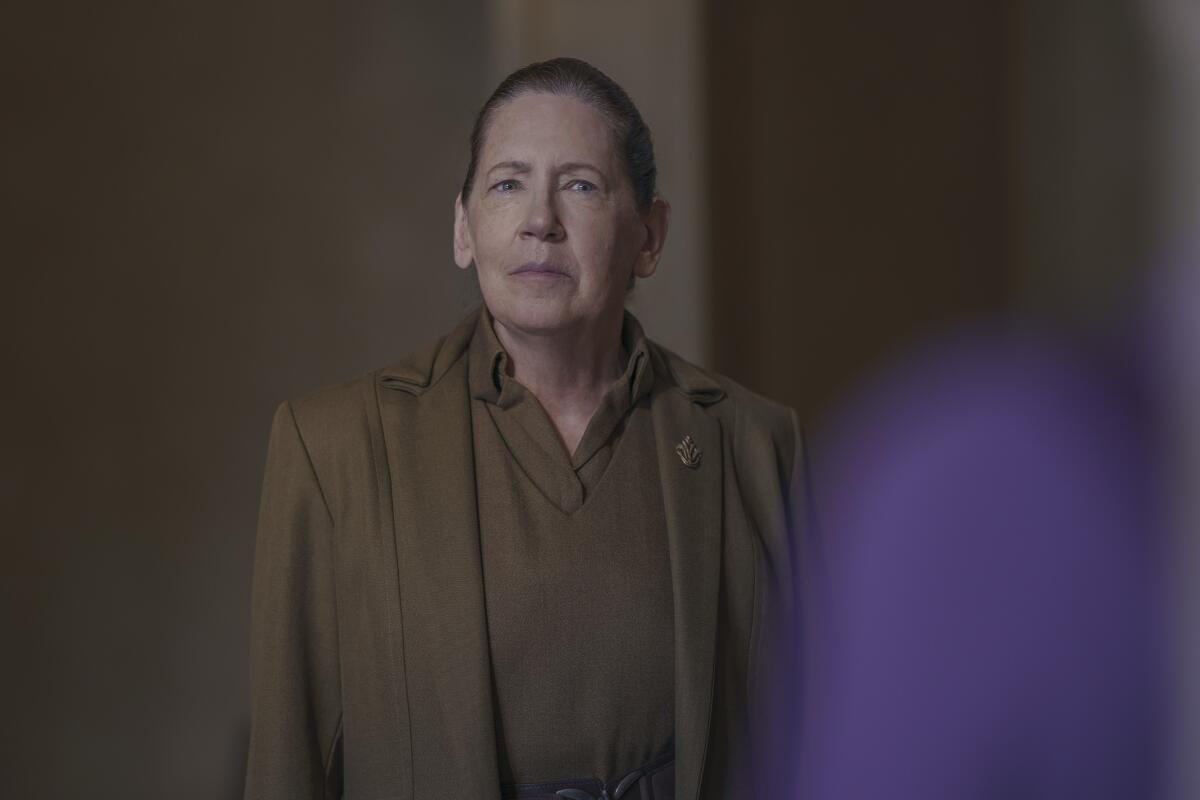
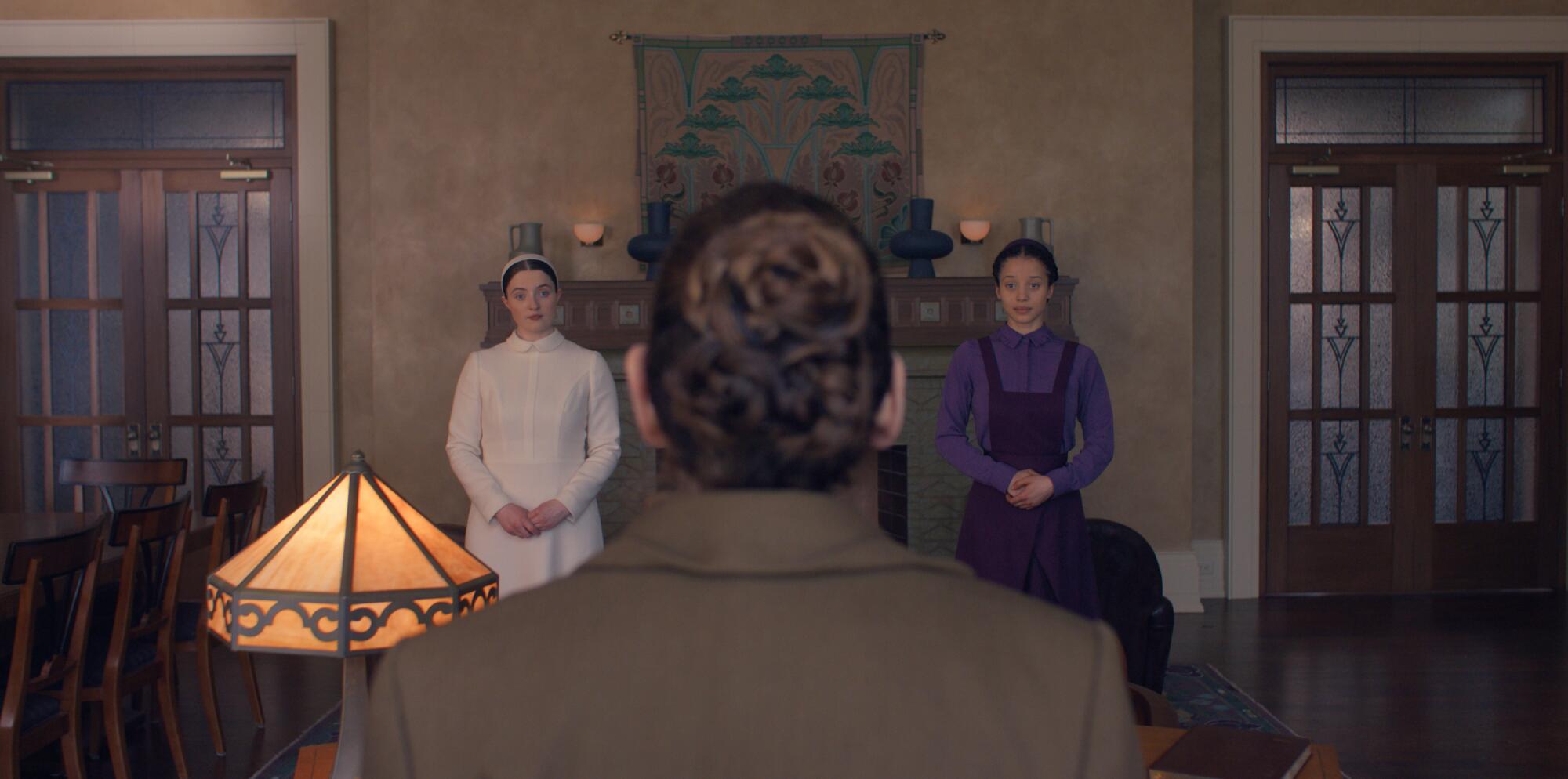
Based on Atwood’s 2019 novel of the same name, the new series takes place three to four years after “The Handmaid’s Tale” finale, which kicked off the beginning of the end of Gilead. It is set at an elite preparatory school to groom future wives, made up of daughters of Commanders, many of whom have been taken away from their birth parents, and so-called Pearl Girls, recruited from outside of Gilead. It is named after and run by Aunt Lydia (Ann Dowd), the profoundly complex antagonist from the original series.
Infiniti plays Agnes MacKenzie, the daughter of a high-ranking Commander, but her actual identity is Hannah, the kidnapped biological daughter of June Osborne (Elisabeth Moss). Meanwhile, Halliday plays Daisy, a recent arrival to the Pearl Girl squad who is really there as an undercover spy for the Gilead’s resistance group, Mayday, under the guidance of June. In a departure from the book, Daisy is not June’s other daughter, Baby Nicole.
Bruce Miller, who developed “The Handmaid’s Tale” and served as showrunner for much of its run, returned to adapt the sequel. And much like how June summoned her power to fight against the world that confined her, Miller thinks the grit that Agnes, Daisy and their young peers possess to bring it all down is the reason “The Testaments” won’t feel like doomscrolling.

In “The Testaments,” Daisy (Lucy Halliday), left, is a recent arrival to the Pearl Girl squad who is paired with Agnes MacKenzie (Chase Infiniti), the daughter of a high-ranking Commander, by their school’s overlord, Aunt Lydia.
(Disney)
“The hope that it has is why viewers should be ready to come back,” Miller says. “What kind of women has Gilead built? They built the kind of women that could really bring down Gilead. All the things Gilead told them not to do — become friends, develop their own moral compass — they’ve done them all. If June knocked Gilead on its back, her daughter is gonna stand on their neck until it dies.”
The first three episodes of the series are now streaming on Hulu. In an early April video conversation, The Times caught up with Infiniti and Halliday to discuss their induction into “The Handmaid’s Tale” universe, observing Moss in action and the playlist that made an impression on set. These are edited excerpts from the conversation.
Tell me about your knowledge of Margaret Atwood’s universe. Had you read either book before this project? Did you watch “The Handmaid’s Tale?”
Infiniti: [Points to Halliday] You’ve got the Margaret Atwood No. 1 fan right here.
Halliday: I am the Margaret Atwood No. 1 fan — I hold my hands up. I’d read all of her books. I’d read “Handmaid’s” and “The Testaments” prior to this job and, obviously, I knew about the show.
Infiniti: My first exposure to the story was through the show. I was in high school when “The Handmaid’s Tale” first started airing, and so I remember it kind of taking over my school campus. Everybody was watching it, everybody was talking about it, and I just remember it being so, so massive. And then after that, I read the books.
Halliday: “The Testaments” book came out when I was in school, and my friend brought it in, and we spoke about it at lunchtime. It’s very serendipitous, it’s full circle.
What types of conversations were you having about it?
Halliday: It always feel timely regardless of what point you’re approaching the text at. I think, particularly at the time I read it, and now with this show, what appealed to me was that it was a younger perspective, and it was a new voice in Gilead. I had a level of interest that I hadn’t expected, just because I was a teenage girl at the time I was reading this book and [saw] another experience of a teenage girl that, in some ways, mirrored my own, despite, obviously, I don’t live in Gilead.


After starring in the Oscar-winning “One Battle After Another” as the daughter of revolutionaries, Chase Infiniti is poised to lead another revolution in “The Testaments.” “You feel an extra sense of responsibility playing somebody so young who is fighting for something that is bigger than them,” she says. (Jason Armond / Los Angeles Times)
Chase, how do you see Agnes and how do you think her identity may shift when she is maybe living as Hannah? And Lucy, how do you see the Daisy in flashbacks versus the Daisy we meet in Gilead?
Infiniti: I haven’t thought about how Agnes will be when she is free as Hannah. I have concepts in my mind, but I don’t want to form anything too soon that will change the way that I personally could perform, if we’re lucky [enough] to have a Season 2 and beyond. But I think the growth that you see in Agnes, from even just Season 1, you really see her grow into herself and understand her place and understand her voice in the world.
Halliday: It’s an interesting juxtaposition because Daisy in Toronto is free and liberated and happy, but in a way, she’s not as open-minded as she could be. For example, when it comes to Gilead, she’s got these very strong, preconceived ideas of who these people are. She thinks they’re primitive, and she’s got no interest in befriending them. And then she comes to Gilead, and suddenly she’s lost access to a lot of the opportunities she had in Toronto, where she doesn’t have freedom, she can’t just do whatever she wants to, say what she wants and a there’s a great deal of oppression. But by experiencing these girls and by befriending these girls, she is actually now opening her mind to be more susceptible to friendship, and … understanding individuals who are different from who she is.
Let’s get into Agnes and Daisy’s relationship. They’re initially suspicious and distrusting of each other. What intrigued you about their dynamic?
Infiniti: Lucy has a great description about how she views Agnes and Daisy, which I think is very accurate.
Halliday: I see Agnes and Daisy as being two cats in a room sniffing each other out. And it’s because I think they immediately recognize the inherent similarities present in the other person, and that scares them because the other person, from both of their perspectives, is a foreigner, is not what they want to be associated with, yet there’s this innate kindred spirit present, and they can’t deny that. They’re the same language, just in different fonts. We see that throughout the season, and they really, like, rub off on each other and they have something to give to the other person.
There’s one big change from book to screen. Daisy is not Baby Nicole, the half-sister of Agnes. What did you make of that change, Lucy?
Infiniti: Wait a minute. I thought we were sisters this whole time. [laughs]
Halliday: It actually didn’t impact the story that much because in very many ways, Agnes and Daisy are sisters. Their relationship hasn’t altered because of this information. June is still an incredibly important figure in both of their lives. June adopts Daisy when her family is gone, so they still share all of these pieces of their history. They’ve had very similar life experiences, although unbeknownst to each of them, and the bond that they create for themselves is a sisterhood, and they have a love for each other by the end of the season. Although the lineage may be different, just about every single other aspect of Margaret Atwood’s original Daisy and Agnes remains.

An exterior shot of the elite preparatory school to groom future wives that is central to the story of “The Testaments.” It is named after and run by Aunt Lydia, the profoundly complex antagonist from the original series.
(Disney)
A girl’s menstrual cycle is a key character in this story — the power and promise it holds in the eyes of these teenage girls. What was it like to get back to that mindset of your younger self and your ideas of it then? Agnes is frustrated by the rigidness of being a girl, but she’s also curious about what’s to come, and getting her period is critical to that.
Infiniti: I feel like mine and Agnes’ experiences could not be more different. She was very excited to get it, and she was very eager, too, because of what it promises. And she was scared, but she knew that this was the hopeful step, if she was blessed by God, right, to become a wife — it would only benefit her to have it. Also, there’s so much secrecy around it, and a lot of things that these girls are just not taught about what it actually means to get your period, as opposed to the outside “next steps” that they go through. But I remember when I got mine, I was so scared. I remember I cried because I didn’t know what to do.
Were you home? I was at a sleepover and was mortified.
Infiniti: I was in math class at school — and that’s extra terrifying because I was really bad at math. I just remember being very scared. So, when Agnes gets it, I was a bit in awe of the way that she handles it and the way that she takes it and doesn’t let her fear hold her back in her tracks. That’s something that I found to be very intriguing. But you do feel bad because they don’t really know anything about what it means to have your period, what it means to become a woman and go through puberty like that, and all the changes that are going to happen.
Halliday: Periods are not talked about, really, in a mainstream manner. Whereas in Gilead, it’s not a liberated place, it’s not a really progressive society, but periods are spoken about quite freely. I don’t necessarily have anything to say about it, but I do think it’s an interesting idea that even though we, in society, would like to think of ourselves as not being in Gilead, we’re not as freely speaking about periods and menstruation the way that they do there.
Infiniti: I remember in Episode 2, when Agnes goes through that ceremony and she’s literally telling everybody. She’s like, “I was blessed by God. Yo, I’m on my period.” It was crazy. She said it exactly like that, by the way [laughs]. There’s a whole system to announce that this thing has happened because it’s so uncommon in Gilead.
Halliday: On the set, I remember Mike Barker [who directed the first three episodes] called “menarche playlist” and it was just a bit of a laugh.
Infiniti: Guess what one of the songs was?
Please tell me. I’m thinking Leona Lewis’ “Bleeding Love.”
Infiniti: One of them was totally “… Baby One More Time” by Britney Spears.
Halliday: But I just remember that we’re on set in 2025 and people would be like, “What’s menarche?”
Infiniti: The period aspect is something that I really love that you get to see in the show; you see how openly they all talk about it with each other. Because with your friends, you have very open dialogue, and those are the people who teach you how to use a pad, those people teach you to use a tampon, how to properly take care of yourself in that way. That’s something that I really love about the show is that we get to highlight that, and that’s one of the bonds that it brings between people. Or in the case of our show, the bond that it brings, but also the amount of chaos that it can bring, too, since fertility is so low in Gilead.


In “The Testaments,” Lucy Halliday stars as Daisy, a new Pearl Girl who is really an undercover spy for Mayday. “I hope people watch the show and it only further ignites their disgust for these things and their shock, because we should never be comfortable,” she says. (Jason Armond / Los Angeles Times)
We talked earlier about the flashback and what we learn about how Daisy found herself in Gilead. But we didn’t dig into Elisabeth Moss — she’s an executive producer, but also we get to see her as June. It starts as a brief glimpse, and more in Episode 3, getting the backstory on how she agrees to let Daisy be a spy at the school and help in Mayday’s mission to bring down Gilead. What was it like having Elisabeth on set?
Infiniti: I snuck onto set when she was working with Lucy, don’t worry. She just showered us with so much love and support. That was the biggest gift that we could have gotten since, in a way, she is “The Handmaid’s Tale.” She is the handmaid in “The Handmaid’s Tale.”
Halliday: Getting to watch her was truly a privilege because she is so knowledgeable, she is an encyclopedia when it comes to this world and when it comes to Gilead and these characters. And I wanted to leech off of that. I wanted to take that home with me because it really further enforced to me the importance of being prepared as an actor, and it’s something that I know we both took seriously in terms of our work ethic when approaching this job. But it definitely was daunting — I think that was actually my first day on set, was a scene with her.
Actors often talk about how their costumes inform their performances. The red garments in “The Handmaid’s Tale” became such a symbol of resistance in real life. Here, you’ve got the plum and green garments that are in accordance with a narrow view of what is acceptable for women to wear. How did the costumes inform your work?
Infiniti: The first thing it really taught me was that my posture is not as good as I thought it was because those costumes really force you to take over perfect posture. I remember when we first started to wear them every single day, for at least 12 to 14 hours [a day], your back is hurting because of how perfectly straight you’re standing. Even though the costumes are made to fit you exactly, they are restrictive and so you feel immediately like you’re thrown into Gilead and thrown into these girls’ shoes. You have to be almost like a doll, in a sense.
Halliday: I physically was a different character when I was in the scenes in Toronto versus when I was in Gilead because I was inhabiting the space in a very different way. It felt like a full transformation, and it was so helpful in terms of understanding how Daisy would feel in that environment because she’s not getting to present herself in any way that she would feel comfortable or would normally do it.
Infiniti: And you had your little pearl [in your ear].
Halliday: I would check if it was there for maybe a month after we finished filming. I was walking around looking like a Secret Service agent.
Infiniti: I was like, “Is that how the Pearl Girls communicate with each other?”
Halliday: It was like the Starship Enterprise.


Lucy Halliday, right, and Chase Infiniti of “The Testaments.” (Jason Armond / Los Angeles Times)
Many people speak of the timeliness of the themes of this show. When you’re actively playing these characters, are you thinking about the politics of the story or does that element come later when you’re reflecting on it or watching it?
Halliday: I don’t think it’d be possible to tell a story without being conscious of any sort of parallels because we all watch the news, we’re all aware of the world we live in. But it’s also worth remembering that none of it was ever intended to be a documentary. Margaret Atwood wrote it based on history, and so everything was always factual, but it was historically factual, and it’s just so happened to be that, unfortunately, we’re seeing events repeat themselves or being emulated in reality.
Chase, you’re coming off “One Battle After Another,” which spoke of modern political division and extremism. How was it to go from that to something like this?
Infiniti: One of the cool things that I really loved about both of those projects is the fact that both Willa [her character in the film] and Agnes are revolutionary characters. You feel an extra sense of responsibility playing somebody so young who is fighting for something that is bigger than them. We’re privileged to be part of something that’s saying something about the world and has the ability to enact change in the world. We really wanted to make sure that we were doing justice by the story, by the writing, by Margaret Atwood’s work and telling the story as authentically as we can from our characters, so that in the most perfect situation, we can transcend the screen and continue to touch people and hopefully enact change in viewers’ own personal lives.
Halliday: We hope people enjoy it because it is a source of entertainment. We hope people feel hope because there’s friendship and there’s a beautiful storyline inherent to it. But I think also what would be great is if people watch it and they do feel shocked. People should feel shocked or taken aback or disgusted by these scenes because we have such an overabundance of exposure to scenes of these nature — whether it be on the news or whether it be on a fictional TV show — but we hear about these events all the time nowadays, and I think we run the risk of becoming desensitized to them. I hope people watch the show and it only further ignites their disgust for these things and their shock, because we should never be comfortable. We should never be able to sit with it and feel OK. We should always have that fire burning.