Democrats gain ground with AAPI adults as trust in Republicans fades, AP-NORC/AAPI Data poll finds
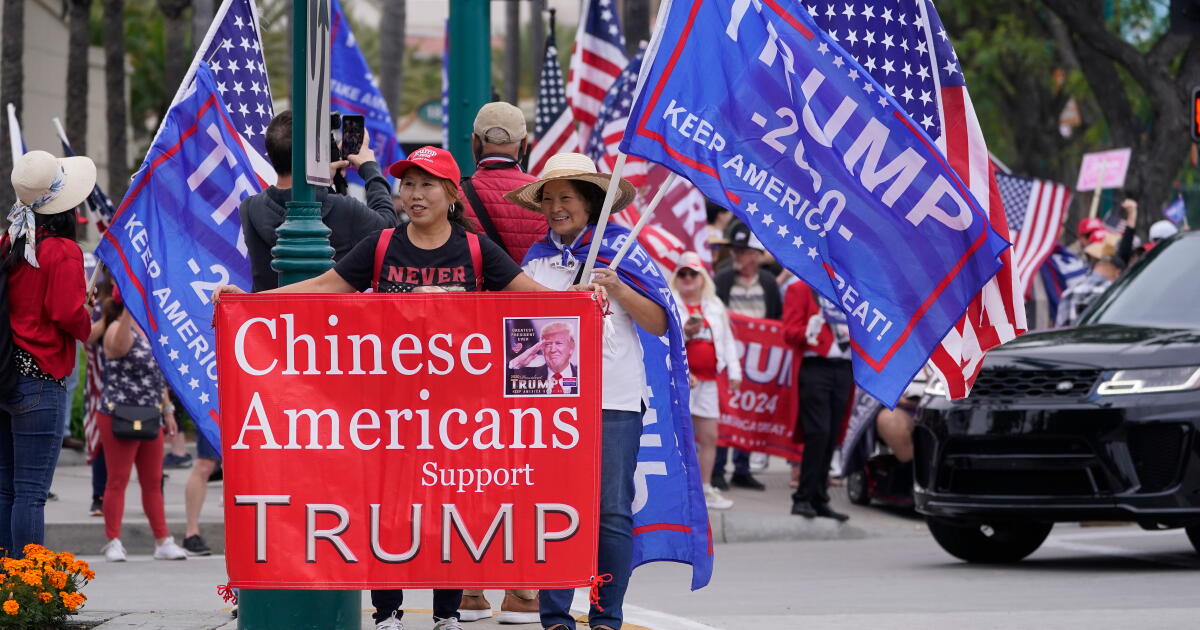
WASHINGTON — Asian Americans, Native Hawaiians and Pacific Islander adults have become more disillusioned with President Trump and Republicans as the Nov. 3 midterm elections approach, according to a new AP-NORC/AAPI Data poll, giving Democrats a substantial edge on major issues like the economy and health care.
The survey, which was conducted from Sept. 8-15 by AAPI Data and The Associated Press-NORC Center for Public Affairs Research, reveals that Trump’s standing on the economy has fallen among AAPI adults over the course of his second term.
About one-quarter of AAPI adults approve of the way Trump is handling his job as president overall. Only about 2 in 10 approve of his performance on the economy, which the vast majority of AAPI adults see as one of the most important issues for the upcoming election.
But although AAPI adults trust Democrats more than Republicans on a wide range of issues, views of the Democratic Party itself are still split.
Rebecca Larocco, a 45-year-old Korean American in Corning, Iowa, voted for Trump in 2016 and is leaning Republican in the midterm elections. She approves of his immigration policies but is unsure about Trump’s handling of the economy as the Iran war continues to compound gas prices.
“Where I’m at, it’s went up almost $1.50 (a gallon),” she said. “I didn’t expect to go into war at all, that has been definitely unexpected and I’m not sure… I’m just hoping they’ll do what they’re saying and get our economy back on track, get immigration and crime lowered.”
The economy is a top issue for AAPI adults
The economy remains top of mind for an overwhelming majority of the AAPI adult population when they consider the midterms. With the ongoing Iran war affecting gas prices and other costs staying elevated, Americans overall are deeply pessimistic about the state of the economy and see it as a high priority for the midterms. That includes AAPI adults — according to the poll, about 9 in 10 rank the economy as one of the most important issues for the upcoming election, and about 8 in 10 say this about the cost of living.
The economy, the cost of living and healthcare dwarf other issues for AAPI adults. About 7 in 10 AAPI adults say healthcare is one of the most important issues for the election, while only about half say this about foreign policy, crime, immigration, election fairness or climate change.
At the same time, Trump’s economic approval among AAPI adults has dropped about 10 percentage points over the course of the year, and there are other signs his popularity has waned with this group. In late 2024, just after the election, about 4 in 10 AAPI adults had a “somewhat” or “very” favorable view of Trump. That’s fallen to about 3 in 10 now.
“What the data show is that any gains that he made not only during the 2024 election — there was a bit of a honeymoon period that Trump enjoyed after the election before Inauguration Day — that has now largely disappeared,” said Karthick Ramakrishnan, founder and executive director of AAPI Data.
Len Takahashi, 57, of Universal City, Texas, describes himself as conservative but voted for Democrats in the last three presidential elections and for Republicans in midterm elections. For this midterm election, he is simply open to candidates who prioritize the economy.
“I would like policies that look in the best interest of the American public,” said Takahashi, who is Japanese American. “That could be bringing down spending, a balanced budget of U.S. spending, bringing down inflation, working towards a more stable economy and, lastly, just a better atmosphere between the far left and far right.”
AAPIs trust Democrats more on most issues but are not entirely sold on the party
Democrats have gained at Republicans’ expense since Trump returned to the White House when it comes to AAPI adults’ trust in handling many key issues.
In a March 2025 poll, AAPI adults were evenly divided over which political party would better handle the economy and immigration. Now, Democrats have a roughly 20-percentage-point advantage on both issues.
Meanwhile, around two-thirds of AAPI adults have a “somewhat” or “very” unfavorable view of the GOP. Only about one-quarter have a “somewhat” or “very” favorable view.
But while trust in the Democrats on specific issues has increased, AAPI adults are ambivalent about the party as a whole. About half, 48%, of AAPI adults have a “somewhat” or “very” unfavorable impression of the Democratic Party, while 44% have a “somewhat” or “very” favorable impression.
A separate AP-NORC survey of registered voters in September found, similarly, that while voters in general are deeply dissatisfied with Trump and the GOP, few think either party is capable of solving important problems.
Louise Rider, 40, is a Democrat living in Chicago. She believes Democrats are better than Republicans across all issues but says she’s unhappy with how the party has governed.
“I don’t think the Democrats are doing great, I think they need a lot of change as a party,” she said. “It’s kind of a helpless feeling, that nothing will get done with both parties unless there’s major changes.”
Some Republicans still stand behind Trump. James Finley, 74, of Lenox, Massachusetts, said Trump deserves some understanding because he cannot bring down high prices overnight. When it comes to Republicans in general, Finley is a little more critical.
“They’ve had the majority for a couple of years,” said Finley, whose ancestry includes Japanese heritage. “I think they could have done a little bit more or maybe a lot more in terms of passing certain things that I wanted to pass.”
Still, he sticks to the party line and because “all I ever hear from Democrats is to get Trump,” Finley said.
AAPIs concerned about fair midterm elections
As the election approaches, many AAPI adults are worried about problems with misinformation, legal challenges to the results, and voter suppression. About half of AAPI adults say it’s a “major problem” in U.S. elections that people who are eligible are not allowed to vote, while about two-thirds see foreign government attempts to influence results as a “major” problem.
Looking ahead to the November election, about half of AAPI adults are “extremely” or “very” concerned about fake or false information about the candidates, and about half also feel this way about legal challenges to the election results.
Finley is unsure if the voting process can be tightly monitored to prevent undocumented or unregistered people from attempting to vote.
But Takahashi, the conservative from Texas, is worried that Trump will try to manipulate the election.
He’s concerned, he said, that Trump would amplify claims of “fraud in the election system” should the midterms not go in his favor. “(He’ll) make that a point to distract the American public,” he said.
Tang, Jiang and Sanders write for the Associated Press. Tang reported from Phoenix and Jiang from New York. The poll of 1,023 U.S. adults who are Asian American, Native Hawaiian and Pacific Islander was conducted Sept. 8-15, using a sample drawn from NORC’s probability-based Amplify AAPI Panel, designed to be representative of the Asian American, Native Hawaiian and Pacific Islander population. The margin of sampling error for all respondents is ±4.7 percentage points. This poll is part of an ongoing project exploring the views of Asian Americans, Native Hawaiians and Pacific Islanders, which are usually not highlighted in other surveys because of small sample sizes and lack of linguistic representation.