hal

‘The Diplomat’ creator on Kate Wyler’s bold choice in Season 4

In case it wasn’t already clear: Debora Cahn, the creator of “The Diplomat,” likes to leave viewers in suspense.

The Netflix political thriller has followed Kate Wyler (Keri Russell), the highly competent, intensely impulsive, deeply flawed and incredibly relatable career diplomat, as she’s cleaned up backroom deals, navigated volatile international crises and unstable government leadership — all while managing a topsy-turvy marriage tangled up in it. And the stakes escalate with each season’s finale, forcing Kate to test her limits. But the fourth season has brought her breaking point.

Alarmed by the questionable decision-making by President Grace Penn (Allison Janney) — as the bullying tactics used against the U.K. to ensure their cooperation against Russia become untenable — Kate resigns in unplanned, but grand fashion at the G7 summit in front of world leaders. She’s eventually joined by other members of Penn’s administration: chief of staff Billie Appiah (Nana Mensah), Secretary of State Miguel Ganon (Miguel Sandoval) and, most notably, her husband, Vice President Hal Wyler (Rufus Sewell).

“We like a good cliffhanger,” Cahn says during a recent video call.

Cahn’s thought about how “The Diplomat” will ultimately conclude. But like the show’s savvy titular character, she perfectly executes the art of the charming evasion when pressed for answers — namely, how close are we to getting there?

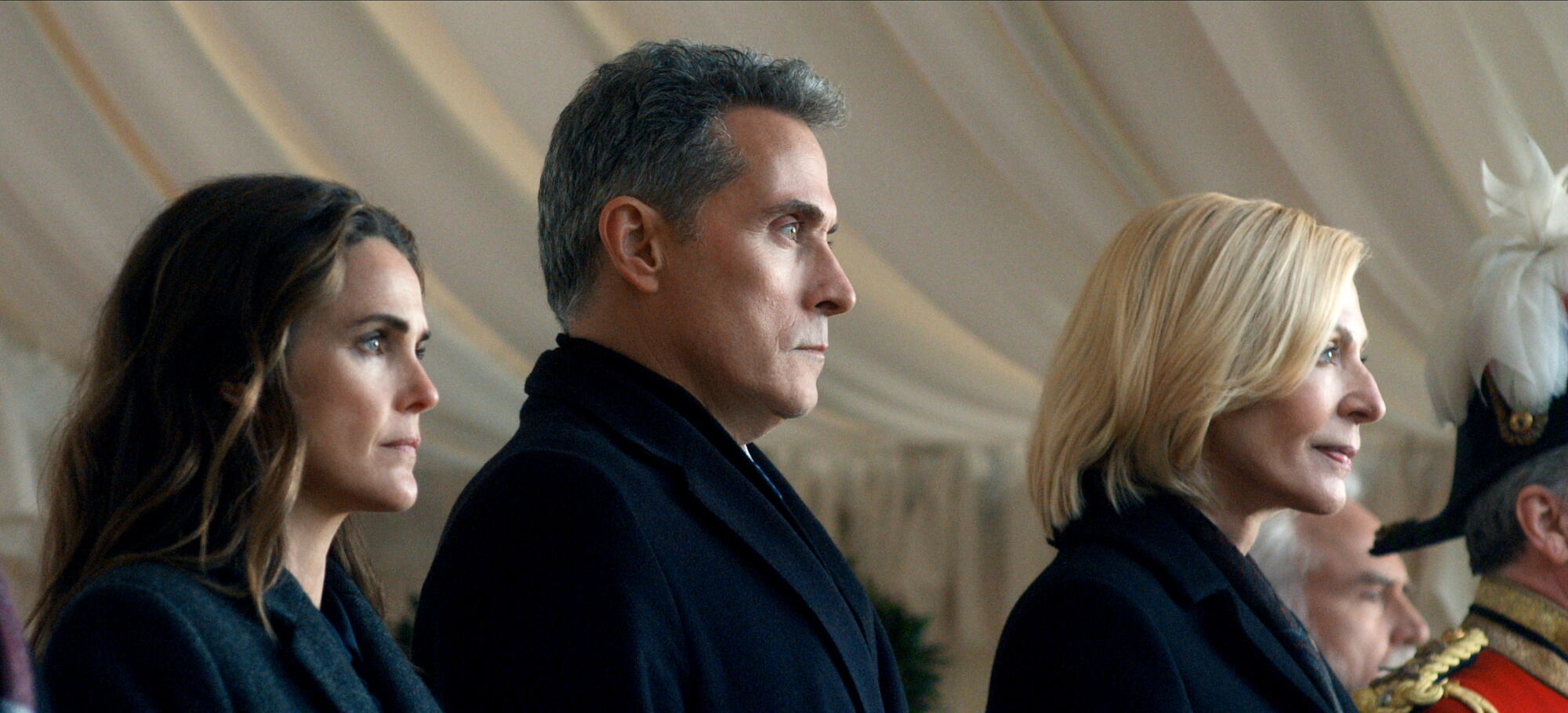
The side profiles of a brunette woman, a man and a blond woman, standing beside each other under a white tent.

Keri Russell as Kate Wyler, left, Rufus Sewell as Hal Wyler, Allison Janney as Grace Penn in Season 4 of “The Diplomat.”

(Netflix)

“I don’t know — maybe it just did,” she teases. Cahn then turns more serious: “I’ve always had an idea of what the end is. As with everything on the show, I’m always delighted to have that idea blown out of the water by a better idea, but so far it hasn’t happened.”

Cahn began her television writing career on Aaron Sorkin’s acclaimed political drama, “The West Wing,” spanning seasons 4 through 7. After working on shows such as “Grey’s Anatomy,” “Vinyl” and “Homeland,” she took the helm as creator and showrunner for the first time with “The Diplomat.” And writing a political drama today meant grappling with a creative responsibility she hadn’t faced before.

“I didn’t have to figure out what ‘The West Wing’s’ political position was going to be or what ‘The West Wing’ thought about the world,” she says. “I want to make a show that is compelling for a lot of different people. And there are certain things that are happening in the world that, as much as I try or would like to be even-handed, … [are] really difficult to ignore when you’re living at a time when you feel like democracy is crumbling.”

On a recent afternoon from her home in New York, Cahn spoke more about the new season of “The Diplomat.” These are edited excerpts from the conversation, which includes spoilers.

A woman and a man sit in the backseat of a car, each staring out their respective window

The marriage between Kate (Keri Russell) and Hal (Rufus Sewell) is tangled with their work.

(Netflix)

So much of the show, but particularly this season, is about lines that are drawn and the crossing of them. How did you and the writers decide what would be the line for Kate?

It took months and months and months to decide because we wanted to treat the question as realistically as possible. A lot of good people don’t quit. And so, why? What’s the reasoning? The whole season is examining that question for Kate and, in a way, for all of them. I didn’t want to be like, “Well, she doesn’t like the president, so she walked on out.”

What did you want out of that final moment of the season?

The moment when she stands up, she has come to a clarifying realization that her line has just been crossed. It happens in that room. And we argued about that a lot. We ended up feeling really strongly that it be what was happening right there. That this was a question she had wrestled with, but when you see that you are off the cliff, it will become clear what you have to do. So for her, Grace’s speech was that moment. She then walks out of the room and thinks: “What the mother f— did I just do? I’ve just ended my career. Have I ended my husband’s career?” That’s how she feels until she hears the door open and sees Billie walk out, and both of them go through a similar moment when they hear the door open, and Ganon walks out; then obviously the last one [is Hal] that really nobody was expecting. But for Kate, there is a big difference between having realized that you can’t go forward because your own line has been crossed, to realizing that you have started a movement, and that there is a contagion in that action.

How much did the real world, particularly international relations, inform or shape the season?

I don’t ever like to do a ripped-from-the-headlines show, particularly because we write it and then a year or two passes before it gets on air. But it did feel like, at a time when this administration was coming back into power again, and their first move was to fire people and really obliterate the institution that we were writing about, it didn’t seem like a story that we could walk around and ignore.

A man in a tuxedo and a woman in a shimmering white gown sit beside each other while applauding

Bradley Whitford as Todd Penn and Allison Janney as Grace Penn in Season 4 of “The Diplomat.”

(Nick Wall/Netflix)

We haven’t had a woman president. We know the sexism around this topic: Women are too weak, women can’t make tough decisions. What was the lay of the conversation in the writers’ room about who Grace Penn would be as president?

The situation that we wanted to sustain throughout the season was she’s not doing these things because she got shot, her stomach hurts and she’s mad. She’s doing things because she became president, and she thinks this is how the country needs to be run. Is there an overcompensation around her making sure that people don’t think that she’s too weak and afraid to be a foreign policy hawk? I think in plenty of circumstances, women in positions like that are more likely to take a strong decisive military action because there is this looming concern of, “Well is she tough enough? Is she gonna try and have everybody hold hands and make up?” There is an instinct to make sure that people realize that that isn’t your plan. Every one of the decisions that she made, we made sure that there was a smart, strategic, security mandated argument for doing what she was doing.

What Grace says at the top of that summit regarding the U.K. and Russia, if you didn’t know what was going on behind the scenes, it would seem reasonable and strategic.

I’m happy to hear you say that because that was very deliberate. We went round and round with different versions of what she said in that speech because some people would listen to it and say, “Oh, my God, she can’t say that. It’s just overwhelmingly reprehensible.” Then we would show our Washington people, and they were like, “It’s not so bad.” Democrats who were like, “This isn’t crazy. This is kind of middle of the road these days.” We realized that we couldn’t have her saying things that have become accepted in Washington because the public would view it as monstrous, and we didn’t want to be portraying a villain.

Is that the most difficult thing for you as the showrunner of a political show today — a president as a villain?

It’s trickier than I hoped it would be. I’m not really interested in the presidency as much as I’m interested in the thousands of people who interact with the president and perhaps don’t, as individuals, wield as much power in their hands as that office holder does. But real power, particularly in numbers, can make things happen or stop really disastrous things from happening. Whether or not we think that there’s a villain in the White House, what does everybody else do to try to manage it?

A bald man sits in front of a desk with U.K. flags positioned on either side of him

Rory Kinnear, who plays Prime Minister Nicol Trowbridge, sings opera in a scene where his character is having a hallucination.

(Clifton Prescod / Netflix)

There’s a surreal interlude with Prime Minister Nicol Trowbridge (Rory Kinnear) and his hallucinations — he’s singing opera, at one point. How did you arrive at that turn for him?

I would be lying if I didn’t say one of the big reasons I wanted to do that was because I found out Rory Kinnear sings opera. When we knew we were going to have this situation where he was going to through something even more stressful than everything that he’s been through up until now, it felt like it would be really great to see what’s going on in there [his mind]. I called him up and I said, “I’d like to have you singing ‘Pagliacci’ — is that OK?” And he was like, “Well, let’s start warming up now.”

For a brief moment, with Grace shot, Hal is acting president. I’m curious how you arrived at the length of time he’d fill in for Grace. It’s a few hours. And it reveals so much.

There’s a gravitational pull that we’ve been resisting ever since we made the president a big role, and then placed one of our leads in the role of vice president. There’s this pull toward the White House. But I’ve never wanted to be like, “Oh, well, then Hal’s president. Then, Hal dies, and Kate’s president! Everybody gets a chance.” Once he was VP, it started to seem equally absurd to not have a taste of that because it is, in fact, the reality in that job.

Making Hal a president for a long period of time wasn’t all that interesting to me, but I did want a little bit of a window into it. We think we really know what Hal Wyler is going to do in that role — and by we, I mean Kate, really —and it just isn’t true at all. It also turns out she really had no idea who he was as a vice president, and he’s a much different person than she thought. She thought he was going to continue to be a bull in a china shop, big swings and big ideas and asking for forgiveness, not permission. That’s not who he’s been in that job.

A group of people line up on a stage

Billie (Nana Mensah), left, Kate (Russell), Hal (Sewell), Grace (Janney), Fitzwilliam (Neil Pearson) and Todd (Whitford) in “The Diplomat.”

(Nick Wall/Netflix)

Both couples faced questions like: Who is this person I married or how am I responding to who they are at this moment? What were you interested in exploring in both these dynamics?

The conversation that we were just having is in a way relevant for all four of them. Not only is Hal different than Kate thought he would be, Hal’s different than Hal thought he would be. I haven’t run a show before. This is this is my first time in that position, and I am absolutely different than I thought I would be. I was 100% sure I knew exactly how I would handle things, and it didn’t happen. That’s an idea that we wanted to keep alive for Hal and definitely for Grace. You can prepare for it all you want and still not know.

You can’t help but feel for Todd as he tries to figure out Grace. But then he nearly dismantles NATO and you’re like, Todd!

Todd goes through two phases. He has this terrible feeling of helplessness that is eventually supplanted by this terrible feeling of power that he’s unable to manage. In a lot of ways, the Todd story is the most realistic one we’re telling because a lot of people who’ve never done this before are making the most consequential decisions, literally in the world. And Todd’s not a dumb guy, and I don’t think the people that we’re watching do this are dumb people, but, boy, are they in over their head really fast.

I want to talk about Grace and Todd and the use of “babe.” There’s something so intriguing to me about what they’ve done with that pet name across the season.

You’re thinking about all my favorite things. I don’t know what to say other than I’m glad it’s reading. You take a term of affection, and, at a certain point, it just becomes a name. The affection that it carries with it is just a horrible memory of a moment that is clearly gone.
Source link

‘Lanterns’ finale: The creators on John Stewart’s journey, the Halogram

This story contains spoilers for Episode 8 of HBO Max’s “Lanterns.”

From the very first time Tom King and DC Studios’ James Gunn ever talked about a Green Lantern show, they envisioned John Stewart as the kind of hero who could generate excitement and change the tide of any battle upon his arrival.

“The idea was to build a character as compelling and impactful as, say, Thor in the Marvel universe,” says King, the “Lanterns” co-creator, during a recent video call. “Someone who arrives in a movie with a thunderclap, and … the audience [just] screams when they arrive because you’re in love with that character … not just [for] the power set they have, but the integrity of that character.”

That hero officially takes flight in Sunday’s “Lanterns” finale.

Episode 8 of the HBO Max superhero crime drama, titled “Dirt and Stars,” sees John Stewart (Aaron Pierre) take up the mantle as Earth’s newest Green Lantern. After solving the mystery of his predecessor Hal Jordan’s (Kyle Chandler) death, Stewart claims Jordan’s power ring as his own, recites his oath and jets off toward his next adventure. (A second season of “Lanterns” has not been announced, but the character will appear in Gunn’s upcoming “Superman” sequel, “Man of Tomorrow.”)

Co-created by King, Damon Lindelof and Chris Mundy, “Lanterns” introduces Jordan as a grizzled, veteran member of the Green Lantern Corps, intergalactic space cops who are armed with a special ring that allows them to manifest objects and manipulate energy.

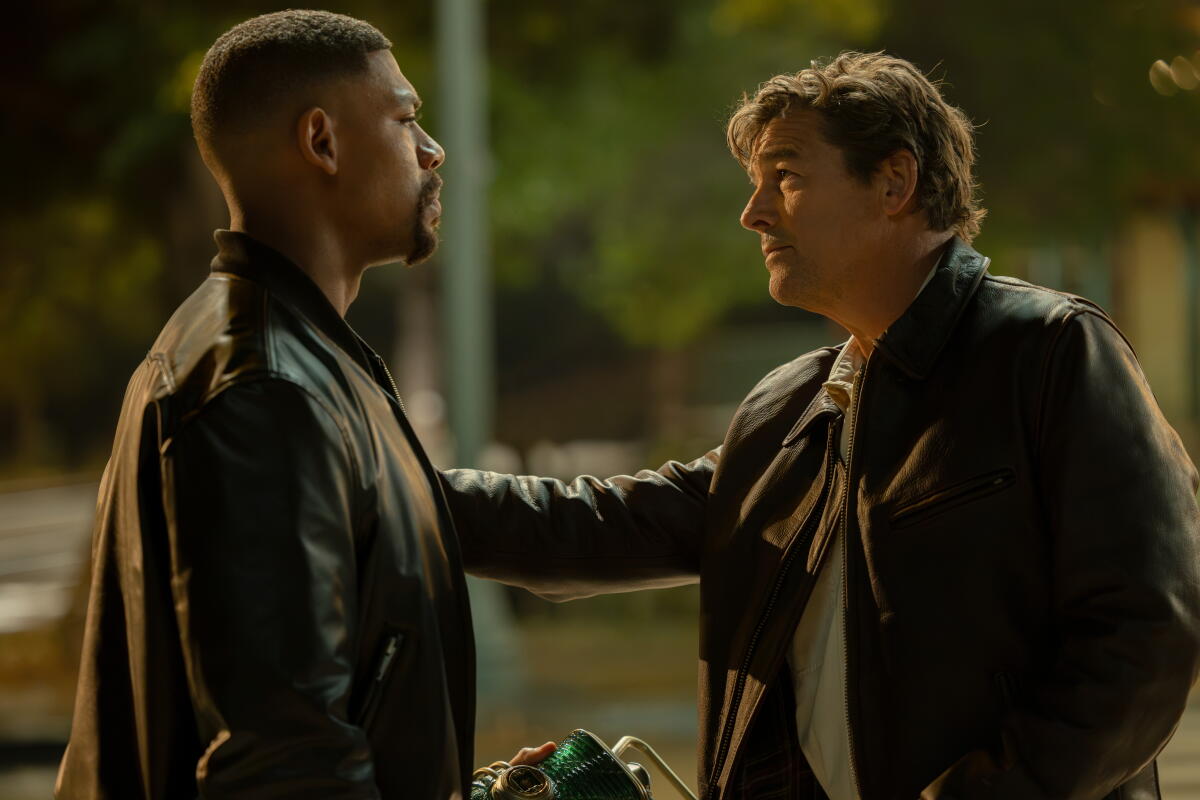
Kyle Chandler with his hand on Aaron Pierre's shoulder

In the finale, John Stewart, left, claims Hal Jordan’s (Kyle Chandler) ring as his own.

(John Johnson / HBO Max)

Stewart is a new Green Lantern recruit, but when an investigation into the whereabouts of a killer alien robot on the run goes awry, they go their separate ways.

“One of the cool things about the canonical Green Lanterns is that, technically speaking, there’s only one ring delegated to this particular sector in which Earth fell,” says Lindelof of one of the show’s central conflicts.

The creative team knew from the jump that Stewart would be the one to bear that ring at the end of the season, but the idea that Stewart would be a child prodigy whose parents preordained his path to become the next Green Lantern developed over time.

“We [decided] the first part of John’s life is going to be [about] coming to terms with the fact that he doesn’t really want the ring — or he doesn’t want the ring on those terms,” Lindelof says. “Then there would have to be some period of time where he was living his dream. … Then and only then would he be able to wipe the slate clean, as it were, and gravitate back toward a healthy way to want the ring.”

In the comics, Green Lanterns are known for their oaths, which they recite when recharging their rings or to reaffirm their commitment to the group. In “Lanterns,” Stewart creates his own version that acknowledges his journey and perspective on becoming a Green Lantern.

“We talked a lot about it in the room, but the feeling was that he was changing the relationship with the Guardians in that moment,” Mundy says, referring to the immortal aliens that created the Green Lantern Corps.

two men walking in a desert

In the end, Hal, left, is able to impart lessons that nobody else would have been able to teach John.

(John Johnson / HBO Max)

The Guardians had once considered Stewart an ideal replacement for Jordan because he was willing to blindly follow orders, but by the time he claimed Jordan’s ring, it’s clear Stewart has no plans to be affiliated with the Guardians or the Green Lantern Corps in that way, and the writers wanted his oath to reflect that.

“We wanted John to take [the role] on his terms,” Mundy says. “Even though Hal didn’t train him as well as he should have trained him, he taught him lessons that nobody else would have taught him. … [Including] how you need to be your own person even as you’re working for this organization.”

Besides his unconventional path to becoming a Green Lantern, Stewart is in possession of a unique lantern for recharging his ring that was forged by Sinestro, Jordan’s disgraced mentor.

The “Lanterns” showrunner remained coy when asked whether this lantern’s more ominous origins could lead to any unintended consequences for Stewart.

“It’s rife with possibility, is what I will say,” Mundy says.

In separate interviews, Mundy, Lindelof and King discussed the “Lanterns” finale, Stewart and Jordan’s bittersweet reconciliation and the show’s fiercely protective mothers. Their comments have been edited for clarity and length.

Because the “real” Hal is killed in 2026, his relationship with John is left unresolved. John shares a moment with the Halogram, the backup version of 2006 Hal’s consciousness, after working with him and the mystery is solved, but can you address that lack of proper closure for them?

Mundy: We talked about this thing as a love story between these guys in a certain way, but one of them has to die in order for them to truly come together. Even over the course of the Halogram being in the show, he never called John “Junior” ever. He always called him “trainee.” Until the last moment when he says … “I love you, too, Junior.” There’s something very bittersweet about the fact that the two people we spent all that time with don’t fully have their moment together.

King: What I think is hinted at between the Halogram and the final Hal we get is this Sinestro subplot. This is right from the comics, but Hal’s best friend, his mentor, the person who trained him, betrayed everything he trusted and Hal had to put him away. I think the trauma of that moment closed Hal up. It damaged him … so he was unable to see John for what he is and unable to listen to John the way he should. [With the Halogram] John finally encounters a Hal who hasn’t gone through that and they can have conversations they couldn’t have before. John can start to feel the empathy that Hal denied him, and he can see Hal for who Hal really is.

Lindelof: I love the idea that that version of Hal and John are unresolved. There is no apology. There is no forgiveness. The only closure that John can get is from this earlier version of Hal who has a lot of sympathy and empathy, not just for John, but for himself. Obviously, this is a crazy sci-fi superhero show, but that feels more authentic to life. Sort of like when someone that you love is gone, and you find a note that they wrote or an old birthday card and you extrapolate new meaning from it even though it’s from an earlier version of them.

a woman standing and a man sitting at a table in a restaurant

Viewers get some backstory on the romance between Kerry Kane (Kelly Macdonald) and Hal.

(John Johnson / HBO Max)

Why was it important to show more of 2026 Hal Jordan’s life before his death in the finale?

Lindelof: The only flavoring that we get of him directly [before this] is in the diner scene, when John comes for his apology and doesn’t get one. Only toward the very end of that scene after John has hit Hal, and Hal says, “Don’t let anybody know that you were here,” is there a flash that something has changed in this guy. It’s one thing for Kerry to tell us that they were in love, or to hear Hal’s “buttercup” voicemail, but I think that the audience needed to see it and experience it. Hal is not a changed man in 2026, but he’s an evolved man. And there’s real tragedy inherent in all of the decisions that he’s making because we know that all of those decisions basically lead him to be a corpse in the stands at a football game. The subtle differences by which Kyle plays older Hal versus Halogram Hal is really on sharp display in the finale.

With Noah being a Manhunter, it turned out that he and John were dealing with similar questions around lineage and legacy and nature versus nurture. How did the exploration into these themes evolve during the show’s development? Much of it is unpacked in their truck ride together.

King: The basic idea [was] that John had been one of these kids who had been told, “You’re going to be this when you grow up.” Like a Tiger Woods or Michael Jackson-esque child. We started talking about what that’s like — to be a prodigy, to be forced into [something]. The idea that you’re kind of programmed by your parents. And then we were talking about Manhunters. The problem with Manhunters is they’ve been programmed to do this one thing, and they can’t defy their programming [to eradicate mankind]. That’s why they had to eventually be erased. Then we started talking about the parallel of programming and overcoming programming, and what makes you human, what doesn’t, that parallel came first. Those were the very nascent ideas, and we took that to our brilliant writers room, and [Breannah Gibson], Justin [Britt-Gibson] and Vanessa [Baden Kelly] added their own personal experience to that and made it a much richer … and personal story.

Mundy: John still doesn’t know if he’s about to die in this car. Noah is trying to learn about himself and figure out if he wants to kill John or die himself. The important thing was to hold that tension and then kind of step that conversation through chapters. There’s anger about what happened to Zoe. After he understands that a little bit better, he says “these are the different ways my life could go.” And then John can actually bring a piece of himself. We talked all the time about the way John was raised and the programming of the Manhunters and what’s “programming” and what’s “being raised.” Then there’s a confession that ends up being false, but also this request to be killed. There were three distinct sections of that conversation, and we wanted them all to be meaningful and personal.

a man in a leather jacket and a woman in a coatsstanding next to each other

In the final scenes of the episode, John and Kerry have a conversation about what parents are willing to do for their children.

(John Johnson / HBO Max)

With both Hal and John, so much of their intergenerational trauma is tied to their fathers. But with Noah and John, you also see just how big of a role their mothers have played in shaping them. How did that aspect come about?

Mundy: Once we knew that Noah was a Manhunter, it felt too cheap and too easy for that to be the answer [to the mystery of Hal’s death]. But it felt key to the answer of it, and we were talking so much about parenthood and what you would do for your child and what it means. What’s protecting people and what’s not? It just became a given pretty early on that Kerry would be the answer at the end. It just fit into the same story Bernadette was going through. And [John’s] conversation with Kerry explains so much of that.

Lindelof: I think this all came from Vanessa Baden Kelly. We had written the pilot, where John’s father is shooting the apple off of his head, and then when Vanessa came on shortly thereafter, she’s like, “Where’s mom?” It is one of those moments where you realize it, particularly because we were three men, but also inside of the canon of these superheroes, it’s always a dad. So the idea was having Bernadette really be the mastermind of John’s upbringing as a way to provide a simultaneous salve for her husband’s shame about being afraid about losing out on the opportunity.

I think that Kerry is an equally fierce mother. Obviously, she loves Hal. But when you watch it a second time after you’ve seen the finale, you realize that there’s guilt there as well because of what she did to him, all in the name of her son.

John starts to reframe what Bernadette did as something for him, as opposed to something for her — in a lot of ways, it was a selfless act. She’s doing it knowing that her child will hate her, but that he’ll be the Earth’s Green Lantern, and there’s going to be an aspirational quality to that for generations to follow.

Source link