haji wright

Folarin Balogun urges U.S. to stay poised despite unjust red card

Like a good striker, Folarin Balogun never loses sight of the goal. And the goal for the U.S. team in this summer’s World Cup hasn’t been just to win, which they’ve done, but to inspire.

And that’s how Balogun found himself on the field, shaking hands with Brazilian referee Raphael Claus, about 45 minutes after Claus gave him a controversial red card in Wednesday’s win over Bosnia-Herzegovina, a red card that will keep him out of Monday’s round-of-16 game with Belgium.

“Little kids are watching, and we have to show them the correct way to handle things, even when you think it’s unjust,” Balogun said Friday.

“It’s not an excuse to be disrespectful, to not do the right thing. I’m aware that the World Cup might be the first time a lot of American viewers are tuning in. So it’s important, whether things happen to you good or bad, just to continue to be yourself.”

That doesn’t mean Balogun didn’t think the red card was unjust. He does. And he definitely thinks something bad happened to him and his team since Balogun, the Americans’ leading scorer with three goals in as many games, will have to sit out the team’s most important game in a generation.

It’s just means that Balogun, who celebrated his 25th birthday Friday, is also mature enough to understand a game — even a World Cup elimination game — is just a game.

“It’s been a roller coaster,” he said before the team’s training session at the University of Washington. “There’s been lots of different emotions. I’ve been upset, I’ve been happy. But for me, it was just important to stay calm. I never want to react out of anger and out of emotion.”

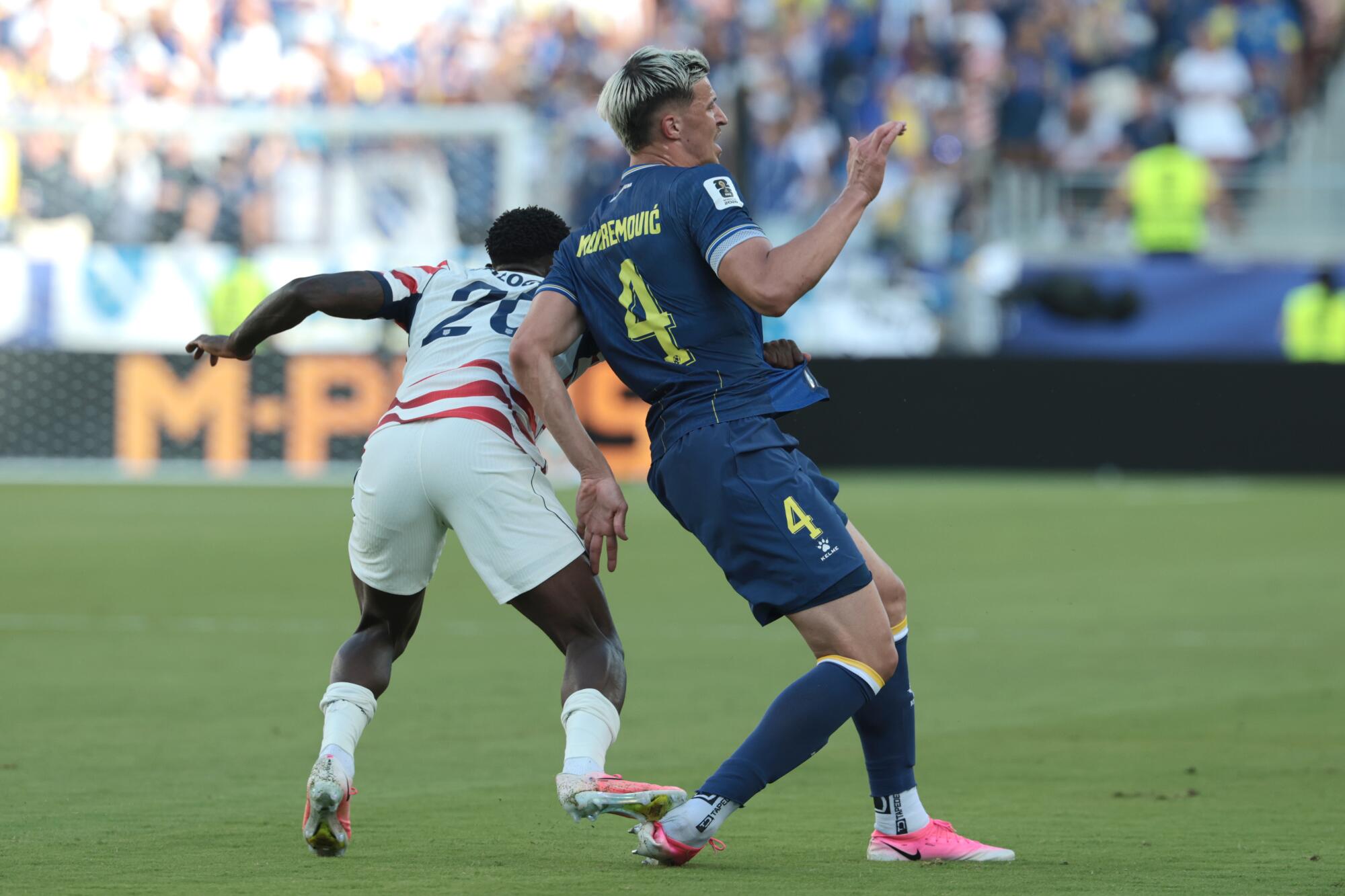
Balogun, who had given his team a 1-0 lead in the waning seconds of the first half, collided with Tarik Muharemovic 16 minutes into the second half, and when the Bosnian defender planted his right leg below Balogun’s right foot, the American inadvertently stomped on his right ankle, twisting it awkwardly.

U.S. forward Folarin Balogun steps on Bosnia-Herzegovina defender Tarik Muharemovic's foot and received a red card.

U.S. forward Folarin Balogun steps on Bosnia-Herzegovina defender Tarik Muharemovic’s foot and received a red card.

(Robert Gauthier/Los Angeles Times)

Both players went down and Claus did not signal a foul or pull card. But after the video assistant referee urged him to watch a replay, Claus walked away from the monitor and flashed the red card. That left the U.S. to finish Wednesday’s game with just 10 men and disqualified Balogun for Monday’s game. U.S. Soccer said Friday FIFA’s disciplinary committee did not add any games to Balogun’s suspension.

“There’s the scenarios that you simply can’t avoid,” he said, “and it has to be taken into context when it’s being reviewed. I felt it wasn’t on this occasion. There’s nowhere else to put your leg. It’s going to be unavoidable.

“I think a yellow card would have been fair. [But] it’s something that’s happened, so we have to move forward, and I have to accept it. The most important thing is just to focus on the bigger picture, which is Belgium.”

Replacing Balogun won’t be easy since he’s emerged as one of the team’s most effective and creative players, either scoring of setting up the go-ahead goal in all three of the U.S. wins.

“We’ve got guys that can fill in and have to be ready for the opportunity to step up,” midfielder Tyler Adams said. “When you miss a player like Balo, obviously things change a little bit. But we’ve been flexible. Guys have shown that they’re ready to play.”

The most likely replacements are Ricardo Pepi and Haji Wright. Pepi, who scored 16 goals for PSV in the Dutch Eredivisie this season, played 90 minutes in place of Balogun in the U.S. loss to Turkey in the final group-stage match. Wright, who had 17 goals for Coventry City in the English Championship, played in all four U.S. games in the 2022 World Cup, scoring once, but he has made just one appearance in this summer’s tournament.

“Balo is an important part of our team, and it’s a disappointing way for him to miss the next game,” said Wright, who grew up in Culver City and spent three years in the Galaxy academy. “But, I’ll always be ready and prepared for whatever comes.”

A victory over Belgium would send the U.S. to the quarterfinals of a World Cup for just the second time. It would also give it four wins in the tournament, double the number of victories in any previous World Cup and marking the first time the Americans have won twice in the knockout stages in the same tournament.

U.S. forward Ricardo Pepi pursues the ball during a World Cup match against Bosnia-Herzegovina at Levi's Stadium.

U.S. forward Ricardo Pepi pursues the ball during a World Cup match against Bosnia-Herzegovina at Levi’s Stadium in Santa Clara , Calif., on Wednesday.

(Robert Gauthier/Los Angeles Times)

It’s a moment, Adams acknowledged Friday, many players have waited for their whole lives.

“You need to embrace the moment, that’s for sure,” he said. “To have the opportunity to play in a round-of-16 game — which, obviously, last World Cup we did, but it was the first knockout game, not the second — it’s exciting. It was nice to get a little bit of a taste of what it feels like to play with something a little bit more on the line in the last game. I think that’s good preparation.

“Advancing and taking this thing as far as we can is the most important thing. We have a good opportunity here to do so.”
Source link

U.S. looks to make more World Cup history in round of 16 vs. Belgium

Mauricio Pochettino’s team continues to do things in this summer’s World Cup that no U.S. team has ever done before.

Its three wins are the most in a single tournament. So are the 10 goals in four games. It has the best goal differential ever and its two shutouts ties a record.

Yet all that means absolutely nothing to the players.

“They’re great milestones,” captain Tim Ream said. “But I don’t think anybody’s even once mentioned the different things that we’re doing. We’re focused on what we’re doing daily on the training ground, because that puts us in the best possible position to to put these performances.

“So yeah, not aware or even worried about records that we’re breaking.”

Well, except for maybe one.

With Wednesday’s gritty 2-0 over Bosnia and Herzegovina, a game the U.S. finished with just 10 men, the Americans won a game in the World Cup knockout stage for just the second time. That sends them on to a round-of-16 meeting with Belgium on Monday in Seattle where a win would be — you guessed it — historic.

“It’s cool and it’s great and it’s an accomplishment,” midfielder Weston McKennie said of the records. “But at the same time, we have high expectations for ourselves. That’s what we expect of ourselves, what we expect of our team.

“We just want to focus on Belgium now and continue to try to make history.”

That chore got a good deal more difficult because of an unwanted team record that was also set Wednesday. When Folarin Balogun scored a goal late in the first half then drew a red card early in the second, he became the first American — and third player ever — to get one of each in the same World Cup knockout game.

“Cool record,” defender Chris Richards said.

But while the goal, Balogun’s third of the tournament, proved to be all the U.S. needed to beat Bosnia, the red card — which cannot be appealed according to U.S. Soccer — means he’s suspended for the game with Belgium.

“It’s just so unfortunate, honestly,” Christian Pulisic said. “Looking back at it, it seems so harsh. I just told him he’s done so much for us, and now we’ve got his back.”

The red card came in the 64th minute with the U.S. protecting a 1-0 lead built on Balogun’s goal just before the intermission. The American striker was battling hulking Bosnia defender Tarik Muharemovic for a loose ball when he inadvertently raked Muharemovic’s right calf with his studs up, then landed on his ankle, twisting it awkwardly.

Brazilian referee Raphael Claus did not flash either card before stopping play at the behest of the video assistant referee. But after consulting a slow-motion reply, Claus gave Balogun a red card for a dangerous challenge.

“For me, never is this a red card,” said Pochettino, now the winningest U.S. coach in World Cup history. “Watching after on TV, never was [it his] intention to step up on the player. That was a normal action in football.”

Maybe. But Claus sent Balogun off just the same, leaving the U.S. to protect a one-goal advantage for the final 30 minutes while playing a man down. It was probably the sternest test the Americans have faced in the tournament.

“It would be easy to have an excuse if they did score,” McKennie said. “But that’s not the type of team we are.”

For Ream, the challenge was actually no challenge at all.

“Would it be weird if I downplayed this and said [I] wasn’t even fazed by it?” he said. “It didn’t feel like we were down a man. We were still able to carve out chances and we were still able to keep hold of the ball. Everybody knew their roles.

“It felt really calm and felt really, really easy and simple for us in that moment.”

And that allowed another hero to shrug off the pain of his own wounds and step up big.

Early in the second half a Bosnian player stomped on Malik Tillman, shredding his boot and cutting his right foot (but not drawing a red card). During the hydration break, Tillman was able to change shoes and in the 82nd minute, his white sock turning red with blood, he found himself standing over a free kick just outside the Bosnian penalty area.

“I’ve been dreaming about this game. I’ve been dreaming about, yeah, maybe taking a free kick and scoring,” said Tillman, who bent the ball off the gloved right hand of Bosnian keeper Nikola Vasilj and into the net for his first World Cup goal. “I trained for this in our practices and then it actually came true.”

So did the team’s dreams of reaching the round of 16, only now they’re arriving without their leading scorer, who will have to watch the Belgium game from the stands. Balogun’s absence, however, creates opportunity for others, with Haji Wright and Ricardo Pepi the most likely candidates to take his place.

And if this U.S. team has proven anything, it’s proven that it loves nothing more than embracing opportunities to prove people wrong.

“We’re going to miss him for the next game but we know that if it’s Pepi or Haji, whoever, is going to step up next and they’re going to do the job just as well as he did,” Richards said of Balogun. “One thing about this team is we’re really a big family and we’re shown it this whole tournament.

“Coming in, there was a lot of question marks about our whole team in general. Game by game we started to put ourselves right. Because we knew we had it the whole time.”

Source link

Cristian Roldan may be the last U.S. men’s soccer player to win a state title

Cristian Roldan and Haji Wright grew up less than three years and 30 miles apart, Roldan in Pico Rivera and Wright in Culver City. The odds that they would go on to become teammates on not one, but two, U.S. World Cup teams seem astronomical.

Yet despite starting at the same time and place and arriving together at the same destination, the two players followed completely different paths to get there.

Wright joined the Galaxy’s academy at 14 and signed with Schalke of the top tier German Bundesliga days after his 18th birthday. Roldan was still playing for El Rancho, when he was 17, making him the only member of the U.S. World Cup team to play four years at a public high school.

“I might be the last one,” Roldan said. “I hope not.”

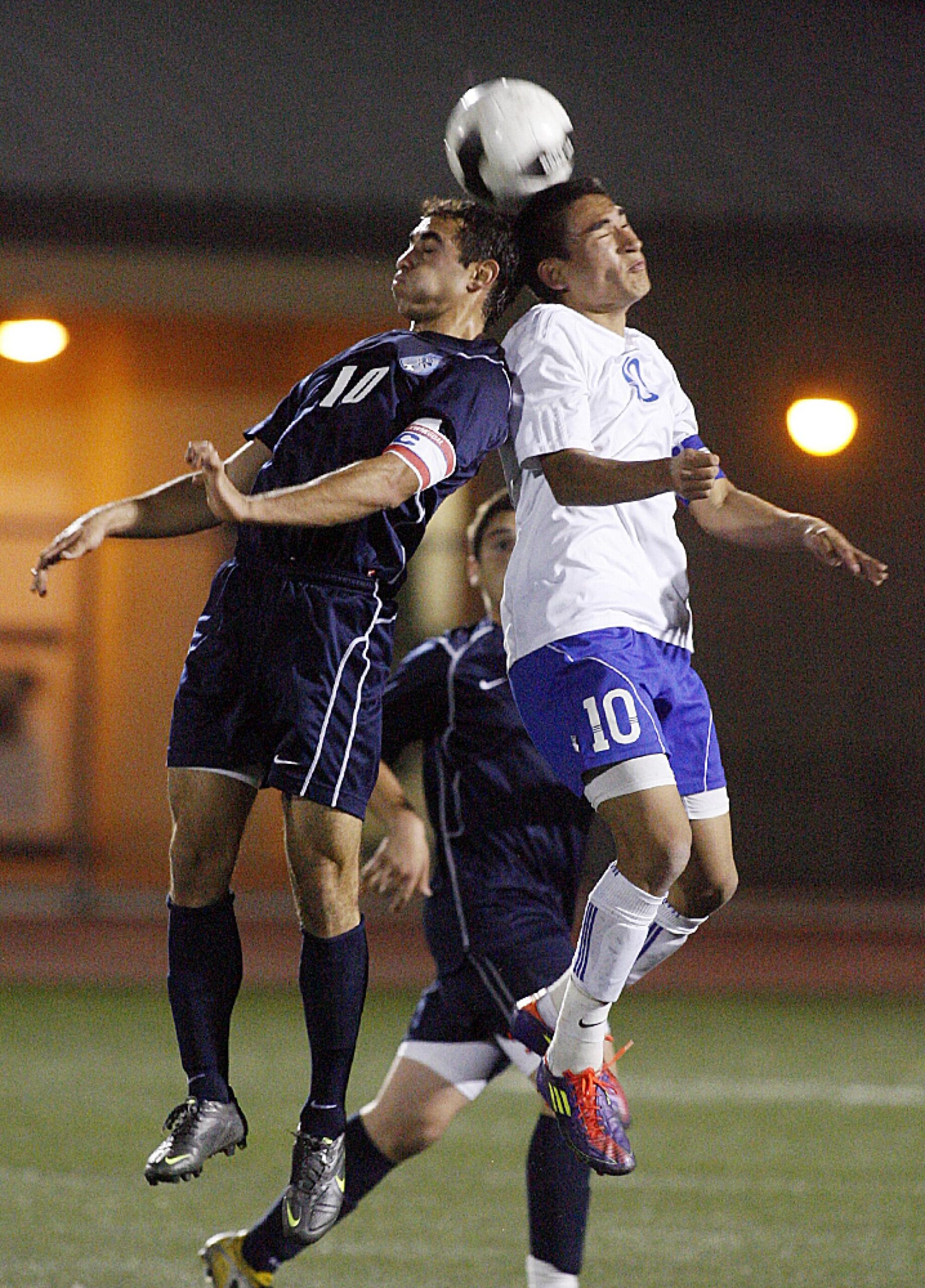
Crescenta Valley's Salar Hajimirsadeghi and El Rancho's Cristian Roldan meet in unison for a header.

Crescenta Valley’s Salar Hajimirsadeghi and El Rancho’s Cristian Roldan meet in unison for a header.

(Tim Berger / Glendale News Press)

High school soccer was once the foundation of the sport in the U.S. Eighteen players on the 2002 World Cup team, the only American team to reach the tournament quarterfinals, played for their high school teams. By 2022, the only man on the roster who played four years for a public school was Roldan.

“I don’t wish my story, or how I ended up here, was any different,” Roldan said. “What I will say was it made it more difficult to be here, play[ing] four years in high school. But it makes my story special.”

His story becomes even more special with this World Cup, which opened for the U.S. in Inglewood, a 45-minute drive from his boyhood home, and will continue when the Americans face Australia on Friday in Seattle, where Roldan played two years at the University of Washington and 12 seasons as an all-star midfielder with the Sounders, winning two MLS titles.

“When we talk about people’s paths, Cristian’s is not the standard right now,” said older brother Cesar, an athletic trainer with the Galaxy. “Cristian did it mostly to be around his friends. He wanted to play with his buddies.

“That is not a standard way to make it into MLS. And forget about making [it] all the way to the national team.”

“Yeah, it’s different,” Cristian said with a smile. “Being able to play in your backyard, have friends and family there. It’s a celebration.”

And it may never be repeated.

Roldan, 31, is the third-oldest player on the U.S. team, so the MLS academy system was just getting started when he enrolled at El Rancho in 2010. But as the academy system and the Elite Club National League became larger and more powerful, they began to throw their weight around.

Academy and elite club teams essentially robbed prep soccer of its best players by forcing them to choose between their high school teams and elite club programs, demanding a year-round commitment and banning participation in other sports. When top players began opting for the academies, others had no choice but to follow if they wanted to be seen and scouted.

That also robbed U.S. soccer of one of the few advantages it has over European and South American countries, most of whom have nothing to rival the high school and college sports infrastructure where kids can play and develop for free.

The United States' Cristian Roldan sprints during a training session.

Cristian Roldan sprints during a training session Tuesday in Irvine ahead of the United States’ World Cup match against Australia on Friday.

(Andre Penner / Associated Press)

“That’s not available in Germany or England, or whatever,” said Brian Schmetzer, Roldan’s coach with the Sounders. “I like the fact that the United States is a big enough country where we can give kids opportunities to continue playing.”

Especially since the academy and elite club pathways aren’t open to everybody. Moving from a free neighborhood high school team to an academy can be expensive, erecting a “pay-to-play” barrier that often restricts those programs to wealthier families. Travel to games and practices can also be an issue. Since many high school-age players can’t drive, a parent has to accept the responsibility of toting them back and forth to team activities.

That leaves little time for work, which can pose an additional financial burden.

“My parents would have done whatever for us. So they would have made things happen,” Cesar Roldan said of Cristian. “But he really didn’t have any of those options. There was just not the opportunity.”

Paul Caliguiri, who played in two World Cups before retiring as the second-most-capped player in U.S. Soccer history, said the slow strangulation of high school soccer will ensure some talented players will be overlooked.

“There are a lot more qualified players that choose the path of high school soccer rather than the full-time academies,” he said. “The issue is that many of those players that don’t go to full-time academies when the opportunity presents is likely due to transportation.

“We need to have more full-time training offered to players without increasing the ‘pay to play’ cost.”

Dominic Picon, who coached all three Roldan brothers at El Rancho, agrees.

“We’re losing a ton of kids who never get seen,” he said. “There’s a lot of kids that just get lost in the shuffle simply because we have a very limited scope of how we find players. If you look at our three main sports — baseball, basketball and football — virtually all of them play high school sports. They all come through that pipeline.”

Roldan, the son of a Guatemalan immigrant father and a Salvadoran-born mother, said he never really considered any of those issues when he decided to play with the neighborhood kids in high school, just as his older brother Cesar had done.

“I looked up to my brother and I wanted to share a similar path as he did,” he said. “And I wanted to win a trophy for the city of Pico Rivera, which only has one high school.”

U.S. midfielder Cristian Roldan defends the ball from Senegal forward Habib Diarra.

U.S. midfielder Cristian Roldan defends the ball from Senegal forward Habib Diarra during an international friendly match on May 31.

(Scott Kinser / Associated Press)

He made good on that last pledge in his senior season. Playing with younger brother Alex, who was a junior, Roldan scored 54 goals and had 31 assists — what Picon calls “video-game numbers” — to lead El Rancho to 29 wins and a CIF Southern Section title. Individually, he was named the Gatorade national player of the year.

Alex would go on to play alongside Cristian with the Sounders and captain the Salvadoran national team. Picon said he knew the brothers were good. But he didn’t know how good.

“When you’re coaching them, they’re in high school,” he said. “You never look at them and say, ‘You know, these guys are going to be in the World Cup someday.’”

In fact, there was some doubt both would even play in college. Alex was headed to a junior college in Arizona before receiving a last-minute offer from Seattle University. And Cristian, despite his award-winning senior season, had very few firm offers from top schools, in part because he insisted on playing high school soccer and in part because he was small at 5-foot-7.

“What hurt him is playing at a public school,” Picon said. “His rise was improbable because of where he came from, but also when he did play in front of [college] coaches, I think his size was something that dissuaded coaches.”

Contrast that with Wright, whose exposure at the academy level helped him get stamped as one of the country’s top youth players, opening up professional opportunities before he was old enough to vote.

In the end, it wasn’t Roldan’s talent that got him a scholarship as much as it was the boldness of his mother Ana. When Washington coach Jamie Clark inadvertently sat down next to her at the Surf Cup showcase in San Diego, she urged him to have a look at her son.

He did, then called Picon the next week.

“He’s a legit player,” Picon remembers telling Clark. “He’s better than 99% of the academy players out there. It’s just because of where he plays, the city that he’s from.”

Cristian Roldan speaks to reporters during a team training session in Seattle on Thursday.

Cristian Roldan speaks to reporters during a team training session in Seattle on Thursday.

(Soobum Im / Getty Images)

Picon was right. In his first season at Washington, Roldan was the Pac-12 freshman of the year and after his sophomore season he turned pro. MLS stardom and two World Cup selections were on the horizon. And there was luck in that, the coach says.

But that good fortune started at home with parents who put their faith in public schools, then saw that faith rewarded.

“It’s the quintessential American story, right?” Picon offered. “You have immigrant parents. They come here and they put a lot of trust in the public school system. At the elementary level, the teachers were tasked with making sure they have a grasp of English. They did that.

“At middle school, they were tasked with getting them prepared for high school and they did that. All three were accepted into a four-year [college], their kids.

“Where Cristian and his brothers lucked out is having the parents that they did. They were the type of parents that any coach, high school or club, would want to have.”

Getting to the World Cup, then, isn’t always determined by the path you take. Sometimes the most important factors are how and where you started.

Source link