Haiti

Haiti’s Culture Ministry fires workers over citadel stampede that killed 25 | Government News

At least nine people have been arrested following the stampede, including police officers and ministry employees.

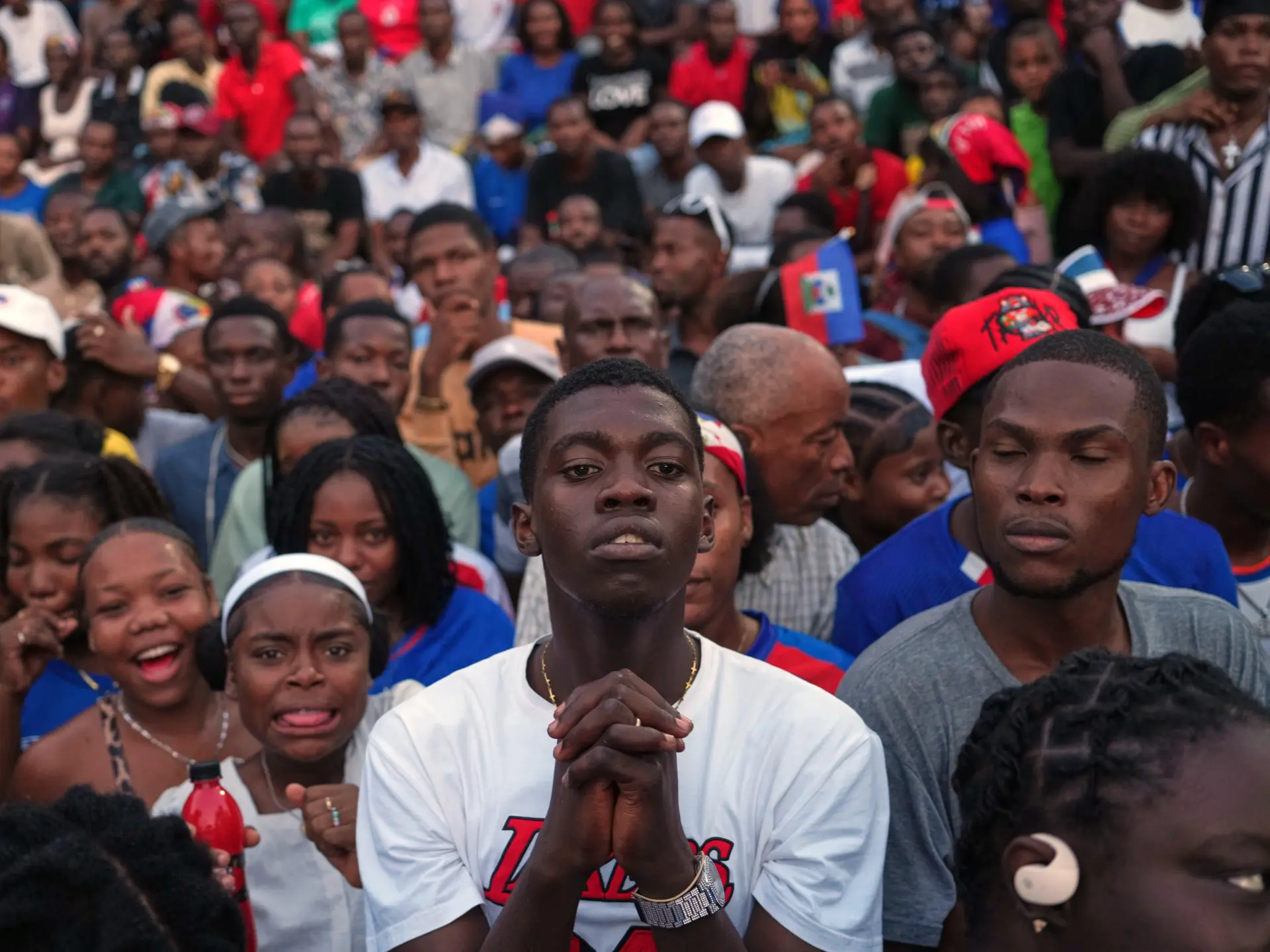
Haiti has begun three days of national mourning, following a deadly stampede at the Citadelle Laferriere in the northern part of the country.

At least 25 people were killed in the crush that formed at the entrance of the popular tourist site on Saturday, with some visitors pressing to exit while others pushed to enter.

Recommended Stories

list of 3 itemsend of list

On Tuesday, the Ministry of Culture and Communication announced that two government officials were fired in the aftermath of the stampede.

One, a director with the Institute for the Preservation of National Heritage, was accused of “serious negligence”. The other, who served in the Ministry of Culture and Communication, was criticised for “biased passivity”.

“The Ministry of Culture and Communication, without going into the details of the criminal investigation, believes that the tragedy at La Citadelle is the result of administrative negligence,” it said in a statement.

The government, it added, “will fully assume its responsibilities”, as the event “must outrage the public conscience”.

The tragedy marks one of several crises the Haitian government is facing as it approaches its first round of general elections later this year.

Already, nine suspects have been arrested in connection with the deadly stampede, including five police officers and two employees from the Institute for the Preservation of National Heritage.

The crush of people took place as a local DJ held an event at the citadel, a 19th-century fortress commissioned after the Haitian Revolution, when Haiti’s enslaved population overthrew French colonial rule.

Since its construction, the citadel has become a symbol of Haitian sovereignty.

But the stampede on Saturday was exacerbated by stormy weather conditions, as rain pummelled northern Haiti and participants at the event ran for cover.

Elsewhere in the country, approximately 12 people died due to the heavy downpours, and at least 900 homes and one hospital have been flooded.

The Haitian government has also been grappling with the threat of gang violence, particularly since the assassination of then-President Jovenel Moise in 2021.

His death left a power vacuum in the government that criminal networks have sought to exploit. Federal elections have been repeatedly postponed for much of the last decade.

Earlier this month, a United Nations-backed Gang Suppression Force began to arrive in the country to help address the violence.

From March 2025 through mid-January of this year, the UN has counted at least 5,519 gang-related deaths in Haiti. Roughly 16,000 people have been killed since 2022, and more than 1.5 million have been displaced.

Authorities called for more aid on Tuesday, as the violence continued. In the Marigot commune, seven people were killed and a police station was burned in an overnight gang attack.

Marigot Mayor Rene Danneau described the victims as informants who helped the police. He called on Haiti’s government to step in.

“We are asking the prime minister to take all necessary measures,” he told Radio Television Caraibes.

Source link

At least 30 dead in stampede at Haiti’s historic Citadelle Laferriere | News

The fortress was packed before the annual celebration at the UNESCO World Heritage Site, authorities say.

At least 30 people have been killed in a stampede in the northern countryside of Haiti, according to authorities, who warned that the death toll could rise.

Jean Henri Petit, head of Civil Protection for Haiti’s Nord Department, said the stampede occurred on Saturday at the Citadelle Laferriere, an early-19th-century fortress built shortly after Haiti’s independence from France.

Recommended Stories

list of 4 itemsend of list

One of Haiti’s most popular tourist attractions, “La Citadelle” was packed with students and visitors who had come to participate in an annual celebration at the fortress, which was designated a World Heritage Site by the United Nations Educational, Scientific and Cultural Organization (UNESCO) in 1982.

Prime Minister Alix Didier Fils-Aime said in a statement that he “extends his sincere condolences to the bereaved families and assures them of his profound solidarity during this time of mourning and great suffering”.

He added that “many young people” were in attendance at La Citadelle’s celebrations, although it is unknown who died, and the prime minister’s statement did not give an estimate of the death toll.

Rescue operations continue

Petit said the stampede occurred at the entrance to the site, adding that the rain further exacerbated the disaster.

“The minister of Culture and Communication has confirmed the deaths of 30 people at the Citadelle Henri on Saturday, April 11, 2026,” Culture Minister Emmanuel Menard told the AFP news agency in a written message.

“The injured are currently receiving the necessary medical care, and a rescue team is searching for any missing persons,” Menard said, without giving an exact figure of those injured.

The deadly stampede comes as Haiti is grappling with widespread violence by gangs that have massacred civilians, as well as an increasingly deadly crackdown by security forces.

The island nation has also been the site of various disasters in recent years, including a 2024 fuel tank explosion that killed two dozen people, another fuel tank blast in 2021 that killed 90 people, and an earthquake that left some 2,000 people dead that same year.

Source link

Kenya Rejects UN Abuse Findings in Haiti Mission

A dispute has emerged between Kenya and the United Nations over allegations of sexual exploitation and abuse linked to a UN backed security mission in Haiti. The force, largely composed of Kenyan police officers, was deployed in June 2024 to stabilise a country where armed gangs control much of the capital.

A UN report, based on findings from its Human Rights Office, concluded that four allegations of abuse were substantiated. Kenya has formally rejected these findings, asserting that its own internal investigation found no evidence to support the claims. This divergence has opened a deeper debate over credibility, jurisdiction, and the persistent problem of accountability in international interventions.

Conflicting Investigative Authority

At the core of the dispute lies a fundamental question: who has the authority to determine truth and accountability in multinational missions. The United Nations, through its human rights mechanisms, operates as an external oversight body, positioning itself as impartial and norm driven. Kenya, by contrast, asserts sovereign control over its personnel, emphasising that its internal inquiry was independent and shared with relevant stakeholders.

This clash reflects a structural ambiguity built into international peace operations. While missions are authorised or supported by the UN, enforcement power over individual personnel remains with contributing states. As a result, accountability mechanisms are fragmented, allowing for conflicting conclusions such as those seen in this case.

Historical Context and Institutional Credibility

The controversy is intensified by Haiti’s history with international peacekeeping missions, particularly the MINUSTAH deployment between 2004 and 2017. That mission was marred by widespread allegations of sexual exploitation and abuse, many involving vulnerable populations, including children. Despite the scale of accusations, prosecutions were rare, largely dependent on the willingness of troop contributing countries to act.

This legacy casts a long shadow over current operations. Allegations, whether proven or disputed, are not assessed in isolation but through a lens of accumulated mistrust. The UN therefore faces pressure to demonstrate that oversight mechanisms have improved, while Kenya is equally motivated to avoid reputational damage associated with past failures of the peacekeeping system.

Power, Reputation, and Strategic Stakes

Kenya’s firm rejection of the UN findings is not only a legal position but also a political one. As the primary contributor to the mission, Nairobi has invested significant diplomatic capital in presenting itself as a stabilising force in Haiti. Accepting the UN’s conclusions would risk undermining both domestic legitimacy and international standing.

For the United Nations, the stakes are similarly high. Its credibility as a guarantor of human rights depends on its willingness to investigate and publicly report abuses, even when doing so creates friction with member states. Backing down or appearing inconsistent would weaken its already challenged authority in overseeing multinational operations.

Victims and the Accountability Gap

Amid institutional disagreement, the position of alleged victims becomes increasingly precarious. When investigative bodies reach opposing conclusions, the likelihood of justice diminishes. The reliance on troop contributing countries to prosecute their own personnel has historically resulted in limited accountability, reinforcing perceptions of impunity.

This gap is not merely procedural but systemic. Without a unified mechanism for enforcement, findings risk becoming symbolic rather than consequential. The repetition of such disputes suggests that structural reforms within the peacekeeping system remain incomplete.

Implications

The dispute signals potential strain in cooperation between Kenya and the United Nations at a critical moment for the Haiti mission. Operational effectiveness may be affected if trust between the UN and its primary personnel contributor erodes. At the same time, the controversy could deter other countries from participating in similar missions, given the reputational risks involved.

More broadly, the case highlights enduring contradictions in international peace operations. The system depends on state contributions but lacks full authority over them, creating a persistent tension between sovereignty and accountability.

Analysis

This episode underscores a recurring paradox in global governance. The United Nations is tasked with upholding universal norms, yet it relies on sovereign states that retain ultimate control over their agents. When allegations of abuse arise, this division of authority becomes a fault line.

Kenya’s rejection of the UN findings is therefore not an anomaly but an expression of this structural tension. Both sides are operating within their respective logics: the UN prioritising normative legitimacy, and Kenya defending sovereign jurisdiction and institutional credibility.

The result is not simply disagreement over facts but a deeper contest over who defines accountability in international interventions. Until this question is resolved, similar disputes are likely to recur, particularly in high risk environments where oversight is most needed and most difficult to enforce.

With information from Reuters.

Source link