guns

Taiwan’s Skyguard Anti-Aircraft Guns Now Equipped With Anti-Drone Nets

Anti-drone nets and cages are rapidly becoming as ubiquitous as the drones they are meant to stop, appearing on today’s battlefields, over roads, around buildings, atop armored vehicles, and even protecting naval vessels. One recent example comes from Taiwan, where anti-aircraft guns have been enclosed in netting to help defend against the growing threat of drone attacks from Chinese forces .

An image, heavily edited, that began to circulate recently shows a pair of Republic of China Air Force (ROCAF) Skyguard towed twin-barreled 35mm anti-aircraft cannons with geodesic, dome-like latice structures over them, covered with anti-drone netting. The twin guns protrude out into the open to provide clearance. The design appears intended mainly to defeat small first-person-view (FPV) type drones attempting to dive directly onto the guns.

The ROCAF operates around 24 of these Swiss-made systems, specifically the GDF-006 version. They are frequently deployed to protect Taiwanese airbases, which may well be the case here, too.

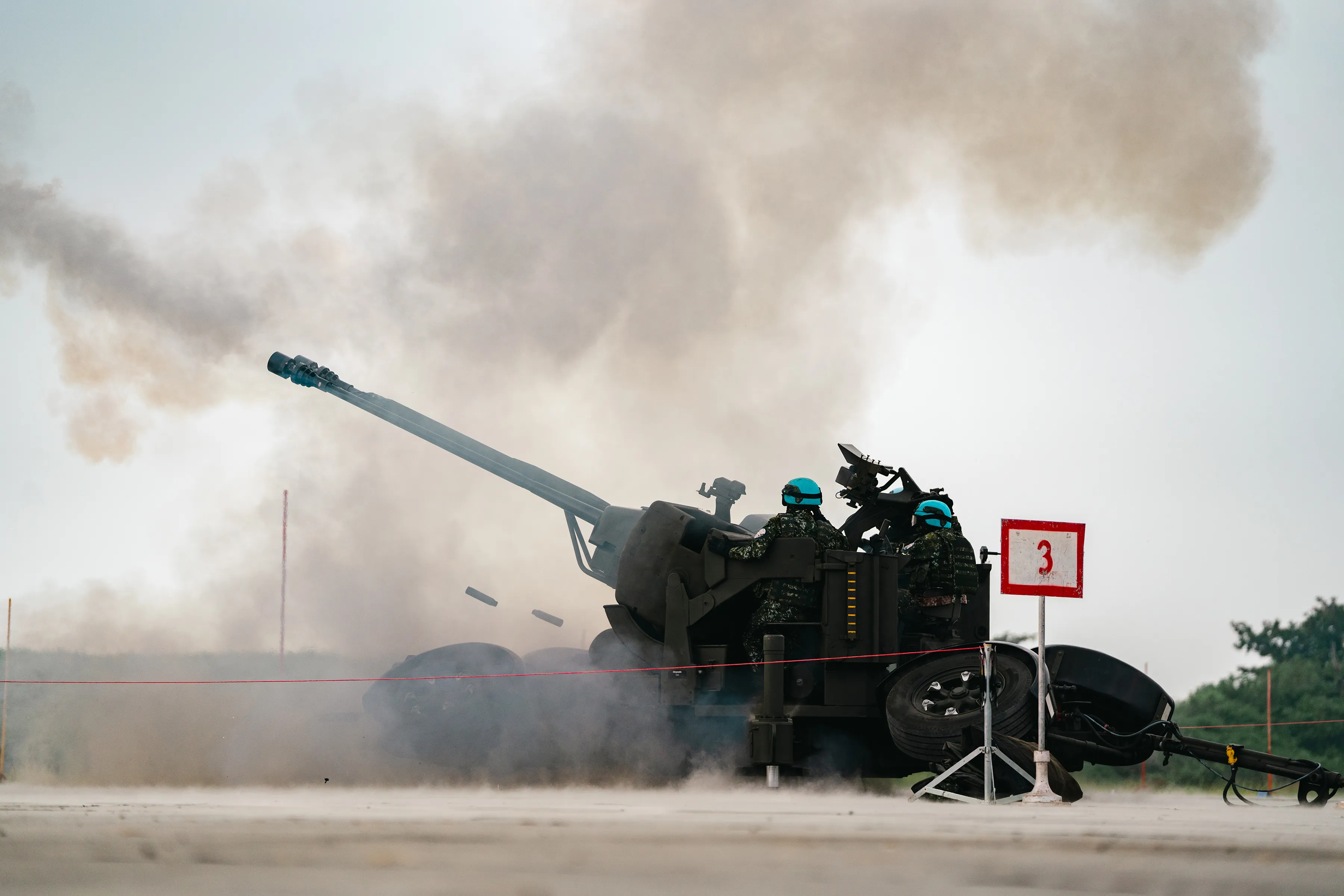
A ROCAF GDF-006 Skyguard opens fire. Taiwanese Ministry of Defense

That the ROCAF is going to the trouble of shielding the Skyguard from drones (at least smaller, FPV types) is significant.

Despite being a legacy Cold War-era design, the Swiss-made system remains one of Taiwan’s most effective point-defense weapons against exactly the kinds of aerial threats that have proliferated in recent years, including drones and cruise missiles.

The ROCAF operates around 24 of these systems, specifically the GDF-006 version. They are frequently deployed to protect Taiwanese airbases, which may well be the case in this instance. Keeping them operational during a conflict would be critical, making them logical candidates for additional physical protection against drone attacks.

Rheinmetall Air Defence – Oerlikon Skyguard 3 air defence system thumbnail

Rheinmetall Air Defence – Oerlikon Skyguard 3 air defence system


In particular, the radar-guided Skyguard can engage drones using Advanced Hit Efficiency and Destruction (AHEAD) ammunition. These programmable airburst rounds release a cloud of sub-projectiles just ahead of the target, greatly increasing the probability of a kill against small, slow, and maneuvering aerial threats. They are also effective against cruise missiles, rockets, and mortar projectiles. Besides improving lethality and speeding engagements, the airburst effect also reduces the risk of collateral damage on the ground.

Rheinmetall Air Defence: Ahead - Highly effective, programmable ammunition thumbnail

Rheinmetall Air Defence: Ahead – Highly effective, programmable ammunition


As such, the Skyguard remains in ROCAF service alongside more modern air-defense systems as part of Taiwan’s layered integrated air-defense network. Other ground-based systems fielded by the air force include the U.S.-made Patriot and the indigenous Tien Kung (Sky Bow) family for long-range air and ballistic missile defense. At the lower end, Sparrow surface-to-air missile launchers can be integrated with the Skyguard’s radar and fire-control system to provide another layer of protection. Taiwan formally retired the last of its HAWK surface-to-air missile systems in 2023, later donating some of these to Ukraine.

ROCAF GDF-006 Skyguards light up the sky during a night exercise. Taiwanese Ministry of Defense

As we reported in the past, Taiwan is also set to procure the combat-proven National Advanced Surface-to-Air Missile System (NASAMS) after the United States approved its sale to the country in 2024. As we previously examined, the medium-range system is particularly well suited to defeating cruise missiles and standoff one-way attack drones. It also has the significant benefit of being fed from the common stockpile of AIM-120 Advanced Medium-Range Air-to-Air Missiles (AMRAAM) that already arm many of the ROCAF’s fighter jets.

Meanwhile, the Republic of China Army fields an even wider array of ground-based air defense systems, including more mobile equipment and man-portable air defense systems (MANPADS). Republic of China Army anti-aircraft units are also equipped with anti-aircraft guns, namely the locally made T-82T towed twin-barreled 20mm anti-aircraft cannon, based on the M39 developed for the U.S. Air Force in the late 1940s.

A Republic of China Army T-82T towed twin-barreled 20mm anti-aircraft gun. Office of the Taiwanese President

Taiwan’s multi-layered integrated air-defense system is a critical component of the island’s ability to withstand any aerial assault from China, should Beijing ever go on the offensive against the island. As China rapidly expands both the quantity and sophistication of its unmanned capabilities, however, even air-defense assets themselves are increasingly vulnerable to drone attack.

Protecting the Skyguard with netting reflects this evolving threat. Chinese drones of all types would be employed not only for one-way attack missions, but also for intelligence gathering, target acquisition for standoff strikes, communications relay, and electronic warfare. Swarms of inexpensive drones could also be used to saturate Taiwan’s defenses, exposing key air-defense assets to attack while forcing them to expend valuable ammunition.

A video showing a Chinese drone swarm experiment involving loitering munitions launched from a light tactical vehicle:

中国电科陆空协同固定翼无人机“蜂群”系统 thumbnail

中国电科陆空协同固定翼无人机“蜂群”系统


Taiwan’s airbases would rank among Beijing’s highest-priority targets in any conflict. The ROCAF already prepares for this possibility by routinely exercising from secondary airfields and highway strips. Wherever ROCAF aircraft are deployed, however, air-defense systems like the Skyguard would be essential to protecting these locations.

Even during peacetime, Taiwan faces a drone threat, especially over islands situated extremely close to the Chinese mainland. In 2022, multiple incursions led to the Taiwanese military announcing that it would shoot down uncrewed aerial vehicles that don’t respond to its warnings, a threat that it soon carried out. These moves came after Taiwanese authorities said they would deploy undisclosed domestically developed drone defense systems across its territory, and following a highly public encounter between a Chinese drone and two Taiwanese soldiers, as you can read about more here.

Imagery filmed from a Chinese drone, showing Taiwanese sentries throw rocks or other objects at the UAV:

陸無人機闖入大膽島 我官兵「丟石頭」反擊|TVBS新聞 thumbnail

陸無人機闖入大膽島 我官兵「丟石頭」反擊|TVBS新聞


At this point, it is also worth recalling other considerable efforts that Taiwan makes to ensure its military assets might survive a potential invasion from the Chinese mainland. In the past, we have looked at how Taiwanese tanks and other armored vehicles have been hidden in urban environments using some ingenious camouflage methods, including hiding them under junk and making them look like civilian construction equipment.

A Republic of China Army M113 armored personnel carrier concealed under a bridge. ROC Military News Agency

Meanwhile, whether draped over roads, tanks, artillery positions, or warships, anti-drone nets have become a defining visual feature of the drone age. Their adoption by the ROCAF to protect its Skyguard guns shows that even dedicated air-defense systems that are suited to down small drones are far from immune from attack by those threats.

Thanks to Taepodong for alerting us to this story.

Contact the author: thomas@thewarzone.com

Thomas Newdick is a staff writer at TWZ, where he covers military aviation, defense technology, weapons systems, and international security. Based in Berlin, Germany, he reports on conflicts, military modernization efforts, and emerging aerospace technologies around the world, with a particular interest in airpower and its role in contemporary warfare. His reporting is informed by deep expertise in modern and historical airpower, particularly in Europe, with a focus on military aviation, air campaigns, and aerospace developments across the continent and beyond.


Source link

Heavy Machine Guns Appear On Key Russian Commercial Tanker In Baltic

One of Russia’s commercially flagged vessels in the Baltic has appeared armed with heavy machine guns, and it isn’t just any cargo hauler. The weapons fit is likely intended to provide close-in protection against naval drone attacks but is also evidence of increasingly bold measures taken by Moscow to ensure that military bases in its strategically important Kaliningrad exclave continue to be supported. After all, the ship in question, the Marshal Vasilevskiy, is a highly strategic one — Russia’s only floating storage and regasification vessel — that plays a key role in supporting Kaliningrad.

This comes at the same time that Russia ramps up efforts to protect its notorious ‘shadow fleet,’ used to circumvent Western sanctions on oil exports, despite efforts to interdict it.

Evidence of the armed tanker development was brought to light in an exclusive report from Holger Roonemaa, an investigative journalist working for Delfi Estonia, an Estonia-based news website.

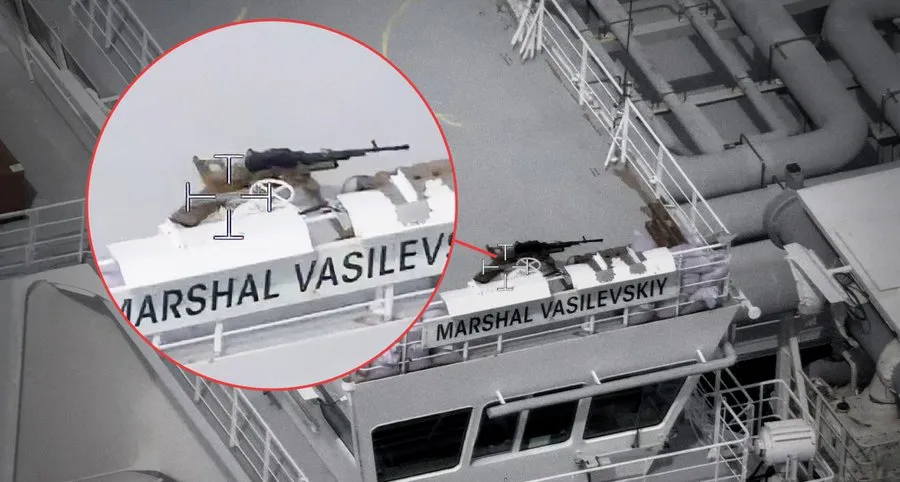
Roonemaa secured the release of imagery from the Estonian Border Guard showing the Marshal Vasilevskiy operating in the Baltic Sea last month, with machine gun positions on either side of the deck above the bridge.

A close-up view of one of the heavy machine guns on the bridge of the Marshal Vasilevskiy. PPA/Delfi Estonia, with permission

The Marshal Vasilevskiy, a 945-foot liquefied natural gas (LNG) tanker of 118,000 gross tonnage, was spotted by an Estonian Border Guard surveillance aircraft as it was sailing past Estonia’s western islands toward the Russian port of Bolshoi Bor in the Gulf of Finland.

The sandbagged gun positions were armed with 12.7mm Kord heavy machine guns, a belt-fed weapon that is used by infantry, as well as being mounted on vehicles and ships.

KORD Heavy Machine Gun thumbnail

KORD Heavy Machine Gun


The Marshal Vasilevskiy is not a part of the shadow fleet, but it has been subject to sanctions. Moreover, this appears to be the first direct evidence of Russia installing weapons on a civilian ship in the Baltic region.

The vessel is owned by the Gazprom company and regularly supplies Kaliningrad with natural gas, with four such voyages identified since last August.

A rear view of the Marshal Vasilevskiy. PPA/Delfi Estonia, with permission

Almost certainly, the guns on the Marshal Vasilevskiy are intended to help defend against Ukrainian drone attacks.

The Kord fires at a rate of 600-650 rounds per minute and has an effective range of around 2,000 yards.

Earlier this month, Ukraine used aerial drones to attack the prestigious Russian Navy base at Kronstadt, near St. Petersburg, in what appears to have been the first strike of its kind against the Baltic Fleet.

By targeting Kronstadt, Ukraine signaled the opening up of a new front in its drone war with Russia, namely against the Baltic Fleet while it is in port.

Previously, Ukraine’s naval campaign had focused overwhelmingly on the Russian Black Sea Fleet. Many successful attacks have been recorded against Black Sea Fleet vessels and facilities, forcing the general evacuation of Russian naval assets from occupied Crimea and to bases in Russia proper. Ukrainian attacks on Russian-linked shipping have also extended, to a more limited extent, into the Mediterranean.

These attacks have also involved a growing and increasingly advanced array of uncrewed surface vessels (USVs, or ‘drone boats’) as well as uncrewed underwater vessels (UUVs).

Ukraine’s proven ability to launch long-range aerial drone attacks, as seen in the video below, as well as to bring kamikaze drones closer to Russian targets, and strike them from short range, underscores the potential vulnerability of Russian tankers working the Baltic, too.

While Ukraine, as far as is known, has not launched any USV or UUV attacks in the Baltic, it would certainly be within its capabilities to do so.

At the same time, Russia has no doubt also considered the possibility of an Operation Spiderweb-type attack in the Baltic, in which short-range drones could be launched covertly, in mass, from locations much closer to their targets.

In the same way that Operation Spiderweb used commercial trucks as covert launch platforms for one-way aerial attack drones, any suitable vessel could be used in the same way by Ukraine in the Baltic, whether to launch aerial drones, USVs, or UUVs.

In this context, the Marshal Vasilevskiy would be a particularly prized tanker. It is currently Russia’s only floating storage and regasification vessel, a ship that takes on board super-cooled LNG and then converts it into gas that is then fed into pipelines, in this case, in Kaliningrad.

As well as countering potential drone attacks, putting guns on the Marshal Vasilevskiy sends a signal to NATO forces not to interfere with it. Warning shots could be fired to send a message to boarding parties or helicopters. Russia’s willingness to use warning shots was demonstrated in the English Channel earlier this month. With the Kord gun, the vessel could bring down a helicopter with ease, forcing a boarding force to kinetically attack the ship before attempting boarding.

Typically, the crew of a vessel such as the Marshal Vasilevskiy would not be trained to operate heavy machine guns. This raises the likelihood that the ship’s crew includes members of the Russian military or, more likely, the Federal Security Service (FSB), Russia’s principal security agency. It is not inconceivable that man-portable air defense systems (MANPADS) could also be stowed below decks to defend against an aerial drone attack.

The development comes as Russia takes increasingly forceful measures to protect the vessels of its shadow fleet. These provide Russia with a critical lifeline, allowing oil to be sold and funds generated to continue the country’s war against Ukraine. Both China and India regularly accept such deliveries.

Over the past year, European authorities have intercepted shadow fleet tankers on several occasions, typically on the grounds of flying a false flag or for being suspected of damaging undersea cables.

The Russian shadow fleet vessel Smyrtos is boarded by Royal Marines from 42 Commando and U.K. law enforcement officers on June 14. Crown Copyright

There have been previous reports indicating that shadow-fleet oil tankers regularly include former mercenaries and soldiers among their crews.

Holger Roonemaa has helped establish that almost half of the “passengers” listed as going aboard the Marshal Vasilevskiy also have backgrounds in the Russian military, the National Guard, and/or the FSB.

At the same time, Russian Navy warships are increasingly used for escort, monitoring, and security missions for shadow fleet tankers as they transit the Baltic Sea carrying sanctioned Russian oil to markets prepared to bypass Western restrictions. You can read more about this here.

Returning to this vessel, the appearance of heavy machine guns on it is significant because it illustrates Russia’s militarization of civilian shipping supporting critical operations. There are many historical precedents of merchant vessels being armed during wartime, but it remains unusual to see a commercially flagged tanker openly carrying heavy machine guns in this region. In areas with piracy, it is not uncommon for security crews on vessels to be equipped with small arms, but this is a different kind of weapon, and the ship is operating in waters with no piracy risk attached.

The Marshal Vasilevskiy photographed in port in 2019. Kees Torn

In practical terms, a pair of Kord machine guns could be effective against small drones or boats at close range, but would offer little protection against larger, coordinated attacks, let alone modern anti-ship missiles.

With that in mind, it’s possible Russia might further boost the weapons fit of the Marshal Vasilevskiy to provide a more comprehensive defense. After all, this vessel is a critical asset, due to its unique capabilities in the Russian merchant fleet, and its special role supporting Kaliningrad. This makes it a strategic vulnerability that demands protection. If lost, it could have an asymmetric impact, threatening the ability to keep military assets in the exclave operational.

More broadly, this is evidence of Russia’s growing concern that logistics vessels, including civilian ones supporting critical infrastructure, could become targets in the Baltic region, too, as the war increasingly extends beyond traditional battlefields and further from Ukraine.

Contact the author: thomas@thewarzone.com

Thomas Newdick is a staff writer at TWZ, where he covers military aviation, defense technology, weapons systems, and international security. Based in Berlin, Germany, he reports on conflicts, military modernization efforts, and emerging aerospace technologies around the world, with a particular interest in airpower and its role in contemporary warfare. His reporting is informed by deep expertise in modern and historical airpower, particularly in Europe, with a focus on military aviation, air campaigns, and aerospace developments across the continent and beyond.


Source link

Inside SOCOM’s Search For New Machine Guns, Rifles And Ammo

When it comes to machine guns and rifles, U.S. Special Operations Command (SOCOM) wants its operators to have deadlier weapons that shoot further with greater accuracy, are lighter to carry. The command also wants some to be able to chamber hypervelocity ammunition that is under development. To get more insights about what firearms commandos will be packing in the future, we spoke with Lt. Col. Alan Wood, SOCOM’s Program Manager for Special Operations Forces (SOF) Lethality. In an exclusive interview during the annual SOF Week conference in Tampa, Florida, Wood told us what’s working, what isn’t and what gets him, in his words, “pretty excited.”

Some of the questions and answers have been edited for clarity.

U.S. Special Operations Command is looking for new weapons for its operators. (U.S. Army photo by Sgt. Jaerett Engeseth) U.S. special operations service members conduct combat operations in support of Operation Resolute Support in Southeast Afghanistan, May 2019. U.S. Army photo by Sgt. Jaerett Engeseth

Q: SOCOM just put out an Area of Interest (AOI) request for what is being called the Hypervelocity Improved Carbine (HICAR) program, designed to “develop an improved carbine capable of operating with currently issued 5.56 NATO ammunition, while also incorporating design features to ensure reliability, durability, and longevity with the use of future hypervelocity 5.56x45mm ammunition.” What can you tell me about that?

A: So, HICAR’s got me excited. Back in the late teens, the Army went down this higher velocity [route], and I’m intentionally using the word velocity and not pressure in what they’ve done with the M7 and M8 rifles. They’ve been able to increase the velocity and therefore create a flatter shooting rifle as well as a rifle that has greater energy on target, and that does incredible things for barrier defeat in a lot of situations. Now we’ve had 10 years, almost, for that technology to mature, people have learned things, and the question then becomes, what could we do for special operators in calibers that are not new?

The advantage for SOF operators is I’ve got, say, the Green Berets who do a lot of partnering with foreign SOF operators, but there’s no [6.8mm] ammo running around central Africa, or you know, pick your favorite spot where we like to do partnering operations around the world. But there’s a lot of 5.56mm and other common cartridges of that nature, and so what we want to…achieve is maybe not the same effect as what the Army’s done with the M7 and the M8 and that high-velocity ammunition that they have, but where could we get close to that in 5.56 and potentially other calibers in the future.

It really goes back to the evolution in steel case ammo that Federal started several years ago, and there’s been more iterations of that coming out – new alloys for cases that far exceed performance of the standard brass that we’ve been using for the last 100 years. And the really amazing part is they can actually be cheaper than brass as well, so we get more performance at a lower cost. It’s a win-win.

Cameroonian special forces soldiers prepare to assault a mock village during exercise Flintlock 26 at an Ivorian training facility in Côte d’Ivoire, April 18, 2026. Since 2005, Flintlock has served as U.S. Africa Command’s premier annual special operations exercise. This year’s exercise brought together more than 30 countries across Côte d’Ivoire and Libya to build lethality and readiness, strengthen counterterrorism skills and increase collaboration across borders. (U.S. Army photo by Spc. Edgar Martinez)
Cameroonian special forces soldiers prepare to assault a mock village during exercise Flintlock 26 at an Ivorian training facility in Côte d’Ivoire, April 18, 2026. S (U.S. Army photo by Spc. Edgar Martinez) Spc. Edgar Martinez

Q: Can you provide any information about the hypervelocity rounds themselves?

A: At this point, it’s still a significant science project, and so there are no specific high velocity rounds that are fielded at this point. It’s an R&D project, and we’re trying to see where we can take that technology.

Q: Can you give me a sense of what you’re looking for in those rounds, and any timelines?

A:  You can see the round and what we’re going to do based on the HICAR document on Sam.gov, so that’s as much information as there is out there. What we’re really looking for is what does it [do] for the rifle? Because as you start getting into rifle development – there are a lot of things to consider, other than how much pressure can you put in the chamber. You’ve got to worry about the failure modes, and you know what happens if you get a projectile stuck in the chamber, things along those lines. There are a lot of other things that you have to worry about, because you want to make sure not only is the gun effective, but it’s got to be safe, and it’s also got to be suitable for the particular mission, and so that’s that broad spectrum that we’re trying to balance and trade off with everything that’s out there in between both the ammunition and the rifle that’s firing it.

SAM.gov

Q: Can you provide an update on fielding of the Mid-Range Gas Gun, both assault and sniper configurations?

A: There is some sensitivity to that… We have been fielding the Mid-Range Gas Gun-Sniper variant since 2023, and we just recently started procurement of the assault variant, so we are pretty excited about getting kicked off of the assault variant from [Lewis Machine & Tool] LMT.

Q: When was the assault variant fielded?

A: We’re currently under a production contract with that. We have not begun to field it.

Q: Any timeline on that?

A: Actually, we are still having those discussions with the vendors. I don’t have an answer for that one.

U.S. Special Operations Command (SOCOM) recently awarded a contract for new rifles chambered to fire the 6.5mm Creedmoor round to Lewis Machine & Tool (LMT).
U.S. Special Operations Command (SOCOM) recently awarded a contract for new rifles chambered to fire the 6.5mm Creedmoor round to Lewis Machine & Tool (LMT). LMT

Q: Why are you excited about the new Mid-Range Gas Gun-Assault (MRGG-A) variant?

A: That one kind of solves the extended range for those mid-range calibers, both 7.62 NATO and the 6.5mm Creedmoor round. That weapon exceeds a 1,200-meter point target in 6.5mm Creedmoor. It’s just a phenomenal, accurate weapon system for our SOF operators. All the components are super excited about this one.

Piston driven AR15 VS gas impingement thumbnail

Piston driven AR15 VS gas impingement


Q: Can you provide an update on the Light Machine Gun-Medium (LMG-M) that is supposed to be chambered in .338 Norma Magnum?

A: SOCOM has paused that program at this time as far as a significant fielding. However, we are fielding a small portion to one unit, not to be mentioned, and we’re going to see how that works out in that unit. We’re doing a small fielding combat evaluation with a unit to see how it’s functioning.

SOCOM

Q: What about SOCOM’s other lightweight machine gun programs?

A: We just got into an OTA [Other Transaction Authority contract] for the Lightweight Machine Gun- Assault (LMG-A), the 7.62 variant, and have a couple competitors there working designs there and expect to have that out to replace the MK 48 in the Fiscal Year 2028-2029 timeframe.

Q: Is the LMG-M being provided by Sig Sauer?

A: Yes.

SIG SAUER MG 338 Machine Gun thumbnail

SIG SAUER MG 338 Machine Gun


Q: Walk me through the advantages of a Norma .338 round.

A: So .338 has some significant range. The .338 has greater range than traditional .50 cal, and the particular round that we have is more effective on target than the .50 caliber at those greater ranges. However, if you compare it to 7.62 or some other lighter cartridges, it is still a heavier round. There are tradeoffs in the .338 machine gun world.

Q: What does the .338 bring to the table for operators?

A: You can replace a .50 caliber’s weighted system with a lighter system that is also dismountable. So, for instance, if you had a light vehicle that had trouble carrying a .50 cal plus a significant amount of ammunition, if you switch over to .338 you can save hundreds of pounds and keep that vehicle under its [gross vehicle weight rating] GVWR. Or especially if you’re doing things like jumping a vehicle that has to be able to hit the ground pretty hard – things along those lines. It allows you to reduce some of that weight, but be able to maintain the range and effectiveness.

GDOTS - LightWeight Medium Machine Gun (LWMMG) [1080p] thumbnail

GDOTS – LightWeight Medium Machine Gun (LWMMG) [1080p]


Q: One last question, what can you tell me about any counter drone rounds that you are either fielding or looking to field across all platforms?

A: We have definitely been looking at counter-drone rounds specifically in the current calibers and so what can I do to augment operators with the rifle that they’re currently carrying. We’ve also been experimenting with various other things, from shotguns to 40 millimeters [40mm grenade], and we’re still trying to sort through there. There’s a lot of things you have to think about when you’re looking at the effectiveness of a round like that. Unfortunately, I can’t go any deeper than that, because I’m really getting into more of an [operational security] OPSEC type of thing, I don’t want to go there.

Contact the author: howard@twz.com

Howard is a Senior Staff Writer for The War Zone, and a former Senior Managing Editor for Military Times. Prior to this, he covered military affairs for the Tampa Bay Times as a Senior Writer. Howard’s work has appeared in various publications including Yahoo News, RealClearDefense, and Air Force Times.


Source link