Felicia Day is reviving ‘The Guild’ thanks to a $5-million Kickstarter
In 2007, the actor Felicia Day debuted “The Guild,” one of the first works, maybe the first, to demonstrate that the web could be a legitimate platform for full-blown, character-driven, narrative comedy. (YouTube was only two years old at the time.)
Online since there was a line to be on, Day — also known also for “Supernatural,” “Buffy the Vampire Slayer,” “Eureka,” “Mystery Science Theater 3000” and as the female lead in Joss Whedon’s “Dr. Horrible’s Sing-Along Blog” alongside Neil Patrick Harris and Nathan Fillion — played Cyd, a.k.a. Codex, a young woman at loose ends who finds community with a group of gamers whose quirkiness puts her own into perspective. The series, which she created and wrote, from experience, grew more ambitious and technically impressive across its six seasons, with cameos by the likes of Fillion, Zachary Levi, Stan Lee, Brent Spiner, late Mythbuster Grant Imahara and Wil Wheaton. There was a cultural specificity to the setting and storytelling — lots of gaming jargon and jokes — but the humor in the characters was universal, and the show, for all its well-proportioned silliness, felt very alive.
Now, as the series’ 20th anniversary approaches, Day is reviving “The Guild” as a feature, “The Guild: Ren Faire’d,” through a Kickstarter campaign due to end Friday. By the time I pledged, early on the first day of fundraising, the campaign had already met its initial $1.5-million goal — the minimum required, Day calculated, to pull off a version of her script. As of this writing, with just a few days to go, the campaign has raised more than $5 million. Everything over $4.5 million will go to making the film even better, but also support “Conludo,” a new game-playing series with Wheaton along the lines of their “Table Top,” created in 2012 for the Day-founded YouTube channel Geek & Sundry.
Day is also the author of a charming memoir, “You’re Never Weird on the Internet,” and a mental exercise book, “Embrace Your Weird: Face Your Fears and Unleash Creativity.” Earlier this year, Simon & Schuster published “The Lost Daughter of Sparta,” her graphic novel (with illustrator Rowan MacColl) about Philonoe, Helen of Troy’s lesser-known fourth sister, an on-brand tale of self-determination and embrace of one’s difference.
I interviewed Day by email as she traveled the convention circuit.


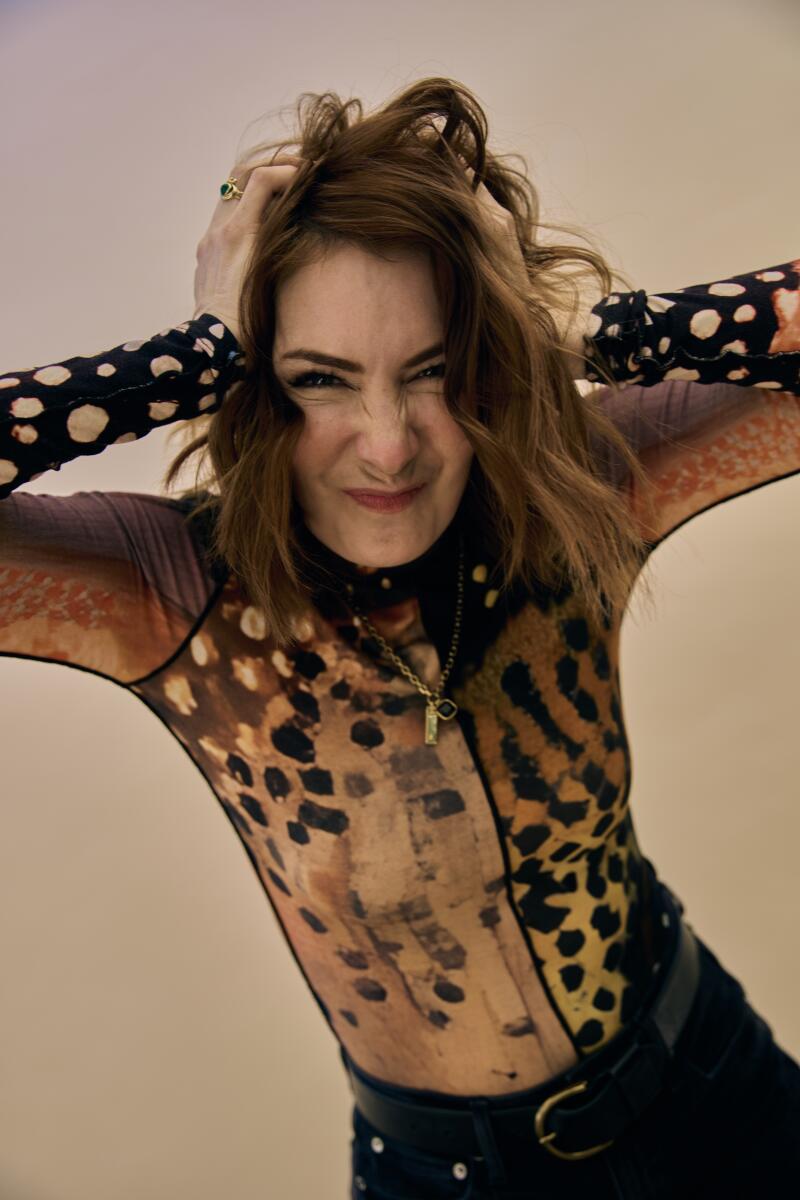
Day’s Kickstarter surpassed $5 million, allowing her to make not only “The Guild: Ren Faire’d” but also a new game-playing series. (Parker Burr / For The Times)
How does it feel to be back wearing, or about to wear, the character of Codex?
It’s so empowering to go back to this world that I crafted and this character that means so much to me and my fans. She and I have diverged a lot over the years, but her voice is still strong and clear in my ear, and I’ve had so much fun writing for her again. I haven’t been in charge of my own stories on this scale in a long time, so this all definitely feels like coming home.
It was an offer to turn “The Guild” into a television show that prompted you to get the film going. Had you thought of the possibility of bringing it back before then?
Early in 2025, I’d been thinking about the 20th anniversary of the show and how to celebrate it, but a movie is a huge project, one I was wary of committing to. A phone call with a very nice Hollywood executive wanting me to reboot the show with younger actors was the kick in the pants I needed. The business has been so hard on me, and a lot of people, especially these last five or so years. To even think about having the one project I held dear taken away from me? That got my fire lit.
How did you know to hang on to your IP?
I had met a few people in the early web days who’d sold their show to producers and networks, only to have them buried in development hell and never be seen again. My audience meant, and still means, so much to me, that I didn’t see the point in losing control of the show when it felt like we were doing all the right things on our own. The fans’ support gave me that confidence, and thank goodness for it, or I wouldn’t be able to make a movie today.
How did you cast the original show? Were any of the actors already gamers?
I wrote two of the main parts for improv friends, Zaboo (Sandeep Parikh) and Vork (Jeff Lewis), and I found the rest of the actors from a Backstage casting call. Several of them were already gamers, but a few were anything but (namely, Amy Okuda, who played Tinkerballa — she took some arm twisting). Over the years, though, they’ve all turned into gamers. We’ve enjoyed many a Fortnite session together, especially during COVID times.


Felicia Day as Codex. Other characters returning for “The Guild: Ren Faire’d” are Zaboo (Sandeep Parikh) and Vork (Jeff Lewis).
How has your reunion been going?
I had to make sure the script was good enough before I asked my fans to support it, so in February I had a table read with the main cast. Truly, it felt like no time had passed. We were all laughing so hard, ribbing each other on any little mistakes. It was so much fun to rediscover our characters together again. What we have together as a group is magic, and I can’t wait to get the band back together on set again.
You have a “no AI” sign on the Kickstarter page. What are your thoughts about artificial intelligence versus human creativity?
I look at AI as a great robber of humanity. Not only in the sheer existence of the AI itself, which is comprised of literal stolen material, but in robbing creators of their process. Because process is everything. It’s the whole point, in my opinion. That challenging struggle to write a first draft is how you discover who you are as an artist. But if you don’t do the work, you’ll never truly find out what you want to say to the world. You can’t create anything truly unique to yourself. It just makes me sad. To use a tool filled with other people’s stolen ideas in order to fast forward to an end result for attention, well, that isn’t art. That’s a cheap dopamine hit. And you’re no better a creator for having done it. Please don’t rob yourself like that.
The movie will be set at a Renaissance Faire. What’s your own history with them? Do you go in costume?
I’ve gone to Ren Faires for over a decade. We have a few great ones in SoCal I encourage everyone to explore. The costumes, the vendors, the food — all of it transports you to another world in such a magical way. I want to celebrate everything I love about the setting in our movie. I often go in costume, now with my 9-year-old daughter. It’s actually our Mother’s Day tradition and very dear to my heart.

Day on her work and motherhood: “I’ve learned that, especially as an artist, you have to be your own protector, own advocate, and give yourself unconditional love to be able to tap into what makes your art your own.”
(Parker Burr / For The Times)
Has motherhood changed how you work?
Absolutely. I had no idea how to parent myself before I parented another person. I’ve learned that, especially as an artist, you have to be your own protector, own advocate, and give yourself unconditional love to be able to tap into what makes your art your own. My experience writing this movie has been entirely different from in the past, when I let fear and outside pressure take the fun out of creating. This time, I allowed myself room to play and to make mistakes, just like I encourage my daughter to do. I think my work has benefited greatly from that gentle parenting.
The original “Guild” and the way you’ve mounted this campaign feels like the work of friends, like Mickey and Judy getting the gang together in a someone’s uncle’s barn to put on a show. (Which isn’t to say “amateur.”)
The heart of everything I do is this: I just want to play with my friends and my fans. I want to delight them with new ideas. I want to surprise them with laughs. The industry often divorces us from what got us into the business in the first place: making believe. Creating together. I like my work to embody the kind of spirit you can’t have in more mainstream media where there are levels of approvals over everything and the budgets are so high that the pressure takes the fun out of it. Yes, it’s challenging to make anything with fewer resources, but the community can see the ins and outs of my process and I hope that empowers them, in turn, to create their own things with their own friends one day.
What inspired your new graphic novel?
Being cut off from Hollywood over COVID made me brave enough to write a story I knew wouldn’t be anything an executive would care about if I pitched it. For many years, I didn’t allow myself to develop ideas like that. What was the use if they didn’t find it useful? But in allowing myself the space to write this story set in the world of Greek mythology, I’ve found new confidence as a writer. I want to keep telling stories only I can tell, in whatever format I can. I never want to discard them again because other people won’t find them useful. I hope that anyone reading the book feels the same encouragement to follow their inner muse. Because everyone deserves to be loved for exactly who they are, even our stories.