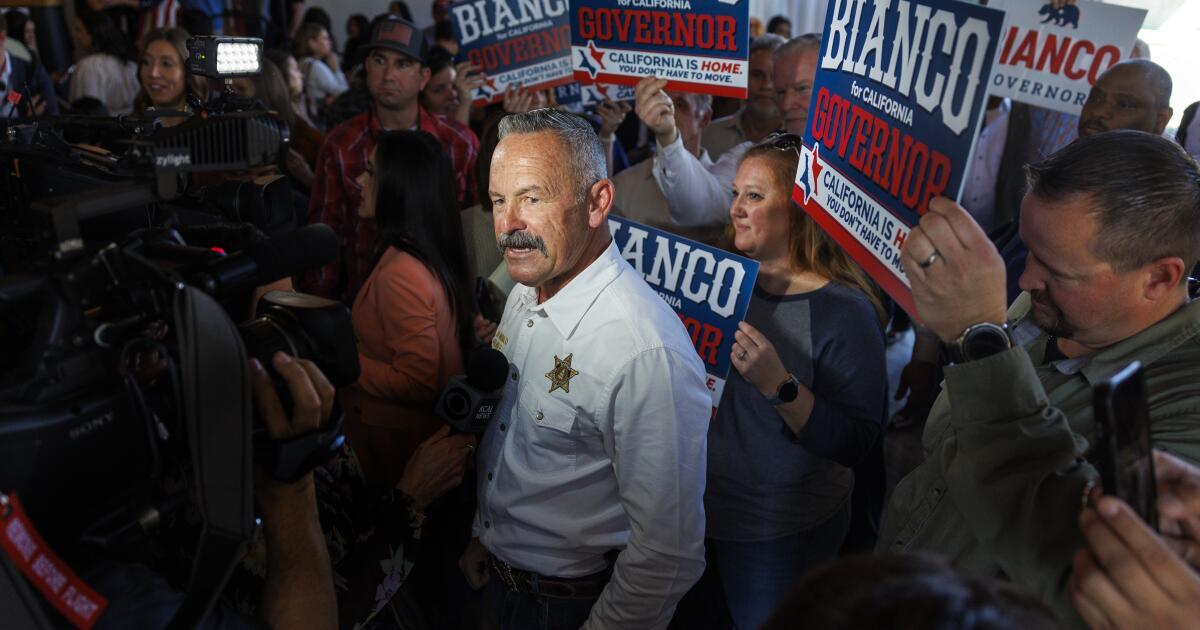
gubernatorial candidate

The Riverside County sheriff has seized 650,000 ballots. Here’s what we know

Chad Bianco, the Riverside County sheriff and a leading Republican candidate for governor, has seized more than 650,000 ballots from last November’s election as part of an investigation that he called a “fact-finding mission” to determine if they were fraudulently counted.

Atty. Gen. Rob Bonta, the state’s top law enforcement official, has sharply criticized the probe, which he called “unprecedented in both scope and scale.”

In a March 4 letter to the sheriff, Bonta said the seizure of the ballots “sets a dangerous precedent and will only sow distrust in our elections.” He threatened to seek legal recourse if Bianco does not halt his investigation.

Bianco said Friday that his investigators are looking into allegations by a local citizens group that “did their own audit” and found that the county’s tally was falsely inflated by more than 45,000 votes — a claim that local election officials have emphatically rejected.

Here is what we know.

Why were ballots taken?

According to Bonta’s office, Bianco’s department on Feb. 26 took about 1,000 boxes of ballot materials in Riverside County related to the November election for Proposition 50, which temporarily redrew the state’s congressional districts to favor Democrats in response to partisan redistricting in Republican states, including Texas.

Bianco said that it’s his “constitutional duty” to investigate a potential crime and that he is not trying to change the election results.

The investigation includes all of the ballots cast in the county, where Proposition 50 passed with 56% of the vote, a margin of more than 82,000 ballots. Statewide, it passed with 64% of the vote, a margin of more than 3.3 million ballots.

Bianco said he had been contacted by “a group of citizen volunteers” that said it performed an audit finding that 45,896 more ballots were counted than were cast. He did not name the group, but the allegations match those made by a group called the Riverside Election Integrity Team.

In a February presentation to the Riverside County Board of Supervisors, Registrar of Voters Art Tinoco disputed the group’s allegations and said they were based on a misunderstanding of raw data that had not been fully processed.

The actual discrepancy, Tinoco said, was 103 votes — a variance of 0.016%.

How did the sheriff get the ballots?

Bianco said his department served the registrar with a warrant “approved and signed by a judge” on Feb. 9.

According to Bonta’s office, an additional warrant was issued on Feb. 23. Bianco said the warrants are now sealed.

In the March 4 letter to Bianco, the attorney general said he had “serious concerns” about whether the sheriff had probable cause to seize the election materials.

Bonta questioned whether Bianco had concealed information from the magistrate judge who approved the warrants, including details from the registrar’s analysis of the citizen group’s allegations.

An official from Bonta’s office told The Times that the attorney general “found out in the middle of the week that [Bianco] was going to execute the warrants on a Friday.” Bonta’s office asked the sheriff to slow down and share information about the investigation, but “instead of waiting, he actually moved it up” and seized the ballots sooner than planned, said the official, who would only speak on background.

Bianco said a Riverside County Superior Court judge ordered the appointment of a special master to oversee the ballot count. His investigators had already begun counting, but the tally would start over under the court’s guidance, Bianco said.

The ballots would have soon been destroyed

California law requires county officials to keep election materials — including ballots and voter identification envelopes — for 22 months for elections involving a federal office and for six months for all other contests.

The materials must be sealed and then destroyed at the end of the retention period.

The Proposition 50 election took place on Nov. 4, so the ballots are scheduled to be destroyed in May.

Why investigate now?

Political observers say that Bianco — a leading gubernatorial candidate — appears to be vying for attention from President Trump and his supporters.

Kim Nalder, a political science professor and director of the Project for an Informed Electorate at Sacramento State, said the investigation appears to be “an electoral ploy.”

“At this stage in the election, most voters haven’t really tuned into the gubernatorial race, and there are a ton of candidates,” she said. “People who don’t know his background will know now. This is clear signaling.”

Trump has repeatedly called on the federal government to “nationalize” state-run elections. He remains fixated on his 2020 election loss and has falsely claimed widespread fraud.

In January, the FBI raided the elections office in Fulton County, Ga., seizing 2020 presidential election records. And this month, the Republican leader of Arizona’s state Senate said he had handed over 2020 election records to the FBI, complying with a federal grand jury subpoena for records related to a controversial audit of the election in Maricopa County.

Bianco is an outspoken Trump supporter.

A poll released last week by UC Berkeley’s Institute of Governmental Studies and co-sponsored by The Times showed Bianco and conservative commentator Steve Hilton leading the crowded field of gubernatorial candidates by slim margins, with the Democratic vote split among multiple candidates in a left-leaning state.

The top two vote getters, regardless of party, will advance to the November election.

Bianco said the investigation was “not a recount” for Proposition 50 and had nothing to do with his campaign for governor.
Source link

Anxiety grows among California Democrats as gubernatorial candidates rebuff calls to drop out

Despite a plea from the head of the California Democratic Party for underperforming candidates to drop out of the governor’s race, all but one of the party’s top hopefuls spurned the request.

Party leaders fear the growing possibility that the crowded field will split the Democratic electorate in the state’s June top-two primary election and result in two Republicans advancing to the November ballot, ensuring a Republican governor being elected for the first time since 2006.

His advice largely unheeded, state party Chairman Rusty Hicks on Thursday said the fate of a Democratic victory now rests squarely on the gubernatorial candidates who flouted him.

“The candidates for Governor now have a chance to showcase a viable path to win,” Hicks said in a statement Thursday.

Eight top Democratic candidates filed the official paperwork to appear on the June ballot after Hicks released a letter on Tuesday urging those “who cannot show meaningful progress towards winning” to drop out. Friday is the deadline to file to appear on the primary election ballot. On March 21, the secretary of state’s office will formally announce who will appear on the June ballot.

“It sounded like someone who has his head in the sand,” former Los Angeles Mayor Antonio Villaraigosa said of Hicks’ open letter. “[Most] of us filed within 24 hours of getting that letter. It created some press but not much else. It didn’t impact [most] of the candidates and it certainly didn’t impact my candidacy.”

Democratic strategist Elizabeth Ashford said it was appropriate for Hicks and other Democratic leaders to make a public plea as opposed to keeping such discussions solely behind closed doors.

But the response showed the limited power of the modern-day party bosses.

“It’s definitely not Tammany Hall,” said Ashford, referring to the storied Democratic political machine that had a grip on New York City politics for nearly a century. “The party and Rusty are influential and they are helpful and that is their role. I don’t think anyone would be comfortable with outright public strong-arming of specific candidates.”

Ashford, who worked for former Govs. Jerry Brown and Arnold Schwarzenegger, along with former Vice President Kamala Harris when she served as state attorney general, added that the minimal power of the state GOP is likely a factor in the dynamics of Democrats’ decision to stay in the race. Democratic registered voters outnumber Republicans by almost a 2-to-1 margin in the state, and Democrats control every statewide elected office and hold supermajorities in both chambers of the California Legislature.

“If there were a strong viable opposition that existed, if the Republican Party was actually relevant in California, I think that would sort of force greater unity amongst Democrats,” she said.

Just one of the nine major Democrats did heed the party chair’s message. Ian Calderon, a former Los Angeles-area Assemblyman who consistently polled near the bottom of the field, withdrew from the race and endorsed Rep. Eric Swalwell (D-Dublin) on Thursday.

Candidates cannot withdraw their name from the ballot once they officially file to run for office, leading to some fears that even if other candidates drop out of the race, a crowded primary ballot could still split California’s liberal votes.

“I’m disappointed most of them will be on the ballot,” said Lorena Gonzalez, the head of the California Federation of Labor Unions, which will announce whether it endorses in the governor’s race on March 16. But “I do still think you can have people drop out of the race or become viable. I think that there are candidates who know viability is a real thing they have to show in coming weeks” before ballots start being mailed to voters.

Jodi Hicks, chief executive and president of Planned Parenthood Affiliates of California, said she is “still worried” about the prospect of two Republicans winning the top two spots in the June primary, shutting Democrats out of any chance of winning the governor’s office in November.

“I didn’t have any specifics of who I wanted to do what,” she said. “I’m just very, very concerned and the stakes are really high right now and seem to be getting worse by the day.”

Republican candidate Steve Hilton, a former Fox News host, said he is “confident that I’ll be in the top two” along with a Democratic candidate. “I find it very difficult to believe that the Democratic Party will just surrender California and allow two Republicans to be in the top two.”

Hilton made the comments Thursday after a gubernatorial forum in Sacramento hosted by the California Assn. of Realtors focused on housing and homeownership. Villaraigosa, former Health and Human Services Secretary Xavier Becerra, San Jose Mayor Matt Mahan and former Rep. Katie Porter also attended. Swalwell, who is currently in Washington, joined the panel virtually.

During the panel, candidates were in broad agreement about the need to reduce barriers and costs in order to build more housing in California, where the median single-family home costs more than $820,000. Many also endorsed proposals to disincentivize private investment firms from buying up homes as well as a $25-billion bond proposed by former Sen. Bob Hertzberg to help first-time homebuyers afford a down payment.

“This really isn’t a debate because we’re agreeing so much with each other,” Hilton said at one point during the event.

That political alignment on one of the most pressing issues facing California may explain why voters are having such a difficult time deciding who to support.

A recent poll of the Public Policy Institute of California found that the five candidates topping the crowded field were within 4 percentage points of one another: Porter, Swalwell, Hilton, Democratic hedge fund founder Tom Steyer and Republican Riverside County Sheriff Chad Bianco. Earlier polls had Hilton and Bianco leading the field, though many voters remained undecided.

Some candidates took issue with Hicks’ push to cull the field, noting that most of the lower-polling candidates he asked to drop out are people of color.

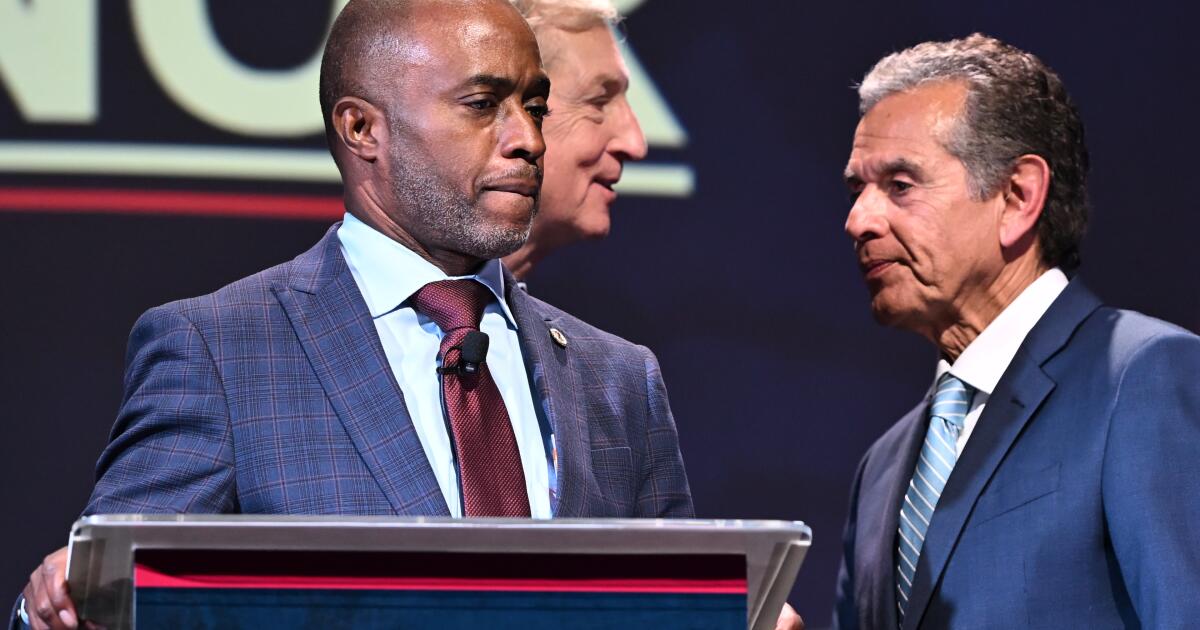
“Our political system is rigged, corrupted by the political elites, the wealthy and well connected,” state Supt. of Public Instruction Tony Thurmond, who is Black and Latino, said in a video posted on social media in response to the open letter. “The California Democratic Party is essentially telling every person of color in the race for Governor to drop out.”

Villaraigosa argued that enough voters remain undecided that it was too early for quality candidates to call it quits.

“Most people don’t even know who’s in the race,” said Villaraigosa. “It’s premature to be thinking about getting out of the race. I certainly am not considering it and I feel no pressure.”

Aside from the opinion polls, other indicators on who may emerge from the pack a candidates are slowly emerging.

Though it wasn’t enough to win the party’s endorsement, Swalwell won support from 24% of delegates at the state Democratic convention last month, the most of any party candidate.

While spending is no guarantee of success, Steyer has donated $47.4 million of his own wealth to his campaign. Mahan, who recently entered the race and is supported by Silicon Valley leaders, has quickly raised millions of dollars, as have two independent expenditures committees backing his bid.

Ashford said part of candidates’ decisions to remain in the race could have been driven by their lengthy political careers, as well as Democrats’ crushing November redistricting victory.

“In several cases, these are people who have won statewide office,” she said. “It’s tough to feel like there may not be a sequel to that.”

Nixon reported from Sacramento and Mehta from Los Angeles.

Source link